LINEAR INDUCTION
MOTOR
PREPARED BY:
MERAJ AKHTAR
JAHANGIRABAD INSTITUTE OF TECHNOLOGY
BARABANKI-UP
WHAT ARE LINEAR MOTORS?
 Linear motors are electric induction motors that
produce motion in a straight line rather than
rotational motion.
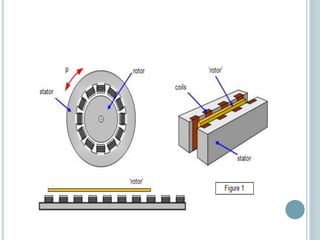
 In a traditional electric motor, the rotor (rotating
part) spins inside the stator (static part)
 In a linear motor, the stator is unwrapped and
laid out flat and the "rotor" moves past it in a
straight line.
CONSTRUCTION OF A LINEAR INDUCTION MOTOR
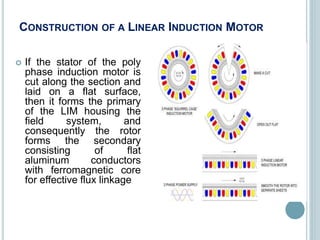
 If the stator of the poly
phase induction motor is
cut along the section and
laid on a flat surface,
then it forms the primary
of the LIM housing the
field system, and
consequently the rotor
forms the secondary
consisting of flat
aluminum conductors
with ferromagnetic core
for effective flux linkage.
WORKING OF A LINEAR INDUCTION MOTOR
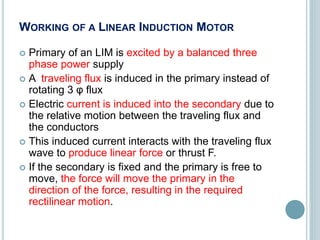
 Primary of an LIM is excited by a balanced three
phase power supply
 A traveling flux is induced in the primary instead of
rotating 3 φ flux
 Electric current is induced into the secondary due to
the relative motion between the traveling flux and
the conductors
 This induced current interacts with the traveling flux
wave to produce linear force or thrust F.
 If the secondary is fixed and the primary is free to
move, the force will move the primary in the
direction of the force, resulting in the required
rectilinear motion.
SPEED
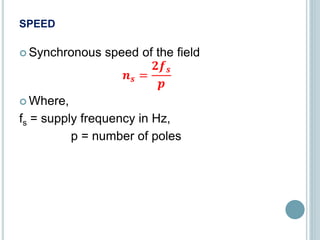
 Synchronous speed of the field
𝒏 𝒔 =
𝟐𝒇 𝒔
𝒑
 Where,
fs = supply frequency in Hz,
p = number of poles
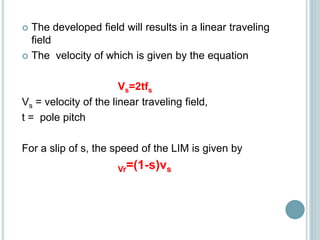
 The developed field will results in a linear traveling
field
 The velocity of which is given by the equation
Vs=2tfs
Vs = velocity of the linear traveling field,
t = pole pitch
For a slip of s, the speed of the LIM is given by
Vr=(1-s)vs
ADVANTAGES
 There are no moving parts to go wrong
 As the platform rides above the track on a cushion
of air, there is no loss of energy to friction or
vibration
 As both acceleration and braking are achieved
through electromagnetism, linear motors are much
quieter than ordinary motors.
DISADVANTAGES
Because the air-gap is greater
 more power is required
 efficiency is lower
APPLICATION OF LINEAR INDUCTION MOTOR
 Automatic sliding doors in electric trains.
 Mechanical handling equipment, such as
propulsion of a train of tubs along a certain
route.
 Metallic conveyor belts.
Unit v linear induction motor

Unit v linear induction motor

  • 1.
    LINEAR INDUCTION MOTOR PREPARED BY: MERAJAKHTAR JAHANGIRABAD INSTITUTE OF TECHNOLOGY BARABANKI-UP
  • 2.
    WHAT ARE LINEARMOTORS?  Linear motors are electric induction motors that produce motion in a straight line rather than rotational motion.  In a traditional electric motor, the rotor (rotating part) spins inside the stator (static part)  In a linear motor, the stator is unwrapped and laid out flat and the "rotor" moves past it in a straight line.
  • 3.
    CONSTRUCTION OF ALINEAR INDUCTION MOTOR  If the stator of the poly phase induction motor is cut along the section and laid on a flat surface, then it forms the primary of the LIM housing the field system, and consequently the rotor forms the secondary consisting of flat aluminum conductors with ferromagnetic core for effective flux linkage.
  • 5.
    WORKING OF ALINEAR INDUCTION MOTOR  Primary of an LIM is excited by a balanced three phase power supply  A traveling flux is induced in the primary instead of rotating 3 φ flux  Electric current is induced into the secondary due to the relative motion between the traveling flux and the conductors  This induced current interacts with the traveling flux wave to produce linear force or thrust F.  If the secondary is fixed and the primary is free to move, the force will move the primary in the direction of the force, resulting in the required rectilinear motion.
  • 6.
    SPEED  Synchronous speedof the field 𝒏 𝒔 = 𝟐𝒇 𝒔 𝒑  Where, fs = supply frequency in Hz, p = number of poles
  • 7.
     The developedfield will results in a linear traveling field  The velocity of which is given by the equation Vs=2tfs Vs = velocity of the linear traveling field, t = pole pitch For a slip of s, the speed of the LIM is given by Vr=(1-s)vs
  • 8.
    ADVANTAGES  There areno moving parts to go wrong  As the platform rides above the track on a cushion of air, there is no loss of energy to friction or vibration  As both acceleration and braking are achieved through electromagnetism, linear motors are much quieter than ordinary motors. DISADVANTAGES Because the air-gap is greater  more power is required  efficiency is lower
  • 9.
    APPLICATION OF LINEARINDUCTION MOTOR  Automatic sliding doors in electric trains.  Mechanical handling equipment, such as propulsion of a train of tubs along a certain route.  Metallic conveyor belts.