1
SINGLE PHASE INDUCTION MOTORS
• Consider that the rotor is stationary
and the stator winding is connected
to a single-phase supply.
• The alternating sinusoidal flux
produced by the stator winding can
be presented as the sum of two
rotating fluxes Φ1 and Φ2, each
equal to one half of the maximum
value of alternating flux (i.e., Φm/2)
Single-phase motors are the most familiar of all electric motors as these
are extensively used in home appliances, shops, offices etc.
Double-field Revolving Theory
and each rotating at synchronous speed (Ns = 120 f/P) in opposite
directions Lecture Notes by Dr.R.M.Larik
2
SINGLE PHASE INDUCTION MOTORS
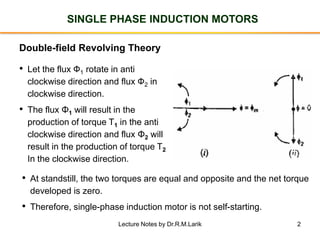
• Let the flux Ф1 rotate in anti
clockwise direction and flux Ф2 in
clockwise direction.
• The flux Φ1 will result in the
production of torque T1 in the anti
clockwise direction and flux Φ2 will
result in the production of torque T2
In the clockwise direction.
Double-field Revolving Theory
• At standstill, the two torques are equal and opposite and the net torque
developed is zero.
• Therefore, single-phase induction motor is not self-starting.
Lecture Notes by Dr.R.M.Larik
3
MAKING 1-PHASE INDUCTION MOTOR SELF-STARTING
• To make a single-phase induction motor self-starting, somehow a
revolving stator magnetic field has to be produced.
• This can be achieved by converting a single-phase supply into two-
phase supply through the use of an additional winding.
• When the motor attains sufficient speed, the starting means (i.e.,
additional winding) may be disconnected.
• Single-phase induction motors are classified according to the method
employed to make them self-starting.
− Split-phase motors
− Capacitor motors
− Shaded pole motors
Lecture Notes by Dr.R.M.Larik
4
SPLIT-PHASE INDUCTION MOTOR
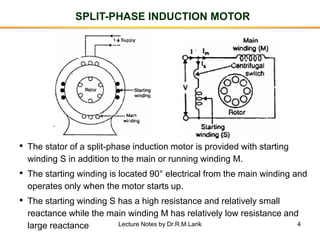
• The stator of a split-phase induction motor is provided with starting
winding S in addition to the main or running winding M.
• The starting winding is located 90° electrical from the main winding and
operates only when the motor starts up.
• The starting winding S has a high resistance and relatively small
reactance while the main winding M has relatively low resistance and
large reactance Lecture Notes by Dr.R.M.Larik
5
SPLIT-PHASE INDUCTION MOTOR (Contd.)
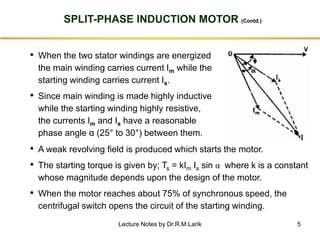
• When the two stator windings are energized
the main winding carries current Im while the
starting winding carries current Is.
• Since main winding is made highly inductive
while the starting winding highly resistive,
the currents Im and Is have a reasonable
phase angle α (25° to 30°) between them.
• A weak revolving field is produced which starts the motor.
• The starting torque is given by; Ts = kIm Is sin α where k is a constant
whose magnitude depends upon the design of the motor.
• When the motor reaches about 75% of synchronous speed, the
centrifugal switch opens the circuit of the starting winding.
Lecture Notes by Dr.R.M.Larik
6
SPLIT-PHASE INDUCTION MOTOR (Contd.)
Characteristics
• The starting torque is 1.5 to 2 times the full-load torque and starting
current is 6 to 8 times the full-load current.
• Since the starting winding is made of fine wire, the current density is
high and the winding heats up quickly, hence, such motors are
suitable where starting periods are not frequent.
• These are essentially constant-speed motors with speed variation of
2-5% from no-load to full-load.
• These motors are suitable where a moderate starting torque is
required and where starting periods are infrequent e.g., to drive fans,
washing machines, small machine tools etc.
Lecture Notes by Dr.R.M.Larik
7
CAPACITOR-START MOTOR
• It is identical to a split-phase motor
except that the starting winding has
as many turns as the main winding.
• Capacitor C is connected in series
with the starting winding whose value
is so chosen that Is leads Im by about
80° (i.e., α ~ 80°) which is much
greater than 25° found in split-phase
motor
• Starting torque is much more than that of a split-phase motor.
• The starting winding is opened by the centrifugal switch when the
motor attains about 75% of synchronous speed.
Lecture Notes by Dr.R.M.Larik
8
CAPACITOR-START MOTOR (Contd.)
Characteristics
• Although starting characteristics of a capacitor-start motor are better
than those of a split-phase motor, both machines possess the same
running characteristics because the main windings are identical.
• The phase angle between the two currents is about 80° compared to
about 25° in a split-phase motor, hence, for the same starting torque,
the current in the starting winding is only about half that in a split-
phase motor resulting in less heating of the starting winding.
• These are used where high starting torque is required and where the
starting period may be long e.g., to drive compressors, large fans,
pumps and high inertia loads
Lecture Notes by Dr.R.M.Larik
9
CAPACITOR-START CAPACITOR-RUN MOTOR
In one design, one capacitor C is used
for both starting and running eliminating
the need of a centrifugal switch and at
the same time improves the power
factor and efficiency of the motor.
In other design, one smaller capacitor
C1 is permanently connected for
optimum running, and the larger one C2
is the starting capacitor which is
disconnected when the motor
approaches about 75% of synchronous
speed.
Lecture Notes by Dr.R.M.Larik
10
CAPACITOR-START CAPACITOR-RUN MOTOR (Contd.)
Characteristics
• The starting winding and the capacitor can be designed for perfect 2-
phase operation at any load and to produce a constant torque and
not a pulsating torque as in other single-phase motors.
• These motors have a lower starting torque than capacitor start
motors, since the capacitor is sized to balance the currents in the
main and auxiliary windings at normal load conditions.
• Because of constant torque, the motor is vibration free and can be
used in hospitals, studios, and other places where silence is
important
Lecture Notes by Dr.R.M.Larik
11
SHADED-POLE MOTOR
• It has salient poles on the stator excited by single-phase supply and a
squirrel-cage rotor.
• A portion of each pole is surrounded by a short-circuited turn of copper
strip called shading coil.
Lecture Notes by Dr.R.M.Larik
12
SHADED-POLE MOTOR
Operation
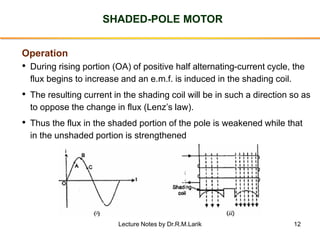
• During rising portion (OA) of positive half alternating-current cycle, the
flux begins to increase and an e.m.f. is induced in the shading coil.
• The resulting current in the shading coil will be in such a direction so as
to oppose the change in flux (Lenz’s law).
• Thus the flux in the shaded portion of the pole is weakened while that
in the unshaded portion is strengthened
Lecture Notes by Dr.R.M.Larik
13
SHADED-POLE MOTOR (Contd.)
Operation (Contd.)
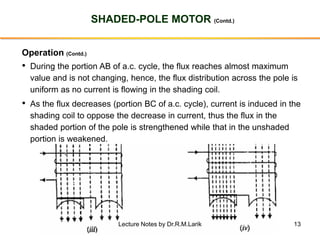
• During the portion AB of a.c. cycle, the flux reaches almost maximum
value and is not changing, hence, the flux distribution across the pole is
uniform as no current is flowing in the shading coil.
• As the flux decreases (portion BC of a.c. cycle), current is induced in the
shading coil to oppose the decrease in current, thus the flux in the
shaded portion of the pole is strengthened while that in the unshaded
portion is weakened.
Lecture Notes by Dr.R.M.Larik
14
SHADED-POLE MOTOR (Contd.)
Operation (Contd.)
• The effect of shading coil is to cause the field flux to shift across the
pole face from the unshaded to the shaded portion which is like rotation
of weak field in the direction from unshaded portion to the shaded
portion of the pole.
• The rotor is of the squirrel-cage type and is under the influence of this
moving field, hence, a small starting torque is developed.
• When the torque starts to rotate the rotor, additional torque is produced
by single-phase induction-motor action and the motor accelerates to full
speed.
Characteristics
Since starting torque, efficiency and power factor are very low, these
motors are only suitable for low power applications e.g., to drive small
fans, toys, hair driers Lecture Notes by Dr.R.M.Larik
15
A.C. SERIES MOTOR OR UNIVERSAL MOTOR (Contd.)
• A d.c. series motor rotates in the same direction regardless of the
polarity of the supply, thus, it can also operate on a single-phase
supply.
• Some changes are needed in d.c. motor for its satisfactory operation
on a.c.
i) The turns of series field winding is to be as low as possible to
minimize its reactance to reduce voltage drop across the field
winding.
ii) High sparking at the brushes when the motor is used on a.c.
supply, because the alternating flux establishes high currents in
the coils short-circuited by the brushes, can be eliminated by
using high-resistance leads from coils to the commutator
segments.
Lecture Notes by Dr.R.M.Larik
16
A.C. SERIES MOTOR OR UNIVERSAL MOTOR (Contd.)
Operation
• When the motor is connected to an
a.c. supply, the same alternating
current flows through the field and
armature windings.
• The field winding produces an
alternating flux Φ that reacts with the
current flowing in the armature to
produce a torque.
• Since both armature current and flux
reverse simultaneously, the torque
always acts in the same direction
Lecture Notes by Dr.R.M.Larik
17
A.C. SERIES MOTOR OR UNIVERSAL MOTOR (Contd.)
Characteristics
• The speed increases with a decrease in load.
• In very small series motors, the losses are high at no load.
• The motor torque is high for large armature currents, thus giving a
high starting torque.
• At full-load, the power factor is about 90%.
• Factional horse power a.c. series motors have high-speed and
high starting torque.
• These motors can be used to drive high-speed vacuum cleaners,
sewing machines, electric shavers, drill machines, machine tools
etc.
Lecture Notes by Dr.R.M.Larik
18
SINGLE-PHASE REPULSION MOTOR
A repulsion motor is similar to an a.c. series motor except that:
• Brushes are not connected to supply but are short-circuited, hence,
currents are induced in the armature conductors by transformer
action.
• The field structure has non-salient pole construction.
• Starting torque can be developed in the motor by adjusting the
position of short-circuited brushes on the commutator.
Lecture Notes by Dr.R.M.Larik
19
SINGLE-PHASE REPULSION MOTOR (Contd.)
Construction
• The field of stator winding is like the main winding of a split-phase
motor and is connected directly to a single-phase source whereas
the armature is similar to a d.c. motor armature.
• The brushes are not connected to supply but are connected to
each other or short-circuited making the rotor into squirrel cage
type.
• By using a commutator motor with brushes short-circuited, it is
possible to vary the starting torque by changing the brush axis.
• It has also better power factor than the conventional single-phase
motor.
Lecture Notes by Dr.R.M.Larik
20
SINGLE-PHASE REPULSION MOTOR (Contd.)
Principle of operation
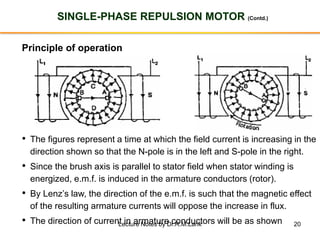
• The figures represent a time at which the field current is increasing in the
direction shown so that the N-pole is in the left and S-pole in the right.
• Since the brush axis is parallel to stator field when stator winding is
energized, e.m.f. is induced in the armature conductors (rotor).
• By Lenz’s law, the direction of the e.m.f. is such that the magnetic effect
of the resulting armature currents will oppose the increase in flux.
• The direction of current in armature conductors will be as shownLecture Notes by Dr.R.M.Larik
21
SINGLE-PHASE REPULSION MOTOR (Contd.)
Principle of operation (Contd.)
• With the brush axis in this position, current will flow from brush B to
brush A where it enters the armature and flows back to brush B through
the two paths ACB and ADB.
• Half of the armature conductors under N-pole carry current inward and
half carry current outward which is also true under S-pole.
• Thus, as much torque is developed in one direction as in the other and
the armature remains stationary.
• Armature will also remain stationary if brush axis is perpendicular to the
stator field axis, because, even then net torque is zero.
• If the brush axis is at some angle other than 0° or 90° to the axis of the
stator field, a net torque developed on accelerates rotor to final speed.
• Direction of rotation of rotor depends upon the direction of brush shift.
Lecture Notes by Dr.R.M.Larik
22
SINGLE-PHASE REPULSION MOTOR (Contd.)
Principle of operation (Contd.)
The total armature torque in a repulsion motor can be shown to be.
Ta  sin 2α
where α = angle between brush axis and stator field axis
For maximum torque, 2α = 90° or α = 45°
Characteristics
• The characteristics is similar to those of an a.c. series motor
• The speed developed by the repulsion motor for any given load
depends upon the position of the brushes.
• It has a high starring torque and relatively low starting current.
Lecture Notes by Dr.R.M.Larik
23
Testing of an Induction Motor
The following testing is done on the Induction Motor
1. Block rotor Test: in this test rotor is Blocked to find copper Losses
1. No load Test; In this test rotor is operated at no load to find core
losses.
Lecture Notes by Dr.R.M.Larik

Single phase induction motor

  • 1.
    1 SINGLE PHASE INDUCTIONMOTORS • Consider that the rotor is stationary and the stator winding is connected to a single-phase supply. • The alternating sinusoidal flux produced by the stator winding can be presented as the sum of two rotating fluxes Φ1 and Φ2, each equal to one half of the maximum value of alternating flux (i.e., Φm/2) Single-phase motors are the most familiar of all electric motors as these are extensively used in home appliances, shops, offices etc. Double-field Revolving Theory and each rotating at synchronous speed (Ns = 120 f/P) in opposite directions Lecture Notes by Dr.R.M.Larik
  • 2.
    2 SINGLE PHASE INDUCTIONMOTORS • Let the flux Ф1 rotate in anti clockwise direction and flux Ф2 in clockwise direction. • The flux Φ1 will result in the production of torque T1 in the anti clockwise direction and flux Φ2 will result in the production of torque T2 In the clockwise direction. Double-field Revolving Theory • At standstill, the two torques are equal and opposite and the net torque developed is zero. • Therefore, single-phase induction motor is not self-starting. Lecture Notes by Dr.R.M.Larik
  • 3.
    3 MAKING 1-PHASE INDUCTIONMOTOR SELF-STARTING • To make a single-phase induction motor self-starting, somehow a revolving stator magnetic field has to be produced. • This can be achieved by converting a single-phase supply into two- phase supply through the use of an additional winding. • When the motor attains sufficient speed, the starting means (i.e., additional winding) may be disconnected. • Single-phase induction motors are classified according to the method employed to make them self-starting. − Split-phase motors − Capacitor motors − Shaded pole motors Lecture Notes by Dr.R.M.Larik
  • 4.
    4 SPLIT-PHASE INDUCTION MOTOR •The stator of a split-phase induction motor is provided with starting winding S in addition to the main or running winding M. • The starting winding is located 90° electrical from the main winding and operates only when the motor starts up. • The starting winding S has a high resistance and relatively small reactance while the main winding M has relatively low resistance and large reactance Lecture Notes by Dr.R.M.Larik
  • 5.
    5 SPLIT-PHASE INDUCTION MOTOR(Contd.) • When the two stator windings are energized the main winding carries current Im while the starting winding carries current Is. • Since main winding is made highly inductive while the starting winding highly resistive, the currents Im and Is have a reasonable phase angle α (25° to 30°) between them. • A weak revolving field is produced which starts the motor. • The starting torque is given by; Ts = kIm Is sin α where k is a constant whose magnitude depends upon the design of the motor. • When the motor reaches about 75% of synchronous speed, the centrifugal switch opens the circuit of the starting winding. Lecture Notes by Dr.R.M.Larik
  • 6.
    6 SPLIT-PHASE INDUCTION MOTOR(Contd.) Characteristics • The starting torque is 1.5 to 2 times the full-load torque and starting current is 6 to 8 times the full-load current. • Since the starting winding is made of fine wire, the current density is high and the winding heats up quickly, hence, such motors are suitable where starting periods are not frequent. • These are essentially constant-speed motors with speed variation of 2-5% from no-load to full-load. • These motors are suitable where a moderate starting torque is required and where starting periods are infrequent e.g., to drive fans, washing machines, small machine tools etc. Lecture Notes by Dr.R.M.Larik
  • 7.
    7 CAPACITOR-START MOTOR • Itis identical to a split-phase motor except that the starting winding has as many turns as the main winding. • Capacitor C is connected in series with the starting winding whose value is so chosen that Is leads Im by about 80° (i.e., α ~ 80°) which is much greater than 25° found in split-phase motor • Starting torque is much more than that of a split-phase motor. • The starting winding is opened by the centrifugal switch when the motor attains about 75% of synchronous speed. Lecture Notes by Dr.R.M.Larik
  • 8.
    8 CAPACITOR-START MOTOR (Contd.) Characteristics •Although starting characteristics of a capacitor-start motor are better than those of a split-phase motor, both machines possess the same running characteristics because the main windings are identical. • The phase angle between the two currents is about 80° compared to about 25° in a split-phase motor, hence, for the same starting torque, the current in the starting winding is only about half that in a split- phase motor resulting in less heating of the starting winding. • These are used where high starting torque is required and where the starting period may be long e.g., to drive compressors, large fans, pumps and high inertia loads Lecture Notes by Dr.R.M.Larik
  • 9.
    9 CAPACITOR-START CAPACITOR-RUN MOTOR Inone design, one capacitor C is used for both starting and running eliminating the need of a centrifugal switch and at the same time improves the power factor and efficiency of the motor. In other design, one smaller capacitor C1 is permanently connected for optimum running, and the larger one C2 is the starting capacitor which is disconnected when the motor approaches about 75% of synchronous speed. Lecture Notes by Dr.R.M.Larik
  • 10.
    10 CAPACITOR-START CAPACITOR-RUN MOTOR(Contd.) Characteristics • The starting winding and the capacitor can be designed for perfect 2- phase operation at any load and to produce a constant torque and not a pulsating torque as in other single-phase motors. • These motors have a lower starting torque than capacitor start motors, since the capacitor is sized to balance the currents in the main and auxiliary windings at normal load conditions. • Because of constant torque, the motor is vibration free and can be used in hospitals, studios, and other places where silence is important Lecture Notes by Dr.R.M.Larik
  • 11.
    11 SHADED-POLE MOTOR • Ithas salient poles on the stator excited by single-phase supply and a squirrel-cage rotor. • A portion of each pole is surrounded by a short-circuited turn of copper strip called shading coil. Lecture Notes by Dr.R.M.Larik
  • 12.
    12 SHADED-POLE MOTOR Operation • Duringrising portion (OA) of positive half alternating-current cycle, the flux begins to increase and an e.m.f. is induced in the shading coil. • The resulting current in the shading coil will be in such a direction so as to oppose the change in flux (Lenz’s law). • Thus the flux in the shaded portion of the pole is weakened while that in the unshaded portion is strengthened Lecture Notes by Dr.R.M.Larik
  • 13.
    13 SHADED-POLE MOTOR (Contd.) Operation(Contd.) • During the portion AB of a.c. cycle, the flux reaches almost maximum value and is not changing, hence, the flux distribution across the pole is uniform as no current is flowing in the shading coil. • As the flux decreases (portion BC of a.c. cycle), current is induced in the shading coil to oppose the decrease in current, thus the flux in the shaded portion of the pole is strengthened while that in the unshaded portion is weakened. Lecture Notes by Dr.R.M.Larik
  • 14.
    14 SHADED-POLE MOTOR (Contd.) Operation(Contd.) • The effect of shading coil is to cause the field flux to shift across the pole face from the unshaded to the shaded portion which is like rotation of weak field in the direction from unshaded portion to the shaded portion of the pole. • The rotor is of the squirrel-cage type and is under the influence of this moving field, hence, a small starting torque is developed. • When the torque starts to rotate the rotor, additional torque is produced by single-phase induction-motor action and the motor accelerates to full speed. Characteristics Since starting torque, efficiency and power factor are very low, these motors are only suitable for low power applications e.g., to drive small fans, toys, hair driers Lecture Notes by Dr.R.M.Larik
  • 15.
    15 A.C. SERIES MOTOROR UNIVERSAL MOTOR (Contd.) • A d.c. series motor rotates in the same direction regardless of the polarity of the supply, thus, it can also operate on a single-phase supply. • Some changes are needed in d.c. motor for its satisfactory operation on a.c. i) The turns of series field winding is to be as low as possible to minimize its reactance to reduce voltage drop across the field winding. ii) High sparking at the brushes when the motor is used on a.c. supply, because the alternating flux establishes high currents in the coils short-circuited by the brushes, can be eliminated by using high-resistance leads from coils to the commutator segments. Lecture Notes by Dr.R.M.Larik
  • 16.
    16 A.C. SERIES MOTOROR UNIVERSAL MOTOR (Contd.) Operation • When the motor is connected to an a.c. supply, the same alternating current flows through the field and armature windings. • The field winding produces an alternating flux Φ that reacts with the current flowing in the armature to produce a torque. • Since both armature current and flux reverse simultaneously, the torque always acts in the same direction Lecture Notes by Dr.R.M.Larik
  • 17.
    17 A.C. SERIES MOTOROR UNIVERSAL MOTOR (Contd.) Characteristics • The speed increases with a decrease in load. • In very small series motors, the losses are high at no load. • The motor torque is high for large armature currents, thus giving a high starting torque. • At full-load, the power factor is about 90%. • Factional horse power a.c. series motors have high-speed and high starting torque. • These motors can be used to drive high-speed vacuum cleaners, sewing machines, electric shavers, drill machines, machine tools etc. Lecture Notes by Dr.R.M.Larik
  • 18.
    18 SINGLE-PHASE REPULSION MOTOR Arepulsion motor is similar to an a.c. series motor except that: • Brushes are not connected to supply but are short-circuited, hence, currents are induced in the armature conductors by transformer action. • The field structure has non-salient pole construction. • Starting torque can be developed in the motor by adjusting the position of short-circuited brushes on the commutator. Lecture Notes by Dr.R.M.Larik
  • 19.
    19 SINGLE-PHASE REPULSION MOTOR(Contd.) Construction • The field of stator winding is like the main winding of a split-phase motor and is connected directly to a single-phase source whereas the armature is similar to a d.c. motor armature. • The brushes are not connected to supply but are connected to each other or short-circuited making the rotor into squirrel cage type. • By using a commutator motor with brushes short-circuited, it is possible to vary the starting torque by changing the brush axis. • It has also better power factor than the conventional single-phase motor. Lecture Notes by Dr.R.M.Larik
  • 20.
    20 SINGLE-PHASE REPULSION MOTOR(Contd.) Principle of operation • The figures represent a time at which the field current is increasing in the direction shown so that the N-pole is in the left and S-pole in the right. • Since the brush axis is parallel to stator field when stator winding is energized, e.m.f. is induced in the armature conductors (rotor). • By Lenz’s law, the direction of the e.m.f. is such that the magnetic effect of the resulting armature currents will oppose the increase in flux. • The direction of current in armature conductors will be as shownLecture Notes by Dr.R.M.Larik
  • 21.
    21 SINGLE-PHASE REPULSION MOTOR(Contd.) Principle of operation (Contd.) • With the brush axis in this position, current will flow from brush B to brush A where it enters the armature and flows back to brush B through the two paths ACB and ADB. • Half of the armature conductors under N-pole carry current inward and half carry current outward which is also true under S-pole. • Thus, as much torque is developed in one direction as in the other and the armature remains stationary. • Armature will also remain stationary if brush axis is perpendicular to the stator field axis, because, even then net torque is zero. • If the brush axis is at some angle other than 0° or 90° to the axis of the stator field, a net torque developed on accelerates rotor to final speed. • Direction of rotation of rotor depends upon the direction of brush shift. Lecture Notes by Dr.R.M.Larik
  • 22.
    22 SINGLE-PHASE REPULSION MOTOR(Contd.) Principle of operation (Contd.) The total armature torque in a repulsion motor can be shown to be. Ta  sin 2α where α = angle between brush axis and stator field axis For maximum torque, 2α = 90° or α = 45° Characteristics • The characteristics is similar to those of an a.c. series motor • The speed developed by the repulsion motor for any given load depends upon the position of the brushes. • It has a high starring torque and relatively low starting current. Lecture Notes by Dr.R.M.Larik
  • 23.
    23 Testing of anInduction Motor The following testing is done on the Induction Motor 1. Block rotor Test: in this test rotor is Blocked to find copper Losses 1. No load Test; In this test rotor is operated at no load to find core losses. Lecture Notes by Dr.R.M.Larik