Electric Machine – II
EE 501
 Single phase induction motor
 Single phaseAC series motor (universal motor)
 Synchronous machine
 Generator (alternator)
 Motor
 Special machines
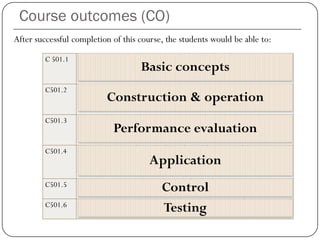
Course outcomes (CO)
After successful completion of this course, the students would be able to:
C 501.1 Use concepts in trigonometry, complex algebra, phasor operations and
principles of electromagnetism to find correct solutions to electrical
machine performance questions.
C501.2 Select proper materials and methods for design and construction of
electrical machines within the realm of manufacturing, economic,
performance, efficiency and environmental constraints.
C501.3 Use modeling/simulation parameters with standard equivalent circuit
models to predict correctly the expected performance of various
general-purpose electrical machines.
C501.4 Compare accepted standards and guidelines to select appropriate
electrical machines to meet specified performance requirements and
choose the scope of applicability of various types of electrical machines
in real life multi-disciplinary usages.
C501.5 Demonstrate an understanding of the fundamental control practices
associated with rotating machines.
C501.6 Set up testing strategies to evaluate performance characteristics of
electrical machines.
Basic concepts
Construction & operation
Performance evaluation
Application
Control
Testing
Day 1
Single phase induction motor
ILOs – Day1
 Recapitulate 3-ph IM operation
 Understand 2-ph IM operation
 Generalize the concept of producing RMF
 List the basic applications of 1-ph IM
 Compare between 1-ph IM and poly-phase IM
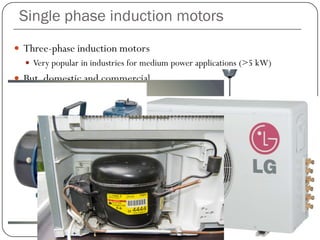
Single phase induction motors
 Three-phase induction motors
 Very popular in industries for medium power applications (>5 kW)
 But, domestic and commercial (shops) use single phase supply
 So, single phase induction motors are used
 Single phase induction motors for low power applications
 cost-effectiveness
 Ruggedness
 Low maintenance requirements
 Loads such as fan, pump, blowers, compressors etc.
Recap of 3-phase induction motors
 In 3-phase induction machine, three windings are placed
around the stator near the air gap.
 These windings are physically apart by 1200 (electrical
degrees) in space.
 When a 3-phase supply voltage is applied to this 3-phase
winding, a magnetic field is developed in the air gap.
 Under balanced condition, the magnetic field will rotate at a
constant speed around the air gap (RMF).
 The rotor conductors will experience change in flux linkage due
to the RMF.
 Under this action, the rotor will start to rotate and will continue
to rotate in the same direction as the stator RMF
Recap of 3-phase induction motors
Thus, in summary, a 3-phase induction motor has
inherent starting as well as running torque that can start
the motor by itself and continue running as soon as the
3-phase supply is switched on.
Activity 1
Thus, in summary, a 3-phase induction motor has
inherent starting as well as running torque that can
start the motor by itself and continue running as soon as
the 3-phase supply is switched on.
starting running
3-phase supply
itself
RMF under unbalanced condition
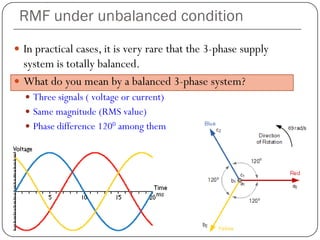
 In practical cases, it is very rare that the 3-phase supply
system is totally balanced.
 What do you mean by a balanced 3-phase system?
 Three signals ( voltage or current)
 Same magnitude (RMS value)
 Phase difference 1200 among them
RMF under unbalanced condition
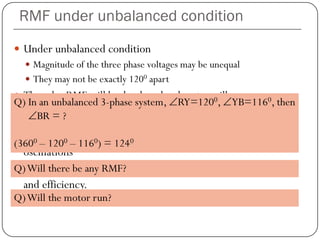
 Under unbalanced condition
 Magnitude of the three phase voltages may be unequal
 They may not be exactly 1200 apart
 Then also RMF will be developed and motor will run.
 RMF strength not constant
 RMF speed also not constant
 Such an unbalanced system may cause speed and torque
oscillations
 Degraded motor performance and reduced motor capacity
and efficiency.
Q) In an unbalanced 3-phase system, ∠RY=1200, ∠YB=1160, then
∠BR = ?
(3600 – 1200 – 1160) = 1240
Q)Will there be any RMF?
Q)Will the motor run?
RMF under unbalanced condition
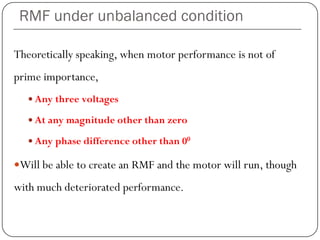
Theoretically speaking, when motor performance is not of
prime importance,
 Any three voltages
 At any magnitude other than zero
 Any phase difference other than 00
Will be able to create an RMF and the motor will run, though
with much deteriorated performance.
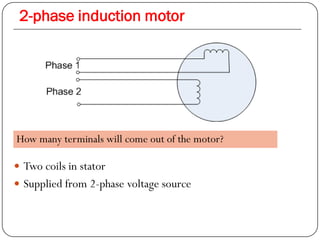
2-phase induction motor
 Two coils in stator
 Supplied from 2-phase voltage source
How many terminals will come out of the motor?
2-phase induction motor
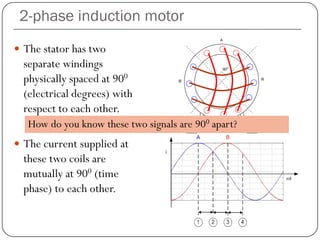
 The stator has two
separate windings
physically spaced at 900
(electrical degrees) with
respect to each other.
 The current supplied at
these two coils are
mutually at 900 (time
phase) to each other.
How do you know these two signals are 900 apart?
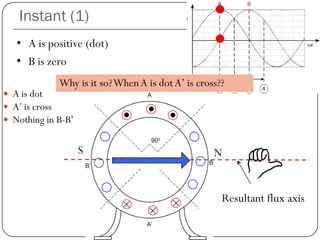
Instant (1)
 A is dot
 A’ is cross
 Nothing in B-B’
• A is positive (dot)
• B is zero
NS
Resultant flux axis
Why is it so?WhenA is dotA’ is cross??
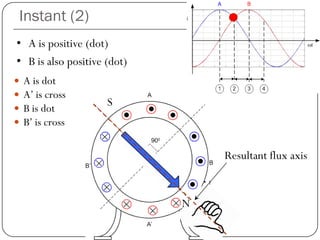
Instant (2)
 A is dot
 A’ is cross
 B is dot
 B’ is cross
• A is positive (dot)
• B is also positive (dot)
N
S
Resultant flux axis
N
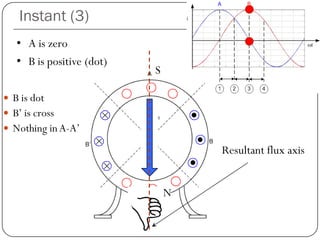
Instant (3)
 B is dot
 B’ is cross
 Nothing inA-A’
• A is zero
• B is positive (dot)
S
Resultant flux axis
N
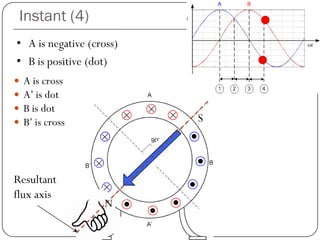
Instant (4)
 A is cross
 A’ is dot
 B is dot
 B’ is cross
• A is negative (cross)
• B is positive (dot)
S
Resultant
flux axis
N
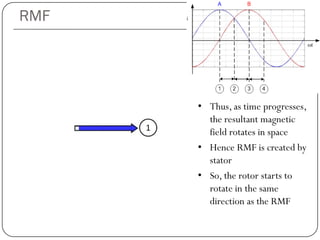
RMF
• Thus, as time progresses,
the resultant magnetic
field rotates in space
• Hence RMF is created by
stator
• So, the rotor starts to
rotate in the same
direction as the RMF
2-phase induction motor
 In ideal case, with the two supply voltages being of same
magnitude and at 900 in time phase with respect to each
other, the magnitude of RMF remains constant and the
motor rotates at steady speed.
2-phase induction motor
 In practical cases
 The 2-phase supply voltages may not be of exactly the same
amplitude
 They may not be in exact phase quadrature
 Then also RMF is developed
 The motor will run, but
 at less speed
 low capacity
 with speed and torque ripples (oscillations)
Thus….
 The basic requirement for generating a rotating magnetic
field (RMF) in the air gap of a poly-phase motor is that
 There must be more than one magnetic fields present
 with certain time-phase difference
 and space-phase difference between themselves
 In 3-phase and 2-phase induction motors, this is achieved by
 putting more than one winding in the stator
 supplying those winding with a poly-phase supply
Single phase induction motor
 A large number of fractional horse power (HP)AC motors are
designed for operation with single phase supply
 As in case of household pumps and fans, the supply is only single
phase
 So we can’t use 3-phase or 2-phase induction motors
 The option is to use single phase induction motors that can be run
from the single phase supply that is available
Single phase induction motor - construction
 The first difference between a 3-phase and a single-phase
induction motor is in terms of physical size of the machine
 Three-phase induction motors are big in size
 Single phase induction motors are often of much smaller
size and rating
 Sometimes even 100 times smaller
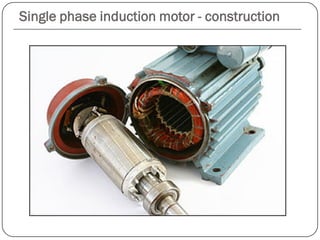
Single phase induction motor - construction
 However, the basic constructional features and materials
almost remain same for both the two.
 Stator:
 Stacks of laminated steel sheets with tooth and slot
 3-phase motor has three coils, but 1-ph motor has only one main
coil
 Rotor:
 Squirrel cage type – exactly similar for 3-phase and 1-phase
motors
Single phase induction motor - construction
Activity
 State –True or False
 3-phase IM uses 3-phase supply to produce RMF
 In 3-phase supply given to a 3-ph star connected IM, if one of
the supply lines gets open, then the motor will continue to
rotate like a 2-phase motor, though not smoothly
 Speed of RMF in a 3-ph or 2-ph IM depends on frequency of
supply voltage
 3-ph IM has 3 supply lines, but single phase IM has only one
supply line
Single Phase Induction Motor

  • 1.
    Electric Machine –II EE 501  Single phase induction motor  Single phaseAC series motor (universal motor)  Synchronous machine  Generator (alternator)  Motor  Special machines
  • 2.
    Course outcomes (CO) Aftersuccessful completion of this course, the students would be able to: C 501.1 Use concepts in trigonometry, complex algebra, phasor operations and principles of electromagnetism to find correct solutions to electrical machine performance questions. C501.2 Select proper materials and methods for design and construction of electrical machines within the realm of manufacturing, economic, performance, efficiency and environmental constraints. C501.3 Use modeling/simulation parameters with standard equivalent circuit models to predict correctly the expected performance of various general-purpose electrical machines. C501.4 Compare accepted standards and guidelines to select appropriate electrical machines to meet specified performance requirements and choose the scope of applicability of various types of electrical machines in real life multi-disciplinary usages. C501.5 Demonstrate an understanding of the fundamental control practices associated with rotating machines. C501.6 Set up testing strategies to evaluate performance characteristics of electrical machines. Basic concepts Construction & operation Performance evaluation Application Control Testing
  • 3.
    Day 1 Single phaseinduction motor
  • 4.
    ILOs – Day1 Recapitulate 3-ph IM operation  Understand 2-ph IM operation  Generalize the concept of producing RMF  List the basic applications of 1-ph IM  Compare between 1-ph IM and poly-phase IM
  • 5.
    Single phase inductionmotors  Three-phase induction motors  Very popular in industries for medium power applications (>5 kW)  But, domestic and commercial (shops) use single phase supply  So, single phase induction motors are used  Single phase induction motors for low power applications  cost-effectiveness  Ruggedness  Low maintenance requirements  Loads such as fan, pump, blowers, compressors etc.
  • 6.
    Recap of 3-phaseinduction motors  In 3-phase induction machine, three windings are placed around the stator near the air gap.  These windings are physically apart by 1200 (electrical degrees) in space.  When a 3-phase supply voltage is applied to this 3-phase winding, a magnetic field is developed in the air gap.  Under balanced condition, the magnetic field will rotate at a constant speed around the air gap (RMF).  The rotor conductors will experience change in flux linkage due to the RMF.  Under this action, the rotor will start to rotate and will continue to rotate in the same direction as the stator RMF
  • 7.
    Recap of 3-phaseinduction motors Thus, in summary, a 3-phase induction motor has inherent starting as well as running torque that can start the motor by itself and continue running as soon as the 3-phase supply is switched on.
  • 8.
    Activity 1 Thus, insummary, a 3-phase induction motor has inherent starting as well as running torque that can start the motor by itself and continue running as soon as the 3-phase supply is switched on. starting running 3-phase supply itself
  • 9.
    RMF under unbalancedcondition  In practical cases, it is very rare that the 3-phase supply system is totally balanced.  What do you mean by a balanced 3-phase system?  Three signals ( voltage or current)  Same magnitude (RMS value)  Phase difference 1200 among them
  • 10.
    RMF under unbalancedcondition  Under unbalanced condition  Magnitude of the three phase voltages may be unequal  They may not be exactly 1200 apart  Then also RMF will be developed and motor will run.  RMF strength not constant  RMF speed also not constant  Such an unbalanced system may cause speed and torque oscillations  Degraded motor performance and reduced motor capacity and efficiency. Q) In an unbalanced 3-phase system, ∠RY=1200, ∠YB=1160, then ∠BR = ? (3600 – 1200 – 1160) = 1240 Q)Will there be any RMF? Q)Will the motor run?
  • 11.
    RMF under unbalancedcondition Theoretically speaking, when motor performance is not of prime importance,  Any three voltages  At any magnitude other than zero  Any phase difference other than 00 Will be able to create an RMF and the motor will run, though with much deteriorated performance.
  • 12.
    2-phase induction motor Two coils in stator  Supplied from 2-phase voltage source How many terminals will come out of the motor?
  • 13.
    2-phase induction motor The stator has two separate windings physically spaced at 900 (electrical degrees) with respect to each other.  The current supplied at these two coils are mutually at 900 (time phase) to each other. How do you know these two signals are 900 apart?
  • 14.
    Instant (1)  Ais dot  A’ is cross  Nothing in B-B’ • A is positive (dot) • B is zero NS Resultant flux axis Why is it so?WhenA is dotA’ is cross??
  • 15.
    Instant (2)  Ais dot  A’ is cross  B is dot  B’ is cross • A is positive (dot) • B is also positive (dot) N S Resultant flux axis N
  • 16.
    Instant (3)  Bis dot  B’ is cross  Nothing inA-A’ • A is zero • B is positive (dot) S Resultant flux axis N
  • 17.
    Instant (4)  Ais cross  A’ is dot  B is dot  B’ is cross • A is negative (cross) • B is positive (dot) S Resultant flux axis N
  • 18.
    RMF • Thus, astime progresses, the resultant magnetic field rotates in space • Hence RMF is created by stator • So, the rotor starts to rotate in the same direction as the RMF
  • 19.
    2-phase induction motor In ideal case, with the two supply voltages being of same magnitude and at 900 in time phase with respect to each other, the magnitude of RMF remains constant and the motor rotates at steady speed.
  • 20.
    2-phase induction motor In practical cases  The 2-phase supply voltages may not be of exactly the same amplitude  They may not be in exact phase quadrature  Then also RMF is developed  The motor will run, but  at less speed  low capacity  with speed and torque ripples (oscillations)
  • 21.
    Thus….  The basicrequirement for generating a rotating magnetic field (RMF) in the air gap of a poly-phase motor is that  There must be more than one magnetic fields present  with certain time-phase difference  and space-phase difference between themselves  In 3-phase and 2-phase induction motors, this is achieved by  putting more than one winding in the stator  supplying those winding with a poly-phase supply
  • 22.
    Single phase inductionmotor  A large number of fractional horse power (HP)AC motors are designed for operation with single phase supply  As in case of household pumps and fans, the supply is only single phase  So we can’t use 3-phase or 2-phase induction motors  The option is to use single phase induction motors that can be run from the single phase supply that is available
  • 23.
    Single phase inductionmotor - construction  The first difference between a 3-phase and a single-phase induction motor is in terms of physical size of the machine  Three-phase induction motors are big in size  Single phase induction motors are often of much smaller size and rating  Sometimes even 100 times smaller
  • 24.
    Single phase inductionmotor - construction  However, the basic constructional features and materials almost remain same for both the two.  Stator:  Stacks of laminated steel sheets with tooth and slot  3-phase motor has three coils, but 1-ph motor has only one main coil  Rotor:  Squirrel cage type – exactly similar for 3-phase and 1-phase motors
  • 25.
    Single phase inductionmotor - construction
  • 26.
    Activity  State –Trueor False  3-phase IM uses 3-phase supply to produce RMF  In 3-phase supply given to a 3-ph star connected IM, if one of the supply lines gets open, then the motor will continue to rotate like a 2-phase motor, though not smoothly  Speed of RMF in a 3-ph or 2-ph IM depends on frequency of supply voltage  3-ph IM has 3 supply lines, but single phase IM has only one supply line