UNIT I – Basic Concepts
UNIT II – Direct and Inverse kinematics
UNIT III – Manipulator Differential
Motion and Statics
UNIT IV – Path Planning
UNIT V – Dynamics & Control
L.V.Revathi,AP/EIE,KCET
ROBOTICS AND AUTOMATIO
8 79
UNIT I – BASIC CONCEPTS
Robotic
Institute of
America
• A robot is a reprogrammable multi-function
manipulator designed to move material parts, tools
or specialised devices, through variable
programmed motions for the performance of a
variety of tasks.
British
Robots
Association
• An industrial robot is a re-programmable device
designed to both manipulate and transport parts,
tools or specialised manufacturing implements
through variable programmed motions for the
performance of specific manufacturing tasks.
L.V.Revathi,AP/EIE,KCET
HISTORY OF
ROBOTICS
L.V.Revathi,AP/EIE,KCET
TYPES OF ROBOTS
Mobile robots
Industrial Robots
Autonomous Robots
Remote Controlled Robots
Virtual Robots
L.V.Revathi,AP/EIE,KCET
ROBOT CLASSIFICATIONS
• Physical configuration
• Control system
• Movement
• Types of drive
• Application
• Degrees of freedom
• Sensory systems
• Capabilities of robot system
L.V.Revathi,AP/EIE,KCET
• Cartesian configuration
• Cylindrical configuration
• Polar configuration
• Joint-arm configuration
• SCARA
PHYSICAL
CONFIGURATION
• Point to Point robots
• Straight line robots
• Continuous robots
CONTROL SYSTEM
• Fixed Robot
• Mobile Robot
• Walking or Legged robot
MOVEMENT
• Simple and Blind robot
• Vision robot
• Intelligent robot
SENSORY SYSTEM
• Single DOF
• Two DOF
• Three DOF
• Six DOF
DEGRESS OF
FREEDOM
• Manufacturing
• Handling
• Testing
APPLICATION
• Pneumatic drive
• Hydraulic drive
• Electric drive
TYPES OF DRIVE L.V.Revathi,AP/EIE,KCET
ROBOT SPECIFICATIONS
 Accuracy
 Repeatability
 Reliability
 Resolution
 Spatial Resolution
 Precision of Robot
 Quality of Robot
 Reach
 Maximum Speed
 Payload
 Payload Capability of Robot
 Pitch
 Yaw
 Roll
 Duty Cycle
 Offset
L.V.Revathi,AP/EIE,KCET
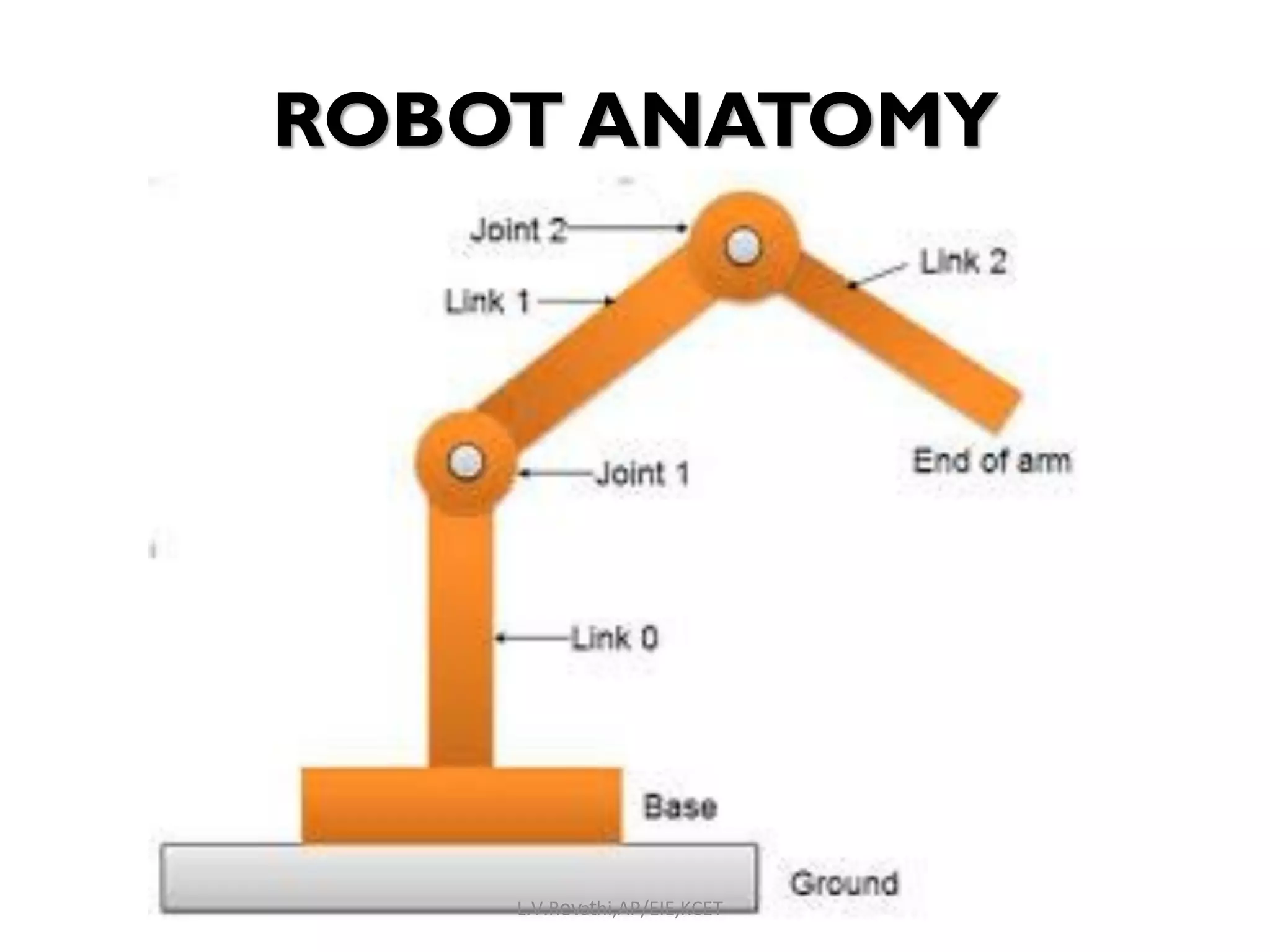
ROBOT ANATOMY
L.V.Revathi,AP/EIE,KCET
PHYSICAL CONFIGURATION
Advantages:
• 3 linear axes
• Easy to visualize
• Rigid structure
• Easy to program off-line
Disadvantages:
• Can only reach in front of itself
• Requires large floor space for
size of work envelop
• Axes hard to seal
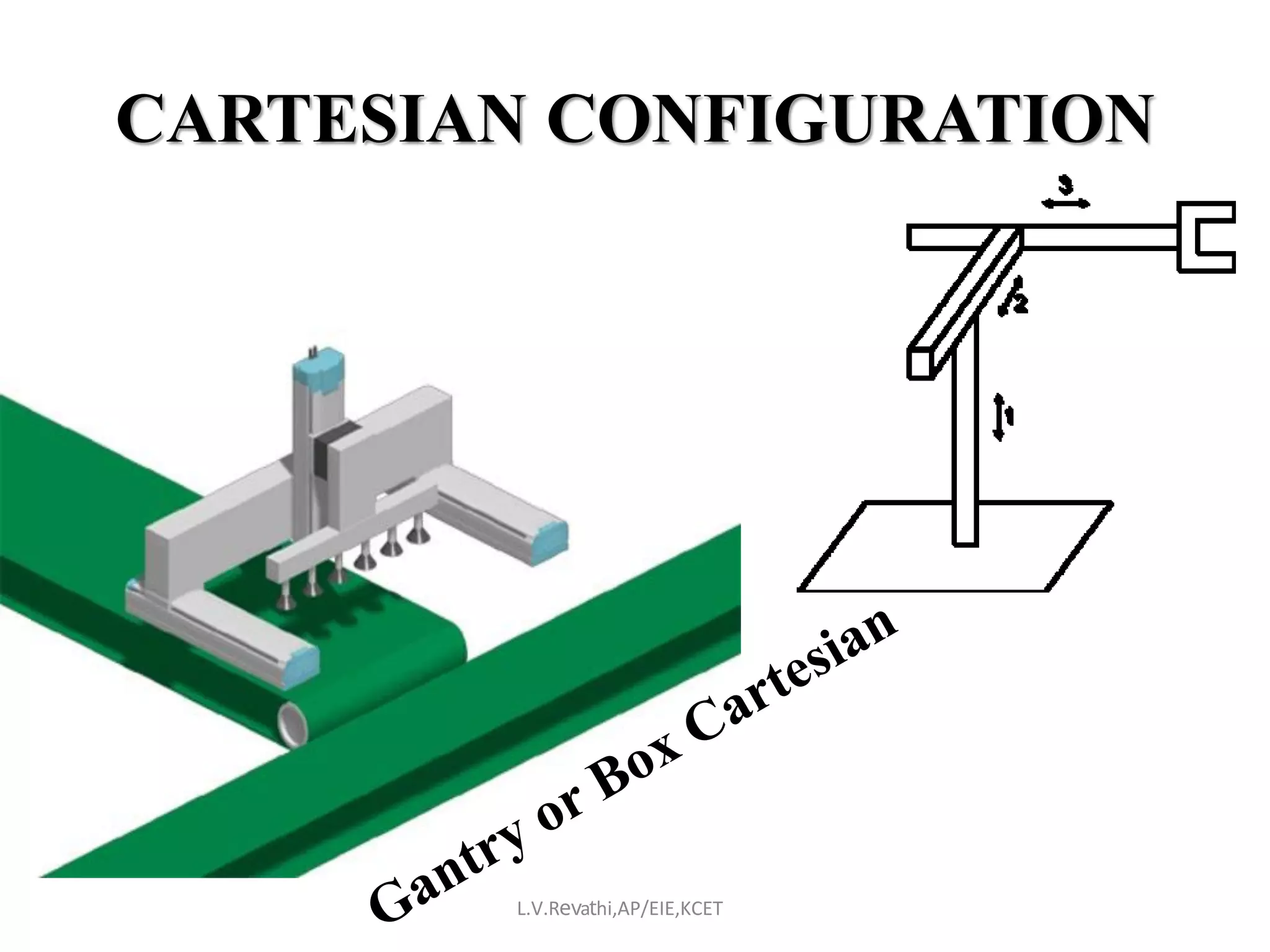
CARTESIAN CONFIGURATION (Rectangular -PPP)
1. Cantilevered Cartesian
2. Gantry or Box Cartesian
L.V.Revathi,AP/EIE,KCET
CARTESIAN CONFIGURATION
L.V.Revathi,AP/EIE,KCET
CYLINDRICAL CONFIGURATION
L.V.Revathi,AP/EIE,KCET
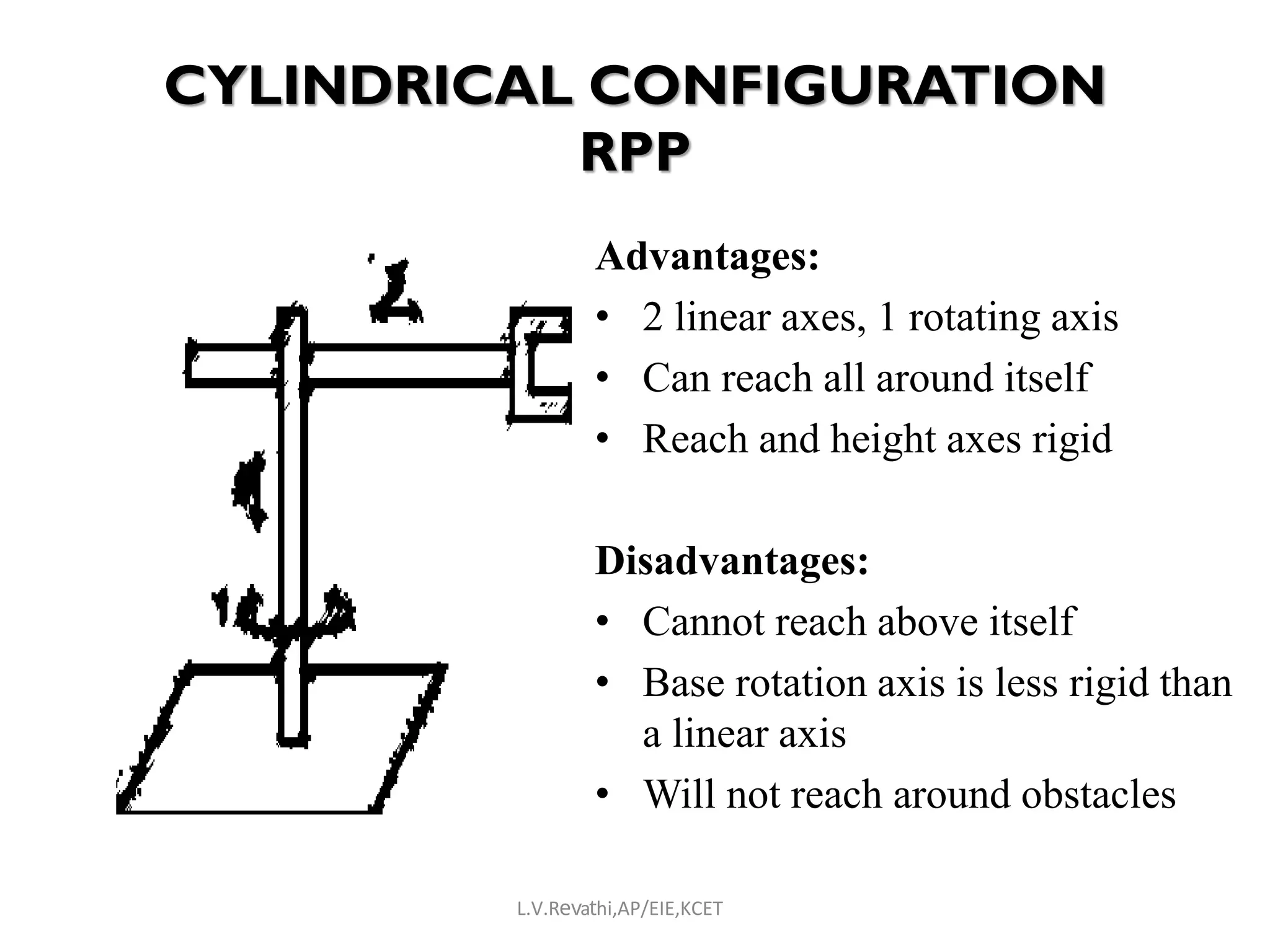
CYLINDRICAL CONFIGURATION
RPP
Advantages:
• 2 linear axes, 1 rotating axis
• Can reach all around itself
• Reach and height axes rigid
Disadvantages:
• Cannot reach above itself
• Base rotation axis is less rigid than
a linear axis
• Will not reach around obstacles
L.V.Revathi,AP/EIE,KCET
POLAR CONFIGURATION
(Spherical -RRP)
Advantages:
• 1 linear axis, 2 rotating axes
• Long horizontal reach
Disadvantage:
• Cannot reach around
obstacles
• Generally has short vertical
reach
L.V.Revathi,AP/EIE,KCET
SCARATYPE CONFIGURATION
RRP or PRR
Advantages:
• 1 linear axis, 2 rotating axes
• Height axis is rigid
• Large work area floor space
• Can reach around obstacles
• Two ways to reach a point
Disadvantage:
• Difficult to program off-line
• Highly complex arm
L.V.Revathi,AP/EIE,KCET
REVOLUTE TYPE CONFIGURATION
(RRR)
Advantages:
• 3 rotating, axes
• Can reach above or below
obstacles
• Largest work area for least
work space
• Two or four ways to reach a
point
Disadvantage:
• Difficult to program off-line
• The most complex manipulator
L.V.Revathi,AP/EIE,KCET
VIDEO -PHYSICAL
CONFIGURATION or ARM
L.V.Revathi,AP/EIE,KCET
WORKSPACE
The volume of space reachable by the end-effector,
Everywhere a robot reaches must be within this space.
Tool orientation and size also important.
L.V.Revathi,AP/EIE,KCET
ARCHITECTURE OF ROBOTIC SYSTEMS
L.V.Revathi,AP/EIE,KCET
ARCHITECTURE OF ROBOTIC SYSTEMS
Actuators:
 Electrical, Hydraulic,
 Pneumatic, Artificial
Muscle
Sensors:
 Camera, Encoder, Photo
Electronic, GPS,
 Compass, Gyroscope,
Inertial navigation,
 Laser Range Scanners,
Pressure
L.V.Revathi,AP/EIE,KCET
DRIVES - ELECTRICAL DRIVE
 Small and medium size robots are
usually powered by electric drives
via gear trains using servomotors
and stepper motors. Most commonly
used are dc motors, although for
larger robots, ac motors may be
utilised. A new design based on
direct drives (without gear trains) is
being developed.
Advantages:
• Better accuracy & repeatability
• Require less floor space
• More towards precise work such as
assembly applications
Disadvantage:
• Generally not as speedy and powerful
as hydraulic robots
• Expensive for large and powerful
robots, can become fire hazard
L.V.Revathi,AP/EIE,KCET
HYDRAULIC DRIVE
 Larger robots are usually
powered by hydraulic drives .
 Hydraulic drive system can
provide rotational motion
(rotary vane actuators) and
linear motion (hydraulic
pistons).
Advantages:
 More strength-to-weight ratio
 Can also actuate at a higher
speed
Disadvantage:
 Require large floor space
 Tendency to oil leakage
L.V.Revathi,AP/EIE,KCET
PNEUMATIC DRIVE
• Generally used For smaller robots
that possess fewer degrees of
freedom (2- 4 joint motions).
• They are limited to pick-and-place
tasks with fast cycles.
• Pneumatic drive system can be
applied to the actuation of piston
devices to provide linear motions.
• Rotational motions can be
achieved by rotary actuators
Advantages:
• Cheaper & lower technology
options for control of speed.
• Safe to use and Light in weight
Disadvantage:
• Require large floor space
• Tendency to oil leakage
L.V.Revathi,AP/EIE,KCET
REPEATABILITY AND ACCURACY
OF ROBOT
Accuracy:
 Accuracy refers to a
robot's ability to position
its wrist end at a desired
target point within the
work volume.
Repeatability:
 Repeatability describes
how a points are repeated
at the same place or
target.
L.V.Revathi,AP/EIE,KCET
ROBOT PROGRAMMING
Robot Programming is the defining of desired
motions so that the robot may perform them without
human intervention.
Identifying and specifying the robot configurations (i.e.
the pose of the end-effector, Pe, with respect to the base-
frame)
L.V.Revathi,AP/EIE,KCET
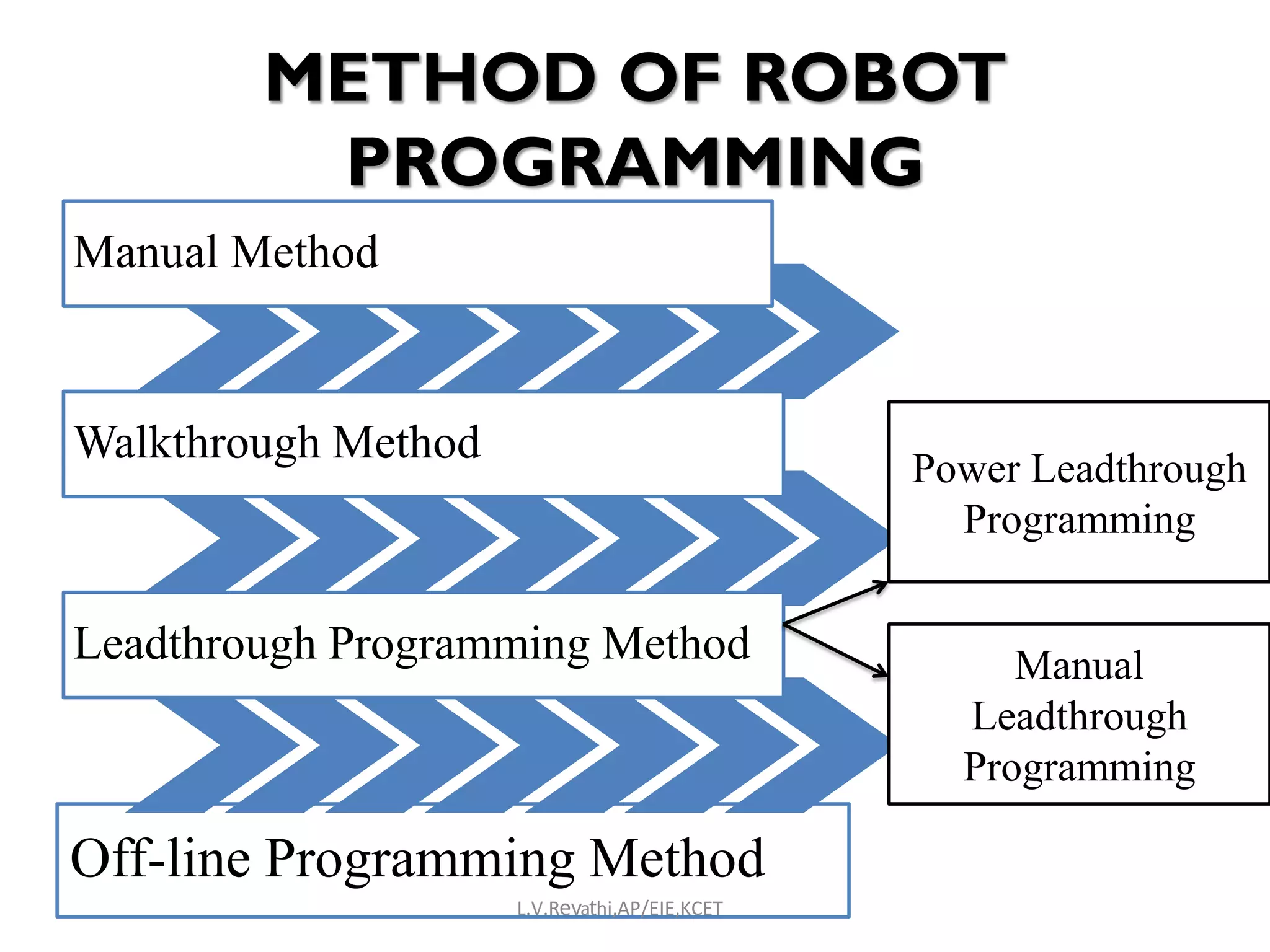
METHOD OF ROBOT
PROGRAMMING
Off-line Programming Method
Manual Method
Walkthrough Method
Leadthrough Programming Method
Power Leadthrough
Programming
Manual
Leadthrough
Programming
L.V.Revathi,AP/EIE,KCET
ROBOT PROGRAMMING
LANGUAGES
High level computer
programming languages
AL
VAL
RAIL
AML
HELP
JARS
Joint Control
Languages
Primitive Motion Languages
Structures programming
Languages
Task Oriented Languages
L.V.Revathi,AP/EIE,KCET
SENSORS
Robotic sensing is a branch of robotics science Intended to give
robots sensing capabilities, so that robots are more human-like.
Robotic sensing mainly gives robots the ability to see, touch,
hear and move and uses algorithms that require environmental
feedback.
The use of sensors in robots has taken them into the next level
of creativity.
Most importantly, the sensors have increased the performance
of robots to a large extent. It also allows the robots to perform several
functions like a human being.L.V.Revathi,AP/EIE,KCET
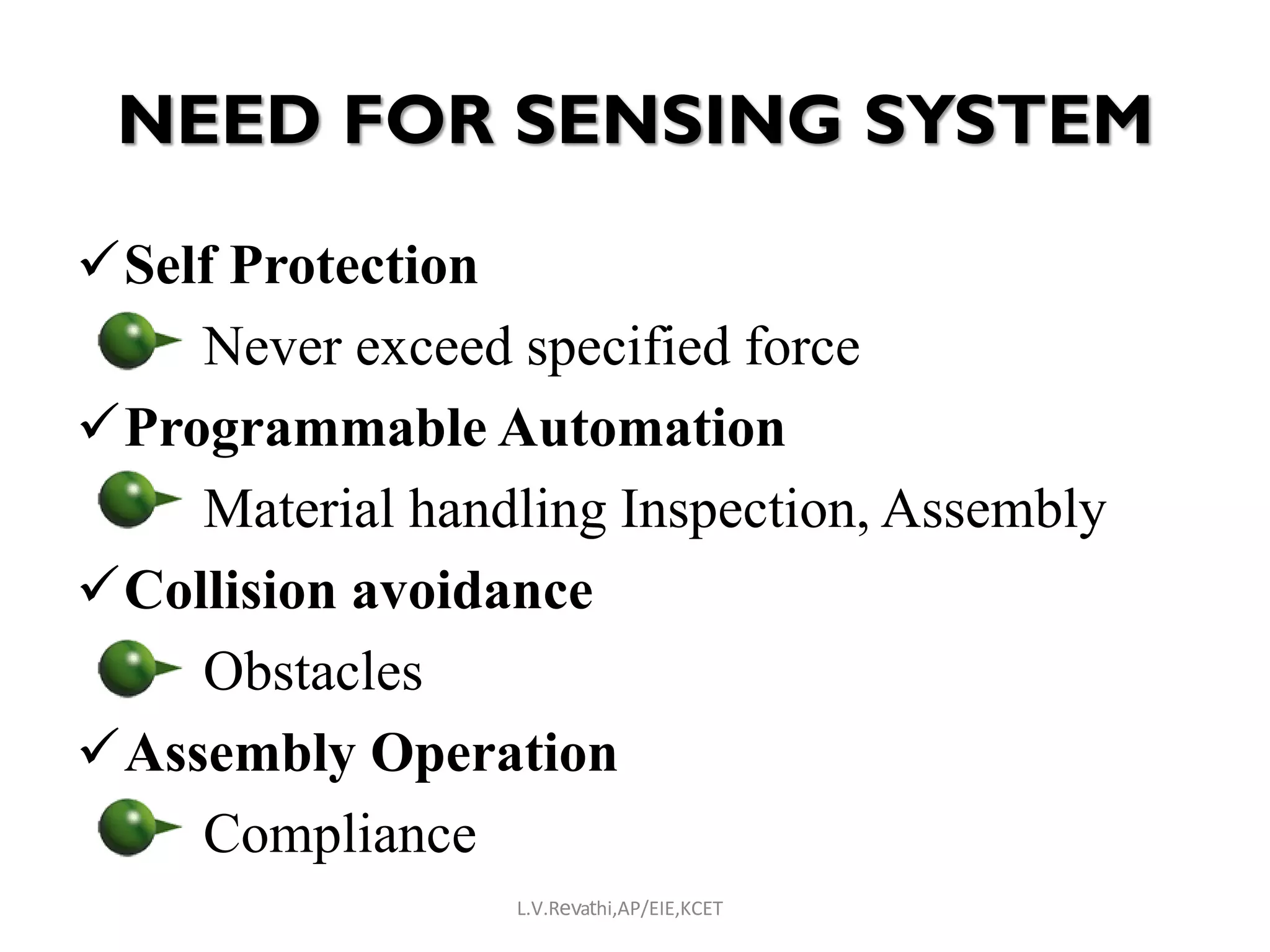
NEED FOR SENSING SYSTEM
Self Protection
Never exceed specified force
Programmable Automation
Material handling Inspection, Assembly
Collision avoidance
Obstacles
Assembly Operation
Compliance
L.V.Revathi,AP/EIE,KCET
TYPES OF SENSORS
Contact Sensing Switches , Piezoelectric
Position Potentiometer, Resolvers, Optical Encoders
Force Spring, Strain Gauges
Torque Hollow Cylinder
Proximity Optical, Eddy current, Magnetic
Touch Sensing Compliance
Vision Camera, Stereo, Vision
L.V.Revathi,AP/EIE,KCET

unit I.pdf

  • 1.
    UNIT I –Basic Concepts UNIT II – Direct and Inverse kinematics UNIT III – Manipulator Differential Motion and Statics UNIT IV – Path Planning UNIT V – Dynamics & Control L.V.Revathi,AP/EIE,KCET ROBOTICS AND AUTOMATIO 8 79
  • 2.
    UNIT I –BASIC CONCEPTS Robotic Institute of America • A robot is a reprogrammable multi-function manipulator designed to move material parts, tools or specialised devices, through variable programmed motions for the performance of a variety of tasks. British Robots Association • An industrial robot is a re-programmable device designed to both manipulate and transport parts, tools or specialised manufacturing implements through variable programmed motions for the performance of specific manufacturing tasks. L.V.Revathi,AP/EIE,KCET
  • 3.
  • 4.
    TYPES OF ROBOTS Mobilerobots Industrial Robots Autonomous Robots Remote Controlled Robots Virtual Robots L.V.Revathi,AP/EIE,KCET
  • 5.
  • 6.
    ROBOT CLASSIFICATIONS • Physicalconfiguration • Control system • Movement • Types of drive • Application • Degrees of freedom • Sensory systems • Capabilities of robot system L.V.Revathi,AP/EIE,KCET
  • 7.
    • Cartesian configuration •Cylindrical configuration • Polar configuration • Joint-arm configuration • SCARA PHYSICAL CONFIGURATION • Point to Point robots • Straight line robots • Continuous robots CONTROL SYSTEM • Fixed Robot • Mobile Robot • Walking or Legged robot MOVEMENT • Simple and Blind robot • Vision robot • Intelligent robot SENSORY SYSTEM • Single DOF • Two DOF • Three DOF • Six DOF DEGRESS OF FREEDOM • Manufacturing • Handling • Testing APPLICATION • Pneumatic drive • Hydraulic drive • Electric drive TYPES OF DRIVE L.V.Revathi,AP/EIE,KCET
  • 8.
    ROBOT SPECIFICATIONS  Accuracy Repeatability  Reliability  Resolution  Spatial Resolution  Precision of Robot  Quality of Robot  Reach  Maximum Speed  Payload  Payload Capability of Robot  Pitch  Yaw  Roll  Duty Cycle  Offset L.V.Revathi,AP/EIE,KCET
  • 9.
  • 10.
    PHYSICAL CONFIGURATION Advantages: • 3linear axes • Easy to visualize • Rigid structure • Easy to program off-line Disadvantages: • Can only reach in front of itself • Requires large floor space for size of work envelop • Axes hard to seal CARTESIAN CONFIGURATION (Rectangular -PPP) 1. Cantilevered Cartesian 2. Gantry or Box Cartesian L.V.Revathi,AP/EIE,KCET
  • 11.
  • 12.
  • 13.
    CYLINDRICAL CONFIGURATION RPP Advantages: • 2linear axes, 1 rotating axis • Can reach all around itself • Reach and height axes rigid Disadvantages: • Cannot reach above itself • Base rotation axis is less rigid than a linear axis • Will not reach around obstacles L.V.Revathi,AP/EIE,KCET
  • 14.
    POLAR CONFIGURATION (Spherical -RRP) Advantages: •1 linear axis, 2 rotating axes • Long horizontal reach Disadvantage: • Cannot reach around obstacles • Generally has short vertical reach L.V.Revathi,AP/EIE,KCET
  • 15.
    SCARATYPE CONFIGURATION RRP orPRR Advantages: • 1 linear axis, 2 rotating axes • Height axis is rigid • Large work area floor space • Can reach around obstacles • Two ways to reach a point Disadvantage: • Difficult to program off-line • Highly complex arm L.V.Revathi,AP/EIE,KCET
  • 16.
    REVOLUTE TYPE CONFIGURATION (RRR) Advantages: •3 rotating, axes • Can reach above or below obstacles • Largest work area for least work space • Two or four ways to reach a point Disadvantage: • Difficult to program off-line • The most complex manipulator L.V.Revathi,AP/EIE,KCET
  • 17.
    VIDEO -PHYSICAL CONFIGURATION orARM L.V.Revathi,AP/EIE,KCET
  • 18.
    WORKSPACE The volume ofspace reachable by the end-effector, Everywhere a robot reaches must be within this space. Tool orientation and size also important. L.V.Revathi,AP/EIE,KCET
  • 19.
    ARCHITECTURE OF ROBOTICSYSTEMS L.V.Revathi,AP/EIE,KCET
  • 20.
    ARCHITECTURE OF ROBOTICSYSTEMS Actuators:  Electrical, Hydraulic,  Pneumatic, Artificial Muscle Sensors:  Camera, Encoder, Photo Electronic, GPS,  Compass, Gyroscope, Inertial navigation,  Laser Range Scanners, Pressure L.V.Revathi,AP/EIE,KCET
  • 21.
    DRIVES - ELECTRICALDRIVE  Small and medium size robots are usually powered by electric drives via gear trains using servomotors and stepper motors. Most commonly used are dc motors, although for larger robots, ac motors may be utilised. A new design based on direct drives (without gear trains) is being developed. Advantages: • Better accuracy & repeatability • Require less floor space • More towards precise work such as assembly applications Disadvantage: • Generally not as speedy and powerful as hydraulic robots • Expensive for large and powerful robots, can become fire hazard L.V.Revathi,AP/EIE,KCET
  • 22.
    HYDRAULIC DRIVE  Largerrobots are usually powered by hydraulic drives .  Hydraulic drive system can provide rotational motion (rotary vane actuators) and linear motion (hydraulic pistons). Advantages:  More strength-to-weight ratio  Can also actuate at a higher speed Disadvantage:  Require large floor space  Tendency to oil leakage L.V.Revathi,AP/EIE,KCET
  • 23.
    PNEUMATIC DRIVE • Generallyused For smaller robots that possess fewer degrees of freedom (2- 4 joint motions). • They are limited to pick-and-place tasks with fast cycles. • Pneumatic drive system can be applied to the actuation of piston devices to provide linear motions. • Rotational motions can be achieved by rotary actuators Advantages: • Cheaper & lower technology options for control of speed. • Safe to use and Light in weight Disadvantage: • Require large floor space • Tendency to oil leakage L.V.Revathi,AP/EIE,KCET
  • 24.
    REPEATABILITY AND ACCURACY OFROBOT Accuracy:  Accuracy refers to a robot's ability to position its wrist end at a desired target point within the work volume. Repeatability:  Repeatability describes how a points are repeated at the same place or target. L.V.Revathi,AP/EIE,KCET
  • 25.
  • 26.
    ROBOT PROGRAMMING Robot Programmingis the defining of desired motions so that the robot may perform them without human intervention. Identifying and specifying the robot configurations (i.e. the pose of the end-effector, Pe, with respect to the base- frame) L.V.Revathi,AP/EIE,KCET
  • 27.
    METHOD OF ROBOT PROGRAMMING Off-lineProgramming Method Manual Method Walkthrough Method Leadthrough Programming Method Power Leadthrough Programming Manual Leadthrough Programming L.V.Revathi,AP/EIE,KCET
  • 28.
    ROBOT PROGRAMMING LANGUAGES High levelcomputer programming languages AL VAL RAIL AML HELP JARS Joint Control Languages Primitive Motion Languages Structures programming Languages Task Oriented Languages L.V.Revathi,AP/EIE,KCET
  • 29.
    SENSORS Robotic sensing isa branch of robotics science Intended to give robots sensing capabilities, so that robots are more human-like. Robotic sensing mainly gives robots the ability to see, touch, hear and move and uses algorithms that require environmental feedback. The use of sensors in robots has taken them into the next level of creativity. Most importantly, the sensors have increased the performance of robots to a large extent. It also allows the robots to perform several functions like a human being.L.V.Revathi,AP/EIE,KCET
  • 30.
    NEED FOR SENSINGSYSTEM Self Protection Never exceed specified force Programmable Automation Material handling Inspection, Assembly Collision avoidance Obstacles Assembly Operation Compliance L.V.Revathi,AP/EIE,KCET
  • 31.
    TYPES OF SENSORS ContactSensing Switches , Piezoelectric Position Potentiometer, Resolvers, Optical Encoders Force Spring, Strain Gauges Torque Hollow Cylinder Proximity Optical, Eddy current, Magnetic Touch Sensing Compliance Vision Camera, Stereo, Vision L.V.Revathi,AP/EIE,KCET