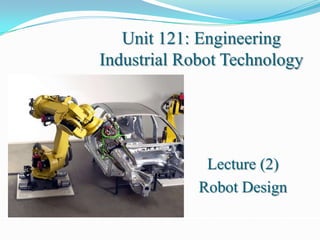
Unit 121: Engineering
Industrial Robot Technology


              Lecture (2)
             Robot Design
Session Outline:
•Manipulator coordinate systems

•Wrist articulations

•Drive mechanisms

•Speed reducers/ gearheads
Manipulator coordinate systems
Cartesian
Cylindrical
Spherical
Selective Compliant Assembly Robot Arm (SCARA)
Articulated Robot
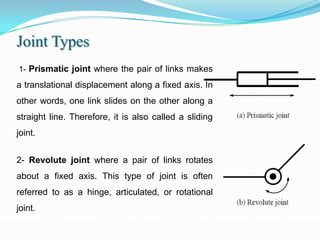
Joint Types
1- Prismatic joint where the pair of links makes

a translational displacement along a fixed axis. In
other words, one link slides on the other along a
straight line. Therefore, it is also called a sliding
joint.


2- Revolute joint where a pair of links rotates
about a fixed axis. This type of joint is often
referred to as a hinge, articulated, or rotational
joint.
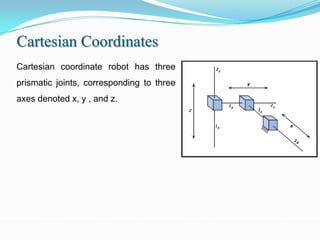
Cartesian Coordinates
Cartesian coordinate robot has three
prismatic joints, corresponding to three
axes denoted x, y , and z.
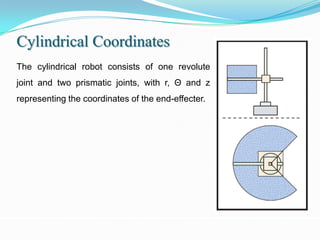
Cylindrical Coordinates
The cylindrical robot consists of one revolute
joint and two prismatic joints, with r, Θ and z
representing the coordinates of the end-effecter.
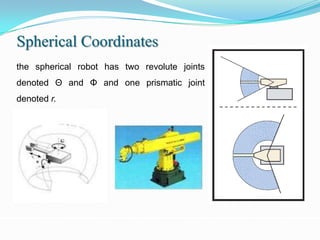
Spherical Coordinates
the spherical robot has two revolute joints
denoted Θ and Φ and one prismatic joint
denoted r.
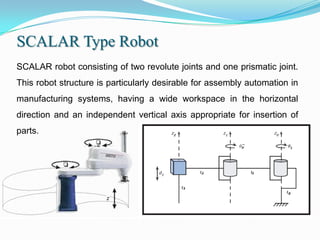
SCALAR Type Robot
SCALAR robot consisting of two revolute joints and one prismatic joint.
This robot structure is particularly desirable for assembly automation in
manufacturing systems, having a wide workspace in the horizontal
direction and an independent vertical axis appropriate for insertion of
parts.
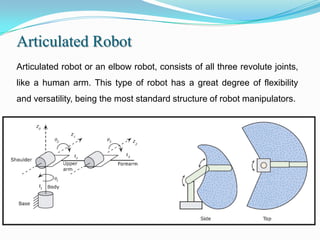
Articulated Robot
Articulated robot or an elbow robot, consists of all three revolute joints,
like a human arm. This type of robot has a great degree of flexibility
and versatility, being the most standard structure of robot manipulators.
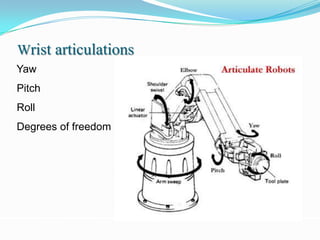
Wrist articulations
Yaw
Pitch
Roll
Degrees of freedom
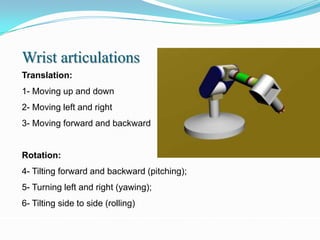
Wrist articulations
Translation:
1- Moving up and down
2- Moving left and right
3- Moving forward and backward


Rotation:
4- Tilting forward and backward (pitching);
5- Turning left and right (yawing);
6- Tilting side to side (rolling)
Drive mechanisms
Mechanical (ball screws, chain/belt, gears)
Pneumatic
Hydraulic
Electrical
Mechanical (ball screws, chain/belt, gears)
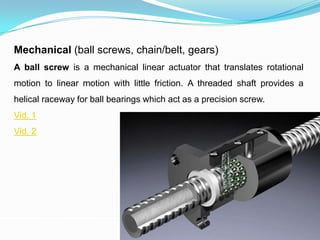
A ball screw is a mechanical linear actuator that translates rotational
motion to linear motion with little friction. A threaded shaft provides a
helical raceway for ball bearings which act as a precision screw.
Vid. 1
Vid. 2
Pneumatic System
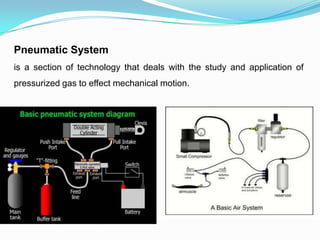
is a section of technology that deals with the study and application of
pressurized gas to effect mechanical motion.
Advantages of pneumatics
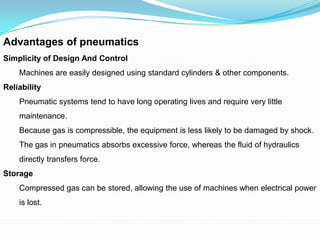
Simplicity of Design And Control
    Machines are easily designed using standard cylinders & other components.
Reliability
    Pneumatic systems tend to have long operating lives and require very little
    maintenance.
    Because gas is compressible, the equipment is less likely to be damaged by shock.
    The gas in pneumatics absorbs excessive force, whereas the fluid of hydraulics
    directly transfers force.
Storage
    Compressed gas can be stored, allowing the use of machines when electrical power
    is lost.
Hydraulic System
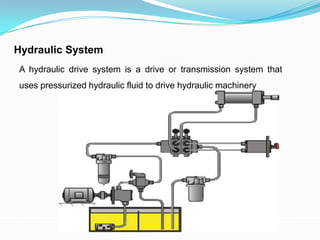
A hydraulic drive system is a drive or transmission system that
uses pressurized hydraulic fluid to drive hydraulic machinery
Speed reducers/ gearheads
Harmonic
Cycloidal
parallel shaft spur gear
Planetary
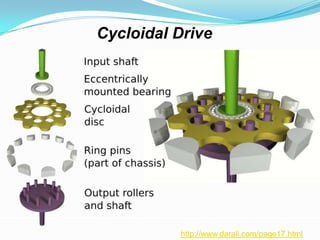
Cycloidal Drive


          http://www.darali.com/page17.html
Lecture #2 Robot design

Lecture #2 Robot design

  • 1.
    Unit 121: Engineering IndustrialRobot Technology Lecture (2) Robot Design
  • 2.
    Session Outline: •Manipulator coordinatesystems •Wrist articulations •Drive mechanisms •Speed reducers/ gearheads
  • 3.
    Manipulator coordinate systems Cartesian Cylindrical Spherical SelectiveCompliant Assembly Robot Arm (SCARA) Articulated Robot
  • 4.
    Joint Types 1- Prismaticjoint where the pair of links makes a translational displacement along a fixed axis. In other words, one link slides on the other along a straight line. Therefore, it is also called a sliding joint. 2- Revolute joint where a pair of links rotates about a fixed axis. This type of joint is often referred to as a hinge, articulated, or rotational joint.
  • 5.
    Cartesian Coordinates Cartesian coordinaterobot has three prismatic joints, corresponding to three axes denoted x, y , and z.
  • 6.
    Cylindrical Coordinates The cylindricalrobot consists of one revolute joint and two prismatic joints, with r, Θ and z representing the coordinates of the end-effecter.
  • 7.
    Spherical Coordinates the sphericalrobot has two revolute joints denoted Θ and Φ and one prismatic joint denoted r.
  • 8.
    SCALAR Type Robot SCALARrobot consisting of two revolute joints and one prismatic joint. This robot structure is particularly desirable for assembly automation in manufacturing systems, having a wide workspace in the horizontal direction and an independent vertical axis appropriate for insertion of parts.
  • 9.
    Articulated Robot Articulated robotor an elbow robot, consists of all three revolute joints, like a human arm. This type of robot has a great degree of flexibility and versatility, being the most standard structure of robot manipulators.
  • 10.
  • 11.
    Wrist articulations Translation: 1- Movingup and down 2- Moving left and right 3- Moving forward and backward Rotation: 4- Tilting forward and backward (pitching); 5- Turning left and right (yawing); 6- Tilting side to side (rolling)
  • 12.
    Drive mechanisms Mechanical (ballscrews, chain/belt, gears) Pneumatic Hydraulic Electrical
  • 13.
    Mechanical (ball screws,chain/belt, gears) A ball screw is a mechanical linear actuator that translates rotational motion to linear motion with little friction. A threaded shaft provides a helical raceway for ball bearings which act as a precision screw. Vid. 1 Vid. 2
  • 14.
    Pneumatic System is asection of technology that deals with the study and application of pressurized gas to effect mechanical motion.
  • 15.
    Advantages of pneumatics Simplicityof Design And Control Machines are easily designed using standard cylinders & other components. Reliability Pneumatic systems tend to have long operating lives and require very little maintenance. Because gas is compressible, the equipment is less likely to be damaged by shock. The gas in pneumatics absorbs excessive force, whereas the fluid of hydraulics directly transfers force. Storage Compressed gas can be stored, allowing the use of machines when electrical power is lost.
  • 16.
    Hydraulic System A hydraulicdrive system is a drive or transmission system that uses pressurized hydraulic fluid to drive hydraulic machinery
  • 17.
  • 18.
    Cycloidal Drive http://www.darali.com/page17.html