DIFFERENTIALS (FINAL DRIVE)
Final Drive
 A finaldrive is that partof a power transmission system between the
drive shaft and the differential.
 Its function is to changethe direction of the power transmitted by the
drive shaft through 90 degreesto the driving axles.
 At the same time. it provides a fixed reduction between the speed of the
drive shaft and the axle driving the wheels.
The reduction or gear ratio of the final drive
 This is determined by dividing the number of teeth on the ring gear by
the number of teeth on the pinion gear.
 In passenger vehicles, this speed reduction varies from about 3: 1 to 5: 1.
In trucks it varies from about5: 1 to 11: 1.
 To calculate rear axle ratio, countthe number of teeth on each gear.
Then divide the number of pinion teeth into the number of ring gear
teeth.
 For example, if the pinion gear has 10 teeth and the ring gear has 30 (30
divided by 10), the rear axle ratio would be 3: 1.
 This means that the pinion rotates three times for one revolution of the
ring gear.
The higher axle ratio, 4.11: 1 for instance, would increase acceleration and
pulling power but would decrease fuel economy. The engine would have to run
at a higher rpm to maintain an equal cruising speed.
The lower axle ratio. 3: 1, would reduceacceleration and pulling power but
would increasefuel mileage. The engine would run at a lower rpm while
maintaining the same speed.
TYPES OF GEARS USED IN DIFFERENTIAL UNIT
1. Spiral bevel gears
 This gears have curved gear teeth with the pinion and ring gear on
the same center-line.
 This type of final drive is used extensively in truck and occasionally in
older automobiles.
 This design allows for constant contact between the ring gear and
pinion.
 It also necessitates the use of heavy grade lubricants.
2. Hypoid Gear
 The hypoid gear final drive is an improvementor variation of the
spiral bevel design and is commonly used in light and medium
trucks and all domestic rear-wheeldrive automobiles.
 The pinion sits offset lowered, from the centreline of the ring gear
 Improved gear mesh because of larger gear tooth contactarea
 Improved gear life and less noise during operation
 Hypoid gears have replaced spiral bevel gearsbecause they lower
the hump in the floor of the vehicle and improvegear-meshing
action.
Figure5-13, thepinion meshes with the ring gear below the centreline and is at
a slight angle (less than 90 degrees). This angle and the use of heavier (larger)
teeth permitan increased amountof power to be transmitted while the size of
the ring gear and housing remain constant.
Figure5-13.- Typesof final
drives gears
DIFFERENTIAL
The differential isa device that splits the engine torquetwo ways, allowing each
outputto spin at a differentspeed.
The differential has the following functions:
 It allows wheels to rotate at different speeds when turning
 Splits the amount of torque going to each wheel
 Provides a final gear reduction
 Transfers power from half-shafts to the wheels
PARTS OF THE DIFF AND THEIR FUNCTIONS
POWERFLOW OF A DIFFERENTIAL
TYPES OF DIFFERENTIALS
OPEN DIFFERENTIAL
 An open differentialis the most common type of differential found in
passenger carsand truckstoday.
 It is a very simple (cheap) design that uses 4 gears (sometimes 6), that
are referred to as spider gears, to drive the axle shafts but also allow
them to rotate at differentspeeds if necessary.
 There are two differenttypes of gears on the diff, pinion gears/ spider
gears and the axle side gears.
 The differentialcage (nothousing) receives rotational torquethrough the
ring gear and uses it to drive the differential pin.
 The differentialpinion gears ride on this pin/shaft and are driven by it.
 Rotationaltorque is then transferred to the axle side gears and out
through the cv shafts/axle shafts to the wheels.
 If the vehicle is travelling in a straightline, there is no differential action
and the differentialpinion gears will simply drive the axle side gears.
 If the vehicle enters a turn, the outer wheel must rotatefaster than the
inside wheel.
 The differentialpinion gears will start to rotate as they drive the axle side
gears, allowing the outer wheel to speed up and the inside wheel to slow
down.
 This design works well as long as both of the driven wheels have traction.
If one wheel does not have enough traction, rotational torquewill follow the
path of least resistance and the wheel with little traction will spin while the
wheel with traction will notrotate at all. Since the wheel with traction is not
rotating, the vehicle cannotmove.
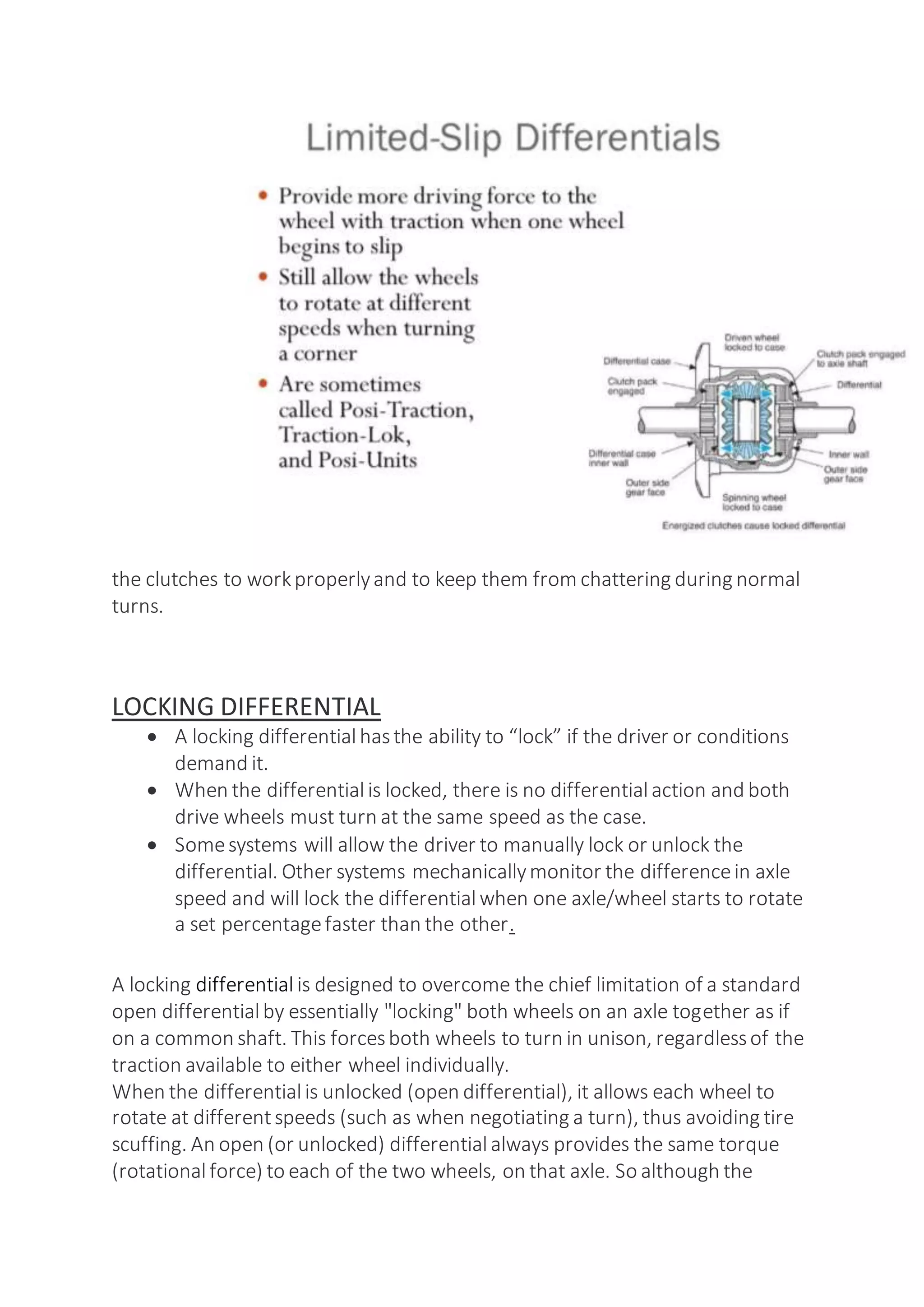
LIMITED SLIP DIFFERENTIALS
 Limited slip differentialstransmitequal torqueto both wheels when
driving straight. However, when onewheel spins due to loss of traction
the unit automatically providesmore power to the wheel that has
traction.
 Highly effective for daily driving and works well in rain, mud and snow.
 However, in situations where absolute lockup is needed, a limited slip is
not the best choice dueto the factthat limited slips do slip in some
situations.
 An example of it slipping would be with one tire in the air.
 This does not provide enough resistance and the differential acts like it's
open or standard counterpart.
Limited slips generally area driven by a series of clutch disc located behind the
side gears. The differentdisc are held under tension with springs. As the slip
increases the tension increases between the differentlayers of disc and
provides resistance to limit the slip between the wheels. A drawback to this is
that they need to be rebuilt as they do wear and their effectiveness diminishes
over time. A special additive is also needed for the differential fluid to enable
the clutches to workproperlyand to keep them from chattering during normal
turns.
LOCKING DIFFERENTIAL
 A locking differentialhasthe ability to “lock” if the driver or conditions
demand it.
 When the differentialis locked, there is no differential action and both
drive wheels must turn at the same speed as the case.
 Somesystems will allow the driver to manually lock or unlock the
differential. Other systems mechanicallymonitor the differencein axle
speed and will lock the differential when one axle/wheel starts to rotate
a set percentagefaster than the other.
A locking differential is designed to overcome the chief limitation of a standard
open differentialby essentially "locking" both wheels on an axle together as if
on a common shaft. This forcesboth wheels to turn in unison, regardlessof the
traction available to either wheel individually.
When the differentialis unlocked (open differential), it allows each wheel to
rotate at differentspeeds (such as when negotiating a turn), thus avoiding tire
scuffing. An open (or unlocked) differential always provides the same torque
(rotationalforce) to each of the two wheels, on that axle. So although the
wheels can rotate at differentspeeds, they apply the same rotational force,
even if oneis entirely stationary, and the other spinning. (equal torque, unequal
rotationalspeed).
By contrast, a locked differentialforcesboth left and rightwheels on the same
axle to rotate at the same speed under nearly all circumstances, without regard
to tractionaldifferencesseen at either wheel. Therefore, each wheel can apply
as much rotationalforceas the traction under it will allow, and the torqueson
each side-shaft will be unequal. (unequal torque, equal rotational speeds).
Exceptions apply to automatic lockers, discussed below.
A locked differentialcan providea significanttraction advantageover an open
differential.
ADVANTAGES AND DISADVANTAGES OF VARIOUS
DIFFERENTIALS
open
differential
 allows the drive
wheels to rotate
at differentials
speeds so that
 power is
transferred to
the wheel with
least resistance
the vehicle can
turn corners
effectively
 it makes turning
safe and wear-
free
 it is simple and
cheap to
manufacture and
also reliable
which can cause
the vehicle to
stuck in mud
sand or gravel
limited slip
differential
 ensures both
wheels receive
the same amount
of torque
 expensive to
manufacture
 it is reactive,
which means it
only begins to
lock up after
wheel slip has
occurred
locking
differential
 it is effective in
mud, sand and
snow as it
ensures that
torque continues
to flow to the
wheel with
higher traction
 behaves like an
open diff when
not locked
which means
that power is
transferred to
the wheel with
least traction
 difficult to turn
on high grip
surfaces
 responsible for
high tyre wear
DIFFERENTIAL MEASUREMENTSAND ADJUSTMENTS
Several measurements and adjustments are made when assembling a
differential. when "setting up" (measuring and adjusting) a
differential. correct bearing preloads and gear clearances are
extremely critical. the most important differential measurements and
adjustments (fig. 5-19) include the following:
1. pinion gear depth
2. pinion bearing preload
3. case bearing preload
4. ring gear runout
5. ring and pinion backlash
6. ring and pinion contact pattern
PINION GEAR DEPTH
 the pinion gear depth refers to the distance the pinion gear
extends into the carrier.
 pinion depth affects where the pinion gear teeth meshes with
the ring gear teeth.
 pinion gear depth is commonly adjusted by varying shim
thickness on the pinion gear and bearing assembly.
PINION BEARING PRELOAD
 the pinion bearing preload is frequently adjusted by tightening
the pinion nut to compress a collapsible spacer.
 the more the pinion nut is torqued, the more the spacer will
compress to increase the preload or tightness of the bearings.
 with a collapsible spacer, only tighten the pinion nut in small
increments. then measure the pinion preload by turning the
pinion nut with an inch-pound torque wrench.
 a solid spacer and pinion nut are used, shims control pinion
bearing preload. the pinion nut is torqued to a specific value
found in the service manual.
 to set pinion bearing preload, use a holding tool to keep the
pinion gear stationary. then a breaker bar or torque wrench can
be used to tighten the pinion nut.
CASE BEARING PRELOAD
 the case bearing preload is the amount of force pushing the
differential case bearings together.
 as with pinion bearing preload, it is critical. if preload is too low
(bearings too loose), differential case movement and ring and
pinion gear noise can result. if preload is too high (bearings too
tight), bearing overheating and failure can result.
 when adjusting nuts are used, the nuts are typically tightened
until all of the play is out of the bearings.
 then each nut is tightened a specific portion of a turn to preload
the bearings. this is done when adjusting backlash.
when shims are used, a feeler gauge is used to check side clearance
between the case bearing and the carrier. this action will let you
calculate the correct shim thickness to preload the case bearings.
refer to the service manual for special equipment and procedures.
RING GEAR RUNOUT
 the ring gear runout is the amount of wobble or side-to-side
movement produced when the ring gear is rotated.
 ring gear runout must not be beyond the manufacturer's
specifications.
 to measure ring gear runout, mount a dial indicator against the
back of the ring gear (fig. 5-20).
 the indicator stem should be perpendicular to the ring gear
surface.
 then turn the ring gear and note the indicator reading.
 if the ring gear is within specifications, locate a position on the
ring gear that indicates one half of the maximum runout on the
gauge.
 mark the gear at that point. then rotate the ring gear until the
teeth on the opposite side of the gear from the mark are in
mesh with the pinion gear.
if ring gear runout is excessive, check the ring gear mounting and
differential case runout. if not a mounting problem, replace either the
ring gear and pinion or the case as needed
RING AND PINION BACKLASH
 the ring and pinion backlash refers to the amount of space
between the meshing teeth of the gears.
 backlash is needed to allow for heat expansion
 as the gears operate, they produce friction and heat. this makes
the gears expand, reducing the clearance between the meshing
teeth of the gears.
 without backlash, the ring and pinion teeth can jam into each
other and fail in a very short period of time. however, too much
ring and pinion backlash can cause gear noise (whirring, roaring,
or clunking).
 to measure ring and pinion backlash, position a dial indicator
stem on one of the ring gear teeth.
 then, while holding the pinion gear stationary, wiggle the ring
gear back and forth.
 indicator needle movement will equal gear backlash. compare
your measurements to the manufacturer's specifications and
adjust as needed.
backlash adjustment can be made by adjusting nuts or by moving
shims from one side to the other. to increase backlash, move the ring
gear away from the pinion gear. to decrease backlash, move the ring
gear towards the pinion gear.
RING AND PINION TOOTH CONTACT PATTERN
 the ring and pinion tooth contact pattern is used to double-
check ring and pinion adjustment.
 to check the accuracy of your adjustments, coat the ring gear
teeth with a thin coat of red lead, white grease, hydrated ferric
oxide (yellow oxide or iron), or engineer’s blue.
 turn the ring gear one way and then the other to rub the teeth
together, producing a contact pattern on the teeth. carefully
note the contact pattern that shows up on the teeth where the
substance used has been wiped off.
 a good contact pattern is one located in the centre of the gear
teeth
Toe (narrow part of the gear tooth)
Heel (wide part of the gear tooth)
Drive side (convex side of the gear tooth)
Coast side (concave side of the gear tooth)
When used gears are adjusted properly, the contact pattern will vary
from that of new gears. the important thing to keep in mind with
used gears is that the pattern should be closer to the toe than the
heel of the tooth.
Once you have obtained the proper adjustment on the ring and
pinion, bolt the carrier housing in place. make sure you use a new
gasket. tighten the bolts according to the manufacturer's
specifications to prevent them from working loose. reinstall the axle
shafts and new gaskets. reconnect the drive shaft and fill the axle
housing with the proper lubricant.
AXLES
REAR AXLE AND FRONT AXLE
The rear axle is a part of the power train consisting of two half
shafts that form the driving axle in most vehicles.
The major parts of the rear-axle assembly are:
 Differentialassembly
 Rear-axlehousing
 Drive axles
 Bearings
 Seals
Construction Design of the axle
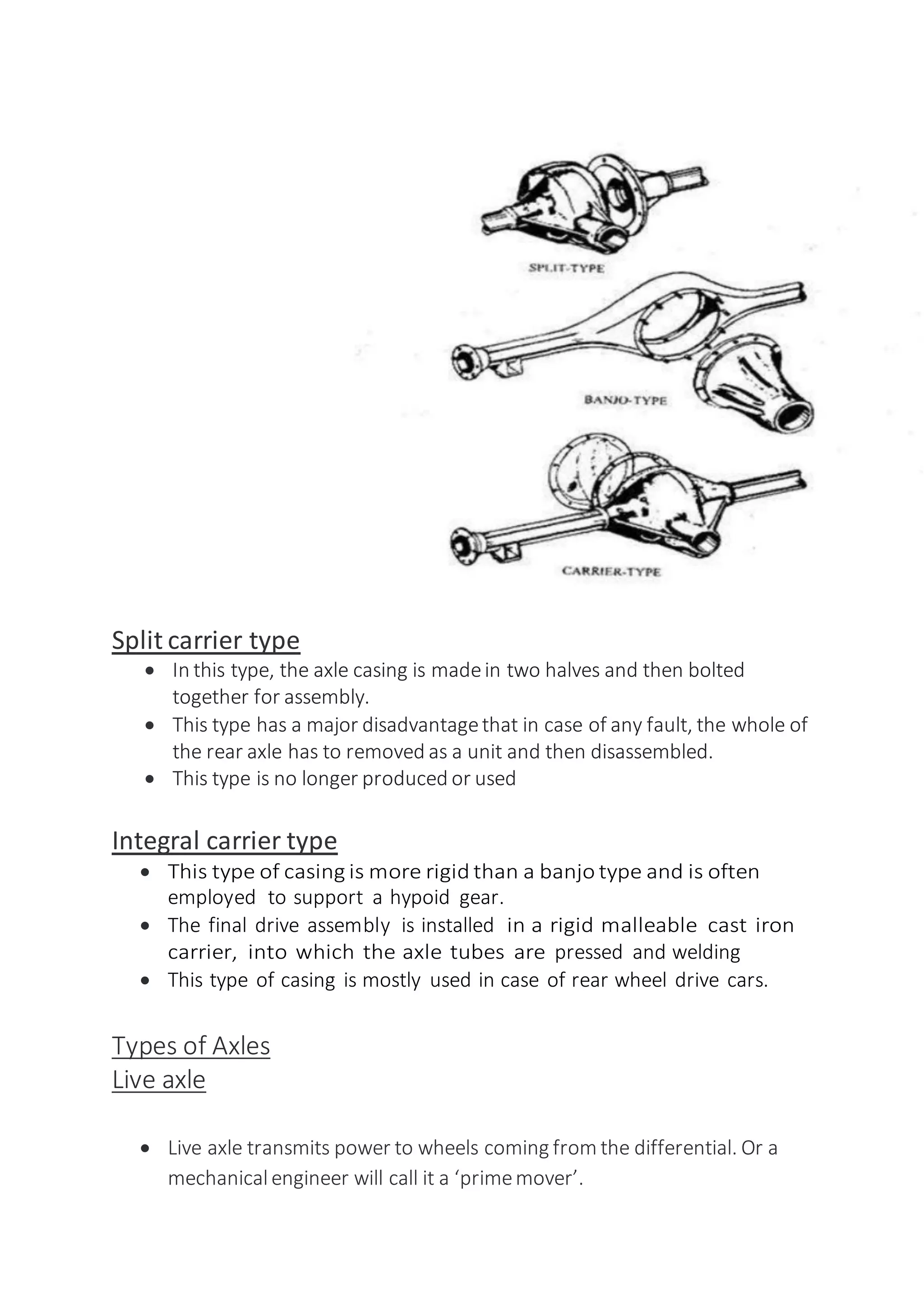
They are classified into three types namely:
1. Banjo/ separatecarrier type
2. Split carrier type
3. Integral/ Salisburycarrier type
Banjo carrier type.
 The tubular axle section of this casing is built up of steel pressings, which
is welded together and suitably strengthened to withstand the bending
load.
 The centre of this casing with the axle tube on one side resembles a
banjo.
 The final drive assembly is mounted in detachable malleable iron housing
and is secured by a ring of bolts to the axle casing.
 The axle shaftsare slid into this assembly from the road wheel end of the
casing. On some banjo axles a domed plate is bolted to the rear face of
the casing.
 Removal of this plate provides excess to the final drive gearsand in cases
where the axle shaft is secured to the differential, this enables the axle
shaft to be unlocked from the sun gear (side gear).
Split carrier type
 In this type, the axle casing is madein two halves and then bolted
together for assembly.
 This type has a major disadvantagethat in case of any fault, the whole of
the rear axle has to removed as a unit and then disassembled.
 This type is no longer produced or used
Integral carrier type
 This type of casing is more rigid than a banjo type and is often
employed to support a hypoid gear.
 The final drive assembly is installed in a rigid malleable cast iron
carrier, into which the axle tubes are pressed and welding
 This type of casing is mostly used in case of rear wheel drive cars.
Types of Axles
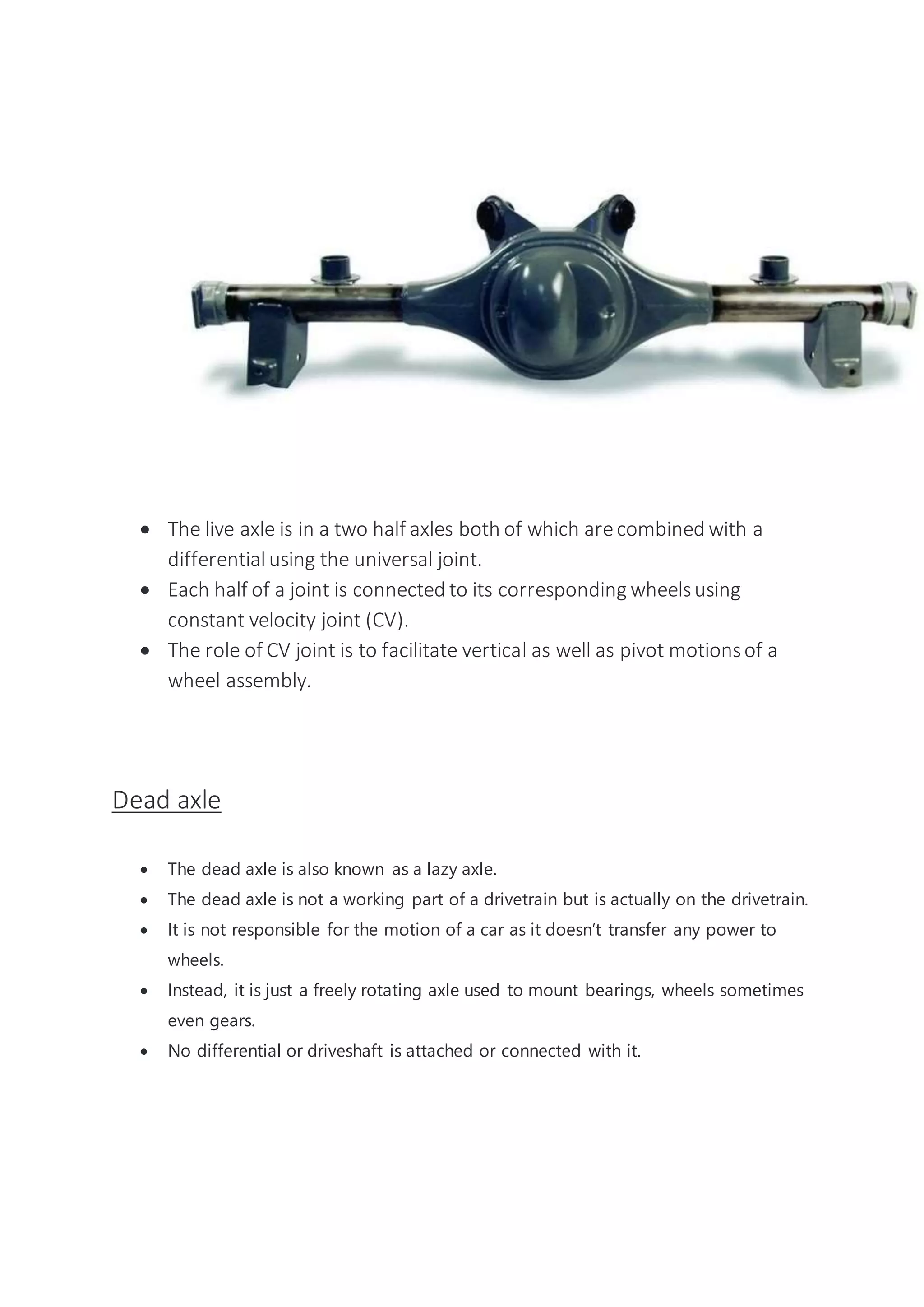
Live axle
 Live axle transmits power to wheels coming from the differential. Or a
mechanicalengineer will call it a ‘primemover’.
 The live axle is in a two half axles both of which arecombined with a
differentialusing the universal joint.
 Each half of a joint is connected to its corresponding wheelsusing
constant velocity joint (CV).
 The role of CV joint is to facilitate vertical as well as pivot motionsof a
wheel assembly.
Dead axle
 The dead axle is also known as a lazy axle.
 The dead axle is not a working part of a drivetrain but is actually on the drivetrain.
 It is not responsible for the motion of a car as it doesn’t transfer any power to
wheels.
 Instead, it is just a freely rotating axle used to mount bearings, wheels sometimes
even gears.
 No differential or driveshaft is attached or connected with it.
METHOD OF SUPPORTING AXLE
SEMI-FLOAT & FULL-FLOAT AXLE
You're probably aware that full floating axles are preferred in high torque, high load
applications as a result of their strength. The simplest manner in which to explain the full
floater's advantage is in the loads that the axle shaft must bear - a semi floating axle is
subjected to torsional and shear stress, while a full floating axle shaft is only subjected to a
torsional load. Any shear force on a full floating axle shaft can be considered negligible based
on the fact that the axle bearings and axle tubes primarily carry the weight of the vehicle and
all its cargo. With few exceptions, semi floating axles are found in light duty pickups while
majority of 3/4 ton and larger pickups come with a full floating axle. The strength of a full
floater comes at a cost, as these axles are also significantly heavier.
SEMI FLOATING AXLE
 a semi floating axle uses a wheel hub that is directly connected to the axle shaft (the
hub and axle shaft are commonly a single part), which is supported by a bearing
located near the wheel end of the axle tube.
 the weight of the vehicle and any cargo must be carried by the axle shaft itself at this
point.
 Therefore, the axle shaft is used to transmit power to the wheel as well as support the
load of the vehicle, applying a bending moment, shear force, and torsional force to
the axle shaft.
 Semi floating axles are both lighter in weight and cheaper to manufacture than full
floating axles, though they have a limited load capacity.
 They are the axle of choice in light duty vehicles, including midsize and 1/2 ton pickup
trucks.
THREE QUARTER FLOATING AXLE
Three-Quarter Floating Axle
This type of axle has a bearing placed between the hub and the axle casing. Thus,
the weightof the vehicle is transferredto the axlecasing, and onlythe side thrust
and driving torquearetaken by theaxle. The axleis keyed rigidlyto the hub, thus
proving the driving connection and maintaining the alignment of the wheel. The
inner end of this axle hasthe same construction as that of the semi-floating axle.
Although the three-quarter floating axle is more reliable it is not as simple as the
semi-floating axle.
FULL FLOATING AXLE
 consists of a wheel hub assemble that is separate from the axle shaft.
 A spindle bolted to the axle tube supports the wheel hub by means of a pair of wheel
bearings.
 The weight of the vehicle and its cargo is transfered to the axle tube, rather than the
axle shaft itself.
 A full floating axle shaft is not subjected to the bending moment or shear force that a
semi floating axle is.
 Rather, the axle shaft's only task is to transmit power to the wheel hub.
 As a result, the shaft is only subjected to torsional loads (for all intents and purposes).
 Full floating axles are rather heavy, but have very large weight carrying capacities.
 They are common on 3/4 ton and heavier trucks, which require the ability to
transport considerable weight.
 To increase the capacity of a semi floating axle, the axle shaft diameter would have to
be increased, where as the spindle and wheel hub design determine, for the most
part, the carrying capacity of a full floating axle. The diagram below provides a rough
comparison between semi and full floating axles.
S
SSSSSSSSSSSSSSSSSSSS
s
S

Differentials and axles

  • 1.
    DIFFERENTIALS (FINAL DRIVE) FinalDrive  A finaldrive is that partof a power transmission system between the drive shaft and the differential.  Its function is to changethe direction of the power transmitted by the drive shaft through 90 degreesto the driving axles.  At the same time. it provides a fixed reduction between the speed of the drive shaft and the axle driving the wheels. The reduction or gear ratio of the final drive  This is determined by dividing the number of teeth on the ring gear by the number of teeth on the pinion gear.  In passenger vehicles, this speed reduction varies from about 3: 1 to 5: 1. In trucks it varies from about5: 1 to 11: 1.  To calculate rear axle ratio, countthe number of teeth on each gear. Then divide the number of pinion teeth into the number of ring gear teeth.  For example, if the pinion gear has 10 teeth and the ring gear has 30 (30 divided by 10), the rear axle ratio would be 3: 1.  This means that the pinion rotates three times for one revolution of the ring gear. The higher axle ratio, 4.11: 1 for instance, would increase acceleration and pulling power but would decrease fuel economy. The engine would have to run at a higher rpm to maintain an equal cruising speed. The lower axle ratio. 3: 1, would reduceacceleration and pulling power but would increasefuel mileage. The engine would run at a lower rpm while maintaining the same speed. TYPES OF GEARS USED IN DIFFERENTIAL UNIT 1. Spiral bevel gears  This gears have curved gear teeth with the pinion and ring gear on the same center-line.
  • 2.
     This typeof final drive is used extensively in truck and occasionally in older automobiles.  This design allows for constant contact between the ring gear and pinion.  It also necessitates the use of heavy grade lubricants. 2. Hypoid Gear  The hypoid gear final drive is an improvementor variation of the spiral bevel design and is commonly used in light and medium trucks and all domestic rear-wheeldrive automobiles.  The pinion sits offset lowered, from the centreline of the ring gear  Improved gear mesh because of larger gear tooth contactarea  Improved gear life and less noise during operation  Hypoid gears have replaced spiral bevel gearsbecause they lower the hump in the floor of the vehicle and improvegear-meshing action. Figure5-13, thepinion meshes with the ring gear below the centreline and is at a slight angle (less than 90 degrees). This angle and the use of heavier (larger) teeth permitan increased amountof power to be transmitted while the size of the ring gear and housing remain constant.
  • 3.
    Figure5-13.- Typesof final drivesgears DIFFERENTIAL The differential isa device that splits the engine torquetwo ways, allowing each outputto spin at a differentspeed. The differential has the following functions:  It allows wheels to rotate at different speeds when turning  Splits the amount of torque going to each wheel  Provides a final gear reduction  Transfers power from half-shafts to the wheels PARTS OF THE DIFF AND THEIR FUNCTIONS
  • 4.
    POWERFLOW OF ADIFFERENTIAL TYPES OF DIFFERENTIALS OPEN DIFFERENTIAL  An open differentialis the most common type of differential found in passenger carsand truckstoday.
  • 5.
     It isa very simple (cheap) design that uses 4 gears (sometimes 6), that are referred to as spider gears, to drive the axle shafts but also allow them to rotate at differentspeeds if necessary.  There are two differenttypes of gears on the diff, pinion gears/ spider gears and the axle side gears.  The differentialcage (nothousing) receives rotational torquethrough the ring gear and uses it to drive the differential pin.  The differentialpinion gears ride on this pin/shaft and are driven by it.  Rotationaltorque is then transferred to the axle side gears and out through the cv shafts/axle shafts to the wheels.  If the vehicle is travelling in a straightline, there is no differential action and the differentialpinion gears will simply drive the axle side gears.  If the vehicle enters a turn, the outer wheel must rotatefaster than the inside wheel.  The differentialpinion gears will start to rotate as they drive the axle side gears, allowing the outer wheel to speed up and the inside wheel to slow down.  This design works well as long as both of the driven wheels have traction. If one wheel does not have enough traction, rotational torquewill follow the path of least resistance and the wheel with little traction will spin while the wheel with traction will notrotate at all. Since the wheel with traction is not rotating, the vehicle cannotmove.
  • 6.
    LIMITED SLIP DIFFERENTIALS Limited slip differentialstransmitequal torqueto both wheels when driving straight. However, when onewheel spins due to loss of traction the unit automatically providesmore power to the wheel that has traction.  Highly effective for daily driving and works well in rain, mud and snow.  However, in situations where absolute lockup is needed, a limited slip is not the best choice dueto the factthat limited slips do slip in some situations.  An example of it slipping would be with one tire in the air.  This does not provide enough resistance and the differential acts like it's open or standard counterpart. Limited slips generally area driven by a series of clutch disc located behind the side gears. The differentdisc are held under tension with springs. As the slip increases the tension increases between the differentlayers of disc and provides resistance to limit the slip between the wheels. A drawback to this is that they need to be rebuilt as they do wear and their effectiveness diminishes over time. A special additive is also needed for the differential fluid to enable
  • 7.
    the clutches toworkproperlyand to keep them from chattering during normal turns. LOCKING DIFFERENTIAL  A locking differentialhasthe ability to “lock” if the driver or conditions demand it.  When the differentialis locked, there is no differential action and both drive wheels must turn at the same speed as the case.  Somesystems will allow the driver to manually lock or unlock the differential. Other systems mechanicallymonitor the differencein axle speed and will lock the differential when one axle/wheel starts to rotate a set percentagefaster than the other. A locking differential is designed to overcome the chief limitation of a standard open differentialby essentially "locking" both wheels on an axle together as if on a common shaft. This forcesboth wheels to turn in unison, regardlessof the traction available to either wheel individually. When the differentialis unlocked (open differential), it allows each wheel to rotate at differentspeeds (such as when negotiating a turn), thus avoiding tire scuffing. An open (or unlocked) differential always provides the same torque (rotationalforce) to each of the two wheels, on that axle. So although the
  • 8.
    wheels can rotateat differentspeeds, they apply the same rotational force, even if oneis entirely stationary, and the other spinning. (equal torque, unequal rotationalspeed). By contrast, a locked differentialforcesboth left and rightwheels on the same axle to rotate at the same speed under nearly all circumstances, without regard to tractionaldifferencesseen at either wheel. Therefore, each wheel can apply as much rotationalforceas the traction under it will allow, and the torqueson each side-shaft will be unequal. (unequal torque, equal rotational speeds). Exceptions apply to automatic lockers, discussed below. A locked differentialcan providea significanttraction advantageover an open differential. ADVANTAGES AND DISADVANTAGES OF VARIOUS DIFFERENTIALS open differential  allows the drive wheels to rotate at differentials speeds so that  power is transferred to the wheel with least resistance
  • 9.
    the vehicle can turncorners effectively  it makes turning safe and wear- free  it is simple and cheap to manufacture and also reliable which can cause the vehicle to stuck in mud sand or gravel limited slip differential  ensures both wheels receive the same amount of torque  expensive to manufacture  it is reactive, which means it only begins to lock up after wheel slip has occurred locking differential  it is effective in mud, sand and snow as it ensures that torque continues to flow to the wheel with higher traction  behaves like an open diff when not locked which means that power is transferred to the wheel with least traction  difficult to turn on high grip surfaces  responsible for high tyre wear
  • 10.
    DIFFERENTIAL MEASUREMENTSAND ADJUSTMENTS Severalmeasurements and adjustments are made when assembling a differential. when "setting up" (measuring and adjusting) a differential. correct bearing preloads and gear clearances are extremely critical. the most important differential measurements and adjustments (fig. 5-19) include the following: 1. pinion gear depth 2. pinion bearing preload 3. case bearing preload 4. ring gear runout 5. ring and pinion backlash 6. ring and pinion contact pattern PINION GEAR DEPTH  the pinion gear depth refers to the distance the pinion gear extends into the carrier.  pinion depth affects where the pinion gear teeth meshes with the ring gear teeth.  pinion gear depth is commonly adjusted by varying shim thickness on the pinion gear and bearing assembly. PINION BEARING PRELOAD  the pinion bearing preload is frequently adjusted by tightening the pinion nut to compress a collapsible spacer.  the more the pinion nut is torqued, the more the spacer will compress to increase the preload or tightness of the bearings.  with a collapsible spacer, only tighten the pinion nut in small increments. then measure the pinion preload by turning the pinion nut with an inch-pound torque wrench.
  • 11.
     a solidspacer and pinion nut are used, shims control pinion bearing preload. the pinion nut is torqued to a specific value found in the service manual.  to set pinion bearing preload, use a holding tool to keep the pinion gear stationary. then a breaker bar or torque wrench can be used to tighten the pinion nut. CASE BEARING PRELOAD  the case bearing preload is the amount of force pushing the differential case bearings together.  as with pinion bearing preload, it is critical. if preload is too low (bearings too loose), differential case movement and ring and pinion gear noise can result. if preload is too high (bearings too tight), bearing overheating and failure can result.  when adjusting nuts are used, the nuts are typically tightened until all of the play is out of the bearings.  then each nut is tightened a specific portion of a turn to preload the bearings. this is done when adjusting backlash. when shims are used, a feeler gauge is used to check side clearance between the case bearing and the carrier. this action will let you calculate the correct shim thickness to preload the case bearings. refer to the service manual for special equipment and procedures. RING GEAR RUNOUT  the ring gear runout is the amount of wobble or side-to-side movement produced when the ring gear is rotated.  ring gear runout must not be beyond the manufacturer's specifications.  to measure ring gear runout, mount a dial indicator against the back of the ring gear (fig. 5-20).  the indicator stem should be perpendicular to the ring gear surface.  then turn the ring gear and note the indicator reading.
  • 12.
     if thering gear is within specifications, locate a position on the ring gear that indicates one half of the maximum runout on the gauge.  mark the gear at that point. then rotate the ring gear until the teeth on the opposite side of the gear from the mark are in mesh with the pinion gear. if ring gear runout is excessive, check the ring gear mounting and differential case runout. if not a mounting problem, replace either the ring gear and pinion or the case as needed RING AND PINION BACKLASH  the ring and pinion backlash refers to the amount of space between the meshing teeth of the gears.  backlash is needed to allow for heat expansion  as the gears operate, they produce friction and heat. this makes the gears expand, reducing the clearance between the meshing teeth of the gears.  without backlash, the ring and pinion teeth can jam into each other and fail in a very short period of time. however, too much ring and pinion backlash can cause gear noise (whirring, roaring, or clunking).  to measure ring and pinion backlash, position a dial indicator stem on one of the ring gear teeth.  then, while holding the pinion gear stationary, wiggle the ring gear back and forth.  indicator needle movement will equal gear backlash. compare your measurements to the manufacturer's specifications and adjust as needed. backlash adjustment can be made by adjusting nuts or by moving shims from one side to the other. to increase backlash, move the ring gear away from the pinion gear. to decrease backlash, move the ring gear towards the pinion gear.
  • 13.
    RING AND PINIONTOOTH CONTACT PATTERN  the ring and pinion tooth contact pattern is used to double- check ring and pinion adjustment.  to check the accuracy of your adjustments, coat the ring gear teeth with a thin coat of red lead, white grease, hydrated ferric oxide (yellow oxide or iron), or engineer’s blue.  turn the ring gear one way and then the other to rub the teeth together, producing a contact pattern on the teeth. carefully note the contact pattern that shows up on the teeth where the substance used has been wiped off.  a good contact pattern is one located in the centre of the gear teeth Toe (narrow part of the gear tooth) Heel (wide part of the gear tooth) Drive side (convex side of the gear tooth) Coast side (concave side of the gear tooth) When used gears are adjusted properly, the contact pattern will vary from that of new gears. the important thing to keep in mind with used gears is that the pattern should be closer to the toe than the heel of the tooth. Once you have obtained the proper adjustment on the ring and pinion, bolt the carrier housing in place. make sure you use a new gasket. tighten the bolts according to the manufacturer's specifications to prevent them from working loose. reinstall the axle shafts and new gaskets. reconnect the drive shaft and fill the axle housing with the proper lubricant. AXLES REAR AXLE AND FRONT AXLE
  • 14.
    The rear axleis a part of the power train consisting of two half shafts that form the driving axle in most vehicles. The major parts of the rear-axle assembly are:  Differentialassembly  Rear-axlehousing  Drive axles  Bearings  Seals Construction Design of the axle They are classified into three types namely: 1. Banjo/ separatecarrier type 2. Split carrier type 3. Integral/ Salisburycarrier type Banjo carrier type.  The tubular axle section of this casing is built up of steel pressings, which is welded together and suitably strengthened to withstand the bending load.  The centre of this casing with the axle tube on one side resembles a banjo.  The final drive assembly is mounted in detachable malleable iron housing and is secured by a ring of bolts to the axle casing.  The axle shaftsare slid into this assembly from the road wheel end of the casing. On some banjo axles a domed plate is bolted to the rear face of the casing.  Removal of this plate provides excess to the final drive gearsand in cases where the axle shaft is secured to the differential, this enables the axle shaft to be unlocked from the sun gear (side gear).
  • 15.
    Split carrier type In this type, the axle casing is madein two halves and then bolted together for assembly.  This type has a major disadvantagethat in case of any fault, the whole of the rear axle has to removed as a unit and then disassembled.  This type is no longer produced or used Integral carrier type  This type of casing is more rigid than a banjo type and is often employed to support a hypoid gear.  The final drive assembly is installed in a rigid malleable cast iron carrier, into which the axle tubes are pressed and welding  This type of casing is mostly used in case of rear wheel drive cars. Types of Axles Live axle  Live axle transmits power to wheels coming from the differential. Or a mechanicalengineer will call it a ‘primemover’.
  • 16.
     The liveaxle is in a two half axles both of which arecombined with a differentialusing the universal joint.  Each half of a joint is connected to its corresponding wheelsusing constant velocity joint (CV).  The role of CV joint is to facilitate vertical as well as pivot motionsof a wheel assembly. Dead axle  The dead axle is also known as a lazy axle.  The dead axle is not a working part of a drivetrain but is actually on the drivetrain.  It is not responsible for the motion of a car as it doesn’t transfer any power to wheels.  Instead, it is just a freely rotating axle used to mount bearings, wheels sometimes even gears.  No differential or driveshaft is attached or connected with it.
  • 17.
    METHOD OF SUPPORTINGAXLE SEMI-FLOAT & FULL-FLOAT AXLE You're probably aware that full floating axles are preferred in high torque, high load applications as a result of their strength. The simplest manner in which to explain the full floater's advantage is in the loads that the axle shaft must bear - a semi floating axle is subjected to torsional and shear stress, while a full floating axle shaft is only subjected to a torsional load. Any shear force on a full floating axle shaft can be considered negligible based on the fact that the axle bearings and axle tubes primarily carry the weight of the vehicle and all its cargo. With few exceptions, semi floating axles are found in light duty pickups while majority of 3/4 ton and larger pickups come with a full floating axle. The strength of a full floater comes at a cost, as these axles are also significantly heavier. SEMI FLOATING AXLE  a semi floating axle uses a wheel hub that is directly connected to the axle shaft (the hub and axle shaft are commonly a single part), which is supported by a bearing located near the wheel end of the axle tube.  the weight of the vehicle and any cargo must be carried by the axle shaft itself at this point.  Therefore, the axle shaft is used to transmit power to the wheel as well as support the load of the vehicle, applying a bending moment, shear force, and torsional force to the axle shaft.  Semi floating axles are both lighter in weight and cheaper to manufacture than full floating axles, though they have a limited load capacity.  They are the axle of choice in light duty vehicles, including midsize and 1/2 ton pickup trucks.
  • 18.
    THREE QUARTER FLOATINGAXLE Three-Quarter Floating Axle This type of axle has a bearing placed between the hub and the axle casing. Thus, the weightof the vehicle is transferredto the axlecasing, and onlythe side thrust and driving torquearetaken by theaxle. The axleis keyed rigidlyto the hub, thus proving the driving connection and maintaining the alignment of the wheel. The inner end of this axle hasthe same construction as that of the semi-floating axle. Although the three-quarter floating axle is more reliable it is not as simple as the semi-floating axle. FULL FLOATING AXLE
  • 19.
     consists ofa wheel hub assemble that is separate from the axle shaft.  A spindle bolted to the axle tube supports the wheel hub by means of a pair of wheel bearings.  The weight of the vehicle and its cargo is transfered to the axle tube, rather than the axle shaft itself.  A full floating axle shaft is not subjected to the bending moment or shear force that a semi floating axle is.  Rather, the axle shaft's only task is to transmit power to the wheel hub.  As a result, the shaft is only subjected to torsional loads (for all intents and purposes).  Full floating axles are rather heavy, but have very large weight carrying capacities.  They are common on 3/4 ton and heavier trucks, which require the ability to transport considerable weight.  To increase the capacity of a semi floating axle, the axle shaft diameter would have to be increased, where as the spindle and wheel hub design determine, for the most part, the carrying capacity of a full floating axle. The diagram below provides a rough comparison between semi and full floating axles. S SSSSSSSSSSSSSSSSSSSS s
  • 20.