INTRODUTION TO DIFFERETIAL
PURPOSE AND FUNTION
 Differential is mechanism used to transfer power
between transmission and final drive. Differentials
perform two basic functions:
 –They turn the drive coming from transmission 90
degrees to the drive axles.
–They allow the drive axles to turn at different speeds
when cornering.
 When wheeled machine moving straight ahead, both
wheels free to rotate. Engine power applied to
differential, each drive axle receives same amount
power. Each driving wheel travels same distance at
same speed.
 When machine needs to turn, the outer wheel must
travel farther and faster than inner wheel. If machine
didn’t have differential that allows wheels to rotate at
different speeds, wheels would skid when machine was
turned. If machine had no differentials, would be very
OPERATION
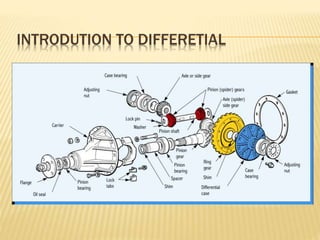
 Consider typical differential seen on wheeled machine such as
garden tractor. Differential case contains two side gears and
two pinion gears. The two drive axles connected to the side
gears; the two pinion gears connected together by a small shaft
that runs through differential case. Pinion gears and their shaft
rotate together as one. Two side gears are in constant mesh
with the pinion gears.
 Some differentials driven by drive shaft. Many differentials
driven instead by chains or belts. A ring gear is bolted to
differential case, and a drive pinion gear on drive shaft meshes
with the ring gear. When drive shaft rotates, its drive pinion
gear causes the ring gear to turn. Because ring gear is bolted to
the differential case, the ring gear and differential case rotate
together as unit.
OPERATION
 When differential case rotates, the pinion gears inside
case are carried around in circle with case. At same time,
because pinion gears meshed with the side gears and
axles, the side gears and axles also forced to rotate.
 When machine driving in straight line, both axles (and
thus, both drive wheels) rotate at same speed. When a
corner is turned, the inside wheel travels shorter distance
than outside wheel, so inside wheel must turn slower
than outside wheel. As result, side gear on inside axle
turns slower than the side gear on outside axle. When
this occurs, pinion gears inside differential case “walk”
forward on the inside side gear, and simultaneously
drive the outside gear at faster speed. Thus, speed
removed from inside axle, transferred to the outside
axle, with both axles using same amount power.
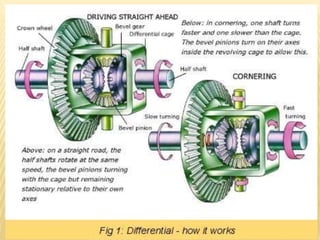
• The drive pinion drives the ring gear which is attached to the
differential case
• When going straight ahead:
– The differential housing and its components rotate as an
assembly
– Power is transferred equally to both wheel
• When turning a corner:
– The wheels must travel at different speeds to prevent tire
scrubbing
– Differential pinion gears “walk” around slower side gear and
cause other side gear to turn faster
– The percentage of speed that is removed from one wheel is
given to the other .
FAULTS/CAUSES/REMEDYS
Faults and Causes
1. Worn gears or bearings
and pinion and crown
wheel mesh too close –
WHINE OR HUM ON
DRIVE
2. Worn differential –
NOISY WHEN
CORNERING
3. Excessive backlash
and worn gears –HUM
OR WHINE ON
Remedy
1. Replace : Adjust them.
2. Renew the system by
changing the gears
3. Replace : Adjust them.
TERMS
 Hum means To make a low continuous
sound
 Whine means Move with a whining sound or
Make a high-pitched, screeching noise.
 Backlash means to moved back from an
impact. When the pinion move back from the
crown wheel or a gear move out of mesh.
 Mesh means Contact by fitting together or
The act of interlocking or meshing.
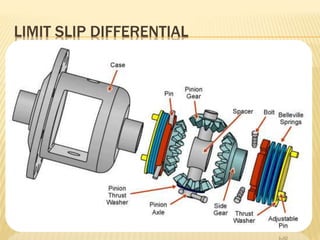
LIMIT SLIP DIFFERENTIAL
 There are several different designs currently in use today.
Some work better than others depending on the application.
 Clutch pack type
 – It uses two sets of clutches, each consisting of steel plates
and friction plates
 – The steel plates are splined to the differential case and the
friction plates are splined to the side gears
 – During cornering, the plates slip, allowing the wheels to
turn at different speeds
 • Cone-type
 – It uses two cone clutches with one cone that has frictional
material on its outer surface and the other with a grooved
surface on the inside
 – Cones allow wheels to turn at different speeds during
cornering, while providing torque to both wheels during
straight-ahead driving
TYPE OF LIMIT SLIP DIFFERENTIAL
Viscous clutch-type
– It uses steel and frictional clutch plates that rely on
the resistance of high-viscosity silicone fluid for
application
– A difference in rotational speed causes the fluid to
shear and allows one wheel to turn at a different
speed than the other one
PURPOSE AND FUNCTIONS
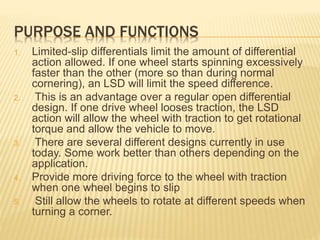
1. Limited-slip differentials limit the amount of differential
action allowed. If one wheel starts spinning excessively
faster than the other (more so than during normal
cornering), an LSD will limit the speed difference.
2. This is an advantage over a regular open differential
design. If one drive wheel looses traction, the LSD
action will allow the wheel with traction to get rotational
torque and allow the vehicle to move.
3. There are several different designs currently in use
today. Some work better than others depending on the
application.
4. Provide more driving force to the wheel with traction
when one wheel begins to slip
5. Still allow the wheels to rotate at different speeds when
turning a corner.
OPERATION OF THE LIMIT SLIP DIFFERENTIAL
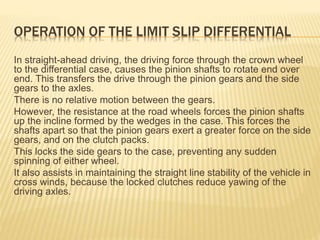
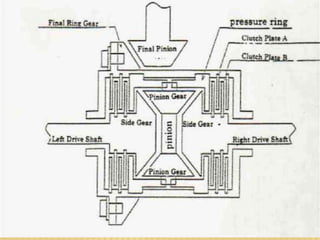
In straight-ahead driving, the driving force through the crown wheel
to the differential case, causes the pinion shafts to rotate end over
end. This transfers the drive through the pinion gears and the side
gears to the axles.
There is no relative motion between the gears.
However, the resistance at the road wheels forces the pinion shafts
up the incline formed by the wedges in the case. This forces the
shafts apart so that the pinion gears exert a greater force on the side
gears, and on the clutch packs.
This locks the side gears to the case, preventing any sudden
spinning of either wheel.
It also assists in maintaining the straight line stability of the vehicle in
cross winds, because the locked clutches reduce yawing of the
driving axles.
OPERATION OF THE LIMIT SLIP DIFFERENTIAL
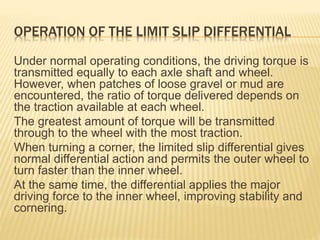
Under normal operating conditions, the driving torque is
transmitted equally to each axle shaft and wheel.
However, when patches of loose gravel or mud are
encountered, the ratio of torque delivered depends on
the traction available at each wheel.
The greatest amount of torque will be transmitted
through to the wheel with the most traction.
When turning a corner, the limited slip differential gives
normal differential action and permits the outer wheel to
turn faster than the inner wheel.
At the same time, the differential applies the major
driving force to the inner wheel, improving stability and
cornering.
GROUP IVB NAMES
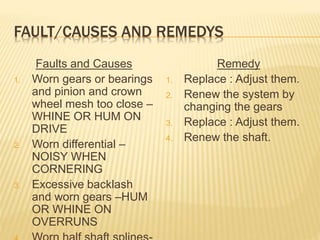
FAULT/CAUSES AND REMEDYS
Faults and Causes
1. Worn gears or bearings
and pinion and crown
wheel mesh too close –
WHINE OR HUM ON
DRIVE
2. Worn differential –
NOISY WHEN
CORNERING
3. Excessive backlash
and worn gears –HUM
OR WHINE ON
OVERRUNS
Remedy
1. Replace : Adjust them.
2. Renew the system by
changing the gears
3. Replace : Adjust them.
4. Renew the shaft.
Differentail

Differentail

  • 2.
  • 3.
    PURPOSE AND FUNTION Differential is mechanism used to transfer power between transmission and final drive. Differentials perform two basic functions:  –They turn the drive coming from transmission 90 degrees to the drive axles. –They allow the drive axles to turn at different speeds when cornering.  When wheeled machine moving straight ahead, both wheels free to rotate. Engine power applied to differential, each drive axle receives same amount power. Each driving wheel travels same distance at same speed.  When machine needs to turn, the outer wheel must travel farther and faster than inner wheel. If machine didn’t have differential that allows wheels to rotate at different speeds, wheels would skid when machine was turned. If machine had no differentials, would be very
  • 4.
    OPERATION  Consider typicaldifferential seen on wheeled machine such as garden tractor. Differential case contains two side gears and two pinion gears. The two drive axles connected to the side gears; the two pinion gears connected together by a small shaft that runs through differential case. Pinion gears and their shaft rotate together as one. Two side gears are in constant mesh with the pinion gears.  Some differentials driven by drive shaft. Many differentials driven instead by chains or belts. A ring gear is bolted to differential case, and a drive pinion gear on drive shaft meshes with the ring gear. When drive shaft rotates, its drive pinion gear causes the ring gear to turn. Because ring gear is bolted to the differential case, the ring gear and differential case rotate together as unit.
  • 5.
    OPERATION  When differentialcase rotates, the pinion gears inside case are carried around in circle with case. At same time, because pinion gears meshed with the side gears and axles, the side gears and axles also forced to rotate.  When machine driving in straight line, both axles (and thus, both drive wheels) rotate at same speed. When a corner is turned, the inside wheel travels shorter distance than outside wheel, so inside wheel must turn slower than outside wheel. As result, side gear on inside axle turns slower than the side gear on outside axle. When this occurs, pinion gears inside differential case “walk” forward on the inside side gear, and simultaneously drive the outside gear at faster speed. Thus, speed removed from inside axle, transferred to the outside axle, with both axles using same amount power.
  • 6.
    • The drivepinion drives the ring gear which is attached to the differential case • When going straight ahead: – The differential housing and its components rotate as an assembly – Power is transferred equally to both wheel • When turning a corner: – The wheels must travel at different speeds to prevent tire scrubbing – Differential pinion gears “walk” around slower side gear and cause other side gear to turn faster – The percentage of speed that is removed from one wheel is given to the other .
  • 8.
    FAULTS/CAUSES/REMEDYS Faults and Causes 1.Worn gears or bearings and pinion and crown wheel mesh too close – WHINE OR HUM ON DRIVE 2. Worn differential – NOISY WHEN CORNERING 3. Excessive backlash and worn gears –HUM OR WHINE ON Remedy 1. Replace : Adjust them. 2. Renew the system by changing the gears 3. Replace : Adjust them.
  • 9.
    TERMS  Hum meansTo make a low continuous sound  Whine means Move with a whining sound or Make a high-pitched, screeching noise.  Backlash means to moved back from an impact. When the pinion move back from the crown wheel or a gear move out of mesh.  Mesh means Contact by fitting together or The act of interlocking or meshing.
  • 10.
  • 11.
     There areseveral different designs currently in use today. Some work better than others depending on the application.  Clutch pack type  – It uses two sets of clutches, each consisting of steel plates and friction plates  – The steel plates are splined to the differential case and the friction plates are splined to the side gears  – During cornering, the plates slip, allowing the wheels to turn at different speeds  • Cone-type  – It uses two cone clutches with one cone that has frictional material on its outer surface and the other with a grooved surface on the inside  – Cones allow wheels to turn at different speeds during cornering, while providing torque to both wheels during straight-ahead driving
  • 12.
    TYPE OF LIMITSLIP DIFFERENTIAL Viscous clutch-type – It uses steel and frictional clutch plates that rely on the resistance of high-viscosity silicone fluid for application – A difference in rotational speed causes the fluid to shear and allows one wheel to turn at a different speed than the other one
  • 13.
    PURPOSE AND FUNCTIONS 1.Limited-slip differentials limit the amount of differential action allowed. If one wheel starts spinning excessively faster than the other (more so than during normal cornering), an LSD will limit the speed difference. 2. This is an advantage over a regular open differential design. If one drive wheel looses traction, the LSD action will allow the wheel with traction to get rotational torque and allow the vehicle to move. 3. There are several different designs currently in use today. Some work better than others depending on the application. 4. Provide more driving force to the wheel with traction when one wheel begins to slip 5. Still allow the wheels to rotate at different speeds when turning a corner.
  • 14.
    OPERATION OF THELIMIT SLIP DIFFERENTIAL In straight-ahead driving, the driving force through the crown wheel to the differential case, causes the pinion shafts to rotate end over end. This transfers the drive through the pinion gears and the side gears to the axles. There is no relative motion between the gears. However, the resistance at the road wheels forces the pinion shafts up the incline formed by the wedges in the case. This forces the shafts apart so that the pinion gears exert a greater force on the side gears, and on the clutch packs. This locks the side gears to the case, preventing any sudden spinning of either wheel. It also assists in maintaining the straight line stability of the vehicle in cross winds, because the locked clutches reduce yawing of the driving axles.
  • 15.
    OPERATION OF THELIMIT SLIP DIFFERENTIAL Under normal operating conditions, the driving torque is transmitted equally to each axle shaft and wheel. However, when patches of loose gravel or mud are encountered, the ratio of torque delivered depends on the traction available at each wheel. The greatest amount of torque will be transmitted through to the wheel with the most traction. When turning a corner, the limited slip differential gives normal differential action and permits the outer wheel to turn faster than the inner wheel. At the same time, the differential applies the major driving force to the inner wheel, improving stability and cornering.
  • 17.
  • 18.
    FAULT/CAUSES AND REMEDYS Faultsand Causes 1. Worn gears or bearings and pinion and crown wheel mesh too close – WHINE OR HUM ON DRIVE 2. Worn differential – NOISY WHEN CORNERING 3. Excessive backlash and worn gears –HUM OR WHINE ON OVERRUNS Remedy 1. Replace : Adjust them. 2. Renew the system by changing the gears 3. Replace : Adjust them. 4. Renew the shaft.

Editor's Notes

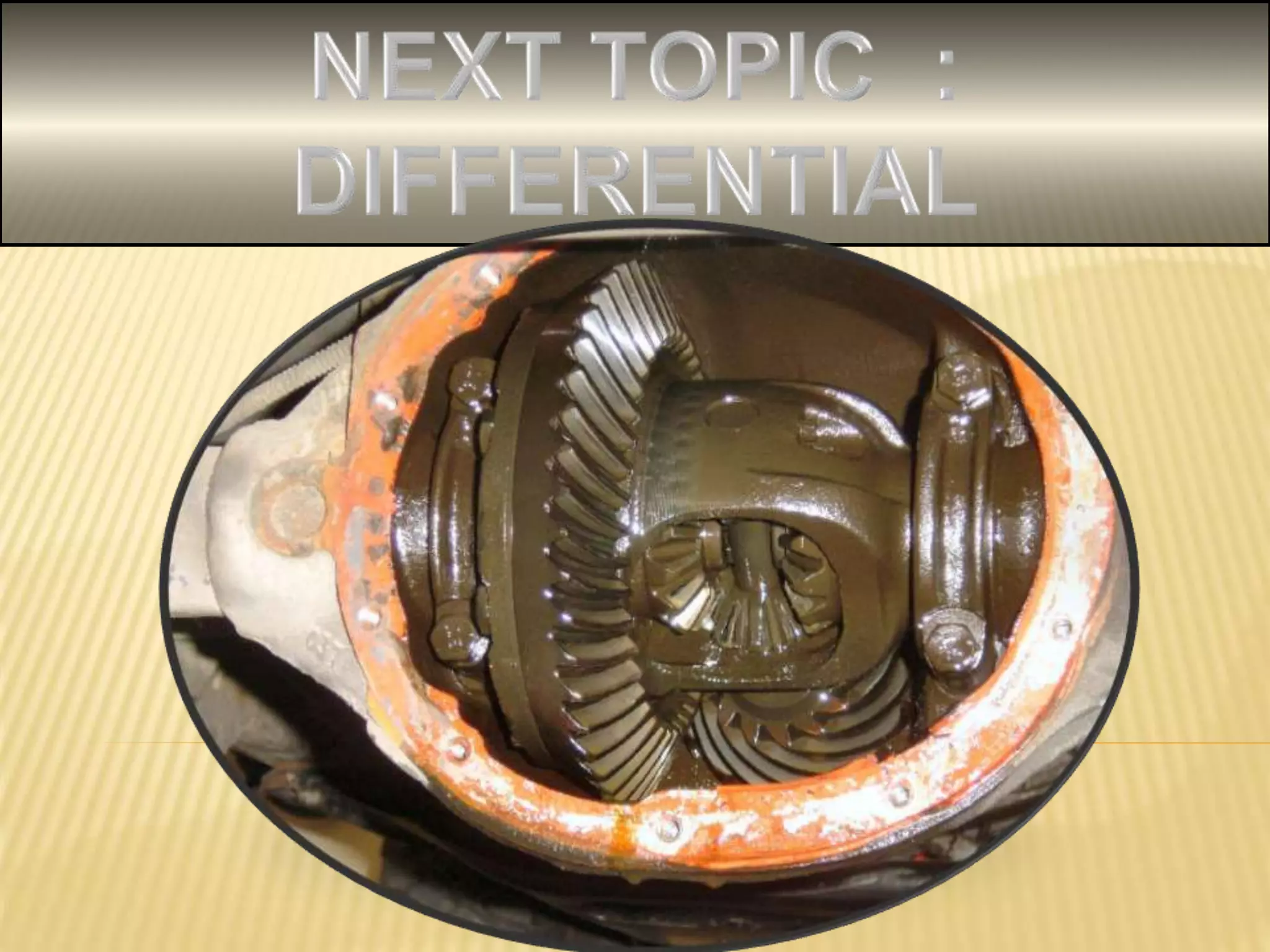
  • #2 NEXT TOPIC : DIFFERENTAIL