DEVELOPMENT AND FABRICATION OF
ELECTROMAGNETIC ENGINE
Submitted by
Avin Ganapathi
Rithin R
Srinivas Rangan L
Vinay M
1
2
A PROJECT WORK PROPOSAL ON
DEVELOPMENT AND
FABRICATION OF
ELECTROMAGNETIC ENGINE
Submitted By
AVIN GANAPATHI(4MH09ME010)
RITHIN R(4MH11ME094)
SREENIVAS RANGAN L(4MH11ME104)
VINAY M(4MH11ME118)
Under the Guidance of
Prof. B HARISH
Assistant Professor
Department of Mechanical
Engineering
MIT Mysore
DEPARTMENT OF MECHANICAL ENGINEERING
MAHARAJA INSTITUTE OF TECHNOLOGY
MYSORE - 571438
Index
1. Introduction
2. Literature survey
3. Overview
4. Components and description
5. Design Calculations
6. Fabrication and Assembly
7. Cost estimation
8. Testing
3
9. Result
10. Conclusion and Scope for future
development
References.
Fabricated model photographs
4
Introduction
• Conventional Engine Concept
An Internal Combustion is an engine where
combustion of fuel occurs with an oxidizer in
combustion chamber that is an integral part of
working fluid flow circuit.
5
Drawbacks of IC engine
• Air pollution.
• Because of high demand and decreasing
supply, the price of fuel is increasing.
• Running cost Maintenance cost is high.
• Manufacturing cost is high.
6
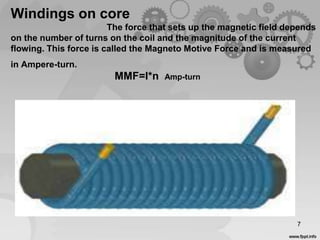
Windings on core
The force that sets up the magnetic field depends
on the number of turns on the coil and the magnitude of the current
flowing. This force is called the Magneto Motive Force and is measured
in Ampere-turn.
7
MMF=I*n Amp-turn
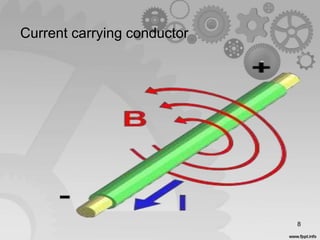
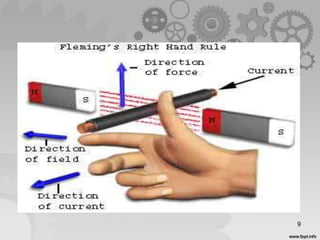
Current carrying conductor
8
9
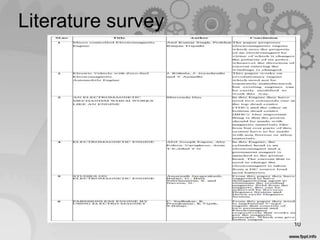
Literature survey
10
OVERVIEW
11
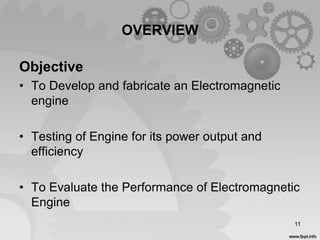
Objective
• To Develop and fabricate an Electromagnetic
engine
• Testing of Engine for its power output and
efficiency
• To Evaluate the Performance of Electromagnetic
Engine
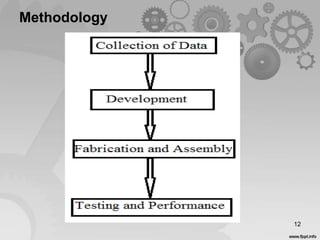
Methodology
12
COMPONENTS AND DESCRIPTION
• Cylinder
13
• Piston
14
• Connecting rod
15
• Flywheel
16
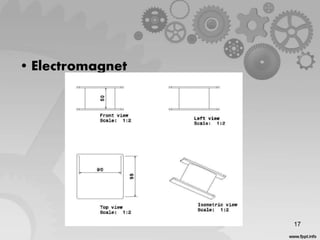
• Electromagnet
17
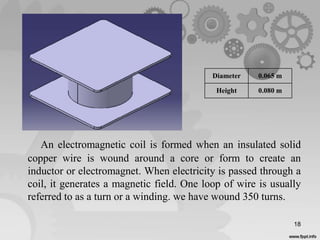
An electromagnetic coil is formed when an insulated solid
copper wire is wound around a core or form to create an
inductor or electromagnet. When electricity is passed through a
coil, it generates a magnetic field. One loop of wire is usually

referred to as a turn or a winding. we have wound 350 turns.
18
Diameter 0.065 m
Height 0.080 m
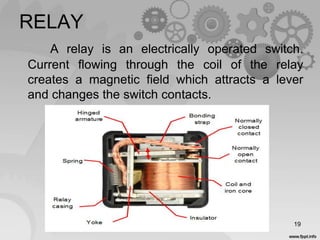
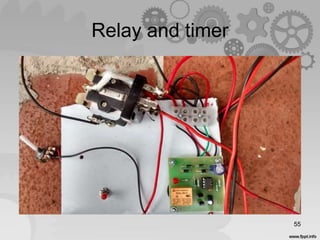
RELAY
A relay is an electrically operated switch.
Current flowing through the coil of the relay
creates a magnetic field which attracts a lever
and changes the switch contacts.
19
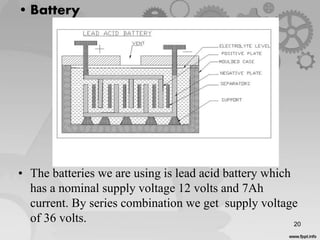
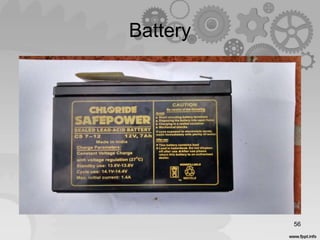
• Battery
• The batteries we are using is lead acid battery which
has a nominal supply voltage 12 volts and 7Ah
current. By series combination we get supply voltage
of 36 volts. 20
21
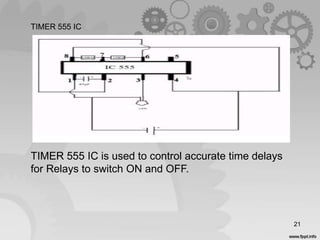
TIMER 555 IC
TIMER 555 IC is used to control accurate time delays
for Relays to switch ON and OFF.
DESIGN CALCULATION
Input voltage = 36 V
Input current = 10A
Input Power = Voltage × Current= 36 × 10 = 360W
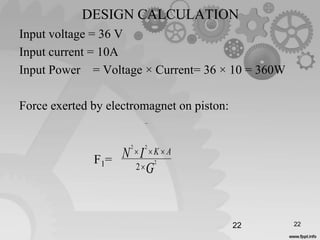
Force exerted by electromagnet on piston:
F1=
22
G
IN AK
2
22
2

22
Where, N = number of turns = 350
I = Current flowing through coil = 10 A
K = Permeability of free space = 4π×10-7
A = Cross-sectional area of electromagnet (radius
r = 0.0325m)
G = Least distance between electromagnet and
permanent magnet = 0.01m
d = diameter of electromagnet = 0.065 m
On substitution we get
Max Force F1 = 255.40 N
23
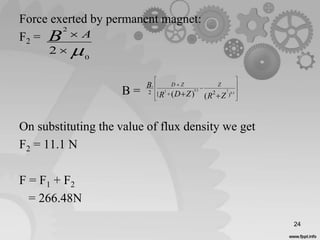
Force exerted by permanent magnet:
F2 =
B =
On substituting the value of flux density we get
F2 = 11.1 N
F = F1 + F2
= 266.48N
0
2
2 
 AB













 5.0
25.02
)2[2
()( ZRZDR
B ZZDr
24
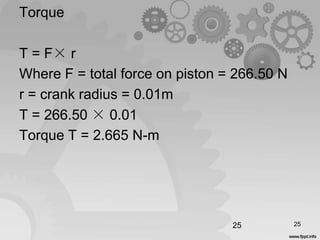
Torque
T = F× r
Where F = total force on piston = 266.50 N
r = crank radius = 0.01m
T = 266.50 × 0.01
Torque T = 2.665 N-m
25 25
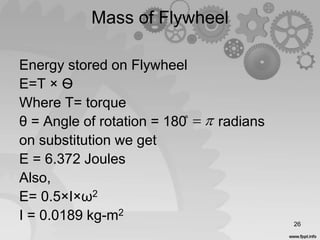
Mass of Flywheel

Energy stored on Flywheel
E=T × Ѳ
Where T= torque
θ = Angle of rotation = 180̊ radians
on substitution we get
E = 6.372 Joules
Also,
E= 0.5×I×ω2
I = 0.0189 kg-m2
26
60
2 TN
P



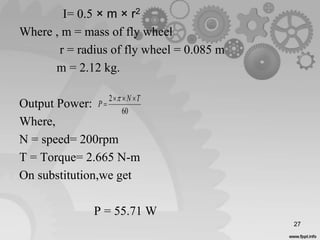
I= 0.5 × m × r2
Where , m = mass of fly wheel
r = radius of fly wheel = 0.085 m
m = 2.12 kg.
Output Power:
Where,
N = speed= 200rpm
T = Torque= 2.665 N-m
On substitution,we get
P = 55.71 W
27
100
360
81.55

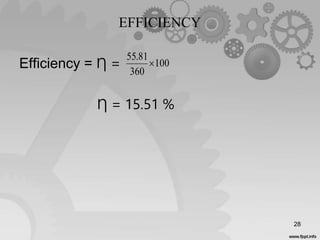
EFFICIENCY
Efficiency = Ƞ =
Ƞ = 15.51 %
28
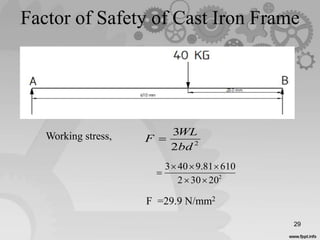
Factor of Safety of Cast Iron Frame
29
2
2
3
bd
WL
F 
2
20302
61081.9403



F =29.9 N/mm2
Working stress,
Where L = Length of the frame in mm,
W = Weight acting on the frame in Kg
b = Breadth in mm
d = Depth in mm
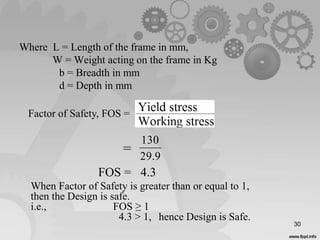
30
9.29
130
Factor of Safety, FOS =
=
FOS = 4.3
When Factor of Safety is greater than or equal to 1,
then the Design is safe.
i.e., FOS ≥ 1
4.3 > 1, hence Design is Safe.
FABRICATION AND ASSEMBLY
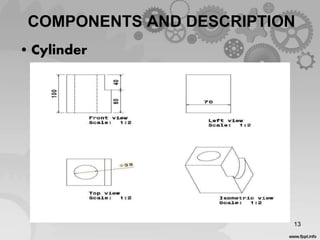
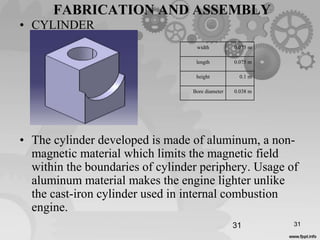
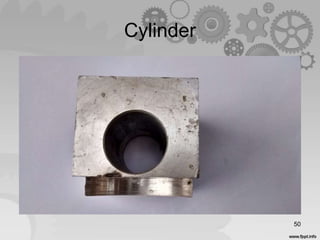
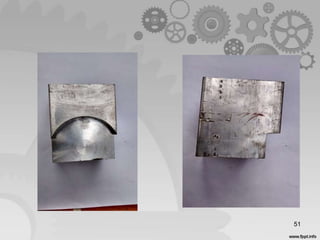
• CYLINDER
• The cylinder developed is made of aluminum, a non-
magnetic material which limits the magnetic field
within the boundaries of cylinder periphery. Usage of
aluminum material makes the engine lighter unlike
the cast-iron cylinder used in internal combustion
engine.
31
width 0.075 m
length 0.075 m
height 0.1 m
Bore diameter 0.038 m
31
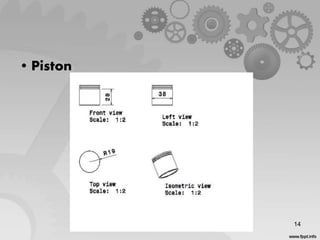
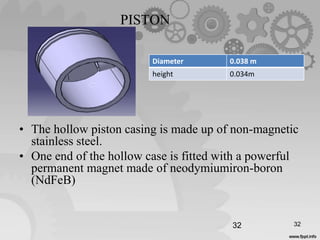
PISTON
• The hollow piston casing is made up of non-magnetic
stainless steel.
• One end of the hollow case is fitted with a powerful
permanent magnet made of neodymiumiron-boron
(NdFeB)
32
Diameter 0.038 m
height 0.034m
32
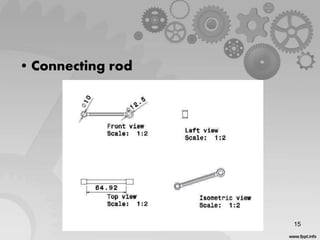
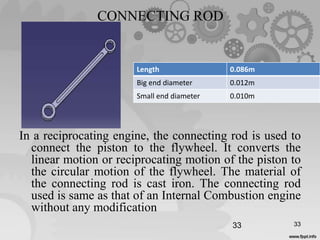
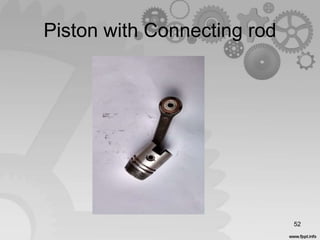
CONNECTING ROD
In a reciprocating engine, the connecting rod is used to
connect the piston to the flywheel. It converts the
linear motion or reciprocating motion of the piston to
the circular motion of the flywheel. The material of
the connecting rod is cast iron. The connecting rod
used is same as that of an Internal Combustion engine
without any modification
33
Length 0.086m
Big end diameter 0.012m
Small end diameter 0.010m
33
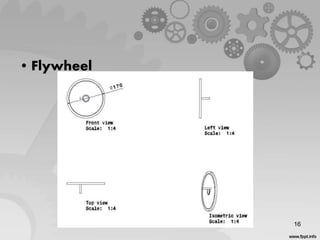
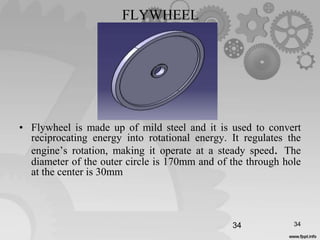
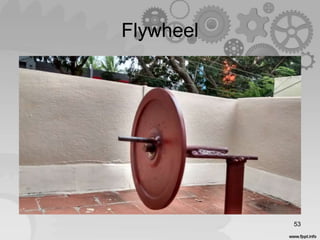
FLYWHEEL
• Flywheel is made up of mild steel and it is used to convert
reciprocating energy into rotational energy. It regulates the
engine’s rotation, making it operate at a steady speed. The
diameter of the outer circle is 170mm and of the through hole
at the center is 30mm
34 34
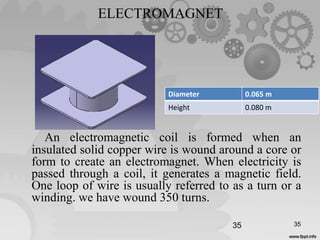
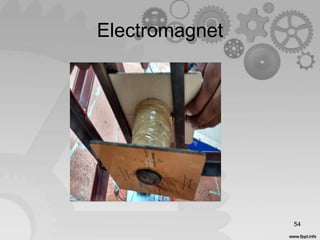
ELECTROMAGNET
An electromagnetic coil is formed when an
insulated solid copper wire is wound around a core or
form to create an electromagnet. When electricity is
passed through a coil, it generates a magnetic field.
One loop of wire is usually referred to as a turn or a
winding. we have wound 350 turns.
35
Diameter 0.065 m
Height 0.080 m
35
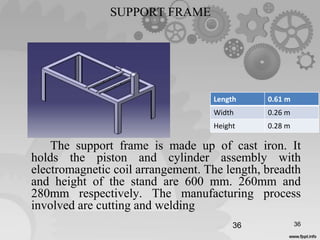
SUPPORT FRAME
The support frame is made up of cast iron. It
holds the piston and cylinder assembly with
electromagnetic coil arrangement. The length, breadth
and height of the stand are 600 mm. 260mm and
280mm respectively. The manufacturing process
involved are cutting and welding
36
Length 0.61 m
Width 0.26 m
Height 0.28 m
36
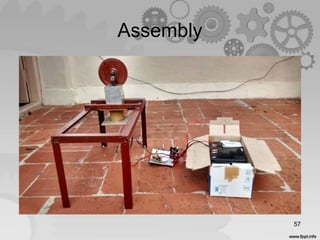
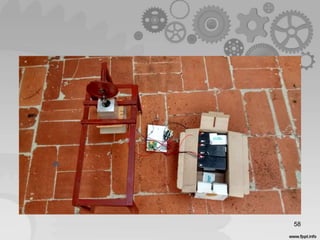
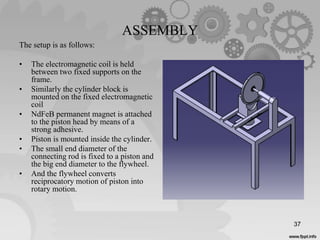
ASSEMBLY
The setup is as follows:
• The electromagnetic coil is held
between two fixed supports on the
frame.
• Similarly the cylinder block is
mounted on the fixed electromagnetic
coil
• NdFeB permanent magnet is attached
to the piston head by means of a
strong adhesive.
• Piston is mounted inside the cylinder.
• The small end diameter of the
connecting rod is fixed to a piston and
the big end diameter to the flywheel.
• And the flywheel converts
reciprocatory motion of piston into
rotary motion.
37
38
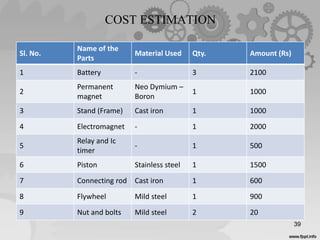
COST ESTIMATION
Sl. No.
Name of the
Parts
Material Used Qty. Amount (Rs)
1 Battery - 3 2100
2
Permanent
magnet
Neo Dymium –
Boron
1 1000
3 Stand (Frame) Cast iron 1 1000
4 Electromagnet - 1 2000
5
Relay and Ic
timer
- 1 500
6 Piston Stainless steel 1 1500
7 Connecting rod Cast iron 1 600
8 Flywheel Mild steel 1 900
9 Nut and bolts Mild steel 2 20
39
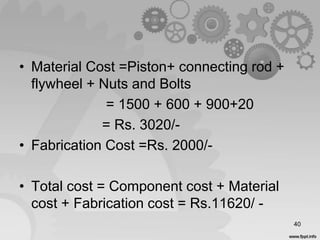
• Material Cost =Piston+ connecting rod +
flywheel + Nuts and Bolts
= 1500 + 600 + 900+20
= Rs. 3020/-
• Fabrication Cost =Rs. 2000/-
• Total cost = Component cost + Material
cost + Fabrication cost = Rs.11620/ -
40
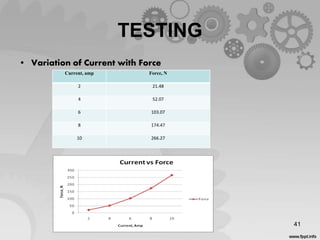
TESTING
• Variation of Current with Force
41
Current, amp Force, N
2 21.48
4 52.07
6 103.07
8 174.47
10 266.27
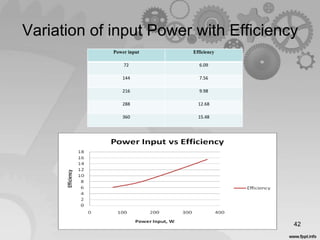
Variation of input Power with Efficiency
42
Power input Efficiency
72 6.09
144 7.56
216 9.98
288 12.68
360 15.48
RESULT
The prototype of an electromagnetic engine which works on
the principle of magnetism was successfully developed, fabricated
and tested. Result analysis was done on the prototype. The results
obtained are as follows.
• Prototype of an engine which works on the principle of magnetism
was tested successfully.
• It uses electricity as its input without fuel.
• The prototype creates no pollution and is eco-friendly.
• Only the repulsive force between the magnet and electromagnet is
used for power generation.
• Acceleration is done by controlling the timer which controls the relay.
• Maximum efficiency obtained was 15.81 %.
• Maximum output power obtained was 55.81 W .
43
CONCLUSION AND SCOPE FOR FUTURE
DEVELOPMENT
The prototype is an idea which uses the property of an
electromagnet by virtue of which it changes the polarity of its poles
whenever the direction of current is changed. This variation in polarity is
utilized to attract or repel the permanent magnet attached to the piston. The
usage of relay and timer will limit the output of the engine. By using an ECU
in the engine instead, power can be obtained on each stroke which will
result in an increased output. Also, by inserting more permanent magnets in
series on the piston will enhance the output of the engine. By slight
modification in design and by the use of better hands the engine can be
modified to generate more power, thereby increasing its efficiency, so that it
can be used in commercial vehicles and other applications.
44
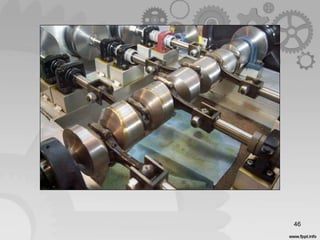
Jeff Baird-
A inventor whose creation was recently featured in Popular
Science magazine unveiled his latest invention Saturday.
Ada area resident Jeff Baird’s newest invention is an
engine that uses a technology that really isn’t new at all.
Large batteries fire the magnets and the motor acts as
an alternator that keeps the batteries charged
continuously.
The technology works like windmills except it uses
magnets instead of wind.
45
46
47
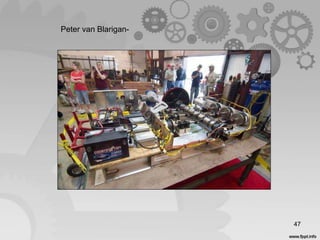
Peter van Blarigan-
References
• [1]Atulkumarsingh, PrabhatRanjanTripathi, Microcontrolled Electromagnetic Engine, 2011, International
Conference on Advances in Electrical and Electronics Engineering (ICAEE'2011)
• [2]J.Rithula,J.Jeyashruthi and Y Anandhi,Electric Vehicle with Zero-fuel ElectromagneticAutomobile
Engine,2013,1,2&3Department of Electrical & Electronics Engineering, Sri Sairam Engineering College, West
Tambaram, Chennai, India. Volume 6, Number 4 (2013), pp. 483-486
• [3]Shirsendu Das,An ELECTROMAGNETIC MECHANISM WHICH WORKS LIKE AN ENGINE, IJETT- Volume 4
Issue 6-June 2013
• [4]Abil Joseph Eapen, AbyEshowVarughese, Arun T.P,Athul T.N, 2014,
ELECTROMAGNETIC ENGINE, International Journal of Research in Engineering and Technology.
• [5]AmarnathJayaprakash, Balaji, G., Bala Subramanian, S. and Naveen, N.,STUDIES ON ELECTROMAGNETIC
ENGINE International Journal of Development Research Vol. 4, Issue, 3, pp. 519-524, March, 2014
• [6]C. Sudhakar, K. Premkumar, K.Vijith, S.Balaji,“EMISSIONLESS ENGINE BY USING ELECTRO MAGNET”,
2014
• [7]K.Mahadevan and L.Balaveera Reddy “DESIGN DATA HAND BOOK” for Mechanical Engineers, Third
Edition.
• [8]Peter van Blarigan, “ADVANCED INTERNAL COMBUSTION ENGINE RESEARCH ” Proceedings of the 2000
DOE Hydrogen Program Review.
48
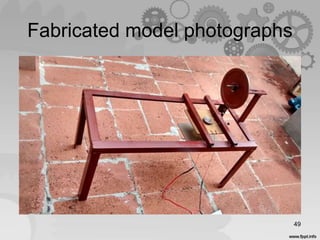
Fabricated model photographs
49
Cylinder
50
51
Piston with Connecting rod
52
Flywheel
53
Electromagnet
54
Relay and timer
55
Battery
56
Assembly
57
58
59
60

ELECTROMAGNETIC ENGINE

  • 1.
    DEVELOPMENT AND FABRICATIONOF ELECTROMAGNETIC ENGINE Submitted by Avin Ganapathi Rithin R Srinivas Rangan L Vinay M 1
  • 2.
    2 A PROJECT WORKPROPOSAL ON DEVELOPMENT AND FABRICATION OF ELECTROMAGNETIC ENGINE Submitted By AVIN GANAPATHI(4MH09ME010) RITHIN R(4MH11ME094) SREENIVAS RANGAN L(4MH11ME104) VINAY M(4MH11ME118) Under the Guidance of Prof. B HARISH Assistant Professor Department of Mechanical Engineering MIT Mysore DEPARTMENT OF MECHANICAL ENGINEERING MAHARAJA INSTITUTE OF TECHNOLOGY MYSORE - 571438
  • 3.
    Index 1. Introduction 2. Literaturesurvey 3. Overview 4. Components and description 5. Design Calculations 6. Fabrication and Assembly 7. Cost estimation 8. Testing 3
  • 4.
    9. Result 10. Conclusionand Scope for future development References. Fabricated model photographs 4
  • 5.
    Introduction • Conventional EngineConcept An Internal Combustion is an engine where combustion of fuel occurs with an oxidizer in combustion chamber that is an integral part of working fluid flow circuit. 5
  • 6.
    Drawbacks of ICengine • Air pollution. • Because of high demand and decreasing supply, the price of fuel is increasing. • Running cost Maintenance cost is high. • Manufacturing cost is high. 6
  • 7.
    Windings on core Theforce that sets up the magnetic field depends on the number of turns on the coil and the magnitude of the current flowing. This force is called the Magneto Motive Force and is measured in Ampere-turn. 7 MMF=I*n Amp-turn
  • 8.
  • 9.
  • 10.
  • 11.
    OVERVIEW 11 Objective • To Developand fabricate an Electromagnetic engine • Testing of Engine for its power output and efficiency • To Evaluate the Performance of Electromagnetic Engine
  • 12.
  • 13.
  • 14.
  • 15.
  • 16.
  • 17.
  • 18.
    An electromagnetic coilis formed when an insulated solid copper wire is wound around a core or form to create an inductor or electromagnet. When electricity is passed through a coil, it generates a magnetic field. One loop of wire is usually referred to as a turn or a winding. we have wound 350 turns. 18 Diameter 0.065 m Height 0.080 m
  • 19.
    RELAY A relay isan electrically operated switch. Current flowing through the coil of the relay creates a magnetic field which attracts a lever and changes the switch contacts. 19
  • 20.
    • Battery • Thebatteries we are using is lead acid battery which has a nominal supply voltage 12 volts and 7Ah current. By series combination we get supply voltage of 36 volts. 20
  • 21.
    21 TIMER 555 IC TIMER555 IC is used to control accurate time delays for Relays to switch ON and OFF.
  • 22.
    DESIGN CALCULATION Input voltage= 36 V Input current = 10A Input Power = Voltage × Current= 36 × 10 = 360W Force exerted by electromagnet on piston: F1= 22 G IN AK 2 22 2  22
  • 23.
    Where, N =number of turns = 350 I = Current flowing through coil = 10 A K = Permeability of free space = 4π×10-7 A = Cross-sectional area of electromagnet (radius r = 0.0325m) G = Least distance between electromagnet and permanent magnet = 0.01m d = diameter of electromagnet = 0.065 m On substitution we get Max Force F1 = 255.40 N 23
  • 24.
    Force exerted bypermanent magnet: F2 = B = On substituting the value of flux density we get F2 = 11.1 N F = F1 + F2 = 266.48N 0 2 2   AB               5.0 25.02 )2[2 ()( ZRZDR B ZZDr 24
  • 25.
    Torque T = F×r Where F = total force on piston = 266.50 N r = crank radius = 0.01m T = 266.50 × 0.01 Torque T = 2.665 N-m 25 25
  • 26.
    Mass of Flywheel  Energystored on Flywheel E=T × Ѳ Where T= torque θ = Angle of rotation = 180̊ radians on substitution we get E = 6.372 Joules Also, E= 0.5×I×ω2 I = 0.0189 kg-m2 26
  • 27.
    60 2 TN P    I= 0.5× m × r2 Where , m = mass of fly wheel r = radius of fly wheel = 0.085 m m = 2.12 kg. Output Power: Where, N = speed= 200rpm T = Torque= 2.665 N-m On substitution,we get P = 55.71 W 27
  • 28.
  • 29.
    Factor of Safetyof Cast Iron Frame 29 2 2 3 bd WL F  2 20302 61081.9403    F =29.9 N/mm2 Working stress,
  • 30.
    Where L =Length of the frame in mm, W = Weight acting on the frame in Kg b = Breadth in mm d = Depth in mm 30 9.29 130 Factor of Safety, FOS = = FOS = 4.3 When Factor of Safety is greater than or equal to 1, then the Design is safe. i.e., FOS ≥ 1 4.3 > 1, hence Design is Safe.
  • 31.
    FABRICATION AND ASSEMBLY •CYLINDER • The cylinder developed is made of aluminum, a non- magnetic material which limits the magnetic field within the boundaries of cylinder periphery. Usage of aluminum material makes the engine lighter unlike the cast-iron cylinder used in internal combustion engine. 31 width 0.075 m length 0.075 m height 0.1 m Bore diameter 0.038 m 31
  • 32.
    PISTON • The hollowpiston casing is made up of non-magnetic stainless steel. • One end of the hollow case is fitted with a powerful permanent magnet made of neodymiumiron-boron (NdFeB) 32 Diameter 0.038 m height 0.034m 32
  • 33.
    CONNECTING ROD In areciprocating engine, the connecting rod is used to connect the piston to the flywheel. It converts the linear motion or reciprocating motion of the piston to the circular motion of the flywheel. The material of the connecting rod is cast iron. The connecting rod used is same as that of an Internal Combustion engine without any modification 33 Length 0.086m Big end diameter 0.012m Small end diameter 0.010m 33
  • 34.
    FLYWHEEL • Flywheel ismade up of mild steel and it is used to convert reciprocating energy into rotational energy. It regulates the engine’s rotation, making it operate at a steady speed. The diameter of the outer circle is 170mm and of the through hole at the center is 30mm 34 34
  • 35.
    ELECTROMAGNET An electromagnetic coilis formed when an insulated solid copper wire is wound around a core or form to create an electromagnet. When electricity is passed through a coil, it generates a magnetic field. One loop of wire is usually referred to as a turn or a winding. we have wound 350 turns. 35 Diameter 0.065 m Height 0.080 m 35
  • 36.
    SUPPORT FRAME The supportframe is made up of cast iron. It holds the piston and cylinder assembly with electromagnetic coil arrangement. The length, breadth and height of the stand are 600 mm. 260mm and 280mm respectively. The manufacturing process involved are cutting and welding 36 Length 0.61 m Width 0.26 m Height 0.28 m 36
  • 37.
    ASSEMBLY The setup isas follows: • The electromagnetic coil is held between two fixed supports on the frame. • Similarly the cylinder block is mounted on the fixed electromagnetic coil • NdFeB permanent magnet is attached to the piston head by means of a strong adhesive. • Piston is mounted inside the cylinder. • The small end diameter of the connecting rod is fixed to a piston and the big end diameter to the flywheel. • And the flywheel converts reciprocatory motion of piston into rotary motion. 37
  • 38.
  • 39.
    COST ESTIMATION Sl. No. Nameof the Parts Material Used Qty. Amount (Rs) 1 Battery - 3 2100 2 Permanent magnet Neo Dymium – Boron 1 1000 3 Stand (Frame) Cast iron 1 1000 4 Electromagnet - 1 2000 5 Relay and Ic timer - 1 500 6 Piston Stainless steel 1 1500 7 Connecting rod Cast iron 1 600 8 Flywheel Mild steel 1 900 9 Nut and bolts Mild steel 2 20 39
  • 40.
    • Material Cost=Piston+ connecting rod + flywheel + Nuts and Bolts = 1500 + 600 + 900+20 = Rs. 3020/- • Fabrication Cost =Rs. 2000/- • Total cost = Component cost + Material cost + Fabrication cost = Rs.11620/ - 40
  • 41.
    TESTING • Variation ofCurrent with Force 41 Current, amp Force, N 2 21.48 4 52.07 6 103.07 8 174.47 10 266.27
  • 42.
    Variation of inputPower with Efficiency 42 Power input Efficiency 72 6.09 144 7.56 216 9.98 288 12.68 360 15.48
  • 43.
    RESULT The prototype ofan electromagnetic engine which works on the principle of magnetism was successfully developed, fabricated and tested. Result analysis was done on the prototype. The results obtained are as follows. • Prototype of an engine which works on the principle of magnetism was tested successfully. • It uses electricity as its input without fuel. • The prototype creates no pollution and is eco-friendly. • Only the repulsive force between the magnet and electromagnet is used for power generation. • Acceleration is done by controlling the timer which controls the relay. • Maximum efficiency obtained was 15.81 %. • Maximum output power obtained was 55.81 W . 43
  • 44.
    CONCLUSION AND SCOPEFOR FUTURE DEVELOPMENT The prototype is an idea which uses the property of an electromagnet by virtue of which it changes the polarity of its poles whenever the direction of current is changed. This variation in polarity is utilized to attract or repel the permanent magnet attached to the piston. The usage of relay and timer will limit the output of the engine. By using an ECU in the engine instead, power can be obtained on each stroke which will result in an increased output. Also, by inserting more permanent magnets in series on the piston will enhance the output of the engine. By slight modification in design and by the use of better hands the engine can be modified to generate more power, thereby increasing its efficiency, so that it can be used in commercial vehicles and other applications. 44
  • 45.
    Jeff Baird- A inventorwhose creation was recently featured in Popular Science magazine unveiled his latest invention Saturday. Ada area resident Jeff Baird’s newest invention is an engine that uses a technology that really isn’t new at all. Large batteries fire the magnets and the motor acts as an alternator that keeps the batteries charged continuously. The technology works like windmills except it uses magnets instead of wind. 45
  • 46.
  • 47.
  • 48.
    References • [1]Atulkumarsingh, PrabhatRanjanTripathi,Microcontrolled Electromagnetic Engine, 2011, International Conference on Advances in Electrical and Electronics Engineering (ICAEE'2011) • [2]J.Rithula,J.Jeyashruthi and Y Anandhi,Electric Vehicle with Zero-fuel ElectromagneticAutomobile Engine,2013,1,2&3Department of Electrical & Electronics Engineering, Sri Sairam Engineering College, West Tambaram, Chennai, India. Volume 6, Number 4 (2013), pp. 483-486 • [3]Shirsendu Das,An ELECTROMAGNETIC MECHANISM WHICH WORKS LIKE AN ENGINE, IJETT- Volume 4 Issue 6-June 2013 • [4]Abil Joseph Eapen, AbyEshowVarughese, Arun T.P,Athul T.N, 2014, ELECTROMAGNETIC ENGINE, International Journal of Research in Engineering and Technology. • [5]AmarnathJayaprakash, Balaji, G., Bala Subramanian, S. and Naveen, N.,STUDIES ON ELECTROMAGNETIC ENGINE International Journal of Development Research Vol. 4, Issue, 3, pp. 519-524, March, 2014 • [6]C. Sudhakar, K. Premkumar, K.Vijith, S.Balaji,“EMISSIONLESS ENGINE BY USING ELECTRO MAGNET”, 2014 • [7]K.Mahadevan and L.Balaveera Reddy “DESIGN DATA HAND BOOK” for Mechanical Engineers, Third Edition. • [8]Peter van Blarigan, “ADVANCED INTERNAL COMBUSTION ENGINE RESEARCH ” Proceedings of the 2000 DOE Hydrogen Program Review. 48
  • 49.
  • 50.
  • 51.
  • 52.
  • 53.
  • 54.
  • 55.
  • 56.
  • 57.
  • 58.
  • 59.
  • 60.