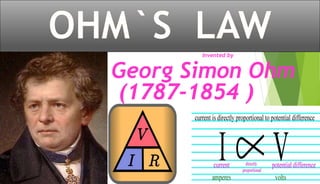
Invented by
Georg Simon Ohm
(1787-1854 )
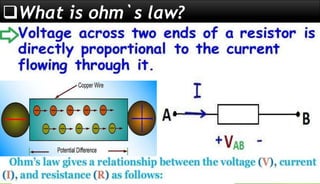
What is ohm`s law?
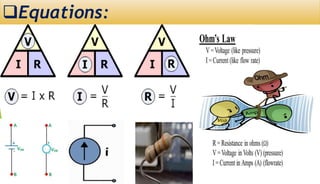
Equations:
 What is Voltage?
A force that pushes the current through
the circuit. Measured in Voltage(V)
RECAP
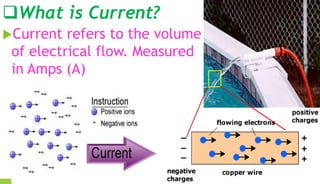
What is Current?
Current refers to the volume
of electrical flow. Measured
in Amps (A)
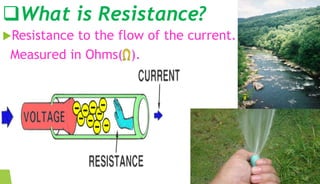
What is Resistance?
Resistance to the flow of the current.
Measured in Ohms( ).
Experiment
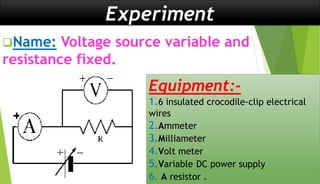
Name: Voltage source variable and
resistance fixed.
Equipment:-
1.6 insulated crocodile-clip electrical
wires
2.Ammeter
3.Milliameter
4.Volt meter
5.Variable DC power supply
6. A resistor .
Procedure
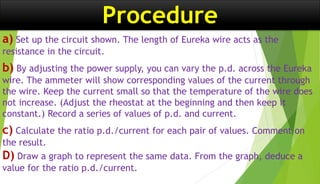
a) Set up the circuit shown. The length of Eureka wire acts as the
resistance in the circuit.
b) By adjusting the power supply, you can vary the p.d. across the Eureka
wire. The ammeter will show corresponding values of the current through
the wire. Keep the current small so that the temperature of the wire does
not increase. (Adjust the rheostat at the beginning and then keep it
constant.) Record a series of values of p.d. and current.
c) Calculate the ratio p.d./current for each pair of values. Comment on
the result.
D) Draw a graph to represent the same data. From the graph, deduce a
value for the ratio p.d./current.
Result
Chart Graph
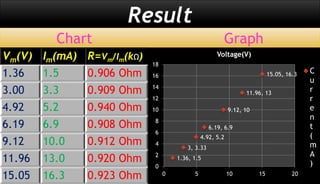
Vm(V) Im(mA) R=Vm/Im(kΩ)
1.36 1.5 0.906 Ohm
3.00 3.3 0.909 Ohm
4.92 5.2 0.940 Ohm
6.19 6.9 0.908 Ohm
9.12 10.0 0.912 Ohm
11.96 13.0 0.920 Ohm
15.05 16.3 0.923 Ohm
1.36, 1.5
3, 3.33
4.92, 5.2
6.19, 6.9
9.12, 10
11.96, 13
15.05, 16.3
0
2
4
6
8
10
12
14
16
18
0 5 10 15 20
Voltage(V)
C
u
r
r
e
n
t
(
m
A
)
Ohm's law Presentation(gub abu bakar siddik )

Ohm's law Presentation(gub abu bakar siddik )

  • 3.
    Invented by Georg SimonOhm (1787-1854 )
  • 4.
  • 5.
  • 6.
     What isVoltage? A force that pushes the current through the circuit. Measured in Voltage(V) RECAP
  • 7.
    What is Current? Currentrefers to the volume of electrical flow. Measured in Amps (A)
  • 8.
    What is Resistance? Resistanceto the flow of the current. Measured in Ohms( ).
  • 9.
    Experiment Name: Voltage sourcevariable and resistance fixed. Equipment:- 1.6 insulated crocodile-clip electrical wires 2.Ammeter 3.Milliameter 4.Volt meter 5.Variable DC power supply 6. A resistor .
  • 10.
    Procedure a) Set upthe circuit shown. The length of Eureka wire acts as the resistance in the circuit. b) By adjusting the power supply, you can vary the p.d. across the Eureka wire. The ammeter will show corresponding values of the current through the wire. Keep the current small so that the temperature of the wire does not increase. (Adjust the rheostat at the beginning and then keep it constant.) Record a series of values of p.d. and current. c) Calculate the ratio p.d./current for each pair of values. Comment on the result. D) Draw a graph to represent the same data. From the graph, deduce a value for the ratio p.d./current.
  • 11.
    Result Chart Graph Vm(V) Im(mA)R=Vm/Im(kΩ) 1.36 1.5 0.906 Ohm 3.00 3.3 0.909 Ohm 4.92 5.2 0.940 Ohm 6.19 6.9 0.908 Ohm 9.12 10.0 0.912 Ohm 11.96 13.0 0.920 Ohm 15.05 16.3 0.923 Ohm 1.36, 1.5 3, 3.33 4.92, 5.2 6.19, 6.9 9.12, 10 11.96, 13 15.05, 16.3 0 2 4 6 8 10 12 14 16 18 0 5 10 15 20 Voltage(V) C u r r e n t ( m A )