Alberto Serna Ramírez
5º de Primaria
Tema 5
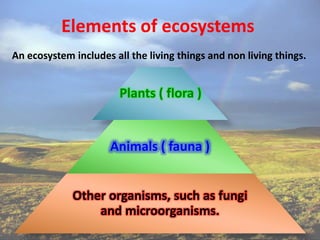
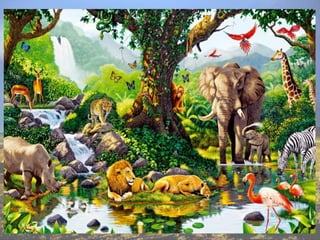
Elements of ecosystems
An ecosystem includes all the living things and non living things.
Plants ( flora )
Animals ( fauna )
Other organisms, such as fungi
and microorganisms.
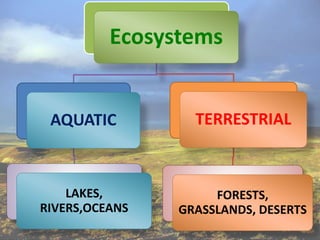
Ecosystems
AQUATIC
LAKES,
RIVERS,OCEANS
TERRESTRIAL
FORESTS,
GRASSLANDS, DESERTS
TERRESTRIAL
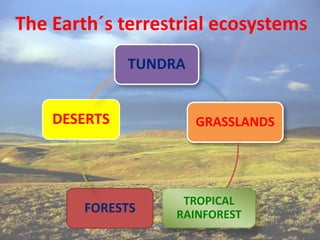
The Earth´s terrestrial ecosystems
TUNDRA
GRASSLANDS
TROPICAL
RAINFORESTFORESTS
DESERTS
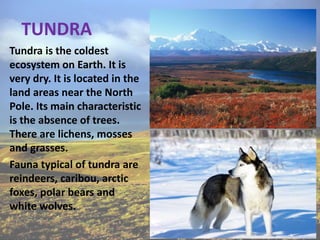
TUNDRA
Tundra is the coldest
ecosystem on Earth. It is
very dry. It is located in the
land areas near the North
Pole. Its main characteristic
is the absence of trees.
There are lichens, mosses
and grasses.
Fauna typical of tundra are
reindeers, caribou, arctic
foxes, polar bears and
white wolves.
GRASSLANDS
Grasslands are flat areas
dominated by grasses.
Two types
- Savannahs in tropical areas.
- Temperate Grasslands
(colder regions).
Grasslands animals are
elephants, giraffes, zebras,
lions, gazelles and antelopes
in savannahs, and bison,
prairie dogs, wolves and
coyotes in prairies.
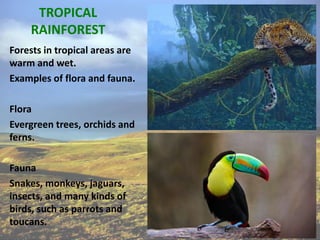
TROPICAL
RAINFOREST
Forests in tropical areas are
warm and wet.
Examples of flora and fauna.
Flora
Evergreen trees, orchids and
ferns.
Fauna
Snakes, monkeys, jaguars,
insects, and many kinds of
birds, such as parrots and
toucans.
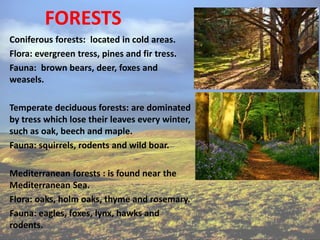
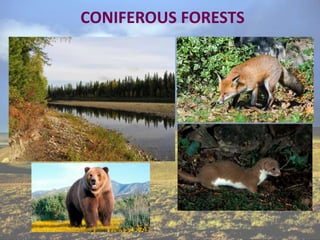
Coniferous forests: located in cold areas.
Flora: evergreen tress, pines and fir tress.
Fauna: brown bears, deer, foxes and
weasels.
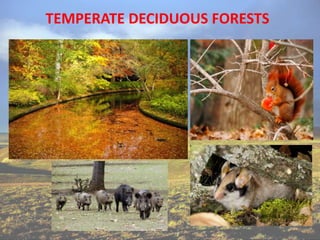
Temperate deciduous forests: are dominated
by tress which lose their leaves every winter,
such as oak, beech and maple.
Fauna: squirrels, rodents and wild boar.
Mediterranean forests : is found near the
Mediterranean Sea.
Flora: oaks, holm oaks, thyme and rosemary.
Fauna: eagles, foxes, lynx, hawks and
rodents.
FORESTS
CONIFEROUS FORESTS
TEMPERATE DECIDUOUS FORESTS
MEDITERRANEAN FORESTS
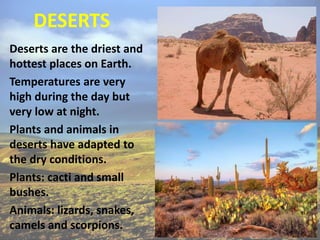
DESERTS
Deserts are the driest and
hottest places on Earth.
Temperatures are very
high during the day but
very low at night.
Plants and animals in
deserts have adapted to
the dry conditions.
Plants: cacti and small
bushes.
Animals: lizards, snakes,
camels and scorpions.
AQUATIC
Aquatic ecosystems
MARINE FRESHWATER
CORAL REEFS
Of all the marine
ecosystems coral
reefs are the
richest in number
of species.
SHORELINE
The shoreline is the
place where sea and
land meet. Animals and
plants which live on
rocky have adapted to
the strong tides and
waves. One examples is
the strong muscular food
that limpets use to cling
to the rocks.
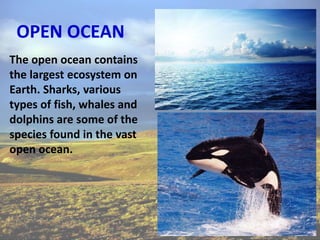
OPEN OCEAN
The open ocean contains
the largest ecosystem on
Earth. Sharks, various
types of fish, whales and
dolphins are some of the
species found in the vast
open ocean.
FLOWING WATER
RIVERS AND STREAMS
Many animals live in
flowing freshwater
ecosystem. These
include fish,
crocodiles, turtles and
frogs.
STANDING WATER
LAKES AND PONDS
The main differences
between lakes and
ponds are that ponds
are smaller and don´t
have waves. Fish,
tadpoles and ducks live
in lakes and pounds.
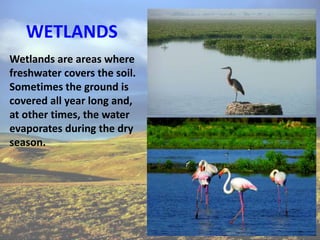
WETLANDS
Wetlands are areas where
freshwater covers the soil.
Sometimes the ground is
covered all year long and,
at other times, the water
evaporates during the dry
season.
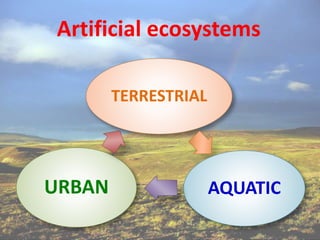
ARTIFICIAL
Artificial ecosystems
TERRESTRIAL
AQUATICURBAN
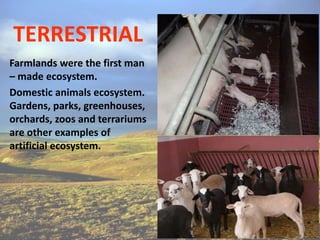
TERRESTRIAL
Farmlands were the first man
– made ecosystem.
Domestic animals ecosystem.
Gardens, parks, greenhouses,
orchards, zoos and terrariums
are other examples of
artificial ecosystem.
AQUATIC
Aquariums, man – made
ponds and fish farms are
examples of artificial
aquatic ecosystems.
URBAN
Urban ecosystem occupy
only about 2% of the land.
Include cats, dogs,
mosquitoes, rats,
cockroaches, flies, pigeons,
migratory birds such as
storks and wild plants such
as grasses.
Unit 5 ecosystems

Unit 5 ecosystems

  • 1.
    Alberto Serna Ramírez 5ºde Primaria Tema 5
  • 2.
    Elements of ecosystems Anecosystem includes all the living things and non living things. Plants ( flora ) Animals ( fauna ) Other organisms, such as fungi and microorganisms.
  • 3.
  • 4.
  • 5.
    The Earth´s terrestrialecosystems TUNDRA GRASSLANDS TROPICAL RAINFORESTFORESTS DESERTS
  • 6.
    TUNDRA Tundra is thecoldest ecosystem on Earth. It is very dry. It is located in the land areas near the North Pole. Its main characteristic is the absence of trees. There are lichens, mosses and grasses. Fauna typical of tundra are reindeers, caribou, arctic foxes, polar bears and white wolves.
  • 7.
    GRASSLANDS Grasslands are flatareas dominated by grasses. Two types - Savannahs in tropical areas. - Temperate Grasslands (colder regions). Grasslands animals are elephants, giraffes, zebras, lions, gazelles and antelopes in savannahs, and bison, prairie dogs, wolves and coyotes in prairies.
  • 8.
    TROPICAL RAINFOREST Forests in tropicalareas are warm and wet. Examples of flora and fauna. Flora Evergreen trees, orchids and ferns. Fauna Snakes, monkeys, jaguars, insects, and many kinds of birds, such as parrots and toucans.
  • 9.
    Coniferous forests: locatedin cold areas. Flora: evergreen tress, pines and fir tress. Fauna: brown bears, deer, foxes and weasels. Temperate deciduous forests: are dominated by tress which lose their leaves every winter, such as oak, beech and maple. Fauna: squirrels, rodents and wild boar. Mediterranean forests : is found near the Mediterranean Sea. Flora: oaks, holm oaks, thyme and rosemary. Fauna: eagles, foxes, lynx, hawks and rodents. FORESTS
  • 10.
  • 11.
  • 12.
  • 13.
    DESERTS Deserts are thedriest and hottest places on Earth. Temperatures are very high during the day but very low at night. Plants and animals in deserts have adapted to the dry conditions. Plants: cacti and small bushes. Animals: lizards, snakes, camels and scorpions.
  • 14.
  • 15.
  • 17.
    CORAL REEFS Of allthe marine ecosystems coral reefs are the richest in number of species.
  • 18.
    SHORELINE The shoreline isthe place where sea and land meet. Animals and plants which live on rocky have adapted to the strong tides and waves. One examples is the strong muscular food that limpets use to cling to the rocks.
  • 19.
    OPEN OCEAN The openocean contains the largest ecosystem on Earth. Sharks, various types of fish, whales and dolphins are some of the species found in the vast open ocean.
  • 21.
    FLOWING WATER RIVERS ANDSTREAMS Many animals live in flowing freshwater ecosystem. These include fish, crocodiles, turtles and frogs.
  • 22.
    STANDING WATER LAKES ANDPONDS The main differences between lakes and ponds are that ponds are smaller and don´t have waves. Fish, tadpoles and ducks live in lakes and pounds.
  • 23.
    WETLANDS Wetlands are areaswhere freshwater covers the soil. Sometimes the ground is covered all year long and, at other times, the water evaporates during the dry season.
  • 24.
  • 25.
  • 26.
    TERRESTRIAL Farmlands were thefirst man – made ecosystem. Domestic animals ecosystem. Gardens, parks, greenhouses, orchards, zoos and terrariums are other examples of artificial ecosystem.
  • 27.
    AQUATIC Aquariums, man –made ponds and fish farms are examples of artificial aquatic ecosystems.
  • 28.
    URBAN Urban ecosystem occupy onlyabout 2% of the land. Include cats, dogs, mosquitoes, rats, cockroaches, flies, pigeons, migratory birds such as storks and wild plants such as grasses.