Habitats Made by  Jyotsna Narang
A  habitat  is the place where living things live. It is more than just a home it includes the whole surrounding area. The habitat provides the animal or plant with  food  or  shelter . What is a habitat ?
Animals and plants Most plants and animals are specially adapted to survive in a  particular  habitat. They have developed  special features  to suit the demands of their environment. This is called  adaption .
Some examples of adaption
All birds have similar characteristics. But many water birds have features that are different from those birds live on land. Long legs are good for wading These wings act as flippers Webbed  feet for swimming
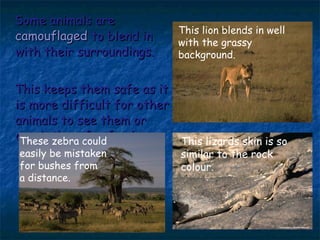
Some animals are  camouflaged  to blend in with their surroundings. This keeps them safe as it is more difficult for other animals to see them or catch them for food. These zebra could easily be mistaken  for bushes from  a distance. This lizards skin is so similar to the rock colour.  This lion blends in well with the grassy background.
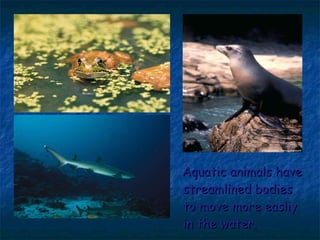
Aquatic animals have streamlined bodies to move more easliy in the water.
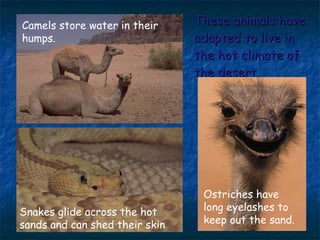
These animals have adapted to live in the hot climate of the desert. Camels store water in their humps. Ostriches have long eyelashes to keep out the sand. Snakes glide across the hot sands and can shed their skin
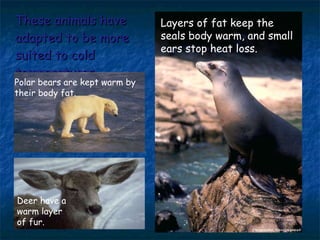
These animals have adapted to be more suited to cold temperatures. Layers of fat keep the seals body warm, and small ears stop heat loss. Polar bears are kept warm by their body fat. Deer have a warm layer of fur.
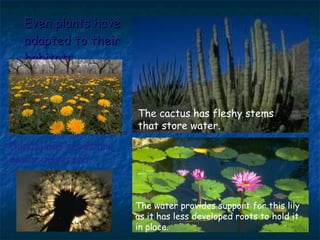
Even plants have adapted to their habitats. The cactus has fleshy stems that store water. The water provides support for this lily as it has less developed roots to hold it in place. Dandelions seeds are easily dispersed.
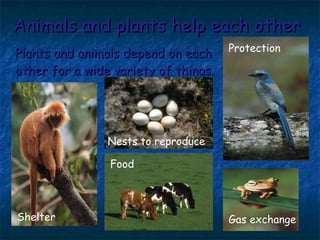
Animals and plants help each other Plants and animals depend on each other for a wide variety of things. Food Nests to reproduce Shelter Protection Gas exchange
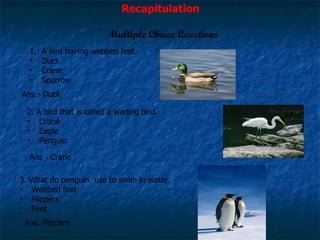
Multiple Choice Questions 3. What do penguin  use to swim in water. Webbed feet Flippers Feet  A bird having webbed feet. Duck Crane Sparrow Ans - Duck 2. A bird that is called a wading bird. Crane Eagle Penguin Ans - Crane Ans. Flippers Recapitulation
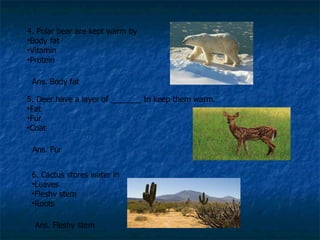
4. Polar bear are kept warm by Body fat Vitamin Protein Ans. Body fat 5. Deer have a layer of _______ to keep them warm. Fat Fur Coat  Ans. Fur 6. Cactus stores water in Leaves Fleshy stem Roots Ans. Fleshy stem
Identify and collect  5-8 animals that have streamlined bodies. Find out how streamlined body is helpful to them. Make a collage of animals having streamlined bodies.  Project
Assignment Ques 1. What do you mean by habitat? Ques2. How do plants  and animals depend on each other? Ques3. Name three animals that camouflage. Ques4. How do the following given animals  survive in cold temperature 1. Polar bear 2. Deer 3. Seal

Habitats

  • 1.
    Habitats Made by Jyotsna Narang
  • 2.
    A habitat is the place where living things live. It is more than just a home it includes the whole surrounding area. The habitat provides the animal or plant with food or shelter . What is a habitat ?
  • 3.
    Animals and plantsMost plants and animals are specially adapted to survive in a particular habitat. They have developed special features to suit the demands of their environment. This is called adaption .
  • 4.
  • 5.
    All birds havesimilar characteristics. But many water birds have features that are different from those birds live on land. Long legs are good for wading These wings act as flippers Webbed feet for swimming
  • 6.
    Some animals are camouflaged to blend in with their surroundings. This keeps them safe as it is more difficult for other animals to see them or catch them for food. These zebra could easily be mistaken for bushes from a distance. This lizards skin is so similar to the rock colour. This lion blends in well with the grassy background.
  • 7.
    Aquatic animals havestreamlined bodies to move more easliy in the water.
  • 8.
    These animals haveadapted to live in the hot climate of the desert. Camels store water in their humps. Ostriches have long eyelashes to keep out the sand. Snakes glide across the hot sands and can shed their skin
  • 9.
    These animals haveadapted to be more suited to cold temperatures. Layers of fat keep the seals body warm, and small ears stop heat loss. Polar bears are kept warm by their body fat. Deer have a warm layer of fur.
  • 10.
    Even plants haveadapted to their habitats. The cactus has fleshy stems that store water. The water provides support for this lily as it has less developed roots to hold it in place. Dandelions seeds are easily dispersed.
  • 11.
    Animals and plantshelp each other Plants and animals depend on each other for a wide variety of things. Food Nests to reproduce Shelter Protection Gas exchange
  • 12.
    Multiple Choice Questions3. What do penguin use to swim in water. Webbed feet Flippers Feet A bird having webbed feet. Duck Crane Sparrow Ans - Duck 2. A bird that is called a wading bird. Crane Eagle Penguin Ans - Crane Ans. Flippers Recapitulation
  • 13.
    4. Polar bearare kept warm by Body fat Vitamin Protein Ans. Body fat 5. Deer have a layer of _______ to keep them warm. Fat Fur Coat Ans. Fur 6. Cactus stores water in Leaves Fleshy stem Roots Ans. Fleshy stem
  • 14.
    Identify and collect 5-8 animals that have streamlined bodies. Find out how streamlined body is helpful to them. Make a collage of animals having streamlined bodies. Project
  • 15.
    Assignment Ques 1.What do you mean by habitat? Ques2. How do plants and animals depend on each other? Ques3. Name three animals that camouflage. Ques4. How do the following given animals survive in cold temperature 1. Polar bear 2. Deer 3. Seal