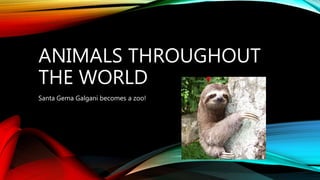
ANIMALS THROUGHOUT
THE WORLD
Santa Gema Galgani becomes a zoo!
ANIMALS ARE AMAZING LIVING
THINGS…
IN GROUPS:
• You are going to choose an animal.
• Any animal will do it. Just think the animal
that you would like to choose and choose
it.
• It has to be a REAL animal. A dinosaur does
not count; we are talking about animals
that live nowadays.
• Once you have chosen your animal, you
are going to complete the chart given
about the features this animal presents.
• Think if the animal:
• Is vertebrate or invertebrate
• Is a herbivore, carnivore or omnivore
animal.
• Is a viviparous or an oviparous animal.
• Has special features: where does it live,
etcétera.
ANIMAL FEATURES
VERTEBRATES AND INVERTEBRATES
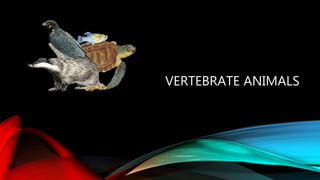
VERTEBRATE ANIMALS
• Vertebrate animals are those
animals that have a backbone and
a bony or cartilaginous skeleton.
Mammals, birds, reptiles,
amphibians and fish are vertebrate
animals.
INVERTEBRATE ANIMALS
• Invertebrate animals are those animals
that don’t have a backbone or spinal
chord. Most of the animals in the
world are invertebrates.. Sponges,
cnidarians, molluscs, arthropods,
worms and echinoderms are
invertebrate animals.
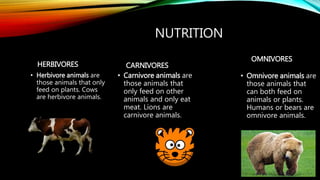
NUTRITION
HERBIVORES
• Herbivore animals are
those animals that only
feed on plants. Cows
are herbivore animals.
CARNIVORES
• Carnivore animals are
those animals that
only feed on other
animals and only eat
meat. Lions are
carnivore animals.
OMNIVORES
• Omnivore animals are
those animals that
can both feed on
animals or plants.
Humans or bears are
omnivore animals.
REPRODUCTION
VIVIPAROUS ANIMALS
• Viviparous animals develop their
babies inside the mother’s belly.
Mammals are viviparous animals.
OVIPAROUS ANIMALS
• Oviparous animals develop their babies
outside the mother’s belly. They develop
inside eggs. Birds, fish or amphibians are
oviparous animals.
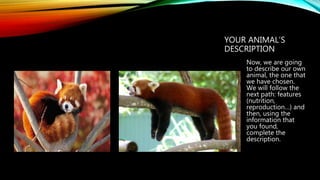
YOUR ANIMAL’S
DESCRIPTION
Now, we are going
to describe our own
animal, the one that
we have chosen.
We will follow the
next path: features
(nutrition,
reproduction…) and
then, using the
information that
you found,
complete the
description.
VERTEBRATE ANIMALS
MAMMALS
• Mammals are viviparous animals, with their skin covered with hair or fur, and
breathe the air through the lungs. There are four different groups:
• Carnivore mamals.
• Mammals with hooves: instead of toes, these mammals have hooves. Most of them
are herbivore, and some are omnivores.
• Primates: they have five fingers in each hand and five toes in each feet. Human
beings belong to this group.
• Cetaceans: they are aquatic mammals. Unlike fish, they have lungs, so they have to
take air through their blowhole once in a while to survive. Dolphins or whales are
cetaceans.
MAMMALS: viviparous,
vertebrates, hair or fur,
lungs.
Carnivores
Primates
Cetaceans
Mammals
with
hooves
BIRDS
Birds are oviparous animals with the body covered with feathers. Most of them use
their wings to fly, and they have a beak to eat instead of a mouth. They breather
through their lungs. There are four different types of birds:
• Flightless birds: they cannot fly. Ostriches are flightless birds.
• Waterfowl: their feet are prepared to swim. Swans and ducks are waterfowl.
• Birds of prey: they are carnivores. They have strong claws and beaks. Eagles are birds
of prey.
• Songbirds: they are the largest group.
BIRDS: oviparous,
feathers, wings, lungs.
Flightless
birds
Birds of
prey
Songbirds
Waterfowl
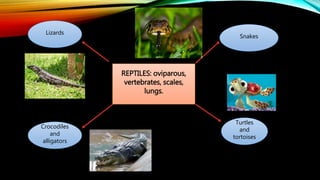
REPTILES• Reptiles are vertebrate, oviparous animals. Most of them are
terrestrial. They have their body covered in scales, and
breather air through their lungs. There are four different
groups:
• Lizards: terrestrial, carnivorous animals. They have short legs
and a tail. Some can remove the tail to confuse predators.
• Snakes: they have no legs, and slither on the ground.
• Crocodiles: they have their bodies covered with hard scales.
They are carnivore, and crocodiles and alligators belong to
this group.
• Tortoises and turtles: they have a hard Shell. Tortoises are
terrestrial, and turtles are aquatic.
REPTILES: oviparous,
vertebrates, scales,
lungs.
Lizards
Turtles
and
tortoises
Snakes
Crocodiles
and
alligators
AMPHIBIANS• Amphibians are both aquatic and terrestrial, and
oviparous animals. They have four legs, and their skin
is bare. They breathe through their lungs and skin.
• They Suffer metamorphosis. Metamorphosis is the
process of changing from a tadpole to an adult
amphibian.
AMPHIBIANS: terrestrial
and aquatic,
vertebrates, bare skin,
lungs and skin.
With a tail
Without a tail
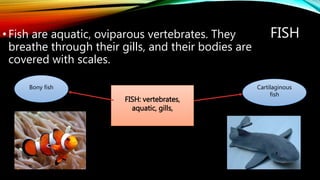
FISH• Fish are aquatic, oviparous vertebrates. They
breathe through their gills, and their bodies are
covered with scales.
FISH: vertebrates,
aquatic, gills,
Bony fish Cartilaginous
fish
INVERTEBRATE ANIMALS
INVERTERBRATE ANIMALS
• There are lots of animals that are invertebrates. They
don’t have a backbone (also called spinal chord)
• There are six groups: sponges, cnidarians, worms,
molluscs, echinoderms and arthropods.
SPONGES
• They are very simple. They cannot move by themselves.
• Their sac-like bodies are covered of pores.
• They filter the nutritive substances in seawater for food.
CNIDARIANS
• They are aquatic invertebrates.
• They have got jelly-like bodies that look like UMBRELLAS.
• They have poisonous tentacles.
WORMS
• They have long, soft bodies.
• They haven’t got legs.
• Some live in the soil (like the earthworms) and other live in water (fireworms)
MOLLUSCS
• They have soft bodies, and protect themselves with one or two shells.
• They are oviparous.
• There are different groups:
• Bivalves
• Snails and slugs.
• Squids and cuttlefish.
• Octopuses:
MOLLUSCS: Soft bodies,
shells, oviparous.
Bivalves
Squids
and
cuttlefish
Snails and
slugs
Octopuses
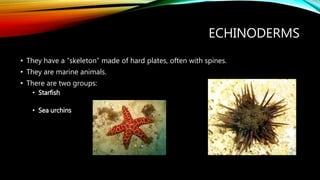
ECHINODERMS
• They have a “skeleton” made of hard plates, often with spines.
• They are marine animals.
• There are two groups:
• Starfish
• Sea urchins
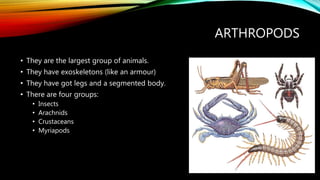
ARTHROPODS
• They are the largest group of animals.
• They have exoskeletons (like an armour)
• They have got legs and a segmented body.
• There are four groups:
• Insects
• Arachnids
• Crustaceans
• Myriapods
ARTHROPODS:
EXOSKELETON,
SEGMENTED BODY,
LEGS
Insects
Crustaceans
Arachnids
Myriapods
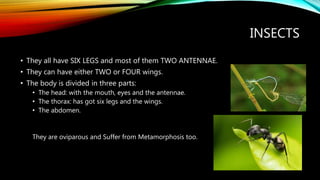
INSECTS
• They all have SIX LEGS and most of them TWO ANTENNAE.
• They can have either TWO or FOUR wings.
• The body is divided in three parts:
• The head: with the mouth, eyes and the antennae.
• The thorax: has got six legs and the wings.
• The abdomen.
They are oviparous and Suffer from Metamorphosis too.
OTHER ARTHROPODS
Arachnids
They have eight legs.
They haven’t got
antennae.
They produce silk to
create their webs.
Crustaceans
They have a hard
exoskeleton.
They have got antennae
and ten legs.
Myriapods
They have long bodies.
They have many
identical segments.
They have got a pair of
antennae.

Animals throughout the world

  • 1.
    ANIMALS THROUGHOUT THE WORLD SantaGema Galgani becomes a zoo!
  • 2.
    ANIMALS ARE AMAZINGLIVING THINGS…
  • 3.
    IN GROUPS: • Youare going to choose an animal. • Any animal will do it. Just think the animal that you would like to choose and choose it. • It has to be a REAL animal. A dinosaur does not count; we are talking about animals that live nowadays. • Once you have chosen your animal, you are going to complete the chart given about the features this animal presents. • Think if the animal: • Is vertebrate or invertebrate • Is a herbivore, carnivore or omnivore animal. • Is a viviparous or an oviparous animal. • Has special features: where does it live, etcétera.
  • 4.
  • 5.
    VERTEBRATES AND INVERTEBRATES VERTEBRATEANIMALS • Vertebrate animals are those animals that have a backbone and a bony or cartilaginous skeleton. Mammals, birds, reptiles, amphibians and fish are vertebrate animals. INVERTEBRATE ANIMALS • Invertebrate animals are those animals that don’t have a backbone or spinal chord. Most of the animals in the world are invertebrates.. Sponges, cnidarians, molluscs, arthropods, worms and echinoderms are invertebrate animals.
  • 6.
    NUTRITION HERBIVORES • Herbivore animalsare those animals that only feed on plants. Cows are herbivore animals. CARNIVORES • Carnivore animals are those animals that only feed on other animals and only eat meat. Lions are carnivore animals. OMNIVORES • Omnivore animals are those animals that can both feed on animals or plants. Humans or bears are omnivore animals.
  • 7.
    REPRODUCTION VIVIPAROUS ANIMALS • Viviparousanimals develop their babies inside the mother’s belly. Mammals are viviparous animals. OVIPAROUS ANIMALS • Oviparous animals develop their babies outside the mother’s belly. They develop inside eggs. Birds, fish or amphibians are oviparous animals.
  • 8.
    YOUR ANIMAL’S DESCRIPTION Now, weare going to describe our own animal, the one that we have chosen. We will follow the next path: features (nutrition, reproduction…) and then, using the information that you found, complete the description.
  • 9.
  • 10.
    MAMMALS • Mammals areviviparous animals, with their skin covered with hair or fur, and breathe the air through the lungs. There are four different groups: • Carnivore mamals. • Mammals with hooves: instead of toes, these mammals have hooves. Most of them are herbivore, and some are omnivores. • Primates: they have five fingers in each hand and five toes in each feet. Human beings belong to this group. • Cetaceans: they are aquatic mammals. Unlike fish, they have lungs, so they have to take air through their blowhole once in a while to survive. Dolphins or whales are cetaceans.
  • 11.
    MAMMALS: viviparous, vertebrates, hairor fur, lungs. Carnivores Primates Cetaceans Mammals with hooves
  • 12.
    BIRDS Birds are oviparousanimals with the body covered with feathers. Most of them use their wings to fly, and they have a beak to eat instead of a mouth. They breather through their lungs. There are four different types of birds: • Flightless birds: they cannot fly. Ostriches are flightless birds. • Waterfowl: their feet are prepared to swim. Swans and ducks are waterfowl. • Birds of prey: they are carnivores. They have strong claws and beaks. Eagles are birds of prey. • Songbirds: they are the largest group.
  • 13.
    BIRDS: oviparous, feathers, wings,lungs. Flightless birds Birds of prey Songbirds Waterfowl
  • 14.
    REPTILES• Reptiles arevertebrate, oviparous animals. Most of them are terrestrial. They have their body covered in scales, and breather air through their lungs. There are four different groups: • Lizards: terrestrial, carnivorous animals. They have short legs and a tail. Some can remove the tail to confuse predators. • Snakes: they have no legs, and slither on the ground. • Crocodiles: they have their bodies covered with hard scales. They are carnivore, and crocodiles and alligators belong to this group. • Tortoises and turtles: they have a hard Shell. Tortoises are terrestrial, and turtles are aquatic.
  • 15.
  • 16.
    AMPHIBIANS• Amphibians areboth aquatic and terrestrial, and oviparous animals. They have four legs, and their skin is bare. They breathe through their lungs and skin. • They Suffer metamorphosis. Metamorphosis is the process of changing from a tadpole to an adult amphibian. AMPHIBIANS: terrestrial and aquatic, vertebrates, bare skin, lungs and skin. With a tail Without a tail
  • 17.
    FISH• Fish areaquatic, oviparous vertebrates. They breathe through their gills, and their bodies are covered with scales. FISH: vertebrates, aquatic, gills, Bony fish Cartilaginous fish
  • 18.
  • 19.
    INVERTERBRATE ANIMALS • Thereare lots of animals that are invertebrates. They don’t have a backbone (also called spinal chord) • There are six groups: sponges, cnidarians, worms, molluscs, echinoderms and arthropods.
  • 20.
    SPONGES • They arevery simple. They cannot move by themselves. • Their sac-like bodies are covered of pores. • They filter the nutritive substances in seawater for food.
  • 21.
    CNIDARIANS • They areaquatic invertebrates. • They have got jelly-like bodies that look like UMBRELLAS. • They have poisonous tentacles.
  • 22.
    WORMS • They havelong, soft bodies. • They haven’t got legs. • Some live in the soil (like the earthworms) and other live in water (fireworms)
  • 23.
    MOLLUSCS • They havesoft bodies, and protect themselves with one or two shells. • They are oviparous. • There are different groups: • Bivalves • Snails and slugs. • Squids and cuttlefish. • Octopuses:
  • 24.
    MOLLUSCS: Soft bodies, shells,oviparous. Bivalves Squids and cuttlefish Snails and slugs Octopuses
  • 25.
    ECHINODERMS • They havea “skeleton” made of hard plates, often with spines. • They are marine animals. • There are two groups: • Starfish • Sea urchins
  • 26.
    ARTHROPODS • They arethe largest group of animals. • They have exoskeletons (like an armour) • They have got legs and a segmented body. • There are four groups: • Insects • Arachnids • Crustaceans • Myriapods
  • 27.
  • 28.
    INSECTS • They allhave SIX LEGS and most of them TWO ANTENNAE. • They can have either TWO or FOUR wings. • The body is divided in three parts: • The head: with the mouth, eyes and the antennae. • The thorax: has got six legs and the wings. • The abdomen. They are oviparous and Suffer from Metamorphosis too.
  • 29.
    OTHER ARTHROPODS Arachnids They haveeight legs. They haven’t got antennae. They produce silk to create their webs. Crustaceans They have a hard exoskeleton. They have got antennae and ten legs. Myriapods They have long bodies. They have many identical segments. They have got a pair of antennae.