Course: BA (Hons) Textiles
Year: Three

Unit: BA7: Final Project 1: Research,
development and reflection

Project Title: Project Preparation

Project 1 of 1 within this unit
Course: BA (Hons) Textiles
Year: Three

Unit: BA7: Final Project 1: Research,
development and reflection

Project Title: Project Preparation

Project 1 of 1 within this unit
what
why
how
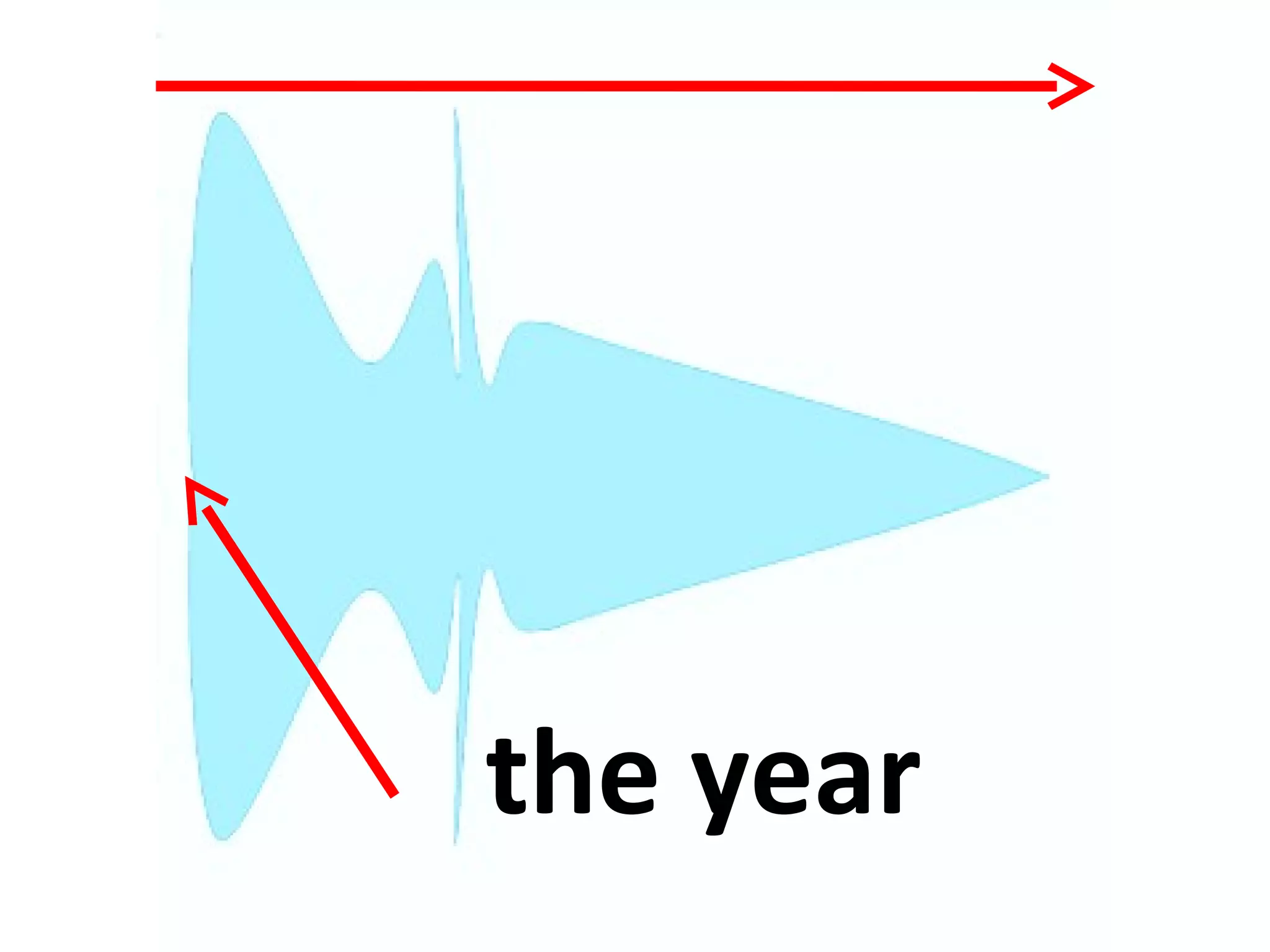
the year
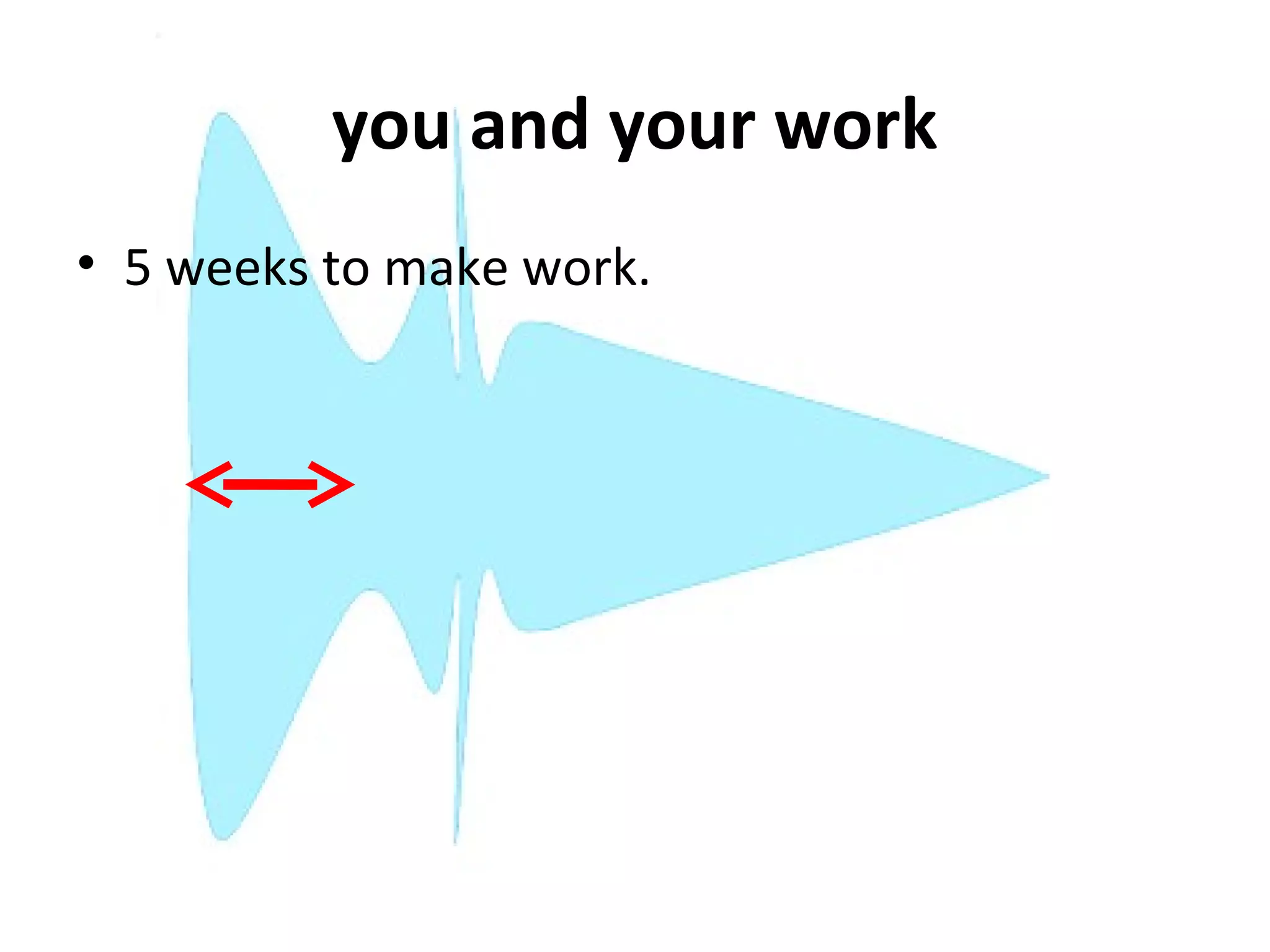
you and your work
• 5 weeks to make work.
you and your work
• The first 5 weeks of this course are about you
  developing what you want to.
you and your work

•It is about you identifying, developing and
following a research path in both your practical
and textural work.
you and your work


•You will need to consider how to use your time
effectively as you cannot get this time back.
you and your work


•Supported by individual tutorials alongside
developmental and skill based workshops.
you and your work
It envisage that this time will involve you in -
•Research - Deciding on your path(s) of interests
and supporting your thinking.
•Context - looking around at the work of others
and where work is seen - shops, galleries etc.
•Experimenting - trying stuff out by using skills
and techniques.
•Testing - making stuff, including final piece(s)
•Reflection - on what you have done and then
presenting it to others.
you and your work
• It is expected that you will make a body of
  work for yourself - all of these activities -
  research, context, experimenting, testing,
  final completed pieces and reflection are your
  work.
reflection
• Nov 5th –
• Pecha Kucha
• This is you presenting what you have done, a
  chance to bring all your work together and
  decide on what to do next.
reflection
• Pecha Kucha 20x20
  is a simple presentation format where you
      show 20 images, each for 20 seconds.
  The images advance automatically and you
      talk along to the images.
reflection
• Preparation.
• We are very enthusiastic about this task and
  its relationship to learning within the course.
reflection
• This has been conceived as a 'rounding up' of
  your initial body of work - after which it is
  anticipated that you will go on to further
  develop your work and practice - this is so
  that you can now focus.
• This is within the context that you will be
  getting a response from your cohort - this is
  feedback and needing to consider it - this is
  reflection.
reflection
• So -
• Consider       what you want to tell us
            what you want us to know
            what you want to learn
• Tell a story.
• Engage with your audience.
• Consider your learning.
focus
• 4 weeks
• Developing what your work is, could or should
  be.

• To Dec 2nd
focus
• This is time to focus what it is that you do,
  what you are interested in, to hone skills and
  develop techniques and processes.
• It is expected that you will make a body of
  focused work for yourself.
• Become an expert.
team
• Dec
• 2 team projects
team
•   Using your skills within a team
•   Professionalism
•   Finding your place
•   Testing yourself
team
• Task 1

• This will be a one week project.
team
• Task 2

• This will be a three week project.
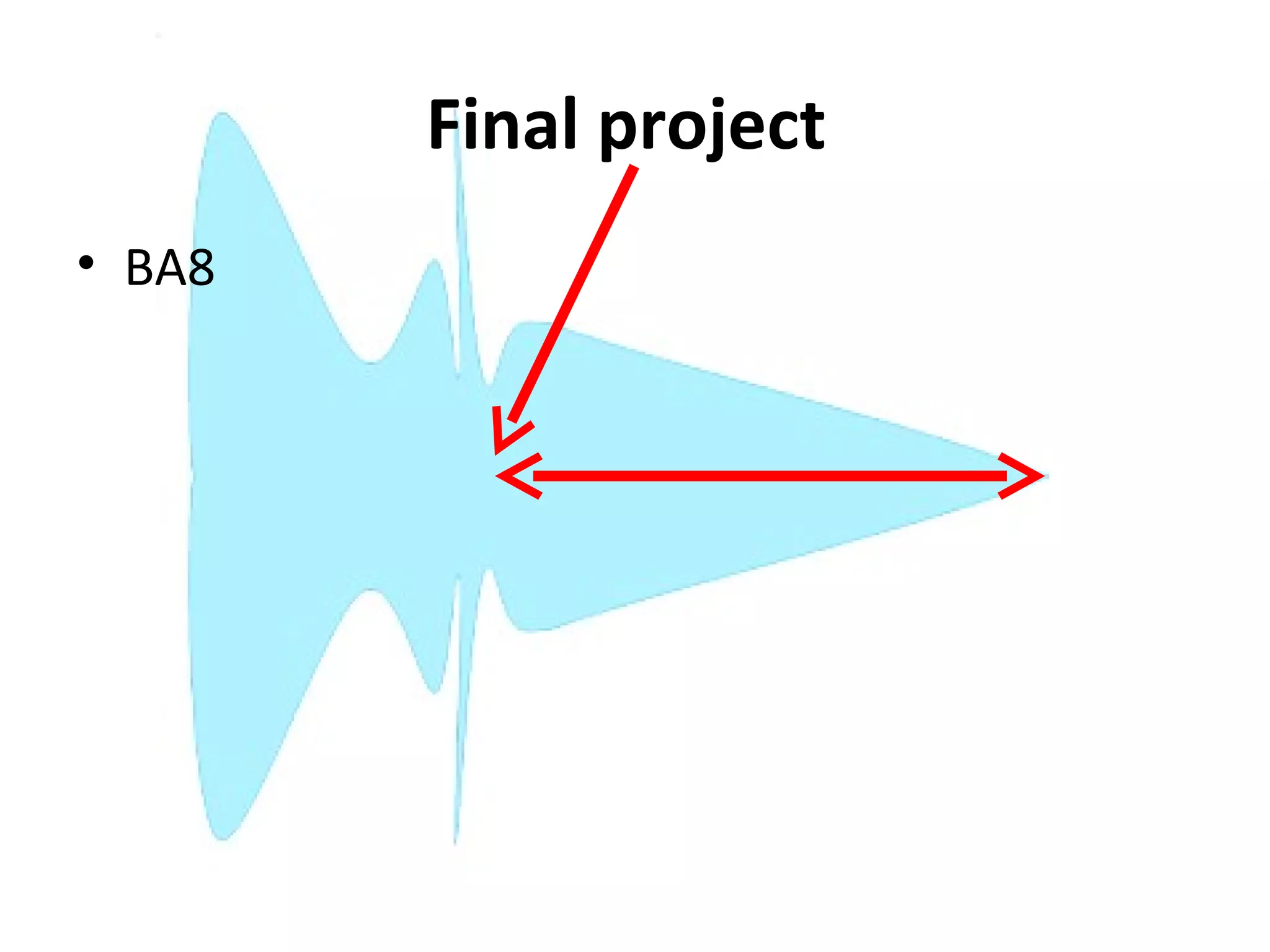
Final project
• BA8
Final project
•   BA8
•   Learning agreement
•   Thinking about the future?
•   How do you want to use your time?
•   What do you want to learn?
Final project
• BA8
• This is time to make work that will be your BA
  final project.
• 10 weeks
Mid Year Review
Mid Year Review
• Stew Gallery
• Mid Year Review
degree show
degree show
• What is this for?

• Presenting yourself
• Becoming public
• Becoming professional

• What next?
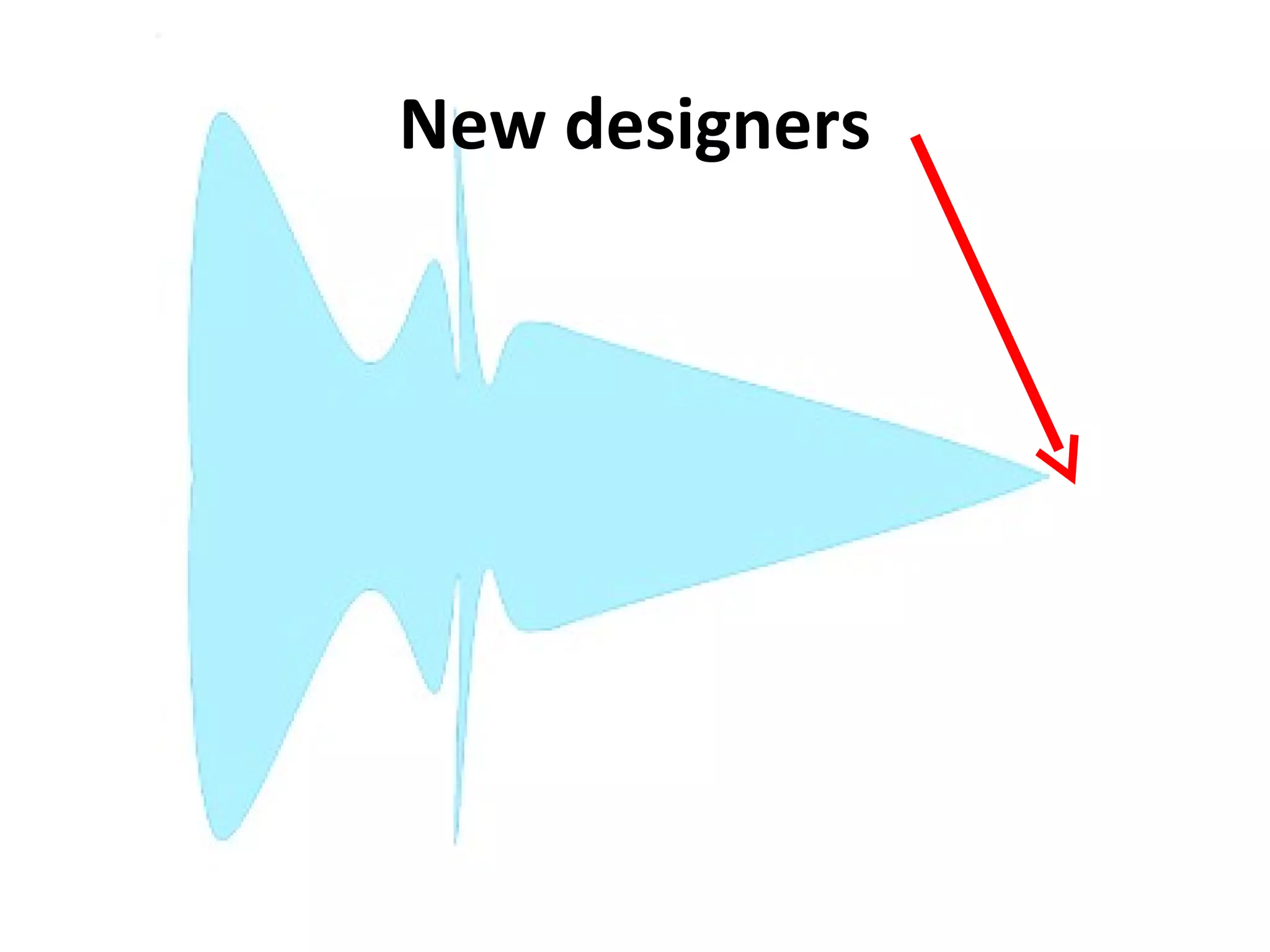
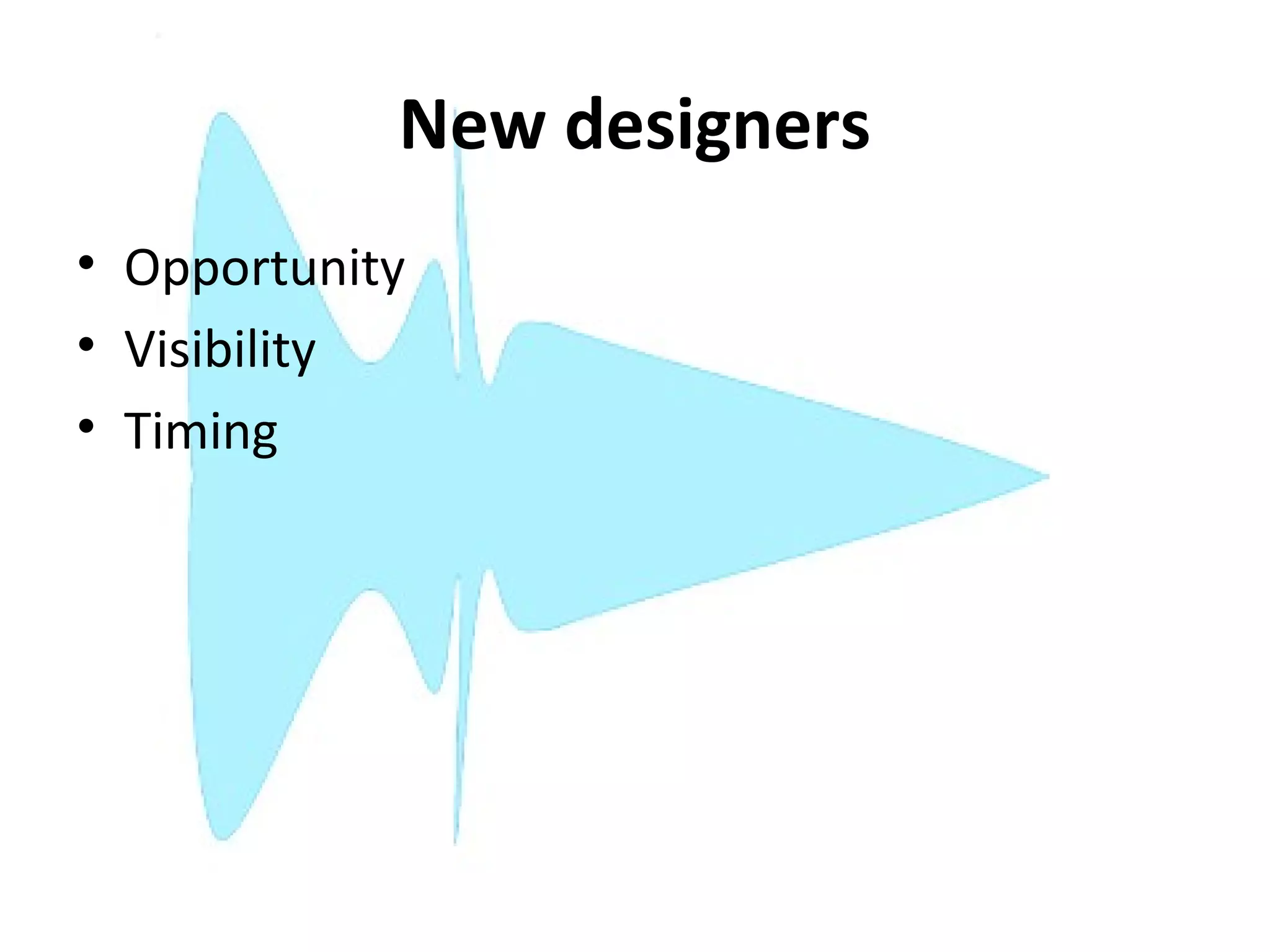
New designers
New designers
• Opportunity
• Visibility
• Timing
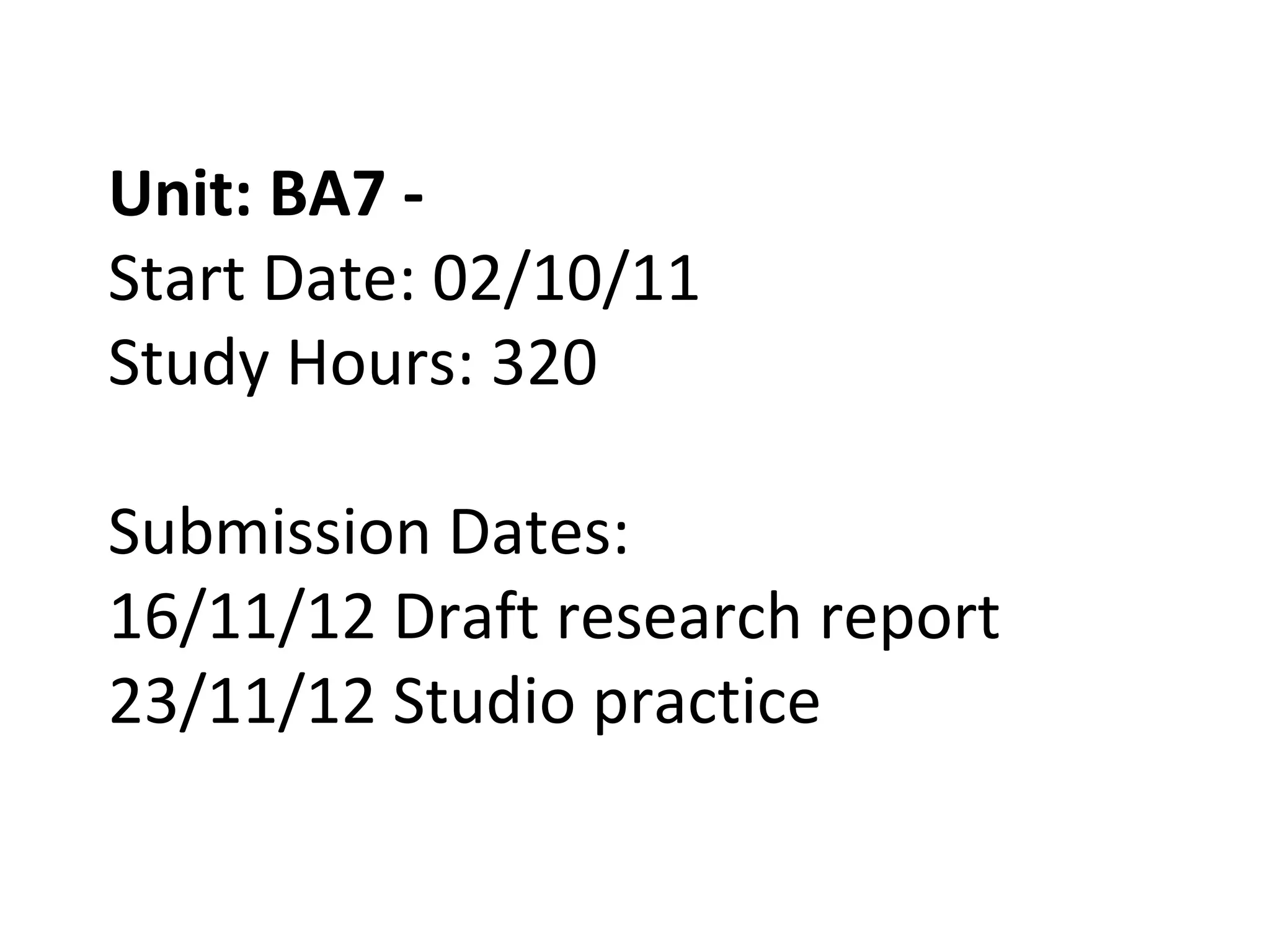
Unit: BA7 -
Start Date: 02/10/11
Study Hours: 320

Submission Dates:
16/11/12 Draft research report
23/11/12 Studio practice
• Description
  This project initiates your final year of study and
  aims to prepare you in planning, developing and
  organising your final project work for the next
  unit. In the early stages of the project you will be
  given advice on designing a Learning Agreement.
  This document will propose the direction of your
  study for the rest of the year and you will need to
  pay careful attention to explaining how your
  intended course of study will address the
  Learning Outcomes for the year.
• Description
  This project initiates your final year of study and
  aims to prepare you in planning, developing and
  organising your final project work for the next
  unit. In the early stages of the project you will be
  given advice on designing a Learning Agreement.
  This document will propose the direction of your
  study for the rest of the year and you will need to
  pay careful attention to explaining how your
  intended course of study will address the
  Learning Outcomes for the year.
• Description

• prepare you in planning, developing and
  organising your final project work for the next
  unit. In the early stages of the project you will be
• designing a Learning Agreement. This document
• propose the direction of your study for the rest
  of the year.
• address the Learning Outcomes for the year.
• The project also enables you to broaden and
  deepen your understanding of the importance of
  research and the types of research that are
  appropriate and relevant to your area of study
  within textiles. Experimentation and
  development of ideas, techniques and materials
  will need to be considered in the development of
  your project into its final stages in the next unit.
  You may want to consider how your work in each
  unit will prepare you for employment or further
  study.
• The project also enables you to broaden and
  deepen your understanding of the importance of
  research and the types of research that are
  appropriate and relevant to your area of study
  within surface design. Experimentation and
  development of ideas, techniques and materials
  will need to be considered in the development of
  your project into its final stages in the next unit.
  You may want to consider how your work in each
  unit will prepare you for employment or further
  study.
• broaden and deepen your understanding of the
  importance of research.
• appropriate and relevant to your area of study.
• Experimentation and development of ideas,
  techniques and materials. will need to be
• development of your project into its final stages
  in the next unit. You may want to consider how
• employment or further study.
• The project involves development of a research
  report alongside your studio development. Your
  research report will be developed independently
  with support from your tutors and will form an
  investigation into an area closely related to your
  practice in textiles. This could be a theoretical,
  social or cultural issue or something more closely
  aligned to the industry practice associated with
  your subject.
• The project involves development of a research
  report alongside your studio development. Your
  research report will be developed independently
  with support from your tutors and will form an
  investigation into an area closely related to your
  practice in textiles. This could be a theoretical,
  social or cultural issue or something more closely
  aligned to the industry practice associated with
  your subject.
• development of a research report alongside your
  studio development.
• investigation into an area closely related to your
  practice in textiles.
• theoretical, social or cultural issue. or something
• closely aligned to the industry practice associated
  with your subject.
• This project addresses the key areas of study as
  follows:
• Studio Practice: Your studio practice will be
  determined by the direction of your intended project.
  You will be expected to experiment with techniques,
  materials and concepts that you have learnt in Years 1
  and 2. Time management and organisation are
  essential in planning your project and access to
  appropriate workshops, as is your ability to assess risks
  and use safe working practices. It is important that you
  develop a range of visual, text based and material
  research throughout this project. You should also
  consider the contexts that you may want to explore.
• This project addresses the key areas of study as
  follows:
• Studio Practice: Your studio practice will be
  determined by the direction of your intended project.
  You will be expected to experiment with techniques,
  materials and concepts that you have learnt in Years 1
  and 2. Time management and organisation are
  essential in planning your project and access to
  appropriate workshops, as is your ability to assess risks
  and use safe working practices. It is important that you
  develop a range of visual, text based and material
  research throughout this project. You should also
  consider the contexts that you may want to explore.
• determined by the direction of your intended
  project.
• experiment with techniques, materials and
  concepts that you have learnt in Years 1 and 2.
• time management and organisation are essential.
• develop a range of visual, text based and material
  research. throughout this project. You should
  also
• consider the contexts. that you may want to
  explore.
• Business and Professional Skills: This project will
  include sessions on fund-raising,
  entrepreneurship and effective communication
  to a variety of audiences. Your independent
  research report may be wholly or partially
  concerned with investigating aspects of the
  creative industries associated with your subject.
  You will receive tutorial support throughout this
  project.
•
• Business and Professional Skills: This project will
  include sessions on fund-raising,
  entrepreneurship and effective communication
  to a variety of audiences. Your independent
  research report may be wholly or partially
  concerned with investigating aspects of the
  creative industries associated with your subject.
  You will receive tutorial support throughout this
  project.
•
• fund-raising, entrepreneurship.
• effective communication to a variety of
  audiences.
• independent research report associated with
  your subject.
 You will receive tutorial support throughout this
  project.
•
Developing a team for -
• The Stew Gallery Show
  and
• The Degree Show

 who?
 why?
 what?
• Contextual Studies: The project will address
  historical and theoretical research methods that
  will help you to critically engage with your work.
  You will be guided in planning, researching and
  writing a sustained research report. Your
  independent research report may be wholly or
  partially concerned with investigating contextual
  issues concerned with your studio project. You
  will be supported in your learning by a series of
  seminars where you will consider the content
  and presentation of your draft research report
• Contextual Studies: The project will address
  historical and theoretical research methods that
  will help you to critically engage with your work.
  You will be guided in planning, researching and
  writing a sustained research report. Your
  independent research report may be wholly or
  partially concerned with investigating contextual
  issues concerned with your studio project. You
  will be supported in your learning by a series of
  seminars where you will consider the content
  and presentation of your draft research report
• historical and theoretical research methods.
• critically engage with your work.
• planning, researching and writing a sustained
  research report.
• independent research report concerned with
  investigating contextual issues concerned with
  your studio project. You will be supported in your
• consider the content and presentation of your
  draft research report.
assessment

• What is physically expected from you and
  where you do it.
assessment
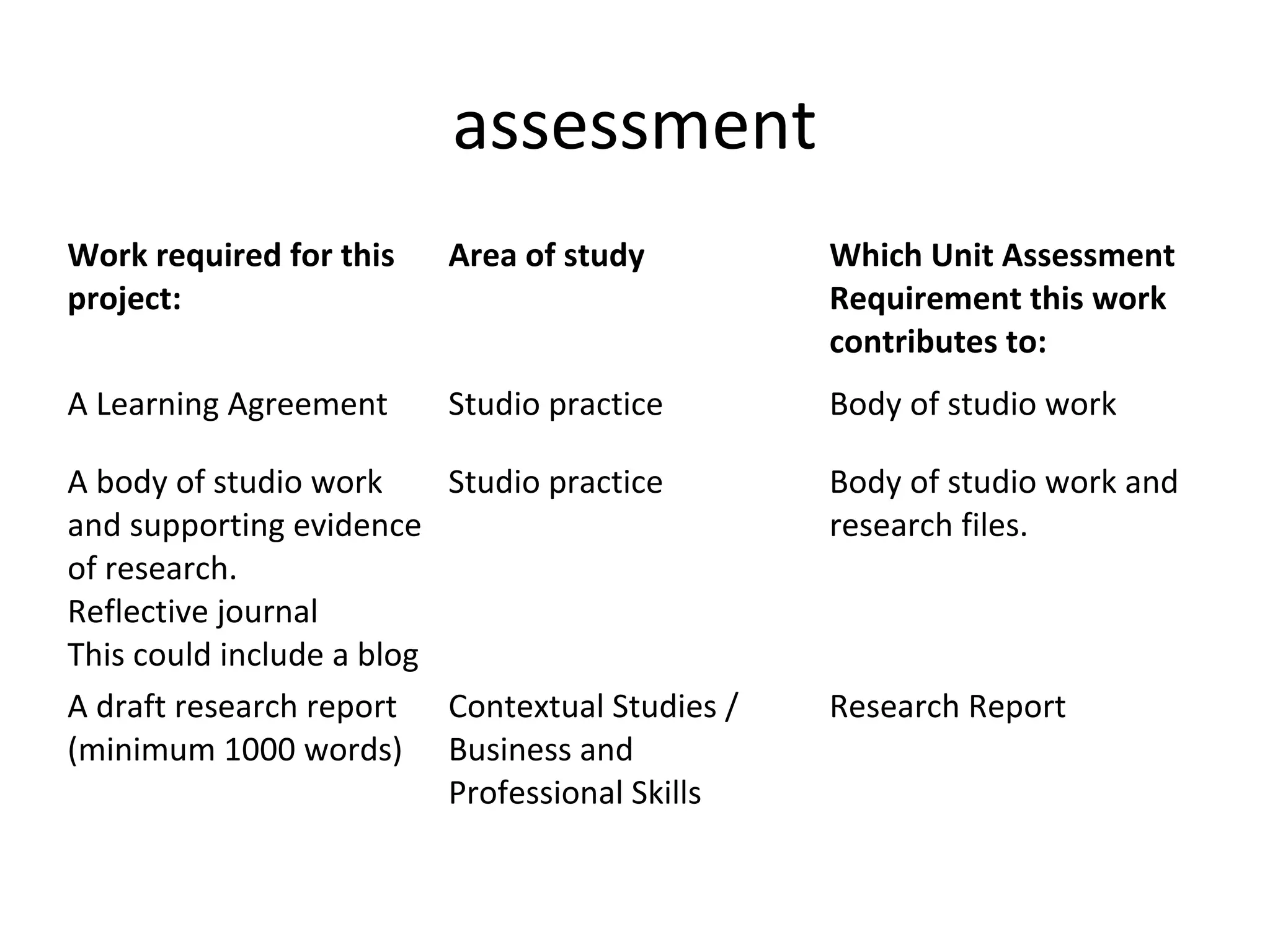
Work required for this   Area of study          Which Unit Assessment
project:                                        Requirement this work
                                                contributes to:
A Learning Agreement     Studio practice        Body of studio work

A body of studio work     Studio practice       Body of studio work and
and supporting evidence                         research files.
of research.
Reflective journal
This could include a blog
A draft research report Contextual Studies /    Research Report
(minimum 1000 words) Business and
                          Professional Skills
assessment

• What we look for and what you need to do.
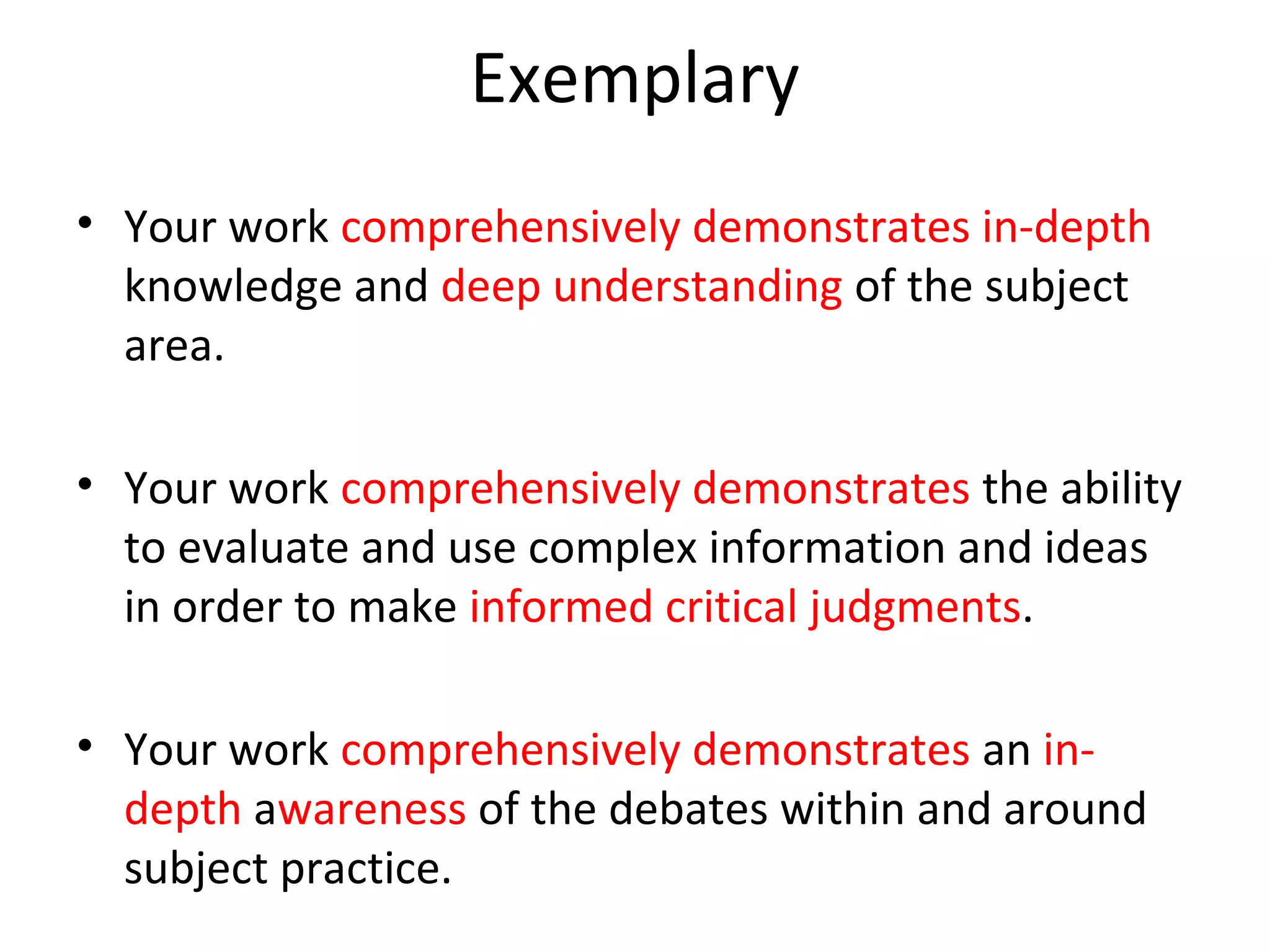
Exemplary
• Your work comprehensively demonstrates in-depth
  knowledge and deep understanding of the subject
  area.

• Your work comprehensively demonstrates the ability
  to evaluate and use complex information and ideas
  in order to make informed critical judgments.

• Your work comprehensively demonstrates an in-
  depth awareness of the debates within and around
  subject practice.
Excellent
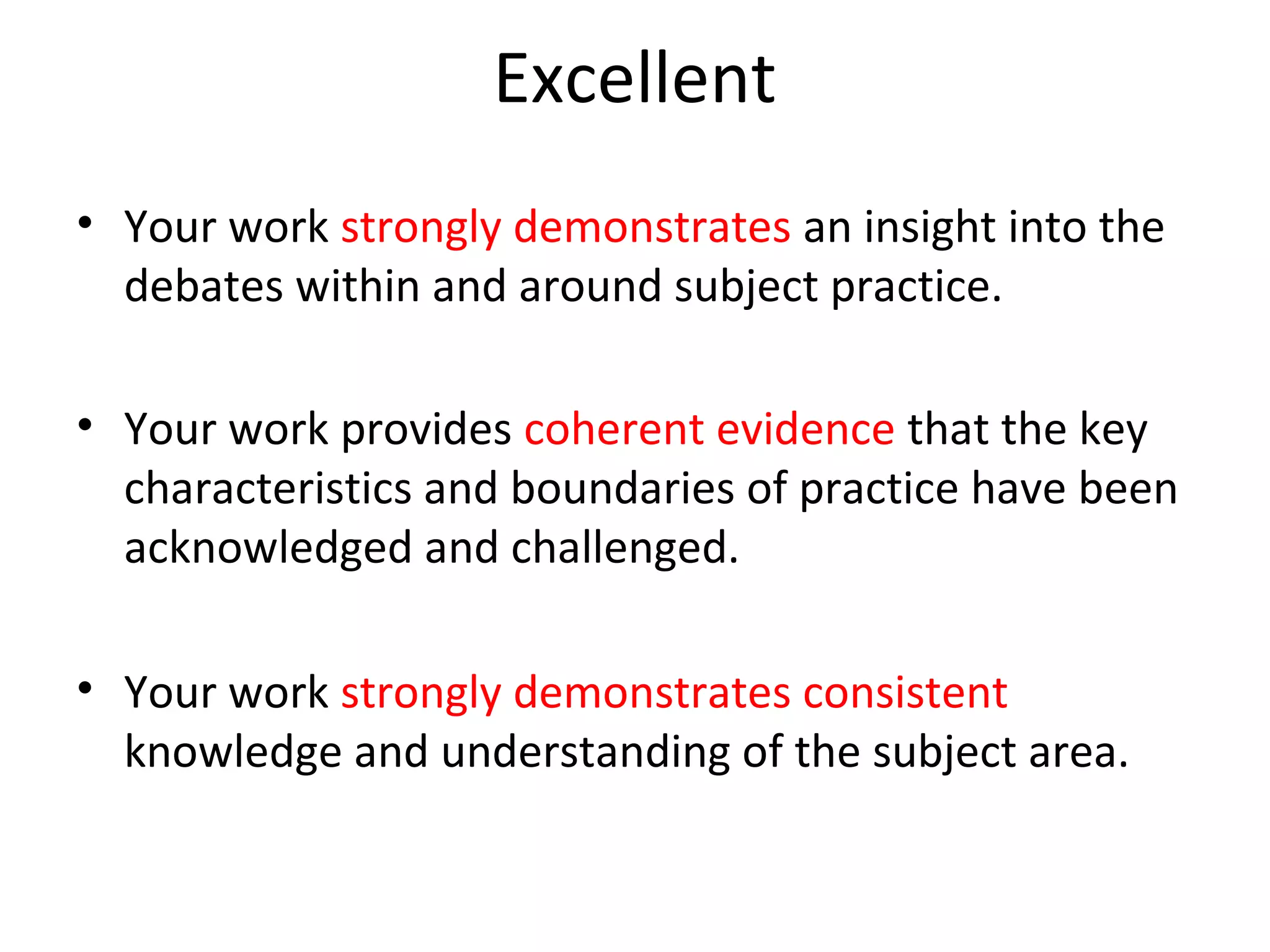
• Your work strongly demonstrates an insight into the
  debates within and around subject practice.

• Your work provides coherent evidence that the key
  characteristics and boundaries of practice have been
  acknowledged and challenged.

• Your work strongly demonstrates consistent
  knowledge and understanding of the subject area.
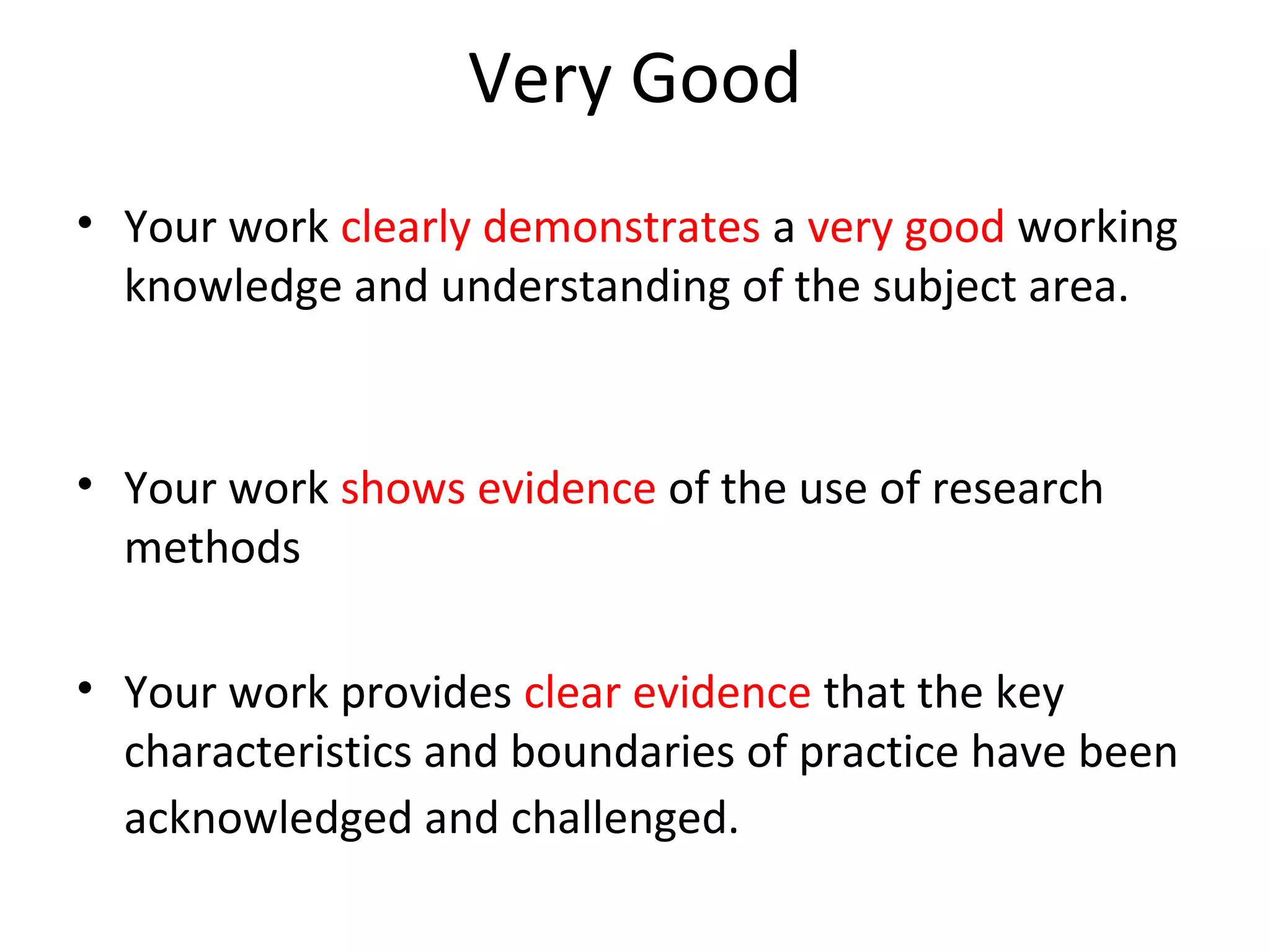
Very Good
• Your work clearly demonstrates a very good working
  knowledge and understanding of the subject area.


• Your work shows evidence of the use of research
  methods

• Your work provides clear evidence that the key
  characteristics and boundaries of practice have been
  acknowledged and challenged.
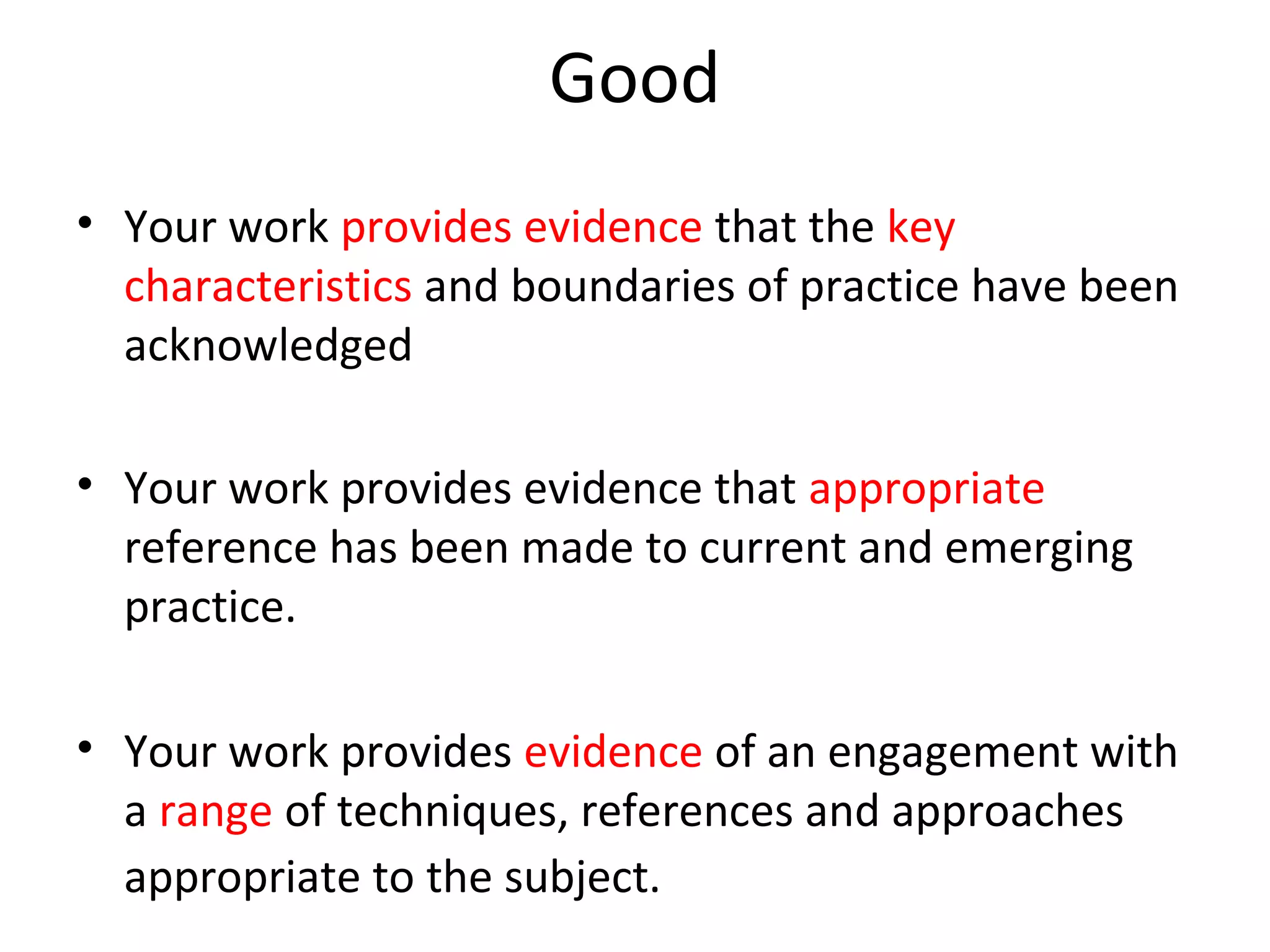
Good
• Your work provides evidence that the key
  characteristics and boundaries of practice have been
  acknowledged

• Your work provides evidence that appropriate
  reference has been made to current and emerging
  practice.

• Your work provides evidence of an engagement with
  a range of techniques, references and approaches
  appropriate to the subject.
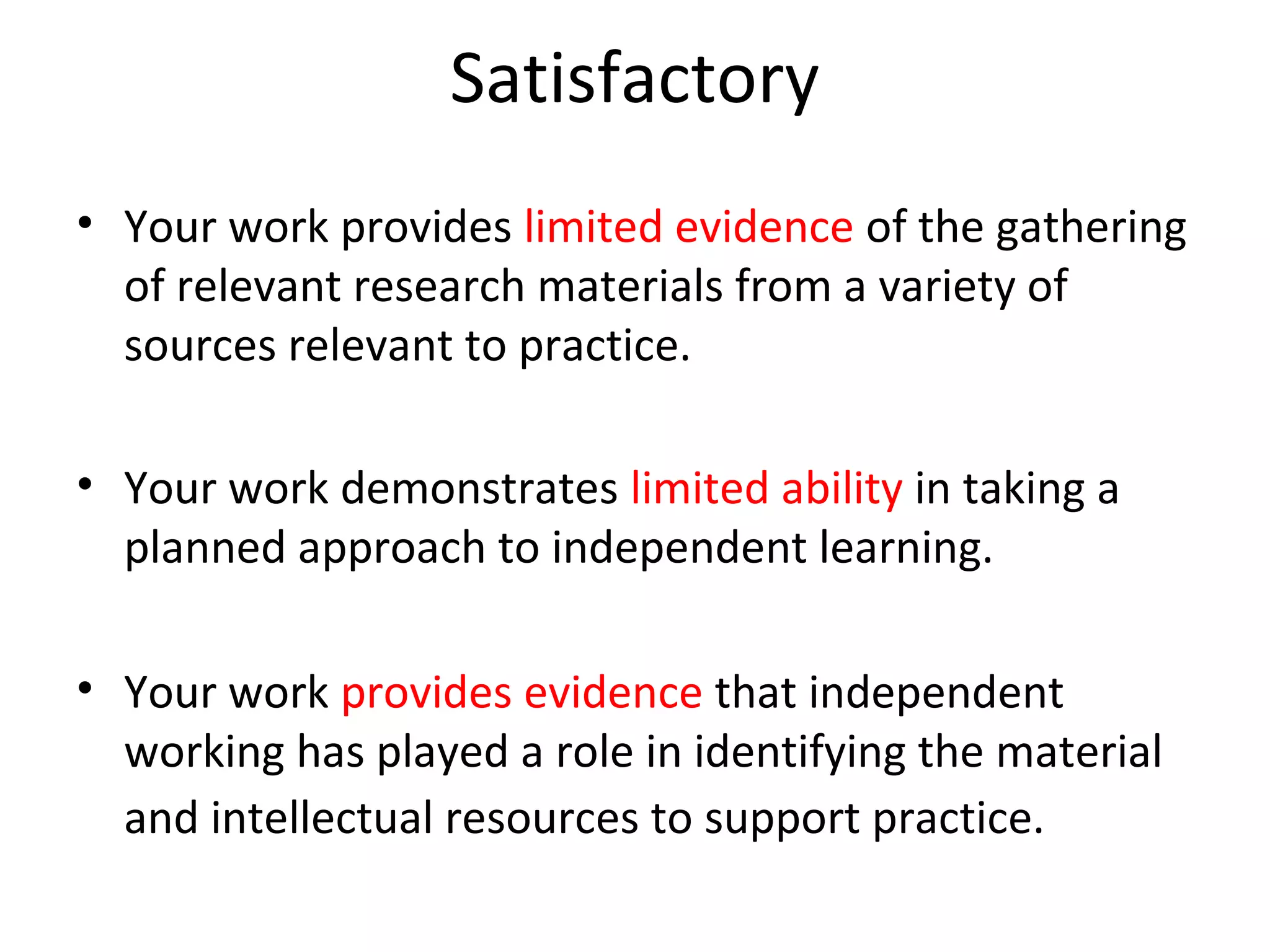
Satisfactory
• Your work provides limited evidence of the gathering
  of relevant research materials from a variety of
  sources relevant to practice.

• Your work demonstrates limited ability in taking a
  planned approach to independent learning.

• Your work provides evidence that independent
  working has played a role in identifying the material
  and intellectual resources to support practice.
Poor (Marginal Fail)
• Your work provides limited or insufficient evidence
  that reference has been made to current and
  emerging practice.

• Your work demonstrates a limited capacity to
  identify issues or questions related to your subject.


• Your work provides limited or partial evidence of an
  engagement with a range of techniques, references
  and approaches appropriate to the subject.
Unsatisfactory (Fail)
• Your work indicates little or no achievement in
  taking a planned approach to independent learning.


• Your work provides little or no evidence of a creative
  approach to communication

• Your work provides little or no evidence of a
  questioning approach to practice or problem solving.
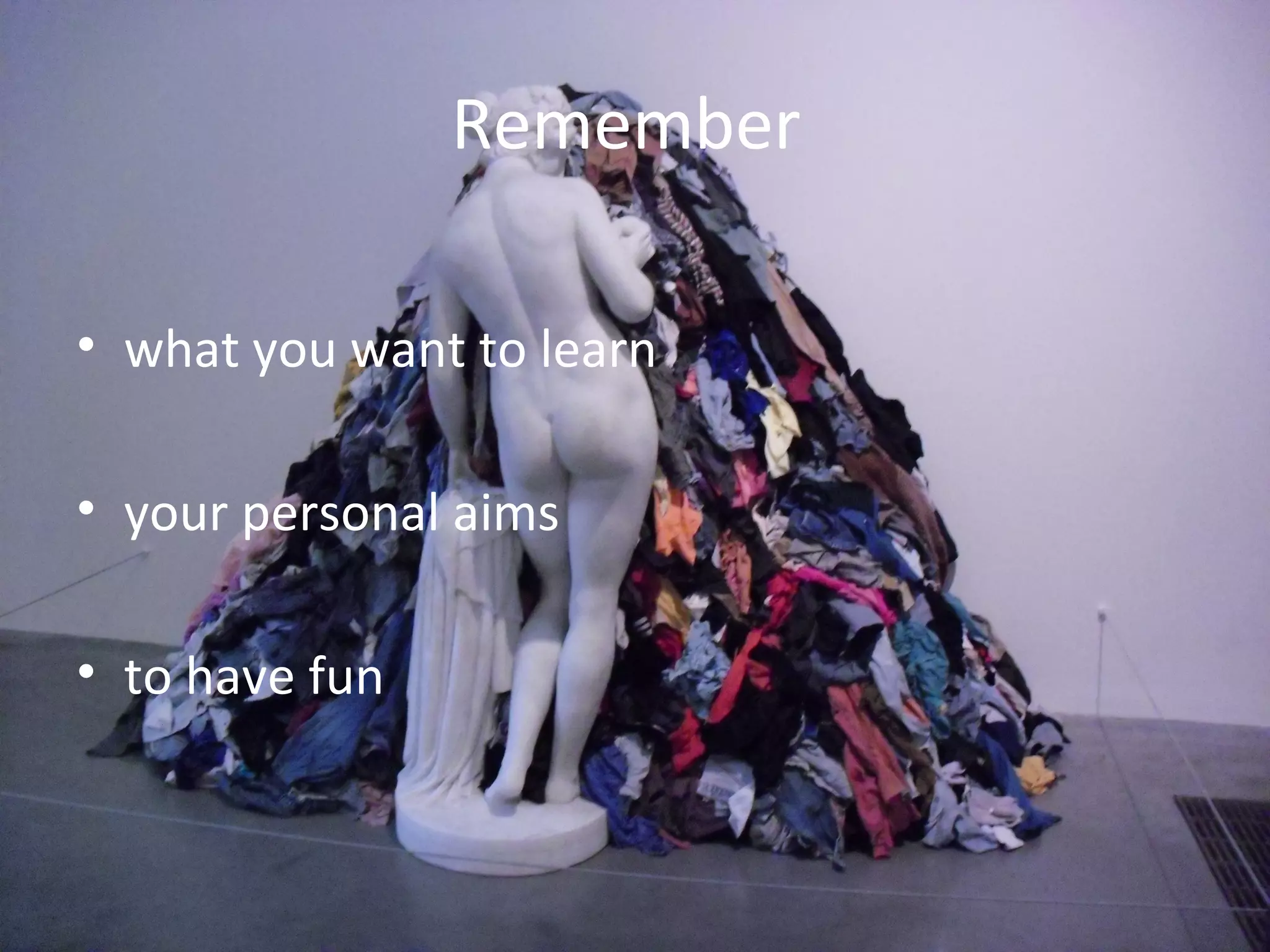
Remember

• what you want to learn

• your personal aims

• to have fun
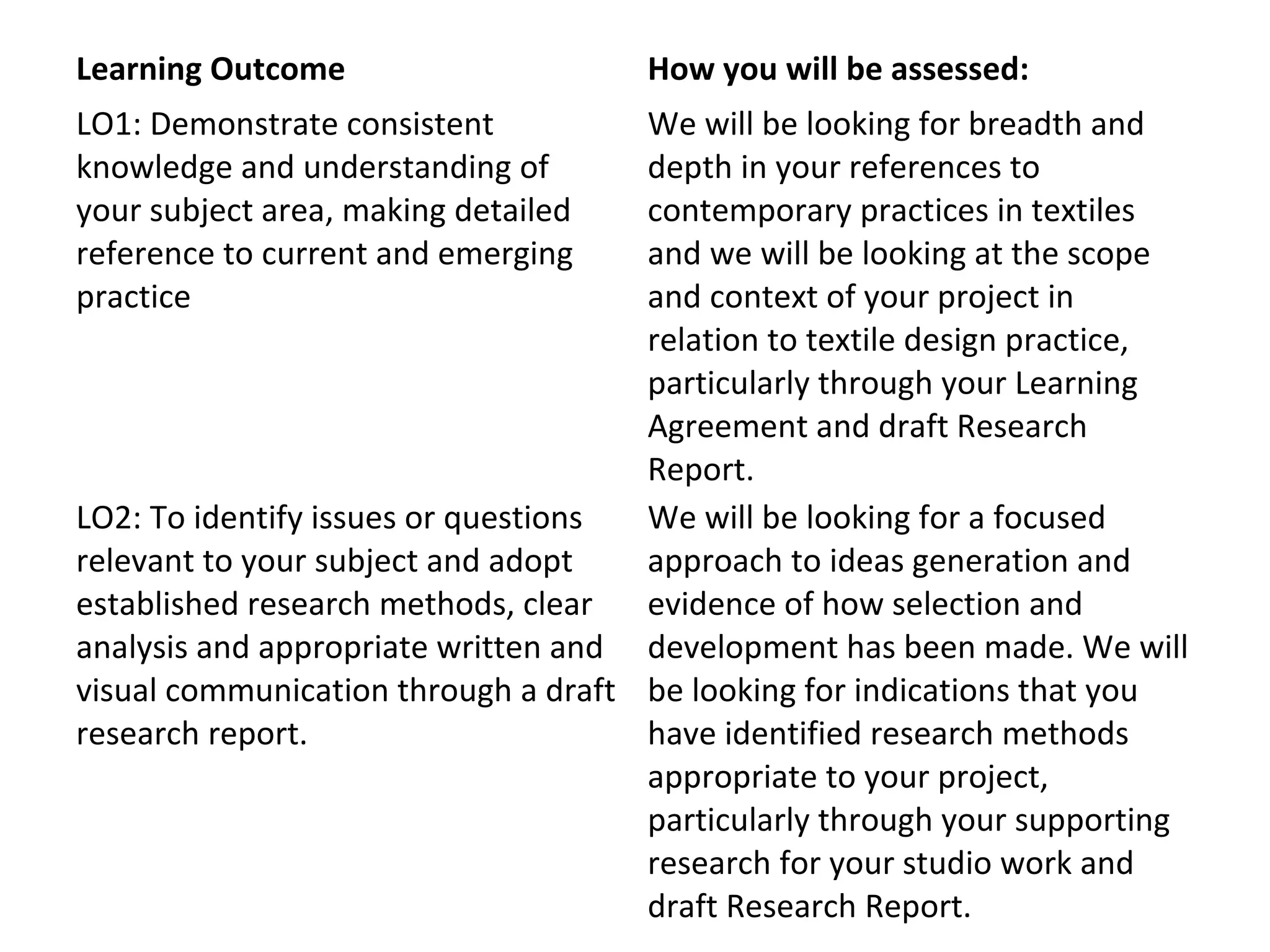
Learning Outcome                     How you will be assessed:
LO1: Demonstrate consistent          We will be looking for breadth and
knowledge and understanding of       depth in your references to
your subject area, making detailed   contemporary practices in textiles
reference to current and emerging    and we will be looking at the scope
practice                             and context of your project in
                                     relation to textile design practice,
                                     particularly through your Learning
                                     Agreement and draft Research
                                     Report.
LO2: To identify issues or questions We will be looking for a focused
relevant to your subject and adopt   approach to ideas generation and
established research methods, clear  evidence of how selection and
analysis and appropriate written and development has been made. We will
visual communication through a draft be looking for indications that you
research report.                     have identified research methods
                                     appropriate to your project,
                                     particularly through your supporting
                                     research for your studio work and
                                     draft Research Report.
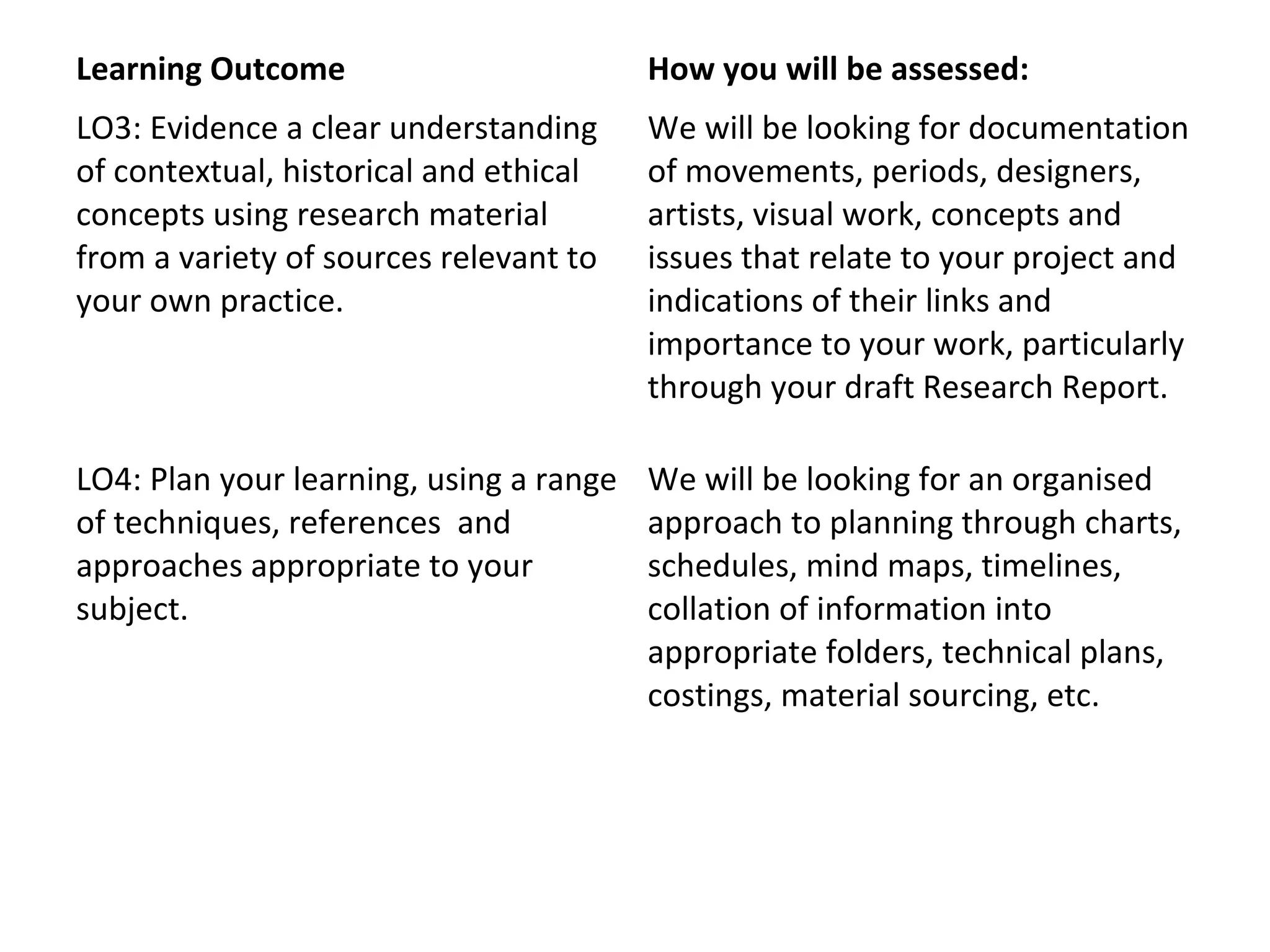
Learning Outcome                         How you will be assessed:
LO3: Evidence a clear understanding      We will be looking for documentation
of contextual, historical and ethical    of movements, periods, designers,
concepts using research material         artists, visual work, concepts and
from a variety of sources relevant to    issues that relate to your project and
your own practice.                       indications of their links and
                                         importance to your work, particularly
                                         through your draft Research Report.

LO4: Plan your learning, using a range   We will be looking for an organised
of techniques, references and            approach to planning through charts,
approaches appropriate to your           schedules, mind maps, timelines,
subject.                                 collation of information into
                                         appropriate folders, technical plans,
                                         costings, material sourcing, etc.
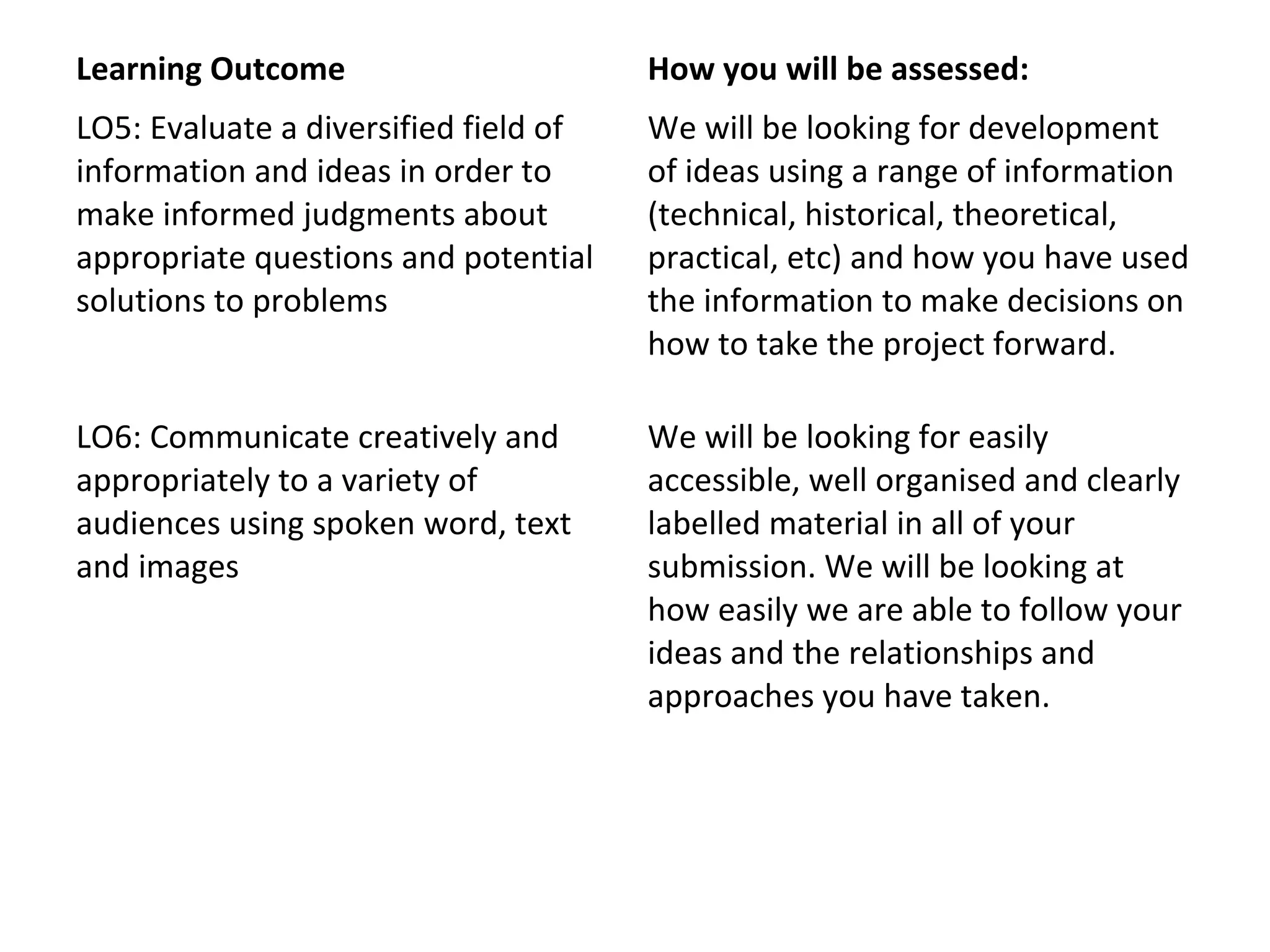
Learning Outcome                       How you will be assessed:
LO5: Evaluate a diversified field of   We will be looking for development
information and ideas in order to      of ideas using a range of information
make informed judgments about          (technical, historical, theoretical,
appropriate questions and potential    practical, etc) and how you have used
solutions to problems                  the information to make decisions on
                                       how to take the project forward.

LO6: Communicate creatively and        We will be looking for easily
appropriately to a variety of          accessible, well organised and clearly
audiences using spoken word, text      labelled material in all of your
and images                             submission. We will be looking at
                                       how easily we are able to follow your
                                       ideas and the relationships and
                                       approaches you have taken.

Unit 7 project briefing

  • 1.
    Course: BA (Hons)Textiles Year: Three Unit: BA7: Final Project 1: Research, development and reflection Project Title: Project Preparation Project 1 of 1 within this unit
  • 9.
    Course: BA (Hons)Textiles Year: Three Unit: BA7: Final Project 1: Research, development and reflection Project Title: Project Preparation Project 1 of 1 within this unit
  • 10.
  • 11.
  • 12.
    you and yourwork • 5 weeks to make work.
  • 13.
    you and yourwork • The first 5 weeks of this course are about you developing what you want to.
  • 14.
    you and yourwork •It is about you identifying, developing and following a research path in both your practical and textural work.
  • 15.
    you and yourwork •You will need to consider how to use your time effectively as you cannot get this time back.
  • 16.
    you and yourwork •Supported by individual tutorials alongside developmental and skill based workshops.
  • 17.
    you and yourwork It envisage that this time will involve you in - •Research - Deciding on your path(s) of interests and supporting your thinking. •Context - looking around at the work of others and where work is seen - shops, galleries etc. •Experimenting - trying stuff out by using skills and techniques. •Testing - making stuff, including final piece(s) •Reflection - on what you have done and then presenting it to others.
  • 18.
    you and yourwork • It is expected that you will make a body of work for yourself - all of these activities - research, context, experimenting, testing, final completed pieces and reflection are your work.
  • 19.
    reflection • Nov 5th– • Pecha Kucha • This is you presenting what you have done, a chance to bring all your work together and decide on what to do next.
  • 20.
    reflection • Pecha Kucha20x20 is a simple presentation format where you show 20 images, each for 20 seconds. The images advance automatically and you talk along to the images.
  • 21.
    reflection • Preparation. • Weare very enthusiastic about this task and its relationship to learning within the course.
  • 22.
    reflection • This hasbeen conceived as a 'rounding up' of your initial body of work - after which it is anticipated that you will go on to further develop your work and practice - this is so that you can now focus. • This is within the context that you will be getting a response from your cohort - this is feedback and needing to consider it - this is reflection.
  • 23.
    reflection • So - •Consider what you want to tell us what you want us to know what you want to learn • Tell a story. • Engage with your audience. • Consider your learning.
  • 24.
    focus • 4 weeks •Developing what your work is, could or should be. • To Dec 2nd
  • 25.
    focus • This istime to focus what it is that you do, what you are interested in, to hone skills and develop techniques and processes. • It is expected that you will make a body of focused work for yourself. • Become an expert.
  • 26.
    team • Dec • 2team projects
  • 27.
    team • Using your skills within a team • Professionalism • Finding your place • Testing yourself
  • 28.
    team • Task 1 •This will be a one week project.
  • 29.
    team • Task 2 •This will be a three week project.
  • 30.
  • 31.
    Final project • BA8 • Learning agreement • Thinking about the future? • How do you want to use your time? • What do you want to learn?
  • 32.
    Final project • BA8 •This is time to make work that will be your BA final project. • 10 weeks
  • 33.
  • 34.
    Mid Year Review •Stew Gallery • Mid Year Review
  • 35.
  • 36.
    degree show • Whatis this for? • Presenting yourself • Becoming public • Becoming professional • What next?
  • 37.
  • 38.
    New designers • Opportunity •Visibility • Timing
  • 39.
    Unit: BA7 - StartDate: 02/10/11 Study Hours: 320 Submission Dates: 16/11/12 Draft research report 23/11/12 Studio practice
  • 40.
    • Description This project initiates your final year of study and aims to prepare you in planning, developing and organising your final project work for the next unit. In the early stages of the project you will be given advice on designing a Learning Agreement. This document will propose the direction of your study for the rest of the year and you will need to pay careful attention to explaining how your intended course of study will address the Learning Outcomes for the year.
  • 41.
    • Description This project initiates your final year of study and aims to prepare you in planning, developing and organising your final project work for the next unit. In the early stages of the project you will be given advice on designing a Learning Agreement. This document will propose the direction of your study for the rest of the year and you will need to pay careful attention to explaining how your intended course of study will address the Learning Outcomes for the year.
  • 42.
    • Description • prepareyou in planning, developing and organising your final project work for the next unit. In the early stages of the project you will be • designing a Learning Agreement. This document • propose the direction of your study for the rest of the year. • address the Learning Outcomes for the year.
  • 43.
    • The projectalso enables you to broaden and deepen your understanding of the importance of research and the types of research that are appropriate and relevant to your area of study within textiles. Experimentation and development of ideas, techniques and materials will need to be considered in the development of your project into its final stages in the next unit. You may want to consider how your work in each unit will prepare you for employment or further study.
  • 44.
    • The projectalso enables you to broaden and deepen your understanding of the importance of research and the types of research that are appropriate and relevant to your area of study within surface design. Experimentation and development of ideas, techniques and materials will need to be considered in the development of your project into its final stages in the next unit. You may want to consider how your work in each unit will prepare you for employment or further study.
  • 45.
    • broaden anddeepen your understanding of the importance of research. • appropriate and relevant to your area of study. • Experimentation and development of ideas, techniques and materials. will need to be • development of your project into its final stages in the next unit. You may want to consider how • employment or further study.
  • 46.
    • The projectinvolves development of a research report alongside your studio development. Your research report will be developed independently with support from your tutors and will form an investigation into an area closely related to your practice in textiles. This could be a theoretical, social or cultural issue or something more closely aligned to the industry practice associated with your subject.
  • 47.
    • The projectinvolves development of a research report alongside your studio development. Your research report will be developed independently with support from your tutors and will form an investigation into an area closely related to your practice in textiles. This could be a theoretical, social or cultural issue or something more closely aligned to the industry practice associated with your subject.
  • 48.
    • development ofa research report alongside your studio development. • investigation into an area closely related to your practice in textiles. • theoretical, social or cultural issue. or something • closely aligned to the industry practice associated with your subject.
  • 49.
    • This projectaddresses the key areas of study as follows: • Studio Practice: Your studio practice will be determined by the direction of your intended project. You will be expected to experiment with techniques, materials and concepts that you have learnt in Years 1 and 2. Time management and organisation are essential in planning your project and access to appropriate workshops, as is your ability to assess risks and use safe working practices. It is important that you develop a range of visual, text based and material research throughout this project. You should also consider the contexts that you may want to explore.
  • 50.
    • This projectaddresses the key areas of study as follows: • Studio Practice: Your studio practice will be determined by the direction of your intended project. You will be expected to experiment with techniques, materials and concepts that you have learnt in Years 1 and 2. Time management and organisation are essential in planning your project and access to appropriate workshops, as is your ability to assess risks and use safe working practices. It is important that you develop a range of visual, text based and material research throughout this project. You should also consider the contexts that you may want to explore.
  • 51.
    • determined bythe direction of your intended project. • experiment with techniques, materials and concepts that you have learnt in Years 1 and 2. • time management and organisation are essential. • develop a range of visual, text based and material research. throughout this project. You should also • consider the contexts. that you may want to explore.
  • 52.
    • Business andProfessional Skills: This project will include sessions on fund-raising, entrepreneurship and effective communication to a variety of audiences. Your independent research report may be wholly or partially concerned with investigating aspects of the creative industries associated with your subject. You will receive tutorial support throughout this project. •
  • 53.
    • Business andProfessional Skills: This project will include sessions on fund-raising, entrepreneurship and effective communication to a variety of audiences. Your independent research report may be wholly or partially concerned with investigating aspects of the creative industries associated with your subject. You will receive tutorial support throughout this project. •
  • 54.
    • fund-raising, entrepreneurship. •effective communication to a variety of audiences. • independent research report associated with your subject. You will receive tutorial support throughout this project. •
  • 55.
    Developing a teamfor - • The Stew Gallery Show and • The Degree Show who? why? what?
  • 56.
    • Contextual Studies:The project will address historical and theoretical research methods that will help you to critically engage with your work. You will be guided in planning, researching and writing a sustained research report. Your independent research report may be wholly or partially concerned with investigating contextual issues concerned with your studio project. You will be supported in your learning by a series of seminars where you will consider the content and presentation of your draft research report
  • 57.
    • Contextual Studies:The project will address historical and theoretical research methods that will help you to critically engage with your work. You will be guided in planning, researching and writing a sustained research report. Your independent research report may be wholly or partially concerned with investigating contextual issues concerned with your studio project. You will be supported in your learning by a series of seminars where you will consider the content and presentation of your draft research report
  • 58.
    • historical andtheoretical research methods. • critically engage with your work. • planning, researching and writing a sustained research report. • independent research report concerned with investigating contextual issues concerned with your studio project. You will be supported in your • consider the content and presentation of your draft research report.
  • 59.
    assessment • What isphysically expected from you and where you do it.
  • 60.
    assessment Work required forthis Area of study Which Unit Assessment project: Requirement this work contributes to: A Learning Agreement Studio practice Body of studio work A body of studio work Studio practice Body of studio work and and supporting evidence research files. of research. Reflective journal This could include a blog A draft research report Contextual Studies / Research Report (minimum 1000 words) Business and Professional Skills
  • 61.
    assessment • What welook for and what you need to do.
  • 62.
    Exemplary • Your workcomprehensively demonstrates in-depth knowledge and deep understanding of the subject area. • Your work comprehensively demonstrates the ability to evaluate and use complex information and ideas in order to make informed critical judgments. • Your work comprehensively demonstrates an in- depth awareness of the debates within and around subject practice.
  • 63.
    Excellent • Your workstrongly demonstrates an insight into the debates within and around subject practice. • Your work provides coherent evidence that the key characteristics and boundaries of practice have been acknowledged and challenged. • Your work strongly demonstrates consistent knowledge and understanding of the subject area.
  • 64.
    Very Good • Yourwork clearly demonstrates a very good working knowledge and understanding of the subject area. • Your work shows evidence of the use of research methods • Your work provides clear evidence that the key characteristics and boundaries of practice have been acknowledged and challenged.
  • 65.
    Good • Your workprovides evidence that the key characteristics and boundaries of practice have been acknowledged • Your work provides evidence that appropriate reference has been made to current and emerging practice. • Your work provides evidence of an engagement with a range of techniques, references and approaches appropriate to the subject.
  • 66.
    Satisfactory • Your workprovides limited evidence of the gathering of relevant research materials from a variety of sources relevant to practice. • Your work demonstrates limited ability in taking a planned approach to independent learning. • Your work provides evidence that independent working has played a role in identifying the material and intellectual resources to support practice.
  • 67.
    Poor (Marginal Fail) •Your work provides limited or insufficient evidence that reference has been made to current and emerging practice. • Your work demonstrates a limited capacity to identify issues or questions related to your subject. • Your work provides limited or partial evidence of an engagement with a range of techniques, references and approaches appropriate to the subject.
  • 68.
    Unsatisfactory (Fail) • Yourwork indicates little or no achievement in taking a planned approach to independent learning. • Your work provides little or no evidence of a creative approach to communication • Your work provides little or no evidence of a questioning approach to practice or problem solving.
  • 69.
    Remember • what youwant to learn • your personal aims • to have fun
  • 71.
    Learning Outcome How you will be assessed: LO1: Demonstrate consistent We will be looking for breadth and knowledge and understanding of depth in your references to your subject area, making detailed contemporary practices in textiles reference to current and emerging and we will be looking at the scope practice and context of your project in relation to textile design practice, particularly through your Learning Agreement and draft Research Report. LO2: To identify issues or questions We will be looking for a focused relevant to your subject and adopt approach to ideas generation and established research methods, clear evidence of how selection and analysis and appropriate written and development has been made. We will visual communication through a draft be looking for indications that you research report. have identified research methods appropriate to your project, particularly through your supporting research for your studio work and draft Research Report.
  • 72.
    Learning Outcome How you will be assessed: LO3: Evidence a clear understanding We will be looking for documentation of contextual, historical and ethical of movements, periods, designers, concepts using research material artists, visual work, concepts and from a variety of sources relevant to issues that relate to your project and your own practice. indications of their links and importance to your work, particularly through your draft Research Report. LO4: Plan your learning, using a range We will be looking for an organised of techniques, references and approach to planning through charts, approaches appropriate to your schedules, mind maps, timelines, subject. collation of information into appropriate folders, technical plans, costings, material sourcing, etc.
  • 73.
    Learning Outcome How you will be assessed: LO5: Evaluate a diversified field of We will be looking for development information and ideas in order to of ideas using a range of information make informed judgments about (technical, historical, theoretical, appropriate questions and potential practical, etc) and how you have used solutions to problems the information to make decisions on how to take the project forward. LO6: Communicate creatively and We will be looking for easily appropriately to a variety of accessible, well organised and clearly audiences using spoken word, text labelled material in all of your and images submission. We will be looking at how easily we are able to follow your ideas and the relationships and approaches you have taken.