working for yourself
its business time....
self-employed - responsibilities
maintaining confidence
finding work
building networks
promoting yourself
managing contracts and commissions
costing and pricing
building good relationships with clients
and other practitioners
self-employed - responsibilities
having high professional standards
delivering the work on time
invoicing for payment
protecting your work
maintaining your business records
running the business on a day-to-day basis
paying your tax.
the real business issues
Your position
self-employed - you need to submit
a Self Assessment tax return for
the tax year, your personal allowance is
£11,500.
https://www.gov.uk/self-assessment-tax-
returns
https://www.access.service.gov.uk/registr
ation/email
Registering
https://www.access.service.gov.uk/registr
ation/email
- send you a letter with your 10-digit
Unique Taxpayer Reference (UTR)
- set up your account for the Self
Assessment online service
Your position
PAYE - is basically the money that gets
taken away from your wages for tax.
The Pay As You Earn (PAYE) system is how
you pay both your income tax and
national insurance (NI). Every time you're
paid, your ‘boss’ takes your tax and NI
from your wages and sends it on to
HMRC.
pricing work - starting
do you need to keep the work?
what other people doing the same sort
of work earn/charge
what similarly qualified people in
different, but not entirely dissimilar,
situations earn/charge
your own experience and flair
quoting for a job
if you really want the job you might
be willing to put in more hours to get
it, or under price for it.
everyone does that sometimes, but
do remember you can’t do it all the
time at some point you have to eat.
Pricing your services
Do your research
Understand the competition
Understand your clients
– how they spend their money
Set yourself targets
Create packages
Be flexible
– focus on building a network to start with
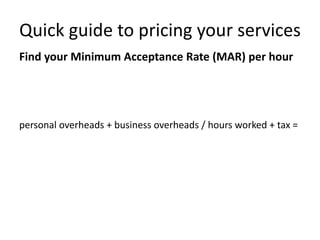
Quick guide to pricing your services
Find your Minimum Acceptance Rate (MAR) per hour
personal overheads + business overheads / hours worked + tax =
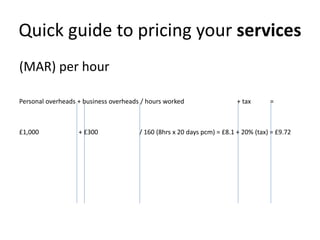
Quick guide to pricing your services
(MAR) per hour
Personal overheads + business overheads / hours worked + tax =
£1,000 + £300 / 160 (8hrs x 20 days pcm) = £8.1 + 20% (tax) = £9.72
pricing work - factors
actual
materials
packaging – labels – tags
postage
advertising
service
time - how much to charge?
recognition
context – the market
its value to you
pricing work - factors
overheads
electricity/gas/oil - heating
rent - equipment
rates
travel - commute
advice – mentor, accounts
work clothes
purchases
bank loan - equipment
pricing work - factors
commission
the cut people take
what they undertake on your behalf
wholesale – retail
%
wholesale – retail
Wholesalers generally buy a large quantity of
products directly from distributors. High-
volume purchase orders typically improve a
wholesaler’s buying power. Many distributors
provide discounts for a certain number of
items purchased or the total amount spent on
merchandise.
http://smallbusiness.chron.com/differences-
between-wholesalers-distributors-retailers-
30836.html
wholesale – retail
Retailers consist of small and large for-profit
businesses that sell products directly to
consumers. To realize a profit, retailers search
for products that coincide with their business
objectives and find suppliers with the most
competitive pricing. Generally, a retailer can
buy small quantities of an item from a
distributor or a wholesaler
http://smallbusiness.chron.com/differences-
between-wholesalers-distributors-retailers-
30836.html
sales agreement
for every sale there must be an agreed
contract between you and your buyer or
client.
Make sure that you write this down.
payment options
Cash sales
Cheques & credit cards
scrutiny - account number, name,
signature, expiry date etc
Paypal
invoiced sales
commissions
20 % - 100% +
agree a schedule of payment
issue your invoices against these agreed
payment dates
credit
30 days?
negotiate the payment over a few
instalments
invoices
invoice should:
be clearly laid out with your name, business
address, telephone, fax number and email
have a number (eg 'Invoice no: 0001') to act as a
sales reference
give a description of the products or services
sold, date of sale or completion and quantity of
goods eg number of prints, or number of days
worked
invoices
invoice should contain:
the name of your customer
self-employed tax reference number
company number and registered address if
set up as a company
include a subtotal for VAT if you are VAT
registered
terms & conditions
state payment is due 30 days from date of
invoice or delivery of goods
other terms and conditions, such as your right to
retain the copyright on your designs or artwork,
charges for storage on late collection of large
pieces or interest on overdue payments.
whatever you decide
keep hard copies
late payment
-Email
-phone
- written reminder - charge interest
and debt recovery costs if you are not
paid promptly
- compensation for administration
(local enterprise agencies)
- Legal proceedings
toolkits
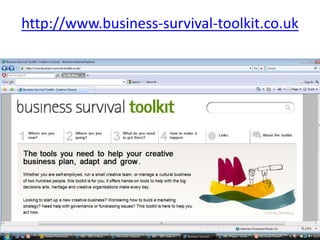
http://www.business-survival-toolkit.co.uk
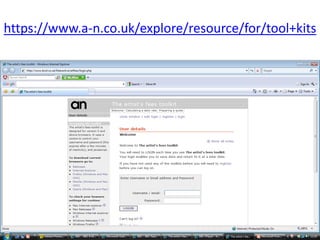
https://www.a-n.co.uk/explore/resource/for/tool+kits
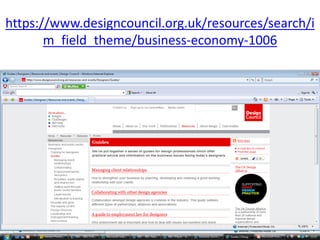
https://www.designcouncil.org.uk/resources/search/i
m_field_theme/business-economy-1006
www.payontime.co.uk
Download the Better Payment Practice Guide, advice
on charging interest and administration fees for late
payment.
www.unpaidinvoices.com
Name and shame those who don't pay!
www.courtservice.gov.uk/mcol/
Claim your money online.
www.dti.gov.uk/publications
Department of Trade and Industry
T: +44 870 150 2500
ACAS Advisory, Conciliation and Arbitration Service
Public Enquiries T: +44 20 7396 5100
payment support
thank you
thank you
thank you
thank you
thank you

Part 03 its business time - working for 'yourself'.

  • 1.
    working for yourself itsbusiness time....
  • 2.
    self-employed - responsibilities maintainingconfidence finding work building networks promoting yourself managing contracts and commissions costing and pricing building good relationships with clients and other practitioners
  • 3.
    self-employed - responsibilities havinghigh professional standards delivering the work on time invoicing for payment protecting your work maintaining your business records running the business on a day-to-day basis paying your tax.
  • 4.
  • 5.
    Your position self-employed -you need to submit a Self Assessment tax return for the tax year, your personal allowance is £11,500. https://www.gov.uk/self-assessment-tax- returns https://www.access.service.gov.uk/registr ation/email
  • 6.
    Registering https://www.access.service.gov.uk/registr ation/email - send youa letter with your 10-digit Unique Taxpayer Reference (UTR) - set up your account for the Self Assessment online service
  • 7.
    Your position PAYE -is basically the money that gets taken away from your wages for tax. The Pay As You Earn (PAYE) system is how you pay both your income tax and national insurance (NI). Every time you're paid, your ‘boss’ takes your tax and NI from your wages and sends it on to HMRC.
  • 8.
    pricing work -starting do you need to keep the work? what other people doing the same sort of work earn/charge what similarly qualified people in different, but not entirely dissimilar, situations earn/charge your own experience and flair
  • 9.
    quoting for ajob if you really want the job you might be willing to put in more hours to get it, or under price for it. everyone does that sometimes, but do remember you can’t do it all the time at some point you have to eat.
  • 10.
    Pricing your services Doyour research Understand the competition Understand your clients – how they spend their money Set yourself targets Create packages Be flexible – focus on building a network to start with
  • 11.
    Quick guide topricing your services Find your Minimum Acceptance Rate (MAR) per hour personal overheads + business overheads / hours worked + tax =
  • 12.
    Quick guide topricing your services (MAR) per hour Personal overheads + business overheads / hours worked + tax = £1,000 + £300 / 160 (8hrs x 20 days pcm) = £8.1 + 20% (tax) = £9.72
  • 13.
    pricing work -factors actual materials packaging – labels – tags postage advertising service time - how much to charge? recognition context – the market its value to you
  • 14.
    pricing work -factors overheads electricity/gas/oil - heating rent - equipment rates travel - commute advice – mentor, accounts work clothes purchases bank loan - equipment
  • 15.
    pricing work -factors commission the cut people take what they undertake on your behalf wholesale – retail %
  • 16.
    wholesale – retail Wholesalersgenerally buy a large quantity of products directly from distributors. High- volume purchase orders typically improve a wholesaler’s buying power. Many distributors provide discounts for a certain number of items purchased or the total amount spent on merchandise. http://smallbusiness.chron.com/differences- between-wholesalers-distributors-retailers- 30836.html
  • 17.
    wholesale – retail Retailersconsist of small and large for-profit businesses that sell products directly to consumers. To realize a profit, retailers search for products that coincide with their business objectives and find suppliers with the most competitive pricing. Generally, a retailer can buy small quantities of an item from a distributor or a wholesaler http://smallbusiness.chron.com/differences- between-wholesalers-distributors-retailers- 30836.html
  • 18.
    sales agreement for everysale there must be an agreed contract between you and your buyer or client. Make sure that you write this down.
  • 19.
    payment options Cash sales Cheques& credit cards scrutiny - account number, name, signature, expiry date etc Paypal
  • 20.
    invoiced sales commissions 20 %- 100% + agree a schedule of payment issue your invoices against these agreed payment dates
  • 21.
    credit 30 days? negotiate thepayment over a few instalments
  • 22.
    invoices invoice should: be clearlylaid out with your name, business address, telephone, fax number and email have a number (eg 'Invoice no: 0001') to act as a sales reference give a description of the products or services sold, date of sale or completion and quantity of goods eg number of prints, or number of days worked
  • 23.
    invoices invoice should contain: thename of your customer self-employed tax reference number company number and registered address if set up as a company include a subtotal for VAT if you are VAT registered
  • 24.
    terms & conditions statepayment is due 30 days from date of invoice or delivery of goods other terms and conditions, such as your right to retain the copyright on your designs or artwork, charges for storage on late collection of large pieces or interest on overdue payments. whatever you decide keep hard copies
  • 25.
    late payment -Email -phone - writtenreminder - charge interest and debt recovery costs if you are not paid promptly - compensation for administration (local enterprise agencies) - Legal proceedings
  • 26.
  • 27.
  • 28.
  • 29.
  • 30.
    www.payontime.co.uk Download the BetterPayment Practice Guide, advice on charging interest and administration fees for late payment. www.unpaidinvoices.com Name and shame those who don't pay! www.courtservice.gov.uk/mcol/ Claim your money online. www.dti.gov.uk/publications Department of Trade and Industry T: +44 870 150 2500 ACAS Advisory, Conciliation and Arbitration Service Public Enquiries T: +44 20 7396 5100 payment support
  • 31.
    thank you thank you thankyou thank you thank you