time to quit
If at first you don't succeed, try, try
again. Then quit. There's no point in
being a damn fool about it.
W. C. Fields
A professional writer is an amateur
who didn't quit.
Richard Bach
recognising when to give up
What gets in the
way of us doing
what we need to
do?
the journey!
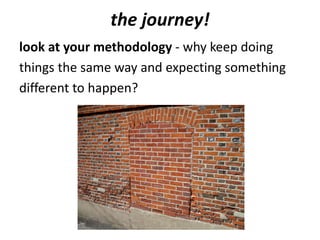
look at your methodology - why keep doing
things the same way and expecting something
different to happen?
"fail quickly."
• If I started with a hundred ideas, I'm lucky if
two or three of those ideas will ever turn into
academic papers. One of my great skills as an
economist has been to recognize the need to
fail quickly and the willingness to jettison a
project as soon as I realize it's likely to fail.
Freakonomics
sunk cost
sunk cost is about the past – it’s the time or
money or sweat you’ve put into a job or
relationship or a project, and which makes
quitting hard.
opportunity cost
opportunity cost is about the future. It means
that for every hour or pound you spend on one
thing, you’re giving up the opportunity to spend
that hour or dollar on something else –
something that might make your life better. If
only you weren’t so worried about the sunk
cost. If only you could …. quit.
What strategies do
we use to help us?
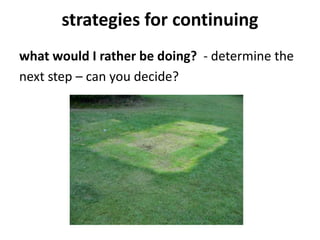
strategies for continuing
what would I rather be doing? - determine the
next step – can you decide?
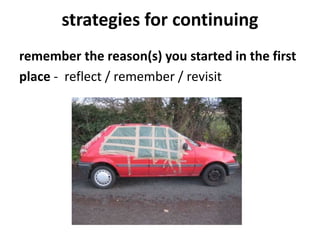
strategies for continuing
remember the reason(s) you started in the first
place - reflect / remember / revisit
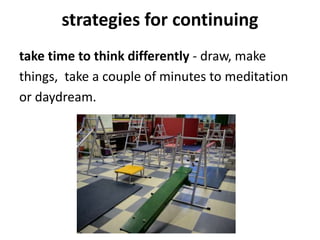
strategies for continuing
take time to think differently - draw, make
things, take a couple of minutes to meditation
or daydream.
strategies for continuing
make a contract with yourself - be honest
strategies for continuing
find someone to trust – build a support team
strategies for continuing
have a schedule - keep goals to pace yourself
strategies for continuing
write notes - write junk
strategies for continuing
break it down – small bites
strategies for continuing
wallow – but not for long
strategies for continuing
go out - walk away and come back
strategies for continuing
be scared – take cold showers often
strategies for continuing
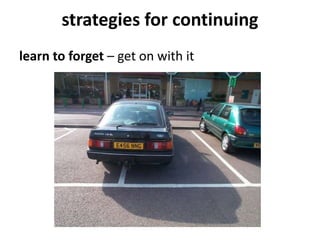
learn to forget – get on with it
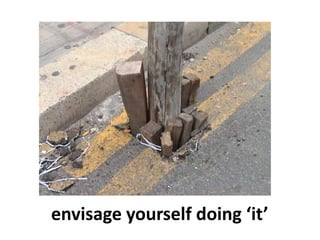
envisage yourself doing ‘it’
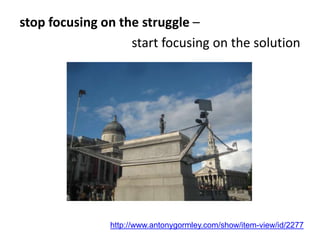
stop focusing on the struggle –
start focusing on the solution
http://www.antonygormley.com/show/item-view/id/2277
making thinking
making-thinking
List all the elements within and connections to your
current project.
Research
Materials
Process’s
Activity
Content
Concepts
Possible outcomes both physical and intentions
making-thinking
Consider
their importance within the project
their relationship to each other
how they influence each other
Title the project
Now create an equation / diagram that
expresses your project.
making-thinking
Pass the equation / diagram to another person.
In response to the equation /diagram you are
now to make a visual representation using
only tape and 1 Sheet of A4 paper.
making-thinking
Return the tape representation to the person
whose equation /diagram you were given.
Without explanation consider what does the
work communicate to you?
Does the representation bring any insights to
your project?
Did your diagram communicate your project?
making-thinking
Share the learning – explain the work.
Where are the gaps?
Did your diagrams / representations
communicate effectively?
Did the response bring new ideas or new ways
of thinking about your project?

Done.....when to quit with tape workshop