Course: BA (Hons) Textiles  Year: One  Unit: BA3  Project Title Self Direction 1  Trends, Contexts, Issues
Project  1  of  2  within this unit  Start Date: 14/03/11  Study Hours: 240  Submission Date: 16/05/11
Description   In this project you will be asked to write your own project brief in the form of a Learning Agreement.
Description  This will identify the concept you wish to investigate and the market you will be designing for.
Description   You will have the opportunity to explore a breadth of contexts for your practice and investigate the implication of this for your own work.
Description  This will involve looking at trends information and current issues within the textile industry
Description You should explore the potential for new ideas based on research of your chosen theme in relation to trend information and issue based debates.
Description The project will allow you to demonstrate how you effectively manage your own learning.
Description The project, whilst building on the knowledge gained from previous units, will focus on further developing experimental approaches to textiles.
Description During the project you will need to research trends information to inform the materials, processes and techniques you will use.
Description You will also be required to look at colour palettes and identify a market and context for your work.
Description This project will give you the opportunity to put into practice the research, development and critical awareness skills that you have been developing in the previous Units.
Description It will also prepare you for study in Year 2 of the course.
Description As part of this project takes place when Year three students are working towards their final assessment you should expect to have more limited access to the studios and workshops.
Description It is important that you consider this when planning you project and the type of processes that you may want to use.
Description You will need to identify when you may need workshop access and book this in advance.
This Project addresses the key areas of study within  Studio Practice  Business and professional skills:  Contextual Studies:  Personal Development and Planning :  what you will actually do in this unit
Studio Practice  You will write a learning agreement and engage in visual and textual research, design development and workshop activities.
Studio Practice  The project will be supported by a series of workshops including drawing, researching trend information, constructing mood boards and preparing for presentation.
Studio Practice  For this project the materials and methods of working will be selected by you.
Studio Practice  As well as developing your skills you should build on the skills and experiences you have gained in previous projects and continue to extend your knowledge of textile techniques and processes.
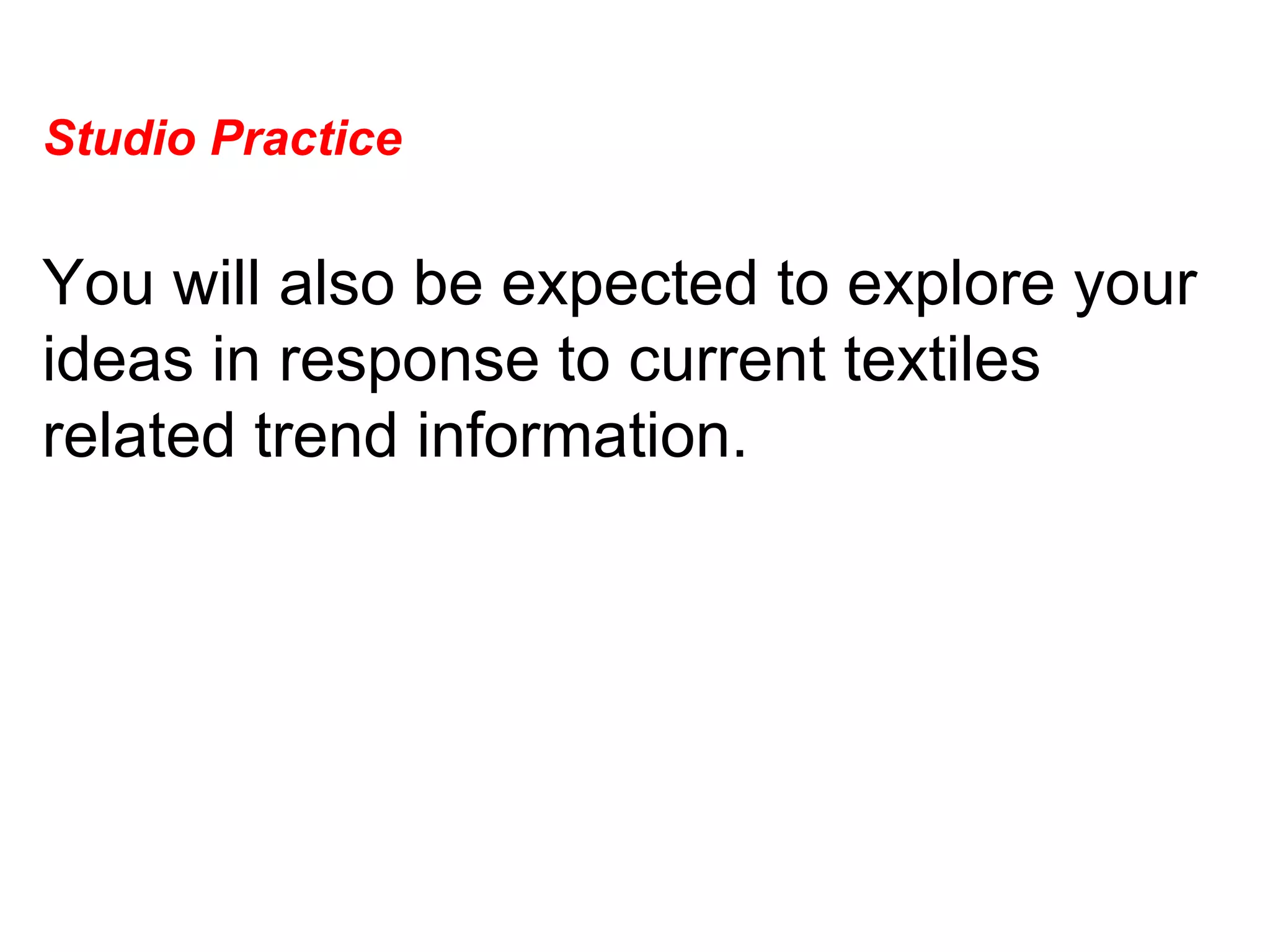
Studio Practice  You will also be expected to explore your ideas in response to current textiles related trend information.
Business and professional skills:  There will be a series of workshops where you will be asked to consider retail, market and trend analysis and research.
Business and professional skills:  For each theme you will also be asked to consider your own practice and research markets and trends applicable to it.
Business and professional skills:  You will produce a short text for each theme as part of a patchwork text that will contribute to the 2,000 Industry Awareness Report that you will submit in the next project.
Contextual Studies:  There will be lectures and group seminars in which you will consider contemporary and historical contexts relating to a range of textiles markets.
Contextual Studies:  These will inform the development of your studio practice and Industry awareness report.
Personal Development and Planning :  You will continue to develop your reflective journal and there will be group sessions where you will consider the development of Learning Agreements and issues relating to Professional Practice .
The next set of tables show the work required for this project, the area of study and which unit assessment requirement this work contributes to
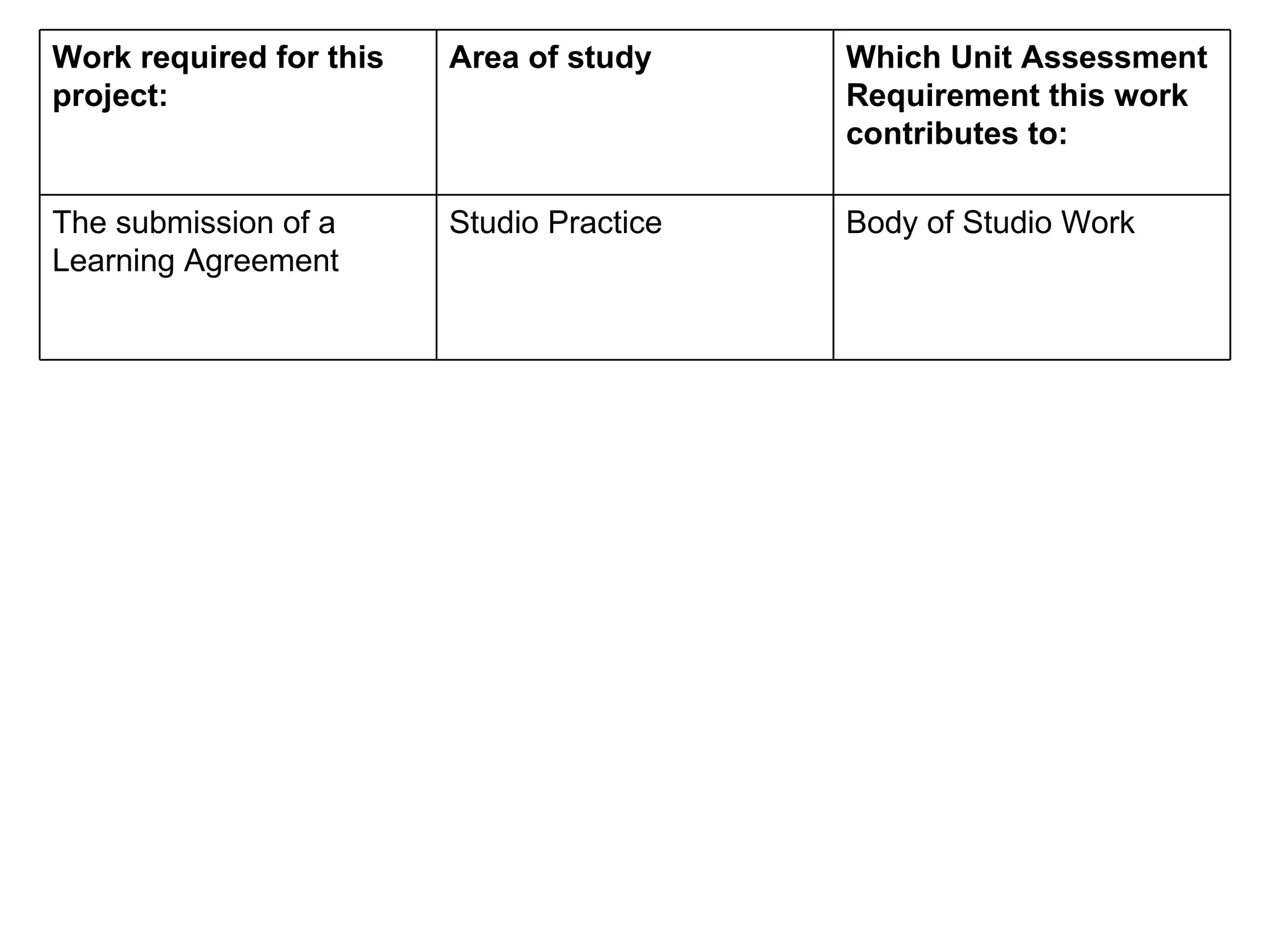
Work required for this project:  Area of study  Which Unit Assessment Requirement this work contributes to:  The submission of a Learning Agreement  Studio Practice  Body of Studio Work
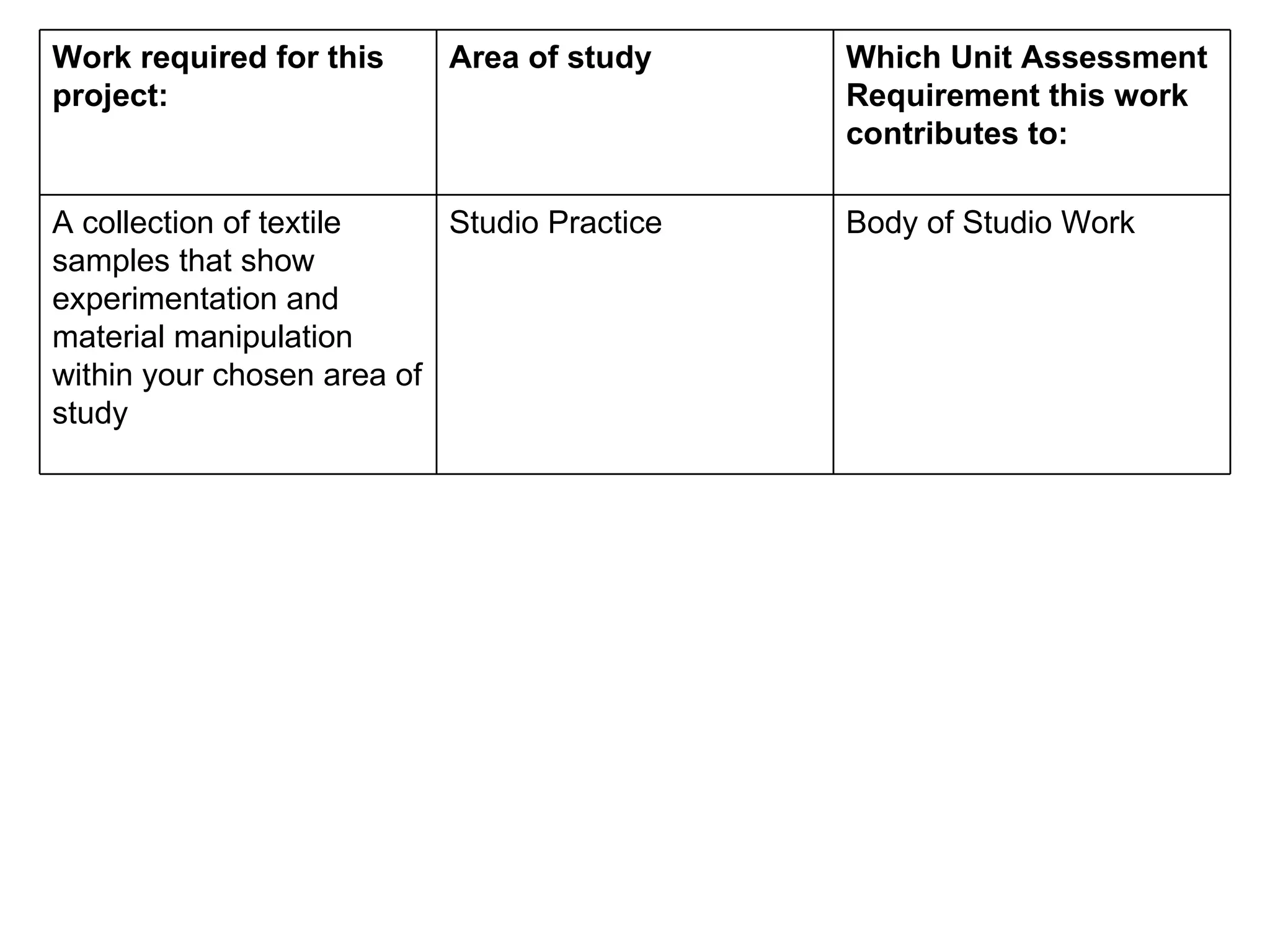
Work required for this project:  Area of study  Which Unit Assessment Requirement this work contributes to:  A collection of textile samples that show experimentation and material manipulation within your chosen area of study  Studio Practice  Body of Studio Work
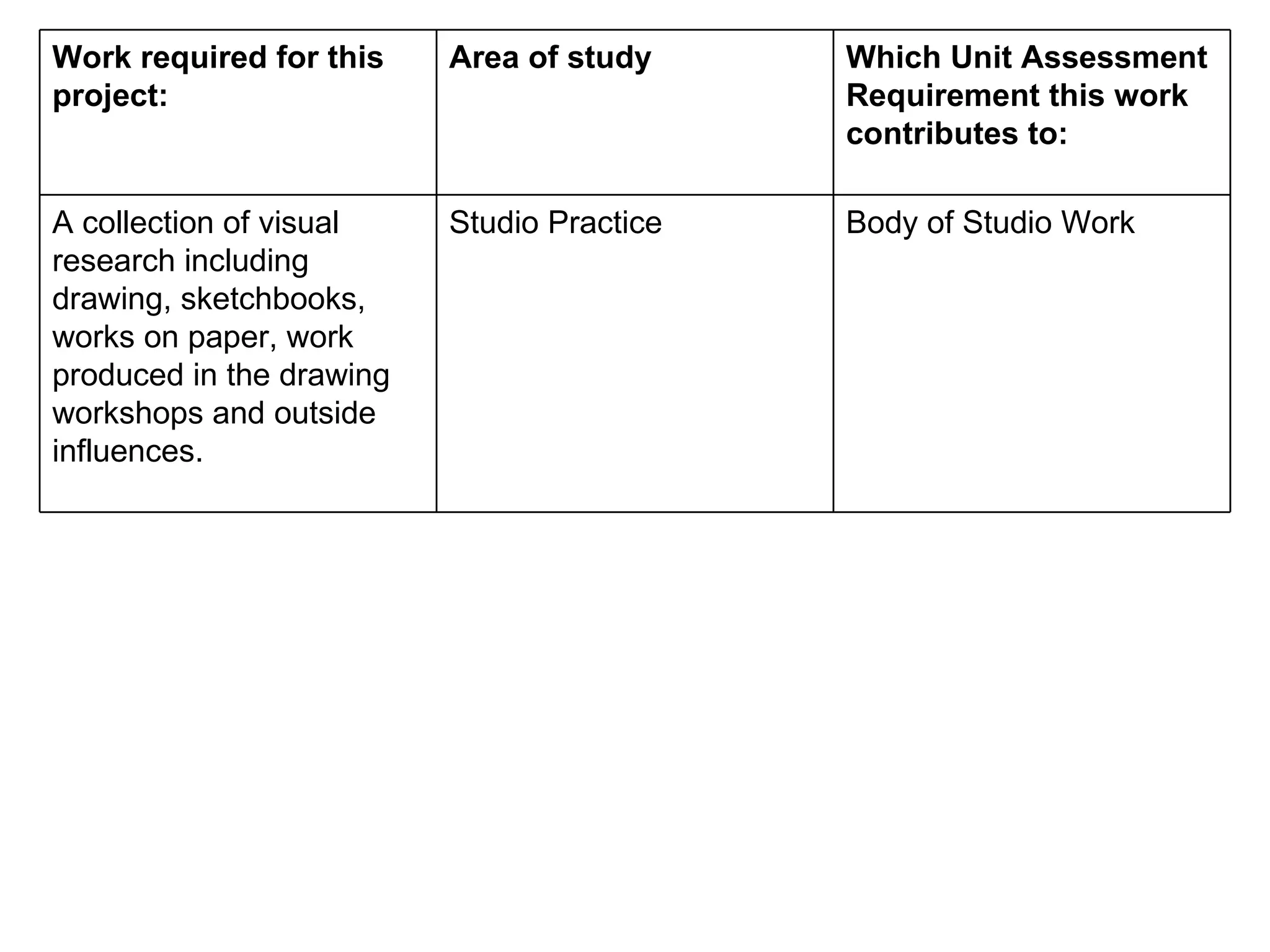
Work required for this project:  Area of study  Which Unit Assessment Requirement this work contributes to:  A collection of visual research including drawing, sketchbooks, works on paper, work produced in the drawing workshops and outside influences.  Studio Practice  Body of Studio Work
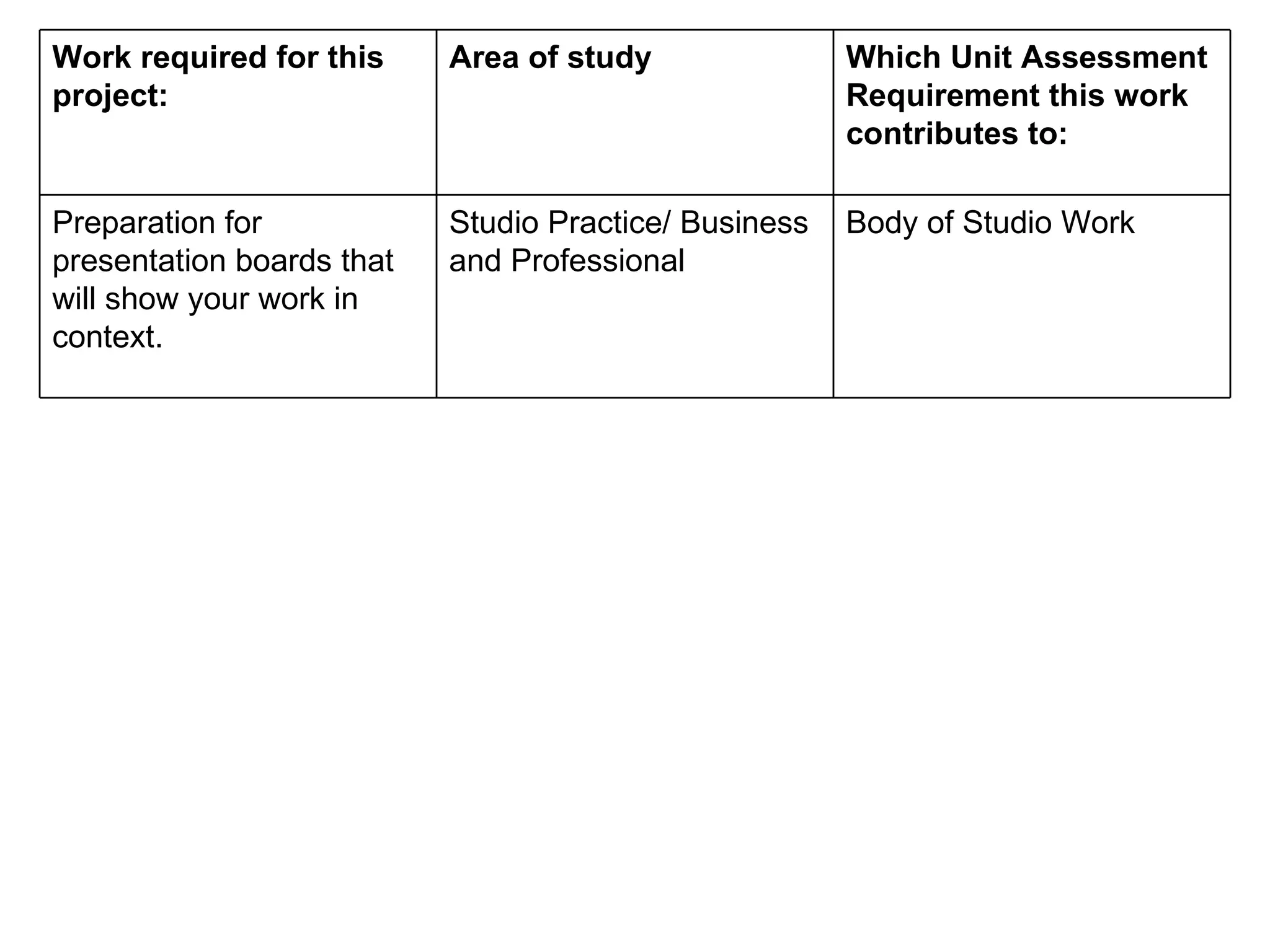
Work required for this project:  Area of study  Which Unit Assessment Requirement this work contributes to:  Preparation for presentation boards that will show your work in context.  Studio Practice/ Business and Professional  Body of Studio Work
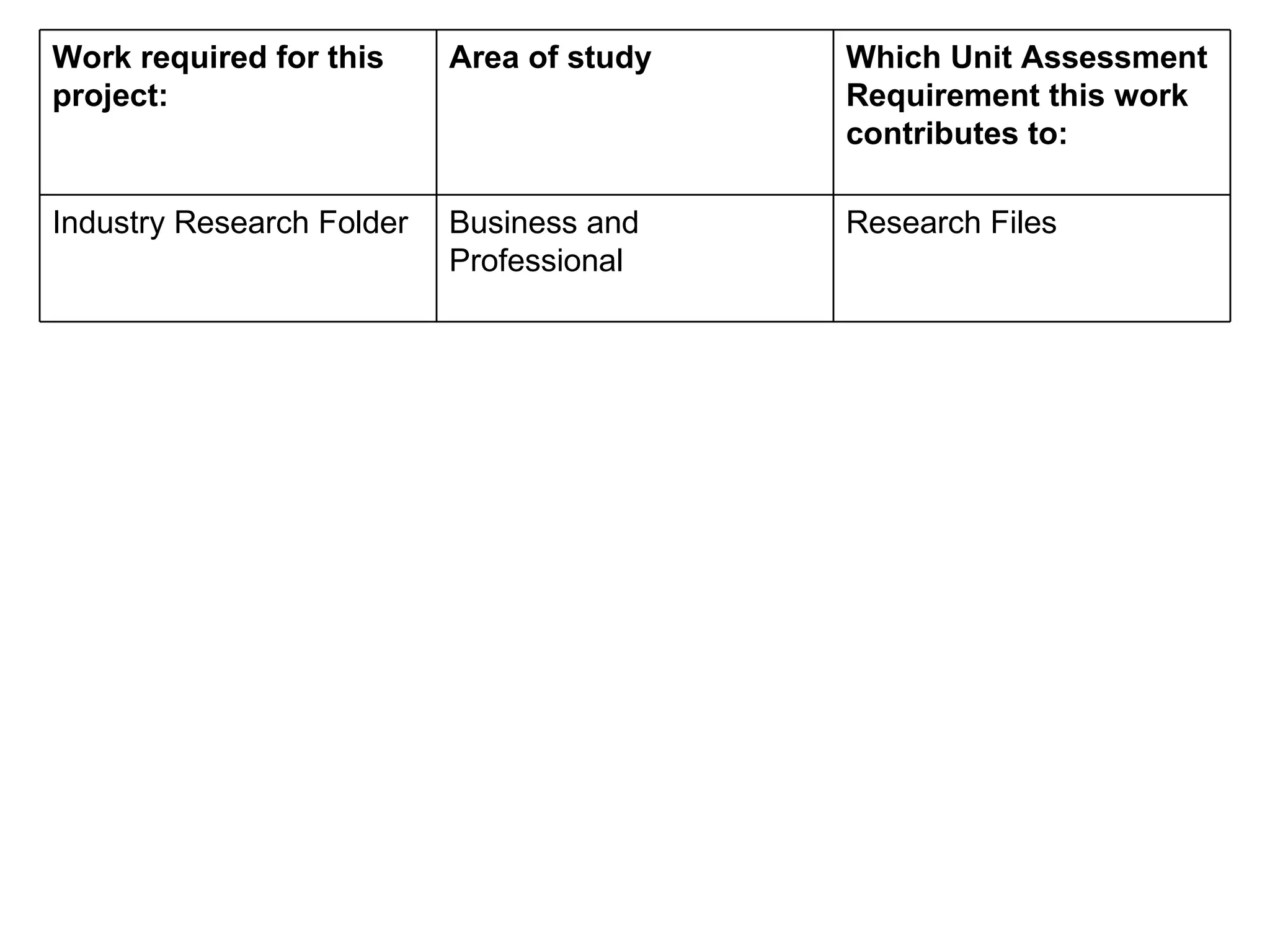
Work required for this project:  Area of study  Which Unit Assessment Requirement this work contributes to:  Industry Research Folder  Business and Professional  Research Files
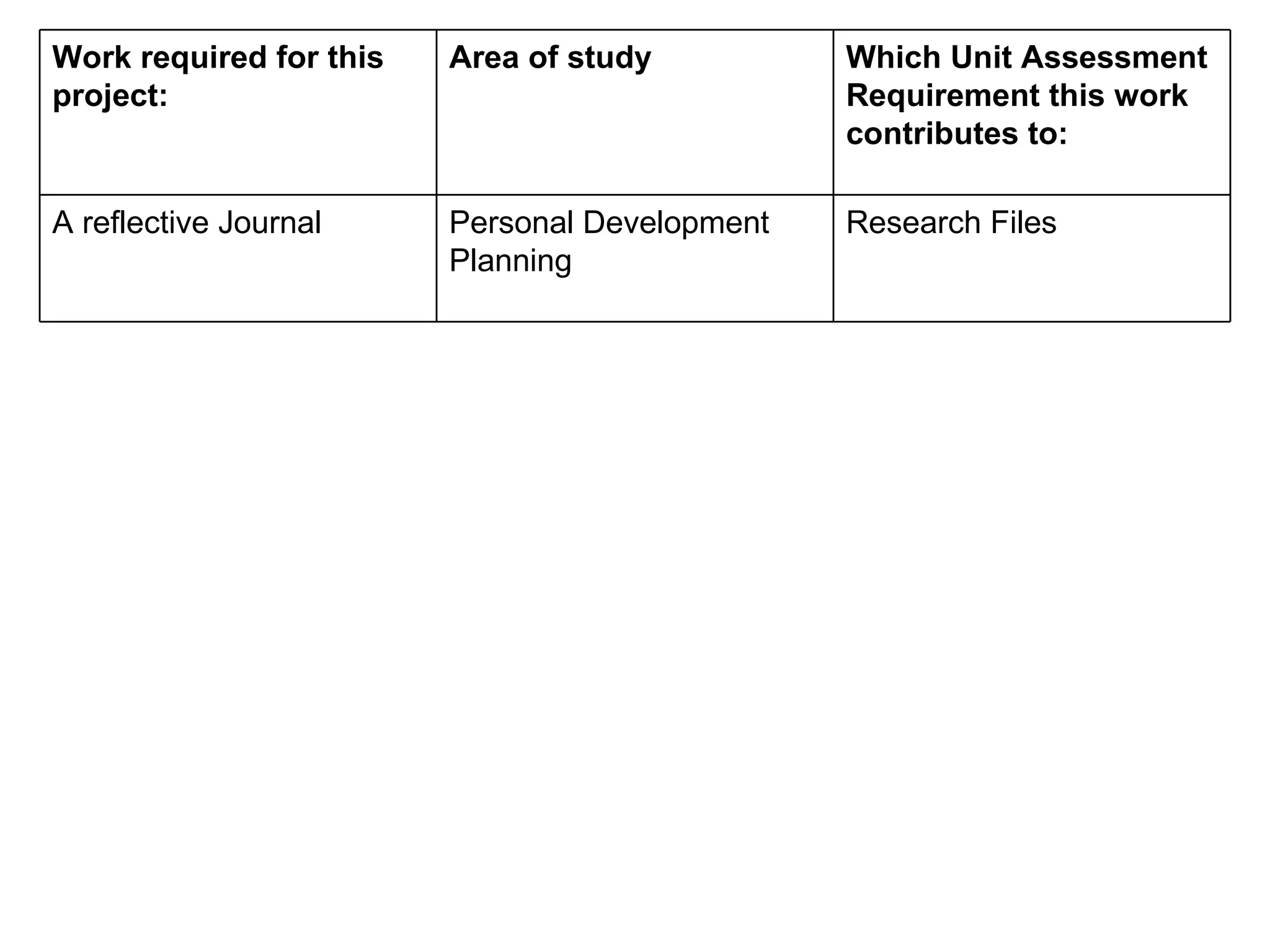
Work required for this project:  Area of study  Which Unit Assessment Requirement this work contributes to:  A reflective Journal  Personal Development Planning  Research Files
The next set of tables show which of the Unit Learning Outcomes are addressed by this project and what you will need to do to show that you have met them.
If you wish to achieve good grades in relation to the learning outcomes I would look at the grading matrix to examine what we are looking for and how we make decisions.
grading matrix https://net.nuca.ac.uk/wiki/_media/learning_and_teaching:ug_grading_matrix_year_1_approved.pdf
Its all about evidence
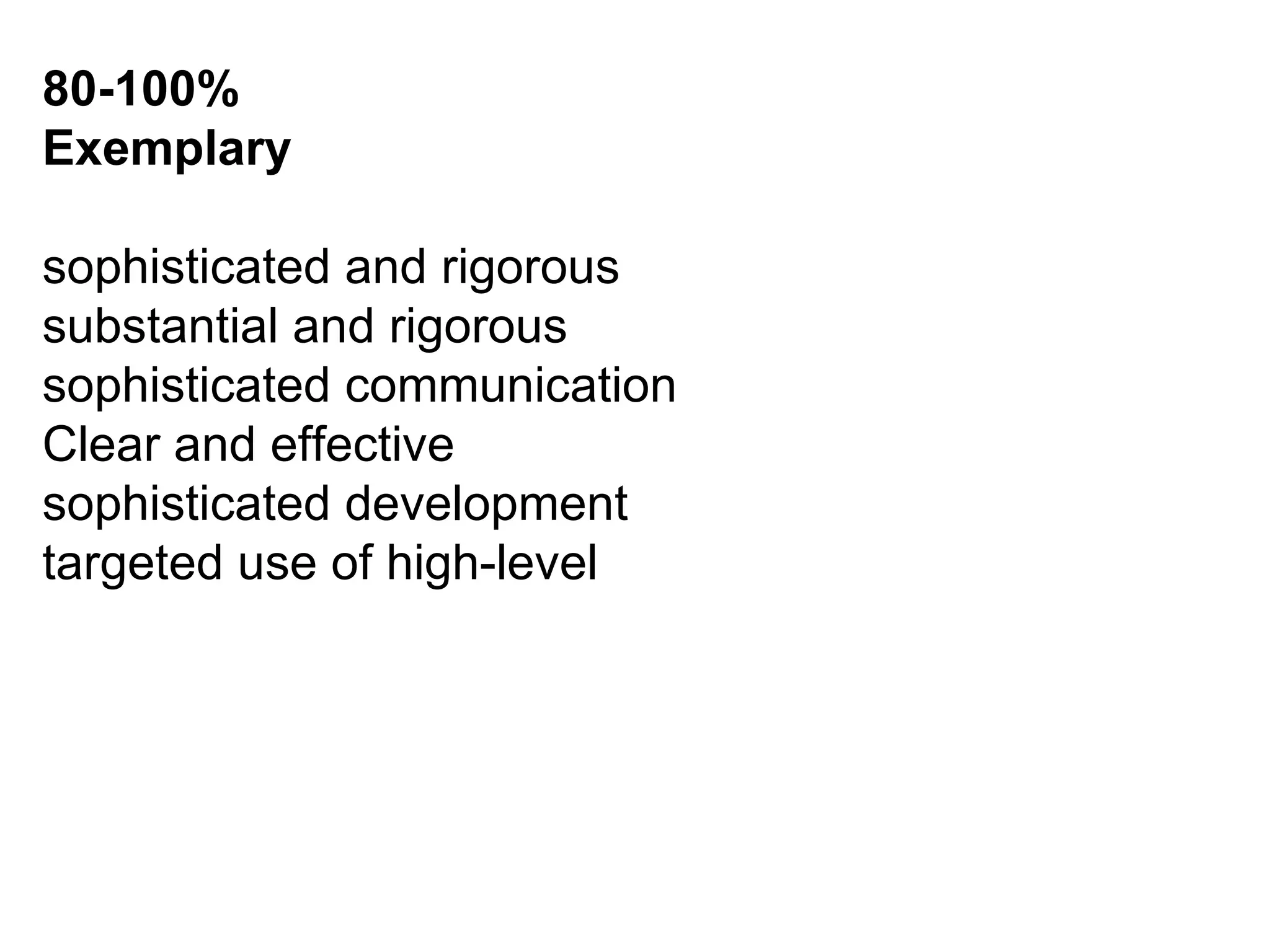
80-100%  Exemplary sophisticated and rigorous  substantial and rigorous  sophisticated communication  Clear and effective  sophisticated development  targeted use of high-level
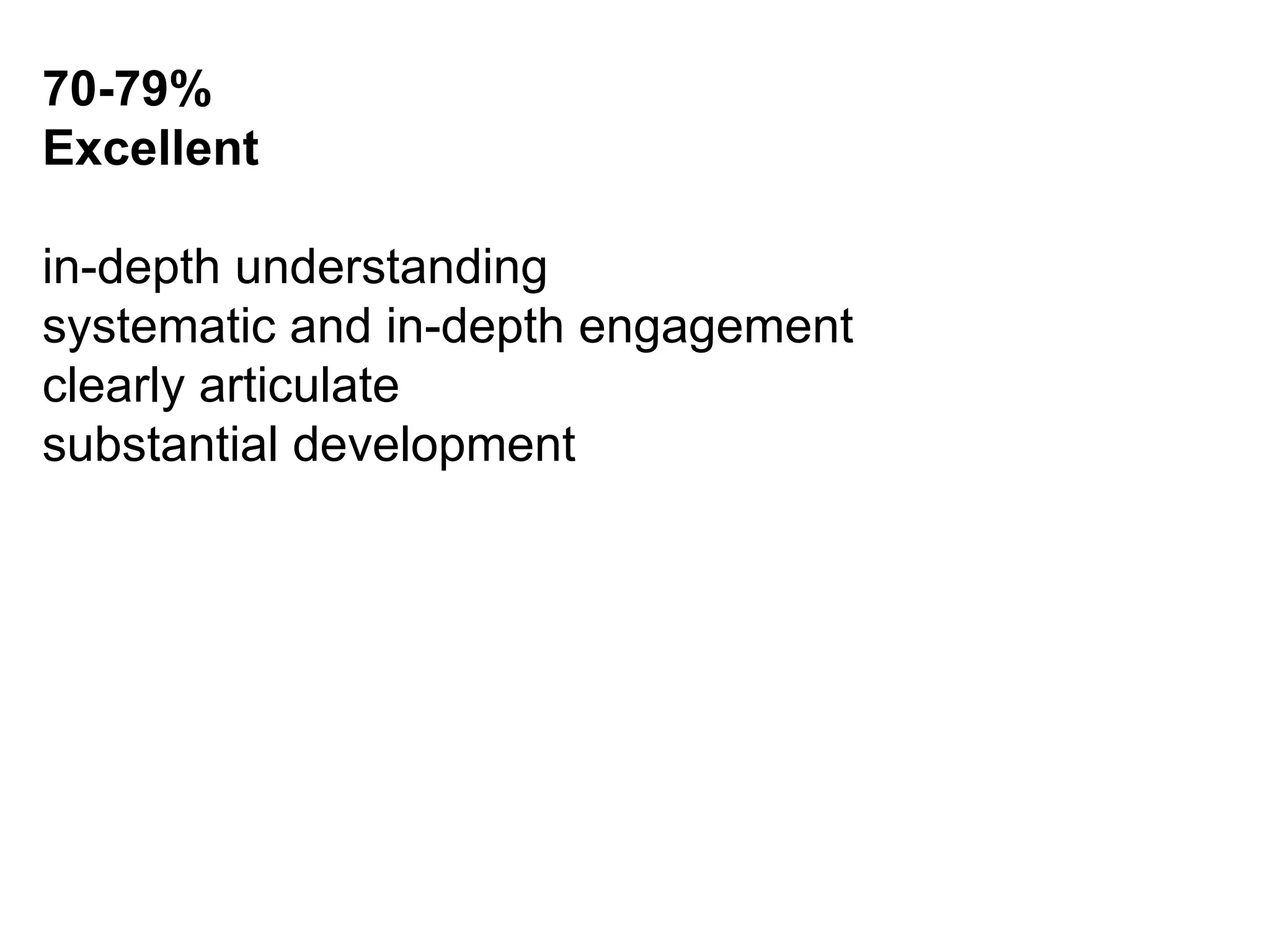
70-79%  Excellent in-depth understanding systematic and in-depth engagement  clearly articulate  substantial development
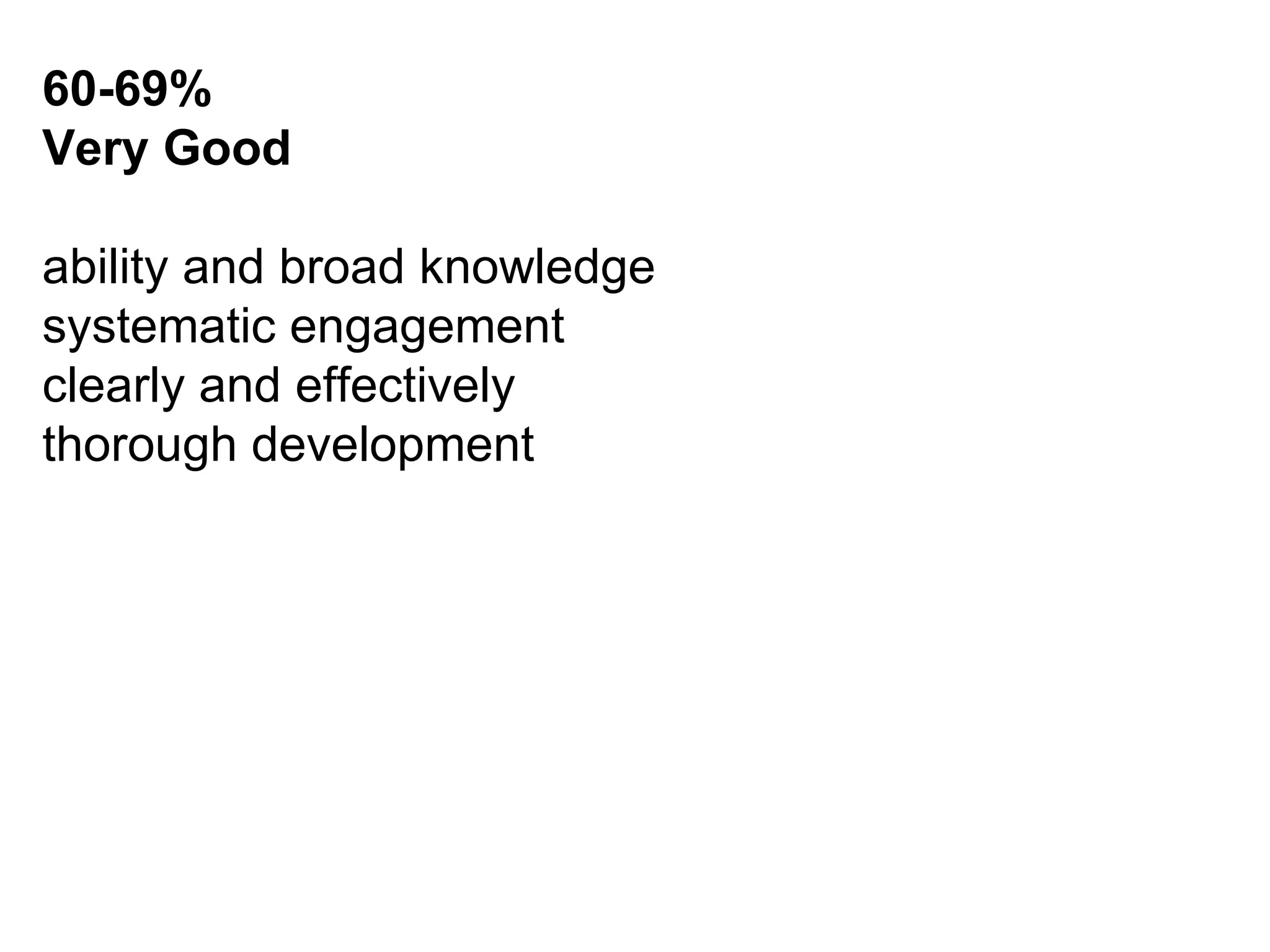
60-69%  Very Good ability and broad knowledge  systematic engagement  clearly and effectively  thorough development
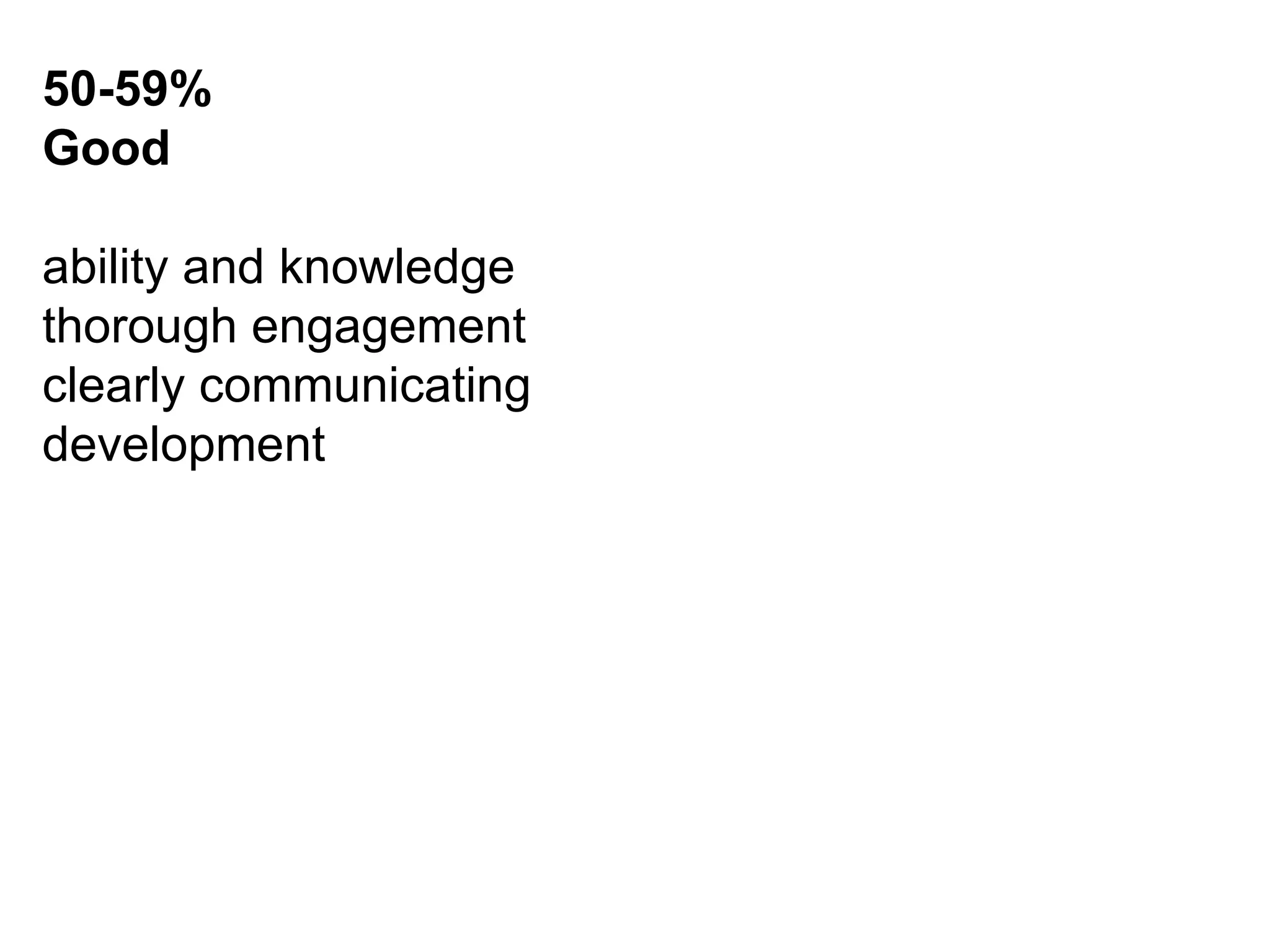
50-59%  Good ability and knowledge  thorough engagement  clearly communicating  development
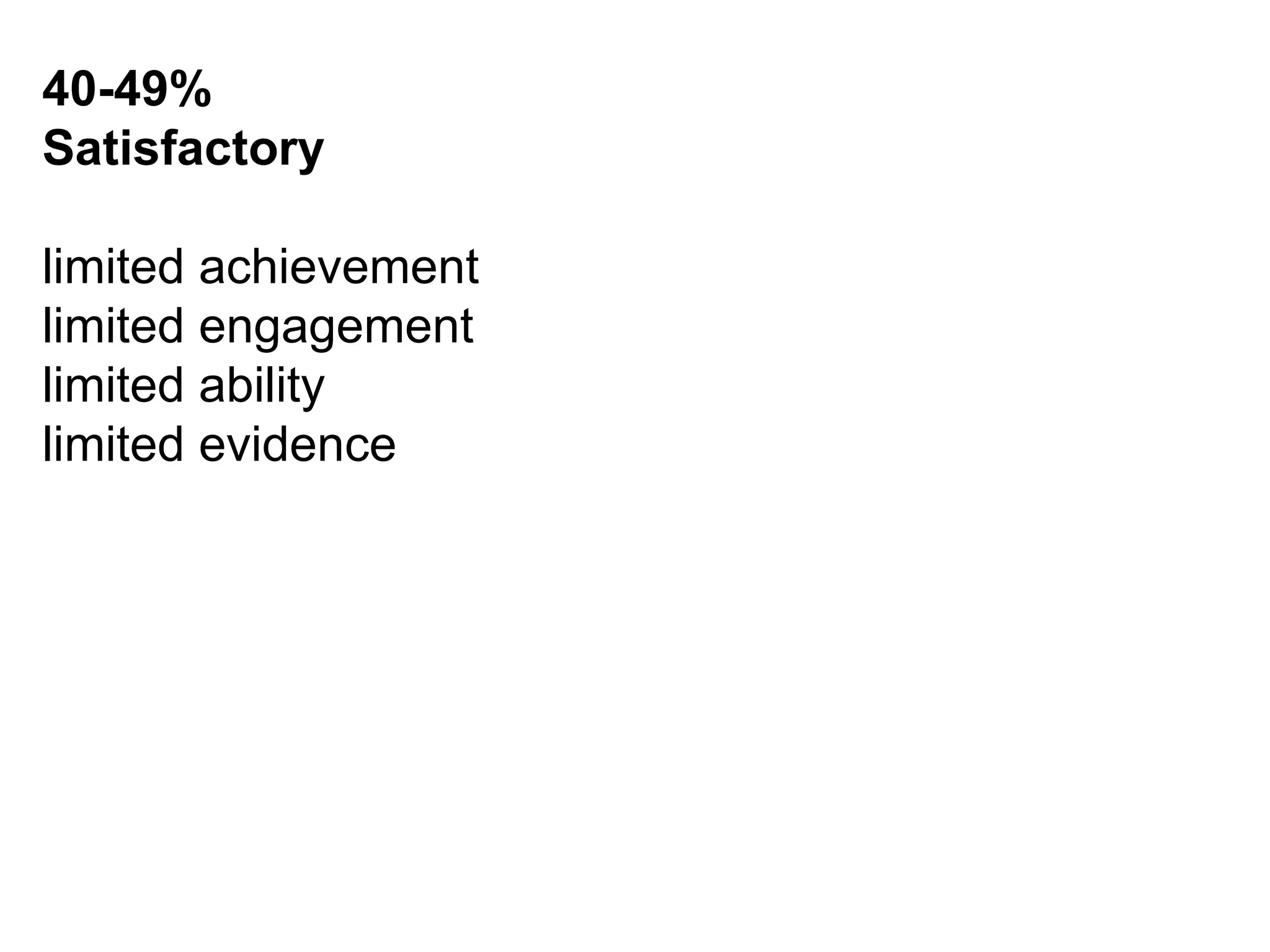
40-49%  Satisfactory limited achievement  limited engagement  limited ability  limited evidence
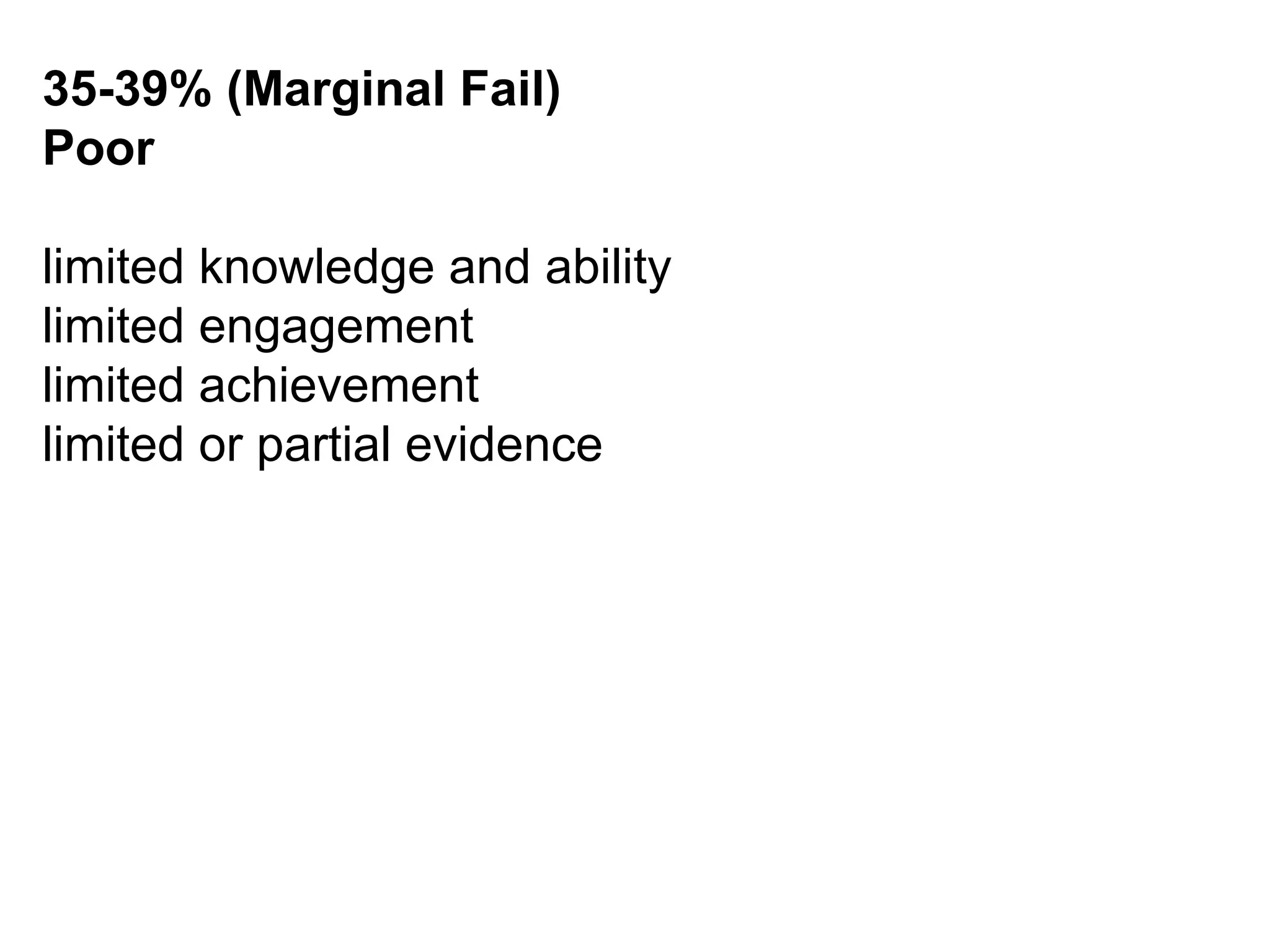
35-39% (Marginal Fail)  Poor limited knowledge and ability  limited engagement  limited achievement  limited or partial evidence
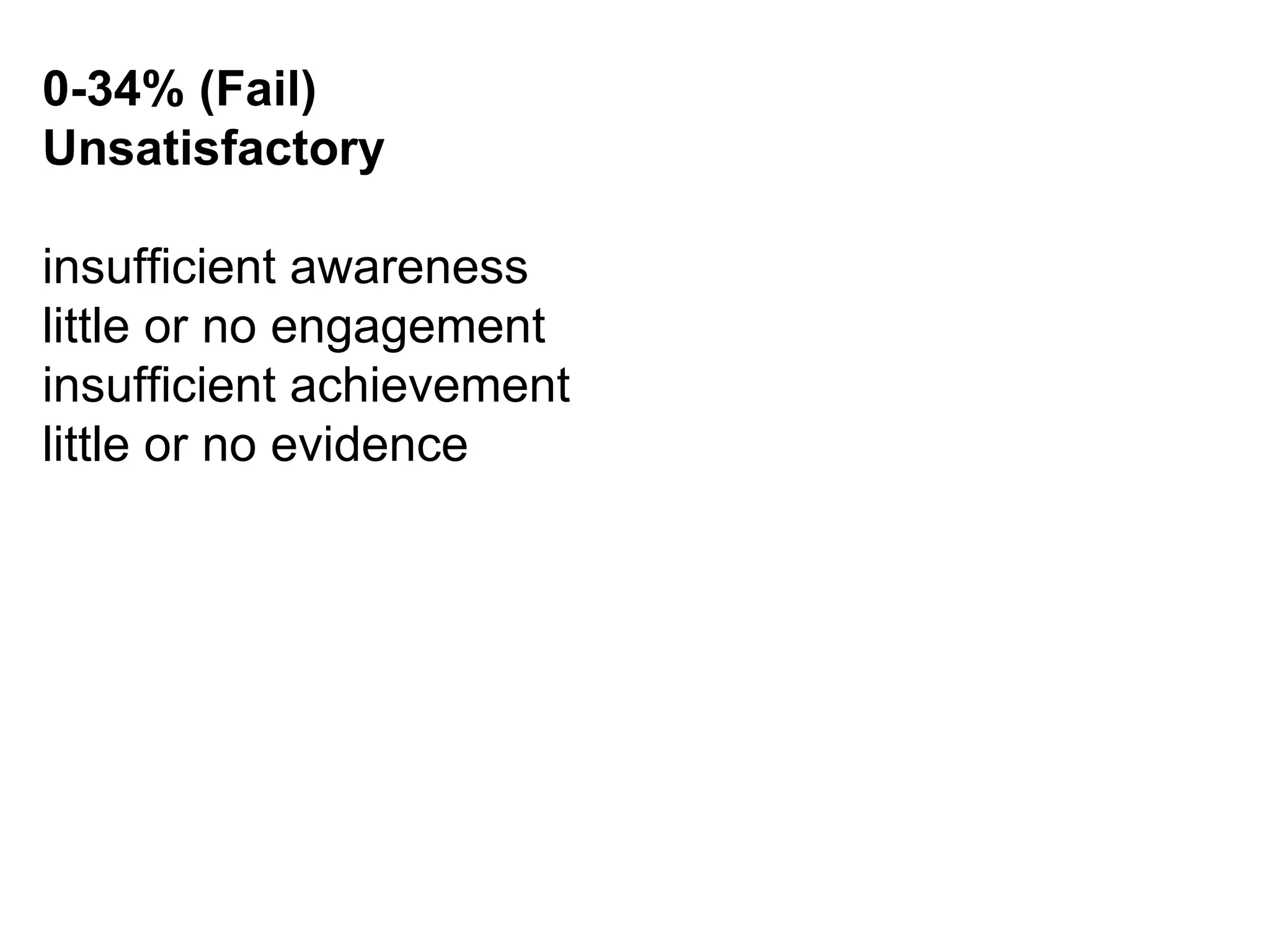
0-34% (Fail)  Unsatisfactory insufficient awareness little or no engagement  insufficient achievement  little or no evidence
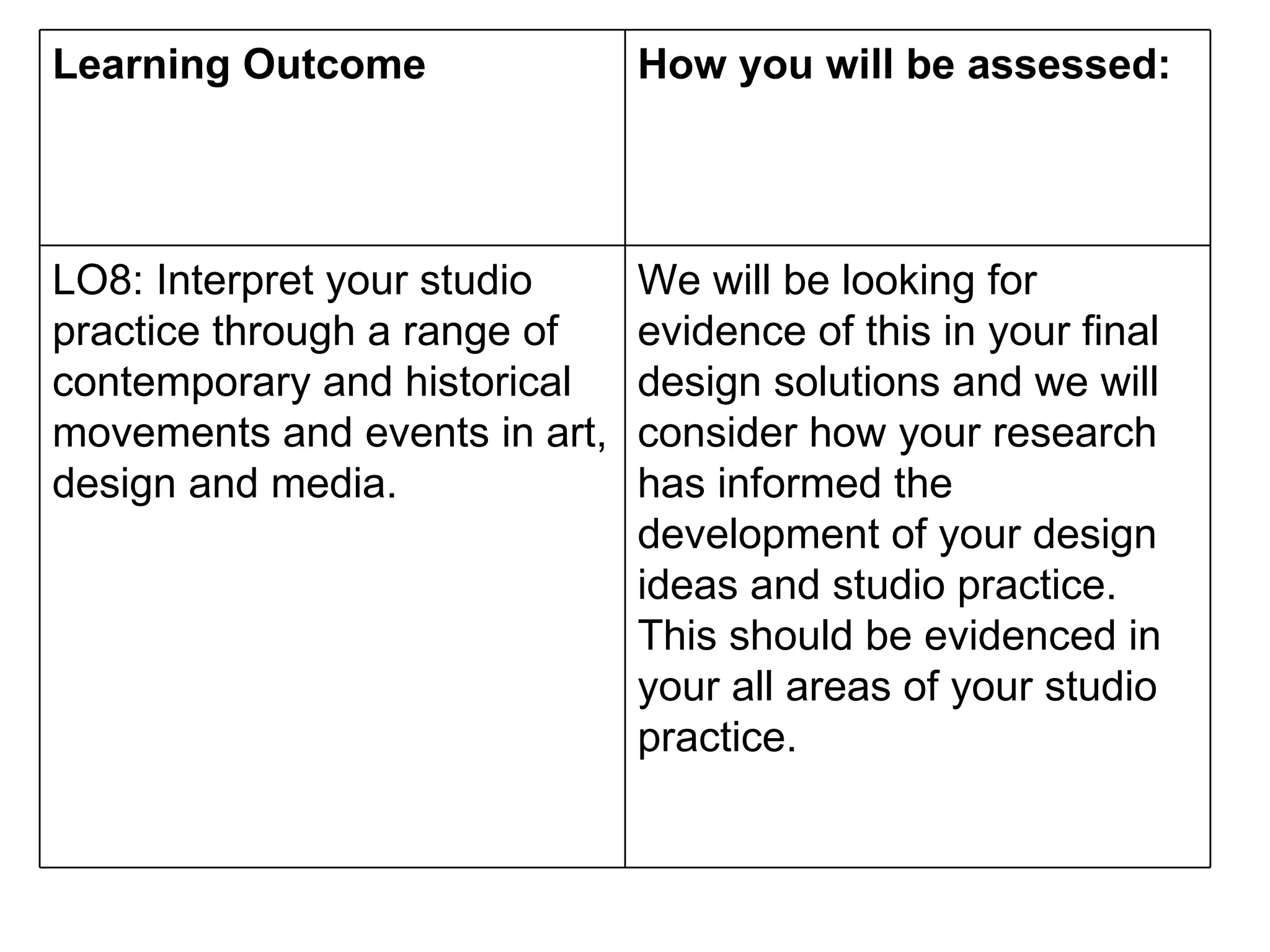
Learning Outcome  How you will be assessed:  LO8: Interpret your studio practice through a range of contemporary and historical movements and events in art, design and media.  We will be looking for evidence of this in your final design solutions and we will consider how your research has informed the development of your design ideas and studio practice. This should be evidenced in your all areas of your studio practice.
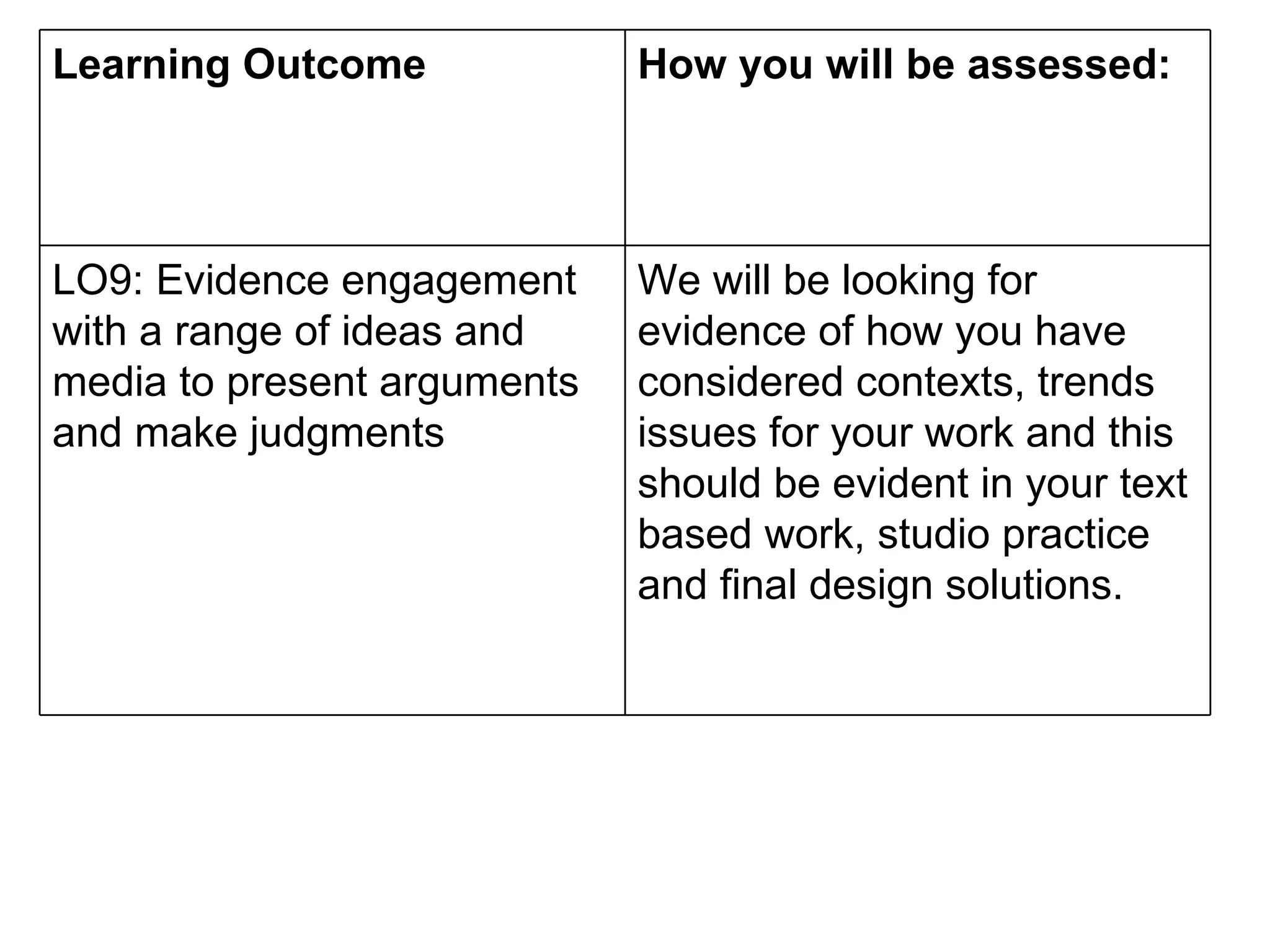
Learning Outcome  How you will be assessed:  LO9: Evidence engagement with a range of ideas and media to present arguments and make judgments  We will be looking for evidence of how you have considered contexts, trends issues for your work and this should be evident in your text based work, studio practice and final design solutions.
Learning Outcome  How you will be assessed:  LO10: Communicate the development of your ideas clearly using text, image or object.  Will be looking for this in the presentation of both your Industry Awareness Report and your portfolio of work and you final design solutions.
Learning Outcome  How you will be assessed:  LO 11: Evidence the transferable skills required for study and employability  Will be looking for this in the presentation of your work and in how you present your text based research in a coherent manner. We will be looking for evidence of the use of IT skills in the presentation of your text based Industry Awareness Report
break – coffee tea fags cake chocolate
Formulating a  Learning agreement  why what how
how How do you write about what you do? How do you write about what you don’t know?  How do you project into and predict the future? How to begin to find answers?
question answers come from asking yourself some questions.
what What are your core ideas?
what What interests you?  Why? - consider the evidence Can you write this down in a sentence?
why Why are you doing it?
what What do you want to achieve?  What are you going to do?
what Focus on the issues you wish to pursue Identify your learning needs Define the scope and nature of the study Identify access and resource issues
how How do you achieve success? How are you going to achieve the learning outcomes of the unit? How does it relate to the aims and assessment criteria of the unit
practical Timetable What can you actually do in the time you are willing to give to the course? – be honest  Budget How much are you actually willing to spend ? Ability Do you need to learn new skills ?
content Be clear and precise about what it is that you are planning to do. Think about what you would like to study and how this relates to your practice Reference material requirements
filling in....... take a copy of the leaning agreement form
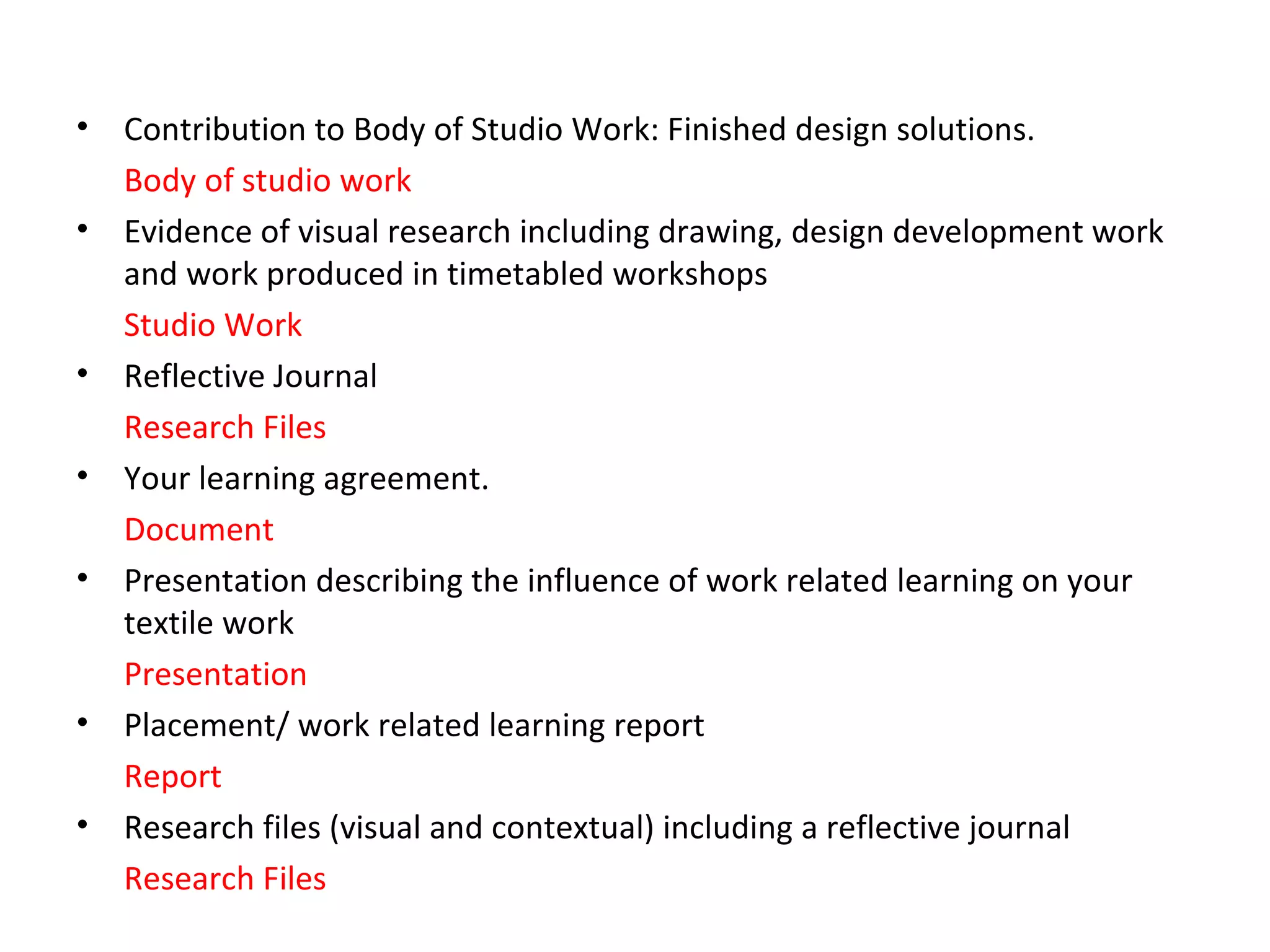
Contribution to Body of Studio Work: Finished design solutions. Body of studio work Evidence of visual research including drawing, design development work and work produced in timetabled workshops Studio Work Reflective Journal Research Files Your learning agreement. Document Presentation describing the influence of work related learning on your textile work Presentation Placement/ work related learning report Report Research files (visual and contextual) including a reflective journal Research Files
Proposal:  What do you intend to do?  Assessment Work:  Body of studio work Studio Work Research Files Document Presentation Report Research Files Schedule of Work:  (to include the deadline for submission of assessment) :   Resource requirements:

deadlines  Leaning agreement form  -  Draft Leaning agreement  -  Feedback from staff - Final Leaning agreement  -  Second project starts -  Work for assessment  -

Unit 3 presentation learning agreement

  • 1.
    Course: BA (Hons)Textiles Year: One Unit: BA3 Project Title Self Direction 1 Trends, Contexts, Issues
  • 2.
    Project 1 of 2 within this unit Start Date: 14/03/11 Study Hours: 240 Submission Date: 16/05/11
  • 3.
    Description In this project you will be asked to write your own project brief in the form of a Learning Agreement.
  • 4.
    Description Thiswill identify the concept you wish to investigate and the market you will be designing for.
  • 5.
    Description You will have the opportunity to explore a breadth of contexts for your practice and investigate the implication of this for your own work.
  • 6.
    Description Thiswill involve looking at trends information and current issues within the textile industry
  • 7.
    Description You shouldexplore the potential for new ideas based on research of your chosen theme in relation to trend information and issue based debates.
  • 8.
    Description The projectwill allow you to demonstrate how you effectively manage your own learning.
  • 9.
    Description The project,whilst building on the knowledge gained from previous units, will focus on further developing experimental approaches to textiles.
  • 10.
    Description During theproject you will need to research trends information to inform the materials, processes and techniques you will use.
  • 11.
    Description You willalso be required to look at colour palettes and identify a market and context for your work.
  • 12.
    Description This projectwill give you the opportunity to put into practice the research, development and critical awareness skills that you have been developing in the previous Units.
  • 13.
    Description It willalso prepare you for study in Year 2 of the course.
  • 14.
    Description As partof this project takes place when Year three students are working towards their final assessment you should expect to have more limited access to the studios and workshops.
  • 15.
    Description It isimportant that you consider this when planning you project and the type of processes that you may want to use.
  • 16.
    Description You willneed to identify when you may need workshop access and book this in advance.
  • 17.
    This Project addressesthe key areas of study within Studio Practice Business and professional skills: Contextual Studies: Personal Development and Planning : what you will actually do in this unit
  • 18.
    Studio Practice You will write a learning agreement and engage in visual and textual research, design development and workshop activities.
  • 19.
    Studio Practice The project will be supported by a series of workshops including drawing, researching trend information, constructing mood boards and preparing for presentation.
  • 20.
    Studio Practice For this project the materials and methods of working will be selected by you.
  • 21.
    Studio Practice As well as developing your skills you should build on the skills and experiences you have gained in previous projects and continue to extend your knowledge of textile techniques and processes.
  • 22.
    Studio Practice You will also be expected to explore your ideas in response to current textiles related trend information.
  • 23.
    Business and professionalskills: There will be a series of workshops where you will be asked to consider retail, market and trend analysis and research.
  • 24.
    Business and professionalskills: For each theme you will also be asked to consider your own practice and research markets and trends applicable to it.
  • 25.
    Business and professionalskills: You will produce a short text for each theme as part of a patchwork text that will contribute to the 2,000 Industry Awareness Report that you will submit in the next project.
  • 26.
    Contextual Studies: There will be lectures and group seminars in which you will consider contemporary and historical contexts relating to a range of textiles markets.
  • 27.
    Contextual Studies: These will inform the development of your studio practice and Industry awareness report.
  • 28.
    Personal Development andPlanning : You will continue to develop your reflective journal and there will be group sessions where you will consider the development of Learning Agreements and issues relating to Professional Practice .
  • 29.
    The next setof tables show the work required for this project, the area of study and which unit assessment requirement this work contributes to
  • 30.
    Work required forthis project: Area of study Which Unit Assessment Requirement this work contributes to: The submission of a Learning Agreement Studio Practice Body of Studio Work
  • 31.
    Work required forthis project: Area of study Which Unit Assessment Requirement this work contributes to: A collection of textile samples that show experimentation and material manipulation within your chosen area of study Studio Practice Body of Studio Work
  • 32.
    Work required forthis project: Area of study Which Unit Assessment Requirement this work contributes to: A collection of visual research including drawing, sketchbooks, works on paper, work produced in the drawing workshops and outside influences. Studio Practice Body of Studio Work
  • 33.
    Work required forthis project: Area of study Which Unit Assessment Requirement this work contributes to: Preparation for presentation boards that will show your work in context. Studio Practice/ Business and Professional Body of Studio Work
  • 34.
    Work required forthis project: Area of study Which Unit Assessment Requirement this work contributes to: Industry Research Folder Business and Professional Research Files
  • 35.
    Work required forthis project: Area of study Which Unit Assessment Requirement this work contributes to: A reflective Journal Personal Development Planning Research Files
  • 36.
    The next setof tables show which of the Unit Learning Outcomes are addressed by this project and what you will need to do to show that you have met them.
  • 37.
    If you wishto achieve good grades in relation to the learning outcomes I would look at the grading matrix to examine what we are looking for and how we make decisions.

  • 38.
  • 39.
    Its all aboutevidence
  • 40.
    80-100% Exemplarysophisticated and rigorous substantial and rigorous sophisticated communication Clear and effective sophisticated development targeted use of high-level
  • 41.
    70-79% Excellentin-depth understanding systematic and in-depth engagement clearly articulate substantial development
  • 42.
    60-69% VeryGood ability and broad knowledge systematic engagement clearly and effectively thorough development
  • 43.
    50-59% Goodability and knowledge thorough engagement clearly communicating development
  • 44.
    40-49% Satisfactorylimited achievement limited engagement limited ability limited evidence
  • 45.
    35-39% (Marginal Fail) Poor limited knowledge and ability limited engagement limited achievement limited or partial evidence
  • 46.
    0-34% (Fail) Unsatisfactory insufficient awareness little or no engagement insufficient achievement little or no evidence
  • 47.
    Learning Outcome How you will be assessed: LO8: Interpret your studio practice through a range of contemporary and historical movements and events in art, design and media. We will be looking for evidence of this in your final design solutions and we will consider how your research has informed the development of your design ideas and studio practice. This should be evidenced in your all areas of your studio practice.
  • 48.
    Learning Outcome How you will be assessed: LO9: Evidence engagement with a range of ideas and media to present arguments and make judgments We will be looking for evidence of how you have considered contexts, trends issues for your work and this should be evident in your text based work, studio practice and final design solutions.
  • 49.
    Learning Outcome How you will be assessed: LO10: Communicate the development of your ideas clearly using text, image or object. Will be looking for this in the presentation of both your Industry Awareness Report and your portfolio of work and you final design solutions.
  • 50.
    Learning Outcome How you will be assessed: LO 11: Evidence the transferable skills required for study and employability Will be looking for this in the presentation of your work and in how you present your text based research in a coherent manner. We will be looking for evidence of the use of IT skills in the presentation of your text based Industry Awareness Report
  • 51.
    break – coffeetea fags cake chocolate
  • 52.
    Formulating a Learning agreement why what how
  • 53.
    how How doyou write about what you do? How do you write about what you don’t know? How do you project into and predict the future? How to begin to find answers?
  • 54.
    question answers comefrom asking yourself some questions.
  • 55.
    what What areyour core ideas?
  • 56.
    what What interestsyou? Why? - consider the evidence Can you write this down in a sentence?
  • 57.
    why Why areyou doing it?
  • 58.
    what What doyou want to achieve? What are you going to do?
  • 59.
    what Focus onthe issues you wish to pursue Identify your learning needs Define the scope and nature of the study Identify access and resource issues


  • 60.
    how How doyou achieve success? How are you going to achieve the learning outcomes of the unit? How does it relate to the aims and assessment criteria of the unit
  • 61.
    practical Timetable Whatcan you actually do in the time you are willing to give to the course? – be honest Budget How much are you actually willing to spend ? Ability Do you need to learn new skills ?
  • 62.
    content Be clearand precise about what it is that you are planning to do. Think about what you would like to study and how this relates to your practice Reference material requirements
  • 63.
    filling in....... takea copy of the leaning agreement form
  • 64.
    Contribution to Bodyof Studio Work: Finished design solutions. Body of studio work Evidence of visual research including drawing, design development work and work produced in timetabled workshops Studio Work Reflective Journal Research Files Your learning agreement. Document Presentation describing the influence of work related learning on your textile work Presentation Placement/ work related learning report Report Research files (visual and contextual) including a reflective journal Research Files
  • 65.
    Proposal: Whatdo you intend to do? Assessment Work: Body of studio work Studio Work Research Files Document Presentation Report Research Files Schedule of Work: (to include the deadline for submission of assessment) :   Resource requirements:
  • 66.
    deadlines Leaningagreement form - Draft Leaning agreement - Feedback from staff - Final Leaning agreement - Second project starts - Work for assessment -