Do you remember
the first time you sat
on an aeroplane and
it was about to take
off?
post-it
What do you
want from the
3rd
year of your
course?
take control of your learning
advice...
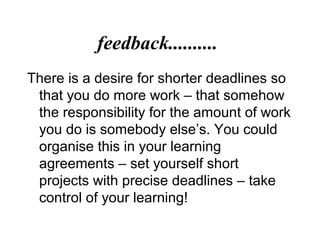
feedback..........
There is a desire for shorter deadlines so
that you do more work – that somehow
the responsibility for the amount of work
you do is somebody else’s. You could
organise this in your learning
agreements – set yourself short
projects with precise deadlines – take
control of your learning!
planning
Organise your time
It really is about
Time management
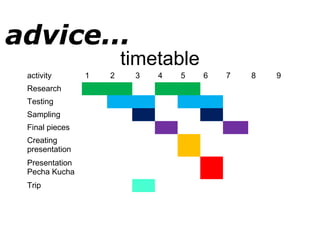
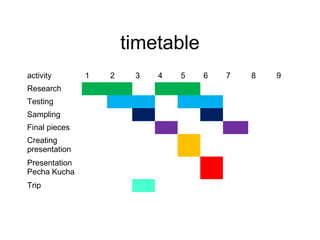
timetable
activity 1 2 3 4 5 6 7 8 9
Research
Testing
Sampling
Final pieces
Creating
presentation
Presentation
Pecha Kucha
Trip
advice...
connections
Your interests –
art history, music, dance, writing, general history,
geography/place, contemporary practice, science
Stuff to do –
Lists, aims and objectives, travel, breaks
Projects –
Set by NUA,
Set by your
Practical stuff -
Coming in, using workshops, equipment, printing etc
Competitions
Research –
Writing -
Visits –
Placements, part of research
Opportunities yet to arise…………………………..
Life ‘other than your practice’ –
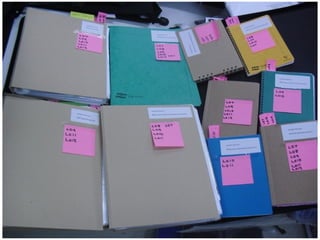
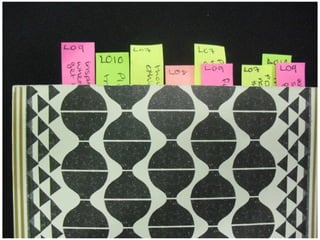
use a notebook
advice...
use a notebook
advice...
why
You will be gone soon.
May 23rd
348 days to go
weekends
250 days to go
holidays
120 days to go
Bank holidays
115 days to go
finish your research report
over the Christmas break
advice...
recognise the value of
research and how it can
support your practice.
advice...
use a notebook
advice...
record
use a reflective journal
blog
advice...
Learn
Photoshop
and
Illustrator
advice...
the structure
of the course
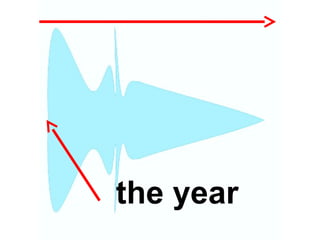
the year
formulating your
approach to your learning
within year 3
why what how
ask yourself questions
lots and continuously
what do you like doing?
why do you make work?
what’s it for?
what do you want from your work?
what do you get from your work?
what is your work about?
who is your audience?
where does the work go?
you and your work
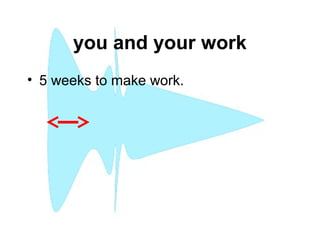
• 5 weeks to make work.
you and your work
• The first 5 weeks of the year are about
you developing what you want to.
 
you and your work
 
•It is about you identifying, developing
and following a research path in both your
practical and textural work.
you and your work
•You will need to consider how to use
your time effectively as you cannot get
this time back.
you and your work
•Learning agreement
•Thinking about the future?
•How do you want to use your time?
•What do you want to learn?
you and your work
•Supported by individual tutorials alongside
developmental and skill based workshops.
you and your work
It is envisaged that this time will involve you in -
•Research - Deciding on your path(s) of interests
and supporting your thinking.
•Context - looking around at the work of others
and where work is seen - shops, galleries etc.
•Experimenting - trying stuff out by using skills
and techniques.
•Testing - making stuff, including final piece(s)
•Reflection - on what you have done and then
presenting it to others.
you and your work
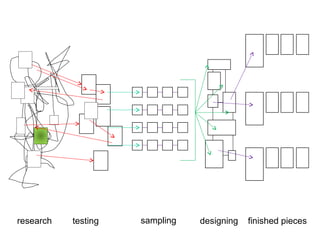
• It is expected that you will make a body
of work for yourself - all of these
activities - research, context,
experimenting, testing, final completed
pieces and reflection are your work.
research testing sampling designing finished pieces
notebook
what
5 words
what do you do?
notebook
why
why do you do what you
do?
notebook
what
title
what are you?
notebook
how
tone - how do you go
about doing what you do?
notebook
what
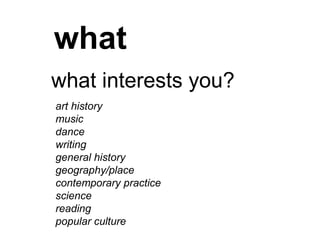
what interests you?
art history
music
dance
writing
general history
geography/place
contemporary practice
science
reading
popular culture
notebook
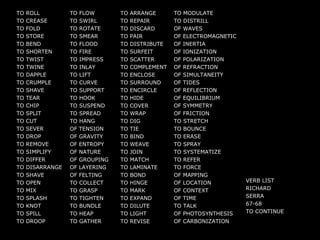
TO ROLL
TO CREASE
TO FOLD
TO STORE
TO BEND
TO SHORTEN
TO TWIST
TO TWINE
TO DAPPLE
TO CRUMPLE
TO SHAVE
TO TEAR
TO CHIP
TO SPLIT
TO CUT
TO SEVER
TO DROP
TO REMOVE
TO SIMPLIFY
TO DIFFER
TO DISARRANGE
TO SHAVE
TO OPEN
TO MIX
TO SPLASH
TO KNOT
TO SPILL
TO DROOP
TO FLOW
TO SWIRL
TO ROTATE
TO SMEAR
TO FLOOD
TO FIRE
TO IMPRESS
TO INLAY
TO LIFT
TO CURVE
TO SUPPORT
TO HOOK
TO SUSPEND
TO SPREAD
TO HANG
OF TENSION
OF GRAVITY
OF ENTROPY
OF NATURE
OF GROUPING
OF LAYERING
OF FELTING
TO COLLECT
TO GRASP
TO TIGHTEN
TO BUNDLE
TO HEAP
TO GATHER
TO ARRANGE
TO REPAIR
TO DISCARD
TO PAIR
TO DISTRIBUTE
TO SURFEIT
TO SCATTER
TO COMPLEMENT
TO ENCLOSE
TO SURROUND
TO ENCIRCLE
TO HIDE
TO COVER
TO WRAP
TO DIG
TO TIE
TO BIND
TO WEAVE
TO JOIN
TO MATCH
TO LAMINATE
TO BOND
TO HINGE
TO MARK
TO EXPAND
TO DILUTE
TO LIGHT
TO REVISE
TO MODULATE
TO DISTRILL
OF WAVES
OF ELECTROMAGNETIC
OF INERTIA
OF IONIZATION
OF POLARIZATION
OF REFRACTION
OF SIMULTANEITY
OF TIDES
OF REFLECTION
OF EQUILIBRIUM
OF SYMMETRY
OF FRICTION
TO STRETCH
TO BOUNCE
TO ERASE
TO SPRAY
TO SYSTEMATIZE
TO REFER
TO FORCE
OF MAPPING
OF LOCATION
OF CONTEXT
OF TIME
TO TALK
OF PHOTOSYNTHESIS
OF CARBONIZATION
VERB LIST
RICHARD
SERRA
67-68
TO CONTINUE
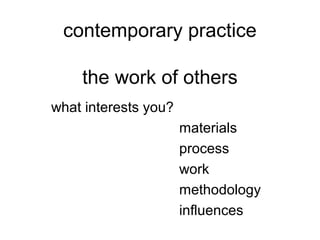
contemporary practice
the work of others
what interests you?
materials
process
work
methodology
influences
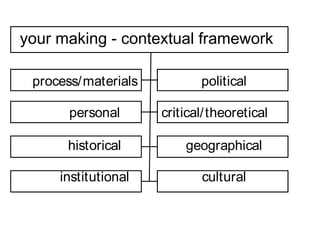
your making - contextual framework
process/materials political
personal critical/theoretical
historical geographical
institutional cultural
 
 
notebook
what
what are your core ideas?
notebook
why
consider the evidence
reflection
• Pecha Kucha
• This is you presenting what you have
done, a chance to bring all your work
together and decide on what to do next.
reflection
• Pecha Kucha 20x20
Is a simple presentation format where you
show 20 images, each for 20 seconds.
The images advance automatically and
you talk along to the images –
consider them as prompts.
reflection
• Preparation.
• We are very enthusiastic about this task
and its relationship to learning within the
course.
reflection
• This has been conceived as a 'rounding up' of
your initial body of work - after which it is
anticipated that you will go on to further
develop your work and practice - this is so
that you can now focus.
• This is within the context that
- you will be getting a response from your
cohort - this is feedback
and
- you need to consider it - this is reflection.
notebook
what
what do you want to of
achieved in 5 weeks?
this could form part of your
learning agreement
focus
• 4 weeks
• Developing what your work is, could or
should be.
• To beginning of Dec
focus
• This is time to focus what it is that you
do, what you are interested in, to hone
skills and develop techniques and
processes.
• It is expected that you will make a body
of focused work for yourself.
• Become an expert.
team
• Dec
• a team project
team
• Using your skills within a team
• Professionalism
• Finding your place
• Testing yourself
team
• Task
• This will be a one week project.
Final project
• BA8
Final project
• BA8
• Learning agreement
• Thinking about the future?
• How do you want to use your time?
• What do you want to learn?
Final project
• BA8
• This is time to make work that will be
your BA final project.
• 10 weeks
Mid Year Review
Mid Year Review
• Stew Gallery
• Mid Year Review
• Formative
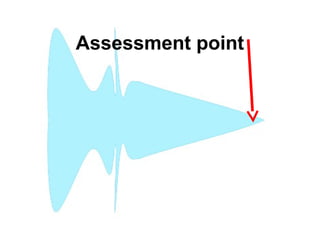
Assessment point
degree show
• What is this for?
• Presenting yourself
• Becoming public
• Becoming professional
• What next?
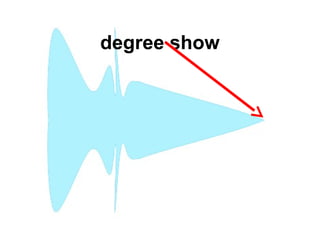
degree show
New designers
• Opportunity
• Visibility
• Timing
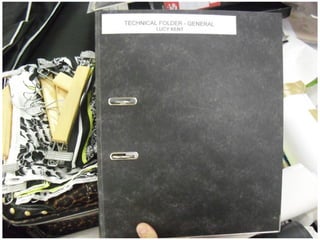
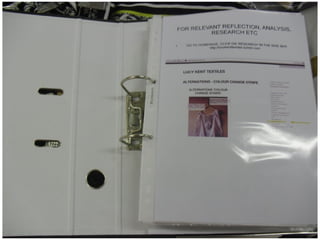
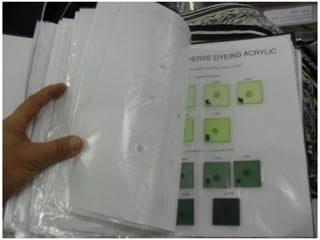
http://lucykenttextiles.tumblr.com/
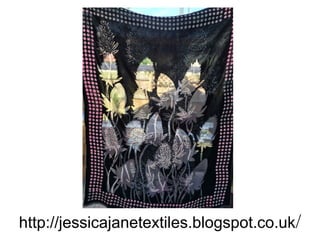
http://jessicajanetextiles.blogspot.co.uk/
notebook
what
what does success look
like?
how
how do you achieve
success?
notebook
what next
how do you want to live
your life?
what
focus on the issues you
wish to pursue
identify your learning
needs
what
define the scope and

nature of the study
identify access and
resource issues
notebook
what
what do you want to
achieve?
what are you going to do
about it?
how
how are you going to
achieve what you want
to learn?
practical
timetable
what can you actually do
in the time you are willing
to give to your learning –
be honest
practical
budget
how much are you actually
willing to spend over the
year?
notebook
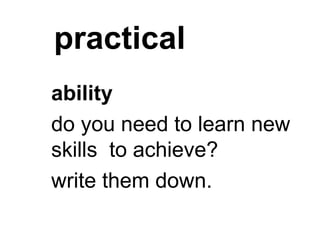
practical
ability
do you need to learn new
skills to achieve?
write them down.
timetable
activity 1 2 3 4 5 6 7 8 9
Research
Testing
Sampling
Final pieces
Creating
presentation
Presentation
Pecha Kucha
Trip
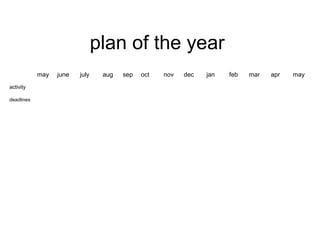
plan of the year
may june july aug sep oct nov dec jan feb mar apr may
activity
deadlines
Pecha Kucha
Images
narrative

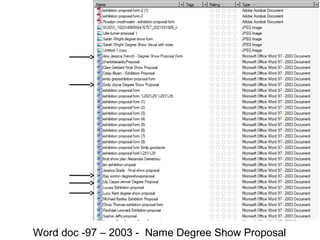
Word doc -97 – 2003 - Name Degree Show Proposal
deadlines
• Keeping to deadlines
• Following instructions
• Developing systems and structures
formatting, mistitling or sending after
deadlines.
the beginning of the end
now this is not the end. it is not even
the beginning of the end. but it is,
perhaps, the end of the beginning.
Churchill
notebook

Introduction to year 3