How to do research?
Xiao Qin
Department of Computer Science and
Software Engineering
Auburn University
http://www.eng.auburn.edu/~xqin
xqin@auburn.edu
Some slides are adapted from notes by Dr. Matthew Turk
1
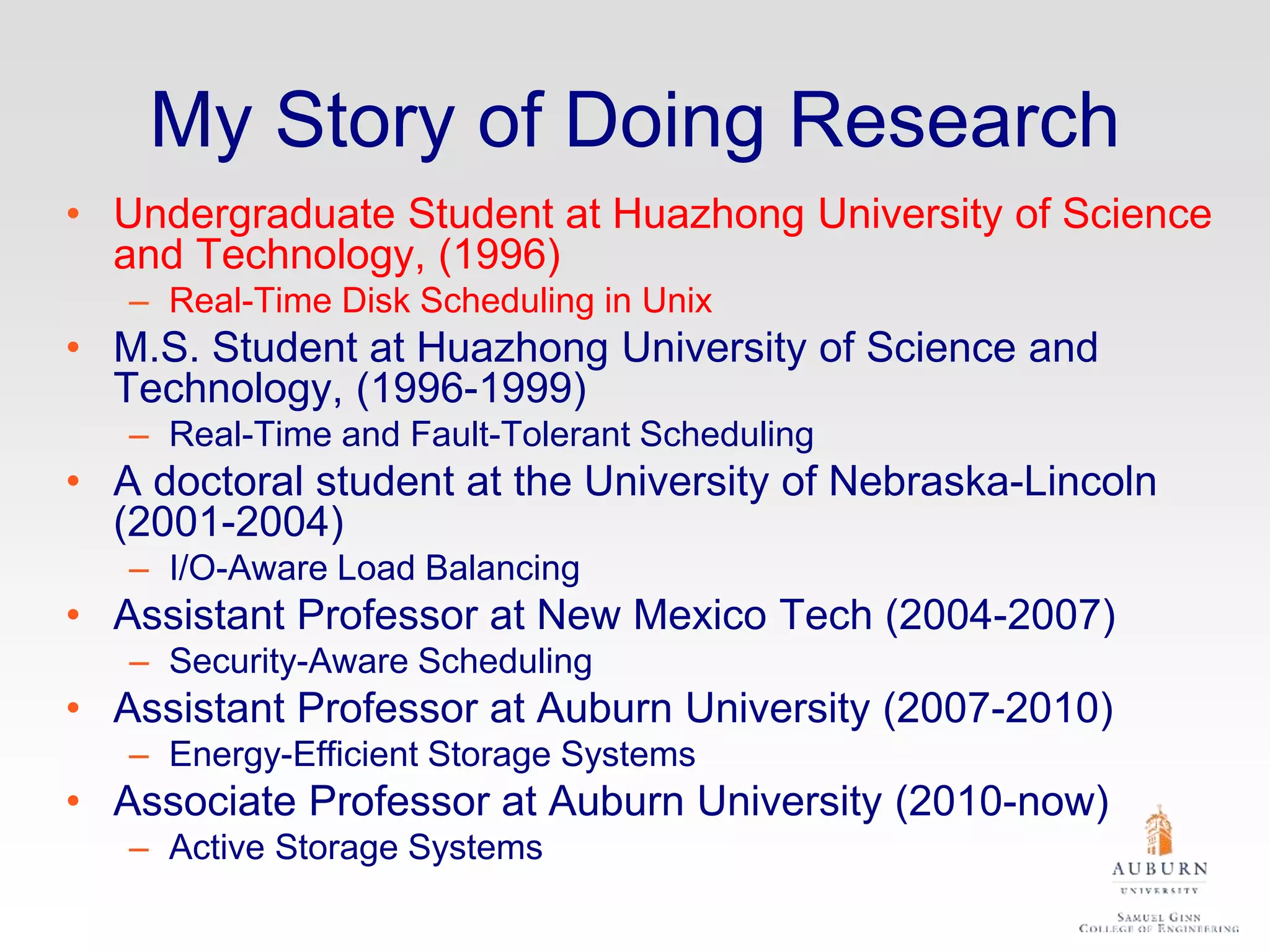
My Story of Doing Research
• Undergraduate Student at Huazhong University of Science
and Technology, (1996)
– Real-Time Disk Scheduling in Unix
• M.S. Student at Huazhong University of Science and
Technology, (1996-1999)
– Real-Time and Fault-Tolerant Scheduling
• A doctoral student at the University of Nebraska-Lincoln
(2001-2004)
– I/O-Aware Load Balancing
• Assistant Professor at New Mexico Tech (2004-2007)
– Security-Aware Scheduling
• Assistant Professor at Auburn University (2007-2010)
– Energy-Efficient Storage Systems
• Associate Professor at Auburn University (2010-now)
– Active Storage Systems
Caveat emptor
• These are my opinions, not departmental
policies
• Talk to others to get their views
• These comments are intended for those
who want to do research
– All undergraduate students, MS students, and
PhD students doing theses and projects
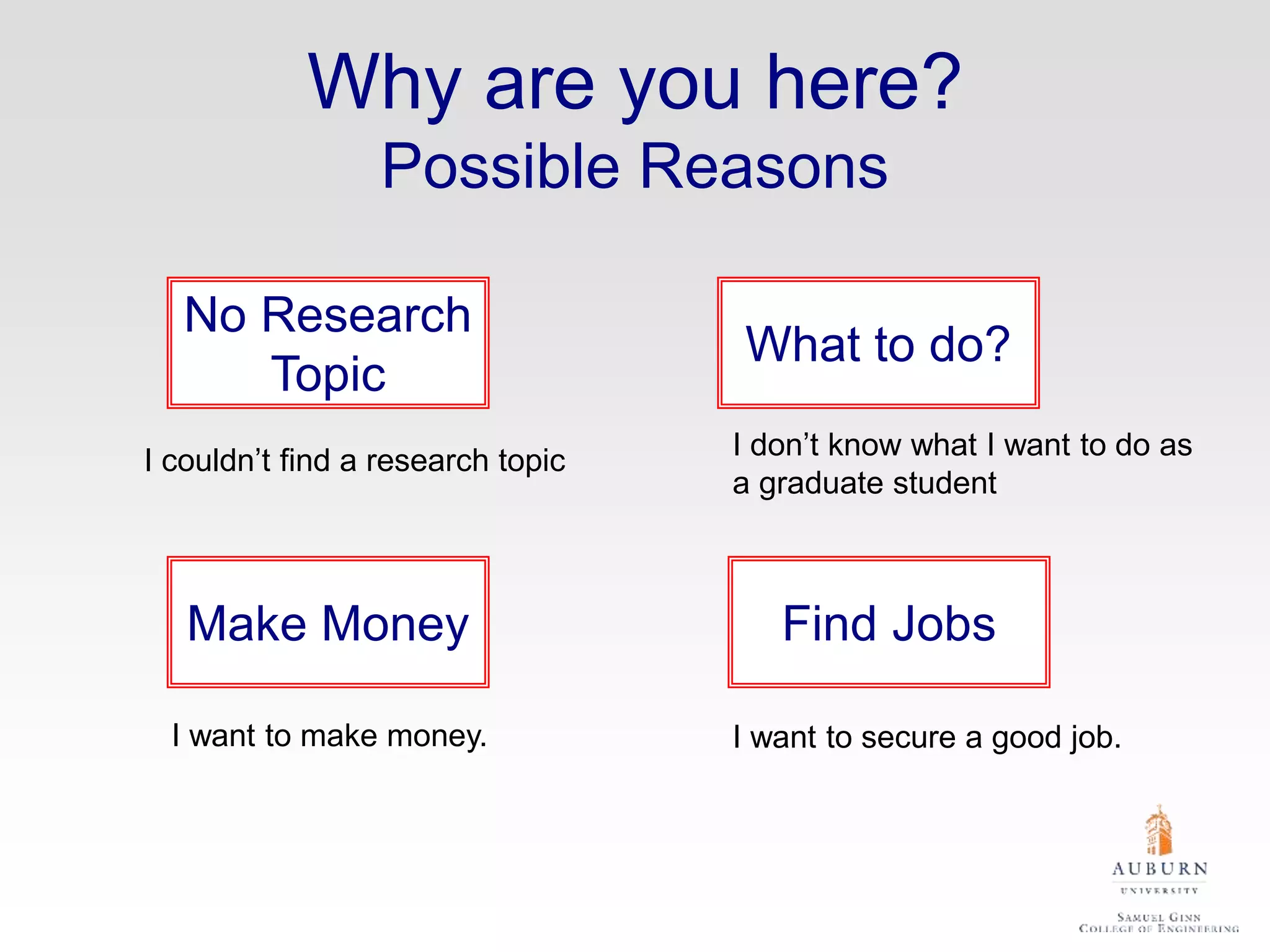
Why are you here?
Possible Reasons
What to do?
No Research
Topic
Make Money Find Jobs
I don’t know what I want to do as
a graduate student
I want to make money.
I couldn’t find a research topic
I want to secure a good job.
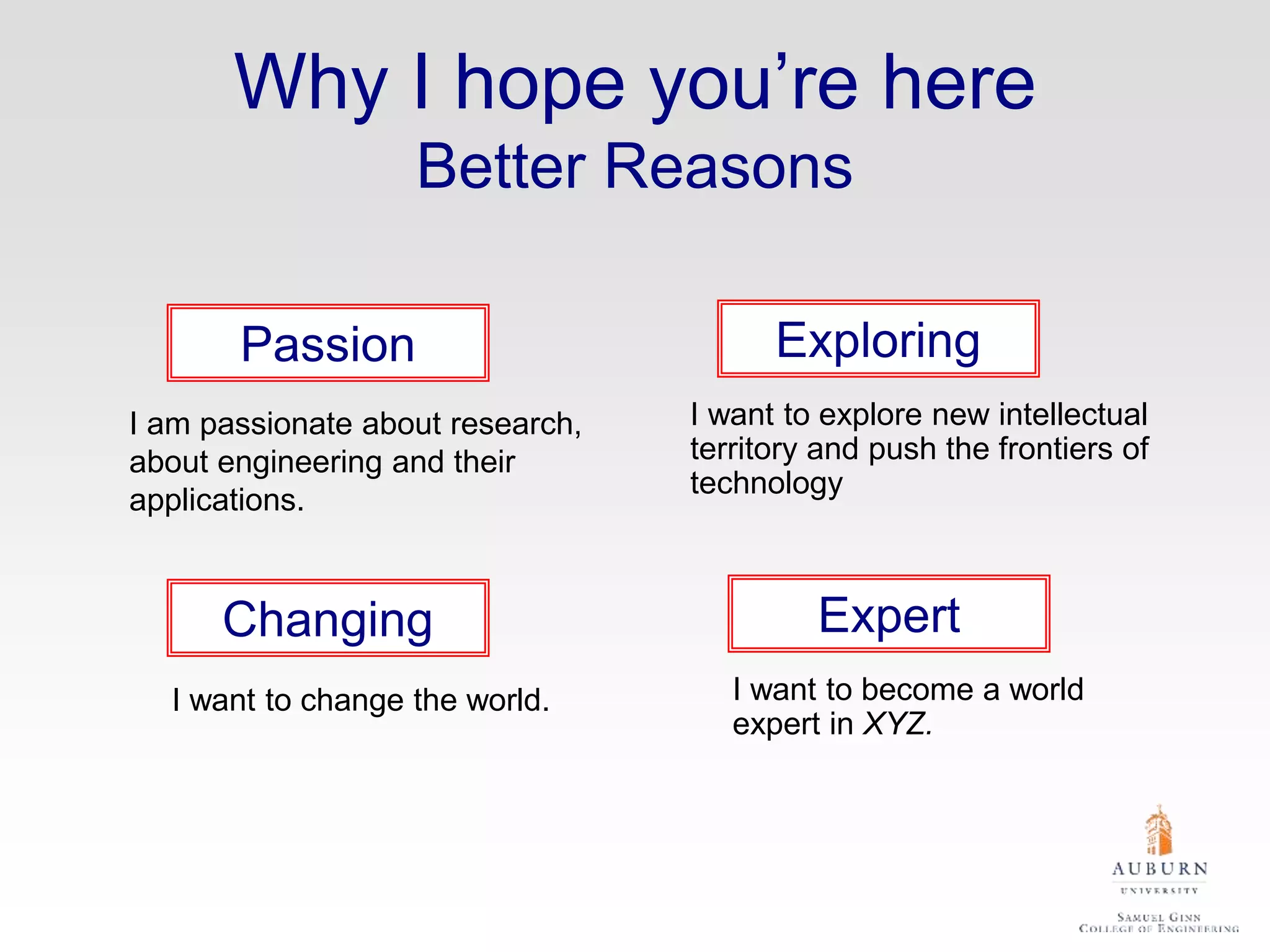
Why I hope you’re here
Better Reasons
ExploringPassion
Changing Expert
I want to explore new intellectual
territory and push the frontiers of
technology
I want to change the world.
I am passionate about research,
about engineering and their
applications.
I want to become a world
expert in XYZ.
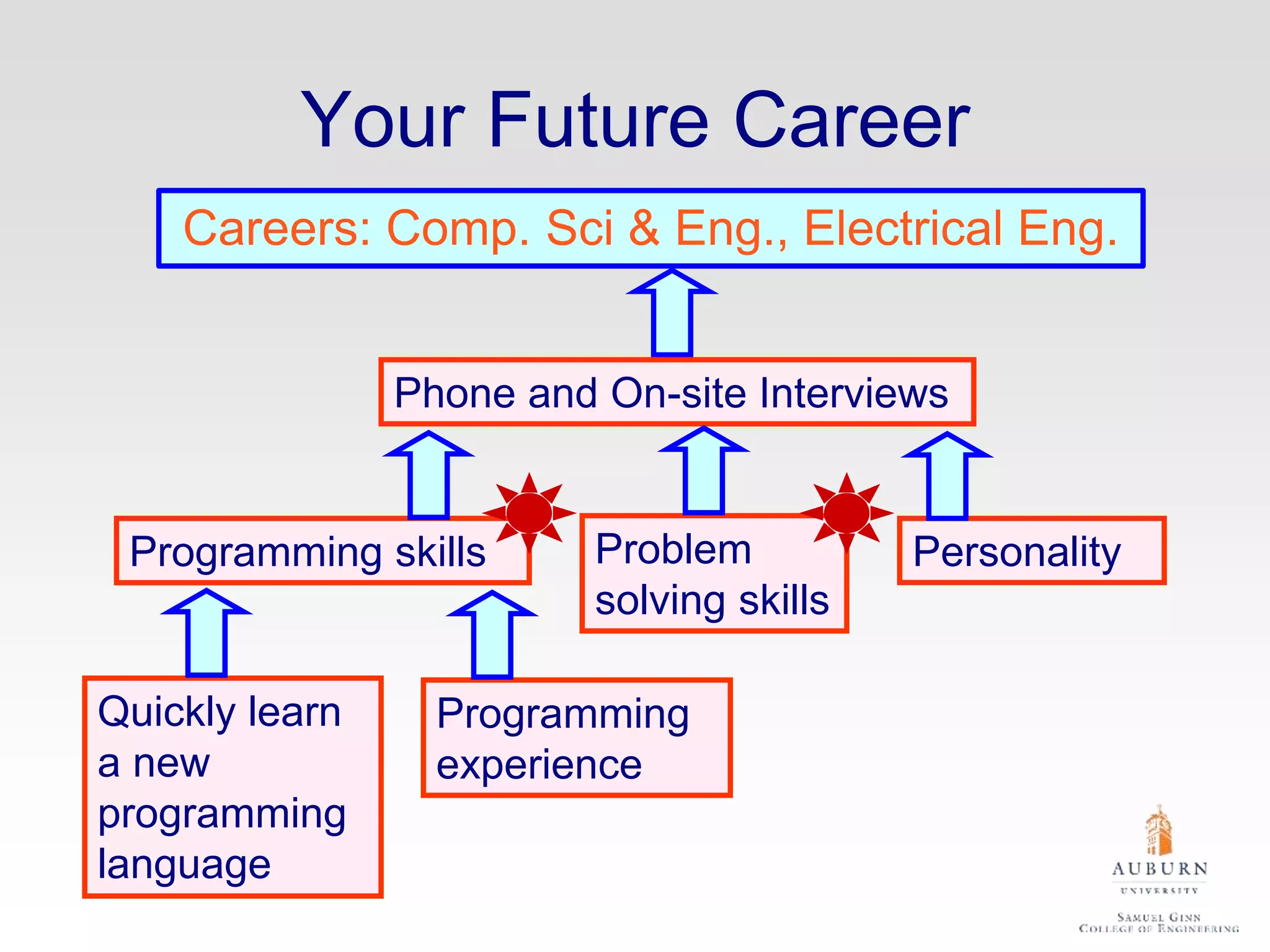
Your Future Career
Careers: Comp. Sci & Eng., Electrical Eng.
Programming skills
Phone and On-site Interviews
Problem
solving skills
Personality
Quickly learn
a new
programming
language
Programming
experience
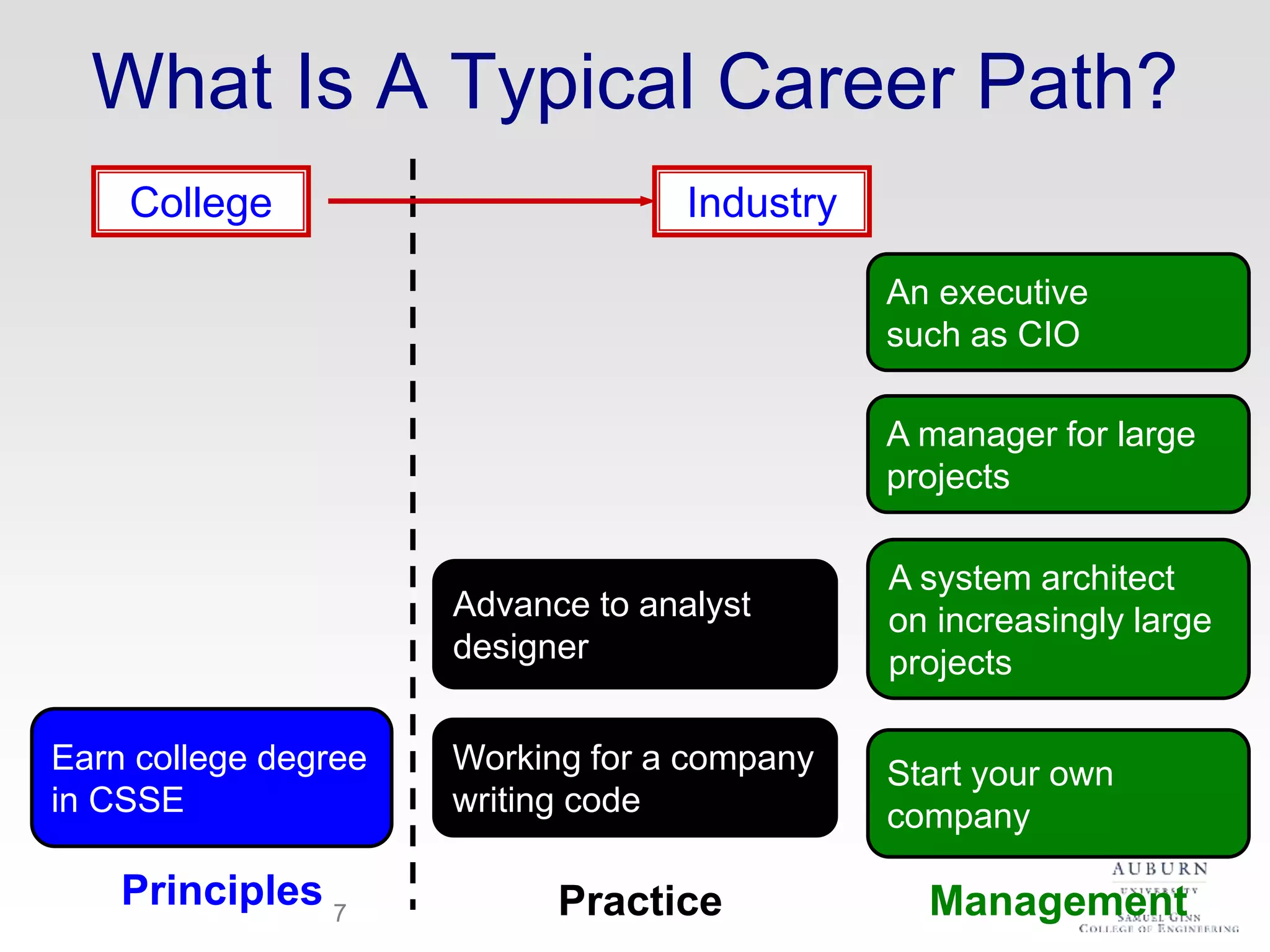
What Is A Typical Career Path?
7
Earn college degree
in CSSE
PracticePrinciples Management
Working for a company
writing code
Advance to analyst
designer
A system architect
on increasingly large
projects
College Industry
A manager for large
projects
An executive
such as CIO
Start your own
company
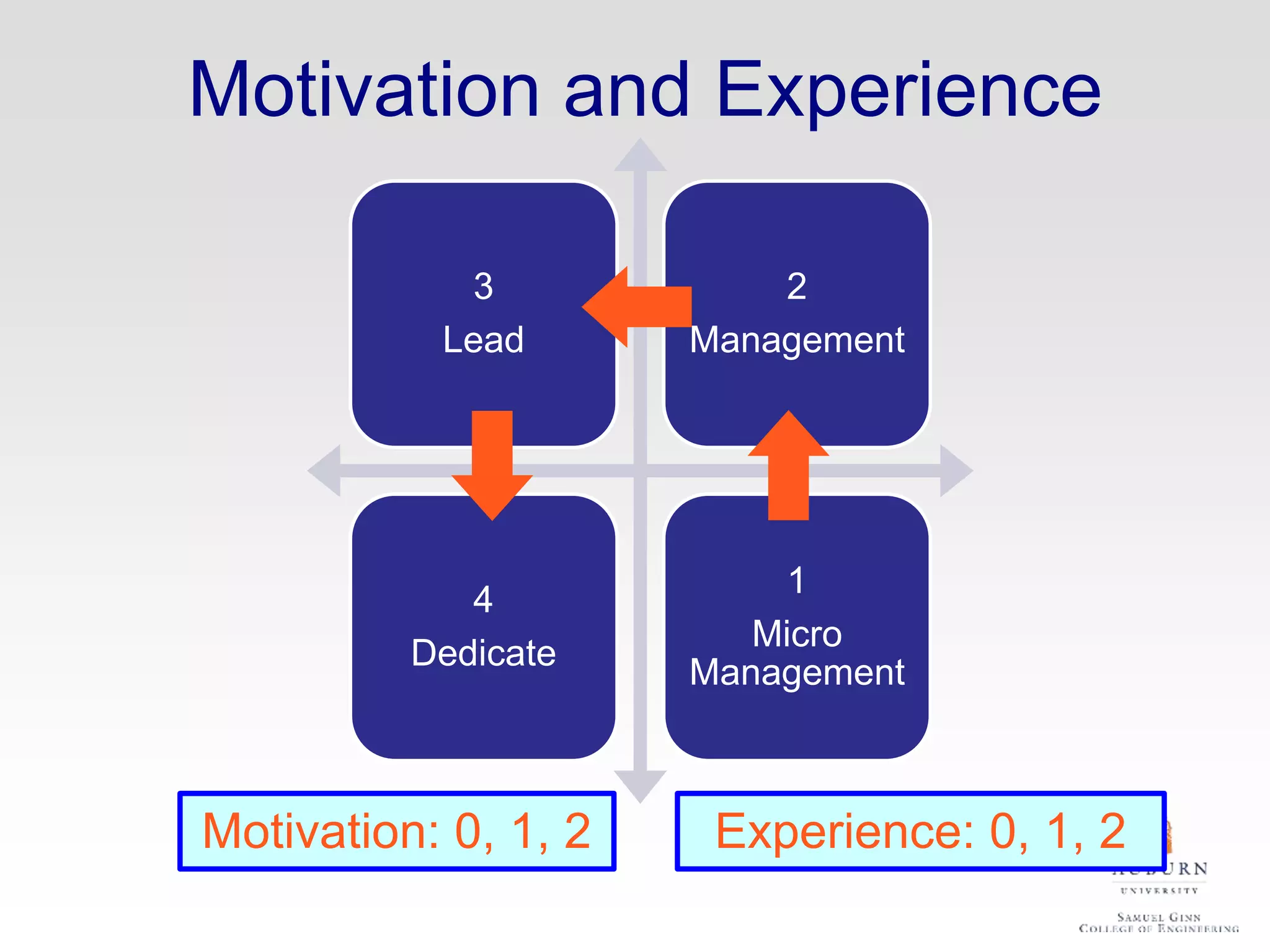
Motivation and Experience
Motivation: 0, 1, 2 Experience: 0, 1, 2
3
Lead
2
Management
4
Dedicate
1
Micro
Management
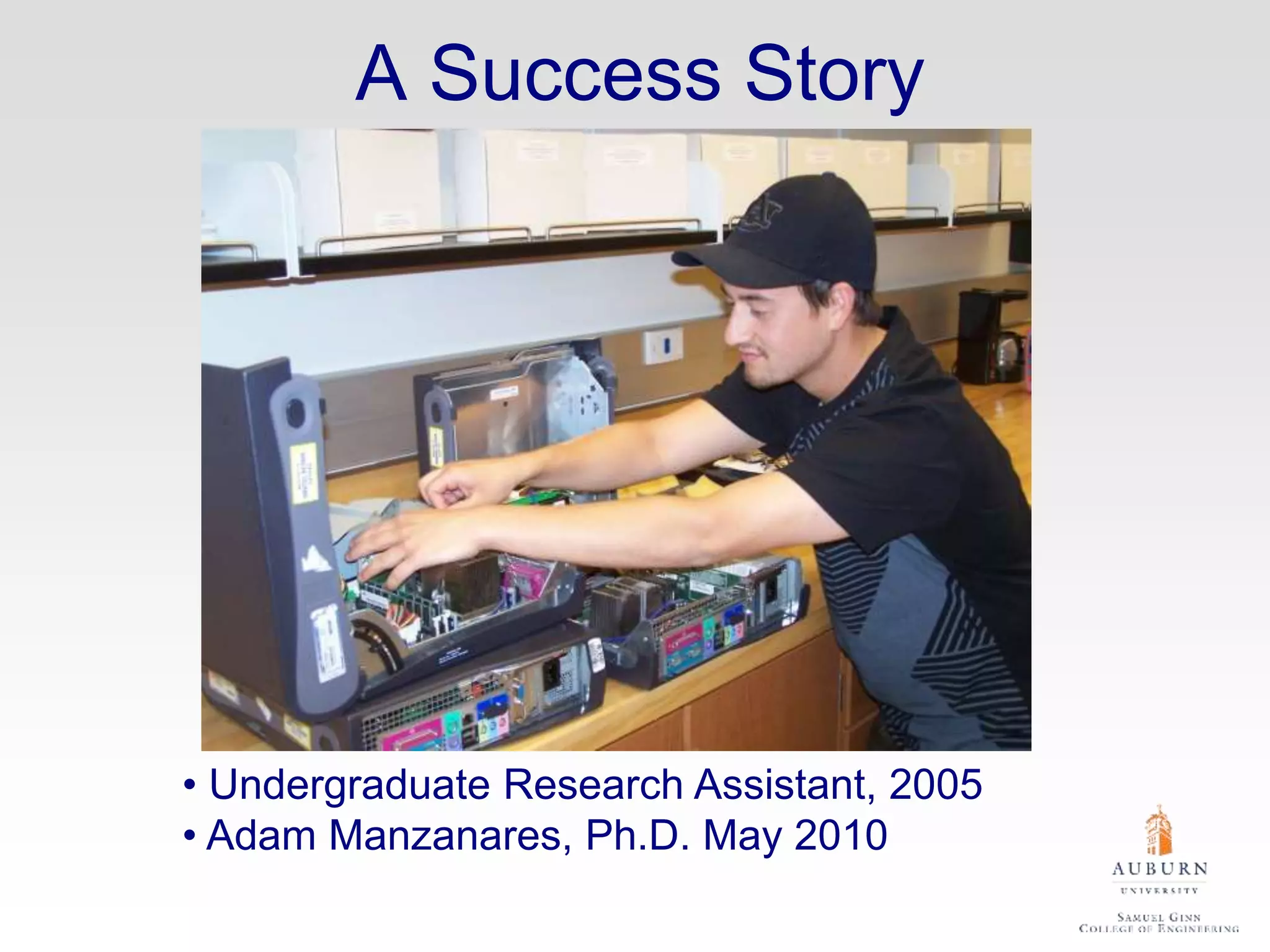
A Success Story
• Undergraduate Research Assistant, 2005
• Adam Manzanares, Ph.D. May 2010
10
10 pieces of advice guaranteed to
make you a successful research
assistant.
How to be a successful
research assistant?
1. Manage Yourself
• Goals, priorities, and planning
– Set goals, and keep them updated
– Make a plan for each day, week, month, quarter
• “Failing to plan means planning to fail”
– Prioritize – do important things first
– Don’t waste time – kill your TV, xBox
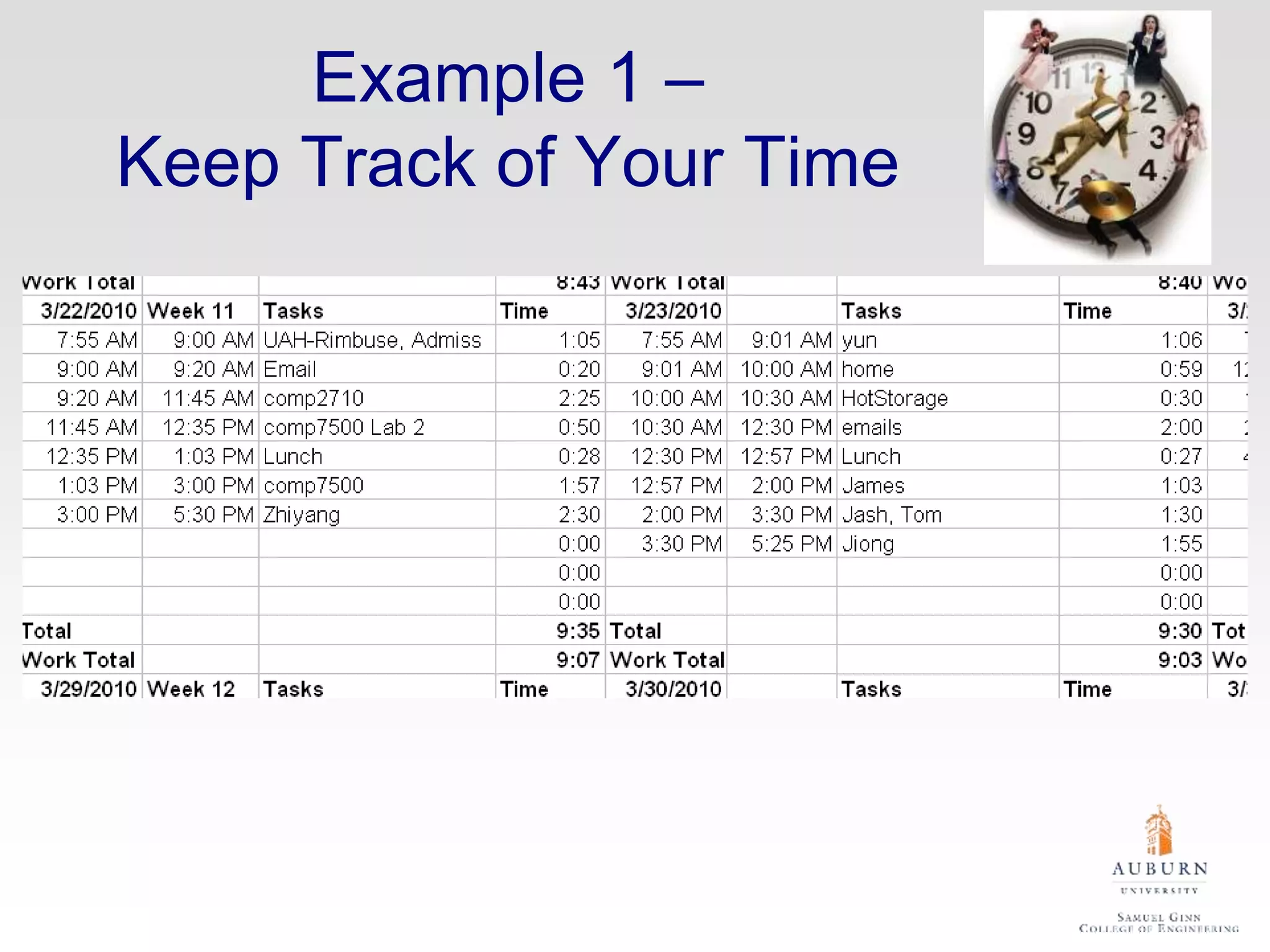
• Keep track of how you spend your time
• Computer Science  Web Browsing Engineering
• “Is this activity helping me to achieve my REU goal?”
– Keep a notebook, write these things down
Example 1 –
Keep Track of Your Time
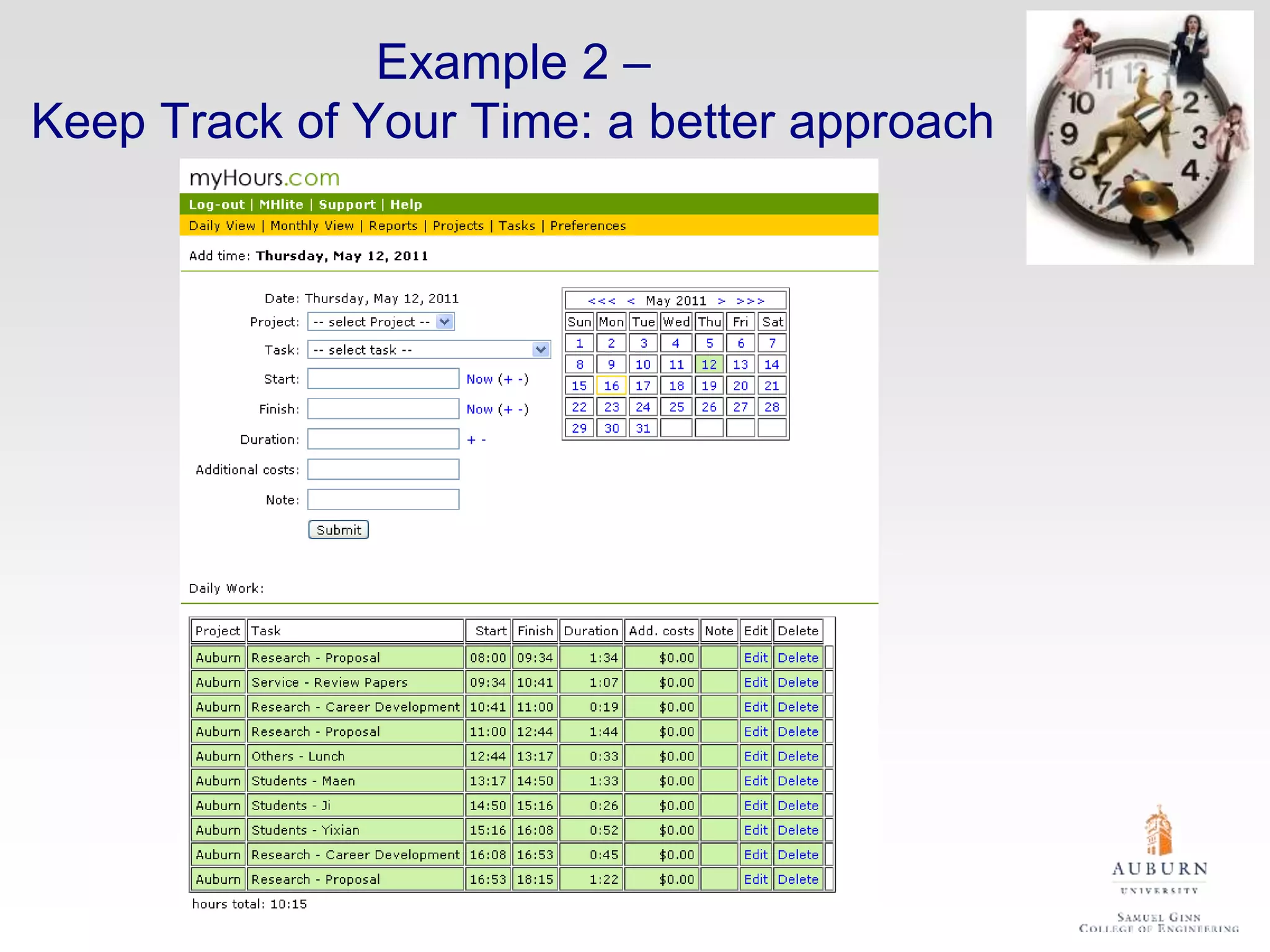
Example 2 –
Keep Track of Your Time: a better approach
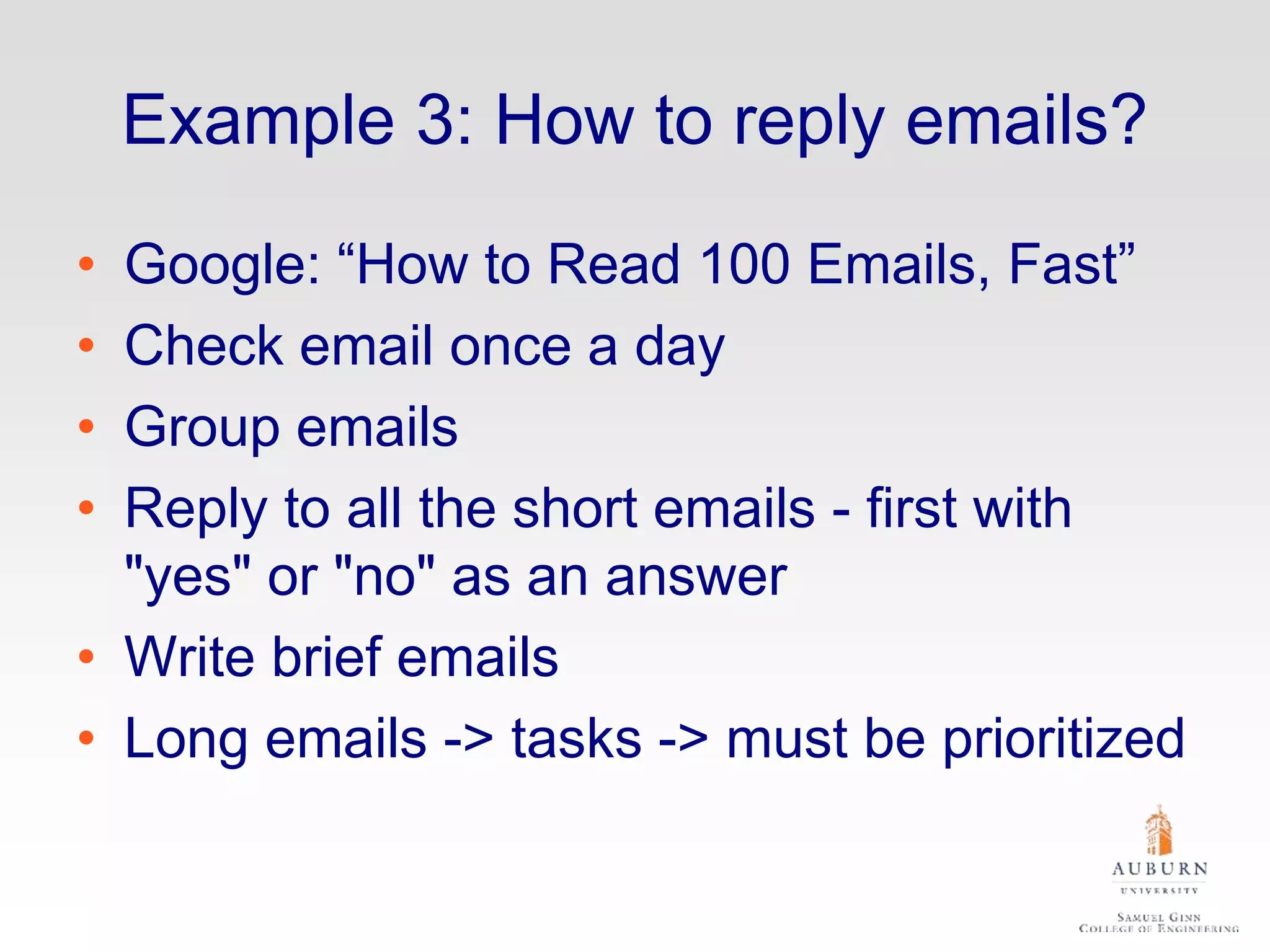
Example 3: How to reply emails?
• Google: “How to Read 100 Emails, Fast”
• Check email once a day
• Group emails
• Reply to all the short emails - first with
"yes" or "no" as an answer
• Write brief emails
• Long emails -> tasks -> must be prioritized
2. Develop Intellectual Discipline
• Think!
– Set aside time for thinking. Really.
• Read! (To be covered in another training session)
– Get to know the literature in your area intimately (not
superficially)
• Act!
– Don’t feel like you have to know everything first
– Don’t worry about being wrong
• Evaluate!
– Solicit feedback – most ideas aren’t so good…
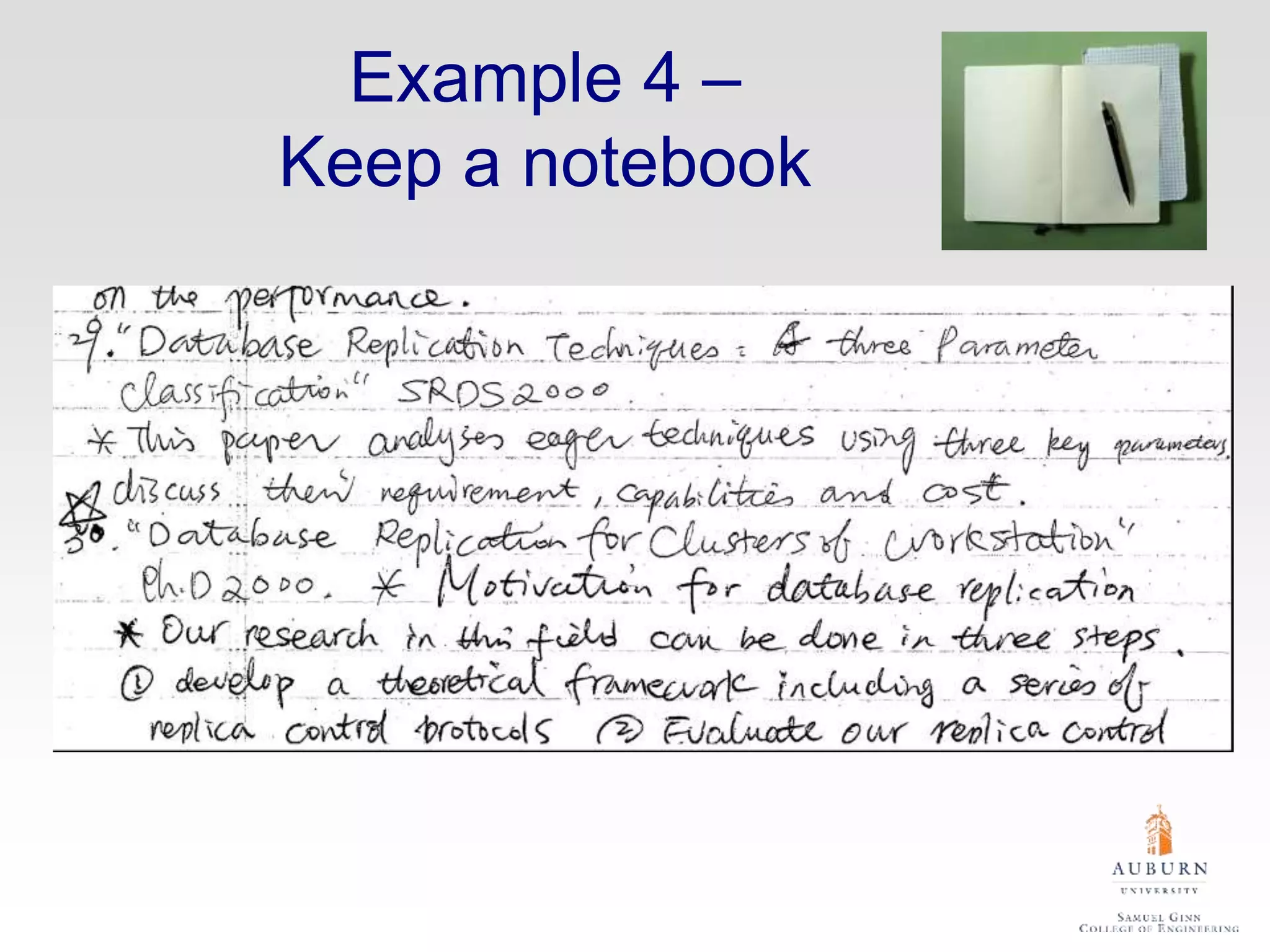
Example 4 –
Keep a notebook
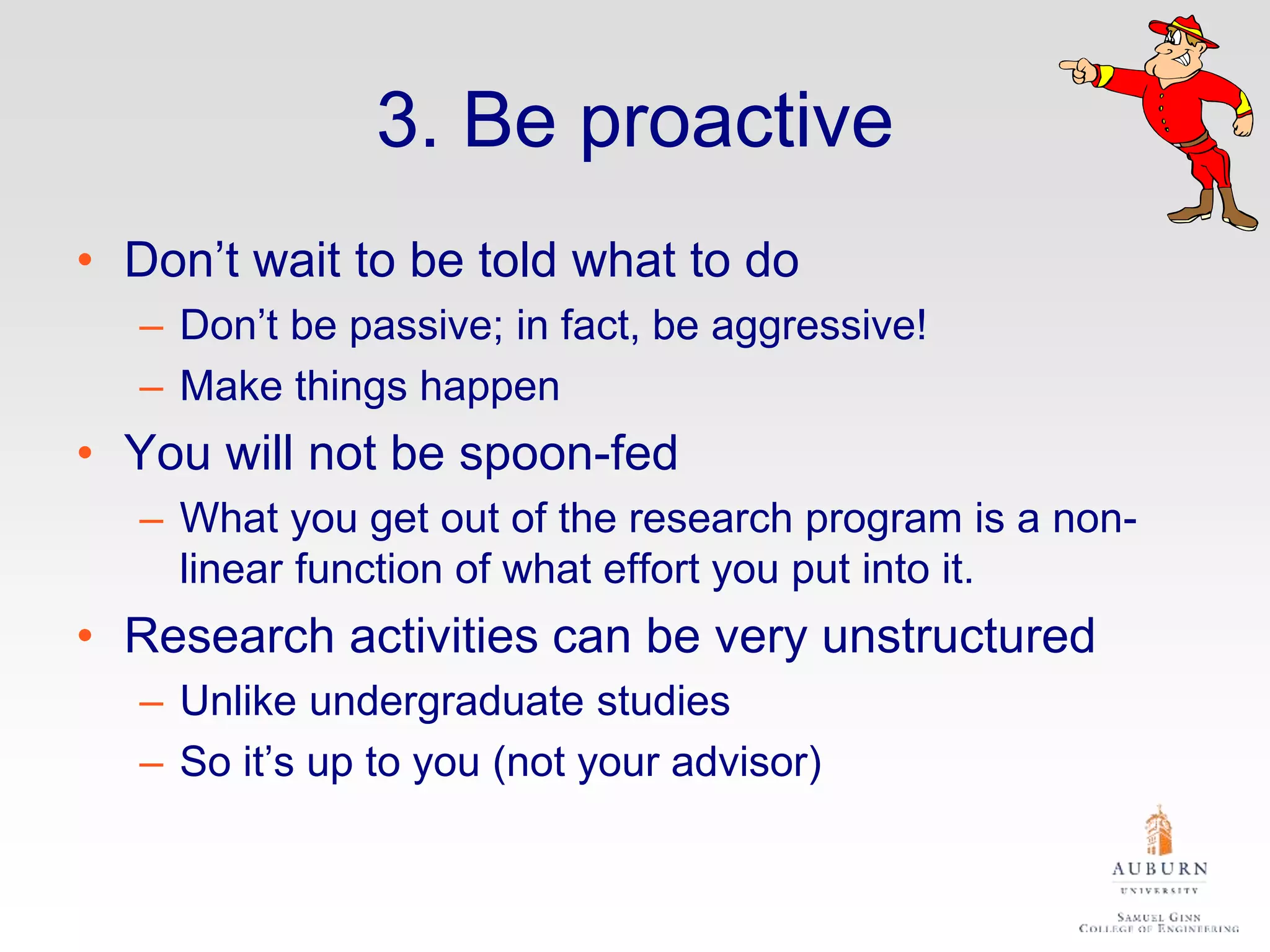
3. Be proactive
• Don’t wait to be told what to do
– Don’t be passive; in fact, be aggressive!
– Make things happen
• You will not be spoon-fed
– What you get out of the research program is a non-
linear function of what effort you put into it.
• Research activities can be very unstructured
– Unlike undergraduate studies
– So it’s up to you (not your advisor)
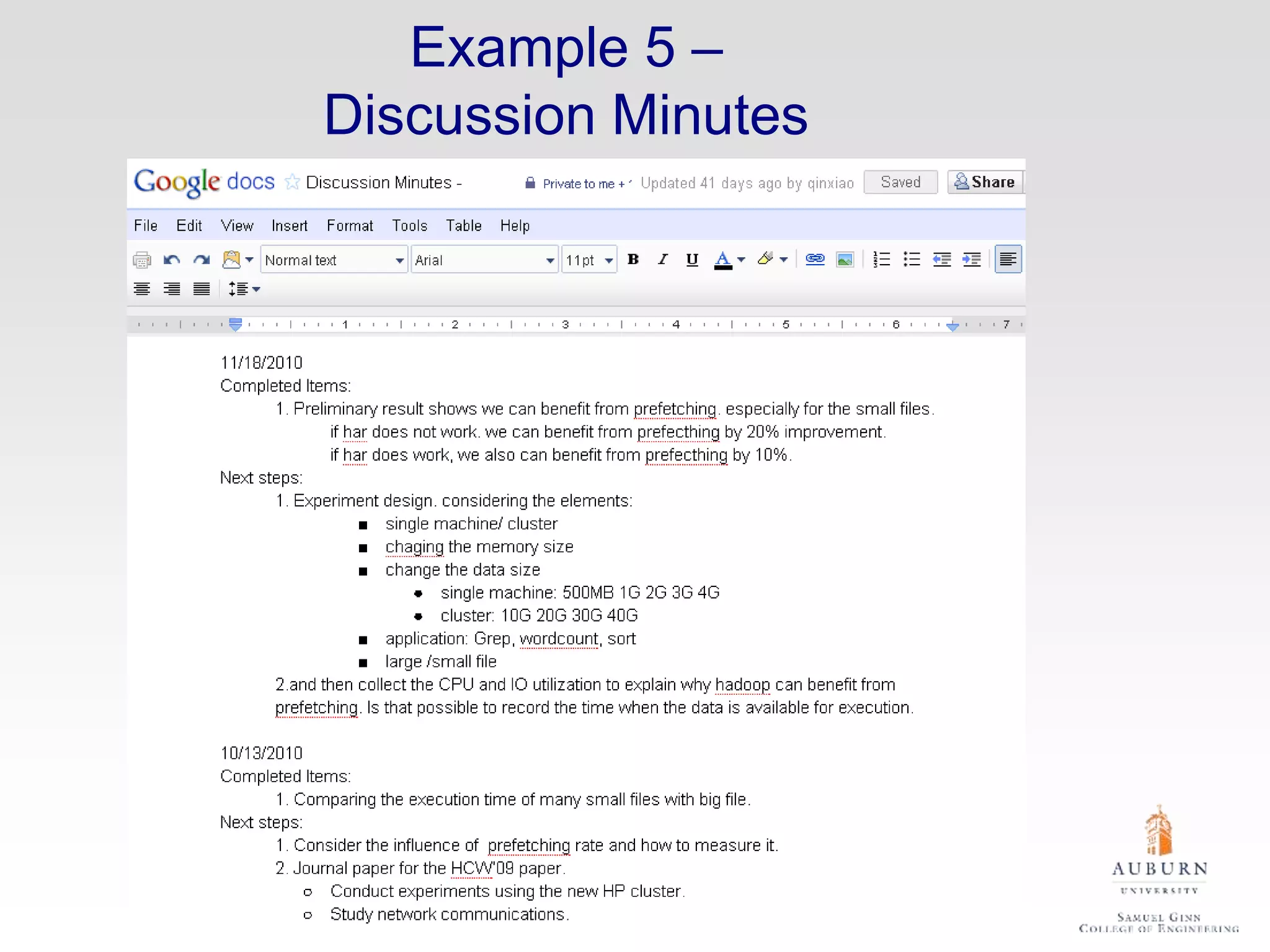
Example 5 –
Discussion Minutes
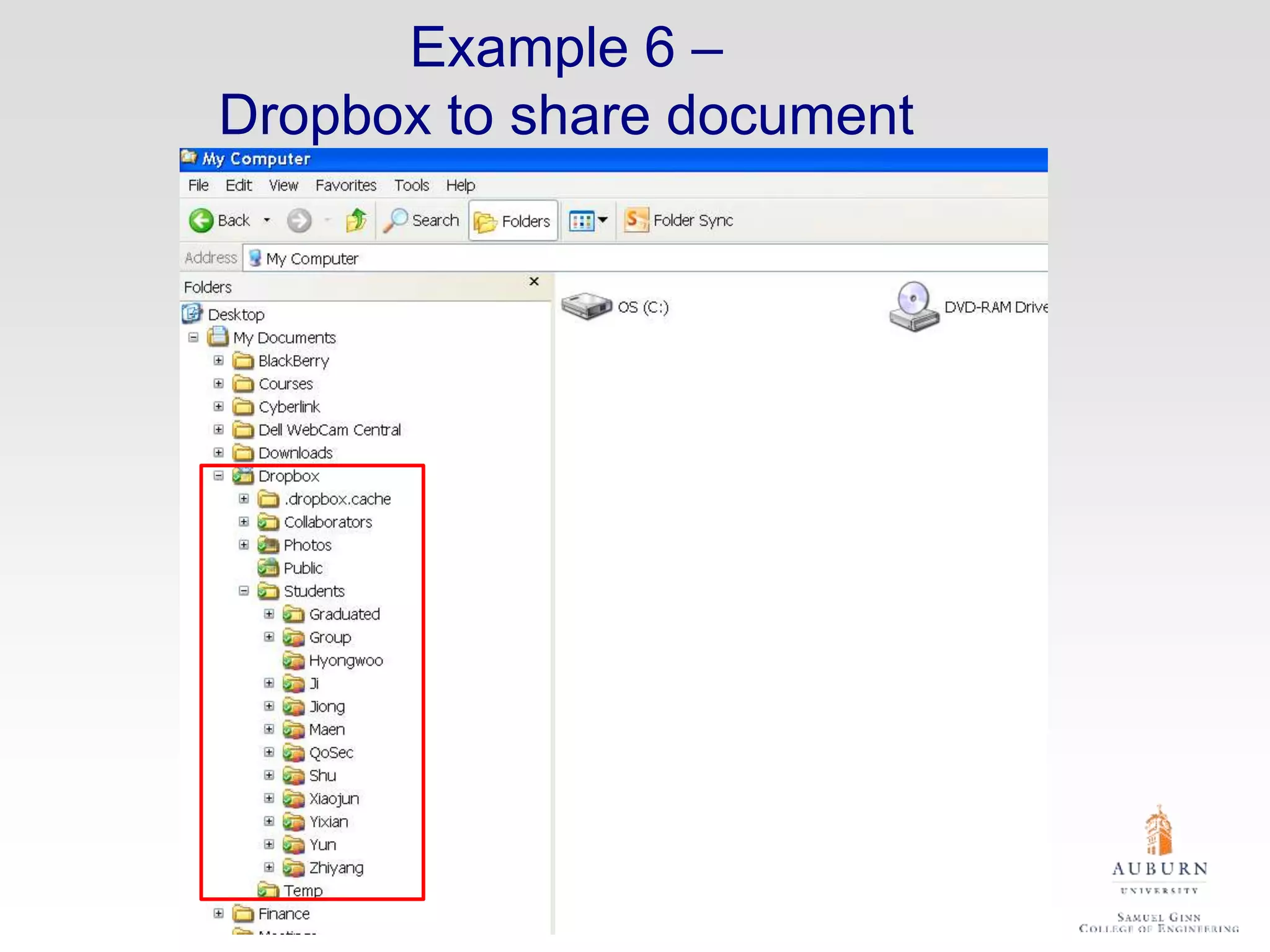
Example 6 –
Dropbox to share document
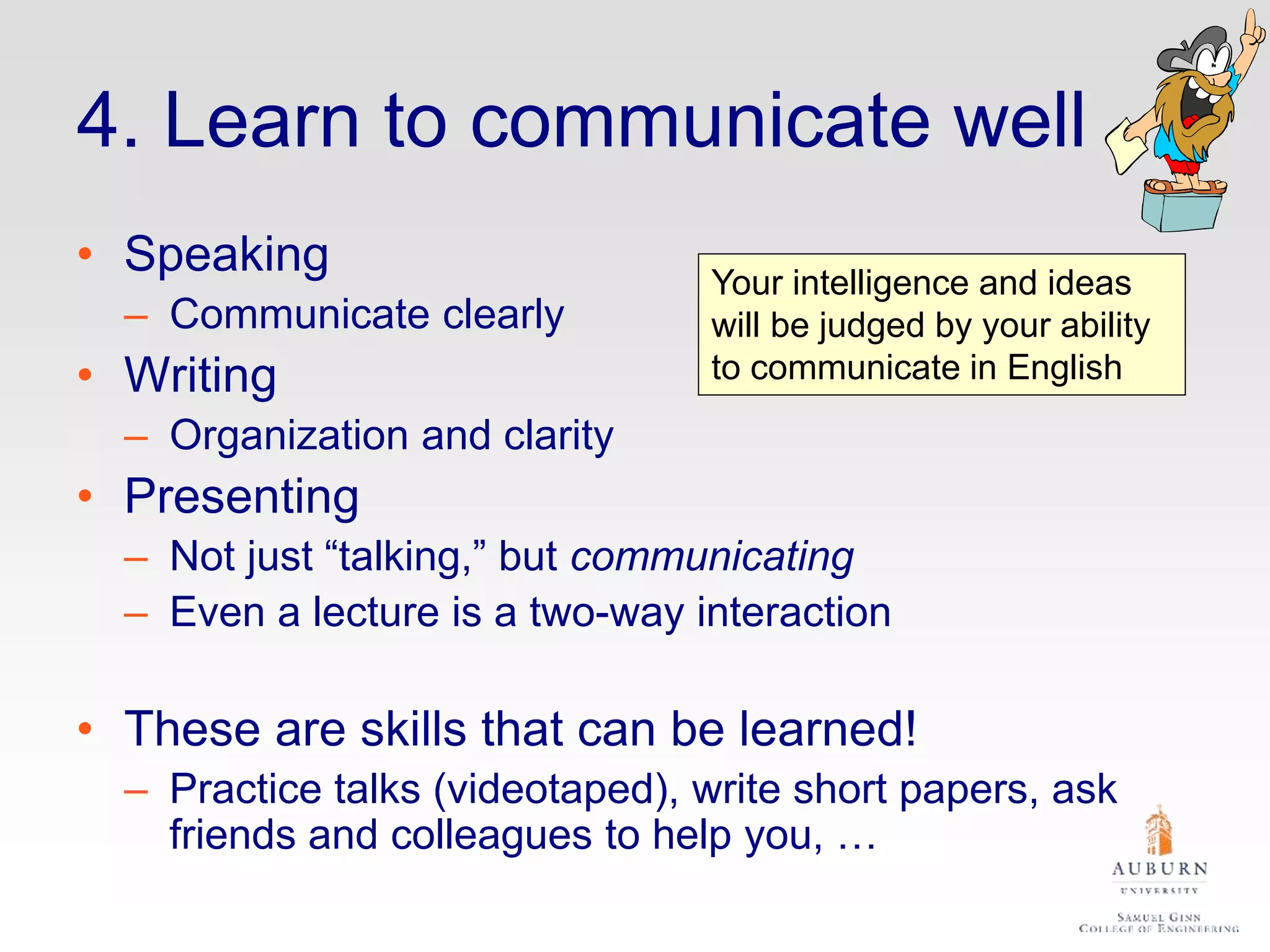
4. Learn to communicate well
• Speaking
– Communicate clearly
• Writing
– Organization and clarity
• Presenting
– Not just “talking,” but communicating
– Even a lecture is a two-way interaction
• These are skills that can be learned!
– Practice talks (videotaped), write short papers, ask
friends and colleagues to help you, …
Your intelligence and ideas
will be judged by your ability
to communicate in English
5. Develop an intellectual
community
• Among your peers at Auburn, create
something different and special
– Ask questions
– Discuss ideas
– Brainstorm
– Argue, challenge
– Collaborate
6. Networking
• Get to know the people in the department
(faculty and grad students), and other people in
your field
– Don’t wait – introduce yourself!
• Go to conferences and meet other REU students
and “famous” researchers
– Be aggressive!
• Talk with visitors: “pick their pockets”
– You never know who will someday offer you a job,
write a reference letter, review your paper, give you
invaluable feedback or insight….
7. Choose a good research
problem
• This is the hardest, and most important, part of
research!
• The Goldilocks problem:
– Not too hard, not too soft, not too hot, not too cold, not
too big, not too small
• Think, read, act, evaluate
– And talk to everyone – not only your advisor
• Passion or duty?
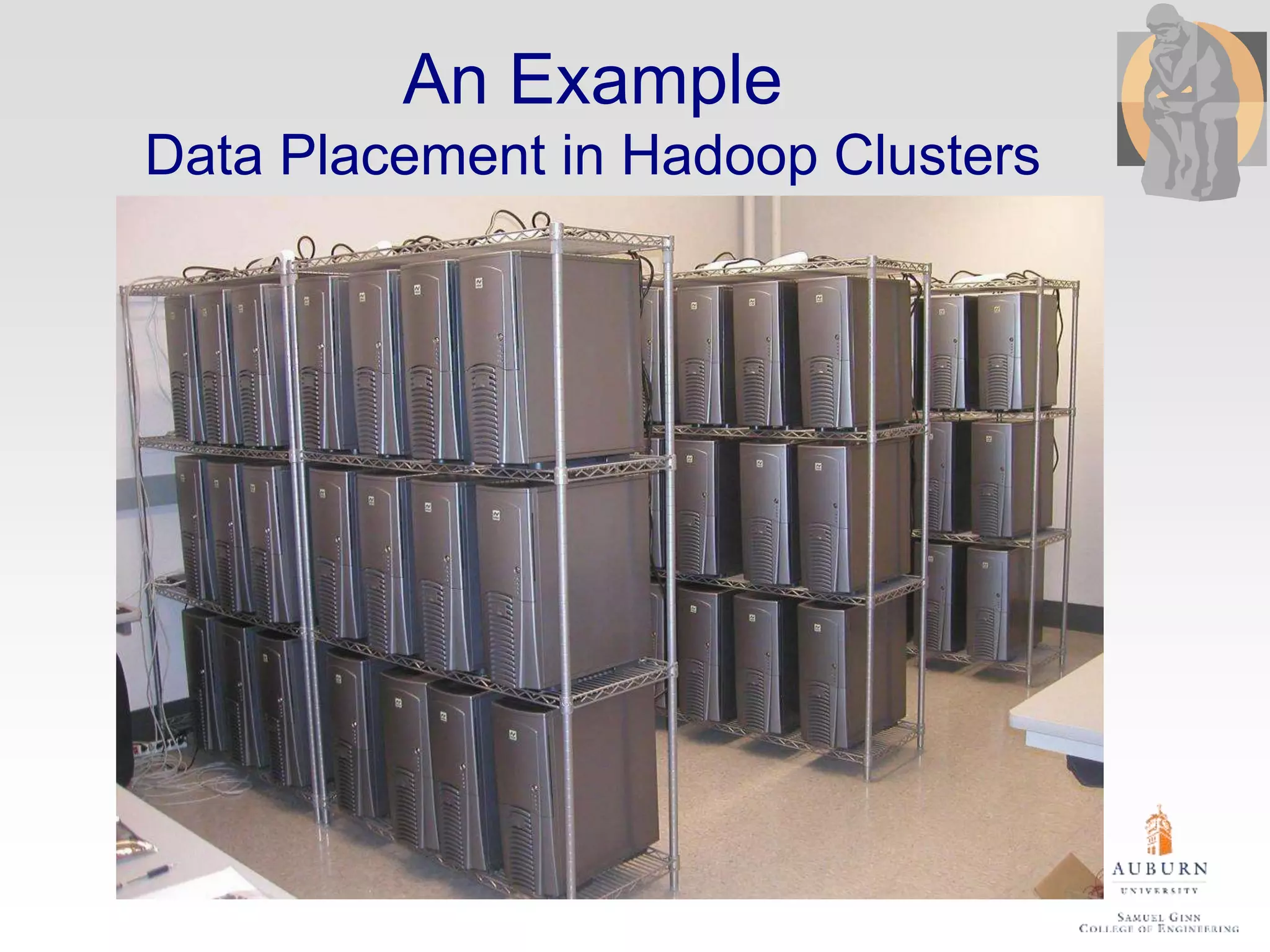
An Example
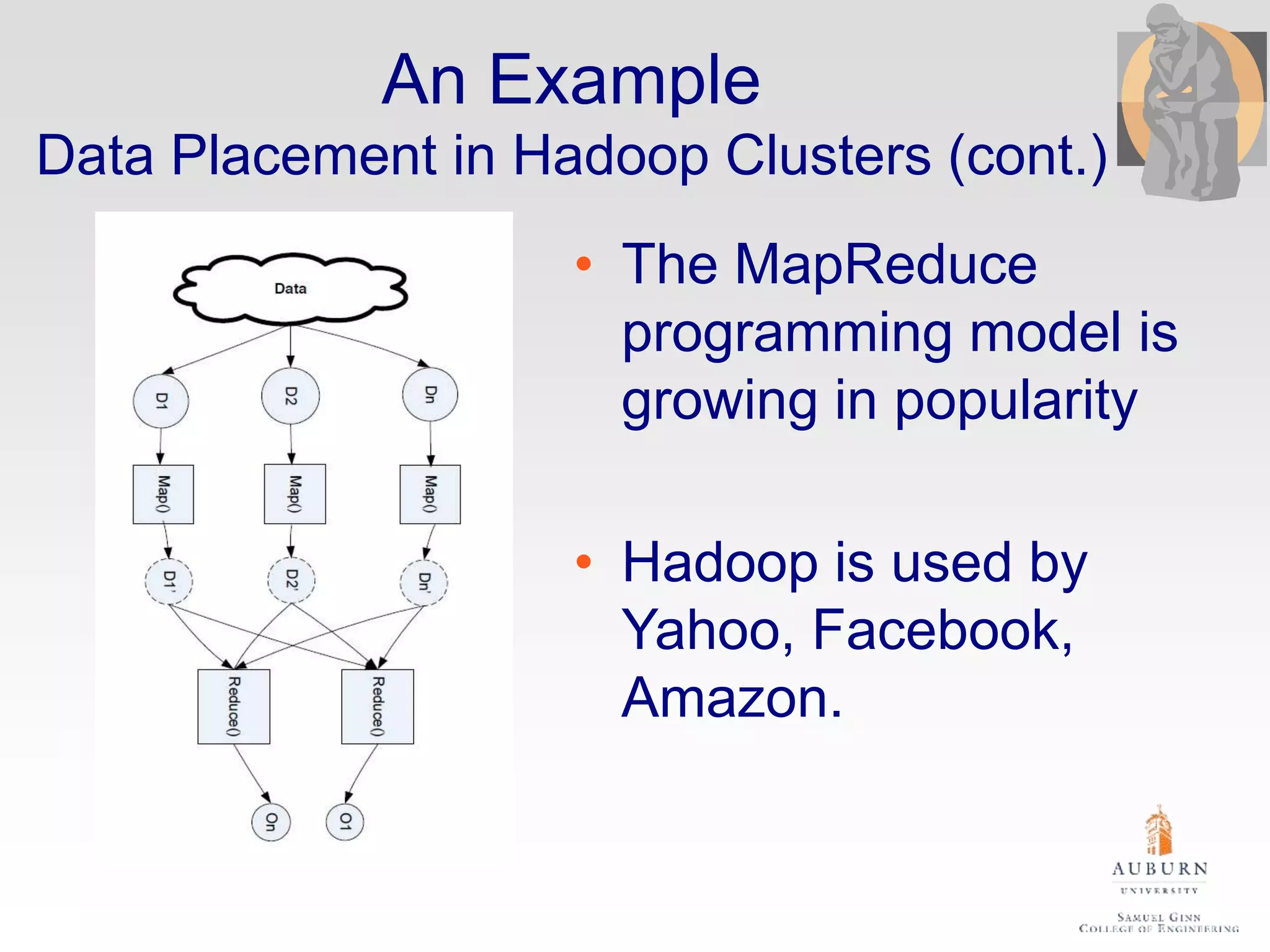
Data Placement in Hadoop Clusters
An Example
Data Placement in Hadoop Clusters (cont.)
• The MapReduce
programming model is
growing in popularity
• Hadoop is used by
Yahoo, Facebook,
Amazon.
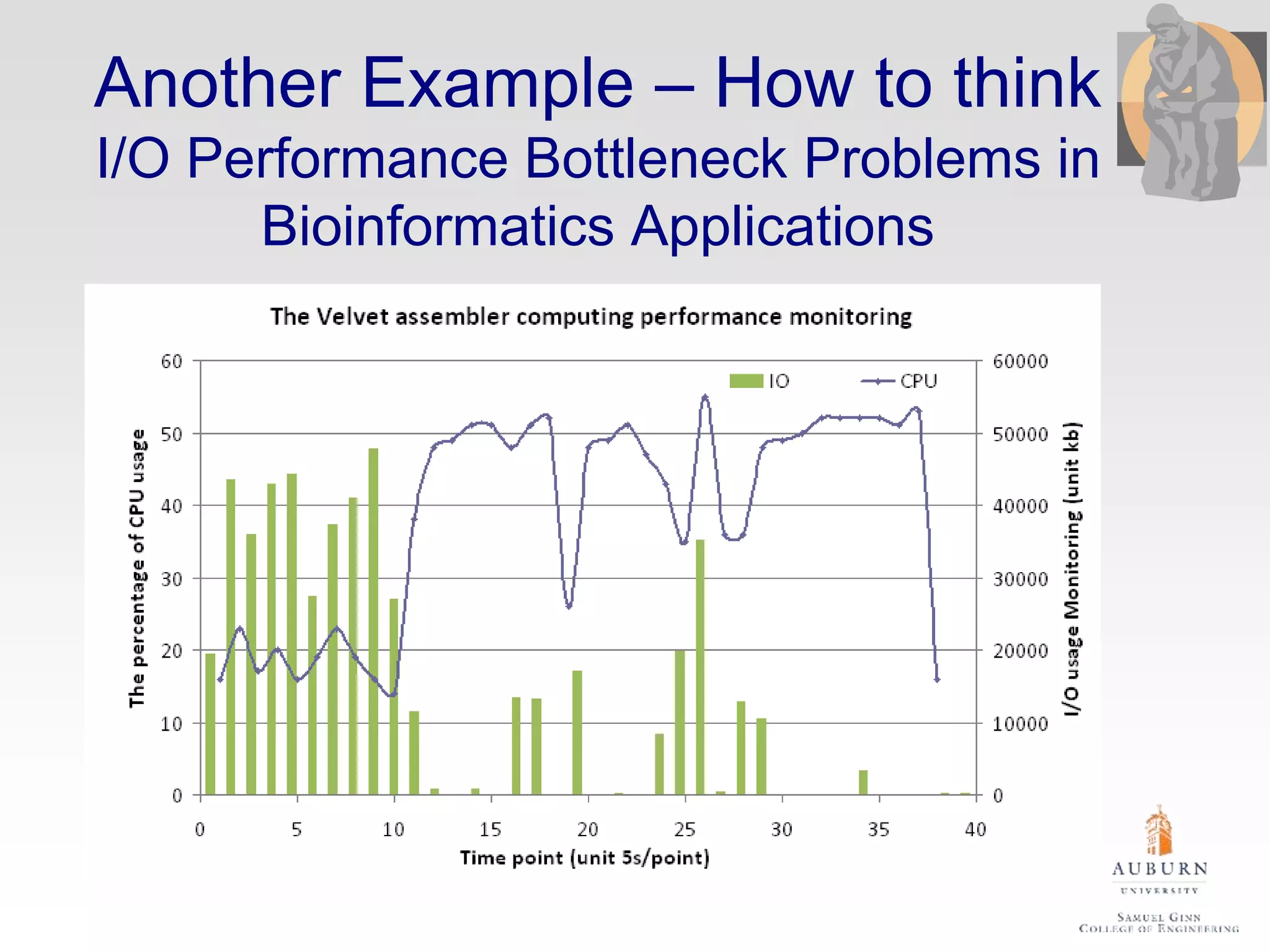
Another Example – How to think
I/O Performance Bottleneck Problems in
Bioinformatics Applications
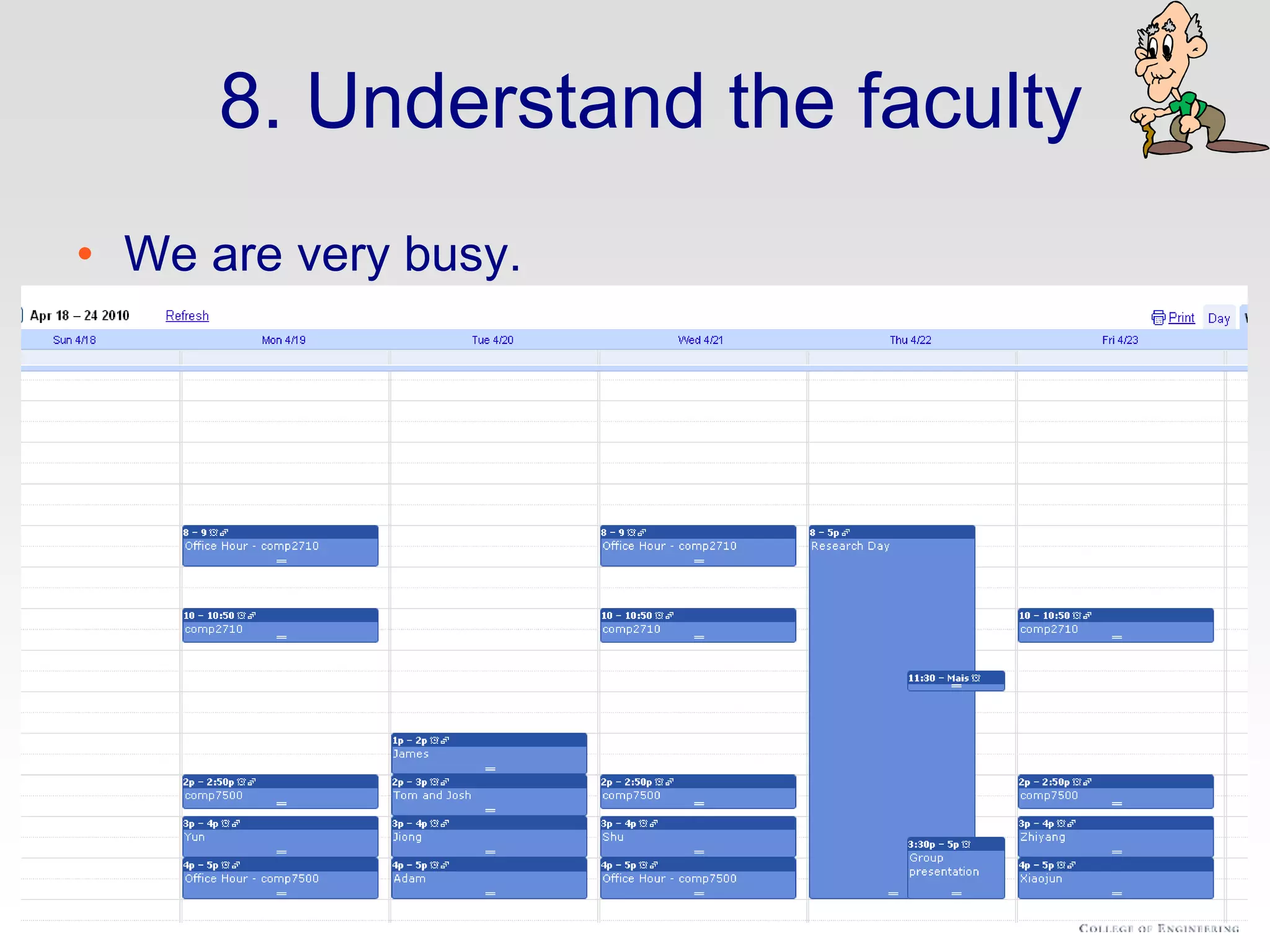
8. Understand the faculty
• We are very busy.
– That’s no excuse. We do have time for you.
• We know more than you do.
– At least for a little while.
– But not as much more as you might think.
• We are not superior beings.
– Most of us have first names.
– Give us feedback too!
• We are part mentor, part colleague, part human.
9. Study successful people
• Senior grad students, faculty, pioneers,
leaders in your field, …
– Read biographies
– Who are your heroes, mentors?
• Seek advice
– But modify it to your particular situation
10. Have a Life
• Work hard, networking, think, read, program,
experiment, build, study, practice, ….
– So little time and so much to do!!
• Still, amidst the chaos of the REU program, it is
very important that you do not lose sight of who
you are and what makes you tick.
– Have a social life
– Don’t neglect your family and friends, your health, your
sanity
– Do make time for things that are important and
meaningful to you
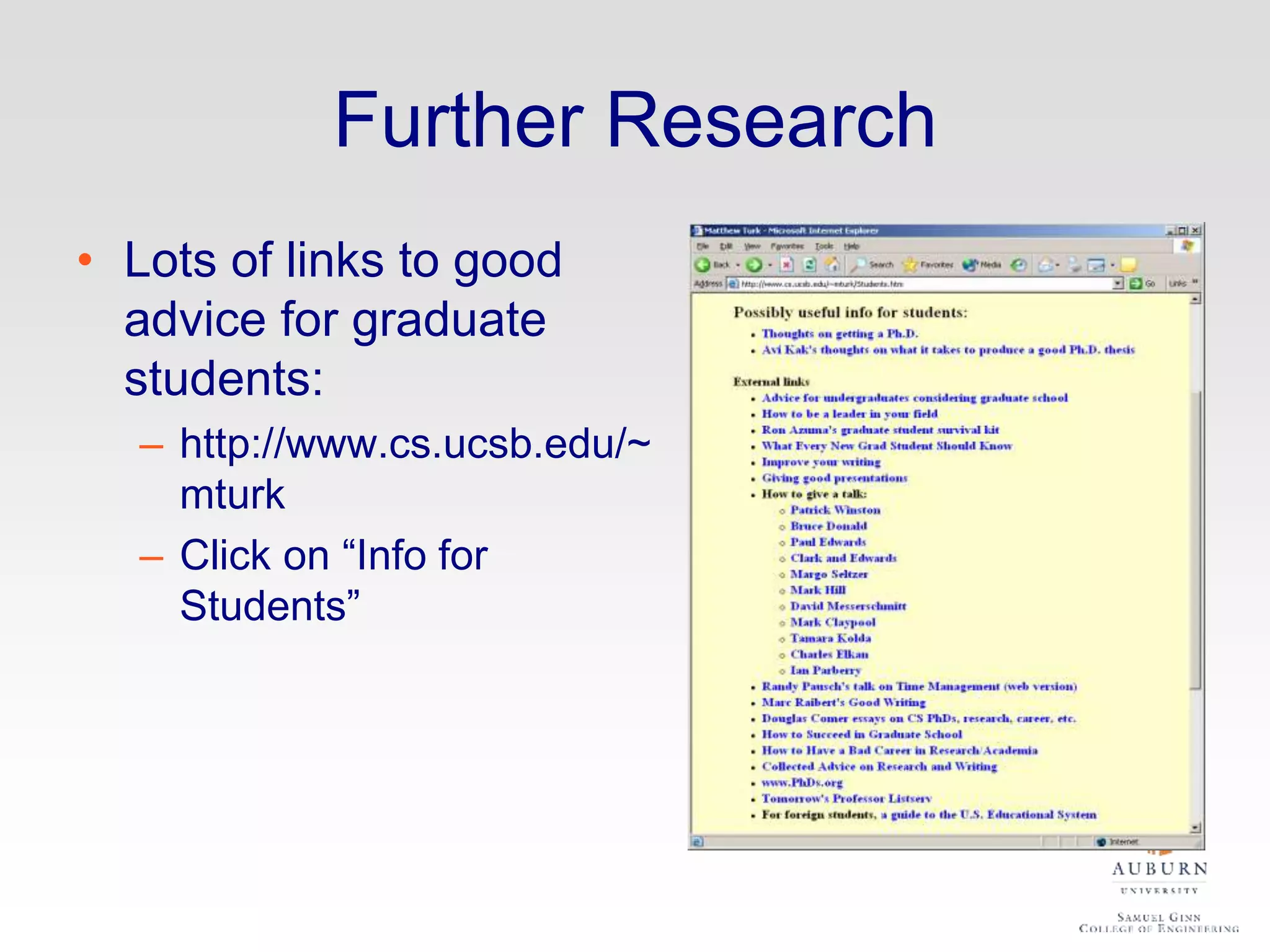
Further Research
• Lots of links to good
advice for graduate
students:
– http://www.cs.ucsb.edu/~
mturk
– Click on “Info for
Students”
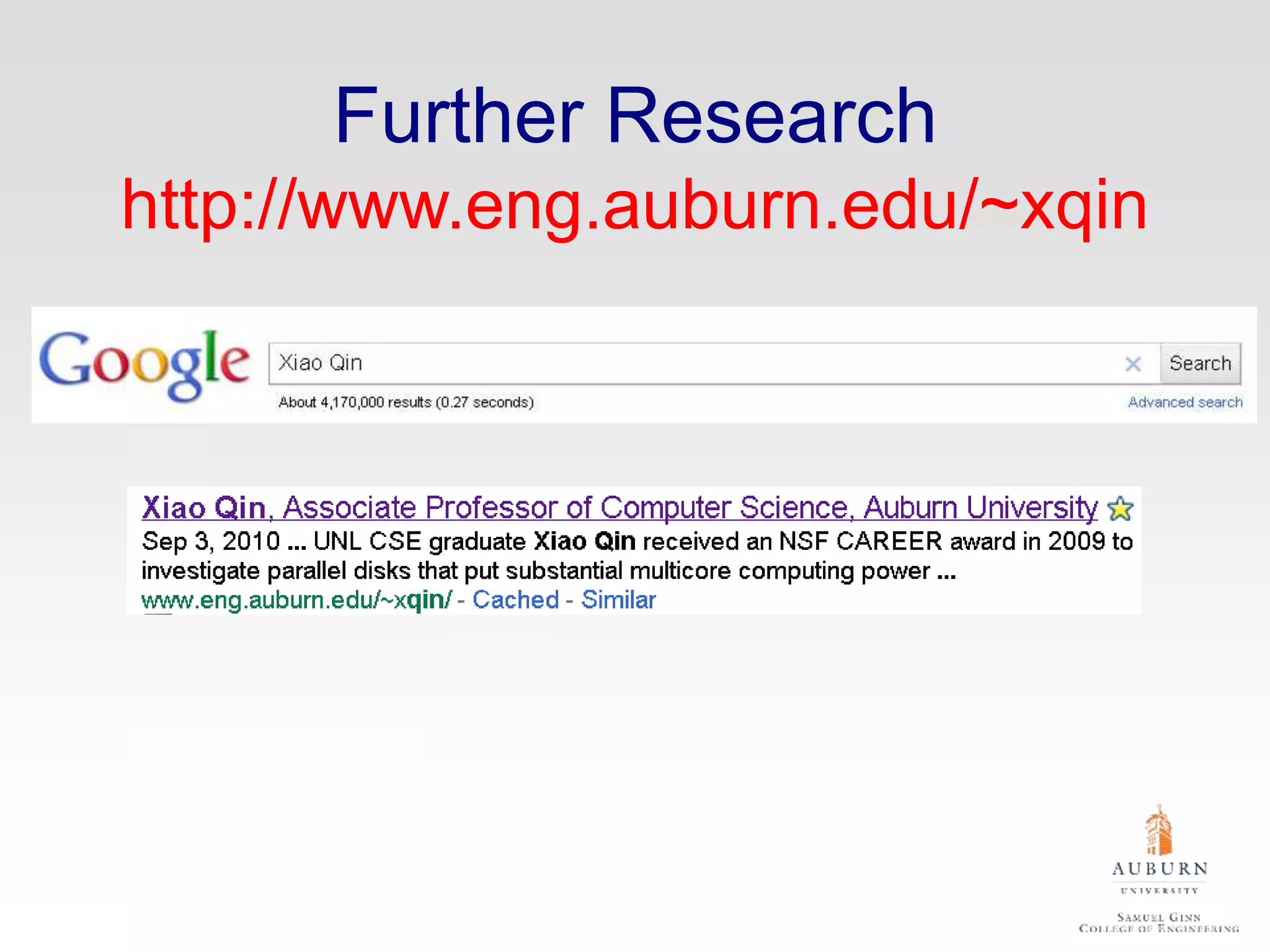
Further Research
http://www.eng.auburn.edu/~xqin
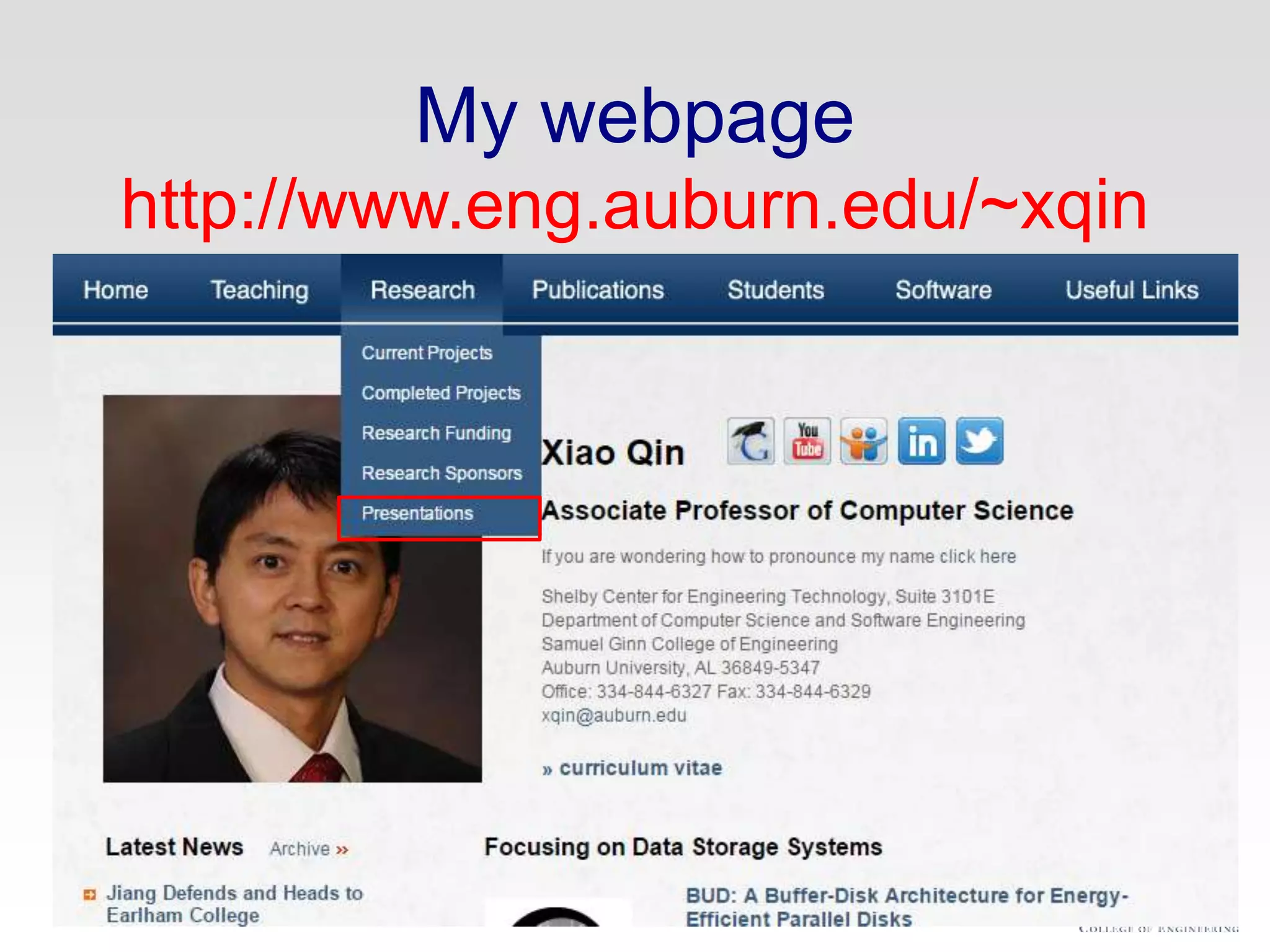
My webpage
http://www.eng.auburn.edu/~xqin
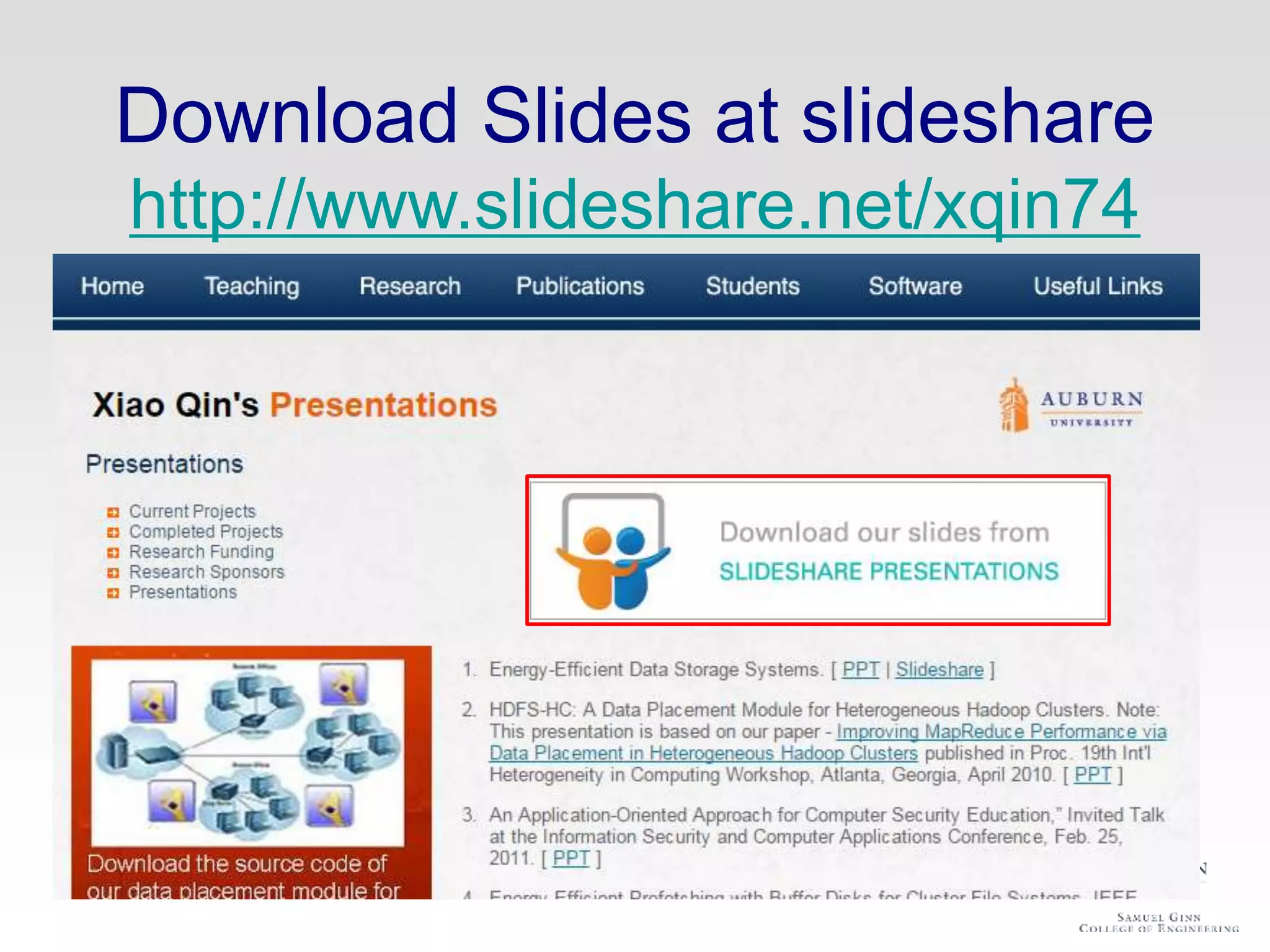
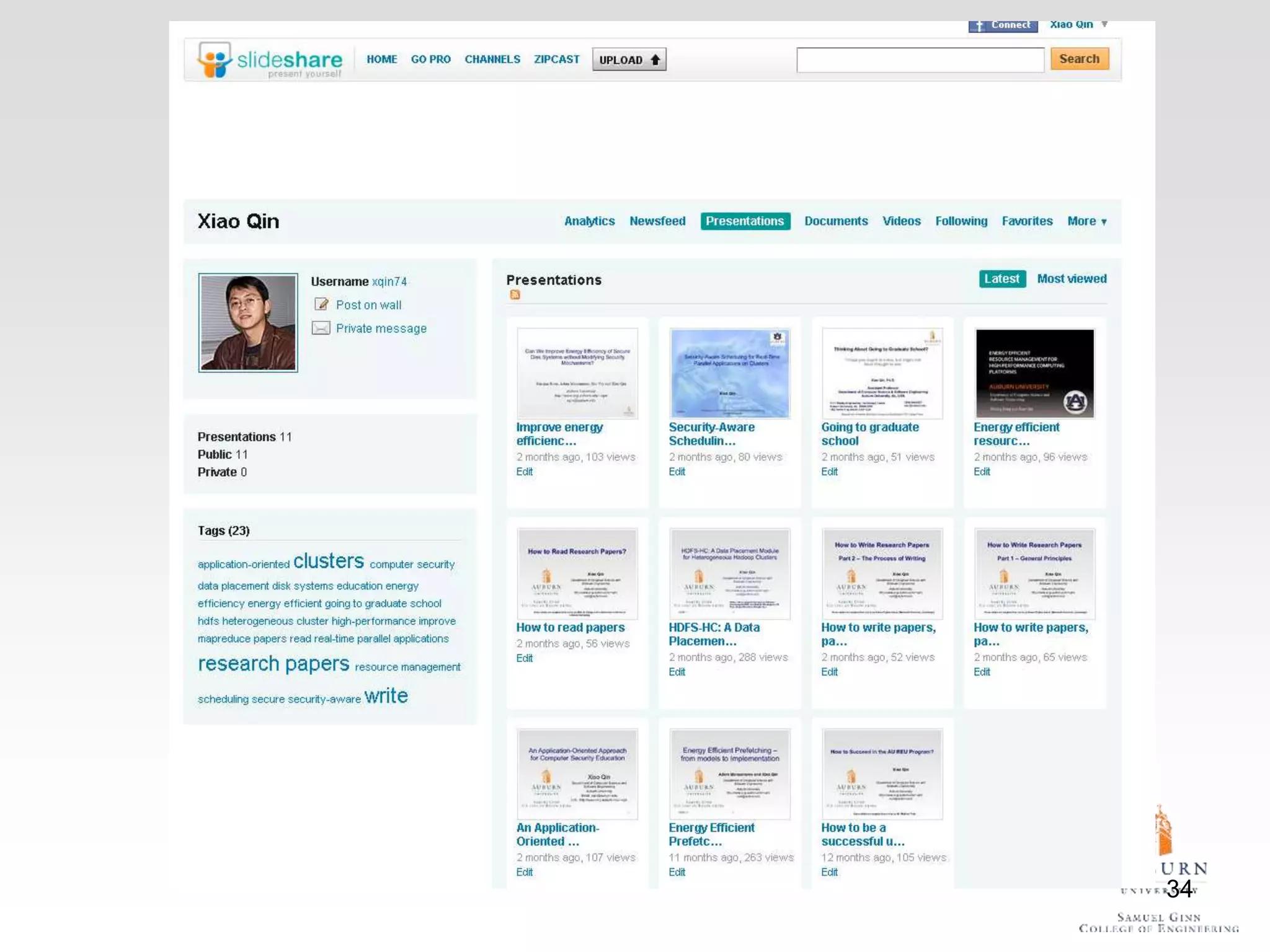
Download Slides at slideshare
http://www.slideshare.net/xqin74
34
Summary
• How to do research?
• 10 pieces of advice
• Choose a good research problem
• Download the slides at
http://www.slideshare.net/xqin74
Questions

How to do research?

  • 1.
    How to doresearch? Xiao Qin Department of Computer Science and Software Engineering Auburn University http://www.eng.auburn.edu/~xqin xqin@auburn.edu Some slides are adapted from notes by Dr. Matthew Turk 1
  • 2.
    My Story ofDoing Research • Undergraduate Student at Huazhong University of Science and Technology, (1996) – Real-Time Disk Scheduling in Unix • M.S. Student at Huazhong University of Science and Technology, (1996-1999) – Real-Time and Fault-Tolerant Scheduling • A doctoral student at the University of Nebraska-Lincoln (2001-2004) – I/O-Aware Load Balancing • Assistant Professor at New Mexico Tech (2004-2007) – Security-Aware Scheduling • Assistant Professor at Auburn University (2007-2010) – Energy-Efficient Storage Systems • Associate Professor at Auburn University (2010-now) – Active Storage Systems
  • 3.
    Caveat emptor • Theseare my opinions, not departmental policies • Talk to others to get their views • These comments are intended for those who want to do research – All undergraduate students, MS students, and PhD students doing theses and projects
  • 4.
    Why are youhere? Possible Reasons What to do? No Research Topic Make Money Find Jobs I don’t know what I want to do as a graduate student I want to make money. I couldn’t find a research topic I want to secure a good job.
  • 5.
    Why I hopeyou’re here Better Reasons ExploringPassion Changing Expert I want to explore new intellectual territory and push the frontiers of technology I want to change the world. I am passionate about research, about engineering and their applications. I want to become a world expert in XYZ.
  • 6.
    Your Future Career Careers:Comp. Sci & Eng., Electrical Eng. Programming skills Phone and On-site Interviews Problem solving skills Personality Quickly learn a new programming language Programming experience
  • 7.
    What Is ATypical Career Path? 7 Earn college degree in CSSE PracticePrinciples Management Working for a company writing code Advance to analyst designer A system architect on increasingly large projects College Industry A manager for large projects An executive such as CIO Start your own company
  • 8.
    Motivation and Experience Motivation:0, 1, 2 Experience: 0, 1, 2 3 Lead 2 Management 4 Dedicate 1 Micro Management
  • 9.
    A Success Story •Undergraduate Research Assistant, 2005 • Adam Manzanares, Ph.D. May 2010
  • 10.
    10 10 pieces ofadvice guaranteed to make you a successful research assistant. How to be a successful research assistant?
  • 11.
    1. Manage Yourself •Goals, priorities, and planning – Set goals, and keep them updated – Make a plan for each day, week, month, quarter • “Failing to plan means planning to fail” – Prioritize – do important things first – Don’t waste time – kill your TV, xBox • Keep track of how you spend your time • Computer Science  Web Browsing Engineering • “Is this activity helping me to achieve my REU goal?” – Keep a notebook, write these things down
  • 12.
    Example 1 – KeepTrack of Your Time
  • 13.
    Example 2 – KeepTrack of Your Time: a better approach
  • 14.
    Example 3: Howto reply emails? • Google: “How to Read 100 Emails, Fast” • Check email once a day • Group emails • Reply to all the short emails - first with "yes" or "no" as an answer • Write brief emails • Long emails -> tasks -> must be prioritized
  • 15.
    2. Develop IntellectualDiscipline • Think! – Set aside time for thinking. Really. • Read! (To be covered in another training session) – Get to know the literature in your area intimately (not superficially) • Act! – Don’t feel like you have to know everything first – Don’t worry about being wrong • Evaluate! – Solicit feedback – most ideas aren’t so good…
  • 16.
  • 17.
    3. Be proactive •Don’t wait to be told what to do – Don’t be passive; in fact, be aggressive! – Make things happen • You will not be spoon-fed – What you get out of the research program is a non- linear function of what effort you put into it. • Research activities can be very unstructured – Unlike undergraduate studies – So it’s up to you (not your advisor)
  • 18.
  • 19.
    Example 6 – Dropboxto share document
  • 20.
    4. Learn tocommunicate well • Speaking – Communicate clearly • Writing – Organization and clarity • Presenting – Not just “talking,” but communicating – Even a lecture is a two-way interaction • These are skills that can be learned! – Practice talks (videotaped), write short papers, ask friends and colleagues to help you, … Your intelligence and ideas will be judged by your ability to communicate in English
  • 21.
    5. Develop anintellectual community • Among your peers at Auburn, create something different and special – Ask questions – Discuss ideas – Brainstorm – Argue, challenge – Collaborate
  • 22.
    6. Networking • Getto know the people in the department (faculty and grad students), and other people in your field – Don’t wait – introduce yourself! • Go to conferences and meet other REU students and “famous” researchers – Be aggressive! • Talk with visitors: “pick their pockets” – You never know who will someday offer you a job, write a reference letter, review your paper, give you invaluable feedback or insight….
  • 23.
    7. Choose agood research problem • This is the hardest, and most important, part of research! • The Goldilocks problem: – Not too hard, not too soft, not too hot, not too cold, not too big, not too small • Think, read, act, evaluate – And talk to everyone – not only your advisor • Passion or duty?
  • 24.
    An Example Data Placementin Hadoop Clusters
  • 25.
    An Example Data Placementin Hadoop Clusters (cont.) • The MapReduce programming model is growing in popularity • Hadoop is used by Yahoo, Facebook, Amazon.
  • 26.
    Another Example –How to think I/O Performance Bottleneck Problems in Bioinformatics Applications
  • 27.
    8. Understand thefaculty • We are very busy. – That’s no excuse. We do have time for you. • We know more than you do. – At least for a little while. – But not as much more as you might think. • We are not superior beings. – Most of us have first names. – Give us feedback too! • We are part mentor, part colleague, part human.
  • 28.
    9. Study successfulpeople • Senior grad students, faculty, pioneers, leaders in your field, … – Read biographies – Who are your heroes, mentors? • Seek advice – But modify it to your particular situation
  • 29.
    10. Have aLife • Work hard, networking, think, read, program, experiment, build, study, practice, …. – So little time and so much to do!! • Still, amidst the chaos of the REU program, it is very important that you do not lose sight of who you are and what makes you tick. – Have a social life – Don’t neglect your family and friends, your health, your sanity – Do make time for things that are important and meaningful to you
  • 30.
    Further Research • Lotsof links to good advice for graduate students: – http://www.cs.ucsb.edu/~ mturk – Click on “Info for Students”
  • 31.
  • 32.
  • 33.
    Download Slides atslideshare http://www.slideshare.net/xqin74
  • 34.
  • 35.
    Summary • How todo research? • 10 pieces of advice • Choose a good research problem • Download the slides at http://www.slideshare.net/xqin74
  • 36.

Editor's Notes

  • #2 How to be a successful research assistant? References: 1. How to Succeed in Graduate School? 2. How to be a good graduate student1? I:\Papers\Talks\How to Do Computer Systems Research\References Dr. Turk @ University of California, Santa Barbara
  • #5 Minsky story – “If you’re here in order to get a job, then you shouldn’t be here.” My story: going to graduate school.
  • #6 And graduate schools, publications, fame, fortune, and more…
  • #12 Be organized and systematic about setting and achieving goals.
  • #13 Be organized and systematic about setting and achieving goals.
  • #14 Be organized and systematic about setting and achieving goals.
  • #16 Research is basically idea generation (plus lots of sweat and tears)
  • #17 Be organized and systematic about setting and achieving goals.
  • #18 REU->graduate school YOU are in charge of your graduate education. It is primarily up to YOU to make it a great experience. Develop a “Can Do” attitude Rose @ Eday
  • #19 Google doc for discussion minutes
  • #20 Google doc for discussion minutes
  • #21 Especially for non-native English speakers, but also for everyone If you live and socialize with people who speak your (non-English) language, you will be at a disadvantage. Force yourself.
  • #22 Okay, be polite and appropriate, but don’t hesitate to ask questions, challenge a speaker, request clarification, etc. (Be nice but firm.) MIT and CMU cultures – confrontational, not polite (but let’s be constructive and purposeful about it) Again, it is up to YOU do make this happen.
  • #24 You’ll be working on this for a long time, and it will be difficult at times. You’d better like it, and truly be interested in it, passionate about it.
  • #25 Research is basically idea generation (plus lots of sweat and tears)
  • #26 Research is basically idea generation (plus lots of sweat and tears)
  • #27 Research is basically idea generation (plus lots of sweat and tears)
  • #28 In particular, your advisor
  • #30 This may seem to contradict everything else I’ve said, but…. This is not your whole life. Keep grad school in perspective: Passion and drive, but not obsession Remind yourself from time to time why you’re doing this. Also remind yourself from time to time what in life is important to you.