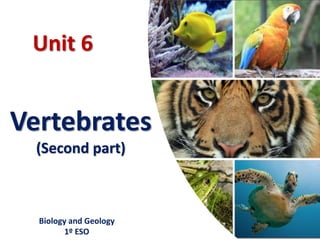
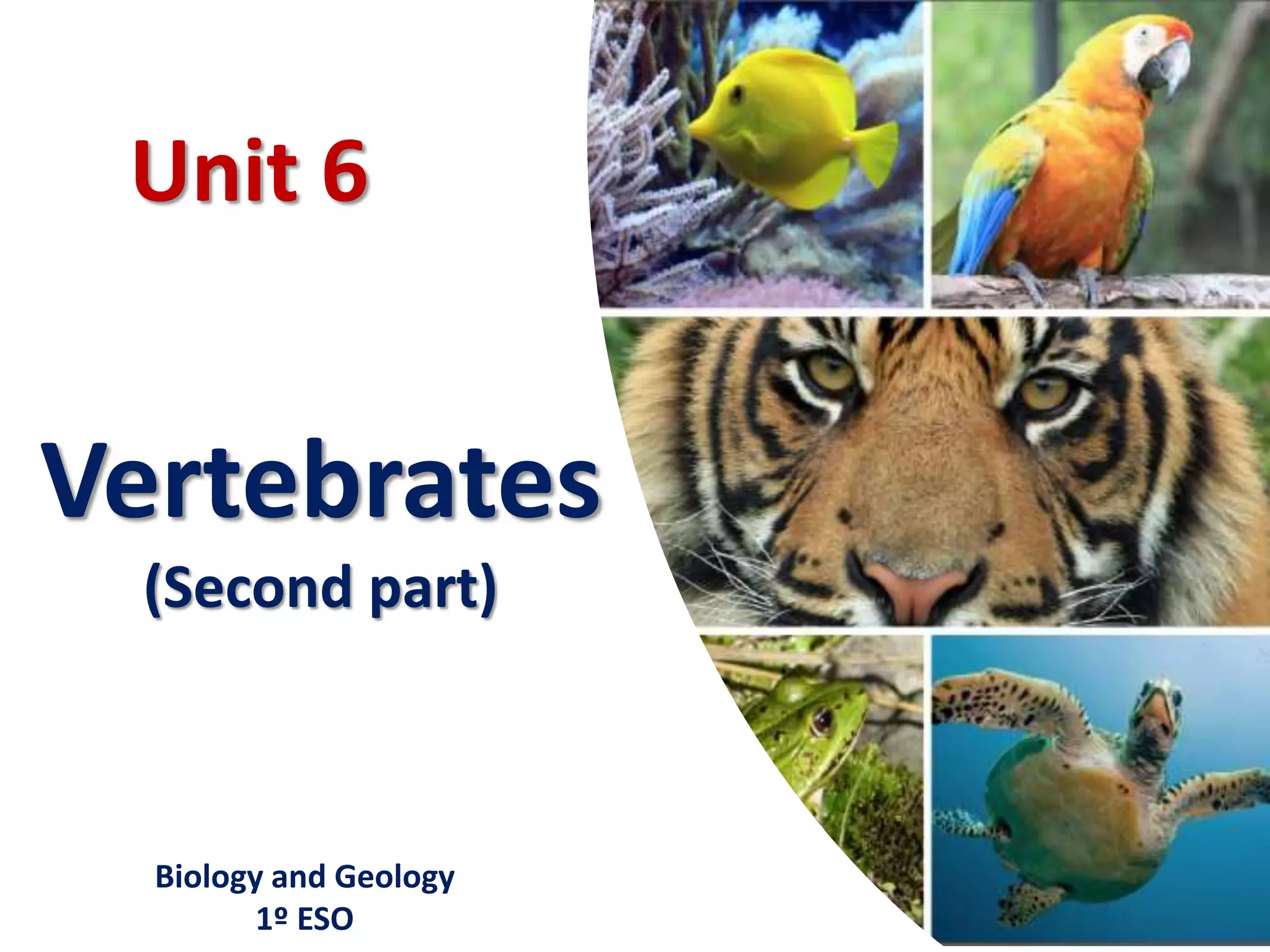
Unit 6
Vertebrates
(Second part)
Biology and Geology
1º ESO
Index
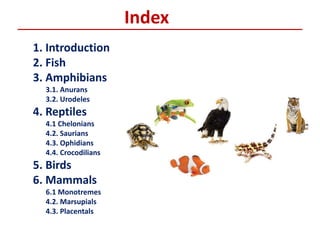
1. Introduction
2. Fish
3. Amphibians
3.1. Anurans
3.2. Urodeles
4. Reptiles
4.1 Chelonians
4.2. Saurians
4.3. Ophidians
4.4. Crocodilians
5. Birds
6. Mammals
6.1 Monotremes
4.2. Marsupials
4.3. Placentals
5Birds
5Birds
Birds are terrestrial vertebrates and most of them can fly.
They have an aerodynamic body. In other words, their body
is shaped in a way that allows them to move through air
with ease when they are flying.
https://www.youtube.
com/watch?v=cDN9q
qoQZr8
5Birds
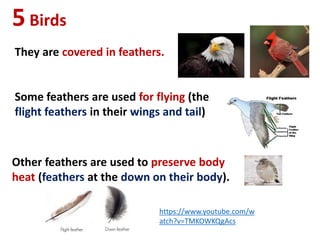
They are covered in feathers.
Some feathers are used for flying (the
flight feathers in their wings and tail)
Other feathers are used to preserve body
heat (feathers at the down on their body).
https://www.youtube.com/w
atch?v=TMKOWKQgAcs
5Birds
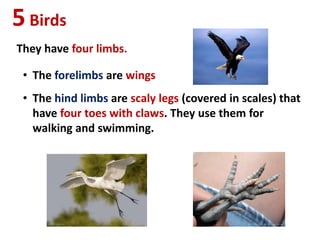
They have four limbs.
• The forelimbs are wings
• The hind limbs are scaly legs (covered in scales) that
have four toes with claws. They use them for
walking and swimming.
5Birds
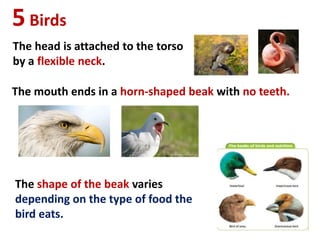
The mouth ends in a horn-shaped beak with no teeth.
The shape of the beak varies
depending on the type of food the
bird eats.
The head is attached to the torso
by a flexible neck.
5Birds
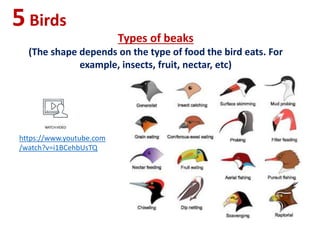
Types of beaks
(The shape depends on the type of food the bird eats. For
example, insects, fruit, nectar, etc)
https://www.youtube.com
/watch?v=i1BCehbUsTQ
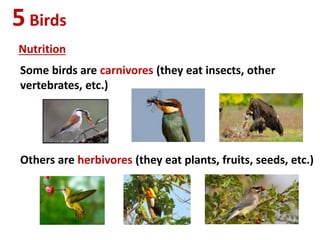
Nutrition
Some birds are carnivores (they eat insects, other
vertebrates, etc.)
Others are herbivores (they eat plants, fruits, seeds, etc.)
5Birds
5Birds
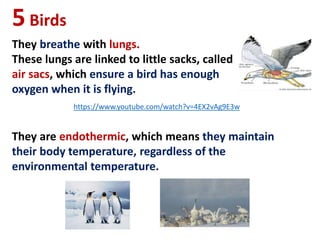
They breathe with lungs.
These lungs are linked to little sacks, called
air sacs, which ensure a bird has enough
oxygen when it is flying.
https://www.youtube.com/watch?v=4EX2vAg9E3w
They are endothermic, which means they maintain
their body temperature, regardless of the
environmental temperature.
5Birds
Reproduction
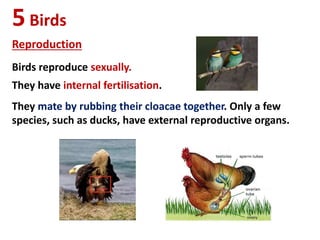
Birds reproduce sexually.
They have internal fertilisation.
They mate by rubbing their cloacae together. Only a few
species, such as ducks, have external reproductive organs.
5Birds
Reproduction
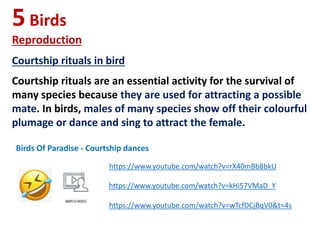
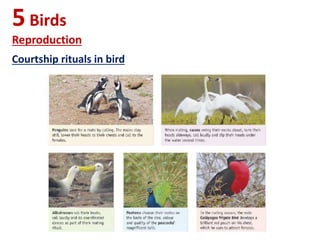
Courtship rituals in bird
Courtship rituals are an essential activity for the survival of
many species because they are used for attracting a possible
mate. In birds, males of many species show off their colourful
plumage or dance and sing to attract the female.
https://www.youtube.com/watch?v=rX40mBb8bkU
Birds Of Paradise - Courtship dances
https://www.youtube.com/watch?v=kHi57VMaD_Y
https://www.youtube.com/watch?v=wTcfDCjBqV0&t=4s
5Birds
Reproduction
Courtship rituals in bird
5Birds
Reproduction
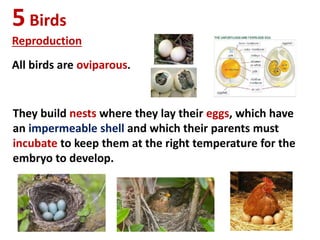
All birds are oviparous.
They build nests where they lay their eggs, which have
an impermeable shell and which their parents must
incubate to keep them at the right temperature for the
embryo to develop.
5Birds
Reproduction
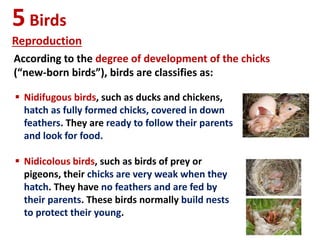
 Nidifugous birds, such as ducks and chickens,
hatch as fully formed chicks, covered in down
feathers. They are ready to follow their parents
and look for food.
 Nidicolous birds, such as birds of prey or
pigeons, their chicks are very weak when they
hatch. They have no feathers and are fed by
their parents. These birds normally build nests
to protect their young.
According to the degree of development of the chicks
(“new-born birds”), birds are classifies as:
5Birds
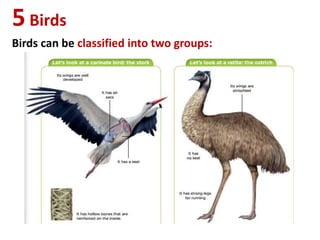
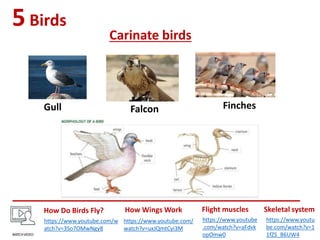
Birds can be classified into two groups:
Carinate birds Ratites
• The majority of birds (gulls,
finches, falcons, etc.)
• Most of them can fly (penguins
cannot fly, but they exhibit flying
motion when they swim).
• They have a structure called keel
(the sternum), which is able to
support the powerful muscles
that move wings and enable the
birds to fly (flight muscles).
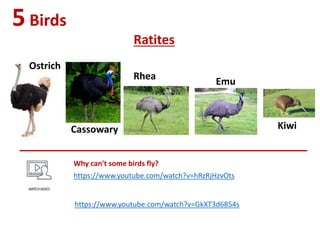
• Just a few birds, generally
large, flightless birds (the
ostrich, the cassowary,
the rhea, the emu, the
kiwi).
• They do not have keel or
flight muscles.
• Their wings are atrophied.
5Birds
Birds can be classified into two groups:
5Birds
Adaptations of birds for flight
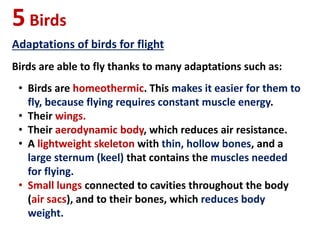
Birds are able to fly thanks to many adaptations such as:
• Birds are homeothermic. This makes it easier for them to
fly, because flying requires constant muscle energy.
• Their wings.
• Their aerodynamic body, which reduces air resistance.
• A lightweight skeleton with thin, hollow bones, and a
large sternum (keel) that contains the muscles needed
for flying.
• Small lungs connected to cavities throughout the body
(air sacs), and to their bones, which reduces body
weight.
5Birds
Carinate birds
Gull FinchesFalcon
How Do Birds Fly?
https://www.youtube.com/w
atch?v=3So7OMwNgy8
How Wings Work
https://www.youtube.com/
watch?v=uxJQmtCyi3M
Flight muscles
https://www.youtube
.com/watch?v=aFdvk
opOmw0
Skeletal system
https://www.youtu
be.com/watch?v=1
1fZS_B6UW4
5Birds
Ratites
Ostrich
Cassowary
Rhea
Kiwi
Emu
https://www.youtube.com/watch?v=GkXT3d6854s
https://www.youtube.com/watch?v=hRzRjHzvOts
Why can't some birds fly?
5Birds
https://www.seo.org/listado-aves-2/Aves de España https://www.youtube.co
m/watch?v=I7dYd-Ra8bk
SINGING BIRDS
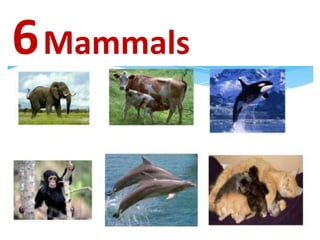
6Mammals
6Mammals
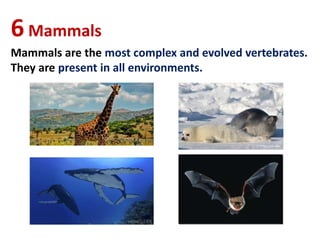
Mammals are the most complex and evolved vertebrates.
They are present in all environments.
6Mammals
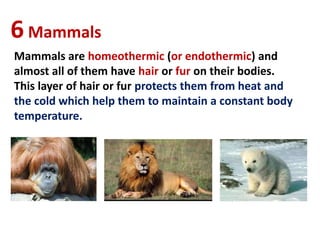
Mammals are homeothermic (or endothermic) and
almost all of them have hair or fur on their bodies.
This layer of hair or fur protects them from heat and
the cold which help them to maintain a constant body
temperature.
6Mammals
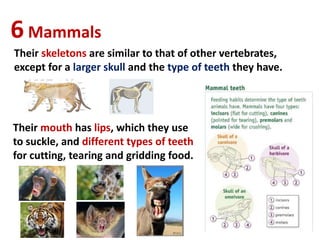
Their skeletons are similar to that of other vertebrates,
except for a larger skull and the type of teeth they have.
Their mouth has lips, which they use
to suckle, and different types of teeth
for cutting, tearing and gridding food.
6Mammals
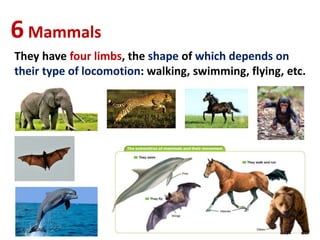
They have four limbs, the shape of which depends on
their type of locomotion: walking, swimming, flying, etc.
6Mammals
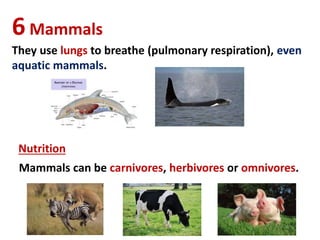
They use lungs to breathe (pulmonary respiration), even
aquatic mammals.
Nutrition
Mammals can be carnivores, herbivores or omnivores.
6Mammals
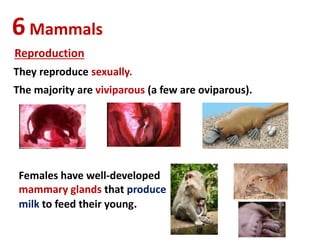
Females have well-developed
mammary glands that produce
milk to feed their young.
Reproduction
They reproduce sexually.
The majority are viviparous (a few are oviparous).
6Mammals
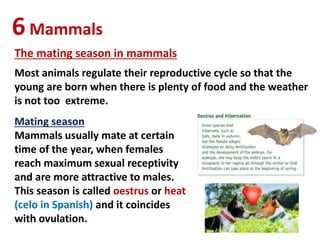
The mating season in mammals
Most animals regulate their reproductive cycle so that the
young are born when there is plenty of food and the weather
is not too extreme.
Mating season
Mammals usually mate at certain
time of the year, when females
reach maximum sexual receptivity
and are more attractive to males.
This season is called oestrus or heat
(celo in Spanish) and it coincides
with ovulation.
6Mammals
The mating season in mammals
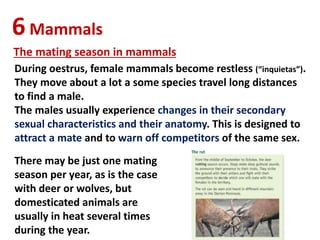
During oestrus, female mammals become restless (“inquietas”).
They move about a lot a some species travel long distances
to find a male.
The males usually experience changes in their secondary
sexual characteristics and their anatomy. This is designed to
attract a mate and to warn off competitors of the same sex.
There may be just one mating
season per year, as is the case
with deer or wolves, but
domesticated animals are
usually in heat several times
during the year.
6Mammals
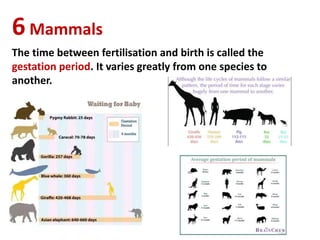
The time between fertilisation and birth is called the
gestation period. It varies greatly from one species to
another.
6Mammals
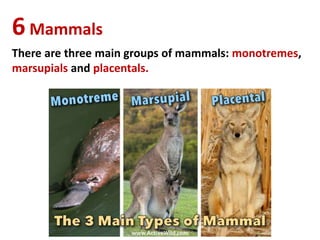
There are three main groups of mammals: monotremes,
marsupials and placentals.
6Mammals
6.1 Monotremes
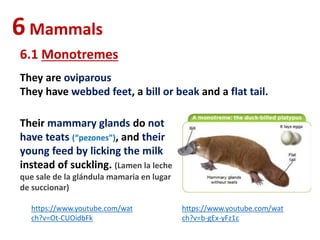
They are oviparous
They have webbed feet, a bill or beak and a flat tail.
Their mammary glands do not
have teats (“pezones”), and their
young feed by licking the milk
instead of suckling. (Lamen la leche
que sale de la glándula mamaria en lugar
de succionar)
https://www.youtube.com/wat
ch?v=Ot-CUOidbFk
https://www.youtube.com/wat
ch?v=b-gEx-yFz1c
6Mammals
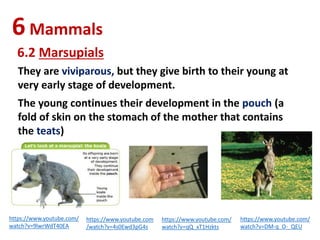
6.2 Marsupials
They are viviparous, but they give birth to their young at
very early stage of development.
The young continues their development in the pouch (a
fold of skin on the stomach of the mother that contains
the teats)
https://www.youtube.com/
watch?v=DM-q_O-_QEU
https://www.youtube.com
/watch?v=4s0Ewd3pG4s
https://www.youtube.com/
watch?v=qQ_xT1Hzkts
https://www.youtube.com/
watch?v=9lwrWdT40EA
6Mammals
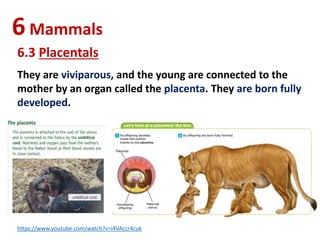
6.3 Placentals
They are viviparous, and the young are connected to the
mother by an organ called the placenta. They are born fully
developed.
https://www.youtube.com/watch?v=i4VAccr4cuk
6Mammals
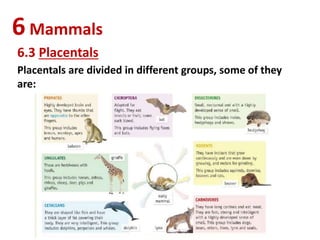
6.3 Placentals
Placentals are divided in different groups, some of they
are:
6Mammals
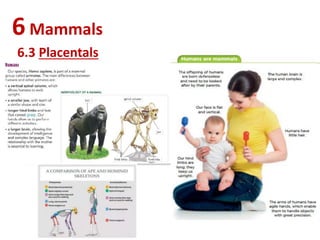
6.3 Placentals
https://www.youtube.com/watch?v=sz3Yv3On4lE
6Mammals
https://www.youtube.com/watch?v=hGonwMTPV6g
https://www.youtube.com/watch?v=vNxyY2ByL7Y
Some videos about mammals
https://www.youtube.com/watch?v=I4qHhdOp26A

Unit 6 vertebrates (part 2)

  • 1.
  • 2.
    Index 1. Introduction 2. Fish 3.Amphibians 3.1. Anurans 3.2. Urodeles 4. Reptiles 4.1 Chelonians 4.2. Saurians 4.3. Ophidians 4.4. Crocodilians 5. Birds 6. Mammals 6.1 Monotremes 4.2. Marsupials 4.3. Placentals
  • 3.
  • 4.
    5Birds Birds are terrestrialvertebrates and most of them can fly. They have an aerodynamic body. In other words, their body is shaped in a way that allows them to move through air with ease when they are flying. https://www.youtube. com/watch?v=cDN9q qoQZr8
  • 5.
    5Birds They are coveredin feathers. Some feathers are used for flying (the flight feathers in their wings and tail) Other feathers are used to preserve body heat (feathers at the down on their body). https://www.youtube.com/w atch?v=TMKOWKQgAcs
  • 6.
    5Birds They have fourlimbs. • The forelimbs are wings • The hind limbs are scaly legs (covered in scales) that have four toes with claws. They use them for walking and swimming.
  • 7.
    5Birds The mouth endsin a horn-shaped beak with no teeth. The shape of the beak varies depending on the type of food the bird eats. The head is attached to the torso by a flexible neck.
  • 8.
    5Birds Types of beaks (Theshape depends on the type of food the bird eats. For example, insects, fruit, nectar, etc) https://www.youtube.com /watch?v=i1BCehbUsTQ
  • 9.
    Nutrition Some birds arecarnivores (they eat insects, other vertebrates, etc.) Others are herbivores (they eat plants, fruits, seeds, etc.) 5Birds
  • 10.
    5Birds They breathe withlungs. These lungs are linked to little sacks, called air sacs, which ensure a bird has enough oxygen when it is flying. https://www.youtube.com/watch?v=4EX2vAg9E3w They are endothermic, which means they maintain their body temperature, regardless of the environmental temperature.
  • 11.
    5Birds Reproduction Birds reproduce sexually. Theyhave internal fertilisation. They mate by rubbing their cloacae together. Only a few species, such as ducks, have external reproductive organs.
  • 12.
    5Birds Reproduction Courtship rituals inbird Courtship rituals are an essential activity for the survival of many species because they are used for attracting a possible mate. In birds, males of many species show off their colourful plumage or dance and sing to attract the female. https://www.youtube.com/watch?v=rX40mBb8bkU Birds Of Paradise - Courtship dances https://www.youtube.com/watch?v=kHi57VMaD_Y https://www.youtube.com/watch?v=wTcfDCjBqV0&t=4s
  • 13.
  • 14.
    5Birds Reproduction All birds areoviparous. They build nests where they lay their eggs, which have an impermeable shell and which their parents must incubate to keep them at the right temperature for the embryo to develop.
  • 15.
    5Birds Reproduction  Nidifugous birds,such as ducks and chickens, hatch as fully formed chicks, covered in down feathers. They are ready to follow their parents and look for food.  Nidicolous birds, such as birds of prey or pigeons, their chicks are very weak when they hatch. They have no feathers and are fed by their parents. These birds normally build nests to protect their young. According to the degree of development of the chicks (“new-born birds”), birds are classifies as:
  • 16.
    5Birds Birds can beclassified into two groups: Carinate birds Ratites • The majority of birds (gulls, finches, falcons, etc.) • Most of them can fly (penguins cannot fly, but they exhibit flying motion when they swim). • They have a structure called keel (the sternum), which is able to support the powerful muscles that move wings and enable the birds to fly (flight muscles). • Just a few birds, generally large, flightless birds (the ostrich, the cassowary, the rhea, the emu, the kiwi). • They do not have keel or flight muscles. • Their wings are atrophied.
  • 17.
    5Birds Birds can beclassified into two groups:
  • 18.
    5Birds Adaptations of birdsfor flight Birds are able to fly thanks to many adaptations such as: • Birds are homeothermic. This makes it easier for them to fly, because flying requires constant muscle energy. • Their wings. • Their aerodynamic body, which reduces air resistance. • A lightweight skeleton with thin, hollow bones, and a large sternum (keel) that contains the muscles needed for flying. • Small lungs connected to cavities throughout the body (air sacs), and to their bones, which reduces body weight.
  • 19.
    5Birds Carinate birds Gull FinchesFalcon HowDo Birds Fly? https://www.youtube.com/w atch?v=3So7OMwNgy8 How Wings Work https://www.youtube.com/ watch?v=uxJQmtCyi3M Flight muscles https://www.youtube .com/watch?v=aFdvk opOmw0 Skeletal system https://www.youtu be.com/watch?v=1 1fZS_B6UW4
  • 20.
  • 21.
    5Birds https://www.seo.org/listado-aves-2/Aves de Españahttps://www.youtube.co m/watch?v=I7dYd-Ra8bk SINGING BIRDS
  • 22.
  • 23.
    6Mammals Mammals are themost complex and evolved vertebrates. They are present in all environments.
  • 24.
    6Mammals Mammals are homeothermic(or endothermic) and almost all of them have hair or fur on their bodies. This layer of hair or fur protects them from heat and the cold which help them to maintain a constant body temperature.
  • 25.
    6Mammals Their skeletons aresimilar to that of other vertebrates, except for a larger skull and the type of teeth they have. Their mouth has lips, which they use to suckle, and different types of teeth for cutting, tearing and gridding food.
  • 26.
    6Mammals They have fourlimbs, the shape of which depends on their type of locomotion: walking, swimming, flying, etc.
  • 27.
    6Mammals They use lungsto breathe (pulmonary respiration), even aquatic mammals. Nutrition Mammals can be carnivores, herbivores or omnivores.
  • 28.
    6Mammals Females have well-developed mammaryglands that produce milk to feed their young. Reproduction They reproduce sexually. The majority are viviparous (a few are oviparous).
  • 29.
    6Mammals The mating seasonin mammals Most animals regulate their reproductive cycle so that the young are born when there is plenty of food and the weather is not too extreme. Mating season Mammals usually mate at certain time of the year, when females reach maximum sexual receptivity and are more attractive to males. This season is called oestrus or heat (celo in Spanish) and it coincides with ovulation.
  • 30.
    6Mammals The mating seasonin mammals During oestrus, female mammals become restless (“inquietas”). They move about a lot a some species travel long distances to find a male. The males usually experience changes in their secondary sexual characteristics and their anatomy. This is designed to attract a mate and to warn off competitors of the same sex. There may be just one mating season per year, as is the case with deer or wolves, but domesticated animals are usually in heat several times during the year.
  • 31.
    6Mammals The time betweenfertilisation and birth is called the gestation period. It varies greatly from one species to another.
  • 32.
    6Mammals There are threemain groups of mammals: monotremes, marsupials and placentals.
  • 33.
    6Mammals 6.1 Monotremes They areoviparous They have webbed feet, a bill or beak and a flat tail. Their mammary glands do not have teats (“pezones”), and their young feed by licking the milk instead of suckling. (Lamen la leche que sale de la glándula mamaria en lugar de succionar) https://www.youtube.com/wat ch?v=Ot-CUOidbFk https://www.youtube.com/wat ch?v=b-gEx-yFz1c
  • 34.
    6Mammals 6.2 Marsupials They areviviparous, but they give birth to their young at very early stage of development. The young continues their development in the pouch (a fold of skin on the stomach of the mother that contains the teats) https://www.youtube.com/ watch?v=DM-q_O-_QEU https://www.youtube.com /watch?v=4s0Ewd3pG4s https://www.youtube.com/ watch?v=qQ_xT1Hzkts https://www.youtube.com/ watch?v=9lwrWdT40EA
  • 35.
    6Mammals 6.3 Placentals They areviviparous, and the young are connected to the mother by an organ called the placenta. They are born fully developed. https://www.youtube.com/watch?v=i4VAccr4cuk
  • 36.
    6Mammals 6.3 Placentals Placentals aredivided in different groups, some of they are:
  • 37.
  • 38.