Avian Anatomy and Physiology
Learning Objectives Describe the anatomical structures of avian skin, beaks, and claws. Describe the structure and functions of feathers. List the types of feathers and the location of each type. List the unique features of the avian skeleton and musculature. Describe the shape and general characteristics of avian eyes and explain how those characteristics effect visual acuity. Describe the unique anatomical features that affect the sense of hearing in nocturnal owls. List the unique anatomical features that affect the sense of taste in birds. List the components of the avian digestive system and describe the functions of each. List the unique features of the avian circulatory and respiratory systems. Describe the composition of avian urine. List and describe the unique features of the avian male and female reproductive systems. List and describe the four classifications of newly hatched chicks.
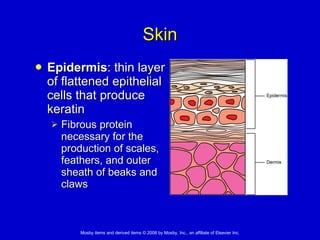
Skin Epidermis : thin layer of flattened epithelial cells that produce keratin Fibrous protein necessary for the production of scales, feathers, and outer sheath of beaks and claws
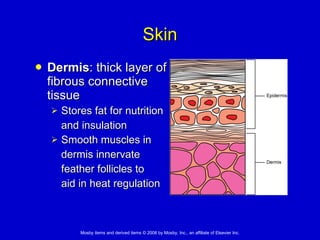
Skin Dermis : thick layer of  fibrous connective  tissue Stores fat for nutrition  and insulation  Smooth muscles in  dermis innervate  feather follicles to  aid in heat regulation
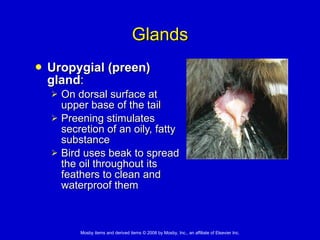
Glands Uropygial (preen) gland : On dorsal surface at upper base of the tail  Preening stimulates secretion of an oily, fatty substance  Bird uses beak to spread the oil throughout its feathers to clean and waterproof them
Beak Derivative of skin  Upper and lower mandible covered with a horny keratin layer  Grows continuously Variable hardness and flexibility, depending on the function
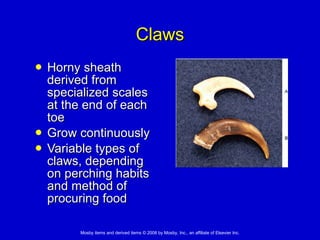
Claws Horny sheath derived from specialized scales at the end of each toe Grow continuously  Variable types of claws, depending on perching habits and method of procuring food
Feathers Outgrowths of skin  Made of protein  Functions: Flight Protect thin skin from trauma, rain, and excessive radiation from sunlight Assist in thermoregulation and camouflage  Used in communication behaviors (e.g., courtship, defense, and recognition)
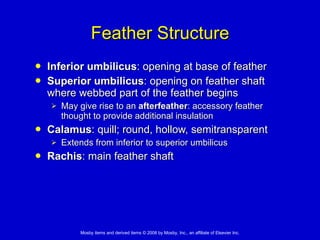
Feather Structure Inferior umbilicus : opening at base of feather Superior umbilicus : opening on feather shaft where webbed part of the feather begins May give rise to an  afterfeather : accessory feather thought to provide additional insulation Calamus : quill; round, hollow, semitransparent Extends from inferior to superior umbilicus Rachis : main feather shaft
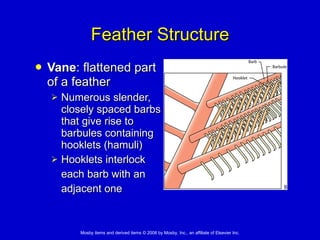
Feather Structure Vane : flattened part  of a feather   Numerous slender,  closely spaced barbs  that give rise to  barbules containing  hooklets (hamuli)  Hooklets interlock  each barb with an  adjacent one
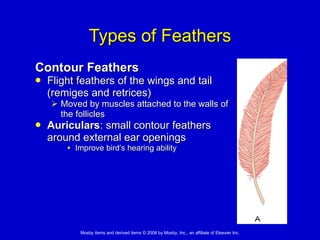
Types of Feathers Contour Feathers Flight feathers of the wings and tail  (remiges and retrices) Moved by muscles attached to the walls of  the follicles Auriculars : small contour feathers  around external ear openings Improve bird’s hearing ability
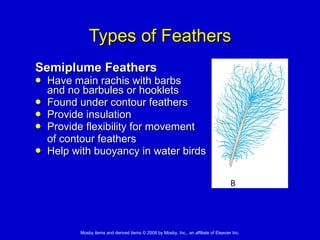
Types of Feathers Semiplume Feathers   Have main rachis with barbs  and no barbules or hooklets  Found under contour feathers Provide insulation Provide flexibility for movement  of contour feathers  Help with buoyancy in water birds
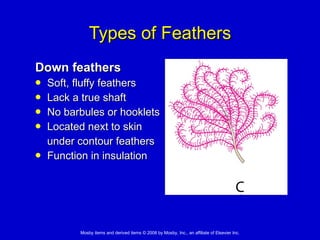
Types of Feathers Down feathers   Soft, fluffy feathers  Lack a true shaft No barbules or hooklets  Located next to skin  under contour feathers  Function in insulation
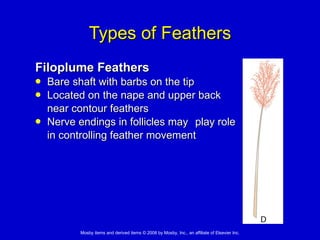
Types of Feathers Filoplume Feathers   Bare shaft with barbs on the tip Located on the nape and upper back  near contour feathers Nerve endings in follicles may  play role  in controlling feather movement
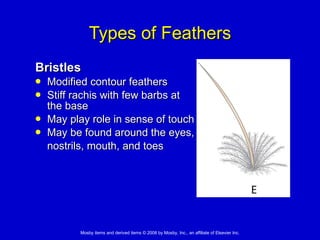
Types of Feathers Bristles Modified contour feathers  Stiff rachis with few barbs at  the base  May play role in sense of touch May be found around the eyes,  nostrils, mouth, and toes
Types of Feathers Powder Down Feathers Grow continuously at the base  Disintegrate at their tip Create waxy powder that spreads throughout the rest of the plumage Birds without a uropygial gland have abundant powder down feathers
Feathers Pterylae : tracts where feathers are located Apteria : bare areas of skin between pterylae Feathers in pterylae overlap one another
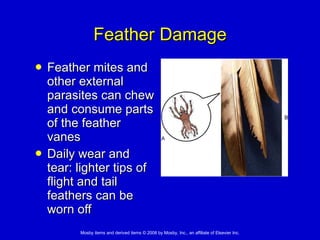
Feather Damage Feather mites and other external parasites can chew and consume parts of the feather vanes Daily wear and tear: lighter tips of flight and tail feathers can be worn off
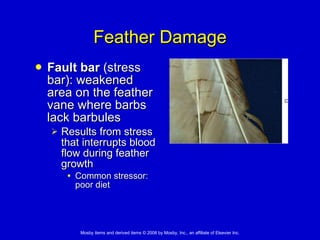
Feather Damage Fault bar  (stress bar): weakened area on the feather vane where barbs lack barbules   Results from stress that interrupts blood flow during feather growth Common stressor:  poor diet
Molting Process of feather replacement  Occurs once to several times a year, depending on species  In most species, feather replacement is symmetrical   One or two pairs of flight feathers molted at a time  Many species of waterfowl molt all flight feathers at once after the breeding season
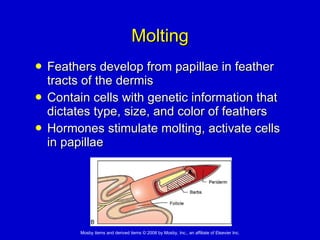
Molting Feathers develop from papillae in feather tracts of the dermis Contain cells with genetic information that dictates type, size, and color of feathers Hormones stimulate molting, activate cells in papillae
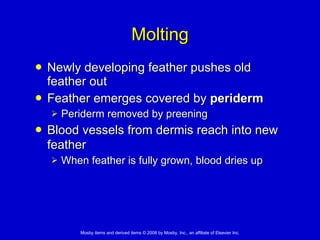
Molting Newly developing feather pushes old feather out Feather emerges covered by  periderm Periderm removed by preening Blood vessels from dermis reach into new feather   When feather is fully grown, blood dries up
Skeletal System
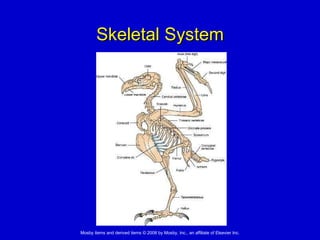
Skeletal System Skeletal modifications allow for flight and walking: Reduction in number of bones Fusion of some bones to form plates Reduction in bone density Loss of internal bone matrix; bone becomes hollow and filled with air spaces
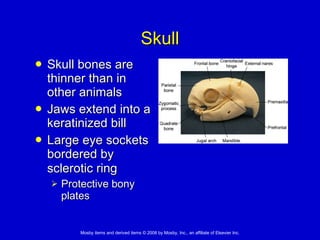
Skull Skull bones are thinner than in other animals  Jaws extend into a keratinized bill Large eye sockets bordered by sclerotic ring   Protective bony plates
Vertebral Column Cervical Vertebrae:   Atlas contains a single condyle for attachment of the skull Allows greater range of head movements   Greater number of cervical vertebrae than mammals Variable in different species
Vertebral Column Thoracic Vertebrae:   Rigid and provide a strong support for the rib cage First few ribs are relatively short and incomplete  Remaining ribs attach to underside of sternum and have a projection (uncinate process) that overlaps the adjoining rear rib to strengthen the rib cage
Vertebral Column Lumbar and Sacral Vertebrae:   Synsacrum : strong bony plate created from fusion of several distal lumbar vertebrae, sacral vertebrae, and first few coccygeal vertebrae  Synsacrum fuses with the pelvis, supports the legs Coccygeal vertebrae: First few are mobile Pygostyle : bony structure created from fusion of some coccygeal vertebrae
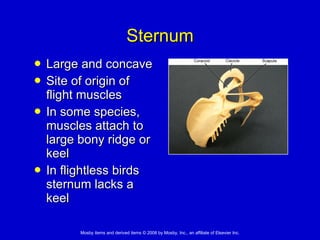
Sternum Large and concave Site of origin of flight muscles In some species, muscles attach to large bony ridge or keel In flightless birds sternum lacks a keel
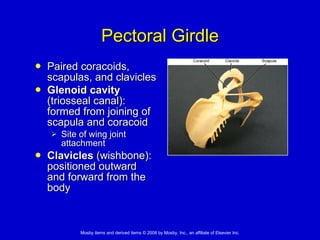
Pectoral Girdle Paired coracoids, scapulas, and clavicles  Glenoid cavity  (triosseal canal): formed from joining of scapula and coracoid   Site of wing joint attachment Clavicles  (wishbone):  positioned outward and forward from the body
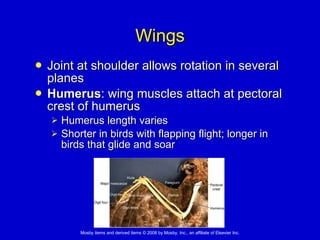
Wings Joint at shoulder allows rotation in several planes Humerus : wing muscles attach at pectoral crest of humerus Humerus length varies Shorter in birds with flapping flight; longer in birds that glide and soar
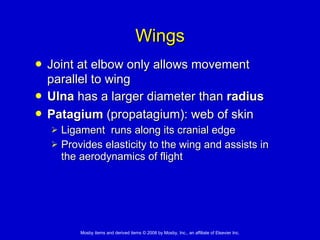
Wings Joint at elbow only allows movement parallel to wing   Ulna  has a larger diameter than  radius Patagium  (propatagium): web of skin   Ligament  runs along its cranial edge Provides elasticity to the wing and assists in the aerodynamics of flight
Wings Alula bone : originates from the wrist and carries the alula feathers (steering feathers) Metacarpal bones  join with the second and third fingers near the distal end of the wing Help support the primary flight feathers
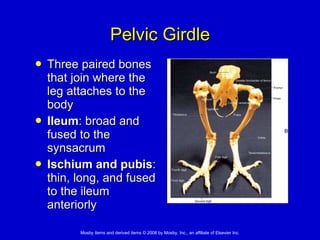
Pelvic Girdle Three paired bones that join where the leg attaches to the body  Ileum : broad and fused to the synsacrum Ischium and pubis : thin, long, and fused to the ileum anteriorly
Hip Femur  (drumstick): short and wide; directed forward at the knee   Allows for lower part of bird's leg to be under its center of gravity Greater and lesser trochanters  on femurs: site of attachment of leg muscles  Tibiotarsus  and Fibula : end at the hock joint Hock : single, elongated bone ( tarsometatarsus )
Feet Metatarsal pad : bottom of foot; surrounded by two, three, or four toes Anisodactyl : one toe faces the rear, other three face forward  Zygodactyl : second and third toes face forward, first and fourth are directed backward Digits  are numbered:  Digit one (rear toe) - one joint; Digit two (medial) - two joints; Digit three - three joints; Digit four (lateral) - four joints
Muscles Skeletal muscles - can have white or red muscle fibers or combination of both White fibers : thick in diameter, low blood supply, little myoglobin Use stores of glycogen to sustain muscle contraction  Found in flight muscles of short-distance fliers Red fibers : thin, have rich supply of blood, fat, myoglobin, and mitochondria   Found in flight muscles of long-distance fliers
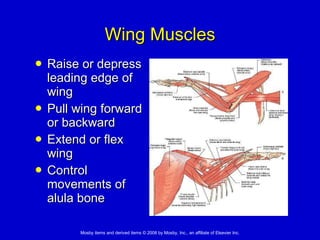
Wing Muscles Raise or depress leading edge of wing Pull wing forward or backward Extend or flex wing Control movements of alula bone
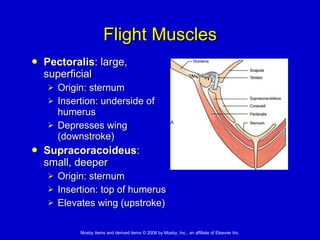
Flight Muscles Pectoralis : large, superficial Origin: sternum Insertion: underside of humerus Depresses wing (downstroke) Supracoracoideus : small, deeper  Origin: sternum  Insertion: top of humerus Elevates wing (upstroke)
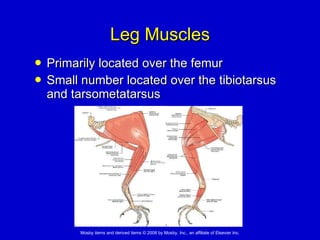
Leg Muscles Primarily located over the femur Small number located over the tibiotarsus  and tarsometatarsus
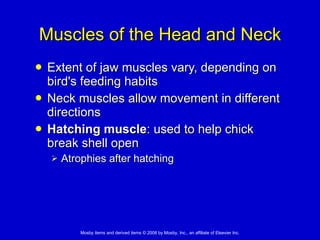
Muscles of the Head and Neck Extent of jaw muscles vary, depending on bird's feeding habits Neck muscles allow movement in different directions Hatching muscle : used to help chick break shell open Atrophies after hatching
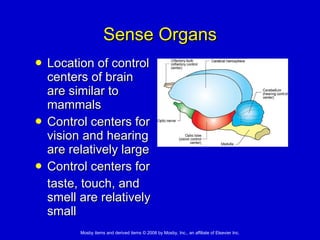
Sense Organs Location of control centers of brain are similar to mammals  Control centers for vision and hearing are relatively large Control centers for  taste, touch, and smell are relatively small
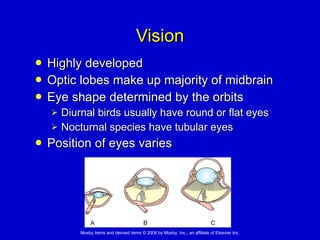
Vision Highly developed Optic lobes make up majority of midbrain Eye shape determined by the orbits Diurnal birds usually have round or flat eyes  Nocturnal species have tubular eyes Position of eyes varies
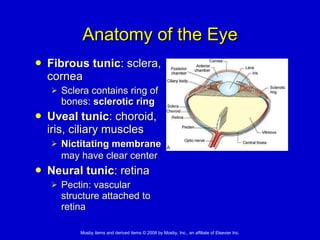
Anatomy of the Eye Fibrous tunic : sclera, cornea Sclera contains ring of bones:  sclerotic ring Uveal tunic : choroid, iris, ciliary muscles Nictitating membrane  may have clear center   Neural tunic : retina Pectin: vascular structure attached to retina
Photoreception Rods and cones similar to mammals  Nocturnal birds have more  rods  than  cones   Rods contain  rhodopsin  - night vision pigment Retina : lightly vascularized and contains numerous photoreceptor cells  Some species have a second temporal fovea rather than a single central fovea  Birds can see wide spectrum of wavelengths
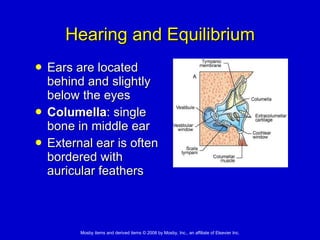
Hearing and Equilibrium Ears are located behind and slightly below the eyes Columella : single bone in middle ear External ear is often bordered with auricular feathers
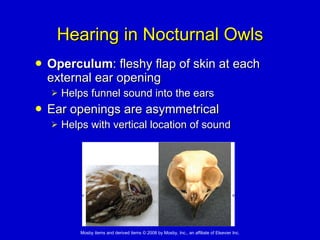
Hearing in Nocturnal Owls Operculum : fleshy flap of skin at each external ear opening  Helps funnel sound into the ears  Ear openings are asymmetrical Helps with vertical location of sound
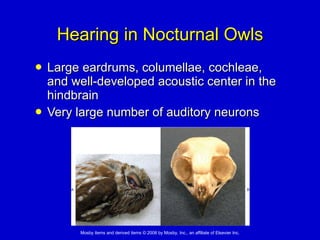
Hearing in Nocturnal Owls Large eardrums, columellae, cochleae, and well-developed acoustic center in the hindbrain  Very large number of auditory neurons
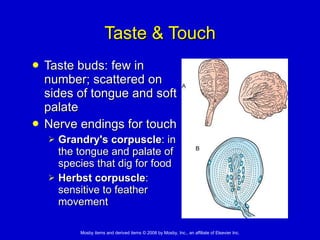
Taste & Touch Taste buds: few in number; scattered on sides of tongue and soft palate Nerve endings for touch Grandry's corpuscle : in the tongue and palate of species that dig for food  Herbst corpuscle : sensitive to feather movement
Smell Highly variable In some species, well developed and needed for locating food In other species, less developed but adequate
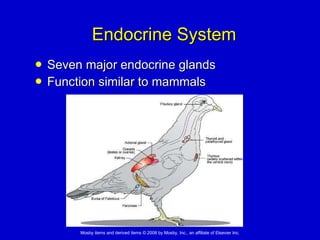
Endocrine System Seven major endocrine glands Function similar to mammals
Digestive System
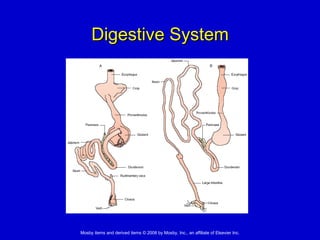
Digestive System Beaks - vary with diet and foraging habits Seedeaters - thick, crushing beak  Woodpeckers - heavy, blunt, chiseling beak Raptors - sharp-edged, tearing, hooked beak  Shorebirds - long, delicate, probing beak
Digestive System Mouth: consists of hard upper palate, soft lower palate, distinctive tongue, salivary glands, taste buds   Soft palate may be enlarged into a pouch used to temporarily store food  Tongue: has few muscles in most species Crop: expansion of esophagus over the furcula in some species Storage pouch for food
Stomach Two compartments: glandular stomach, muscular stomach Proventriculus : anterior glandular stomach; site where chemical digestion begins Gizzard : muscular stomach; striated muscles that grind food   Many birds ingest small pieces of grit to aid in grinding food
Liver and Pancreas Liver Bilobed, right lobe larger than left Pancreas Relatively large; rests in the loop of the duodenum Endocrine portion of pancreas occupies more tissue mass than in mammals
Digestive System Duodenum  Main digestive organ; varies in length and thickness depending on diet Ceca Paired sacs at junction of small and large intestines in some species Play role in water reabsorption and bacterial fermentation of cellulose Contents excreted independent of fecal material
Cloaca End of digesive tract Coprodeum : anterior section; receives excrement from the intestine Urodeum : receives discharge from the kidneys and genital ducts  Proctodeum : posterior section; stores the excrement  Vent : muscular anus
Feeding Habits Diet is determined by:   Physical characteristics (type of bill, feet, plumage, development of senses) Daily activity cycle (diurnal vs. nocturnal) Flight style and endurance Habitat, time of year, geographical location Sex Age
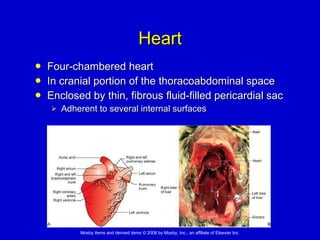
Heart Four-chambered heart  In cranial portion of the thoracoabdominal space  Enclosed by thin, fibrous fluid-filled pericardial sac Adherent to several internal surfaces
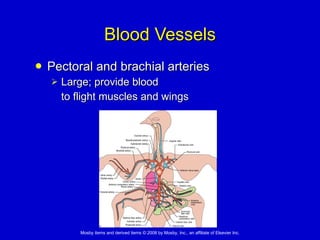
Blood Vessels Pectoral and brachial arteries Large; provide blood  to flight muscles and wings
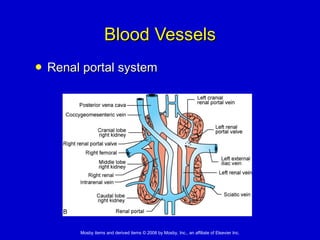
Blood Vessels Renal portal system
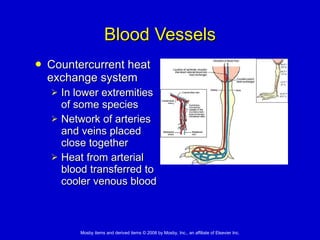
Blood Vessels Countercurrent heat exchange system   In lower extremities of some species Network of arteries and veins placed close together Heat from arterial blood transferred to cooler venous blood
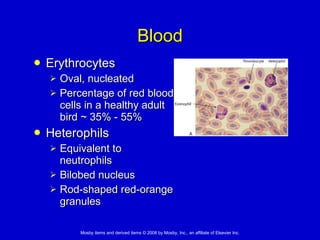
Blood Erythrocytes Oval, nucleated Percentage of red blood cells in a healthy adult bird ~ 35% - 55% Heterophils Equivalent to neutrophils  Bilobed nucleus  Rod-shaped red-orange granules
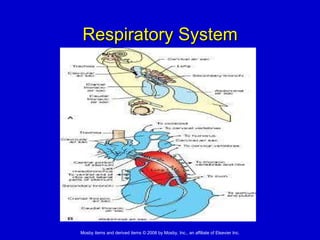
Respiratory System
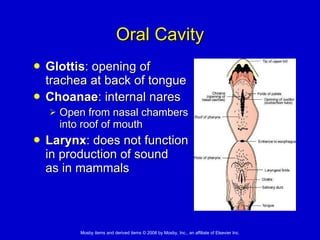
Oral Cavity Glottis : opening of  trachea at back of tongue  Choanae : internal nares   Open from nasal chambers  into roof of mouth Larynx : does not function  in production of sound  as in mammals
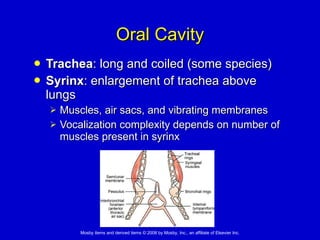
Oral Cavity Trachea : long and coiled (some species) Syrinx : enlargement of trachea above lungs Muscles, air sacs, and vibrating membranes  Vocalization complexity depends on number of muscles present in syrinx
Bronchi Mesobronchi - in lungs   No cartilaginous rings  Divide into secondary bronchi (ventrobronchi)  Ventrobronchi - divide into parabronchi Parabronchi - connect to air capillaries Site of gas exchange
Air Sacs Thin walled, lightly vascularized membranes   Paired - cranial thoracic, caudal thoracic, cervical, and abdominal air sacs Unpaired - interclavicular air sac Reservoirs for air  Provide warmth and moisture to facilitate diffusion of air through capillaries Aid in thermoregulation  Help provide buoyancy
Lungs Small, inelastic Attached to thoracic vertebrae and ribs Air capillaries are at right angles to the blood capillaries   Carbon dioxide continually removed from blood and oxygen continually added
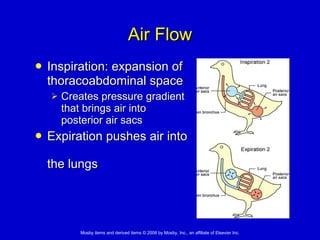
Air Flow Inspiration: expansion of thoracoabdominal space   Creates pressure gradient  that brings air into posterior air sacs  Expiration pushes air into  the lungs
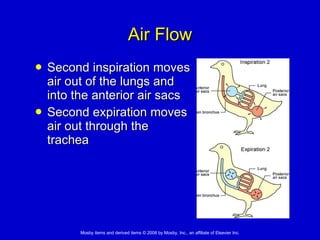
Air Flow Second inspiration moves  air out of the lungs and  into the anterior air sacs  Second expiration moves  air out through the trachea
Respiratory Rate Varies with species, activity level, age, sex, time of day, and outdoor temperature  Smaller birds usually breathe faster than larger birds  Birds in flight have a higher respiratory rate than nonflying birds
Thermoregulation Air in the lungs picks up heat from body tissues and blood and removes it from the body during the breathing process Increased air flow over mouth, pharynx, bronchi, and air sacs increases cooling Achieved through panting or  gular fluttering  (rapid vibrations of upper throat patch)
Thermoregulation Birds bathe or reduce activity level during warmest parts of the day Some species defecate on their legs for evaporative cooling Can adjust the positions of body feathers and posture to promote both heat loss and heat retention  Countercurrent heat exchange system limits heat loss through their bare legs
Urogenital System
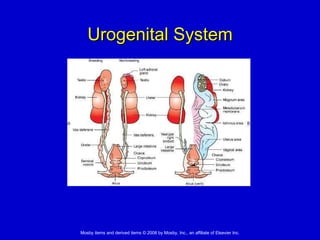
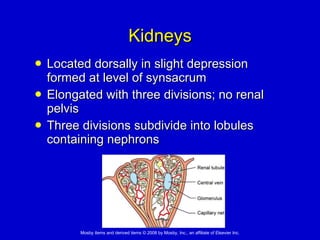
Kidneys Located dorsally in slight depression formed at level of synsacrum Elongated with three divisions; no renal pelvis Three divisions subdivide into lobules containing nephrons
Ureters Surrounded by smooth muscle that helps squeeze urates from the kidney or inhibit their flow into the cloaca Urine passes through ureters to urodeum of the cloaca   Either moved upward to colon and ceca for further reabsorption of water or propelled outward through the vent
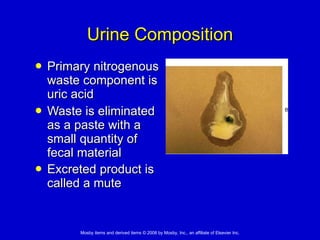
Urine Composition Primary nitrogenous waste component is uric acid  Waste is eliminated as a paste with a small quantity of fecal material Excreted product is called a mute
Reproductive System Reproduction is periodic Increasing daylight stimulates release of hormones that directly affect the reproductive process Reproductive organs larger on the left side of the body   In females the right ovary is rudimentary and not even functional  During nonbreeding season, gonads are relatively small
Copulation Copulation is achieved in one of two ways: Grooved erectile penis is attached to the wall of the cloaca to help transfer sperm into the female's vagina Sperm transfer occurs when the male and female bring their cloacae into close proximity
Oviduct Infundibulum : grabs ovum as it comes out of ovary Magnum : secretes layers of albumin around egg Isthmus : deposits keratin shell membrane
Oviduct Uterus : deposits watery albumin, a hard external shell, and pigmentation Large and muscular Also called the shell gland Vagina : secretes mucus to assist in egg laying; can store sperm for several hours to several days
Clutch Number of eggs that a female lays and incubates  Varies among species   Many species lay one egg per day Some species lay eggs every other day Some larger species may lay at 4- to 5-day intervals
Clutch Total number of eggs that a female can lay varies with the species Determinate layers : specific number of follicles that develop  Indeterminate layers : can produce more eggs than their normal clutch size   Continue to lay eggs if their eggs disappear
Incubation Average incubation temperature for many species is 35° C Prolactin promotes broodiness (incubation behavior) Hormones also stimulate development of a “brood patch” Area of skin on the lower abdomen where heat is transferred to the egg Incubation time varies with the species
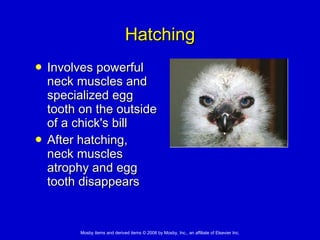
Hatching Involves powerful neck muscles and specialized egg tooth on the outside of a chick's bill After hatching, neck muscles atrophy and egg tooth disappears
Chicks Newly hatched chicks differ in amount of feather cover, status of eyes, and degree of mobility Altricial: hatched with eyes closed and skin bare Semialtricial: covered with down, are immobile, eyes may be open or closed Precocial: covered with downy feathers, eyes open, are mobile, leave the nest quickly Semiprecocial: downy covering, eyes open, limited movement from the nest

19. Avian Anatomy and Physiology

  • 1.
  • 2.
    Learning Objectives Describethe anatomical structures of avian skin, beaks, and claws. Describe the structure and functions of feathers. List the types of feathers and the location of each type. List the unique features of the avian skeleton and musculature. Describe the shape and general characteristics of avian eyes and explain how those characteristics effect visual acuity. Describe the unique anatomical features that affect the sense of hearing in nocturnal owls. List the unique anatomical features that affect the sense of taste in birds. List the components of the avian digestive system and describe the functions of each. List the unique features of the avian circulatory and respiratory systems. Describe the composition of avian urine. List and describe the unique features of the avian male and female reproductive systems. List and describe the four classifications of newly hatched chicks.
  • 3.
    Skin Epidermis :thin layer of flattened epithelial cells that produce keratin Fibrous protein necessary for the production of scales, feathers, and outer sheath of beaks and claws
  • 4.
    Skin Dermis :thick layer of fibrous connective tissue Stores fat for nutrition and insulation Smooth muscles in dermis innervate feather follicles to aid in heat regulation
  • 5.
    Glands Uropygial (preen)gland : On dorsal surface at upper base of the tail Preening stimulates secretion of an oily, fatty substance Bird uses beak to spread the oil throughout its feathers to clean and waterproof them
  • 6.
    Beak Derivative ofskin Upper and lower mandible covered with a horny keratin layer Grows continuously Variable hardness and flexibility, depending on the function
  • 7.
    Claws Horny sheathderived from specialized scales at the end of each toe Grow continuously Variable types of claws, depending on perching habits and method of procuring food
  • 8.
    Feathers Outgrowths ofskin Made of protein Functions: Flight Protect thin skin from trauma, rain, and excessive radiation from sunlight Assist in thermoregulation and camouflage Used in communication behaviors (e.g., courtship, defense, and recognition)
  • 9.
    Feather Structure Inferiorumbilicus : opening at base of feather Superior umbilicus : opening on feather shaft where webbed part of the feather begins May give rise to an afterfeather : accessory feather thought to provide additional insulation Calamus : quill; round, hollow, semitransparent Extends from inferior to superior umbilicus Rachis : main feather shaft
  • 10.
    Feather Structure Vane: flattened part of a feather Numerous slender, closely spaced barbs that give rise to barbules containing hooklets (hamuli) Hooklets interlock each barb with an adjacent one
  • 11.
    Types of FeathersContour Feathers Flight feathers of the wings and tail (remiges and retrices) Moved by muscles attached to the walls of the follicles Auriculars : small contour feathers around external ear openings Improve bird’s hearing ability
  • 12.
    Types of FeathersSemiplume Feathers Have main rachis with barbs and no barbules or hooklets Found under contour feathers Provide insulation Provide flexibility for movement of contour feathers Help with buoyancy in water birds
  • 13.
    Types of FeathersDown feathers Soft, fluffy feathers Lack a true shaft No barbules or hooklets Located next to skin under contour feathers Function in insulation
  • 14.
    Types of FeathersFiloplume Feathers Bare shaft with barbs on the tip Located on the nape and upper back near contour feathers Nerve endings in follicles may play role in controlling feather movement
  • 15.
    Types of FeathersBristles Modified contour feathers Stiff rachis with few barbs at the base May play role in sense of touch May be found around the eyes, nostrils, mouth, and toes
  • 16.
    Types of FeathersPowder Down Feathers Grow continuously at the base Disintegrate at their tip Create waxy powder that spreads throughout the rest of the plumage Birds without a uropygial gland have abundant powder down feathers
  • 17.
    Feathers Pterylae :tracts where feathers are located Apteria : bare areas of skin between pterylae Feathers in pterylae overlap one another
  • 18.
    Feather Damage Feathermites and other external parasites can chew and consume parts of the feather vanes Daily wear and tear: lighter tips of flight and tail feathers can be worn off
  • 19.
    Feather Damage Faultbar (stress bar): weakened area on the feather vane where barbs lack barbules Results from stress that interrupts blood flow during feather growth Common stressor: poor diet
  • 20.
    Molting Process offeather replacement Occurs once to several times a year, depending on species In most species, feather replacement is symmetrical One or two pairs of flight feathers molted at a time Many species of waterfowl molt all flight feathers at once after the breeding season
  • 21.
    Molting Feathers developfrom papillae in feather tracts of the dermis Contain cells with genetic information that dictates type, size, and color of feathers Hormones stimulate molting, activate cells in papillae
  • 22.
    Molting Newly developingfeather pushes old feather out Feather emerges covered by periderm Periderm removed by preening Blood vessels from dermis reach into new feather When feather is fully grown, blood dries up
  • 23.
  • 24.
    Skeletal System Skeletalmodifications allow for flight and walking: Reduction in number of bones Fusion of some bones to form plates Reduction in bone density Loss of internal bone matrix; bone becomes hollow and filled with air spaces
  • 25.
    Skull Skull bonesare thinner than in other animals Jaws extend into a keratinized bill Large eye sockets bordered by sclerotic ring Protective bony plates
  • 26.
    Vertebral Column CervicalVertebrae: Atlas contains a single condyle for attachment of the skull Allows greater range of head movements Greater number of cervical vertebrae than mammals Variable in different species
  • 27.
    Vertebral Column ThoracicVertebrae: Rigid and provide a strong support for the rib cage First few ribs are relatively short and incomplete Remaining ribs attach to underside of sternum and have a projection (uncinate process) that overlaps the adjoining rear rib to strengthen the rib cage
  • 28.
    Vertebral Column Lumbarand Sacral Vertebrae: Synsacrum : strong bony plate created from fusion of several distal lumbar vertebrae, sacral vertebrae, and first few coccygeal vertebrae Synsacrum fuses with the pelvis, supports the legs Coccygeal vertebrae: First few are mobile Pygostyle : bony structure created from fusion of some coccygeal vertebrae
  • 29.
    Sternum Large andconcave Site of origin of flight muscles In some species, muscles attach to large bony ridge or keel In flightless birds sternum lacks a keel
  • 30.
    Pectoral Girdle Pairedcoracoids, scapulas, and clavicles Glenoid cavity (triosseal canal): formed from joining of scapula and coracoid Site of wing joint attachment Clavicles (wishbone): positioned outward and forward from the body
  • 31.
    Wings Joint atshoulder allows rotation in several planes Humerus : wing muscles attach at pectoral crest of humerus Humerus length varies Shorter in birds with flapping flight; longer in birds that glide and soar
  • 32.
    Wings Joint atelbow only allows movement parallel to wing Ulna has a larger diameter than radius Patagium (propatagium): web of skin Ligament runs along its cranial edge Provides elasticity to the wing and assists in the aerodynamics of flight
  • 33.
    Wings Alula bone: originates from the wrist and carries the alula feathers (steering feathers) Metacarpal bones join with the second and third fingers near the distal end of the wing Help support the primary flight feathers
  • 34.
    Pelvic Girdle Threepaired bones that join where the leg attaches to the body Ileum : broad and fused to the synsacrum Ischium and pubis : thin, long, and fused to the ileum anteriorly
  • 35.
    Hip Femur (drumstick): short and wide; directed forward at the knee Allows for lower part of bird's leg to be under its center of gravity Greater and lesser trochanters on femurs: site of attachment of leg muscles Tibiotarsus and Fibula : end at the hock joint Hock : single, elongated bone ( tarsometatarsus )
  • 36.
    Feet Metatarsal pad: bottom of foot; surrounded by two, three, or four toes Anisodactyl : one toe faces the rear, other three face forward Zygodactyl : second and third toes face forward, first and fourth are directed backward Digits are numbered: Digit one (rear toe) - one joint; Digit two (medial) - two joints; Digit three - three joints; Digit four (lateral) - four joints
  • 37.
    Muscles Skeletal muscles- can have white or red muscle fibers or combination of both White fibers : thick in diameter, low blood supply, little myoglobin Use stores of glycogen to sustain muscle contraction Found in flight muscles of short-distance fliers Red fibers : thin, have rich supply of blood, fat, myoglobin, and mitochondria Found in flight muscles of long-distance fliers
  • 38.
    Wing Muscles Raiseor depress leading edge of wing Pull wing forward or backward Extend or flex wing Control movements of alula bone
  • 39.
    Flight Muscles Pectoralis: large, superficial Origin: sternum Insertion: underside of humerus Depresses wing (downstroke) Supracoracoideus : small, deeper Origin: sternum Insertion: top of humerus Elevates wing (upstroke)
  • 40.
    Leg Muscles Primarilylocated over the femur Small number located over the tibiotarsus and tarsometatarsus
  • 41.
    Muscles of theHead and Neck Extent of jaw muscles vary, depending on bird's feeding habits Neck muscles allow movement in different directions Hatching muscle : used to help chick break shell open Atrophies after hatching
  • 42.
    Sense Organs Locationof control centers of brain are similar to mammals Control centers for vision and hearing are relatively large Control centers for taste, touch, and smell are relatively small
  • 43.
    Vision Highly developedOptic lobes make up majority of midbrain Eye shape determined by the orbits Diurnal birds usually have round or flat eyes Nocturnal species have tubular eyes Position of eyes varies
  • 44.
    Anatomy of theEye Fibrous tunic : sclera, cornea Sclera contains ring of bones: sclerotic ring Uveal tunic : choroid, iris, ciliary muscles Nictitating membrane may have clear center Neural tunic : retina Pectin: vascular structure attached to retina
  • 45.
    Photoreception Rods andcones similar to mammals Nocturnal birds have more rods than cones Rods contain rhodopsin - night vision pigment Retina : lightly vascularized and contains numerous photoreceptor cells Some species have a second temporal fovea rather than a single central fovea Birds can see wide spectrum of wavelengths
  • 46.
    Hearing and EquilibriumEars are located behind and slightly below the eyes Columella : single bone in middle ear External ear is often bordered with auricular feathers
  • 47.
    Hearing in NocturnalOwls Operculum : fleshy flap of skin at each external ear opening Helps funnel sound into the ears Ear openings are asymmetrical Helps with vertical location of sound
  • 48.
    Hearing in NocturnalOwls Large eardrums, columellae, cochleae, and well-developed acoustic center in the hindbrain Very large number of auditory neurons
  • 49.
    Taste & TouchTaste buds: few in number; scattered on sides of tongue and soft palate Nerve endings for touch Grandry's corpuscle : in the tongue and palate of species that dig for food Herbst corpuscle : sensitive to feather movement
  • 50.
    Smell Highly variableIn some species, well developed and needed for locating food In other species, less developed but adequate
  • 51.
    Endocrine System Sevenmajor endocrine glands Function similar to mammals
  • 52.
  • 53.
    Digestive System Beaks- vary with diet and foraging habits Seedeaters - thick, crushing beak Woodpeckers - heavy, blunt, chiseling beak Raptors - sharp-edged, tearing, hooked beak Shorebirds - long, delicate, probing beak
  • 54.
    Digestive System Mouth:consists of hard upper palate, soft lower palate, distinctive tongue, salivary glands, taste buds Soft palate may be enlarged into a pouch used to temporarily store food Tongue: has few muscles in most species Crop: expansion of esophagus over the furcula in some species Storage pouch for food
  • 55.
    Stomach Two compartments:glandular stomach, muscular stomach Proventriculus : anterior glandular stomach; site where chemical digestion begins Gizzard : muscular stomach; striated muscles that grind food Many birds ingest small pieces of grit to aid in grinding food
  • 56.
    Liver and PancreasLiver Bilobed, right lobe larger than left Pancreas Relatively large; rests in the loop of the duodenum Endocrine portion of pancreas occupies more tissue mass than in mammals
  • 57.
    Digestive System Duodenum Main digestive organ; varies in length and thickness depending on diet Ceca Paired sacs at junction of small and large intestines in some species Play role in water reabsorption and bacterial fermentation of cellulose Contents excreted independent of fecal material
  • 58.
    Cloaca End ofdigesive tract Coprodeum : anterior section; receives excrement from the intestine Urodeum : receives discharge from the kidneys and genital ducts Proctodeum : posterior section; stores the excrement Vent : muscular anus
  • 59.
    Feeding Habits Dietis determined by: Physical characteristics (type of bill, feet, plumage, development of senses) Daily activity cycle (diurnal vs. nocturnal) Flight style and endurance Habitat, time of year, geographical location Sex Age
  • 60.
    Heart Four-chambered heart In cranial portion of the thoracoabdominal space Enclosed by thin, fibrous fluid-filled pericardial sac Adherent to several internal surfaces
  • 61.
    Blood Vessels Pectoraland brachial arteries Large; provide blood to flight muscles and wings
  • 62.
    Blood Vessels Renalportal system
  • 63.
    Blood Vessels Countercurrentheat exchange system In lower extremities of some species Network of arteries and veins placed close together Heat from arterial blood transferred to cooler venous blood
  • 64.
    Blood Erythrocytes Oval,nucleated Percentage of red blood cells in a healthy adult bird ~ 35% - 55% Heterophils Equivalent to neutrophils Bilobed nucleus Rod-shaped red-orange granules
  • 65.
  • 66.
    Oral Cavity Glottis: opening of trachea at back of tongue Choanae : internal nares Open from nasal chambers into roof of mouth Larynx : does not function in production of sound as in mammals
  • 67.
    Oral Cavity Trachea: long and coiled (some species) Syrinx : enlargement of trachea above lungs Muscles, air sacs, and vibrating membranes Vocalization complexity depends on number of muscles present in syrinx
  • 68.
    Bronchi Mesobronchi -in lungs No cartilaginous rings Divide into secondary bronchi (ventrobronchi) Ventrobronchi - divide into parabronchi Parabronchi - connect to air capillaries Site of gas exchange
  • 69.
    Air Sacs Thinwalled, lightly vascularized membranes Paired - cranial thoracic, caudal thoracic, cervical, and abdominal air sacs Unpaired - interclavicular air sac Reservoirs for air Provide warmth and moisture to facilitate diffusion of air through capillaries Aid in thermoregulation Help provide buoyancy
  • 70.
    Lungs Small, inelasticAttached to thoracic vertebrae and ribs Air capillaries are at right angles to the blood capillaries Carbon dioxide continually removed from blood and oxygen continually added
  • 71.
    Air Flow Inspiration:expansion of thoracoabdominal space Creates pressure gradient that brings air into posterior air sacs Expiration pushes air into the lungs
  • 72.
    Air Flow Secondinspiration moves air out of the lungs and into the anterior air sacs Second expiration moves air out through the trachea
  • 73.
    Respiratory Rate Varieswith species, activity level, age, sex, time of day, and outdoor temperature Smaller birds usually breathe faster than larger birds Birds in flight have a higher respiratory rate than nonflying birds
  • 74.
    Thermoregulation Air inthe lungs picks up heat from body tissues and blood and removes it from the body during the breathing process Increased air flow over mouth, pharynx, bronchi, and air sacs increases cooling Achieved through panting or gular fluttering (rapid vibrations of upper throat patch)
  • 75.
    Thermoregulation Birds batheor reduce activity level during warmest parts of the day Some species defecate on their legs for evaporative cooling Can adjust the positions of body feathers and posture to promote both heat loss and heat retention Countercurrent heat exchange system limits heat loss through their bare legs
  • 76.
  • 77.
    Kidneys Located dorsallyin slight depression formed at level of synsacrum Elongated with three divisions; no renal pelvis Three divisions subdivide into lobules containing nephrons
  • 78.
    Ureters Surrounded bysmooth muscle that helps squeeze urates from the kidney or inhibit their flow into the cloaca Urine passes through ureters to urodeum of the cloaca Either moved upward to colon and ceca for further reabsorption of water or propelled outward through the vent
  • 79.
    Urine Composition Primarynitrogenous waste component is uric acid Waste is eliminated as a paste with a small quantity of fecal material Excreted product is called a mute
  • 80.
    Reproductive System Reproductionis periodic Increasing daylight stimulates release of hormones that directly affect the reproductive process Reproductive organs larger on the left side of the body In females the right ovary is rudimentary and not even functional During nonbreeding season, gonads are relatively small
  • 81.
    Copulation Copulation isachieved in one of two ways: Grooved erectile penis is attached to the wall of the cloaca to help transfer sperm into the female's vagina Sperm transfer occurs when the male and female bring their cloacae into close proximity
  • 82.
    Oviduct Infundibulum :grabs ovum as it comes out of ovary Magnum : secretes layers of albumin around egg Isthmus : deposits keratin shell membrane
  • 83.
    Oviduct Uterus :deposits watery albumin, a hard external shell, and pigmentation Large and muscular Also called the shell gland Vagina : secretes mucus to assist in egg laying; can store sperm for several hours to several days
  • 84.
    Clutch Number ofeggs that a female lays and incubates Varies among species Many species lay one egg per day Some species lay eggs every other day Some larger species may lay at 4- to 5-day intervals
  • 85.
    Clutch Total numberof eggs that a female can lay varies with the species Determinate layers : specific number of follicles that develop Indeterminate layers : can produce more eggs than their normal clutch size Continue to lay eggs if their eggs disappear
  • 86.
    Incubation Average incubationtemperature for many species is 35° C Prolactin promotes broodiness (incubation behavior) Hormones also stimulate development of a “brood patch” Area of skin on the lower abdomen where heat is transferred to the egg Incubation time varies with the species
  • 87.
    Hatching Involves powerfulneck muscles and specialized egg tooth on the outside of a chick's bill After hatching, neck muscles atrophy and egg tooth disappears
  • 88.
    Chicks Newly hatchedchicks differ in amount of feather cover, status of eyes, and degree of mobility Altricial: hatched with eyes closed and skin bare Semialtricial: covered with down, are immobile, eyes may be open or closed Precocial: covered with downy feathers, eyes open, are mobile, leave the nest quickly Semiprecocial: downy covering, eyes open, limited movement from the nest

Editor's Notes

  • #50 Type size?
  • #53 Delete “General Diagram of Avian Digestive System.”
  • #56 Type size?
  • #66 Delete caption and enlarge figure.
  • #77 Delete caption. Leave heading (urogenital system) and enlarge figure.