





C LASS AVES
CLASSIFICATION
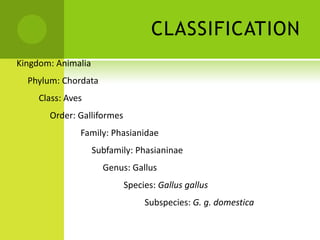
Kingdom: Animalia
  Phylum: Chordata
     Class: Aves
       Order: Galliformes
               Family: Phasianidae
                    Subfamily: Phasianinae
                      Genus: Gallus
                            Species: Gallus gallus
                                 Subspecies: G. g. domestica
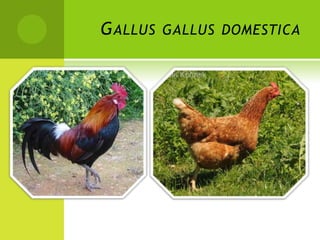
G ALLUS GALLUS DOMESTICA
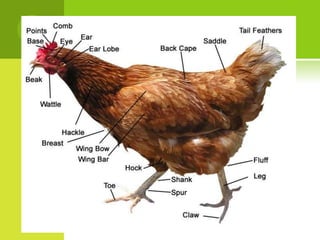
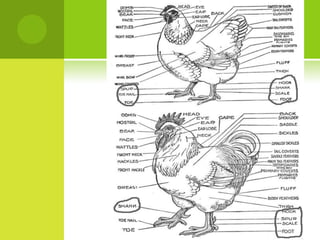
E XTERNAL PARTS OF THE CHICKEN
C HICKEN EYES AND NOSTRILS


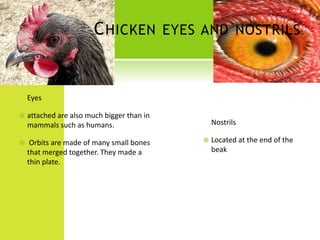
    Eyes

   attached are also much bigger than in
    mammals such as humans.                     Nostrils

    Orbits are made of many small bones       Located at the end of the
    that merged together. They made a           beak
    thin plate.
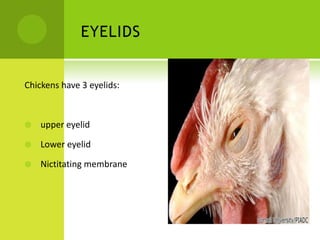
EYELIDS


Chickens have 3 eyelids:


   upper eyelid

   Lower eyelid

   Nictitating membrane
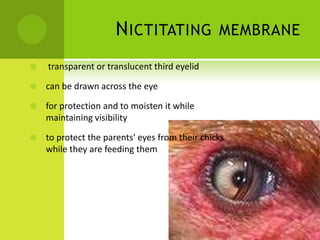
N ICTITATING              MEMBRANE

   transparent or translucent third eyelid

   can be drawn across the eye

   for protection and to moisten it while
    maintaining visibility

   to protect the parents' eyes from their chicks
    while they are feeding them
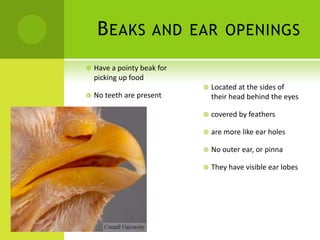
B EAKS          AND EAR OPENINGS

   Have a pointy beak for
    picking up food
                                Located at the sides of
   No teeth are present         their head behind the eyes

                                covered by feathers

                                are more like ear holes

                                No outer ear, or pinna

                                They have visible ear lobes
   It is believed that the same gene that determines the color of the
    ear lobe also determines egg color.

   Their ear lobes also can be colored from near white to near black.
    These birds will lay eggs that are nearly white to a deep, soft
    brown. The shade of brown of the egg will be indicated by the
    degree of color of the ear lobe. In other words, a chicken with
    blackish lobes will not lay a black egg, but it may be a deep brown.
WATTLE


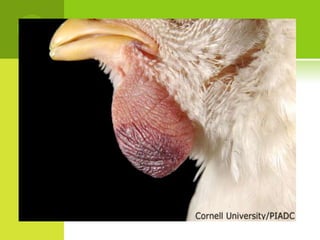
   Wattles are located under the chin.

   They are meaty, red growths.

   Both male and female chicken have wattles.

   wattles cools down the chicken.

   This happens when the blood circulates from the
    comb to the wattles. The circulating blood lowers
    the temperature of the chicken during the hot
    weather.
COMB


   fleshy protuberance on top of the head of a
    chicken
   the cockerel have a larger comb than the hen
    chicken
   act as a cooling mechanism for the birds
   large combs on males attract females as chickens
    can detect colour and are very attracted to the
    colour red.
   serves as an indicator of the bird’s health.
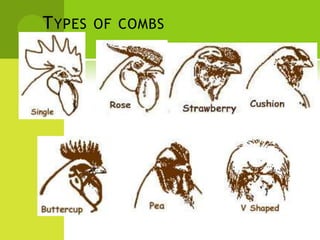
T YPES OF COMBS
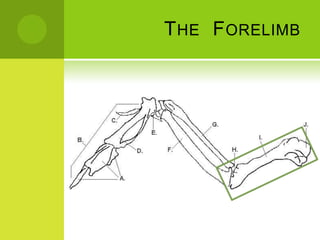
T HE F ORELIMB
T HE F ORELIMB

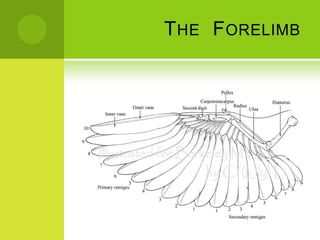
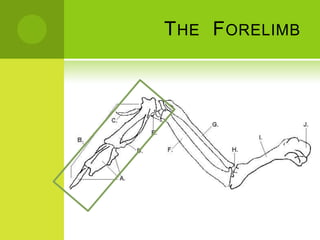
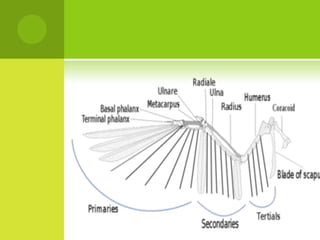
   The bird’s wing and is responsible for
    powered flight.

   Primarily supported by an
    elongated radius, ulna, and modified wrist
    bones.
T HE F ORELIMB
T HE F ORELIMB

   Upper Arm
       Short and stout humerus

       Connects the scapula with the lower arm (or
        forearm)

       Provides the musculature necessary for flight
T HE F ORELIMB
T HE F ORELIMB

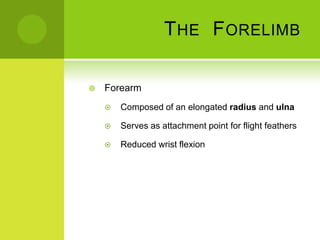
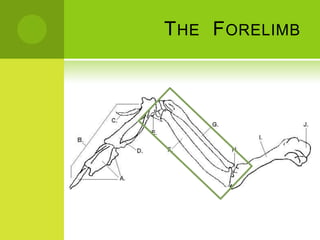
   Forearm
       Composed of an elongated radius and ulna

       Serves as attachment point for flight feathers

       Reduced wrist flexion
T HE F ORELIMB
T HE F ORELIMB

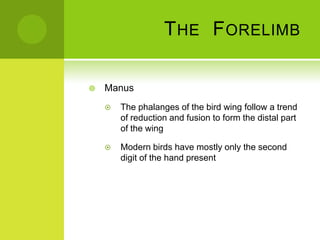
   Manus
       The phalanges of the bird wing follow a trend
        of reduction and fusion to form the distal part
        of the wing

       Modern birds have mostly only the second
        digit of the hand present
T HE F ORELIMB
T HE H INDLIMB
T HE H INDLIMB

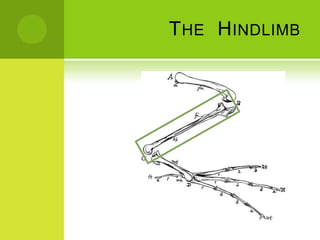
   Composed of the thingh, shank and foot.

   Enables bipedal locomotion for birds.
T HE H INDLIMB

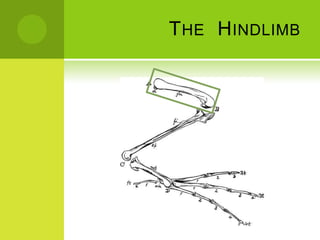
   Thigh
       Upper portion of a bird’s hindlimb

       Composed of a short femur.
T HE H INDLIMB
T HE H INDLIMB

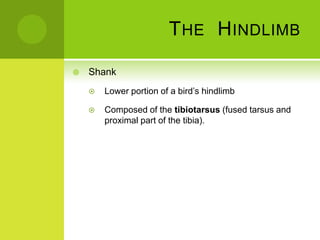
   Shank
       Lower portion of a bird’s hindlimb

       Composed of the tibiotarsus (fused tarsus and
        proximal part of the tibia).
T HE H INDLIMB
F OOT AND REMIGES
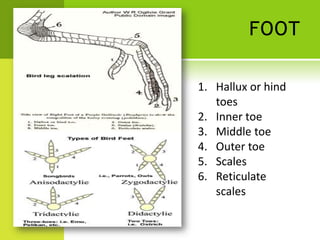
FOOT

1. Hallux or hind
   toes
2. Inner toe
3. Middle toe
4. Outer toe
5. Scales
6. Reticulate
   scales
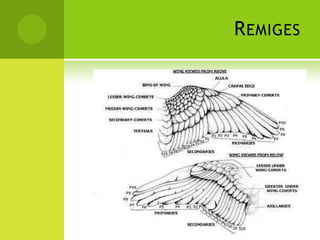
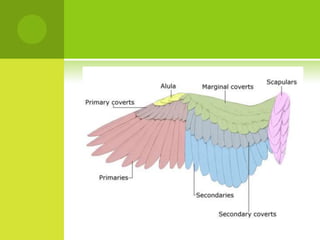
R EMIGES
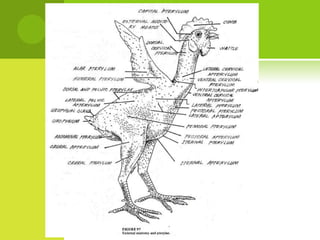
PTERYLAE
   Region on the chicken skin where
    feathers grow
   Symmetrical tracts
   Separated from each other by
    semi-apteria
   Feather macropattern
APTERIA
   Bare area(feathers don’t grow) on
    the chicken skin
   Spaces between the feather
    tracts of birds
   Covered by down or semi-plume
    feathers
Class aves centrum

Class aves centrum

  • 1.
  • 2.
    CLASSIFICATION Kingdom: Animalia Phylum: Chordata Class: Aves Order: Galliformes Family: Phasianidae Subfamily: Phasianinae Genus: Gallus Species: Gallus gallus Subspecies: G. g. domestica
  • 3.
    G ALLUS GALLUSDOMESTICA
  • 4.
    E XTERNAL PARTSOF THE CHICKEN
  • 5.
    C HICKEN EYESAND NOSTRILS Eyes  attached are also much bigger than in mammals such as humans. Nostrils  Orbits are made of many small bones  Located at the end of the that merged together. They made a beak thin plate.
  • 6.
    EYELIDS Chickens have 3eyelids:  upper eyelid  Lower eyelid  Nictitating membrane
  • 7.
    N ICTITATING MEMBRANE  transparent or translucent third eyelid  can be drawn across the eye  for protection and to moisten it while maintaining visibility  to protect the parents' eyes from their chicks while they are feeding them
  • 8.
    B EAKS AND EAR OPENINGS  Have a pointy beak for picking up food  Located at the sides of  No teeth are present their head behind the eyes  covered by feathers  are more like ear holes  No outer ear, or pinna  They have visible ear lobes
  • 9.
    It is believed that the same gene that determines the color of the ear lobe also determines egg color.  Their ear lobes also can be colored from near white to near black. These birds will lay eggs that are nearly white to a deep, soft brown. The shade of brown of the egg will be indicated by the degree of color of the ear lobe. In other words, a chicken with blackish lobes will not lay a black egg, but it may be a deep brown.
  • 10.
    WATTLE  Wattles are located under the chin.  They are meaty, red growths.  Both male and female chicken have wattles.  wattles cools down the chicken.  This happens when the blood circulates from the comb to the wattles. The circulating blood lowers the temperature of the chicken during the hot weather.
  • 12.
    COMB  fleshy protuberance on top of the head of a chicken  the cockerel have a larger comb than the hen chicken  act as a cooling mechanism for the birds  large combs on males attract females as chickens can detect colour and are very attracted to the colour red.  serves as an indicator of the bird’s health.
  • 13.
    T YPES OFCOMBS
  • 15.
    T HE FORELIMB
  • 16.
    T HE FORELIMB  The bird’s wing and is responsible for powered flight.  Primarily supported by an elongated radius, ulna, and modified wrist bones.
  • 17.
    T HE FORELIMB
  • 18.
    T HE FORELIMB  Upper Arm  Short and stout humerus  Connects the scapula with the lower arm (or forearm)  Provides the musculature necessary for flight
  • 19.
    T HE FORELIMB
  • 20.
    T HE FORELIMB  Forearm  Composed of an elongated radius and ulna  Serves as attachment point for flight feathers  Reduced wrist flexion
  • 21.
    T HE FORELIMB
  • 22.
    T HE FORELIMB  Manus  The phalanges of the bird wing follow a trend of reduction and fusion to form the distal part of the wing  Modern birds have mostly only the second digit of the hand present
  • 23.
    T HE FORELIMB
  • 24.
    T HE HINDLIMB
  • 25.
    T HE HINDLIMB  Composed of the thingh, shank and foot.  Enables bipedal locomotion for birds.
  • 26.
    T HE HINDLIMB  Thigh  Upper portion of a bird’s hindlimb  Composed of a short femur.
  • 27.
    T HE HINDLIMB
  • 28.
    T HE HINDLIMB  Shank  Lower portion of a bird’s hindlimb  Composed of the tibiotarsus (fused tarsus and proximal part of the tibia).
  • 29.
    T HE HINDLIMB
  • 30.
    F OOT ANDREMIGES
  • 31.
    FOOT 1. Hallux orhind toes 2. Inner toe 3. Middle toe 4. Outer toe 5. Scales 6. Reticulate scales
  • 33.
  • 36.
  • 37.
    Region on the chicken skin where feathers grow  Symmetrical tracts  Separated from each other by semi-apteria  Feather macropattern
  • 38.
  • 39.
    Bare area(feathers don’t grow) on the chicken skin  Spaces between the feather tracts of birds  Covered by down or semi-plume feathers