NCFE Principles of Business
Administration
Level 2 Certificate
Waterside
Tutor: Michelle Walsh
mwalsh@accross.ac.uk
01254 354413
Induction
 Fire evacuation
 Toilets
 Smoking
 Phone calls / appointments
 Commitment = 70%
 Absences – To be reported
 Brews – 25p per session
 Questions?
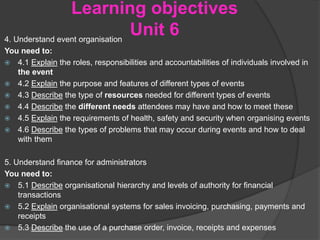
Learning objectives
Unit 64. Understand event organisation
You need to:
 4.1 Explain the roles, responsibilities and accountabilities of individuals involved in
the event
 4.2 Explain the purpose and features of different types of events
 4.3 Describe the type of resources needed for different types of events
 4.4 Describe the different needs attendees may have and how to meet these
 4.5 Explain the requirements of health, safety and security when organising events
 4.6 Describe the types of problems that may occur during events and how to deal
with them
5. Understand finance for administrators
You need to:
 5.1 Describe organisational hierarchy and levels of authority for financial
transactions
 5.2 Explain organisational systems for sales invoicing, purchasing, payments and
receipts
 5.3 Describe the use of a purchase order, invoice, receipts and expenses
1 week left for this unit
We’re working through the second half of the criteria
today
Unit 6 – LO 4 Guidance
AC 4.1
 Roles — Generally, roles are the positions team members
assume or the parts that they play in a particular operation or
process. (For example, a role an individual might assume is that
of facilitator, or communications liaison).
 Responsibilities — On the other hand, responsibilities are the
specific tasks or duties that members are expected to complete as
a function of their roles.
4.1 the event may include, but is not limited to:
 a meeting
 an announcement
 a celebration
 a social occasion
 a product launch
AC 4.1
What does the job of planning a business meeting or event entail? Entire books are
dedicated to answering that question, but the following list includes the fundamentals a
planner must expect to coordinate:
 Site selection
 Hotel accommodations
 Travel arrangements
 Food
 Speakers and entertainment
 Audiovisual equipment
 Recreational activities
 Decorations
 Printing
 Gifts and awards
 Personnel
http://www.wikihow.com/Manage-an-Event
http://www.live-recruitment.co.uk/what-are-the-key-roles-of-an-event-organiser/
http://www.totaljobs.com/careers-advice/job-profile/marketing-advertising-pr-jobs/event-manager-job-description
http://work.chron.com/duties-event-planner-3092.html
AC 4.2
Name a few types of events – Explain
the purpose and features of each one.
Keep this related to the business
environment.
http://hubpages.com/business/Plan-and-Organise-Meetings-NVQ-Level-3-Diploma-in-Business-
and-Administration
http://www.evenues.com/event-planning-guide/types-of-meetings-and-events
http://eventmanagement.com/events/types-of-events/
AC 4.3
4.3 resources may include, but are not limited to:
 human resource
 equipment
 materials
 public address systems
 information technology
Anything you have needed to get before the
event
AC 4.4
4.4 different needs may include, but are not limited to:
 additional needs/requirements
 poor communication skills
 language barriers
http://www.internationalmeetingsreview.com/business/how-make-
your-events-easier-attendees-disabilities-97639
AC 4.5
Getting started
Planning
The level of detail in your planning should be proportionate to the scale of the event and the degree of risk.
 Health and safety management arrangements
 First, decide who will help you with your duties[1] as an event organiser.
 Whatever the scale of the event, make sure there is a clear understanding within the organising team of
who will be responsible for safety matters. For organisations with five or more employees, this is likely to be
driven by the company’s health and safety policy. See Write a health and safety policy for your business[2].
Safety plan
As an event organiser, identify the:
 scale, type and scope of the event
 type and size of audience
 location
 duration of the event
 time of day and year the event will be held
 These factors will help you to determine what resources and facilities will be required.
 Translate this information into an appropriate safety plan.
 The key tool for creating a safety plan is the process of risk assessment[3]. For information to help with your
event risk assessment, see also health and safety topics[4].
http://www.hse.gov.uk/event-safety/
AC 4.6
Think of specific problems during an event
For example;
Technical difficulty
Room double booking
Describe each one and include how you would deal
with it
http://web.mit.edu/eventguide/running/index.html
15 MINS
Unit 6 – LO 5 Guidance
5.1
Organisation hierarchy – Finance transaction
Who may be involved with finances? Levels of authority – why?
Think of budgets, levels of responsibility and accountability.
http://yourbusiness.azcentral.com/financial-hierarchy-organization-
26029.html
https://opsdog.com/industries/finance/finance-organization-chart
http://www.thecqi.org/Knowledge-Hub/Knowledge-portal/Interactions-of-
organisations-and-people/Role-of-the-individual/
http://smallbusiness.chron.com/financial-hierarchy-organization-
15386.html
AC 5.2
Accounting software - SAGE
Easy to use, affordable accounting software for sole traders, start-
ups and small businesses.
 Our range of accounting software is designed to meet the needs of
start-ups, sole traders and small businesses. Choose from a range of
desktop or online accounting that allow you to invoice customers,
analyse business performance and manage VAT, stock, budgets and
more.
Here are just a handful of the great features our accounting software
has to offer:
 Manage income and expenses
 Choose from desktop or cloud based solutions
 Invoice customers with professional, customisable invoices
 Keep bank and accounts accurate with easy bank reconciliation
 No limits to the number of transactions you can enter
 Automatically calculate and submit VAT returns securely to HMRC
 All software comes with either support as standard or has an optional
support package
AC 5.2
Accounting software - QUICKBOOKS
Easy accounting software. No experience required.
 Real-time dashboards
 See how your business is doing at a glance
 Customisable invoices
 Easily create & send invoices with a pay now button
 Track expenses
 Scan receipts to keep your accounts up to date
 Manage VAT
 Accurately track & calculate tax for HMRC
 Run payroll
 Pay employees & manage workplace pensions
 Automatic bank downloads
 Download & categorise bank transactions automatically
 Accept payments
 Get paid faster by accepting card payments
 Connect to your accountant
http://www.intuit.co.uk/
AC 5.2
http://www.sage.co.uk/
http://sfedi.co.uk/standards/business-enterprise-
standard/mn3-keep-financial-records-for-your-
business
http://www.mtu.edu/fso/financial/accounts-payable/
http://smallbusiness.chron.com/difference-between-
invoice-sales-receipts-quickbooks-59695.html
https://www.gov.uk/invoicing-and-taking-payment-
from-customers
AC 5.3
Purchase order:
 Agreement between purchaser and supplier.
Invoice:
 Request for payment.
Receipts:
 Acknowledgment of purchase/payment.
Expenses:
 Everyday expenditure.
Learning outcomes – Unit 6
DID YOU……?
4. Understand event organisation
You need to:
 4.1 Explain the roles, responsibilities and accountabilities of individuals involved in
the event
 4.2 Explain the purpose and features of different types of events
 4.3 Describe the type of resources needed for different types of events
 4.4 Describe the different needs attendees may have and how to meet these
 4.5 Explain the requirements of health, safety and security when organising events
 4.6 Describe the types of problems that may occur during events and how to deal
with them
5. Understand finance for administrators
You need to:
 5.1 Describe organisational hierarchy and levels of authority for financial
transactions
 5.2 Explain organisational systems for sales invoicing, purchasing, payments and
receipts
 5.3 Describe the use of a purchase order, invoice, receipts and expenses
Any questions?
See you next week
You need to complete;
Unit 06

Unit 6 - Section 2

  • 1.
    NCFE Principles ofBusiness Administration Level 2 Certificate Waterside Tutor: Michelle Walsh mwalsh@accross.ac.uk 01254 354413
  • 2.
    Induction  Fire evacuation Toilets  Smoking  Phone calls / appointments  Commitment = 70%  Absences – To be reported  Brews – 25p per session  Questions?
  • 3.
    Learning objectives Unit 64.Understand event organisation You need to:  4.1 Explain the roles, responsibilities and accountabilities of individuals involved in the event  4.2 Explain the purpose and features of different types of events  4.3 Describe the type of resources needed for different types of events  4.4 Describe the different needs attendees may have and how to meet these  4.5 Explain the requirements of health, safety and security when organising events  4.6 Describe the types of problems that may occur during events and how to deal with them 5. Understand finance for administrators You need to:  5.1 Describe organisational hierarchy and levels of authority for financial transactions  5.2 Explain organisational systems for sales invoicing, purchasing, payments and receipts  5.3 Describe the use of a purchase order, invoice, receipts and expenses
  • 4.
    1 week leftfor this unit We’re working through the second half of the criteria today
  • 5.
    Unit 6 –LO 4 Guidance
  • 6.
    AC 4.1  Roles— Generally, roles are the positions team members assume or the parts that they play in a particular operation or process. (For example, a role an individual might assume is that of facilitator, or communications liaison).  Responsibilities — On the other hand, responsibilities are the specific tasks or duties that members are expected to complete as a function of their roles. 4.1 the event may include, but is not limited to:  a meeting  an announcement  a celebration  a social occasion  a product launch
  • 7.
    AC 4.1 What doesthe job of planning a business meeting or event entail? Entire books are dedicated to answering that question, but the following list includes the fundamentals a planner must expect to coordinate:  Site selection  Hotel accommodations  Travel arrangements  Food  Speakers and entertainment  Audiovisual equipment  Recreational activities  Decorations  Printing  Gifts and awards  Personnel http://www.wikihow.com/Manage-an-Event http://www.live-recruitment.co.uk/what-are-the-key-roles-of-an-event-organiser/ http://www.totaljobs.com/careers-advice/job-profile/marketing-advertising-pr-jobs/event-manager-job-description http://work.chron.com/duties-event-planner-3092.html
  • 8.
    AC 4.2 Name afew types of events – Explain the purpose and features of each one. Keep this related to the business environment. http://hubpages.com/business/Plan-and-Organise-Meetings-NVQ-Level-3-Diploma-in-Business- and-Administration http://www.evenues.com/event-planning-guide/types-of-meetings-and-events http://eventmanagement.com/events/types-of-events/
  • 9.
    AC 4.3 4.3 resourcesmay include, but are not limited to:  human resource  equipment  materials  public address systems  information technology Anything you have needed to get before the event
  • 10.
    AC 4.4 4.4 differentneeds may include, but are not limited to:  additional needs/requirements  poor communication skills  language barriers http://www.internationalmeetingsreview.com/business/how-make- your-events-easier-attendees-disabilities-97639
  • 11.
    AC 4.5 Getting started Planning Thelevel of detail in your planning should be proportionate to the scale of the event and the degree of risk.  Health and safety management arrangements  First, decide who will help you with your duties[1] as an event organiser.  Whatever the scale of the event, make sure there is a clear understanding within the organising team of who will be responsible for safety matters. For organisations with five or more employees, this is likely to be driven by the company’s health and safety policy. See Write a health and safety policy for your business[2]. Safety plan As an event organiser, identify the:  scale, type and scope of the event  type and size of audience  location  duration of the event  time of day and year the event will be held  These factors will help you to determine what resources and facilities will be required.  Translate this information into an appropriate safety plan.  The key tool for creating a safety plan is the process of risk assessment[3]. For information to help with your event risk assessment, see also health and safety topics[4]. http://www.hse.gov.uk/event-safety/
  • 12.
    AC 4.6 Think ofspecific problems during an event For example; Technical difficulty Room double booking Describe each one and include how you would deal with it http://web.mit.edu/eventguide/running/index.html
  • 13.
  • 14.
    Unit 6 –LO 5 Guidance
  • 15.
    5.1 Organisation hierarchy –Finance transaction Who may be involved with finances? Levels of authority – why? Think of budgets, levels of responsibility and accountability. http://yourbusiness.azcentral.com/financial-hierarchy-organization- 26029.html https://opsdog.com/industries/finance/finance-organization-chart http://www.thecqi.org/Knowledge-Hub/Knowledge-portal/Interactions-of- organisations-and-people/Role-of-the-individual/ http://smallbusiness.chron.com/financial-hierarchy-organization- 15386.html
  • 16.
    AC 5.2 Accounting software- SAGE Easy to use, affordable accounting software for sole traders, start- ups and small businesses.  Our range of accounting software is designed to meet the needs of start-ups, sole traders and small businesses. Choose from a range of desktop or online accounting that allow you to invoice customers, analyse business performance and manage VAT, stock, budgets and more. Here are just a handful of the great features our accounting software has to offer:  Manage income and expenses  Choose from desktop or cloud based solutions  Invoice customers with professional, customisable invoices  Keep bank and accounts accurate with easy bank reconciliation  No limits to the number of transactions you can enter  Automatically calculate and submit VAT returns securely to HMRC  All software comes with either support as standard or has an optional support package
  • 17.
    AC 5.2 Accounting software- QUICKBOOKS Easy accounting software. No experience required.  Real-time dashboards  See how your business is doing at a glance  Customisable invoices  Easily create & send invoices with a pay now button  Track expenses  Scan receipts to keep your accounts up to date  Manage VAT  Accurately track & calculate tax for HMRC  Run payroll  Pay employees & manage workplace pensions  Automatic bank downloads  Download & categorise bank transactions automatically  Accept payments  Get paid faster by accepting card payments  Connect to your accountant http://www.intuit.co.uk/
  • 18.
  • 19.
    AC 5.3 Purchase order: Agreement between purchaser and supplier. Invoice:  Request for payment. Receipts:  Acknowledgment of purchase/payment. Expenses:  Everyday expenditure.
  • 20.
    Learning outcomes –Unit 6 DID YOU……? 4. Understand event organisation You need to:  4.1 Explain the roles, responsibilities and accountabilities of individuals involved in the event  4.2 Explain the purpose and features of different types of events  4.3 Describe the type of resources needed for different types of events  4.4 Describe the different needs attendees may have and how to meet these  4.5 Explain the requirements of health, safety and security when organising events  4.6 Describe the types of problems that may occur during events and how to deal with them 5. Understand finance for administrators You need to:  5.1 Describe organisational hierarchy and levels of authority for financial transactions  5.2 Explain organisational systems for sales invoicing, purchasing, payments and receipts  5.3 Describe the use of a purchase order, invoice, receipts and expenses
  • 21.
  • 22.
    See you nextweek You need to complete; Unit 06