

From Technology Risk
  to Enterprise Risk:
   The New Frontier
                          Ramsés Gallego
CISM, CGEIT, CISSP, SCPM, CCSK, ITIL, COBIT(f), Six Sigma Black Belt
                         General Manager
                 Entel Security & Risk Management
                         rgallego@entel.es

                                 1
2
3
Definitions


frontier
noun
• the farthermost limits of knowledge or achievement in a particular subject
• a line of division between things <the frontiers separating science and the
humanities — R. W. Clark>

• a new field for exploitative or developmental activity
frontierless adjective

ORIGIN late Middle English : from Old French frontiere, based on Latin frons,
front- ‘front.’


                                           4
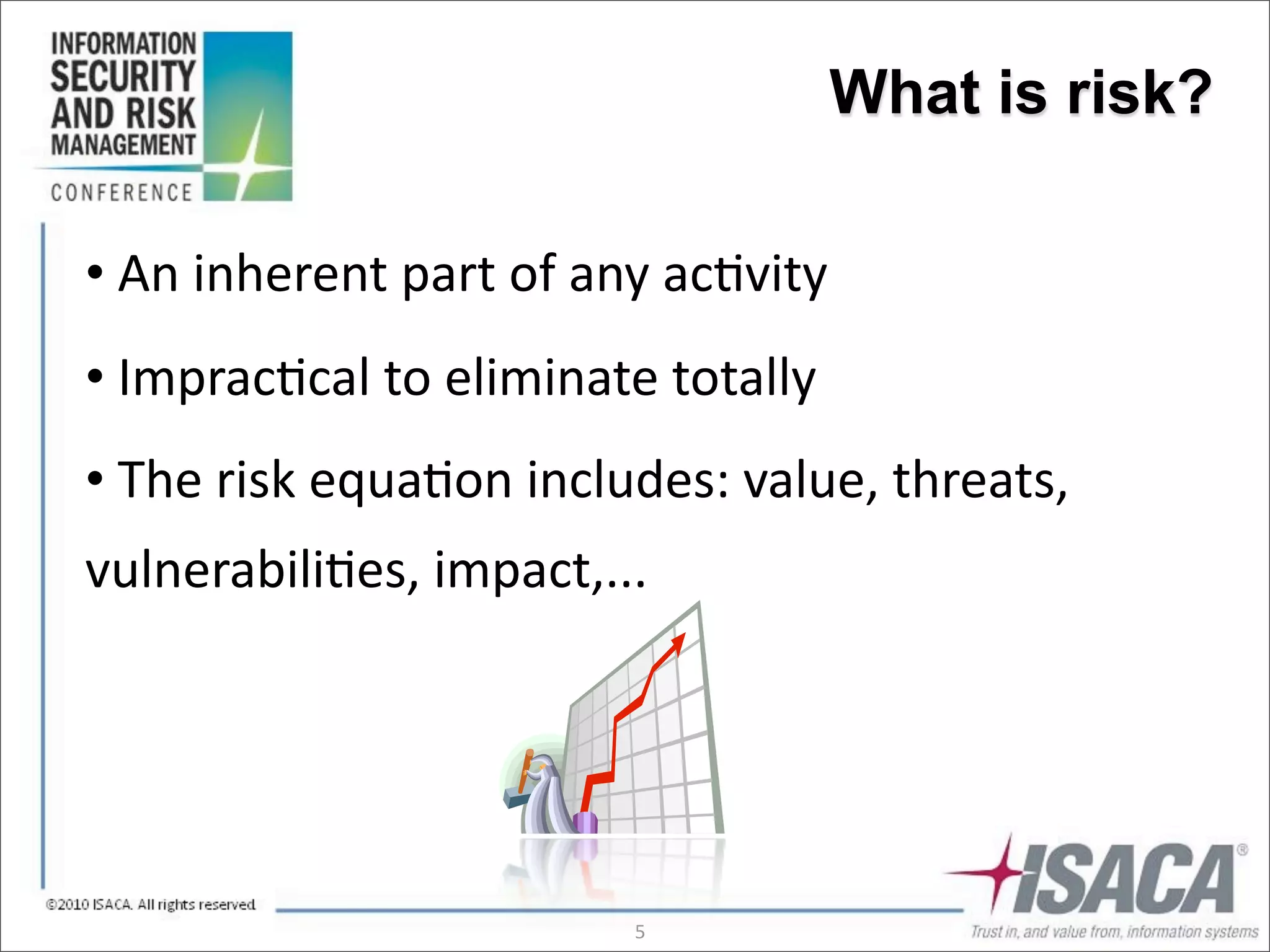
What is risk?

•	
  An	
  inherent	
  part	
  of	
  any	
  ac3vity
•	
  Imprac3cal	
  to	
  eliminate	
  totally
•	
  The	
  risk	
  equa3on	
  includes:	
  value,	
  threats,	
  
vulnerabili3es,	
  impact,...


                                     5
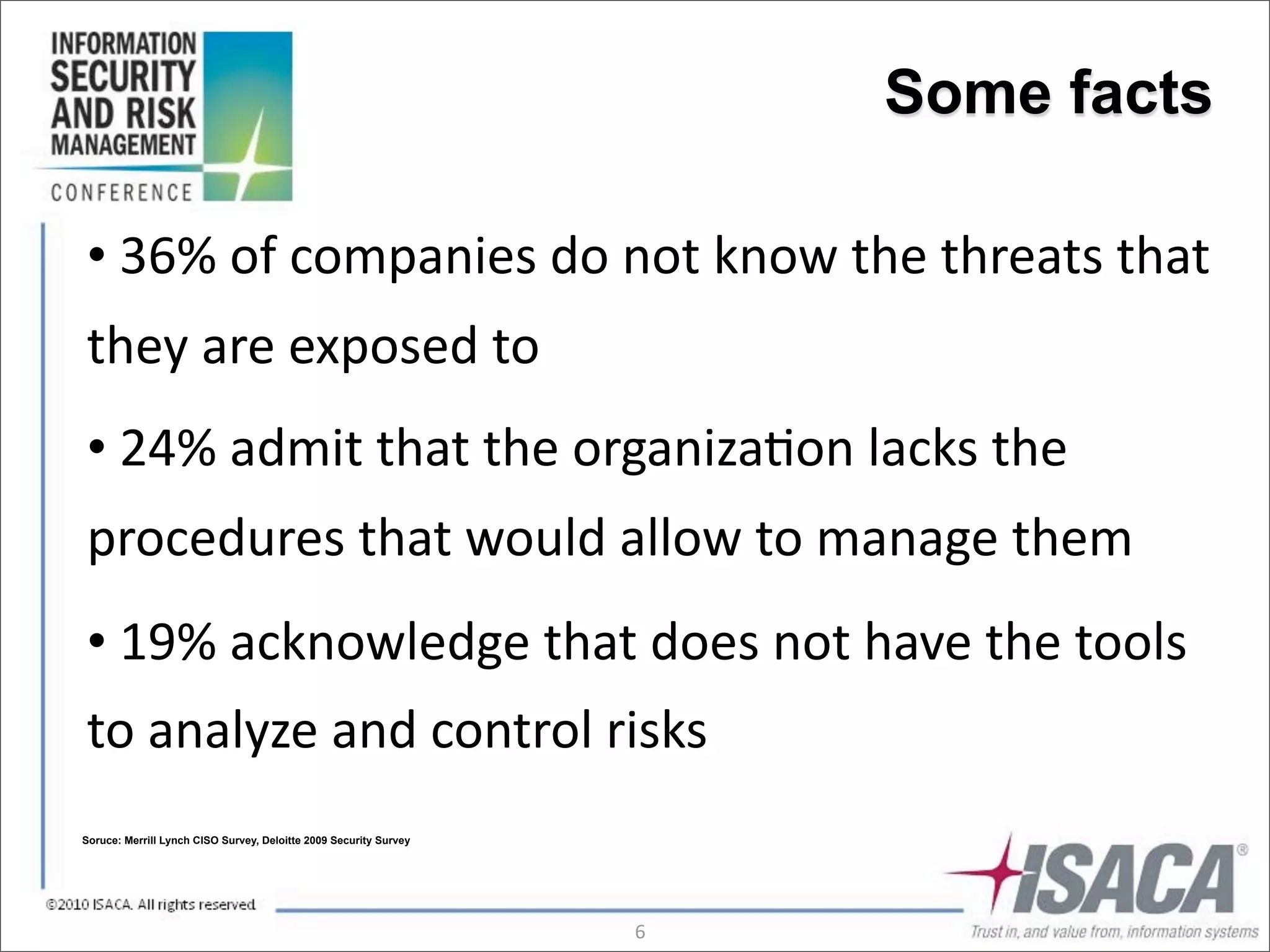
Some facts

•	
  36%	
  of	
  companies	
  do	
  not	
  know	
  the	
  threats	
  that	
  
they	
  are	
  exposed	
  to
•	
  24%	
  admit	
  that	
  the	
  organiza3on	
  lacks	
  the	
  
procedures	
  that	
  would	
  allow	
  to	
  manage	
  them
•	
  19%	
  acknowledge	
  that	
  does	
  not	
  have	
  the	
  tools	
  
to	
  analyze	
  and	
  control	
  risks
Soruce: Merrill Lynch CISO Survey, Deloitte 2009 Security Survey


                                                                   6
The changing face of risk


• 	
  Risk	
  is	
  the	
  level	
  of	
  exposure	
  to	
  uncertain3es	
  that	
  an	
  organiza(on	
  
    must	
  understand	
  and	
  manage	
  effec(vely	
  while	
  performing	
  its	
  
                 du3es	
  to	
  achieve	
  objec3ves	
  and	
  create	
  value


•     	
  The	
  uncertainty	
  of	
  an	
  event	
  happening	
  (or	
  not)	
  can	
  have	
  an	
  
                impact	
  on	
  the	
  achievement	
  of	
  corporate	
  goals


                                                  7
What type of risks are we
                                                          facing?

•	
  Different	
  categories:	
  reputa3onal	
  risk,	
  project	
  management	
  risk,	
  
provisioning	
  risk,	
  HR	
  risk,	
  hygienic	
  risk,	
  fraud	
  risk,	
  legal	
  risk,	
  environmental	
  
risk,	
  opera3onal	
  risk,	
  financial	
  risk,	
  TECHNOLOGY	
  RISK,	
  ...
•	
  Related	
  to:
             –	
  its	
  origin
             –	
  a	
  specific	
  ac3vity,	
  an	
  event	
  or	
  an	
  incident
             –	
  its	
  consequences	
  or	
  impact
             –	
  a	
  reason
             –	
  protec3on	
  mechanisms	
  or	
  countermeasures
             –	
  3me	
  of	
  occurrence


                                                          8
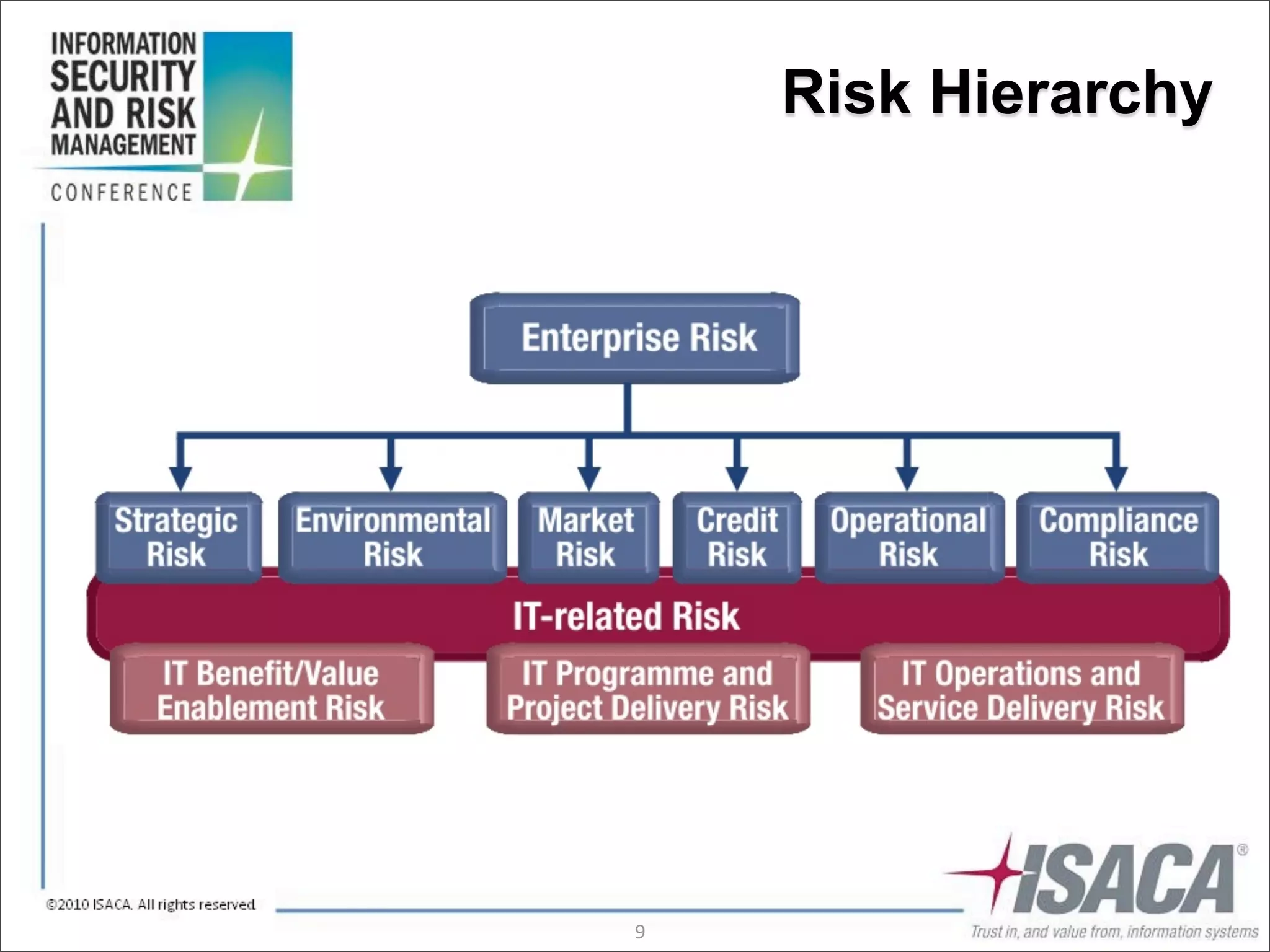
Risk Hierarchy


9
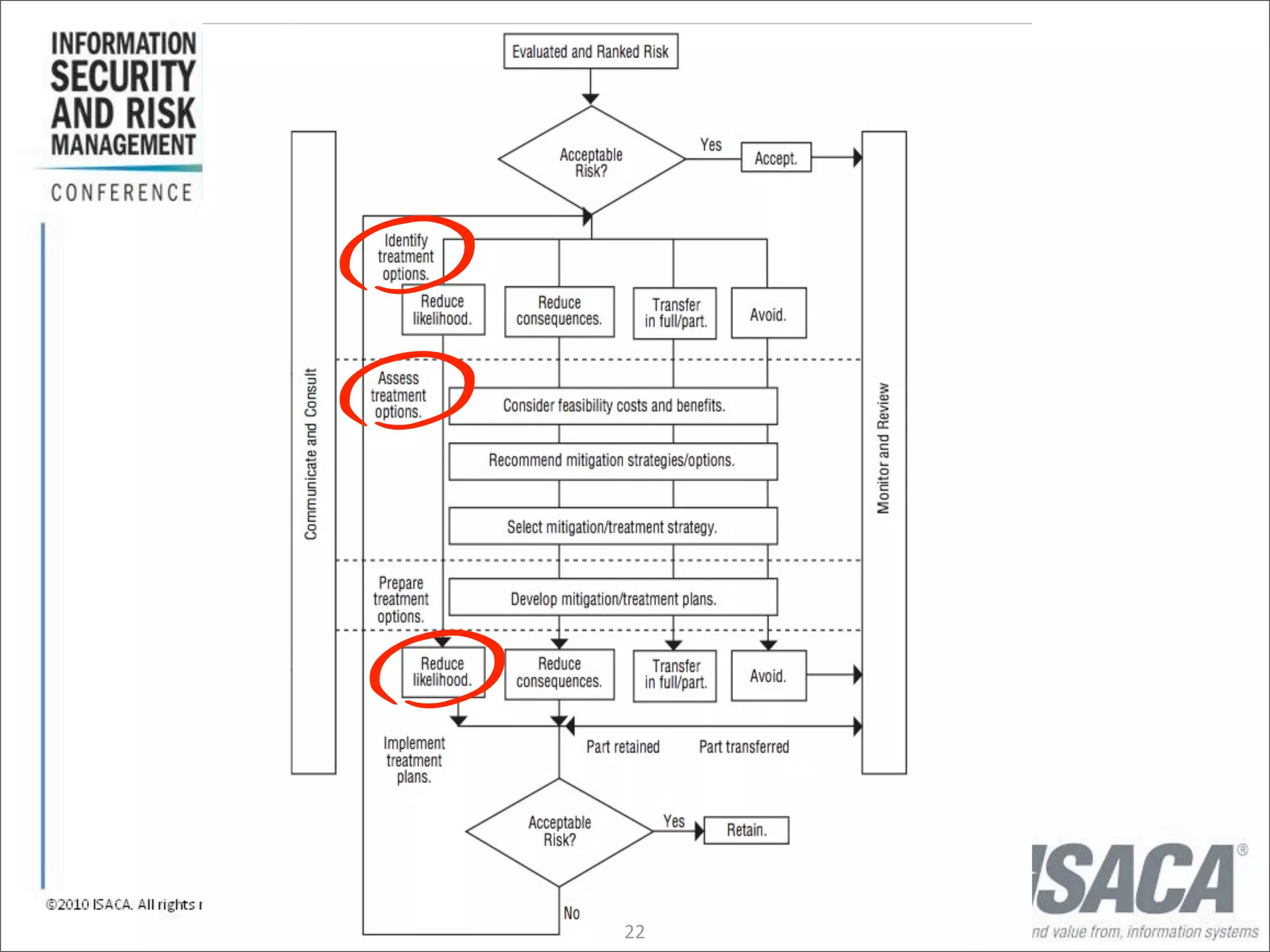
What can we do with risk?


•	
  Transfer	
  risk

•	
  Tolerate	
  or	
  accept

•	
  Terminate	
  the	
  ac3vity

•	
  Treat	
  risk


                                10
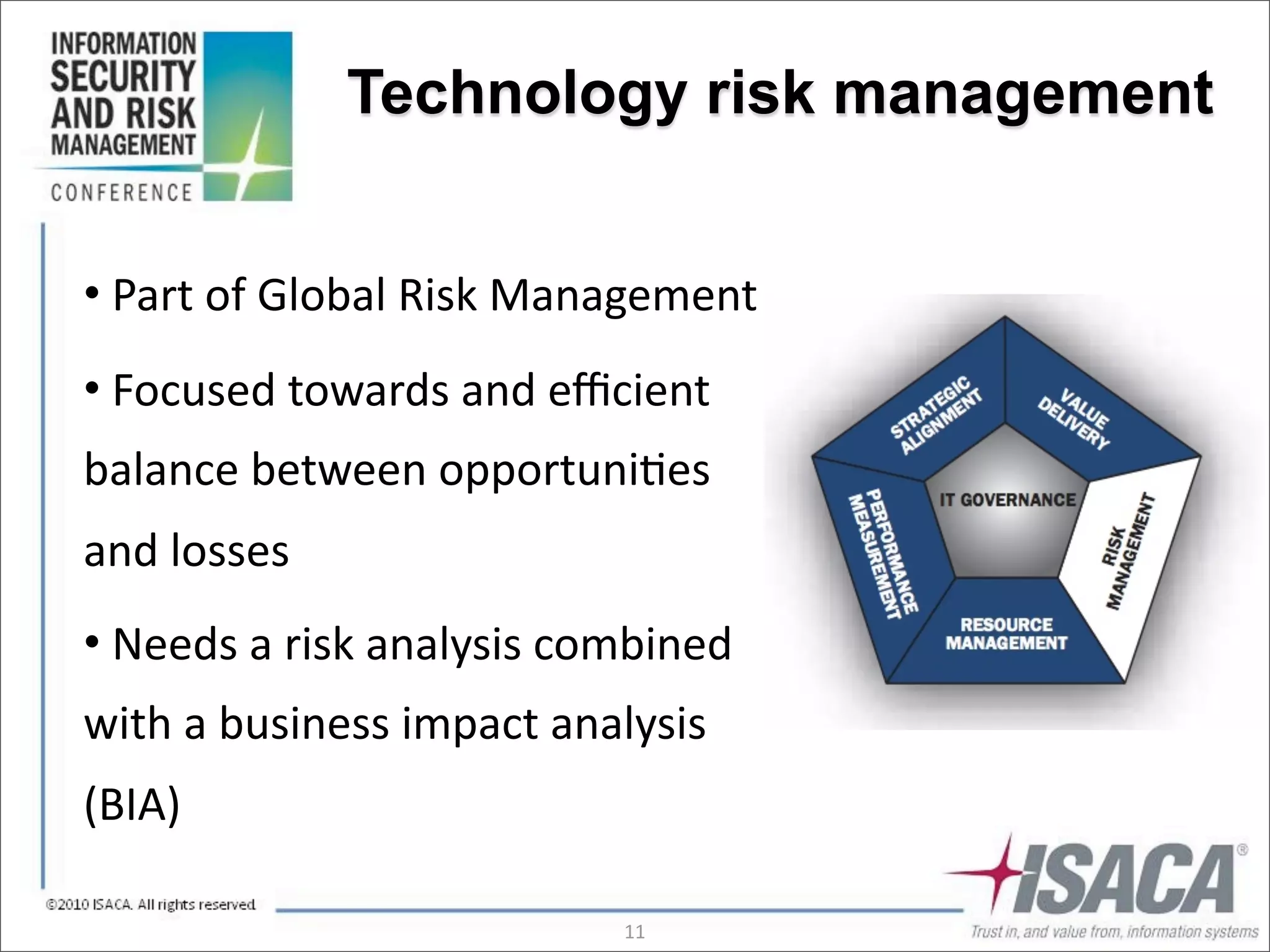
Technology risk management


•	
  Part	
  of	
  Global	
  Risk	
  Management
•	
  Focused	
  towards	
  and	
  efficient	
  
balance	
  between	
  opportuni3es	
  
and	
  losses
•	
  Needs	
  a	
  risk	
  analysis	
  combined	
  
with	
  a	
  business	
  impact	
  analysis	
  
(BIA)

                                         11
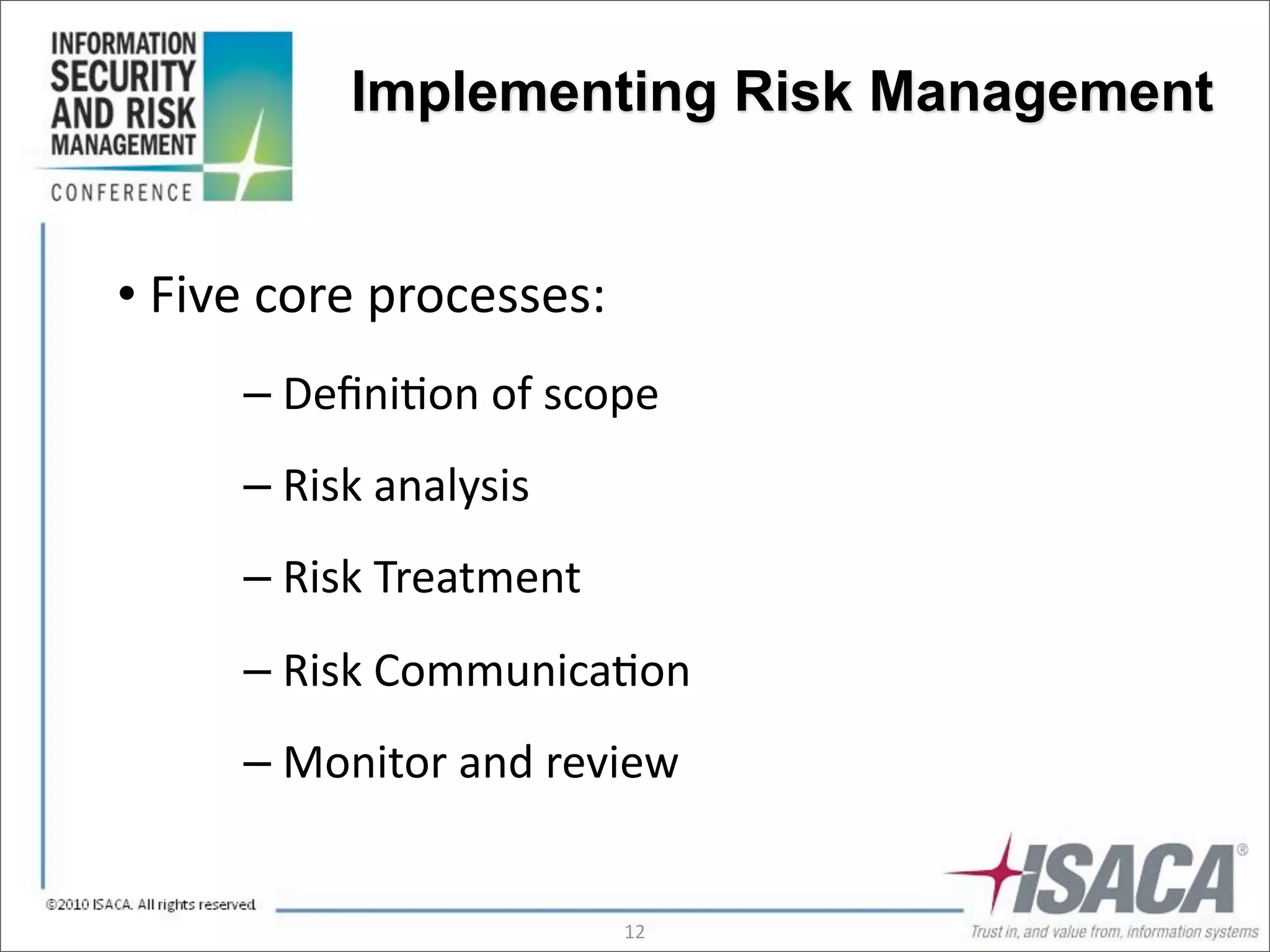
Implementing Risk Management


•	
  Five	
  core	
  processes:
        –	
  Defini3on	
  of	
  scope
        –	
  Risk	
  analysis
        –	
  Risk	
  Treatment
        –	
  Risk	
  Communica3on
        –	
  Monitor	
  and	
  review


                                  12
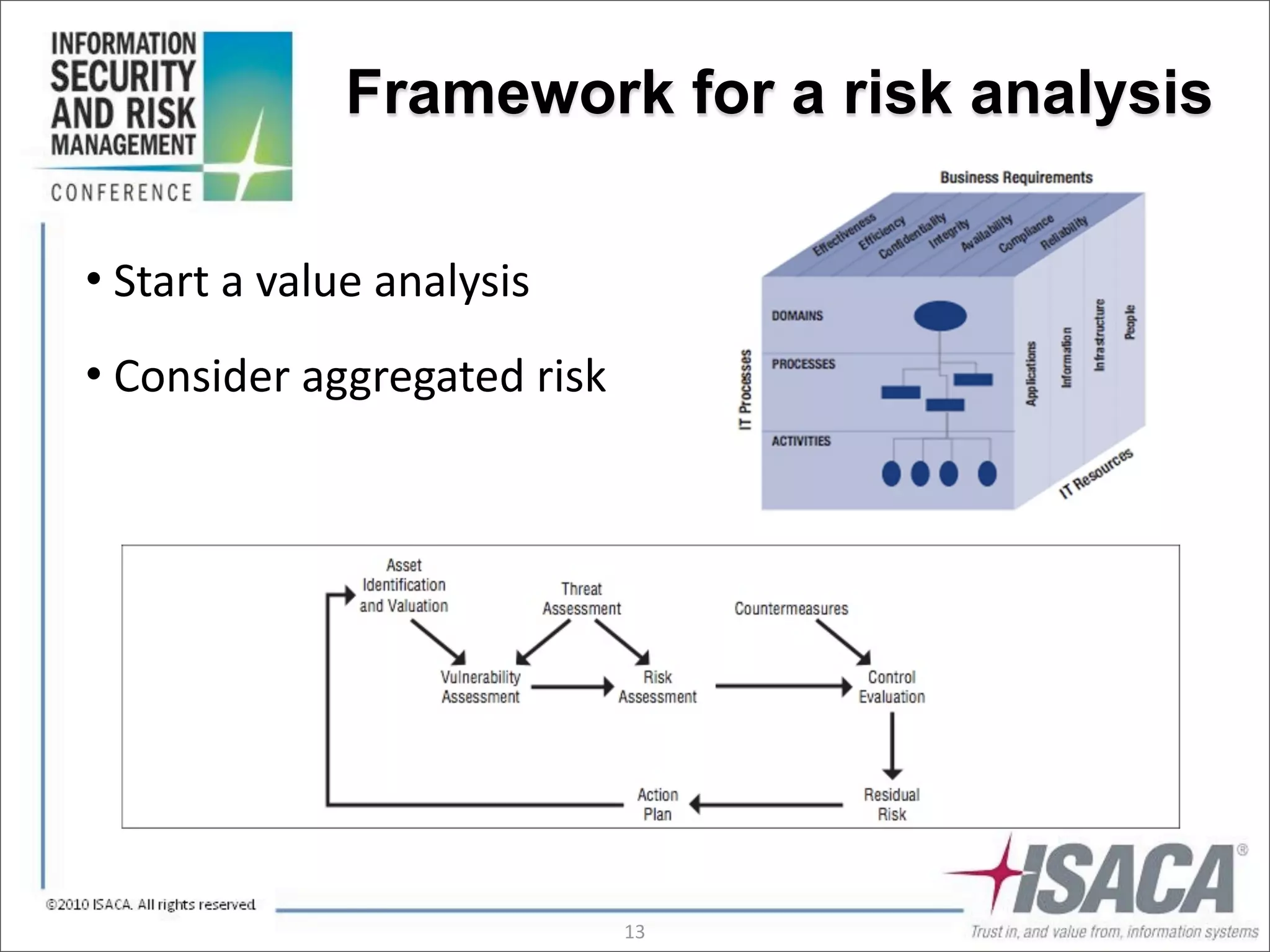
Framework for a risk analysis

•	
  Start	
  a	
  value	
  analysis
•	
  Consider	
  aggregated	
  risk


                                       13
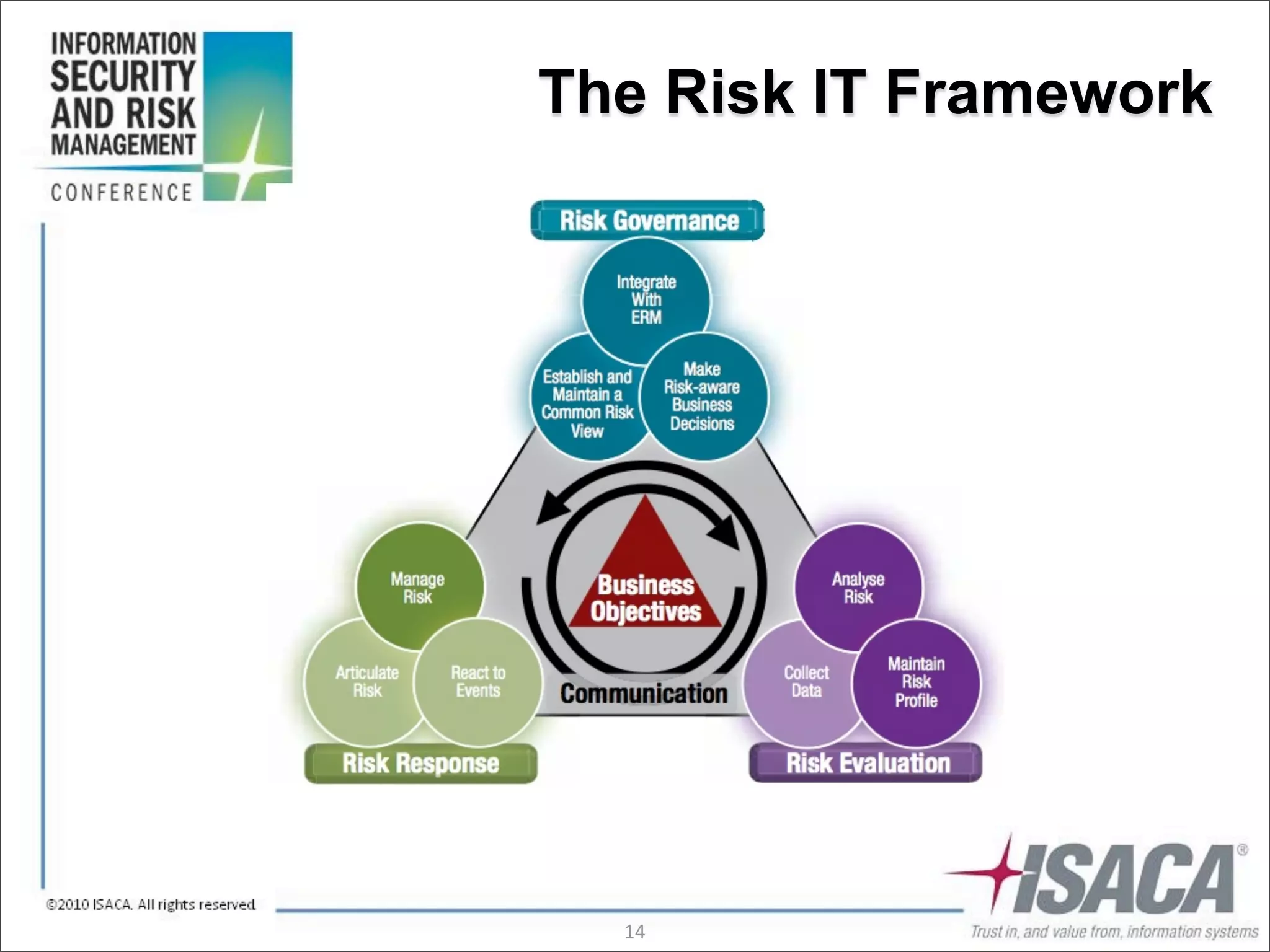
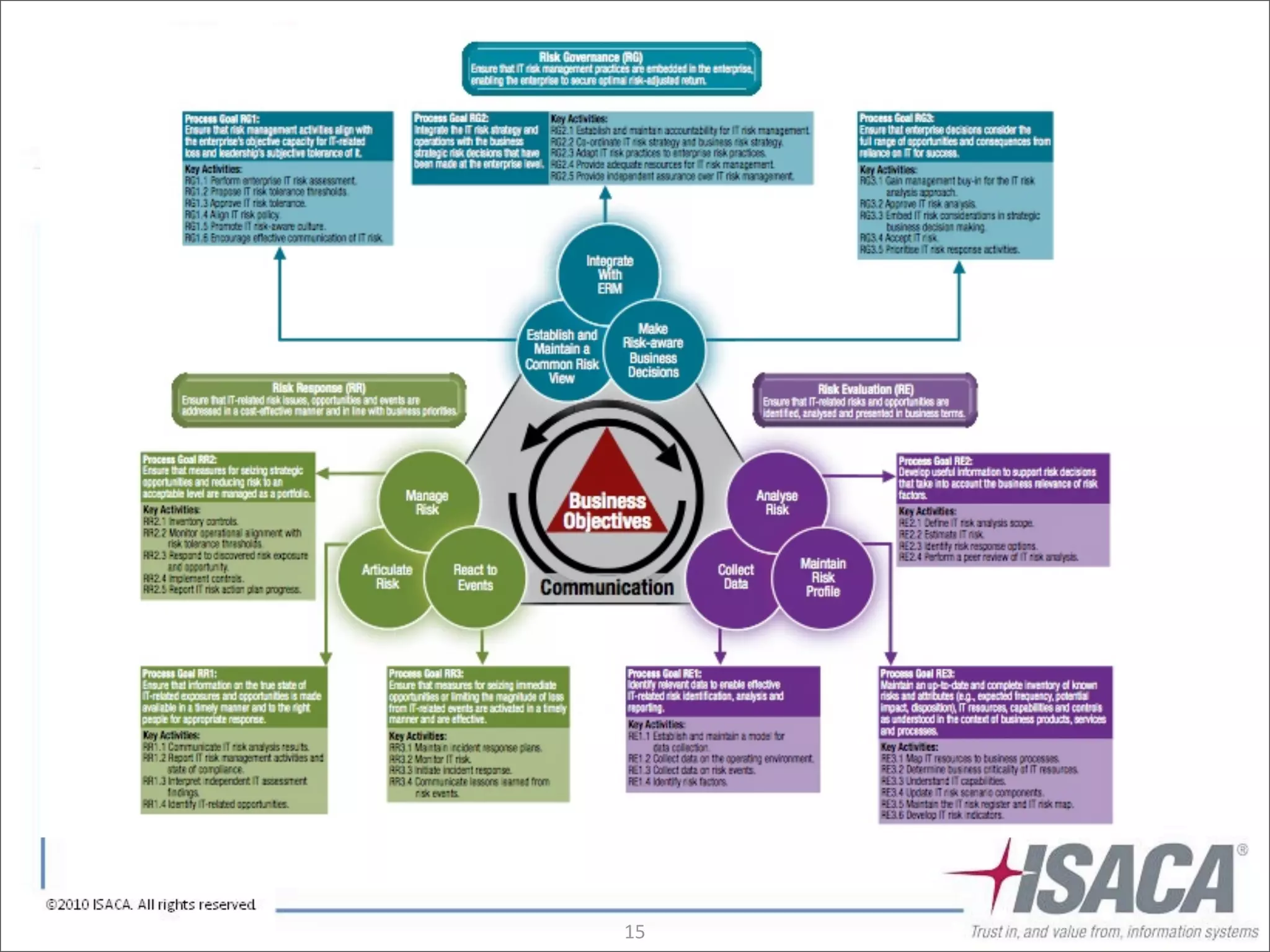
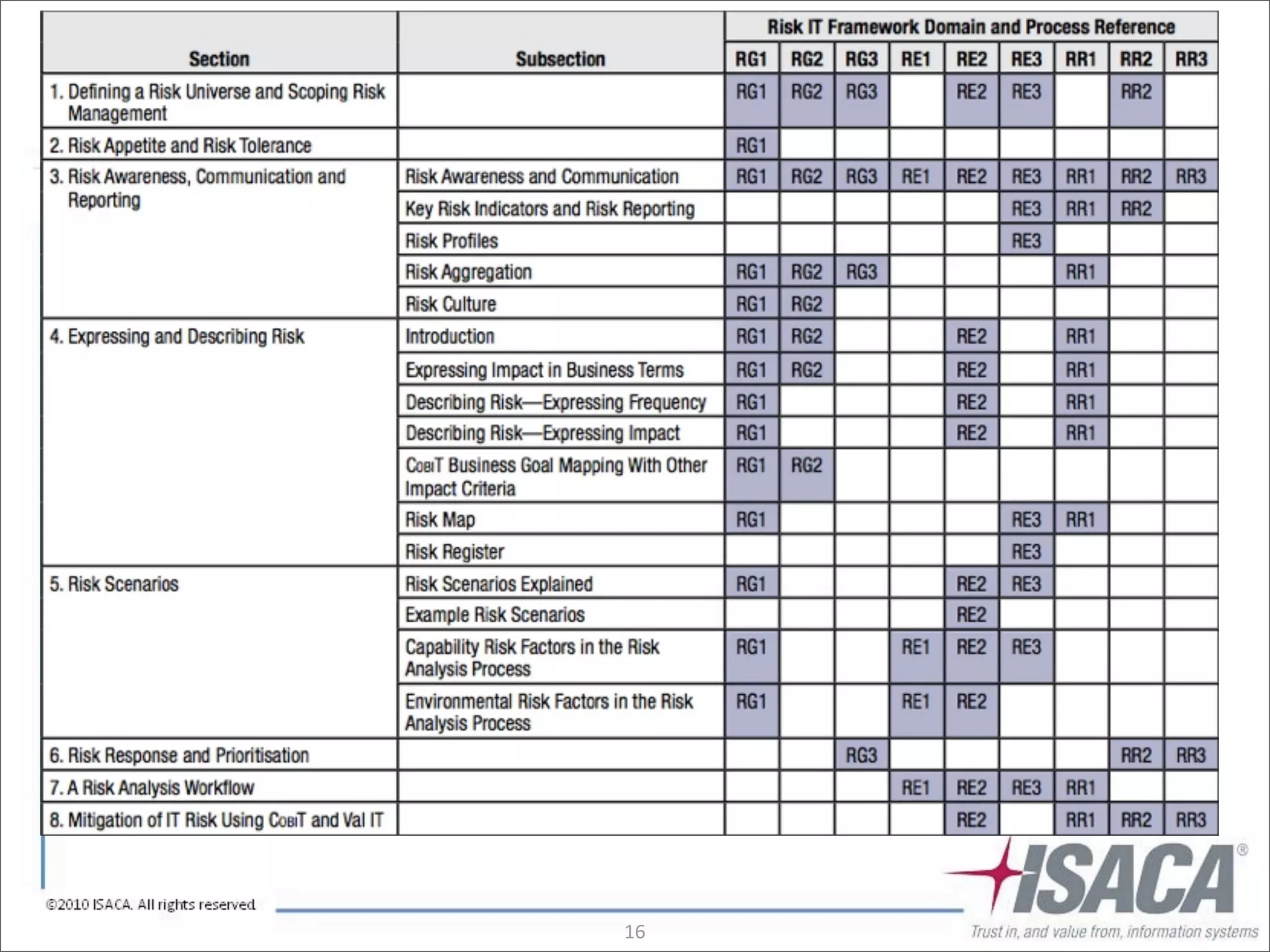
The Risk IT Framework


  14
15
16
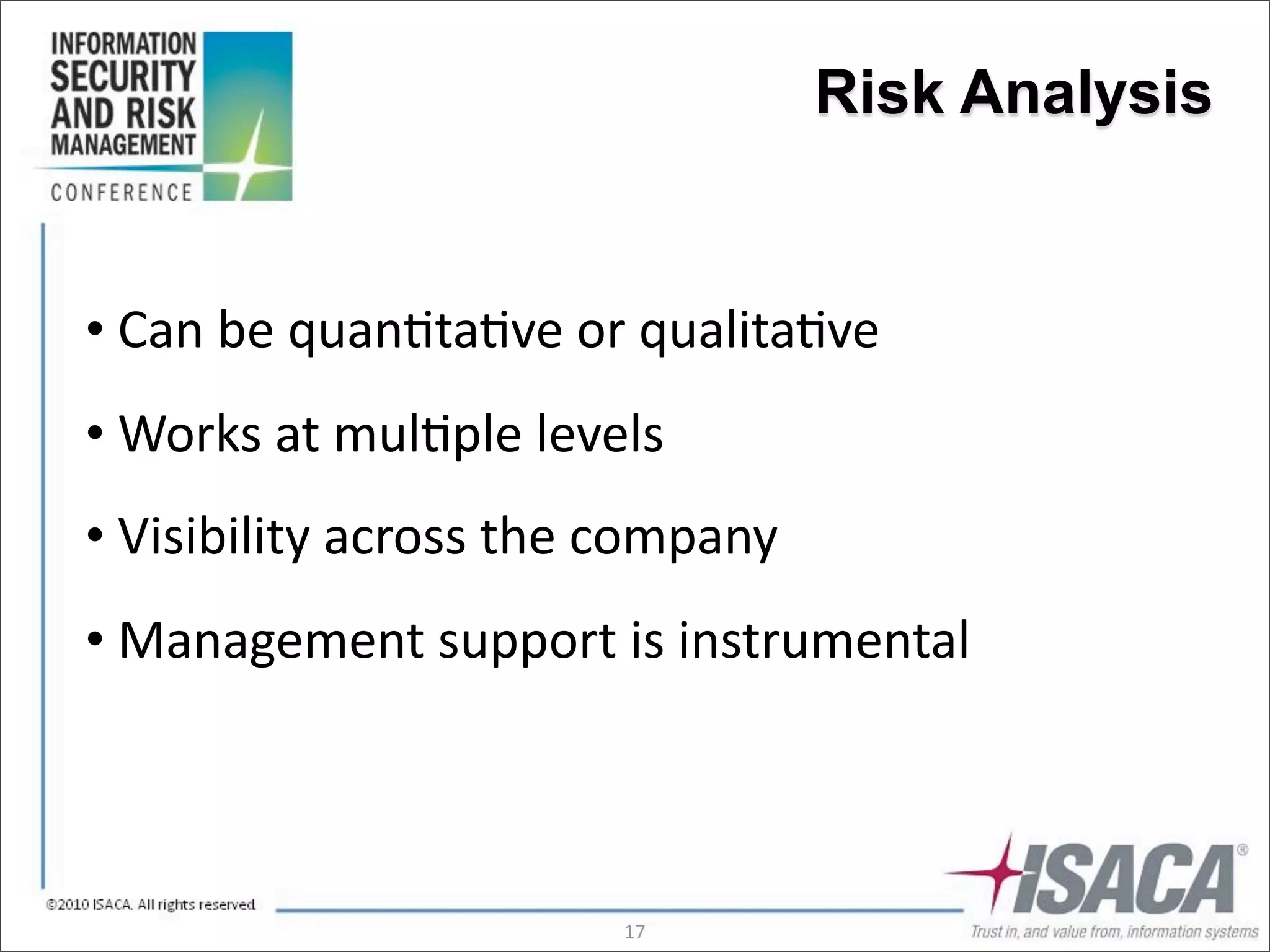
Risk Analysis


•	
  Can	
  be	
  quan3ta3ve	
  or	
  qualita3ve
•	
  Works	
  at	
  mul3ple	
  levels
•	
  Visibility	
  across	
  the	
  company
•	
  Management	
  support	
  is	
  instrumental


                                  17
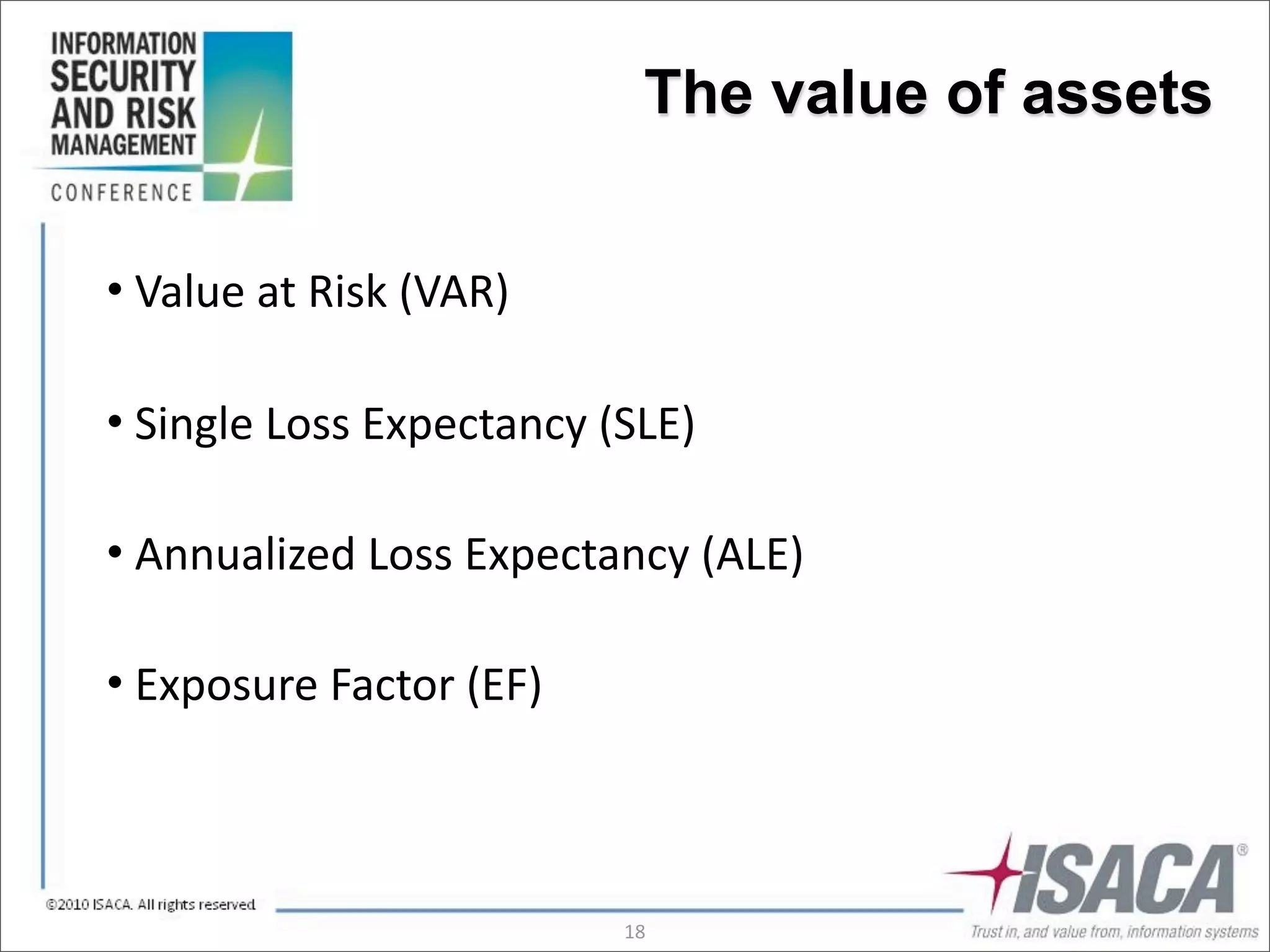
The value of assets


•	
  Value	
  at	
  Risk	
  (VAR)

•	
  Single	
  Loss	
  Expectancy	
  (SLE)

•	
  Annualized	
  Loss	
  Expectancy	
  (ALE)

•	
  Exposure	
  Factor	
  (EF)


                                    18
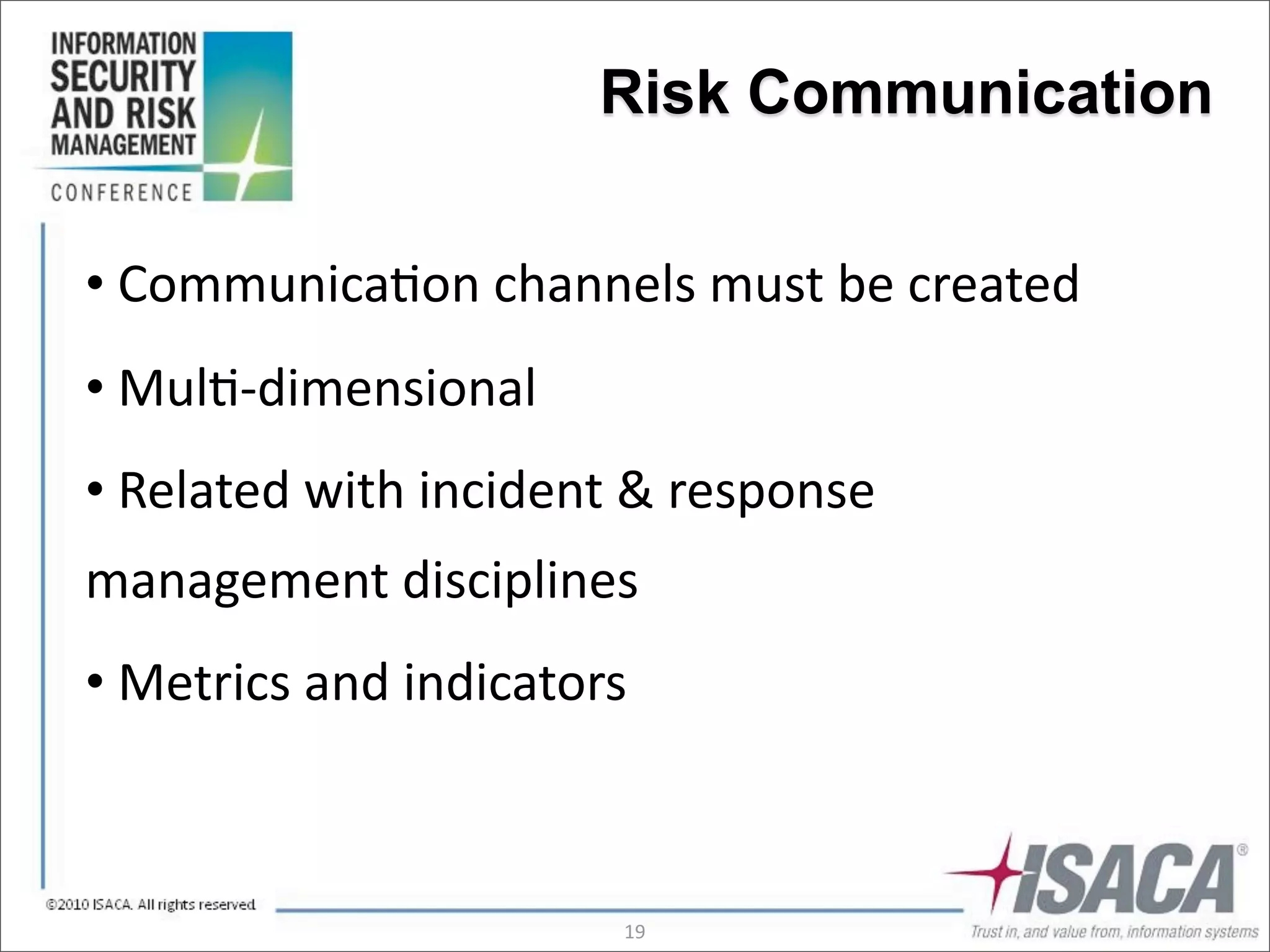
Risk Communication


•	
  Communica3on	
  channels	
  must	
  be	
  created
•	
  Mul3-­‐dimensional
•	
  Related	
  with	
  incident	
  &	
  response	
  
management	
  disciplines
•	
  Metrics	
  and	
  indicators


                                   19
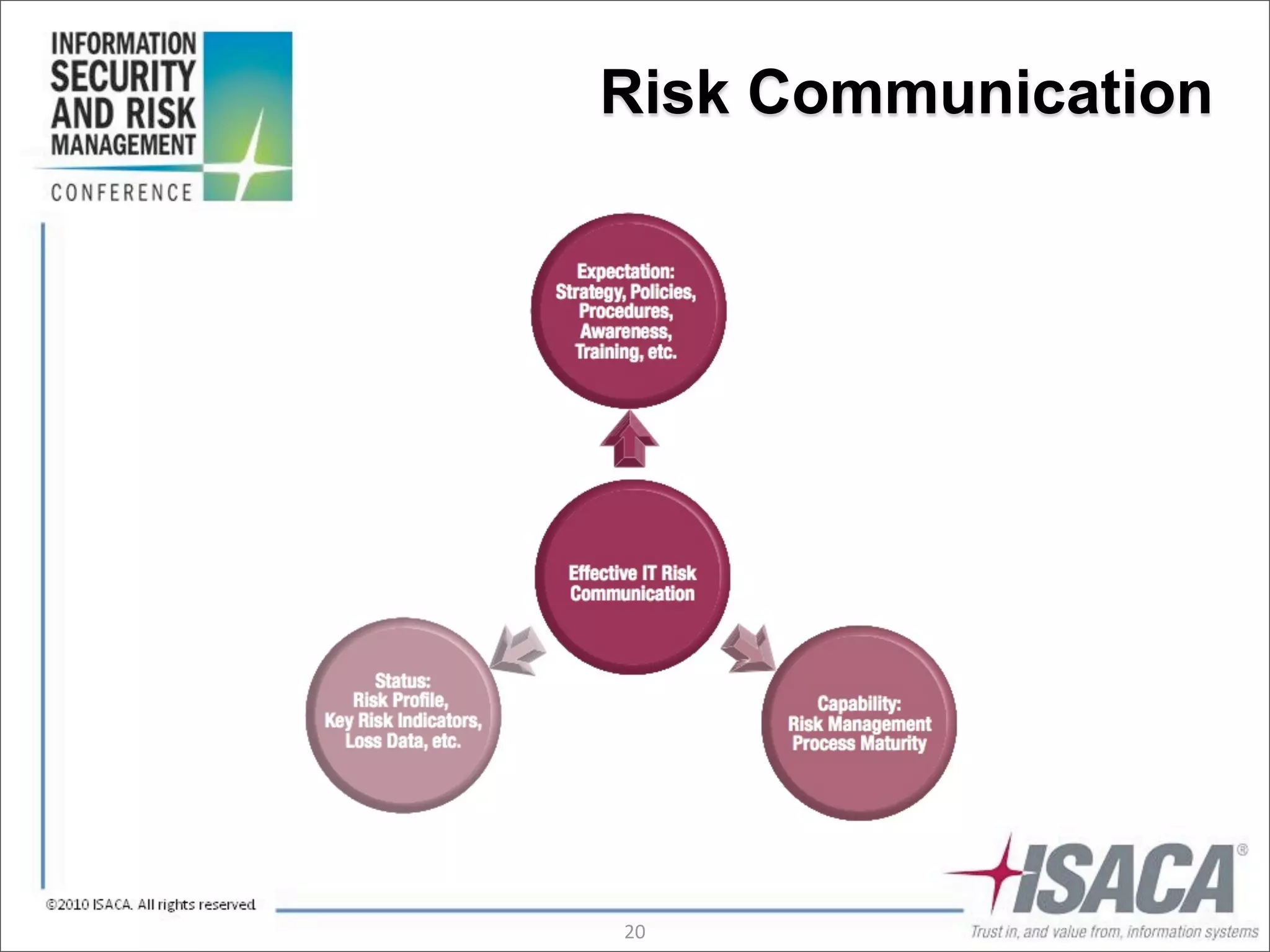
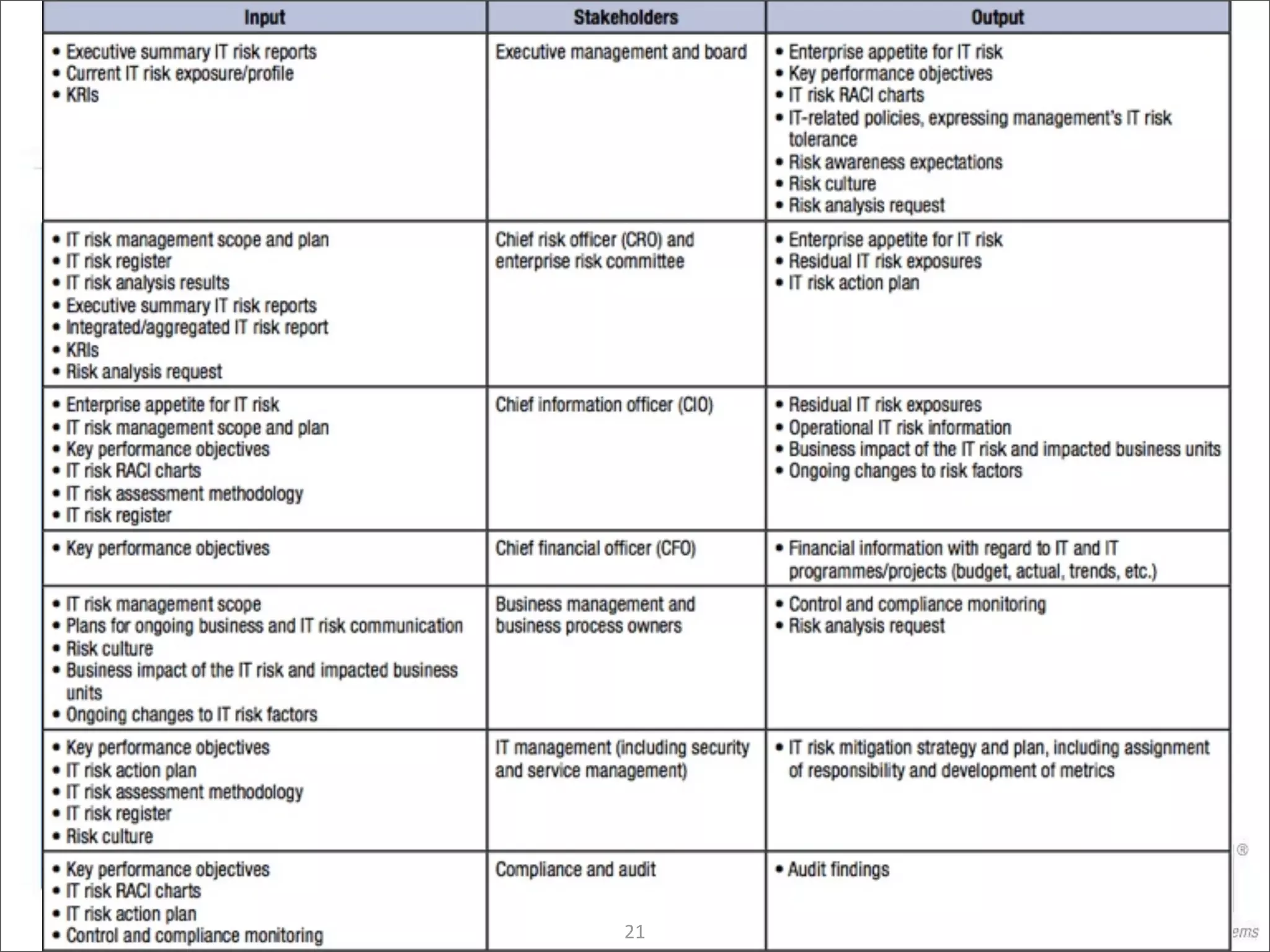
Risk Communication


20
21
22
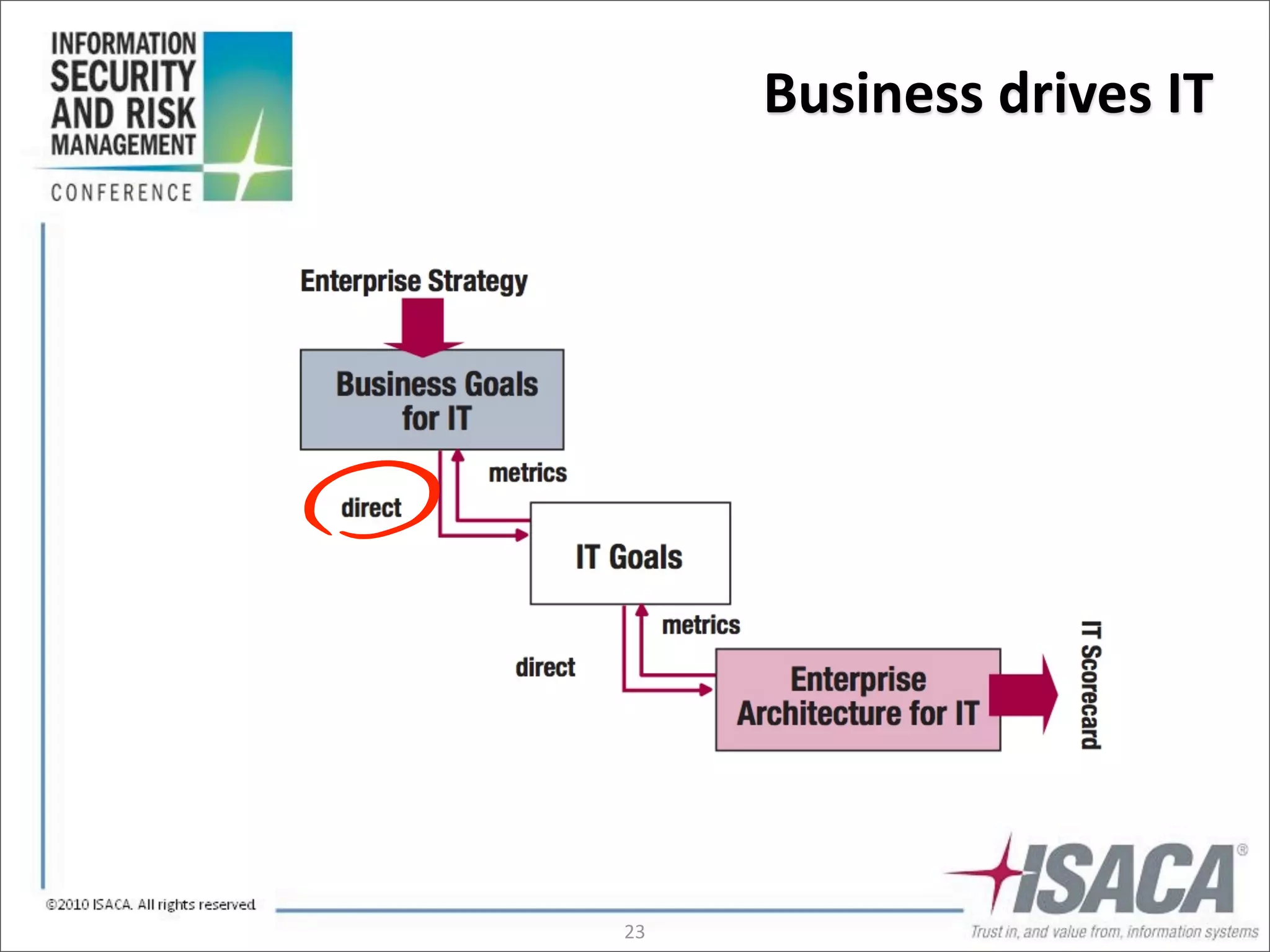
Business	
  drives	
  IT


23
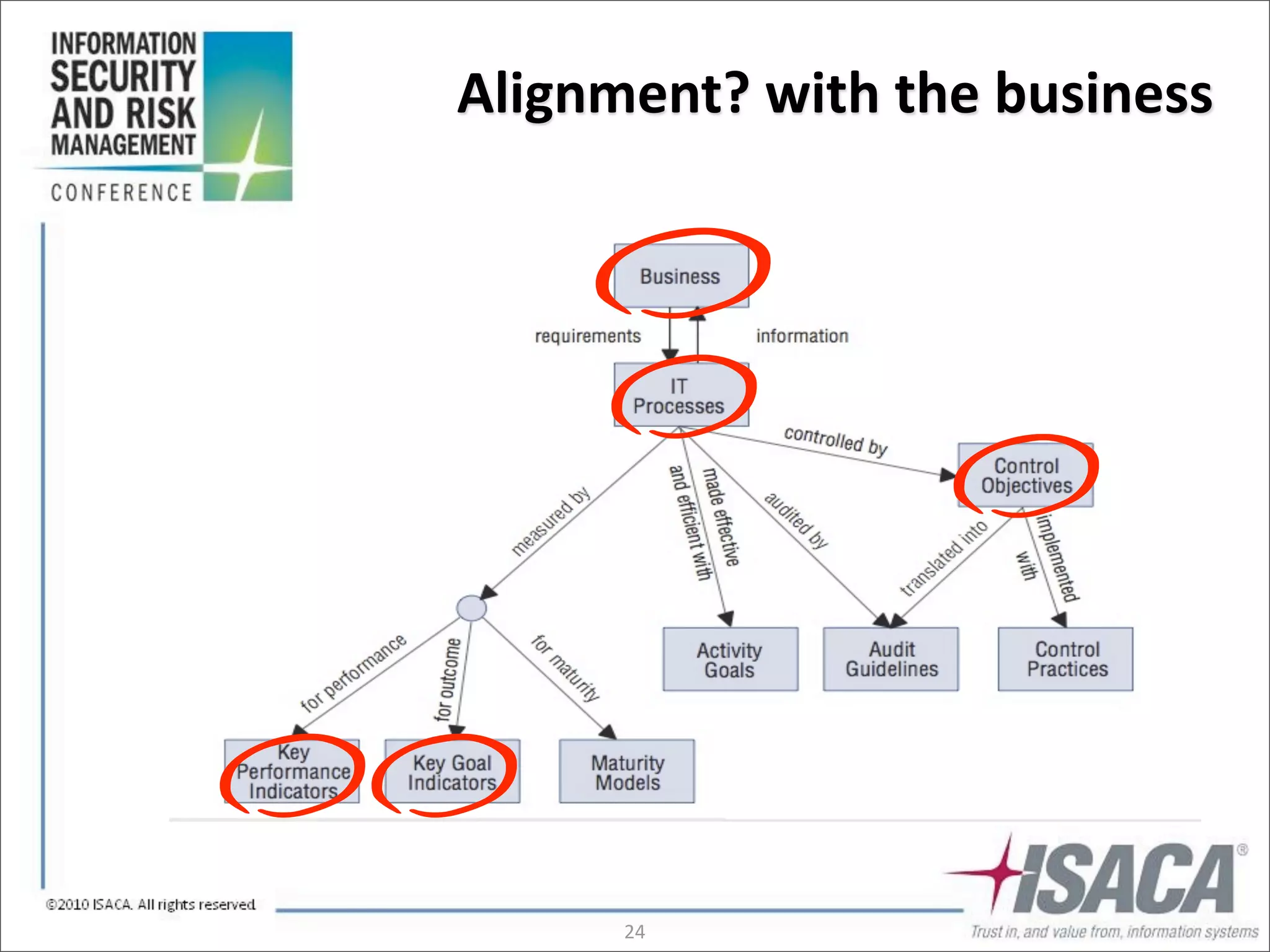
Alignment?	
  with	
  the	
  business


        24
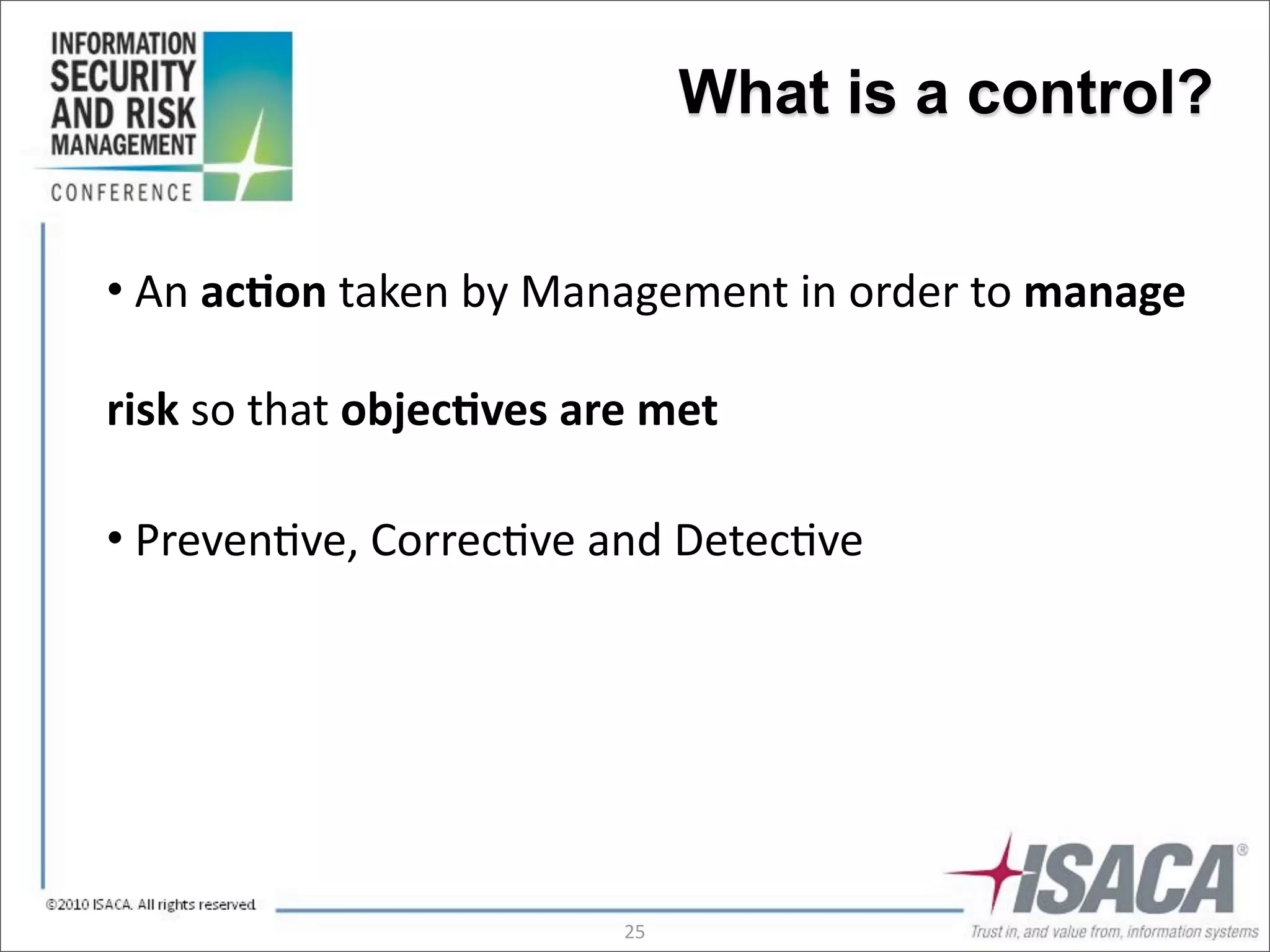
What is a control?


•	
  An	
  ac(on	
  taken	
  by	
  Management	
  in	
  order	
  to	
  manage	
  

risk	
  so	
  that	
  objec(ves	
  are	
  met

•	
  Preven3ve,	
  Correc3ve	
  and	
  Detec3ve


                                      25
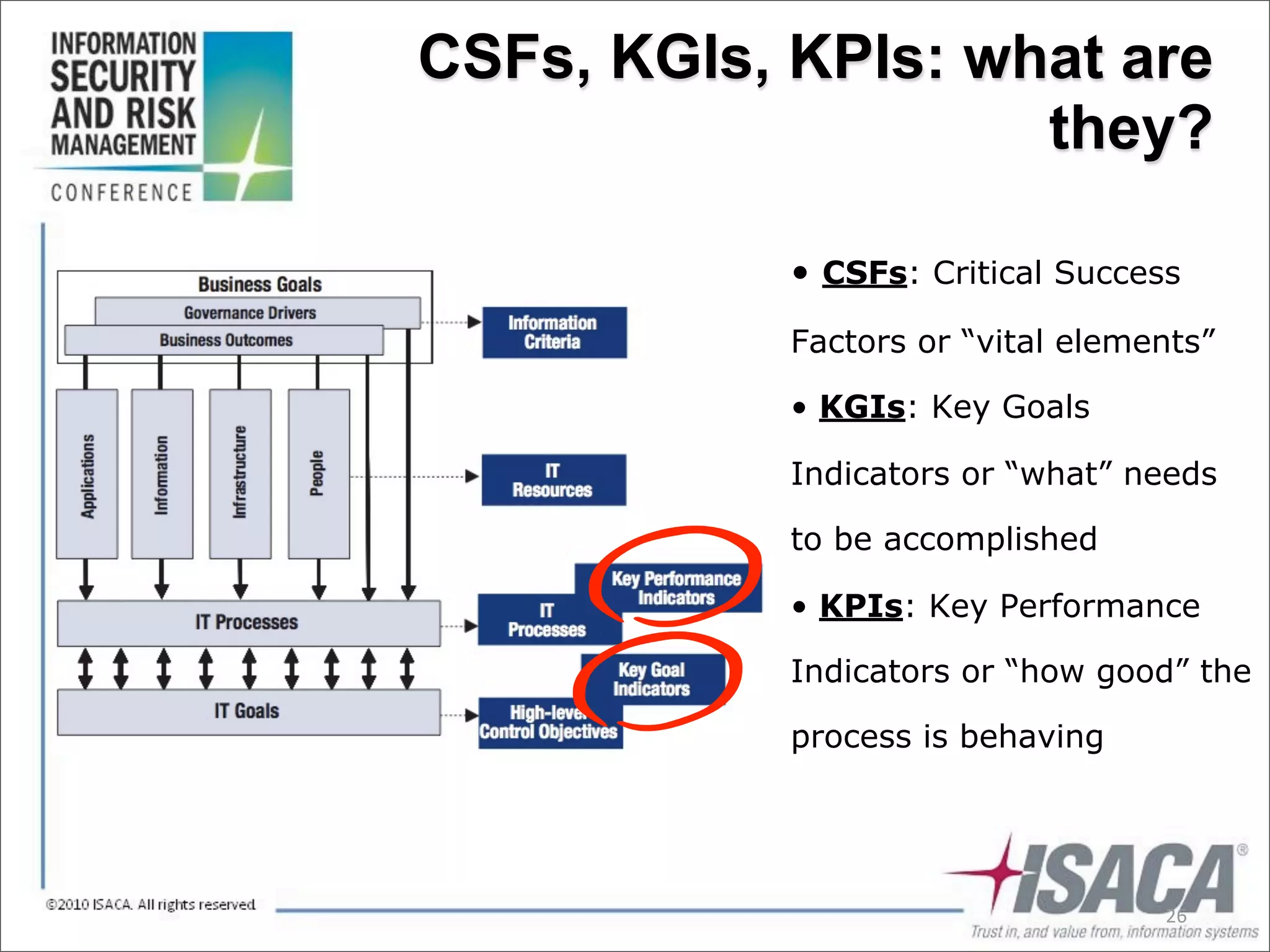
CSFs, KGIs, KPIs: what are
                    they?

            • CSFs: Critical Success
            Factors or “vital elements”

            • KGIs: Key Goals

            Indicators or “what” needs

            to be accomplished

            • KPIs: Key Performance

            Indicators or “how good” the

            process is behaving


                                   26
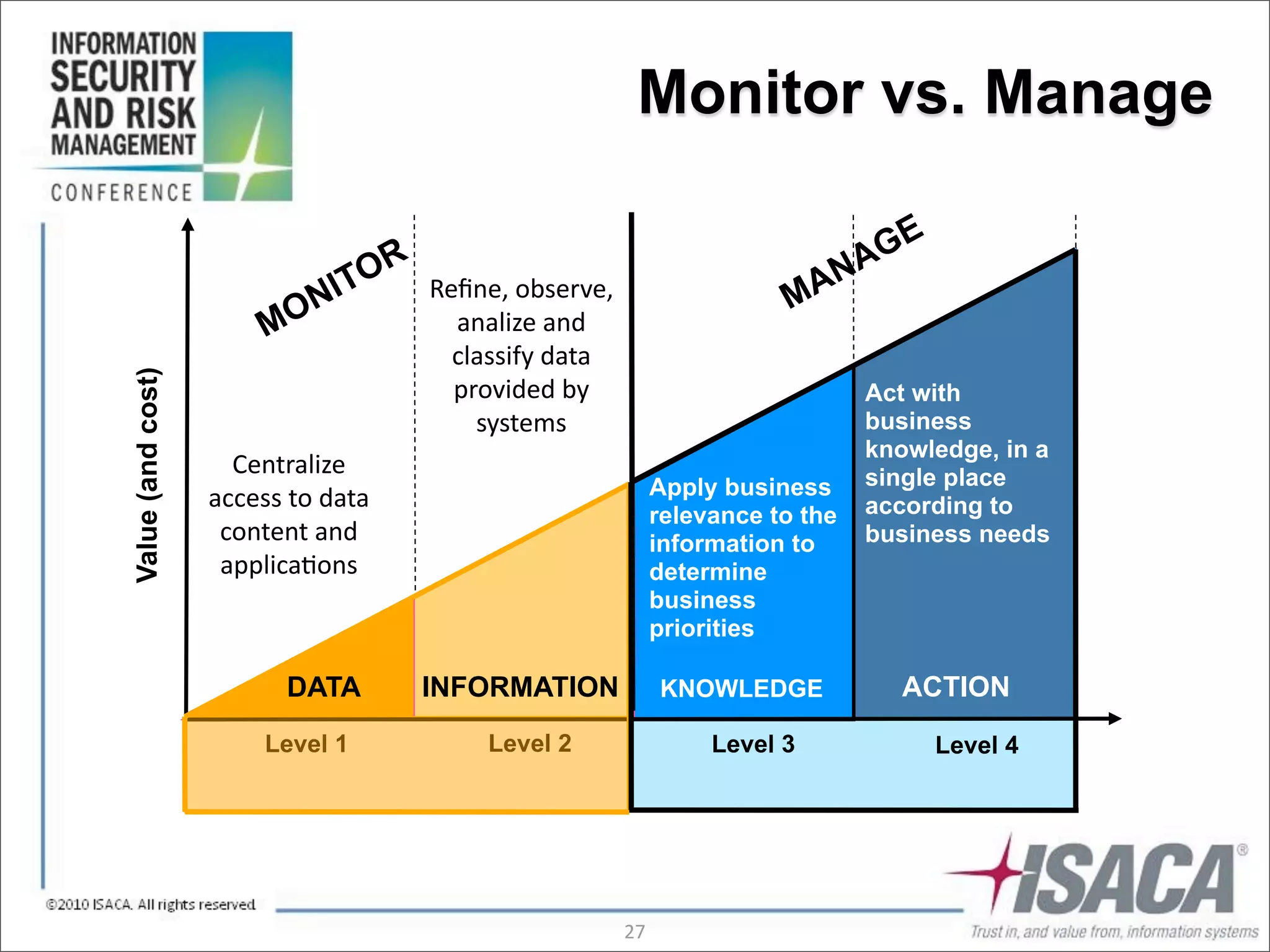
Monitor vs. Manage

                                  R                                                            A GE
                               ITO Refine,	
  observe,	
                               MA
                                                                                           N
                          M ON       analize	
  and	
  
                                               classify	
  data	
  
Value (and cost)


                                               provided	
  by	
                                Act with
                                                 systems                                       business
                                                                                               knowledge, in a
                     Centralize                                                                single place
                   access	
  to	
  data	
                                  Apply business
                                                                           relevance to the    according to
                    content	
  and	
                                       information to      business needs
                    applica3ons                                            determine
                                                                           business
                                                                           priorities

                              DATA            INFORMATION                  KNOWLEDGE              ACTION
                           Level 1                 Level 2                      Level 3               Level 4


                                                                      27
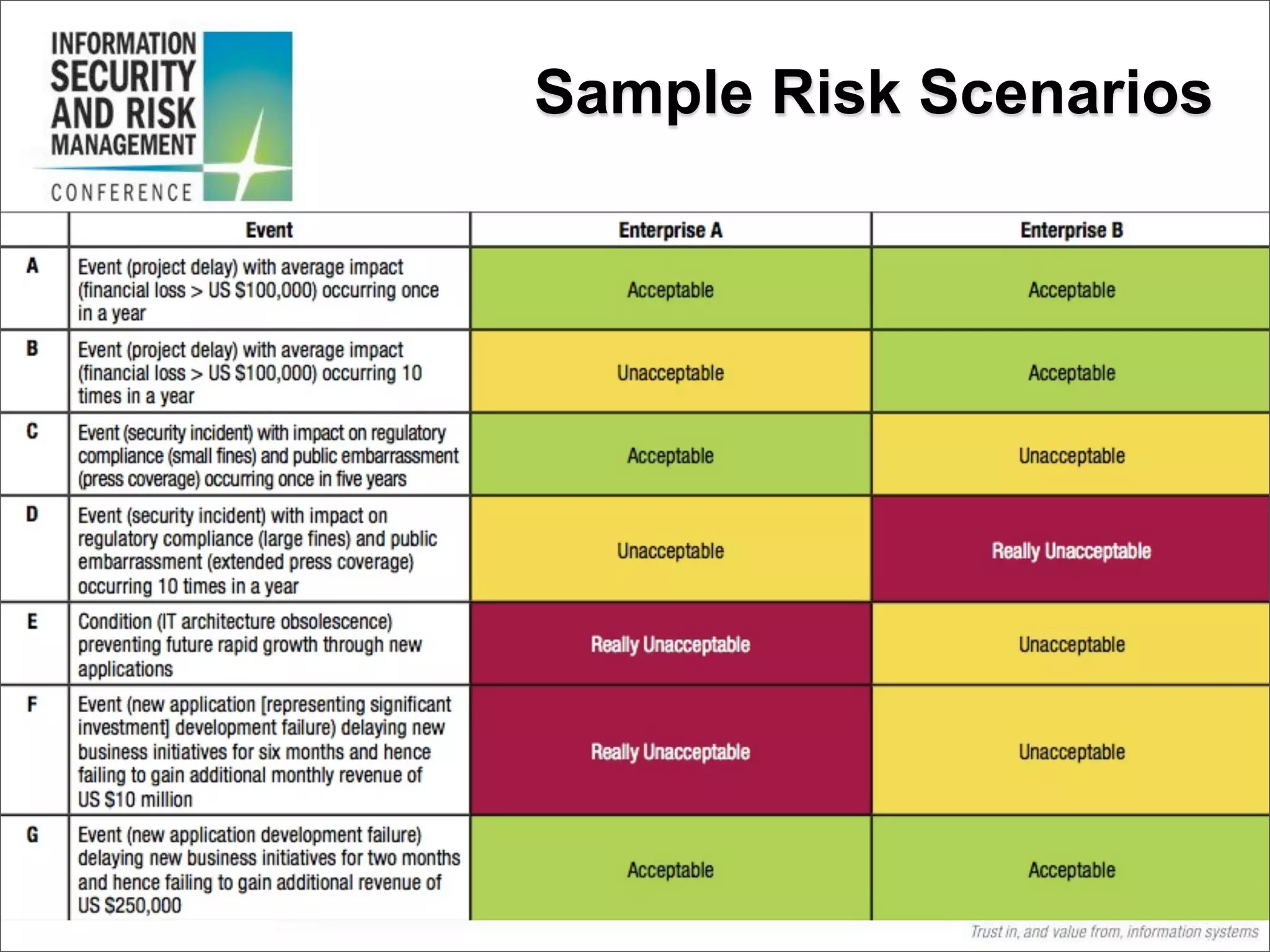
Sample Risk Scenarios
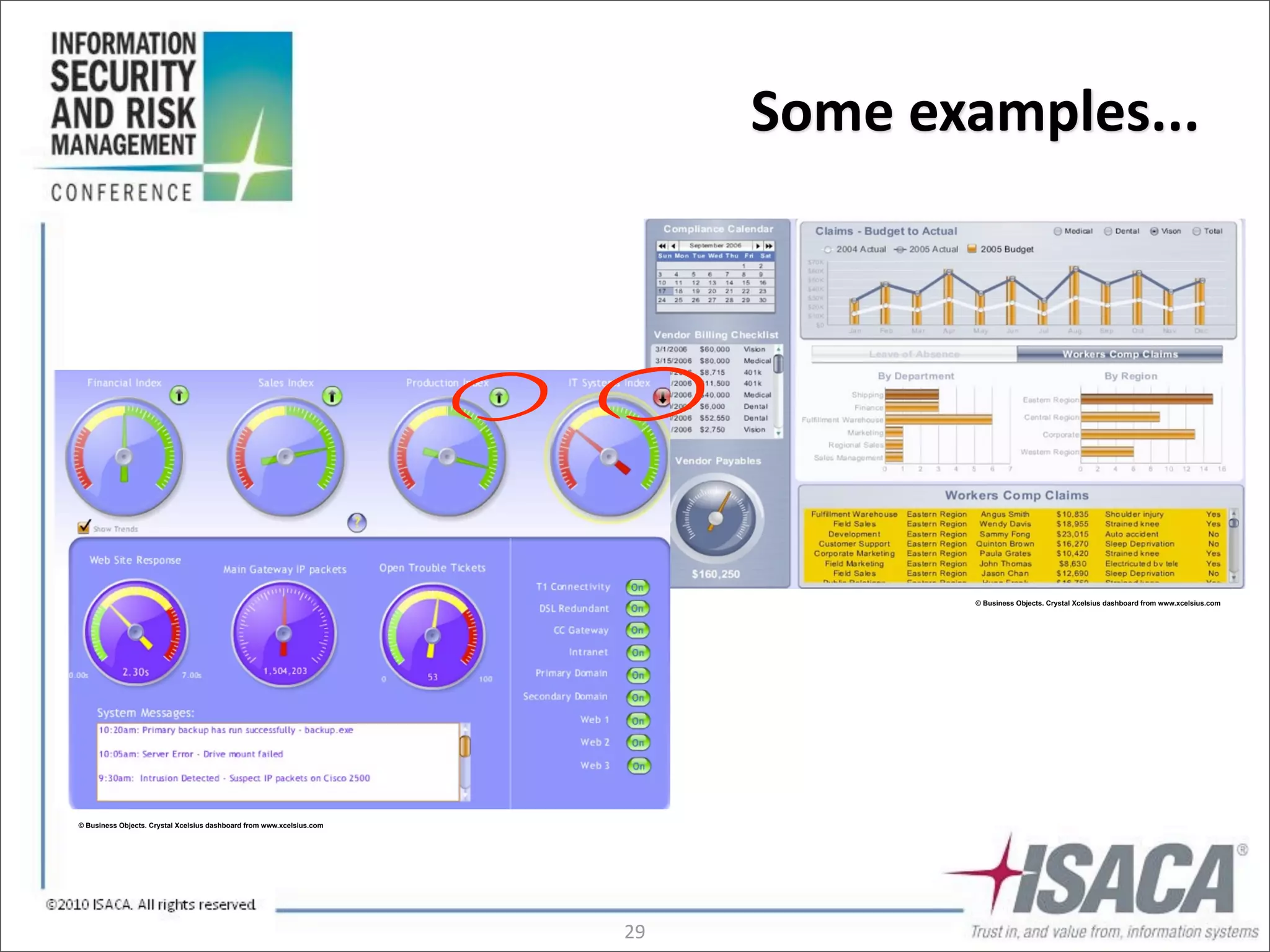
Some	
  examples...


                                                                                     © Business Objects. Crystal Xcelsius dashboard from www.xcelsius.com


© Business Objects. Crystal Xcelsius dashboard from www.xcelsius.com


                                                                       29
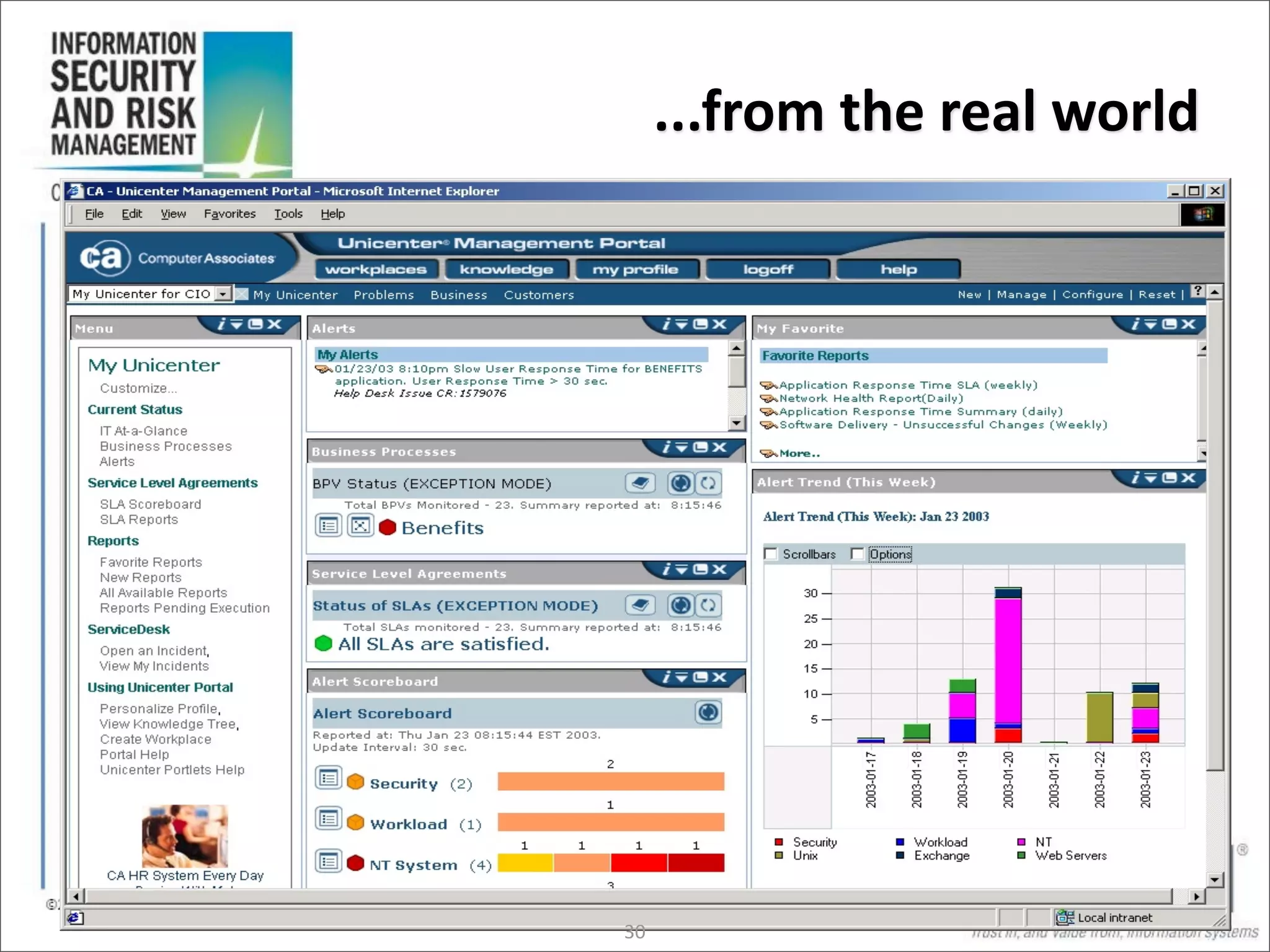
...from	
  the	
  real	
  world


30
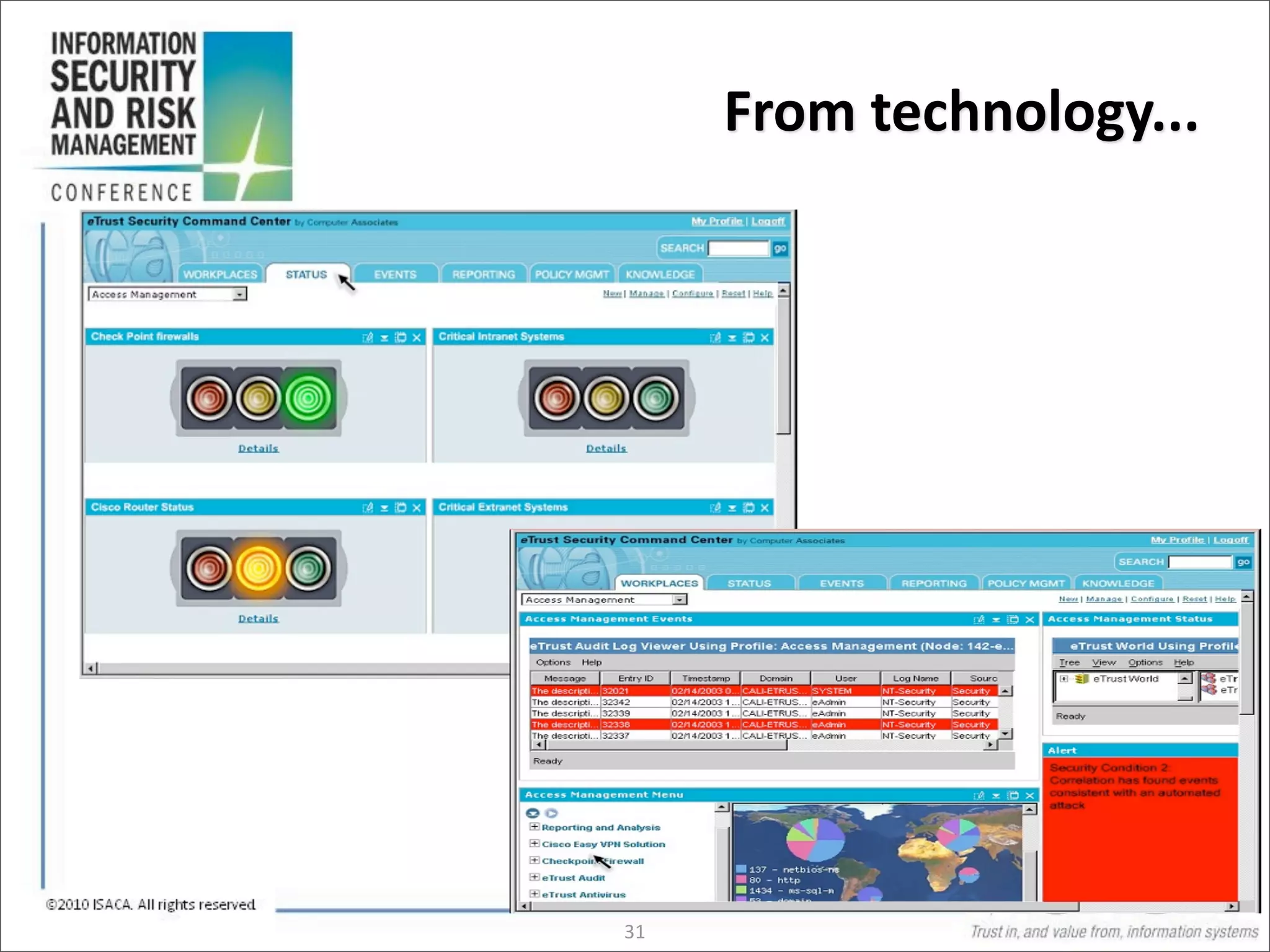
From	
  technology...


31
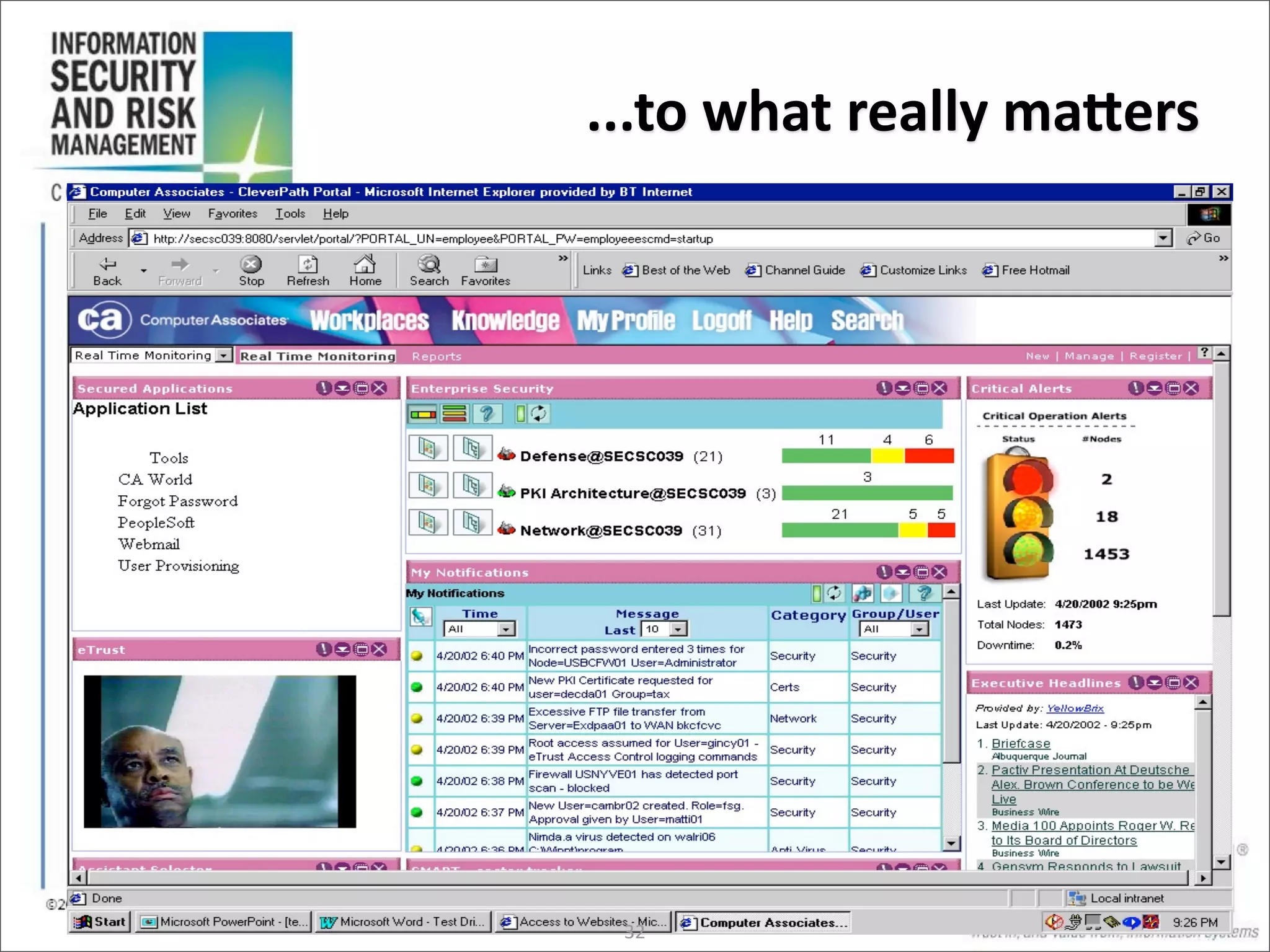
...to	
  what	
  really	
  maOers


  32
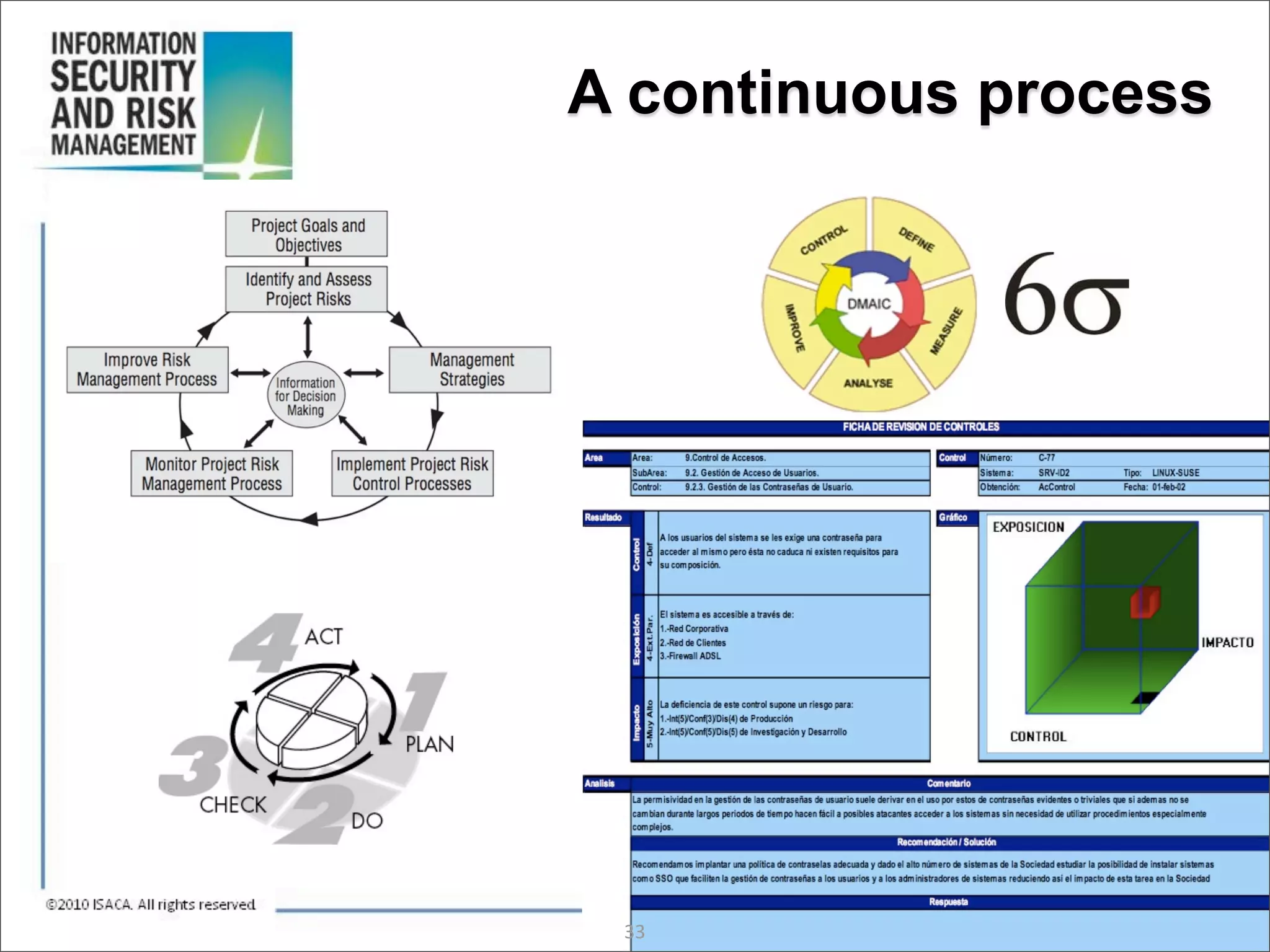
A continuous process


 33
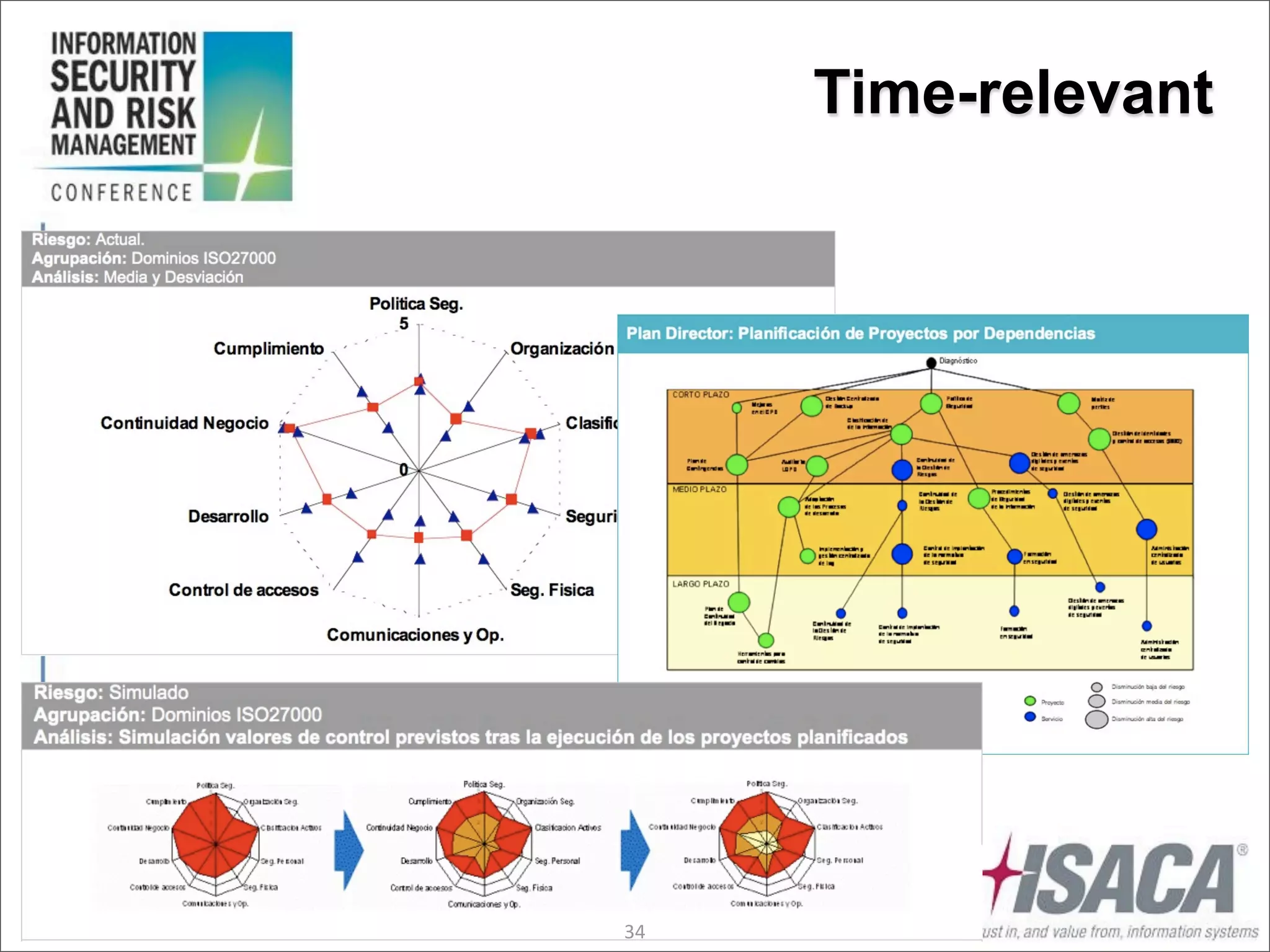
Time-relevant


34
THANK YOU
                       Ramsés Gallego
CISM, CGEIT, CISSP SCPM, CCSK, ITIL, COBIT(f), Six Sigma Black Belt
                  ,
       General Manager - Entel Security & Risk Management
                       rgallego@entel.es


                               35

From technology risk_to_enterprise_risk_the_new_frontier

  • 1.
    From Technology Risk to Enterprise Risk: The New Frontier Ramsés Gallego CISM, CGEIT, CISSP, SCPM, CCSK, ITIL, COBIT(f), Six Sigma Black Belt General Manager Entel Security & Risk Management rgallego@entel.es 1
  • 2.
  • 3.
  • 4.
    Definitions frontier noun • the farthermostlimits of knowledge or achievement in a particular subject • a line of division between things <the frontiers separating science and the humanities — R. W. Clark> • a new field for exploitative or developmental activity frontierless adjective ORIGIN late Middle English : from Old French frontiere, based on Latin frons, front- ‘front.’ 4
  • 5.
    What is risk? •  An  inherent  part  of  any  ac3vity •  Imprac3cal  to  eliminate  totally •  The  risk  equa3on  includes:  value,  threats,   vulnerabili3es,  impact,... 5
  • 6.
    Some facts •  36%  of  companies  do  not  know  the  threats  that   they  are  exposed  to •  24%  admit  that  the  organiza3on  lacks  the   procedures  that  would  allow  to  manage  them •  19%  acknowledge  that  does  not  have  the  tools   to  analyze  and  control  risks Soruce: Merrill Lynch CISO Survey, Deloitte 2009 Security Survey 6
  • 7.
    The changing faceof risk •  Risk  is  the  level  of  exposure  to  uncertain3es  that  an  organiza(on   must  understand  and  manage  effec(vely  while  performing  its   du3es  to  achieve  objec3ves  and  create  value •  The  uncertainty  of  an  event  happening  (or  not)  can  have  an   impact  on  the  achievement  of  corporate  goals 7
  • 8.
    What type ofrisks are we facing? •  Different  categories:  reputa3onal  risk,  project  management  risk,   provisioning  risk,  HR  risk,  hygienic  risk,  fraud  risk,  legal  risk,  environmental   risk,  opera3onal  risk,  financial  risk,  TECHNOLOGY  RISK,  ... •  Related  to: –  its  origin –  a  specific  ac3vity,  an  event  or  an  incident –  its  consequences  or  impact –  a  reason –  protec3on  mechanisms  or  countermeasures –  3me  of  occurrence 8
  • 9.
  • 10.
    What can wedo with risk? •  Transfer  risk •  Tolerate  or  accept •  Terminate  the  ac3vity •  Treat  risk 10
  • 11.
    Technology risk management •  Part  of  Global  Risk  Management •  Focused  towards  and  efficient   balance  between  opportuni3es   and  losses •  Needs  a  risk  analysis  combined   with  a  business  impact  analysis   (BIA) 11
  • 12.
    Implementing Risk Management •  Five  core  processes: –  Defini3on  of  scope –  Risk  analysis –  Risk  Treatment –  Risk  Communica3on –  Monitor  and  review 12
  • 13.
    Framework for arisk analysis •  Start  a  value  analysis •  Consider  aggregated  risk 13
  • 14.
    The Risk ITFramework 14
  • 15.
  • 16.
  • 17.
    Risk Analysis •  Can  be  quan3ta3ve  or  qualita3ve •  Works  at  mul3ple  levels •  Visibility  across  the  company •  Management  support  is  instrumental 17
  • 18.
    The value ofassets •  Value  at  Risk  (VAR) •  Single  Loss  Expectancy  (SLE) •  Annualized  Loss  Expectancy  (ALE) •  Exposure  Factor  (EF) 18
  • 19.
    Risk Communication •  Communica3on  channels  must  be  created •  Mul3-­‐dimensional •  Related  with  incident  &  response   management  disciplines •  Metrics  and  indicators 19
  • 20.
  • 21.
  • 22.
  • 23.
  • 24.
  • 25.
    What is acontrol? •  An  ac(on  taken  by  Management  in  order  to  manage   risk  so  that  objec(ves  are  met •  Preven3ve,  Correc3ve  and  Detec3ve 25
  • 26.
    CSFs, KGIs, KPIs:what are they? • CSFs: Critical Success Factors or “vital elements” • KGIs: Key Goals Indicators or “what” needs to be accomplished • KPIs: Key Performance Indicators or “how good” the process is behaving 26
  • 27.
    Monitor vs. Manage R A GE ITO Refine,  observe,   MA N M ON analize  and   classify  data   Value (and cost) provided  by   Act with systems business knowledge, in a Centralize single place access  to  data   Apply business relevance to the according to content  and   information to business needs applica3ons determine business priorities DATA INFORMATION KNOWLEDGE ACTION Level 1 Level 2 Level 3 Level 4 27
  • 28.
  • 29.
    Some  examples... © Business Objects. Crystal Xcelsius dashboard from www.xcelsius.com © Business Objects. Crystal Xcelsius dashboard from www.xcelsius.com 29
  • 30.
  • 31.
  • 32.
  • 33.
  • 34.
  • 35.
    THANK YOU Ramsés Gallego CISM, CGEIT, CISSP SCPM, CCSK, ITIL, COBIT(f), Six Sigma Black Belt , General Manager - Entel Security & Risk Management rgallego@entel.es 35