FINANCIAL
MANAGEMENT FOR
EVENTS
Aarash Baktash
© Dr. Kayode D. Aleshinloye
LEARNING OBJECTIVES
 Understand the role of financial management in the
overall management of an event
 Create an event budget
 Understand the methods of event costing and ticket
pricing
 Monitor and control the event spending and
incoming finances
 Identify the key elements of budgetary control and
explain the relationship between them
 Understand the advantages and shortcomings of
using a budget
INTRODUCTION
 What is financial management?
 Defined as decisions concerning the sourcing, planning,
allocation, monitoring and evaluation of money resources
 In the event environment, financial decisions takes place
within the overall objectives of the event or festival
Importance of money?
 One of the resources of event management
 For profit events – sourcing and allocation of money is very important
 Primary objective will be incoming dollars (revenue) greater than outgoing
dollars (expenditure)
 For Non-For-Profit events – profit making is far less important than one or
more combination of aims and objective such as community development,
tourism, business networking, and public awareness
 All event must have responsible financial management
INTRODUCTION CONT’D
 Mismanagement of finance?
 Can lead to unforeseen operational risk, such as safety, crowd control
and legal problems
 Imperative for all event managements to know about financial
management
 Legal obligations require event finance to be managed in a proper and
correct manner. For examples:
 Tax obligations – transactions recording
 Client or sponsors wants to see financial statements
 In extreme cases, audit of event finances might be necessary
 Management systems need to be set up in the areas of marketing,
insurance, venue costs and design, sponsorships, re-examination of
contracts and cost savings
CHARACTERISTICS OF FINANCIAL MANAGEMENT
FOR EVENTS
 Although there was a framework for the budget, its
accuracy changed over time
 Unexpected income and cost arise, even for a major
event such as the Olympics
 Financial management is a high-level responsibility
 Event manager is expected to defend spending
 There are mutual dependencies between the areas of
event management – the finances, the operations and
the program
 Even with all these changes, the event must still go on
and every financial decision hang on DEADLINE
• Finance for events can come from:
– sponsorship
– ticket sales (e.g., concerts)
– sales on the day of the event
– money made after the event has taken place (e.g., product
launches)
• Return on investment (ROI) is the measure of the
financial return for the investment in the event
• ROI can be different for each of the stakeholders
• Can be hard to express ROI in purely financial terms
(e.g., community happiness)
Forecasting finance and ROI
What is budget?
 Can be described as a quantified statement of plans (in other words,
the plan is expressed in numerical terms)
 The process includes costing and estimating income and allocating
financial resources
• An event budget is used to compare actual costs and revenues with
projected costs and revenues
• Cash flow is important as most aspects of an event require expenditure
before revenue is obtained
• Funding or sponsorship bodies need to see a budget before committing
to the event
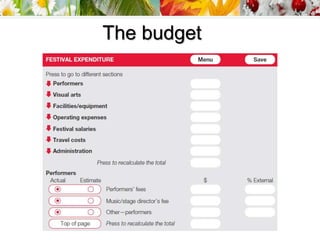
The budget
 Constructing the budget
• Two types of budget process used for events:
– line-item budget focuses on each cost and revenue item of
the total event
– program budget: constructed for a specific program
element (e.g., performance areas or stages)
• A budget imposes financial discipline and can be used for review post-event
The budget
ADVANTAGES OF USING BUDGET
 Forcing management to establish a financial plan for the event and to
allocate resources accordingly
 It imposes financial discipline, regardless of how informally an event
may be organized
 It can also be used for review long after the event is over
 Budget is based on reasonable projections made within an economic
framework, it is a tool for control and not an end in itself.
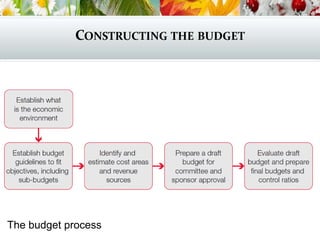
CONSTRUCTING THE BUDGET
The budget process
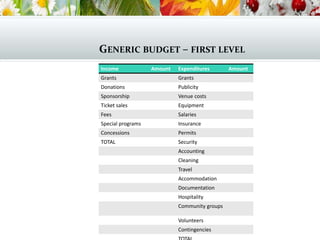
Income Amount Expenditures Amount
Grants Grants
Donations Publicity
Sponsorship Venue costs
Ticket sales Equipment
Fees Salaries
Special programs Insurance
Concessions Permits
TOTAL Security
Accounting
Cleaning
Travel
Accommodation
Documentation
Hospitality
Community groups
Volunteers
Contingencies
GENERIC BUDGET – FIRST LEVEL
The budget
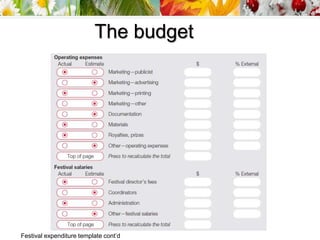
Festival expenditure template cont’d
The budget
Budget is a control mechanism as it enables the event management to identify
when the organizing of the event is drifting away from forecast
• Establish standards of performance
– the budget, indicator ratios, success factors, milestones
• Identify deviations from the standards
of performance
– comparison of budget to actual spend, maybe difficult to do
– Ratios and milestones become important as a method to indicate if there
are problems
• Correct deviations
– by cutting costs, finding more money, or shifting resources
Control and financial ratios
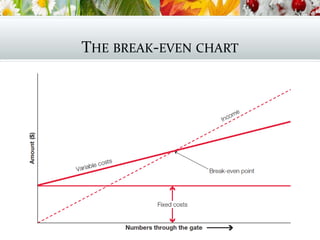
THE BREAK-EVEN CHART
The break-even chart
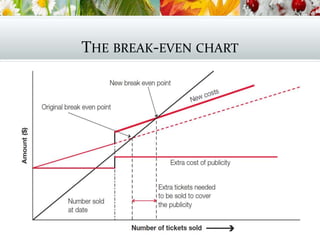
THE BREAK-EVEN CHART
The event break-even chart
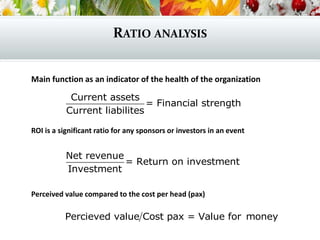
RATIO ANALYSIS
Main function as an indicator of the health of the organization
ROI is a significant ratio for any sponsors or investors in an event
Perceived value compared to the cost per head (pax)
Current assets
= Financial strength
Current liabilites
Net revenue
= Return on investment
Investment
Percieved value Cost pax = Value for money
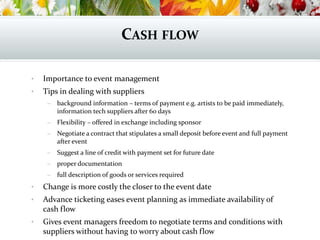
CASH FLOW
• Importance to event management
• Tips in dealing with suppliers
– background information – terms of payment e.g. artists to be paid immediately,
information tech suppliers after 60 days
– Flexibility – offered in exchange including sponsor
– Negotiate a contract that stipulates a small deposit before event and full payment
after event
– Suggest a line of credit with payment set for future date
– proper documentation
– full description of goods or services required
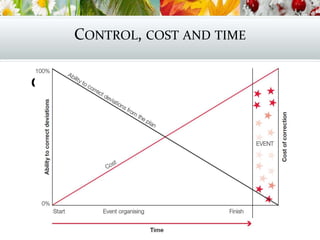
• Change is more costly the closer to the event date
• Advance ticketing eases event planning as immediate availability of
cash flow
• Gives event managers freedom to negotiate terms and conditions with
suppliers without having to worry about cash flow
CONTROL, COST AND TIME
Cash flow
• Classification of costs
– fixed costs, overheads – costs associated with the event regardless of how many
people that come. For example, rent, staff salaries, telephone and other offices
expenses
– variable costs – pertain solely to the event and directly related to the number of
people attending. For example, F&B costs
• Estimating – 3 types
– top-down estimating – based on experience and comparison of similar type and size
 Accuracy +/-25%
– bottom-up estimating – divided into components, cost separately . For example, cost of
speakers, sounds, lighting, and security
– parametric estimating – cost of the event related to one element. For example cost of the
whole event is know by multiplying cost per head by the total attendees.
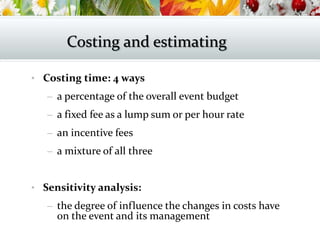
Costing and estimating
• Costing time: 4 ways
– a percentage of the overall event budget
– a fixed fee as a lump sum or per hour rate
– an incentive fees
– a mixture of all three
• Sensitivity analysis:
– the degree of influence the changes in costs have
on the event and its management
Costing and estimating
TIPS ON REDUCING COSTS
• Publicity – WOM, social media
• Equipment – low season/down times hiring
• In-kind gifts – cross promotional
• Hiring charges – offering multiple contracts for
equipment such as tents, generators
• Priorities cost centers – cutting cost
• Volunteers
REVENUE
• Various revenue sources including:
– ticket sales
– Sponsorship
– merchandising
– grants and fundraising
• Ticket pricing
– covering costs (estimated cost of the events by the expected
number of attendees
– market demand ( concert tickets)
– perceived value
TIPS FOR INCREASING PROJECTED INCOME
• Ticket scaling – pricing according to seat position, number of tickets
sold, and time of sale (early bird discounts and subscriptions). Others are
Patrons , special clubs, and friends of the event.
• In-kind support and bartering – exchange with
suppliers such as advertising
• Merchandising – souvenir, VCD or DVD sales
• Broadcast rights
• Sponsorship leverage and activation – gain further
supports from other sponsors. Few sponsors want to be the first sponsor of a
one-off event
• Special features – raffles tickets, auctions
FINANCIAL REPORTING
• Report guidelines
– relevant
– brief and clear
– comparable
– remedial action
• Budget blow-out
• Budget limitation
• Need for staff consultation

Chapter 7 - Financial Management and Events_new.ppt

  • 1.
  • 2.
    LEARNING OBJECTIVES  Understandthe role of financial management in the overall management of an event  Create an event budget  Understand the methods of event costing and ticket pricing  Monitor and control the event spending and incoming finances  Identify the key elements of budgetary control and explain the relationship between them  Understand the advantages and shortcomings of using a budget
  • 3.
    INTRODUCTION  What isfinancial management?  Defined as decisions concerning the sourcing, planning, allocation, monitoring and evaluation of money resources  In the event environment, financial decisions takes place within the overall objectives of the event or festival Importance of money?  One of the resources of event management  For profit events – sourcing and allocation of money is very important  Primary objective will be incoming dollars (revenue) greater than outgoing dollars (expenditure)  For Non-For-Profit events – profit making is far less important than one or more combination of aims and objective such as community development, tourism, business networking, and public awareness  All event must have responsible financial management
  • 4.
    INTRODUCTION CONT’D  Mismanagementof finance?  Can lead to unforeseen operational risk, such as safety, crowd control and legal problems  Imperative for all event managements to know about financial management  Legal obligations require event finance to be managed in a proper and correct manner. For examples:  Tax obligations – transactions recording  Client or sponsors wants to see financial statements  In extreme cases, audit of event finances might be necessary  Management systems need to be set up in the areas of marketing, insurance, venue costs and design, sponsorships, re-examination of contracts and cost savings
  • 5.
    CHARACTERISTICS OF FINANCIALMANAGEMENT FOR EVENTS  Although there was a framework for the budget, its accuracy changed over time  Unexpected income and cost arise, even for a major event such as the Olympics  Financial management is a high-level responsibility  Event manager is expected to defend spending  There are mutual dependencies between the areas of event management – the finances, the operations and the program  Even with all these changes, the event must still go on and every financial decision hang on DEADLINE
  • 6.
    • Finance forevents can come from: – sponsorship – ticket sales (e.g., concerts) – sales on the day of the event – money made after the event has taken place (e.g., product launches) • Return on investment (ROI) is the measure of the financial return for the investment in the event • ROI can be different for each of the stakeholders • Can be hard to express ROI in purely financial terms (e.g., community happiness) Forecasting finance and ROI
  • 7.
    What is budget? Can be described as a quantified statement of plans (in other words, the plan is expressed in numerical terms)  The process includes costing and estimating income and allocating financial resources • An event budget is used to compare actual costs and revenues with projected costs and revenues • Cash flow is important as most aspects of an event require expenditure before revenue is obtained • Funding or sponsorship bodies need to see a budget before committing to the event The budget
  • 8.
     Constructing thebudget • Two types of budget process used for events: – line-item budget focuses on each cost and revenue item of the total event – program budget: constructed for a specific program element (e.g., performance areas or stages) • A budget imposes financial discipline and can be used for review post-event The budget
  • 9.
    ADVANTAGES OF USINGBUDGET  Forcing management to establish a financial plan for the event and to allocate resources accordingly  It imposes financial discipline, regardless of how informally an event may be organized  It can also be used for review long after the event is over  Budget is based on reasonable projections made within an economic framework, it is a tool for control and not an end in itself.
  • 10.
  • 11.
    Income Amount ExpendituresAmount Grants Grants Donations Publicity Sponsorship Venue costs Ticket sales Equipment Fees Salaries Special programs Insurance Concessions Permits TOTAL Security Accounting Cleaning Travel Accommodation Documentation Hospitality Community groups Volunteers Contingencies GENERIC BUDGET – FIRST LEVEL
  • 12.
  • 13.
    Festival expenditure templatecont’d The budget
  • 14.
    Budget is acontrol mechanism as it enables the event management to identify when the organizing of the event is drifting away from forecast • Establish standards of performance – the budget, indicator ratios, success factors, milestones • Identify deviations from the standards of performance – comparison of budget to actual spend, maybe difficult to do – Ratios and milestones become important as a method to indicate if there are problems • Correct deviations – by cutting costs, finding more money, or shifting resources Control and financial ratios
  • 15.
    THE BREAK-EVEN CHART Thebreak-even chart
  • 16.
    THE BREAK-EVEN CHART Theevent break-even chart
  • 17.
    RATIO ANALYSIS Main functionas an indicator of the health of the organization ROI is a significant ratio for any sponsors or investors in an event Perceived value compared to the cost per head (pax) Current assets = Financial strength Current liabilites Net revenue = Return on investment Investment Percieved value Cost pax = Value for money
  • 18.
    CASH FLOW • Importanceto event management • Tips in dealing with suppliers – background information – terms of payment e.g. artists to be paid immediately, information tech suppliers after 60 days – Flexibility – offered in exchange including sponsor – Negotiate a contract that stipulates a small deposit before event and full payment after event – Suggest a line of credit with payment set for future date – proper documentation – full description of goods or services required • Change is more costly the closer to the event date • Advance ticketing eases event planning as immediate availability of cash flow • Gives event managers freedom to negotiate terms and conditions with suppliers without having to worry about cash flow
  • 19.
    CONTROL, COST ANDTIME Cash flow
  • 20.
    • Classification ofcosts – fixed costs, overheads – costs associated with the event regardless of how many people that come. For example, rent, staff salaries, telephone and other offices expenses – variable costs – pertain solely to the event and directly related to the number of people attending. For example, F&B costs • Estimating – 3 types – top-down estimating – based on experience and comparison of similar type and size  Accuracy +/-25% – bottom-up estimating – divided into components, cost separately . For example, cost of speakers, sounds, lighting, and security – parametric estimating – cost of the event related to one element. For example cost of the whole event is know by multiplying cost per head by the total attendees. Costing and estimating
  • 21.
    • Costing time:4 ways – a percentage of the overall event budget – a fixed fee as a lump sum or per hour rate – an incentive fees – a mixture of all three • Sensitivity analysis: – the degree of influence the changes in costs have on the event and its management Costing and estimating
  • 22.
    TIPS ON REDUCINGCOSTS • Publicity – WOM, social media • Equipment – low season/down times hiring • In-kind gifts – cross promotional • Hiring charges – offering multiple contracts for equipment such as tents, generators • Priorities cost centers – cutting cost • Volunteers
  • 23.
    REVENUE • Various revenuesources including: – ticket sales – Sponsorship – merchandising – grants and fundraising • Ticket pricing – covering costs (estimated cost of the events by the expected number of attendees – market demand ( concert tickets) – perceived value
  • 24.
    TIPS FOR INCREASINGPROJECTED INCOME • Ticket scaling – pricing according to seat position, number of tickets sold, and time of sale (early bird discounts and subscriptions). Others are Patrons , special clubs, and friends of the event. • In-kind support and bartering – exchange with suppliers such as advertising • Merchandising – souvenir, VCD or DVD sales • Broadcast rights • Sponsorship leverage and activation – gain further supports from other sponsors. Few sponsors want to be the first sponsor of a one-off event • Special features – raffles tickets, auctions
  • 25.
    FINANCIAL REPORTING • Reportguidelines – relevant – brief and clear – comparable – remedial action • Budget blow-out • Budget limitation • Need for staff consultation