Writing a Memorandum
Business Communication and Report Writing
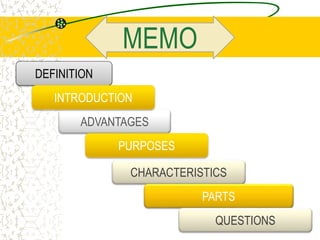
DEFINITION
ADVANTAGES
PURPOSES
CHARACTERISTICS
PARTS
MEMO
INTRODUCTION
QUESTIONS
Definition
A memorandum is
considered “inside”
correspondence.
It is written to someone
in your company.
A written statement you
prepare specially for a
person or communicate
an order to give them
information about a
particular method.
The word memorandum is derived from the Latin
word ‘memo rare’ which means “to remember”.
In law, a memorandum means a document
recording terms of contract.
The plural of memorandum is memorandums or
memoranda.
It is commonly known by its abbreviation, viz., and
memo.
Introduction
Advantages of Memos
Memos are:
Quick & Convenient
Inexpensive
A Written Record
Memos
A memo should be
designed to get your
message across quickly.
Busy people do not want
to waste time reading
unnecessary information.
Purposes of Memos
To Inquire
To Inform
To Report
To Remind
To Promote Goodwill
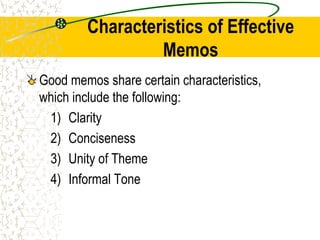
Characteristics of Effective
Memos
Good memos share certain characteristics,
which include the following:
1) Clarity
2) Conciseness
3) Unity of Theme
4) Informal Tone
Clarity
A memo must be clearly written because an
unclear and vague memo will confuse the
reader, leading to delay and no action.
Conciseness
Concise and direct memos are more effective.
A memo should contain only essential
information.
Avoid unnecessary explanations, repetitions,
wordy expressions, and amplification.
Ensure that the memo makes its point with the
fewest possible words
Unity of Theme
A memo which does not have unity of theme,
distracts the reader and ceases (terminates) to
be purposeful.
An important way of ensuring unity in a memo is
to make sure that it deals with only one topic.
A single topic is developed , and related ideas
are subordinated.
Informal Tone
In memo tone is usually informal and
conversational.
As the writer is likely to be familiar with the
reader, personal tone may be used in memos.
A very formal tone might sound intimidating.
Parts of a Memo
Standard memos contain four parts:
1. Heading
2. Opening
3. Body
4. Closing
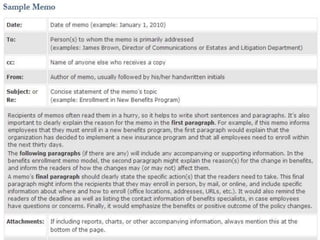
1. Heading:
The heading segment of a memo includes four
elements:
1) To: (Name and designation of the recipient)
2) From: (Name and designation of the sender)
3) Date: ( Complete and Current)
4) Subject : ( Topic of the memo)
To: Mr. Ahmer
Director Sales
From: Mr.Ali
Sales Manager
Date: March 11, 2016
Subject: SALES SUMMARY FOR THE YEAR 2016
OR
Subject: Sales Summary for the Year 2016
Example of Heading Segment
2. Opening
 state purpose of memo, give the facts.
Examples:
“Here is a summary of the measures the Campus
Security Department is taking to ensure that only
authorized people are allowed into the
administrative offices.”
“As you requested, here is a copy of the annual sales
report for our new product ‘Mint Candy’,
launched in December 2015.”
3. Body
Body of the memorandum—single spaced
The body of the memo contains the message of the
memo.
It describes, explains, and discuss the central idea of
the memo and includes all the details that support the
senders’ ideas.
The body may contain a brief statement of the key
recommendations the sender has reached.
4. Closing
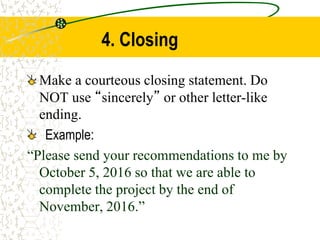
Make a courteous closing statement. Do
NOT use “sincerely” or other letter-like
ending.
Example:
“Please send your recommendations to me by
October 5, 2016 so that we are able to
complete the project by the end of
November, 2016.”
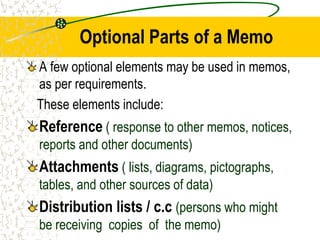
Optional Parts of a Memo
A few optional elements may be used in memos,
as per requirements.
These elements include:
Reference ( response to other memos, notices,
reports and other documents)
Attachments ( lists, diagrams, pictographs,
tables, and other sources of data)
Distribution lists / c.c (persons who might
be receiving copies of the memo)
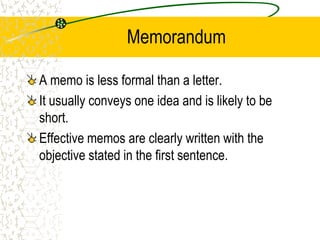
Memorandum
A memo is less formal than a letter.
It usually conveys one idea and is likely to be
short.
Effective memos are clearly written with the
objective stated in the first sentence.
Organization of the Memo
Statement of Purpose
Message
Statement of Future
Action
Special Formatting and
Mechanical Techniques
Use enumerations to list
important items
Use solid capitals and
centering to emphasize an
important detail
Use columns with headings
to make reading and
understanding easier
Special Formatting and
Mechanical Techniques
Use underlining and side
headings to show natural
breaks
Use bullets to emphasize
several points
Use boldface and italics
when appropriate
Use color coding to attract
attention
Important “Nevers” in
Memo Writing
Never write memos or any other
communications which are
unnecessary.
Never write complicated, hard-
to-understand memos.
Keep them simple and to the
point.
Important “Nevers” in
Memos Writing
Never write rude, blunt,
or thoughtless memos.
Never send memos that
have typos, misspelled
words, or grammatical
errors.
– They are a poor reflection
on you!
Important “Nevers” in
Memos Writing
Never waste space with
unnecessary introductory
material.
– Plunge in!
Never leave out
necessary details
causing people to have
to follow up with
questions.
Important “Nevers” in
Memos Writing
Never use a closing line
or a signature in a
memo.
Memo
Make sure the memo is
Clear
Concise
Correct
Concrete
Complete
Memos
Make sure the
memorandum is
Well placed
Has correct punctuation
and spelling
Memos
Be sure the memo
States the purpose clearly
Presents message effectively
Uses a courteous tone
Gives reader complete, accurate details
Concludes appropriately
Thanks

Writing memorandum

  • 1.
    Writing a Memorandum BusinessCommunication and Report Writing
  • 2.
  • 3.
    Definition A memorandum is considered“inside” correspondence. It is written to someone in your company. A written statement you prepare specially for a person or communicate an order to give them information about a particular method.
  • 4.
    The word memorandumis derived from the Latin word ‘memo rare’ which means “to remember”. In law, a memorandum means a document recording terms of contract. The plural of memorandum is memorandums or memoranda. It is commonly known by its abbreviation, viz., and memo. Introduction
  • 5.
    Advantages of Memos Memosare: Quick & Convenient Inexpensive A Written Record
  • 6.
    Memos A memo shouldbe designed to get your message across quickly. Busy people do not want to waste time reading unnecessary information.
  • 7.
    Purposes of Memos ToInquire To Inform To Report To Remind To Promote Goodwill
  • 8.
    Characteristics of Effective Memos Goodmemos share certain characteristics, which include the following: 1) Clarity 2) Conciseness 3) Unity of Theme 4) Informal Tone
  • 9.
    Clarity A memo mustbe clearly written because an unclear and vague memo will confuse the reader, leading to delay and no action.
  • 10.
    Conciseness Concise and directmemos are more effective. A memo should contain only essential information. Avoid unnecessary explanations, repetitions, wordy expressions, and amplification. Ensure that the memo makes its point with the fewest possible words
  • 11.
    Unity of Theme Amemo which does not have unity of theme, distracts the reader and ceases (terminates) to be purposeful. An important way of ensuring unity in a memo is to make sure that it deals with only one topic. A single topic is developed , and related ideas are subordinated.
  • 12.
    Informal Tone In memotone is usually informal and conversational. As the writer is likely to be familiar with the reader, personal tone may be used in memos. A very formal tone might sound intimidating.
  • 13.
    Parts of aMemo Standard memos contain four parts: 1. Heading 2. Opening 3. Body 4. Closing
  • 14.
    1. Heading: The headingsegment of a memo includes four elements: 1) To: (Name and designation of the recipient) 2) From: (Name and designation of the sender) 3) Date: ( Complete and Current) 4) Subject : ( Topic of the memo)
  • 15.
    To: Mr. Ahmer DirectorSales From: Mr.Ali Sales Manager Date: March 11, 2016 Subject: SALES SUMMARY FOR THE YEAR 2016 OR Subject: Sales Summary for the Year 2016 Example of Heading Segment
  • 16.
    2. Opening  statepurpose of memo, give the facts. Examples: “Here is a summary of the measures the Campus Security Department is taking to ensure that only authorized people are allowed into the administrative offices.” “As you requested, here is a copy of the annual sales report for our new product ‘Mint Candy’, launched in December 2015.”
  • 17.
    3. Body Body ofthe memorandum—single spaced The body of the memo contains the message of the memo. It describes, explains, and discuss the central idea of the memo and includes all the details that support the senders’ ideas. The body may contain a brief statement of the key recommendations the sender has reached.
  • 18.
    4. Closing Make acourteous closing statement. Do NOT use “sincerely” or other letter-like ending. Example: “Please send your recommendations to me by October 5, 2016 so that we are able to complete the project by the end of November, 2016.”
  • 19.
    Optional Parts ofa Memo A few optional elements may be used in memos, as per requirements. These elements include: Reference ( response to other memos, notices, reports and other documents) Attachments ( lists, diagrams, pictographs, tables, and other sources of data) Distribution lists / c.c (persons who might be receiving copies of the memo)
  • 21.
    Memorandum A memo isless formal than a letter. It usually conveys one idea and is likely to be short. Effective memos are clearly written with the objective stated in the first sentence.
  • 22.
    Organization of theMemo Statement of Purpose Message Statement of Future Action
  • 23.
    Special Formatting and MechanicalTechniques Use enumerations to list important items Use solid capitals and centering to emphasize an important detail Use columns with headings to make reading and understanding easier
  • 24.
    Special Formatting and MechanicalTechniques Use underlining and side headings to show natural breaks Use bullets to emphasize several points Use boldface and italics when appropriate Use color coding to attract attention
  • 25.
    Important “Nevers” in MemoWriting Never write memos or any other communications which are unnecessary. Never write complicated, hard- to-understand memos. Keep them simple and to the point.
  • 26.
    Important “Nevers” in MemosWriting Never write rude, blunt, or thoughtless memos. Never send memos that have typos, misspelled words, or grammatical errors. – They are a poor reflection on you!
  • 27.
    Important “Nevers” in MemosWriting Never waste space with unnecessary introductory material. – Plunge in! Never leave out necessary details causing people to have to follow up with questions.
  • 28.
    Important “Nevers” in MemosWriting Never use a closing line or a signature in a memo.
  • 29.
    Memo Make sure thememo is Clear Concise Correct Concrete Complete
  • 30.
    Memos Make sure the memorandumis Well placed Has correct punctuation and spelling
  • 31.
    Memos Be sure thememo States the purpose clearly Presents message effectively Uses a courteous tone Gives reader complete, accurate details Concludes appropriately
  • 32.