Soft Skills
Email Etiquette
At the end of this training you
would be able to:
–Understand the principles of
communication
–Learn etiquettes to be used
while sending and receiving
e-mails
–Learn the elementary
principles of writing
–Be aware of the readers
expectation and what
makes up a good e-mail.
Objectives
Write an email to your supervisor thanking him/her
for the appreciation you received
Email Writing
Why do we love e-mail?
In terms of the time factor alone, it’s easy to see why e-mail is the preferred choice
for written communication.
– Let’s take a look at some more reasons why we love e-mail
• It’s written. You can edit and check it before you send it. The recipient can read it, forward it to someone
else, print it out and file it away
• It’s time-zone friendly. E-mail is great for international communication over different time zones
• It’s quick. Messages are usually delivered in seconds. (They may not be read so quickly, but they will be in
the recipient’s inbox.)
• It’s economical. Of course you need to buy a computer and a modem, and (sometimes) pay an Internet
service provider. But no matter where your recipient is, each message should cost no more than a local
phone call
• It’s flexible. You can forward or send multiple copies of messages easily, and attach documents to
messages without any hassle
• You can attach files. As long as your recipient has the software to open it, you can attach a spreadsheet, a
report, photographs, a game, a video — virtually anything!
• It’s non-intrusive. You decide when to read your mail and when to reply
• It can be prioritized. When you open your e-mail first thing in the morning you can prioritize your e-mail-
related work for the day. Simple or urgent tasks can be dealt with quickly before getting involved in more
heavy-duty or non-urgent work
• You see the history of each communication. This is a great tool so you can scroll down and remind
yourself about previous discussions on the topic
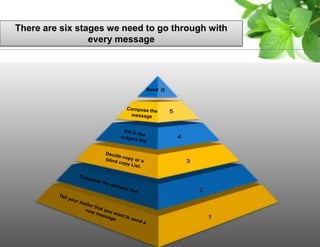
Send
There are six stages we need to go through with
every message
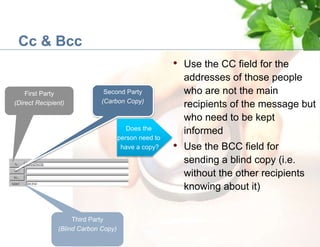
Cc & Bcc
• Use the CC field for the
addresses of those people
who are not the main
recipients of the message but
who need to be kept
informed
• Use the BCC field for
sending a blind copy (i.e.
without the other recipients
knowing about it)
First Party
(Direct Recipient)
Second Party
(Carbon Copy)
Does the
person need to
have a copy?
Third Party
(Blind Carbon Copy)
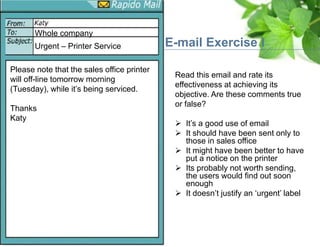
Whole company
Urgent – Printer Service
Please note that the sales office printer
will off-line tomorrow morning
(Tuesday), while it’s being serviced.
Thanks
Katy
Read this email and rate its
effectiveness at achieving its
objective. Are these comments true
or false?
 It’s a good use of email
 It should have been sent only to
those in sales office
 It might have been better to have
put a notice on the printer
 Its probably not worth sending,
the users would find out soon
enough
 It doesn’t justify an ‘urgent’ label
E-mail Exercise I
Why SMART Subject Lines?
Busy business people receive dozens of e-mail messages every
day, sometimes hundreds. It is a constant battle to capture the
attention and interest of your readers. Too often writers compose
subject lines that are far too vague, bland or too long to be
effective. If you are guilty of any of these, then you need help
with your subject lines.
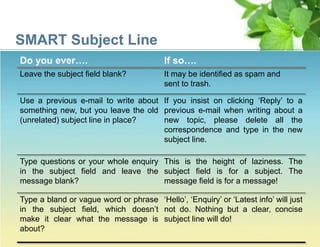
Do you ever…. If so….
Leave the subject field blank? It may be identified as spam and
sent to trash.
Use a previous e-mail to write about
something new, but you leave the old
(unrelated) subject line in place?
If you insist on clicking ‘Reply’ to a
previous e-mail when writing about a
new topic, please delete all the
correspondence and type in the new
subject line.
Type questions or your whole enquiry
in the subject field and leave the
message blank?
This is the height of laziness. The
subject field is for a subject. The
message field is for a message!
Type a bland or vague word or phrase
in the subject field, which doesn’t
make it clear what the message is
about?
‘Hello’, ‘Enquiry’ or ‘Latest info’ will just
not do. Nothing but a clear, concise
subject line will do!
SMART Subject Line
Let’s take a look at some good and
some not-so-good subject lines
– This subject line is useless—it tells the
reader nothing:
• Subject: Enquiry
– This is more specific, giving the reader an
idea of what the message is about:
• Subject: Enquiry about Gold membership
Plan
– This message is OK but still not specific
enough considering the content:
• Subject: Yahoo sale
– This is more meaningful, concise and specific:
• Subject: 27 May—Closing date for Yahoo
sale
Let’s take a look at some good and
some not-so-good subject lines
– This is rather vague:
• Subject: Quarterly results
– This is much more descriptive:
• Subject: Second quarter results up by 20%
– This is good, but is the meaning really clear?
• Subject: 10% pay increase for all employees
– You would probably get excited reading that
subject line, but if in fact the message was to tell
you that you would not be getting a pay increase,
then this subject line would be more SMART:
• Subject: Directors reject 10% pay increase
E-mail Exercise II
Which of these would be
effective subject lines for this
message?
– URGENT! Meeting Friday Mar 12
– Meeting Friday Mar 12
– Meeting about appraisals, business
plan and status report
– I’m calling a meeting of all branch
managers…
– Branch managers’ meeting - Friday,
Mar 12
– Meeting
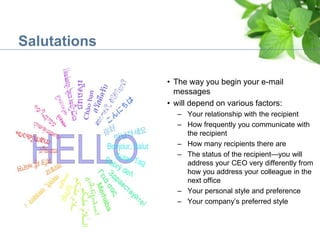
Salutations
• The way you begin your e-mail
messages
• will depend on various factors:
– Your relationship with the recipient
– How frequently you communicate with
the recipient
– How many recipients there are
– The status of the recipient—you will
address your CEO very differently from
how you address your colleague in the
next office
– Your personal style and preference
– Your company’s preferred style
Fast Facts
Greetings like ‘Good
Morning’ or ‘Good
Afternoon’ don’t really
make much sense
with e-mail. You never
Know when your
Recipient will open his
or her mail, especially
When communicating
across time zones.
– Here are some other popular closings:
• Best
• Yours
• Warmly
• Take care
– You could also end with phrases that reflect the purpose of your e-mail, in
which case you really don’t need anything else, such as:
• Have a great day.
• Enjoy your weekend.
• Happy Holidays!
• To your success.
• Keep up the good work.
Ending your message
E
N
D
Signatures
Include your job title, the name of your organization and contact
details. Telephone numbers are particularly important things to
include because the recipient may actually want to discuss the
matter with you verbally. Do remember that whenever any of the
details change you must revise your signature details to ensure
everything is up-to-date.
The ABC of modern business writing
In every message you write, your aim should be to ensure
that every message is:
– Accurate
– Brief
– Clear
Benefits of the ABC Approach
By using the ABC approach in all your writing, you will:
– Save time. Your reader will not have to think about what you mean. It will be crystal
clear.
– Avoid confusion. Your reader will know exactly what you are saying and the response
needed without having to send you an e-mail message or give you a call to clarify
anything.
– Create a good impression. A well-written message will make the reader think well not
only of you but also of your organization.
– Enhance relationships. You will establish a good relationship with people with whom
you communicate regularly.
– Achieve the desired results.
We can use capitals to emphasize
important Sections of our e-mail
messages. Please don’t. Apart from
being more difficult to Read, capital
letters imply shouting and aggression.
SO DON’T USE CAPITALS FOR ANY
PART OF YOUR MESSAGE! also pls
don’t use lower case letters with
abbreviations n acronyms. If u write
this way u r Thot of as lazy and I 4
one wouldn’t want that, wld u?
Fast Fact
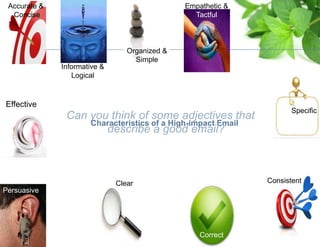
Characteristics of a High-impact Email
Can you think of some adjectives that
describe a good email?
Effective
Persuasive
Accurate &
Concise
Organized &
Simple
Clear
Correct
Consistent
Specific
Empathetic &
Tactful
Informative &
Logical
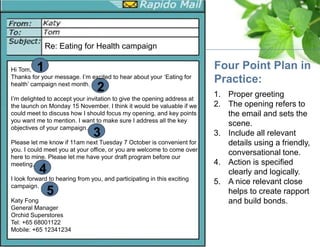
1. Proper greeting
2. The opening refers to
the email and sets the
scene.
3. Include all relevant
details using a friendly,
conversational tone.
4. Action is specified
clearly and logically.
5. A nice relevant close
helps to create rapport
and build bonds.
Four Point Plan in
Practice:
Re: Eating for Health campaign
1
2
3
4
5
Hi Tom,
Thanks for your message. I’m excited to hear about your ‘Eating for
health’ campaign next month.
I’m delighted to accept your invitation to give the opening address at
the launch on Monday 15 November. I think it would be valuable if we
could meet to discuss how I should focus my opening, and key points
you want me to mention. I want to make sure I address all the key
objectives of your campaign.
Please let me know if 11am next Tuesday 7 October is convenient for
you. I could meet you at your office, or you are welcome to come over
here to mine. Please let me have your draft program before our
meeting.
I look forward to hearing from you, and participating in this exciting
campaign.
Katy Fong
General Manager
Orchid Superstores
Tel: +65 68001122
Mobile: +65 12341234
E-mail Exercise III - Use brief paragraphs
I think the criteria the search committee has developed for
selecting the new director are excellent. I like the emphasis on
the candidate’s possessing a finance background. However, I
question the need for “experience in operations research”. I
think the committee is going overboard on that one. Nancy
Drew also asked me to draw up a list of items we need to equip
the new data processing room in the finance department. See
the list attached to this memo. Dilbert, the sales agent at Wang
indicated we could get a sizable discount on electronic
equipment. Let’s talk about this next week.
Rewrite the following using the paragraph technique.
E-mail Exercise IV – Use short sentences
Rewrite the following using short sentences:
The new air express delivery service should speed up our
overnight mailings and give us an advantage over the
competition in serving the East Coast markets, which are
starting to become more competitive as John Spielberg
reported in his memo last week.
E-mail Exercise V – Use listings,
numbering/ bullets
Rewrite the paragraph using listings:
We have set three company goals for the 1992-93 fiscal year.
We want to establish ourselves as a maker of quality
educational toys, expand our product line to include computer
learning games and gain a greater share of the elementary
high-school educational market
E-mail Exercise VI – Punctuate Well
dear tom
I would like to inform you that THE confidential project XYZ that we
have been working on for a month now is close to completion the
estimated end date. Is the 25th of feb 2009
we need to begin our next project by the first week of march 2009
regards
Rachel
Punctuate the following e-mail:
Write an email to your supervisor apologizing for an
error in data that you have sent
Email Writing
When not to use e-mail
E-mail is not always the best form of communication.
Telephone or face-to-face communication would be
more
appropriate when:
– When messages are confidential
– When messages are long and complicated
– When there are many issues to resolve or clarify
– When messages are indiscreet
– When you are angry
– When the message is emotive or sensitive or
intimate.
– You are negotiating.
– You need an instant yes-or-no answer.
Thank
You

Email etiquette.ppt

  • 1.
  • 2.
    At the endof this training you would be able to: –Understand the principles of communication –Learn etiquettes to be used while sending and receiving e-mails –Learn the elementary principles of writing –Be aware of the readers expectation and what makes up a good e-mail. Objectives
  • 3.
    Write an emailto your supervisor thanking him/her for the appreciation you received Email Writing
  • 4.
    Why do welove e-mail? In terms of the time factor alone, it’s easy to see why e-mail is the preferred choice for written communication. – Let’s take a look at some more reasons why we love e-mail • It’s written. You can edit and check it before you send it. The recipient can read it, forward it to someone else, print it out and file it away • It’s time-zone friendly. E-mail is great for international communication over different time zones • It’s quick. Messages are usually delivered in seconds. (They may not be read so quickly, but they will be in the recipient’s inbox.) • It’s economical. Of course you need to buy a computer and a modem, and (sometimes) pay an Internet service provider. But no matter where your recipient is, each message should cost no more than a local phone call • It’s flexible. You can forward or send multiple copies of messages easily, and attach documents to messages without any hassle • You can attach files. As long as your recipient has the software to open it, you can attach a spreadsheet, a report, photographs, a game, a video — virtually anything! • It’s non-intrusive. You decide when to read your mail and when to reply • It can be prioritized. When you open your e-mail first thing in the morning you can prioritize your e-mail- related work for the day. Simple or urgent tasks can be dealt with quickly before getting involved in more heavy-duty or non-urgent work • You see the history of each communication. This is a great tool so you can scroll down and remind yourself about previous discussions on the topic
  • 5.
    Send There are sixstages we need to go through with every message
  • 6.
    Cc & Bcc •Use the CC field for the addresses of those people who are not the main recipients of the message but who need to be kept informed • Use the BCC field for sending a blind copy (i.e. without the other recipients knowing about it) First Party (Direct Recipient) Second Party (Carbon Copy) Does the person need to have a copy? Third Party (Blind Carbon Copy)
  • 7.
    Whole company Urgent –Printer Service Please note that the sales office printer will off-line tomorrow morning (Tuesday), while it’s being serviced. Thanks Katy Read this email and rate its effectiveness at achieving its objective. Are these comments true or false?  It’s a good use of email  It should have been sent only to those in sales office  It might have been better to have put a notice on the printer  Its probably not worth sending, the users would find out soon enough  It doesn’t justify an ‘urgent’ label E-mail Exercise I
  • 8.
    Why SMART SubjectLines? Busy business people receive dozens of e-mail messages every day, sometimes hundreds. It is a constant battle to capture the attention and interest of your readers. Too often writers compose subject lines that are far too vague, bland or too long to be effective. If you are guilty of any of these, then you need help with your subject lines.
  • 9.
    Do you ever….If so…. Leave the subject field blank? It may be identified as spam and sent to trash. Use a previous e-mail to write about something new, but you leave the old (unrelated) subject line in place? If you insist on clicking ‘Reply’ to a previous e-mail when writing about a new topic, please delete all the correspondence and type in the new subject line. Type questions or your whole enquiry in the subject field and leave the message blank? This is the height of laziness. The subject field is for a subject. The message field is for a message! Type a bland or vague word or phrase in the subject field, which doesn’t make it clear what the message is about? ‘Hello’, ‘Enquiry’ or ‘Latest info’ will just not do. Nothing but a clear, concise subject line will do! SMART Subject Line
  • 10.
    Let’s take alook at some good and some not-so-good subject lines – This subject line is useless—it tells the reader nothing: • Subject: Enquiry – This is more specific, giving the reader an idea of what the message is about: • Subject: Enquiry about Gold membership Plan – This message is OK but still not specific enough considering the content: • Subject: Yahoo sale – This is more meaningful, concise and specific: • Subject: 27 May—Closing date for Yahoo sale
  • 11.
    Let’s take alook at some good and some not-so-good subject lines – This is rather vague: • Subject: Quarterly results – This is much more descriptive: • Subject: Second quarter results up by 20% – This is good, but is the meaning really clear? • Subject: 10% pay increase for all employees – You would probably get excited reading that subject line, but if in fact the message was to tell you that you would not be getting a pay increase, then this subject line would be more SMART: • Subject: Directors reject 10% pay increase
  • 12.
    E-mail Exercise II Whichof these would be effective subject lines for this message? – URGENT! Meeting Friday Mar 12 – Meeting Friday Mar 12 – Meeting about appraisals, business plan and status report – I’m calling a meeting of all branch managers… – Branch managers’ meeting - Friday, Mar 12 – Meeting
  • 13.
    Salutations • The wayyou begin your e-mail messages • will depend on various factors: – Your relationship with the recipient – How frequently you communicate with the recipient – How many recipients there are – The status of the recipient—you will address your CEO very differently from how you address your colleague in the next office – Your personal style and preference – Your company’s preferred style
  • 14.
    Fast Facts Greetings like‘Good Morning’ or ‘Good Afternoon’ don’t really make much sense with e-mail. You never Know when your Recipient will open his or her mail, especially When communicating across time zones.
  • 15.
    – Here aresome other popular closings: • Best • Yours • Warmly • Take care – You could also end with phrases that reflect the purpose of your e-mail, in which case you really don’t need anything else, such as: • Have a great day. • Enjoy your weekend. • Happy Holidays! • To your success. • Keep up the good work. Ending your message E N D
  • 16.
    Signatures Include your jobtitle, the name of your organization and contact details. Telephone numbers are particularly important things to include because the recipient may actually want to discuss the matter with you verbally. Do remember that whenever any of the details change you must revise your signature details to ensure everything is up-to-date.
  • 17.
    The ABC ofmodern business writing In every message you write, your aim should be to ensure that every message is: – Accurate – Brief – Clear
  • 18.
    Benefits of theABC Approach By using the ABC approach in all your writing, you will: – Save time. Your reader will not have to think about what you mean. It will be crystal clear. – Avoid confusion. Your reader will know exactly what you are saying and the response needed without having to send you an e-mail message or give you a call to clarify anything. – Create a good impression. A well-written message will make the reader think well not only of you but also of your organization. – Enhance relationships. You will establish a good relationship with people with whom you communicate regularly. – Achieve the desired results.
  • 19.
    We can usecapitals to emphasize important Sections of our e-mail messages. Please don’t. Apart from being more difficult to Read, capital letters imply shouting and aggression. SO DON’T USE CAPITALS FOR ANY PART OF YOUR MESSAGE! also pls don’t use lower case letters with abbreviations n acronyms. If u write this way u r Thot of as lazy and I 4 one wouldn’t want that, wld u? Fast Fact
  • 20.
    Characteristics of aHigh-impact Email Can you think of some adjectives that describe a good email? Effective Persuasive Accurate & Concise Organized & Simple Clear Correct Consistent Specific Empathetic & Tactful Informative & Logical
  • 21.
    1. Proper greeting 2.The opening refers to the email and sets the scene. 3. Include all relevant details using a friendly, conversational tone. 4. Action is specified clearly and logically. 5. A nice relevant close helps to create rapport and build bonds. Four Point Plan in Practice: Re: Eating for Health campaign 1 2 3 4 5 Hi Tom, Thanks for your message. I’m excited to hear about your ‘Eating for health’ campaign next month. I’m delighted to accept your invitation to give the opening address at the launch on Monday 15 November. I think it would be valuable if we could meet to discuss how I should focus my opening, and key points you want me to mention. I want to make sure I address all the key objectives of your campaign. Please let me know if 11am next Tuesday 7 October is convenient for you. I could meet you at your office, or you are welcome to come over here to mine. Please let me have your draft program before our meeting. I look forward to hearing from you, and participating in this exciting campaign. Katy Fong General Manager Orchid Superstores Tel: +65 68001122 Mobile: +65 12341234
  • 22.
    E-mail Exercise III- Use brief paragraphs I think the criteria the search committee has developed for selecting the new director are excellent. I like the emphasis on the candidate’s possessing a finance background. However, I question the need for “experience in operations research”. I think the committee is going overboard on that one. Nancy Drew also asked me to draw up a list of items we need to equip the new data processing room in the finance department. See the list attached to this memo. Dilbert, the sales agent at Wang indicated we could get a sizable discount on electronic equipment. Let’s talk about this next week. Rewrite the following using the paragraph technique.
  • 23.
    E-mail Exercise IV– Use short sentences Rewrite the following using short sentences: The new air express delivery service should speed up our overnight mailings and give us an advantage over the competition in serving the East Coast markets, which are starting to become more competitive as John Spielberg reported in his memo last week.
  • 24.
    E-mail Exercise V– Use listings, numbering/ bullets Rewrite the paragraph using listings: We have set three company goals for the 1992-93 fiscal year. We want to establish ourselves as a maker of quality educational toys, expand our product line to include computer learning games and gain a greater share of the elementary high-school educational market
  • 25.
    E-mail Exercise VI– Punctuate Well dear tom I would like to inform you that THE confidential project XYZ that we have been working on for a month now is close to completion the estimated end date. Is the 25th of feb 2009 we need to begin our next project by the first week of march 2009 regards Rachel Punctuate the following e-mail:
  • 26.
    Write an emailto your supervisor apologizing for an error in data that you have sent Email Writing
  • 27.
    When not touse e-mail E-mail is not always the best form of communication. Telephone or face-to-face communication would be more appropriate when: – When messages are confidential – When messages are long and complicated – When there are many issues to resolve or clarify – When messages are indiscreet – When you are angry – When the message is emotive or sensitive or intimate. – You are negotiating. – You need an instant yes-or-no answer.
  • 28.