NCFE Principles of Business
Administration
Level 2 Certificate
Waterside
Tutor: Michelle Walsh
mwalsh@accross.ac.uk
01254 354413
Induction
 Fire evacuation
 Toilets
 Smoking
 Phone calls / appointments
 Commitment = 70%
 Absences – To be reported
 Brews – 25p per session
 Questions?
Learning objectives – Session
5
Unit 5
1 Understand the principles of effective team
working
1.1 Outline the benefits of effective team working
1.2 Describe how to give feedback constructively
1.3 Explain conflict management techniques that may be used to resolve team
conflicts
1.4 Explain the importance of giving team members the opportunity to discuss work
progress and any issues arising
1.5 Explain the importance of warning colleagues of problems and changes that may
affect them
2 Understand how to buddy a colleague
2.1 Describe what is expected of a buddy
2.2 Explain techniques to give positive feedback and constructive criticism
2.3 Explain techniques to establish rapport with a buddy
Unit 5 – LO 1 Guidance
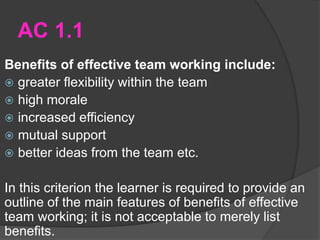
AC 1.1
Benefits of effective team working include:
 greater flexibility within the team
 high morale
 increased efficiency
 mutual support
 better ideas from the team etc.
In this criterion the learner is required to provide an
outline of the main features of benefits of effective
team working; it is not acceptable to merely list
benefits.
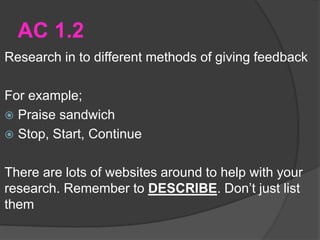
AC 1.2
Research in to different methods of giving feedback
For example;
 Praise sandwich
 Stop, Start, Continue
There are lots of websites around to help with your
research. Remember to DESCRIBE. Don’t just list
them
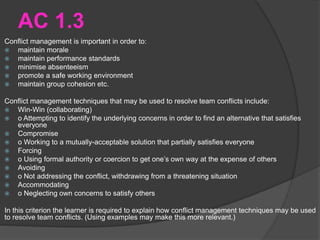
AC 1.3
Conflict management is important in order to:
 maintain morale
 maintain performance standards
 minimise absenteeism
 promote a safe working environment
 maintain group cohesion etc.
Conflict management techniques that may be used to resolve team conflicts include:
 Win-Win (collaborating)
 o Attempting to identify the underlying concerns in order to find an alternative that satisfies
everyone
 Compromise
 o Working to a mutually-acceptable solution that partially satisfies everyone
 Forcing
 o Using formal authority or coercion to get one’s own way at the expense of others
 Avoiding
 o Not addressing the conflict, withdrawing from a threatening situation
 Accommodating
 o Neglecting own concerns to satisfy others
In this criterion the learner is required to explain how conflict management techniques may be used
to resolve team conflicts. (Using examples may make this more relevant.)
AC 1.4
Discussing work progress and any issues arising with team
members provides an opportunity to:
 acknowledge team achievements and celebrate success
 discuss strengths and identify areas for improvement
 clarifying and agreeing any steps required to improve
performance
 identify how systems, procedures, work methods might be
improved etc.
In this criterion the learner is required to describe reasons that
explain the importance of giving team members the opportunity to
discuss work progress and any issues arising. (Using examples
may make this more relevant.)
AC 1.5
Warning colleagues of problems and changes that may affect
them allows issues to be addressed before they get out of hand
and are still manageable, and allows possible solutions to be
explored as opposed to merely reacting to a situation.
 Failure to warn might also threaten the trust relationship with
colleagues, who will typically assume the worst if there is a
failure to communicate.
In this criterion the learner is required to describe reasons that
explain the importance of warning colleagues of problems and
changes that may affect them. (Using examples may make this
more relevant.)
15 MINS
Unit – LO 2 Guidance
Buddy:
 The role may be to show a new member of staff where different departments are within the
building, how to complete certain regular tasks etc.
Feedback:
 information specific
 issue focused
 based on observations
 ‘sandwich’ strategy ie positive/negative/positive
 person to person
 timely
Techniques:
 be approachable
 look for things you have in common
 hone your listening skills
 develop active listening
 have empathy
 reflect and clarify
 use open body language
Learning outcomes – Session 5
DID YOU……?
1 Understand the principles of effective team
working
1.1 Outline the benefits of effective team working
1.2 Describe how to give feedback constructively
1.3 Explain conflict management techniques that may be used to resolve team conflicts
1.4 Explain the importance of giving team members the opportunity to discuss work
progress and any issues arising
1.5 Explain the importance of warning colleagues of problems and changes that may affect
them
2 Understand how to buddy a colleague
2.1 Describe what is expected of a buddy
2.2 Explain techniques to give positive feedback and constructive criticism
2.3 Explain techniques to establish rapport with a buddy
Any questions?
See you next week
You need to work on;
Unit 05

Unit 5 Business Admin

  • 1.
    NCFE Principles ofBusiness Administration Level 2 Certificate Waterside Tutor: Michelle Walsh mwalsh@accross.ac.uk 01254 354413
  • 2.
    Induction  Fire evacuation Toilets  Smoking  Phone calls / appointments  Commitment = 70%  Absences – To be reported  Brews – 25p per session  Questions?
  • 3.
    Learning objectives –Session 5 Unit 5 1 Understand the principles of effective team working 1.1 Outline the benefits of effective team working 1.2 Describe how to give feedback constructively 1.3 Explain conflict management techniques that may be used to resolve team conflicts 1.4 Explain the importance of giving team members the opportunity to discuss work progress and any issues arising 1.5 Explain the importance of warning colleagues of problems and changes that may affect them 2 Understand how to buddy a colleague 2.1 Describe what is expected of a buddy 2.2 Explain techniques to give positive feedback and constructive criticism 2.3 Explain techniques to establish rapport with a buddy
  • 4.
    Unit 5 –LO 1 Guidance
  • 5.
    AC 1.1 Benefits ofeffective team working include:  greater flexibility within the team  high morale  increased efficiency  mutual support  better ideas from the team etc. In this criterion the learner is required to provide an outline of the main features of benefits of effective team working; it is not acceptable to merely list benefits.
  • 6.
    AC 1.2 Research into different methods of giving feedback For example;  Praise sandwich  Stop, Start, Continue There are lots of websites around to help with your research. Remember to DESCRIBE. Don’t just list them
  • 7.
    AC 1.3 Conflict managementis important in order to:  maintain morale  maintain performance standards  minimise absenteeism  promote a safe working environment  maintain group cohesion etc. Conflict management techniques that may be used to resolve team conflicts include:  Win-Win (collaborating)  o Attempting to identify the underlying concerns in order to find an alternative that satisfies everyone  Compromise  o Working to a mutually-acceptable solution that partially satisfies everyone  Forcing  o Using formal authority or coercion to get one’s own way at the expense of others  Avoiding  o Not addressing the conflict, withdrawing from a threatening situation  Accommodating  o Neglecting own concerns to satisfy others In this criterion the learner is required to explain how conflict management techniques may be used to resolve team conflicts. (Using examples may make this more relevant.)
  • 8.
    AC 1.4 Discussing workprogress and any issues arising with team members provides an opportunity to:  acknowledge team achievements and celebrate success  discuss strengths and identify areas for improvement  clarifying and agreeing any steps required to improve performance  identify how systems, procedures, work methods might be improved etc. In this criterion the learner is required to describe reasons that explain the importance of giving team members the opportunity to discuss work progress and any issues arising. (Using examples may make this more relevant.)
  • 9.
    AC 1.5 Warning colleaguesof problems and changes that may affect them allows issues to be addressed before they get out of hand and are still manageable, and allows possible solutions to be explored as opposed to merely reacting to a situation.  Failure to warn might also threaten the trust relationship with colleagues, who will typically assume the worst if there is a failure to communicate. In this criterion the learner is required to describe reasons that explain the importance of warning colleagues of problems and changes that may affect them. (Using examples may make this more relevant.)
  • 10.
  • 11.
    Unit – LO2 Guidance Buddy:  The role may be to show a new member of staff where different departments are within the building, how to complete certain regular tasks etc. Feedback:  information specific  issue focused  based on observations  ‘sandwich’ strategy ie positive/negative/positive  person to person  timely Techniques:  be approachable  look for things you have in common  hone your listening skills  develop active listening  have empathy  reflect and clarify  use open body language
  • 12.
    Learning outcomes –Session 5 DID YOU……? 1 Understand the principles of effective team working 1.1 Outline the benefits of effective team working 1.2 Describe how to give feedback constructively 1.3 Explain conflict management techniques that may be used to resolve team conflicts 1.4 Explain the importance of giving team members the opportunity to discuss work progress and any issues arising 1.5 Explain the importance of warning colleagues of problems and changes that may affect them 2 Understand how to buddy a colleague 2.1 Describe what is expected of a buddy 2.2 Explain techniques to give positive feedback and constructive criticism 2.3 Explain techniques to establish rapport with a buddy
  • 13.
  • 14.
    See you nextweek You need to work on; Unit 05