Define following terms
1.Centroid
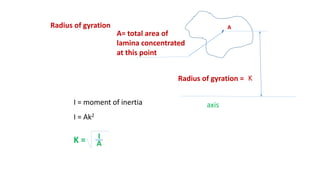
2. Radius of gyration
3.Area moment of Inertia
JNTU – Dec2006
1.Centroid
centroid
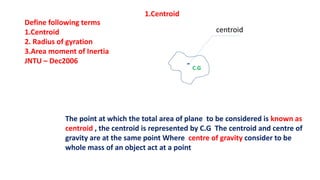
The point at which the total area of plane to be considered is known as
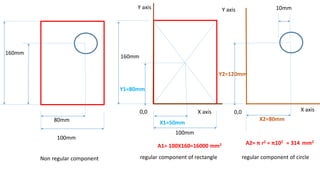
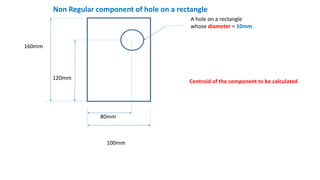
centroid , the centroid is represented by C.G The centroid and centre of
gravity are at the same point Where centre of gravity consider to be
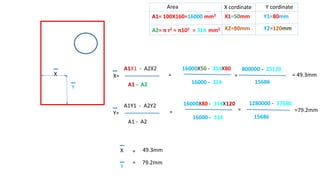
whole mass of an object act at a point
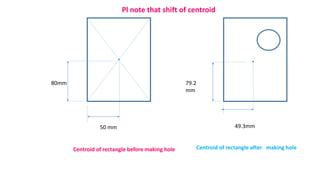
C.G
x axis
Y
y axis
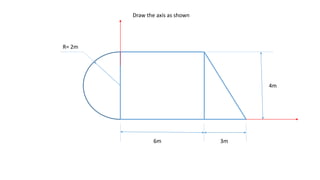
X
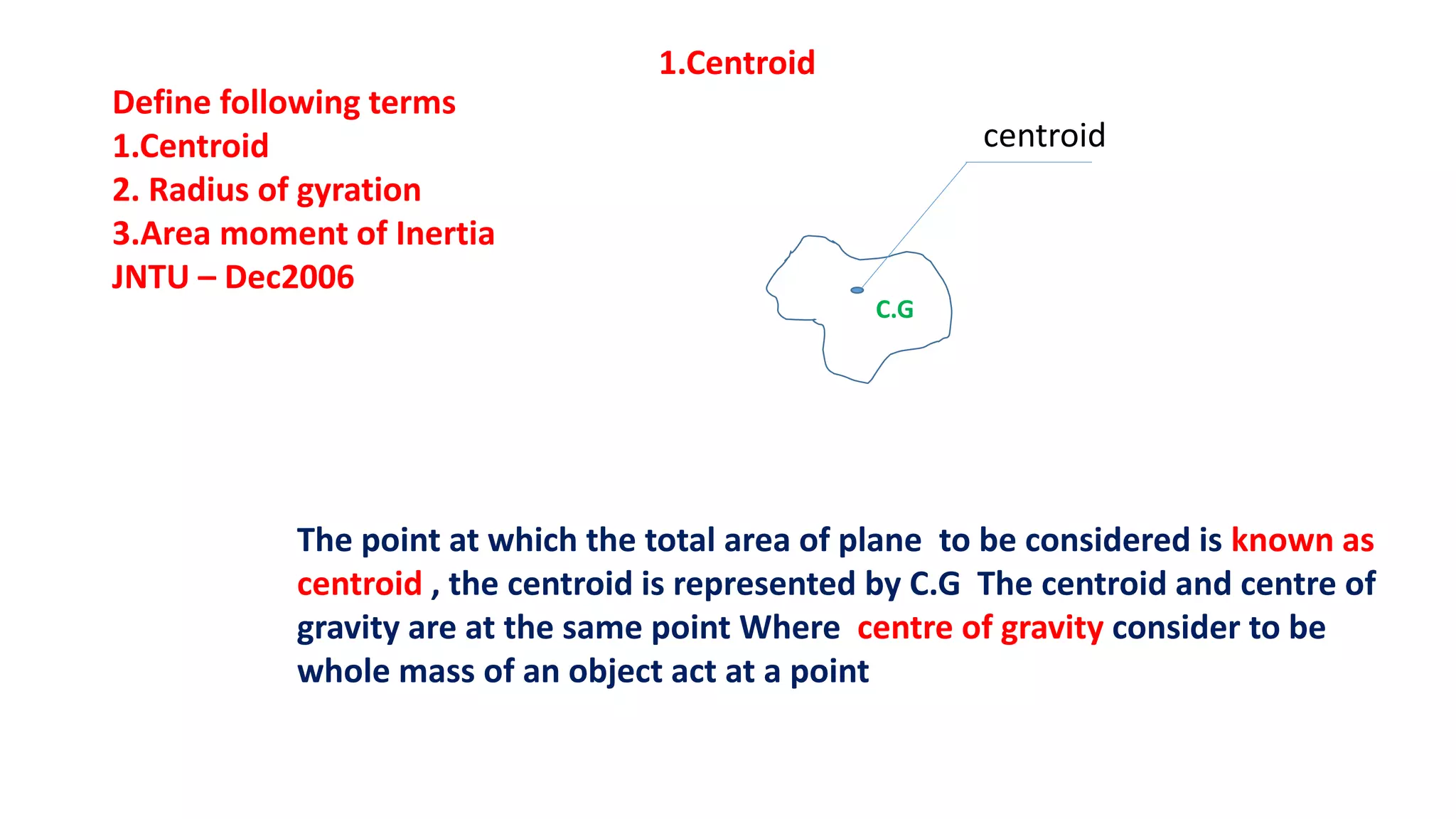
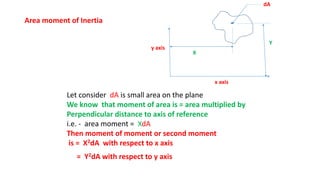
Let consider dA is small area on the plane
We know that moment of area is = area multiplied by
Perpendicular distance to axis of reference
i.e. - area moment = XdA
Then moment of moment or second moment
is = X2dA with respect to x axis
Area moment of Inertia
dA
= Y2dA with respect to y axis
Area moment of Inertia
x axis
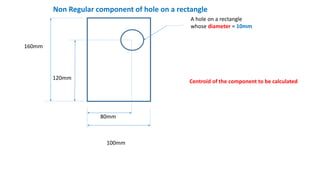
Y
y axis
centroid
C.G
X
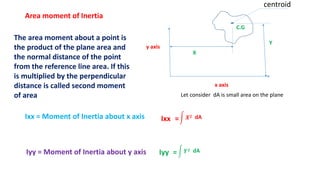
Ixx = Moment of Inertia about x axis
Iyy = Moment of Inertia about y axis
𝑿 𝟐 dAIxx =
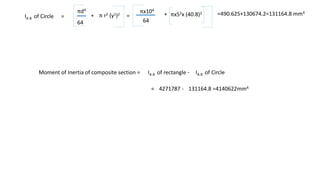
𝒀 𝟐 dAIyy =
The area moment about a point is
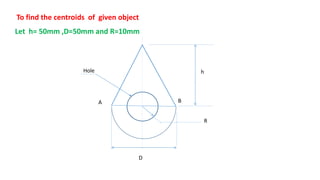
the product of the plane area and
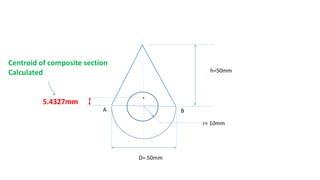
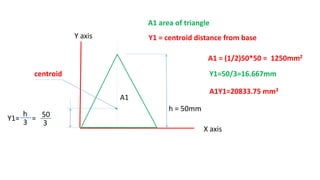
the normal distance of the point
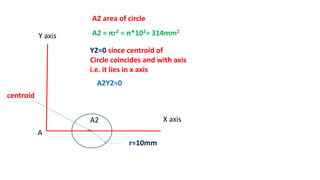
from the reference line area. If this
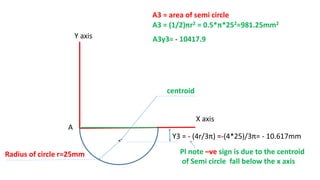
is multiplied by the perpendicular
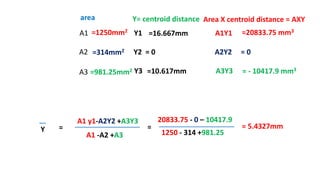
distance is called second moment
of area Let consider dA is small area on the plane
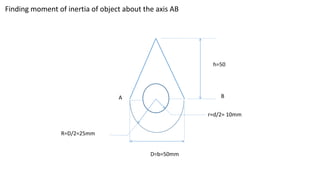
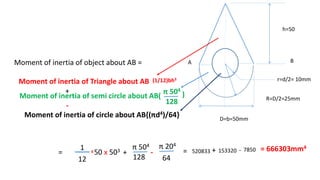
Radius of gyration
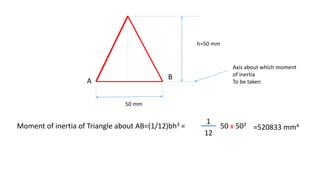
K
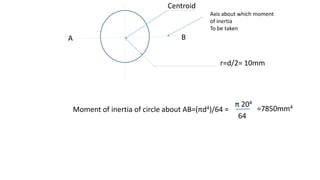
A= total area of
lamina concentrated
at this point
A
Radius of gyration =
axis
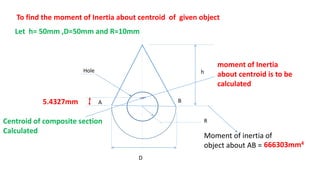
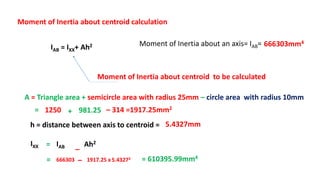
I = Ak2
I = moment of inertia
K = I
A
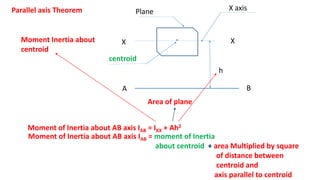
Parallel axis Theorem
X X
h
X axis
A B
Plane
centroid
Moment of Inertia about AB axis IAB = IXX + Ah2
Area of plane
Moment Inertia about
centroid
Moment of Inertia about AB axis IAB = moment of Inertia
about centroid + area Multiplied by square
of distance between
centroid and
axis parallel to centroid
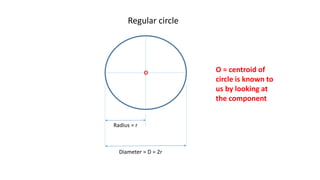
O
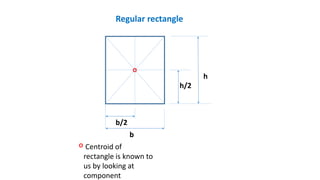
b
b/2
h/2
h
Centroid of
rectangle is known to
us by looking at
component
O
Regular rectangle
Radius = r
Diameter = D = 2r
O O = centroid of
circle is known to
us by looking at
the component
Regular circle
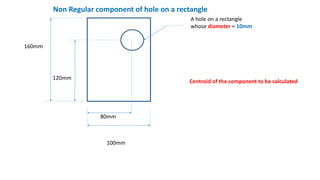
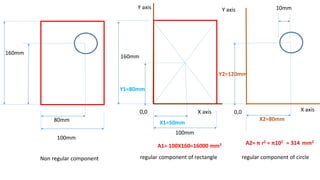
A hole on a rectangle
whose diameter = 10mm
80mm
160mm
120mm
100mm
Non Regular component of hole on a rectangle
Centroid of the component to be calculated
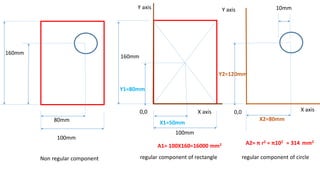
80mm
160mm
100mm
160mm
X2=80mm
Y2=120mm
100mm
X1=50mm
Y1=80mm
10mm
0,0 0,0
Y axis
X axis
Y axis
X axis
Non regular component regular component of rectangle regular component of circle
A1= 100X160=16000 mm2 A2= π r2 = π102 = 314 mm2
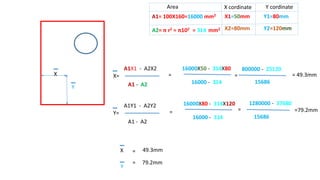
Y
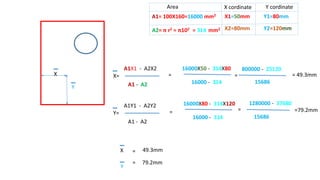
X X=
A1X1 - A2X2
A1 - A2
Y=
A1Y1 - A2Y2
A1 - A2
=
=
A1= 100X160=16000 mm2
A2= π r2 = π102 = 314 mm2
X1=50mm Y1=80mm
X2=80mm Y2=120mm
Area X cordinate Y cordinate
16000X50 - 314X80
16000 - 314
16000X80 - 314X120
16000 - 314
800000 - 25120
=
=
15686
1280000 - 37680
15686
= 49.3mm
=79.2mm
X = 49.3mm
Y
= 79.2mm
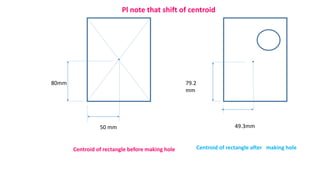
50 mm
80mm
49.3mm
79.2
mm
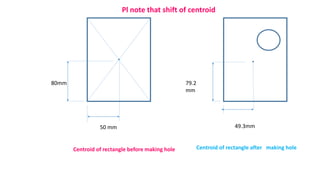
Centroid of rectangle before making hole Centroid of rectangle after making hole
Pl note that shift of centroid
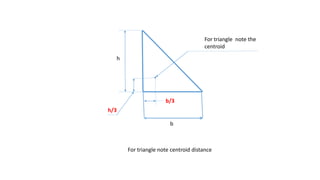
b
h/3
b/3
h
For triangle note the
centroid
For triangle note centroid distance
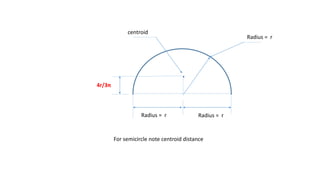
centroid
Radius = rRadius = r
4r/3π
Radius = r
For semicircle note centroid distance
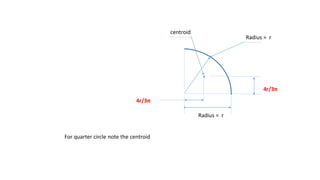
centroid
Radius = rRadius = r
4r/3π
Radius = r
4r/3π
4r/3π
For quarter circle note the centroid
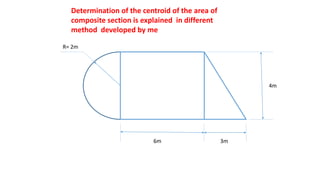
R= 2m
6m 3m
4m
Determination of the centroid of the area of
composite section is explained in different
method developed by me
R= 2m
6m 3m
4m
Draw the axis as shown
R= 2m
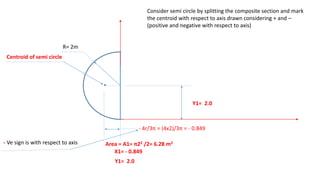
Consider semi circle by splitting the composite section and mark
the centroid with respect to axis drawn considering + and –
(positive and negative with respect to axis)
- 4r/3π = (4x2)/3π = - 0.849
Area = A1= π22 /2= 6.28 m2
X1= - 0.849
Y1= 2.0
Y1= 2.0
- Ve sign is with respect to axis
Centroid of semi circle
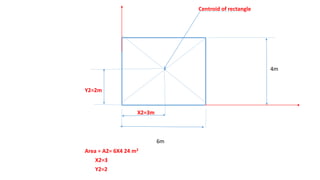
6m
4m
X2=3m
Y2=2m
Area = A2= 6X4 24 m2
X2=3
Y2=2
Centroid of rectangle
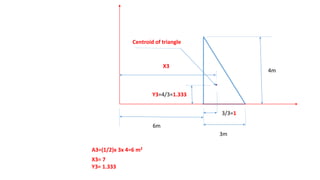
6m
3m
4m
3/3=1
Y3=4/3=1.333
A3=(1/2)x 3x 4=6 m2
X3= 7
Y3= 1.333
X3
Centroid of triangle
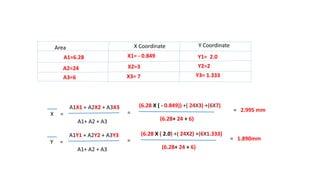
Area X Coordinate Y Coordinate
A1=6.28 X1= - 0.849 Y1= 2.0
A2=24 X2=3 Y2=2
A3=6 X3= 7 Y3= 1.333
X =
A1X1 + A2X2 + A3X3
A1+ A2 + A3
=
(6.28 X ( - 0.849)) +( 24X3) +(6X7)
(6.28+ 24 + 6)
= 2.995 mm
Y =
A1Y1 + A2Y2 + A3Y3
A1+ A2 + A3
=
(6.28 X ( 2.0) +( 24X2) +(6X1.333)
(6.28+ 24 + 6)
= 1.890mm
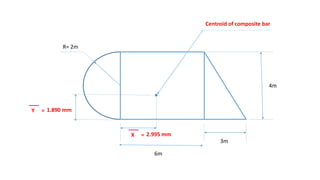
R= 2m
6m
3m
4m
X = 2.995 mm
Y = 1.890 mm
Centroid of composite bar
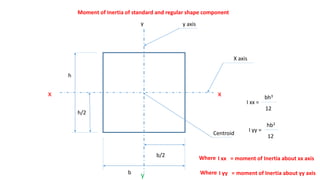
Moment of Inertia of standard and regular shape component
h/2
h
b/2
b
xx
y
y
X axis
y axis
Centroid
I xx =
bh3
12
I yy =
hb3
12
Where I xx = moment of Inertia about xx axis
Where I yy = moment of Inertia about yy axis
x
X axis
x
Y
Y
Y1
BA
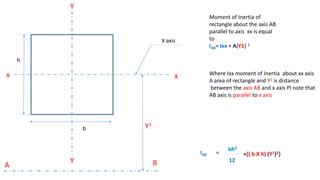
Moment of Inertia of
rectangle about the axis AB
parallel to axis xx is equal
to
IAB= Ixx + A(Y1) 2
Where Ixx moment of Inertia about xx axis
A area of rectangle and Y1 is distance
between the axis AB and x axis Pl note that
AB axis is parallel to x axis
IAB =
bh3
12
+{( b X h) (Y1)2
b
h
}
XX
Y
Y
X axis
Y axis
d = Diameter of circle
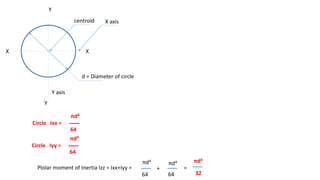
Circle Ixx =
πd4
64
centroid
Circle Iyy =
πd4
64
Plolar moment of Inertia Izz = Ixx+Iyy =
πd4
64
+
πd4
64
=
πd4
32
centroid
Radius = rRadius = r
4r/3π
Radius = r
For semicircle note centroid distance
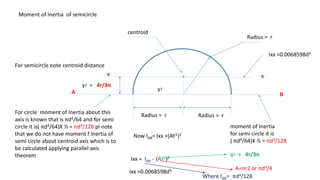
Moment of Inertia of semicircle
For circle moment of Inertia about this
axis is known that is πd4/64 and for semi
circle it is( πd4/64)X ½ = πd4/128 pl note
that we do not have moment f Inertia of
semi circle about centroid axis which is to
be calculated applying parallel axis
theorem
x x
BA
moment of Inertia
for semi circle it is
( πd4/64)X ½ = πd4/128
Now IAB= Ixx +(AY1)2
Y1 =
Ixx =0.0068598d4
Ixx =0.0068598d4
Where IAB= πd4/128
A=πr2 or πd4/4
Ixx = IAB - (AY1)2
Y1
4r/3πY1 =
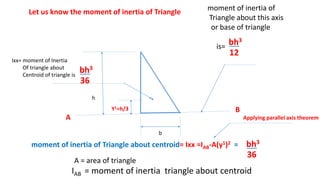
Let us know the moment of inertia of Triangle
A
B
moment of inertia of
Triangle about this axis
or base of triangle
is=
b
Y1=h/3
Ixx= moment of Inertia
Of triangle about
Centroid of triangle is
moment of inertia of Triangle about centroid= Ixx =IAB-A(y1)2 =
h
A = area of triangle
IAB = moment of inertia triangle about centroid
bh3
12
bh3
36
bh3
36
Applying parallel axis theorem
A hole on a rectangle
whose diameter = 10mm
80mm
160mm
120mm
100mm
Non Regular component of hole on a rectangle
Centroid of the component to be calculated
80mm
160mm
100mm
160mm
X2=80mm
Y2=120mm
100mm
X1=50mm
Y1=80mm
10mm
0,0 0,0
Y axis
X axis
Y axis
X axis
Non regular component regular component of rectangle regular component of circle
A1= 100X160=16000 mm2 A2= π r2 = π102 = 314 mm2
Y
X X=
A1X1 - A2X2
A1 - A2
Y=
A1Y1 - A2Y2
A1 - A2
=
=
A1= 100X160=16000 mm2
A2= π r2 = π102 = 314 mm2
X1=50mm Y1=80mm
X2=80mm Y2=120mm
Area X cordinate Y cordinate
16000X50 - 314X80
16000 - 314
16000X80 - 314X120
16000 - 314
800000 - 25120
=
=
15686
1280000 - 37680
15686
= 49.3mm
=79.2mm
X = 49.3mm
Y
= 79.2mm
50 mm
80mm
49.3mm
79.2
mm
Centroid of rectangle before making hole Centroid of rectangle after making hole
Pl note that shift of centroid
A hole on a rectangle
whose diameter = 10mm
80mm
160mm
120mm
100mm
Non Regular component of hole on a rectangle
Centroid of the component to be calculated
80mm
160mm
100mm
160mm
X2=80mm
Y2=120mm
100mm
X1=50mm
Y1=80mm
10mm
0,0 0,0
Y axis
X axis
Y axis
X axis
Non regular component regular component of rectangle regular component of circle
A1= 100X160=16000 mm2 A2= π r2 = π102 = 314 mm2
Y
X X=
A1X1 - A2X2
A1 - A2
Y=
A1Y1 - A2Y2
A1 - A2
=
=
A1= 100X160=16000 mm2
A2= π r2 = π102 = 314 mm2
X1=50mm Y1=80mm
X2=80mm Y2=120mm
Area X cordinate Y cordinate
16000X50 - 314X80
16000 - 314
16000X80 - 314X120
16000 - 314
800000 - 25120
=
=
15686
1280000 - 37680
15686
= 49.3mm
=79.2mm
X = 49.3mm
Y
= 79.2mm
50 mm
80mm
49.3mm
79.2
mm
Centroid of rectangle before making hole Centroid of rectangle after making hole
Pl note that shift of centroid
50 mm
80mm
49.3mm
79.2mm
Centroid of rectangle before making hole
Centroid of rectangle after making hole
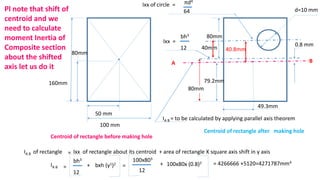
Pl note that shift of
centroid and we
need to calculate
moment Inertia of
Composite section
about the shifted
axis let us do it
Ixx =
bh3
12
Ixx of circle = πd4
64 d=10 mm
0.8 mm
A B
IA B = to be calculated by applying parallel axis theorem
IA B of rectangle Ixx of rectangle about its centroid + area of rectangle X square axis shift in y axis
160mm
100 mm
=
IA B =
bh3
12
+ bxh (y1)2
=
100x803
12
+ 100x80x (0.8)2 = 4266666 +5120=4271787mm4
40.8mm
80mm
80mm
40mm
IA B of Circle =
πd4
64
+ π r2 (y1)2
=
πx104
64
+ πx52x (40.8)2 =490.625+130674.2=131164.8 mm4
Moment of Inertia of composite section = IA B of rectangle - IA B of Circle
4271787 -= 131164.8 =4140622mm4
To find the centroids of given object
Let h= 50mm ,D=50mm and R=10mm
h
D
R
A B
Hole
A1 = (1/2)50*50 = 1250mm2
Y1=50/3=16.667mm
A1Y1=20833.75 mm3
A1
Y1= =
h = 50mm
A1 area of triangle
centroid
Y1 = centroid distance from base
h
3
50
3
X axis
Y axis
r=10mm
A2
Y2=0 since centroid of
Circle coincides and with axis
i.e. it lies in x axis
A2 = πr2 = π*102= 314mm2
A2Y2=0
centroid
A2 area of circle
Y axis
X axis
A
X axis
Y axis
Y3 = - (4r/3π) =-(4*25)/3π= - 10.617mm
Pl note –ve sign is due to the centroid
of Semi circle fall below the x axis
centroid
Radius of circle r=25mm
A3y3= - 10417.9
A3 = (1/2)πr2 = 0.5*π*252=981.25mm2
A3 = area of semi circle
A
A1 y1-A2Y2 +A3Y3
Y =
A1 -A2 +A3
=
20833.75 - 0 – 10417.9
1250 - 314 +981.25
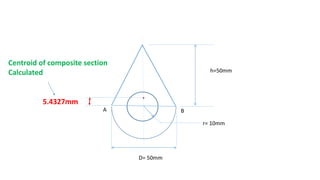
= 5.4327mm
area Y= centroid distance Area X centroid distance = AXY
A1 Y1 A1Y1
A2 Y2 = 0 A2Y2 = 0
A3 Y3 A3Y3
=1250mm2
=16.667mm =20833.75 mm3
=314mm2
=981.25mm2 =10.617mm = - 10417.9 mm3
h=50mm
D= 50mm
r= 10mm
A B
5.4327mm
Centroid of composite section
Calculated
Finding moment of inertia of object about the axis AB
h=50
D=b=50mm
R=D/2=25mm
r=d/2= 10mm
A B
Moment of inertia of Triangle about AB=(1/12)bh3 =
h=50 mm
B
50 mm
A
1
12
50 x 503
=520833 mm4
Axis about which moment
of inertia
To be taken
r=d/2= 10mm
A B
Moment of inertia of circle about AB=(πd4)/64 =
π 204
64
Centroid
=7850mm4
Axis about which moment
of inertia
To be taken
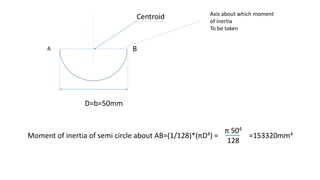
Moment of inertia of semi circle about AB=(1/128)*(πD4) =
π 504
128
D=b=50mm
A B
Centroid
=153320mm4
Axis about which moment
of inertia
To be taken
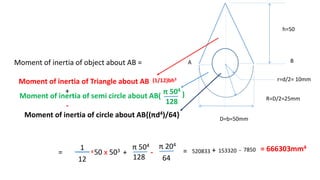
Moment of inertia of object about AB =
Moment of inertia of Triangle about AB
+
Moment of inertia of semi circle about AB(
-
Moment of inertia of circle about AB{(πd4)/64}
1
12
50 x 503= +
π 504
128
-
π 204
64
=x 520833 + 153320 - 7850 = 666303mm4
h=50
D=b=50mm
R=D/2=25mm
r=d/2= 10mm
A B
π 504
128
(1/12)bh3
(
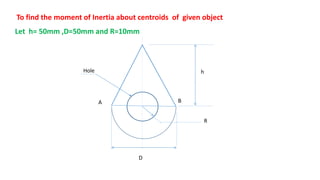
To find the moment of Inertia about centroids of given object
Let h= 50mm ,D=50mm and R=10mm
h
D
R
A B
Hole
h=50mm
D= 50mm
r= 10mm
A B
5.4327mm
Centroid of composite section
Calculated
Moment of inertia of object about AB =
Moment of inertia of Triangle about AB
+
Moment of inertia of semi circle about AB(
-
Moment of inertia of circle about AB{(πd4)/64}
1
12
50 x 503= +
π 504
128
-
π 204
64
=x 520833 + 153320 - 7850 = 666303mm4
h=50
D=b=50mm
R=D/2=25mm
r=d/2= 10mm
A B
π 504
128
(1/12)bh3
(
To find the moment of Inertia about centroid of given object
Let h= 50mm ,D=50mm and R=10mm
h
D
R
A B
Hole
5.4327mm
Centroid of composite section
Calculated
Moment of inertia of
object about AB = 666303mm4
moment of Inertia
about centroid is to be
calculated
Moment of Inertia about centroid calculation
IAB = IXX+ Ah2 Moment of Inertia about an axis= IAB= 666303mm4
Moment of Inertia about centroid to be calculated
A = Triangle area + semicircle area with radius 25mm – circle area with radius 10mm
h = distance between axis to centroid = 5.4327mm
1250= + 981.25 – 314 =1917.25mm2
IXX = IAB Ah2
= 1917.25 x666303 –
–
5.43272 = 610395.99mm4

centroid

  • 1.
    Define following terms 1.Centroid 2.Radius of gyration 3.Area moment of Inertia JNTU – Dec2006 1.Centroid centroid The point at which the total area of plane to be considered is known as centroid , the centroid is represented by C.G The centroid and centre of gravity are at the same point Where centre of gravity consider to be whole mass of an object act at a point C.G
  • 2.
    x axis Y y axis X Letconsider dA is small area on the plane We know that moment of area is = area multiplied by Perpendicular distance to axis of reference i.e. - area moment = XdA Then moment of moment or second moment is = X2dA with respect to x axis Area moment of Inertia dA = Y2dA with respect to y axis
  • 3.
    Area moment ofInertia x axis Y y axis centroid C.G X Ixx = Moment of Inertia about x axis Iyy = Moment of Inertia about y axis 𝑿 𝟐 dAIxx = 𝒀 𝟐 dAIyy = The area moment about a point is the product of the plane area and the normal distance of the point from the reference line area. If this is multiplied by the perpendicular distance is called second moment of area Let consider dA is small area on the plane
  • 4.
    Radius of gyration K A=total area of lamina concentrated at this point A Radius of gyration = axis I = Ak2 I = moment of inertia K = I A
  • 5.
    Parallel axis Theorem XX h X axis A B Plane centroid Moment of Inertia about AB axis IAB = IXX + Ah2 Area of plane Moment Inertia about centroid Moment of Inertia about AB axis IAB = moment of Inertia about centroid + area Multiplied by square of distance between centroid and axis parallel to centroid
  • 6.
    O b b/2 h/2 h Centroid of rectangle isknown to us by looking at component O Regular rectangle
  • 7.
    Radius = r Diameter= D = 2r O O = centroid of circle is known to us by looking at the component Regular circle
  • 8.
    A hole ona rectangle whose diameter = 10mm 80mm 160mm 120mm 100mm Non Regular component of hole on a rectangle Centroid of the component to be calculated
  • 9.
    80mm 160mm 100mm 160mm X2=80mm Y2=120mm 100mm X1=50mm Y1=80mm 10mm 0,0 0,0 Y axis Xaxis Y axis X axis Non regular component regular component of rectangle regular component of circle A1= 100X160=16000 mm2 A2= π r2 = π102 = 314 mm2
  • 10.
    Y X X= A1X1 -A2X2 A1 - A2 Y= A1Y1 - A2Y2 A1 - A2 = = A1= 100X160=16000 mm2 A2= π r2 = π102 = 314 mm2 X1=50mm Y1=80mm X2=80mm Y2=120mm Area X cordinate Y cordinate 16000X50 - 314X80 16000 - 314 16000X80 - 314X120 16000 - 314 800000 - 25120 = = 15686 1280000 - 37680 15686 = 49.3mm =79.2mm X = 49.3mm Y = 79.2mm
  • 11.
    50 mm 80mm 49.3mm 79.2 mm Centroid ofrectangle before making hole Centroid of rectangle after making hole Pl note that shift of centroid
  • 12.
    b h/3 b/3 h For triangle notethe centroid For triangle note centroid distance
  • 13.
    centroid Radius = rRadius= r 4r/3π Radius = r For semicircle note centroid distance
  • 14.
    centroid Radius = rRadius= r 4r/3π Radius = r 4r/3π 4r/3π For quarter circle note the centroid
  • 15.
    R= 2m 6m 3m 4m Determinationof the centroid of the area of composite section is explained in different method developed by me
  • 16.
    R= 2m 6m 3m 4m Drawthe axis as shown
  • 17.
    R= 2m Consider semicircle by splitting the composite section and mark the centroid with respect to axis drawn considering + and – (positive and negative with respect to axis) - 4r/3π = (4x2)/3π = - 0.849 Area = A1= π22 /2= 6.28 m2 X1= - 0.849 Y1= 2.0 Y1= 2.0 - Ve sign is with respect to axis Centroid of semi circle
  • 18.
    6m 4m X2=3m Y2=2m Area = A2=6X4 24 m2 X2=3 Y2=2 Centroid of rectangle
  • 19.
    6m 3m 4m 3/3=1 Y3=4/3=1.333 A3=(1/2)x 3x 4=6m2 X3= 7 Y3= 1.333 X3 Centroid of triangle
  • 20.
    Area X CoordinateY Coordinate A1=6.28 X1= - 0.849 Y1= 2.0 A2=24 X2=3 Y2=2 A3=6 X3= 7 Y3= 1.333 X = A1X1 + A2X2 + A3X3 A1+ A2 + A3 = (6.28 X ( - 0.849)) +( 24X3) +(6X7) (6.28+ 24 + 6) = 2.995 mm Y = A1Y1 + A2Y2 + A3Y3 A1+ A2 + A3 = (6.28 X ( 2.0) +( 24X2) +(6X1.333) (6.28+ 24 + 6) = 1.890mm
  • 21.
    R= 2m 6m 3m 4m X =2.995 mm Y = 1.890 mm Centroid of composite bar
  • 22.
    Moment of Inertiaof standard and regular shape component h/2 h b/2 b xx y y X axis y axis Centroid I xx = bh3 12 I yy = hb3 12 Where I xx = moment of Inertia about xx axis Where I yy = moment of Inertia about yy axis
  • 23.
    x X axis x Y Y Y1 BA Moment ofInertia of rectangle about the axis AB parallel to axis xx is equal to IAB= Ixx + A(Y1) 2 Where Ixx moment of Inertia about xx axis A area of rectangle and Y1 is distance between the axis AB and x axis Pl note that AB axis is parallel to x axis IAB = bh3 12 +{( b X h) (Y1)2 b h }
  • 24.
    XX Y Y X axis Y axis d= Diameter of circle Circle Ixx = πd4 64 centroid Circle Iyy = πd4 64 Plolar moment of Inertia Izz = Ixx+Iyy = πd4 64 + πd4 64 = πd4 32
  • 25.
    centroid Radius = rRadius= r 4r/3π Radius = r For semicircle note centroid distance Moment of Inertia of semicircle For circle moment of Inertia about this axis is known that is πd4/64 and for semi circle it is( πd4/64)X ½ = πd4/128 pl note that we do not have moment f Inertia of semi circle about centroid axis which is to be calculated applying parallel axis theorem x x BA moment of Inertia for semi circle it is ( πd4/64)X ½ = πd4/128 Now IAB= Ixx +(AY1)2 Y1 = Ixx =0.0068598d4 Ixx =0.0068598d4 Where IAB= πd4/128 A=πr2 or πd4/4 Ixx = IAB - (AY1)2 Y1 4r/3πY1 =
  • 26.
    Let us knowthe moment of inertia of Triangle A B moment of inertia of Triangle about this axis or base of triangle is= b Y1=h/3 Ixx= moment of Inertia Of triangle about Centroid of triangle is moment of inertia of Triangle about centroid= Ixx =IAB-A(y1)2 = h A = area of triangle IAB = moment of inertia triangle about centroid bh3 12 bh3 36 bh3 36 Applying parallel axis theorem
  • 27.
    A hole ona rectangle whose diameter = 10mm 80mm 160mm 120mm 100mm Non Regular component of hole on a rectangle Centroid of the component to be calculated
  • 28.
    80mm 160mm 100mm 160mm X2=80mm Y2=120mm 100mm X1=50mm Y1=80mm 10mm 0,0 0,0 Y axis Xaxis Y axis X axis Non regular component regular component of rectangle regular component of circle A1= 100X160=16000 mm2 A2= π r2 = π102 = 314 mm2
  • 29.
    Y X X= A1X1 -A2X2 A1 - A2 Y= A1Y1 - A2Y2 A1 - A2 = = A1= 100X160=16000 mm2 A2= π r2 = π102 = 314 mm2 X1=50mm Y1=80mm X2=80mm Y2=120mm Area X cordinate Y cordinate 16000X50 - 314X80 16000 - 314 16000X80 - 314X120 16000 - 314 800000 - 25120 = = 15686 1280000 - 37680 15686 = 49.3mm =79.2mm X = 49.3mm Y = 79.2mm
  • 30.
    50 mm 80mm 49.3mm 79.2 mm Centroid ofrectangle before making hole Centroid of rectangle after making hole Pl note that shift of centroid
  • 31.
    A hole ona rectangle whose diameter = 10mm 80mm 160mm 120mm 100mm Non Regular component of hole on a rectangle Centroid of the component to be calculated
  • 32.
    80mm 160mm 100mm 160mm X2=80mm Y2=120mm 100mm X1=50mm Y1=80mm 10mm 0,0 0,0 Y axis Xaxis Y axis X axis Non regular component regular component of rectangle regular component of circle A1= 100X160=16000 mm2 A2= π r2 = π102 = 314 mm2
  • 33.
    Y X X= A1X1 -A2X2 A1 - A2 Y= A1Y1 - A2Y2 A1 - A2 = = A1= 100X160=16000 mm2 A2= π r2 = π102 = 314 mm2 X1=50mm Y1=80mm X2=80mm Y2=120mm Area X cordinate Y cordinate 16000X50 - 314X80 16000 - 314 16000X80 - 314X120 16000 - 314 800000 - 25120 = = 15686 1280000 - 37680 15686 = 49.3mm =79.2mm X = 49.3mm Y = 79.2mm
  • 34.
    50 mm 80mm 49.3mm 79.2 mm Centroid ofrectangle before making hole Centroid of rectangle after making hole Pl note that shift of centroid
  • 35.
    50 mm 80mm 49.3mm 79.2mm Centroid ofrectangle before making hole Centroid of rectangle after making hole Pl note that shift of centroid and we need to calculate moment Inertia of Composite section about the shifted axis let us do it Ixx = bh3 12 Ixx of circle = πd4 64 d=10 mm 0.8 mm A B IA B = to be calculated by applying parallel axis theorem IA B of rectangle Ixx of rectangle about its centroid + area of rectangle X square axis shift in y axis 160mm 100 mm = IA B = bh3 12 + bxh (y1)2 = 100x803 12 + 100x80x (0.8)2 = 4266666 +5120=4271787mm4 40.8mm 80mm 80mm 40mm
  • 36.
    IA B ofCircle = πd4 64 + π r2 (y1)2 = πx104 64 + πx52x (40.8)2 =490.625+130674.2=131164.8 mm4 Moment of Inertia of composite section = IA B of rectangle - IA B of Circle 4271787 -= 131164.8 =4140622mm4
  • 37.
    To find thecentroids of given object Let h= 50mm ,D=50mm and R=10mm h D R A B Hole
  • 38.
    A1 = (1/2)50*50= 1250mm2 Y1=50/3=16.667mm A1Y1=20833.75 mm3 A1 Y1= = h = 50mm A1 area of triangle centroid Y1 = centroid distance from base h 3 50 3 X axis Y axis
  • 39.
    r=10mm A2 Y2=0 since centroidof Circle coincides and with axis i.e. it lies in x axis A2 = πr2 = π*102= 314mm2 A2Y2=0 centroid A2 area of circle Y axis X axis A
  • 40.
    X axis Y axis Y3= - (4r/3π) =-(4*25)/3π= - 10.617mm Pl note –ve sign is due to the centroid of Semi circle fall below the x axis centroid Radius of circle r=25mm A3y3= - 10417.9 A3 = (1/2)πr2 = 0.5*π*252=981.25mm2 A3 = area of semi circle A
  • 41.
    A1 y1-A2Y2 +A3Y3 Y= A1 -A2 +A3 = 20833.75 - 0 – 10417.9 1250 - 314 +981.25 = 5.4327mm area Y= centroid distance Area X centroid distance = AXY A1 Y1 A1Y1 A2 Y2 = 0 A2Y2 = 0 A3 Y3 A3Y3 =1250mm2 =16.667mm =20833.75 mm3 =314mm2 =981.25mm2 =10.617mm = - 10417.9 mm3
  • 42.
    h=50mm D= 50mm r= 10mm AB 5.4327mm Centroid of composite section Calculated
  • 43.
    Finding moment ofinertia of object about the axis AB h=50 D=b=50mm R=D/2=25mm r=d/2= 10mm A B
  • 44.
    Moment of inertiaof Triangle about AB=(1/12)bh3 = h=50 mm B 50 mm A 1 12 50 x 503 =520833 mm4 Axis about which moment of inertia To be taken
  • 45.
    r=d/2= 10mm A B Momentof inertia of circle about AB=(πd4)/64 = π 204 64 Centroid =7850mm4 Axis about which moment of inertia To be taken
  • 46.
    Moment of inertiaof semi circle about AB=(1/128)*(πD4) = π 504 128 D=b=50mm A B Centroid =153320mm4 Axis about which moment of inertia To be taken
  • 47.
    Moment of inertiaof object about AB = Moment of inertia of Triangle about AB + Moment of inertia of semi circle about AB( - Moment of inertia of circle about AB{(πd4)/64} 1 12 50 x 503= + π 504 128 - π 204 64 =x 520833 + 153320 - 7850 = 666303mm4 h=50 D=b=50mm R=D/2=25mm r=d/2= 10mm A B π 504 128 (1/12)bh3 (
  • 48.
    To find themoment of Inertia about centroids of given object Let h= 50mm ,D=50mm and R=10mm h D R A B Hole
  • 49.
    h=50mm D= 50mm r= 10mm AB 5.4327mm Centroid of composite section Calculated
  • 50.
    Moment of inertiaof object about AB = Moment of inertia of Triangle about AB + Moment of inertia of semi circle about AB( - Moment of inertia of circle about AB{(πd4)/64} 1 12 50 x 503= + π 504 128 - π 204 64 =x 520833 + 153320 - 7850 = 666303mm4 h=50 D=b=50mm R=D/2=25mm r=d/2= 10mm A B π 504 128 (1/12)bh3 (
  • 51.
    To find themoment of Inertia about centroid of given object Let h= 50mm ,D=50mm and R=10mm h D R A B Hole 5.4327mm Centroid of composite section Calculated Moment of inertia of object about AB = 666303mm4 moment of Inertia about centroid is to be calculated
  • 52.
    Moment of Inertiaabout centroid calculation IAB = IXX+ Ah2 Moment of Inertia about an axis= IAB= 666303mm4 Moment of Inertia about centroid to be calculated A = Triangle area + semicircle area with radius 25mm – circle area with radius 10mm h = distance between axis to centroid = 5.4327mm 1250= + 981.25 – 314 =1917.25mm2 IXX = IAB Ah2 = 1917.25 x666303 – – 5.43272 = 610395.99mm4