Product Design & Value Engineering
Ch: 1 Introduction
P R E PA R E D B Y
MR. CHIRAG PATEL
M.E. (ADVANCED MANUFACTURING SYSTEM)
ASSISTANT PROFESSOR
MECHANICAL ENGINEERING DEPARTMENT
PACIFIC SCHOOL OF ENGINEERING
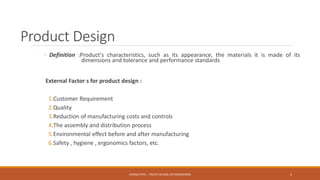
Product Design
◦ Definition :Product's characteristics, such as its appearance, the materials it is made of its
dimensions and tolerance and performance standards
External Factor s for product design :
1.Customer Requirement
2.Quality
3.Reduction of manufacturing costs and controls
4.The assembly and distribution process
5.Environmental effect before and after manufacturing
6.Safety , hygiene , ergonomics factors, etc.
2CHIRAG PATEL - PACIFIC SCHOOL OF ENGINEERING
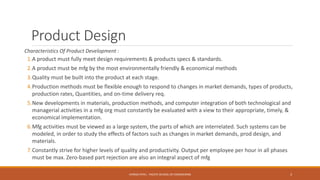
Product Design
Characteristics Of Product Development :
1.A product must fully meet design requirements & products specs & standards.
2.A product must be mfg by the most environmentally friendly & economical methods
3.Quality must be built into the product at each stage.
4.Production methods must be flexible enough to respond to changes in market demands, types of products,
production rates, Quantities, and on-time delivery req.
5.New developments in materials, production methods, and computer integration of both technological and
managerial activities in a mfg org must constantly be evaluated with a view to their appropriate, timely, &
economical implementation.
6.Mfg activities must be viewed as a large system, the parts of which are interrelated. Such systems can be
modeled, in order to study the effects of factors such as changes in market demands, prod design, and
materials.
7.Constantly strive for higher levels of quality and productivity. Output per employee per hour in all phases
must be max. Zero-based part rejection are also an integral aspect of mfg
3CHIRAG PATEL - PACIFIC SCHOOL OF ENGINEERING
Design And Development Of Product
1. Concurrent Engineering(ce)
2. Quality Function Deployment (QFD)
3. Design For (DFX)
4. Failure Mode And Effects Analysis (FMEA)
5. Computation Techniques And Tools
1. Engineering / Product Based Data Management (E/P BDM)
2. Knowledge Based Engineering (KBE)
3. Finite Element Analysis (FEA)
4. Rapid Prototyping (RP)
4CHIRAG PATEL - PACIFIC SCHOOL OF ENGINEERING
Design And Development Of Product
1 Concurrent Engineering(CE)
CE is a systematic approach integrating the design and mfg of products, with a view toward
optimizing all elements involved in the life cycle of the product.
Life cycle means that all aspects of a product, such as design, development, production,
distribution, use, disposal, and recycling, are considered simultaneously.
Basic goals of CE:
1.reduce changes in product’s design & engineering.
2.reduce time and costs involved in taking the product form its design concept to its production
and its introduction into the marketplace.
5CHIRAG PATEL - PACIFIC SCHOOL OF ENGINEERING
1 Concurrent Engineering(CE)
A well-designed product is:
1. functional (design)
2. well-manufactured (production)
3. well-packaged (distribution)
4. durable (functions effectively for its intended life)
5. maintainable (use)
6. resource-efficient (can be disassembled so that components can be recycled-disposal)
For CE to succeed, it must:
1. have the full support of upper management;
2. have multifunctional and interactive teamwork, including support groups
3. utilize all available technologies.
6CHIRAG PATEL - PACIFIC SCHOOL OF ENGINEERING
2.Quality Function Deployment (QFD)
Quality Function Deployment (QFD):
QFD is defined as a method for developing a design quality aiming at satisfying the consumer and then
translating the consumer's demand into design targets and major quality assurance points to be used throughout the
production phase.
QFD performed on
Marketing
Research
Development
 process planning
Quality assurance and
Manufacturing
7CHIRAG PATEL - PACIFIC SCHOOL OF ENGINEERING
2.Quality Function Deployment (QFD)
QFD Approach permits
a) Listening the voice of customer
b) Improving horizontal and vertical communication
c) Setting priorities for product development
d) Improving product reliability
e) Defining technical goals
f) Sequencing the individual goals
g) Defining area of cost reduction
8CHIRAG PATEL - PACIFIC SCHOOL OF ENGINEERING
Design for X(DfX)
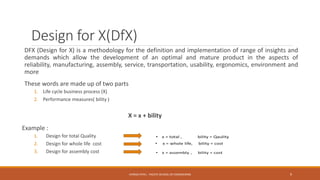
DFX (Design for X) is a methodology for the definition and implementation of range of insights and
demands which allow the development of an optimal and mature product in the aspects of
reliability, manufacturing, assembly, service, transportation, usability, ergonomics, environment and
more
These words are made up of two parts
1. Life cycle business process (X)
2. Performance measures( bility )
X = x + bility
Example :
1. Design for total Quality
2. Design for whole life cost
3. Design for assembly cost
9CHIRAG PATEL - PACIFIC SCHOOL OF ENGINEERING
4 Failure Mode And Effects Analysis
(FMEA)
Definition: Failure modes and effects analysis (FMEA) is a step-by-step approach for identifying
all possible failures in a design, a manufacturing or assembly process, or a product
or service.
There are two type of FMEA
1. Process
2. Design
FMEA used for
1. New development of product
2. Security and problem parts
3. Product of process modification
4. New operation or other condition of existing products
10CHIRAG PATEL - PACIFIC SCHOOL OF ENGINEERING
5 Computation Techniques And Tools
5.1 Computer Aided (CAX) Systems
Definition: Computer-aided technologies (CAx) is a broad term that means the use of computer
technology to aid in the design, analysis, and manufacture of products.
CAX means computer aided (CA) support of industrial production ,where “X” stands for different activities
whiting the product development and manufacturing process.
70 to 80 % product cost are determined in developing phase ,the most important system in this group of tool are
CAD(Computer Aided Design).
Characteristic feature of CAD :
a. X-D geometric modelling (2-D,3-D)
b. Employment of process chains and product models
c. Parametric and associative design
d. Open architecture of hardware and software system
e. User driver software development
f. Distributed product development and life cycle engineering
11CHIRAG PATEL - PACIFIC SCHOOL OF ENGINEERING
5 Computation Techniques And Tools
5.1 CAPP(computer Aided Product Planning) :
CAPP(Computer aided product planning ) is the use of computer technology to aid in the
process planning of a part or product, in manufacturing.
CAPP is the link between CAD and CAM in that it provides for the planning of the process to be
used in producing a designed part.
There are two kind of CAPP system :
1. Variant : A process plan for a new part is created by recalling, identifying and retrieving an
existing plan for a similar part and making necessary modifications for the new part.
2. Regenerative : This system create the production process plan with no reference to any
existing plan
12CHIRAG PATEL - PACIFIC SCHOOL OF ENGINEERING
5 Computation Techniques And Tools
5.2 Engineering /Product Based Data Management (E/P BDM) :
E/P BDM system managed all the information ,data and process –related to product electronically.
It allows two possibilities
1. Creating reports, data transports, images and translation service ,files .NC programmes, documents etc.
2. Provide interfaces to other system (CAD,CAM, etc,) or integration with different database.
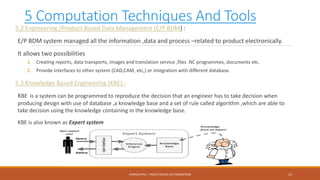
5.3 Knowledge Based Engineering (KBE) :
KBE is a system can be programmed to reproduce the decision that an engineer has to take decision when
producing design with use of database ,a knowledge base and a set of rule called algorithm ,which are able to
take decision using the knowledge containing in the knowledge base.
KBE is also known as Expert system
13CHIRAG PATEL - PACIFIC SCHOOL OF ENGINEERING
5 Computation Techniques And Tools
5.4 Finite Element Analysis :
Finite element analysis (FEA) is a computerized method for predicting how a product reacts to real-
world forces, vibration, heat, fluid flow, and other physical effects.
Finite element analysis shows whether a product will break, wear out, or work the way it was
designed
In this system the model obtained is small meshwork of element joined together b common nodes,
These element can be Flat (for surface representation ),volumetric (for solid representation)
,triangular(three nodes ),tetragonal (four nodes ).etc.
The application of FEM permits side stepping the traditional design cycle based on
prototype –testing – modification -prototype
There are no need to physically have the prototype on hand to perform the analyse like stess,
displacement ,deformation model visitation etc.
14CHIRAG PATEL - PACIFIC SCHOOL OF ENGINEERING
5 Computation Techniques And Tools
5.5 Rapid prototyping (RP) :
Rapid prototyping is a group of techniques used to quickly fabricate a scale model of a physical
part or assembly using three-dimensional computer aided design (CAD) data. Construction of
the part or assembly is usually done using 3D printing or "additive layer manufacturing"
technology
Techniques exist for prototype building are :
MIME (Material Increase Manufacturing) Technique
SLY ( selective Laser Sintering )
SGC (solid group Curing )
FDM (Focused Deposition Modelling)
LOM ( Laminated Object Manufacturing )
15CHIRAG PATEL - PACIFIC SCHOOL OF ENGINEERING
Characteristics Of Firms And Service
Provider
1. Systems Application To Product Design (Objective)
a) To replicate the paper system but no provide secure storage and access
b) To manage or control data ,document or drawing records
c) To manage the process and procedures
d) To maintained a full configuration history of the product
Benefits :
a) Do it faster (time saved by system support for a specific task)
b) Do it better (lower cost or higher quality through considering more option )
c) Not do it all ( the task has been eliminated, automated or combined with another activity, there
by saving time )
2. Types of firm/ organization concern
a) Quality
b) Prise
c) Functionality
d) Development time
16CHIRAG PATEL - PACIFIC SCHOOL OF ENGINEERING
Duration And Implementation Cost Of
Product Development
Cost will become a more important factor in the acquisition of a product in two situations
1. The technology of a product stabilizes and the competitive playing field level, competition is
increasingly based on cost.
2. A customer’s internal economics of financial resources limitation may shift the acquisition decision
toward affordability as a more dominant factor
17CHIRAG PATEL - PACIFIC SCHOOL OF ENGINEERING
Challenging Of Product Development
New product development has a long history in marketing includes:
Research on customer preferences
Product positioning and segmentation
Product forecasting and test marketing
18CHIRAG PATEL - PACIFIC SCHOOL OF ENGINEERING
End of chapter 1
19CHIRAG PATEL - PACIFIC SCHOOL OF ENGINEERING

Product design and value engineering (PDVE) Ch 1 introduction

  • 1.
    Product Design &Value Engineering Ch: 1 Introduction P R E PA R E D B Y MR. CHIRAG PATEL M.E. (ADVANCED MANUFACTURING SYSTEM) ASSISTANT PROFESSOR MECHANICAL ENGINEERING DEPARTMENT PACIFIC SCHOOL OF ENGINEERING
  • 2.
    Product Design ◦ Definition:Product's characteristics, such as its appearance, the materials it is made of its dimensions and tolerance and performance standards External Factor s for product design : 1.Customer Requirement 2.Quality 3.Reduction of manufacturing costs and controls 4.The assembly and distribution process 5.Environmental effect before and after manufacturing 6.Safety , hygiene , ergonomics factors, etc. 2CHIRAG PATEL - PACIFIC SCHOOL OF ENGINEERING
  • 3.
    Product Design Characteristics OfProduct Development : 1.A product must fully meet design requirements & products specs & standards. 2.A product must be mfg by the most environmentally friendly & economical methods 3.Quality must be built into the product at each stage. 4.Production methods must be flexible enough to respond to changes in market demands, types of products, production rates, Quantities, and on-time delivery req. 5.New developments in materials, production methods, and computer integration of both technological and managerial activities in a mfg org must constantly be evaluated with a view to their appropriate, timely, & economical implementation. 6.Mfg activities must be viewed as a large system, the parts of which are interrelated. Such systems can be modeled, in order to study the effects of factors such as changes in market demands, prod design, and materials. 7.Constantly strive for higher levels of quality and productivity. Output per employee per hour in all phases must be max. Zero-based part rejection are also an integral aspect of mfg 3CHIRAG PATEL - PACIFIC SCHOOL OF ENGINEERING
  • 4.
    Design And DevelopmentOf Product 1. Concurrent Engineering(ce) 2. Quality Function Deployment (QFD) 3. Design For (DFX) 4. Failure Mode And Effects Analysis (FMEA) 5. Computation Techniques And Tools 1. Engineering / Product Based Data Management (E/P BDM) 2. Knowledge Based Engineering (KBE) 3. Finite Element Analysis (FEA) 4. Rapid Prototyping (RP) 4CHIRAG PATEL - PACIFIC SCHOOL OF ENGINEERING
  • 5.
    Design And DevelopmentOf Product 1 Concurrent Engineering(CE) CE is a systematic approach integrating the design and mfg of products, with a view toward optimizing all elements involved in the life cycle of the product. Life cycle means that all aspects of a product, such as design, development, production, distribution, use, disposal, and recycling, are considered simultaneously. Basic goals of CE: 1.reduce changes in product’s design & engineering. 2.reduce time and costs involved in taking the product form its design concept to its production and its introduction into the marketplace. 5CHIRAG PATEL - PACIFIC SCHOOL OF ENGINEERING
  • 6.
    1 Concurrent Engineering(CE) Awell-designed product is: 1. functional (design) 2. well-manufactured (production) 3. well-packaged (distribution) 4. durable (functions effectively for its intended life) 5. maintainable (use) 6. resource-efficient (can be disassembled so that components can be recycled-disposal) For CE to succeed, it must: 1. have the full support of upper management; 2. have multifunctional and interactive teamwork, including support groups 3. utilize all available technologies. 6CHIRAG PATEL - PACIFIC SCHOOL OF ENGINEERING
  • 7.
    2.Quality Function Deployment(QFD) Quality Function Deployment (QFD): QFD is defined as a method for developing a design quality aiming at satisfying the consumer and then translating the consumer's demand into design targets and major quality assurance points to be used throughout the production phase. QFD performed on Marketing Research Development  process planning Quality assurance and Manufacturing 7CHIRAG PATEL - PACIFIC SCHOOL OF ENGINEERING
  • 8.
    2.Quality Function Deployment(QFD) QFD Approach permits a) Listening the voice of customer b) Improving horizontal and vertical communication c) Setting priorities for product development d) Improving product reliability e) Defining technical goals f) Sequencing the individual goals g) Defining area of cost reduction 8CHIRAG PATEL - PACIFIC SCHOOL OF ENGINEERING
  • 9.
    Design for X(DfX) DFX(Design for X) is a methodology for the definition and implementation of range of insights and demands which allow the development of an optimal and mature product in the aspects of reliability, manufacturing, assembly, service, transportation, usability, ergonomics, environment and more These words are made up of two parts 1. Life cycle business process (X) 2. Performance measures( bility ) X = x + bility Example : 1. Design for total Quality 2. Design for whole life cost 3. Design for assembly cost 9CHIRAG PATEL - PACIFIC SCHOOL OF ENGINEERING
  • 10.
    4 Failure ModeAnd Effects Analysis (FMEA) Definition: Failure modes and effects analysis (FMEA) is a step-by-step approach for identifying all possible failures in a design, a manufacturing or assembly process, or a product or service. There are two type of FMEA 1. Process 2. Design FMEA used for 1. New development of product 2. Security and problem parts 3. Product of process modification 4. New operation or other condition of existing products 10CHIRAG PATEL - PACIFIC SCHOOL OF ENGINEERING
  • 11.
    5 Computation TechniquesAnd Tools 5.1 Computer Aided (CAX) Systems Definition: Computer-aided technologies (CAx) is a broad term that means the use of computer technology to aid in the design, analysis, and manufacture of products. CAX means computer aided (CA) support of industrial production ,where “X” stands for different activities whiting the product development and manufacturing process. 70 to 80 % product cost are determined in developing phase ,the most important system in this group of tool are CAD(Computer Aided Design). Characteristic feature of CAD : a. X-D geometric modelling (2-D,3-D) b. Employment of process chains and product models c. Parametric and associative design d. Open architecture of hardware and software system e. User driver software development f. Distributed product development and life cycle engineering 11CHIRAG PATEL - PACIFIC SCHOOL OF ENGINEERING
  • 12.
    5 Computation TechniquesAnd Tools 5.1 CAPP(computer Aided Product Planning) : CAPP(Computer aided product planning ) is the use of computer technology to aid in the process planning of a part or product, in manufacturing. CAPP is the link between CAD and CAM in that it provides for the planning of the process to be used in producing a designed part. There are two kind of CAPP system : 1. Variant : A process plan for a new part is created by recalling, identifying and retrieving an existing plan for a similar part and making necessary modifications for the new part. 2. Regenerative : This system create the production process plan with no reference to any existing plan 12CHIRAG PATEL - PACIFIC SCHOOL OF ENGINEERING
  • 13.
    5 Computation TechniquesAnd Tools 5.2 Engineering /Product Based Data Management (E/P BDM) : E/P BDM system managed all the information ,data and process –related to product electronically. It allows two possibilities 1. Creating reports, data transports, images and translation service ,files .NC programmes, documents etc. 2. Provide interfaces to other system (CAD,CAM, etc,) or integration with different database. 5.3 Knowledge Based Engineering (KBE) : KBE is a system can be programmed to reproduce the decision that an engineer has to take decision when producing design with use of database ,a knowledge base and a set of rule called algorithm ,which are able to take decision using the knowledge containing in the knowledge base. KBE is also known as Expert system 13CHIRAG PATEL - PACIFIC SCHOOL OF ENGINEERING
  • 14.
    5 Computation TechniquesAnd Tools 5.4 Finite Element Analysis : Finite element analysis (FEA) is a computerized method for predicting how a product reacts to real- world forces, vibration, heat, fluid flow, and other physical effects. Finite element analysis shows whether a product will break, wear out, or work the way it was designed In this system the model obtained is small meshwork of element joined together b common nodes, These element can be Flat (for surface representation ),volumetric (for solid representation) ,triangular(three nodes ),tetragonal (four nodes ).etc. The application of FEM permits side stepping the traditional design cycle based on prototype –testing – modification -prototype There are no need to physically have the prototype on hand to perform the analyse like stess, displacement ,deformation model visitation etc. 14CHIRAG PATEL - PACIFIC SCHOOL OF ENGINEERING
  • 15.
    5 Computation TechniquesAnd Tools 5.5 Rapid prototyping (RP) : Rapid prototyping is a group of techniques used to quickly fabricate a scale model of a physical part or assembly using three-dimensional computer aided design (CAD) data. Construction of the part or assembly is usually done using 3D printing or "additive layer manufacturing" technology Techniques exist for prototype building are : MIME (Material Increase Manufacturing) Technique SLY ( selective Laser Sintering ) SGC (solid group Curing ) FDM (Focused Deposition Modelling) LOM ( Laminated Object Manufacturing ) 15CHIRAG PATEL - PACIFIC SCHOOL OF ENGINEERING
  • 16.
    Characteristics Of FirmsAnd Service Provider 1. Systems Application To Product Design (Objective) a) To replicate the paper system but no provide secure storage and access b) To manage or control data ,document or drawing records c) To manage the process and procedures d) To maintained a full configuration history of the product Benefits : a) Do it faster (time saved by system support for a specific task) b) Do it better (lower cost or higher quality through considering more option ) c) Not do it all ( the task has been eliminated, automated or combined with another activity, there by saving time ) 2. Types of firm/ organization concern a) Quality b) Prise c) Functionality d) Development time 16CHIRAG PATEL - PACIFIC SCHOOL OF ENGINEERING
  • 17.
    Duration And ImplementationCost Of Product Development Cost will become a more important factor in the acquisition of a product in two situations 1. The technology of a product stabilizes and the competitive playing field level, competition is increasingly based on cost. 2. A customer’s internal economics of financial resources limitation may shift the acquisition decision toward affordability as a more dominant factor 17CHIRAG PATEL - PACIFIC SCHOOL OF ENGINEERING
  • 18.
    Challenging Of ProductDevelopment New product development has a long history in marketing includes: Research on customer preferences Product positioning and segmentation Product forecasting and test marketing 18CHIRAG PATEL - PACIFIC SCHOOL OF ENGINEERING
  • 19.
    End of chapter1 19CHIRAG PATEL - PACIFIC SCHOOL OF ENGINEERING