Canal Lining
๏ต It is the treatment given to the canal bed and banks to
make the canal section impervious.
๏ต Canal lining is the process of during seepage loss
of irrigation water by adding an impermeable layer to the
edges of the trench.
๏ต Seepage can result in losses of 30 to 50 percent of
irrigation water from canals, so adding lining can make
irrigation systems more efficient.
๏ต Common lining materials include compacted earth,
concrete, and plastic membranes.
Advantages of Lining
Water Conservation:
Lining a canal results in reduction in water losses, as
water losses in unlined irrigation canals can be high.
No seepage of water into adjacent land or roads:
If canal banks are highly permeable, the seepage of
water will cause very wet or waterlogged conditions,
or even standing water on adjacent fields or roads.
Lining of such a canal can solve this problem.
Advantages of Lining
Canal linings improve command:
Lining makes it possible to maintain high velocity in
the canal. Generally lined canals are designed with
normal value of silt factor (f= 1.2) and maximum
permissible velocity (from 1.8 m/sec to 2.5 m/sec).
For these values of f and V steepest practicable
longitudinal slope may be adopted. Even then this
slope will be flatter than the slope of unlined canal.
Advantages of Lining
Thus this flat slope raises the FSL in general
and brings the high area of land under
command which have not been irrigated
before.
Another advantage of maintaining high
velocities can be recognized from the fact that
โ€œlined canals require smaller sections to
convey same amount of water as that carried
by unlined canalsโ€.
Advantages of Lining
๏ƒ˜ Canal linings increase available head for power
generation.
๏ƒ˜ Canal linings make the canal section stable.
๏ƒ˜Canal linings prevent bank erosion and breaches.
๏ƒ˜Canal linings assure economical water distribution
๏ƒ˜Canal linings reduce maintenance costs
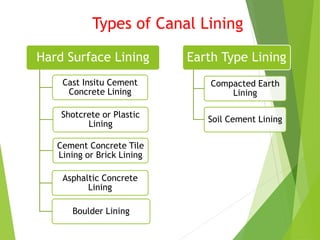
Types of Canal Lining
Hard Surface Lining
Cast Insitu Cement
Concrete Lining
Shotcrete or Plastic
Lining
Cement Concrete Tile
Lining or Brick Lining
Asphaltic Concrete
Lining
Boulder Lining
Earth Type Lining
Compacted Earth
Lining
Soil Cement Lining
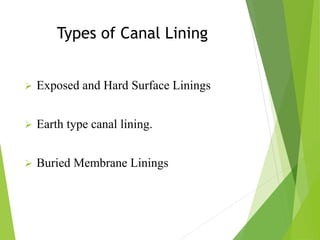
Types of Canal Lining
๏ƒ˜ Exposed and Hard Surface Linings
๏ƒ˜ Earth type canal lining.
๏ƒ˜ Buried Membrane Linings
Types of Canal Lining
๏ƒ˜ Exposed and Hard Surface Linings:-
It includes all linings exposed to wear, erosion and
deterioration effect of the flowing water, operation and
maintenance equipment and other hazards.
Such linings are constructed across of cement concrete
and mortars, bricks, stones and exposed membranes.
Although the initial cost of all these linings is
generally high, the reinforced cement concrete linings
are costliest and are usually recommended for use only
where structural safety is the primary consideration
Types of Canal Lining
๏ƒ˜ Exposed and Hard Surface Linings:-
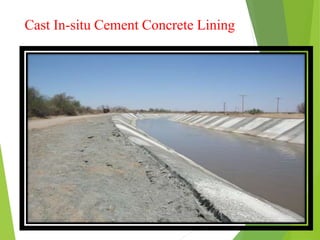
1. Cast in situ cement concrete lining
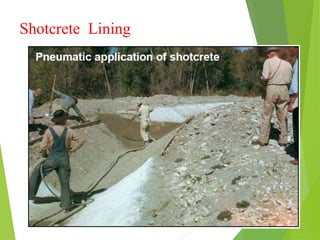
2. Shotcrete or plastic lining.
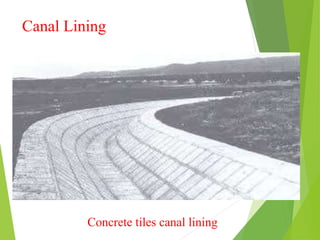
3. Cement concrete tiles lining or Brick lining.
4. Asphalt concrete lining.
5. Boulder lining.
6. Exposed Membrane Linings.
Types of Canal Lining
๏ƒ˜ Earth type canal lining.
Thick compacted earth lining is durable and can
withstand considerable external hydrostatic pressure.
Bentonite has shown considerable promise for use as
a good lining material.
Bentonite containing large percentage of
montmorillonite, is characterised by high water
absorption accompanied by swelling and
imperviousness. It can be used as 5.0 cm thick
membrane covered by protective blanket or as a
mixed inplace layer of soil bentonite and well
compacted.
Types of Canal Lining
๏ƒ˜ Buried Membrane Linings
Hot-applied asphaltic, prefabricated asphalt materials,
plastic film and a layer of bentonite or other types of
clays protected by earth or gravel cover are cheap
linings.
These linings can be provided immediately after
completion of excavation or even later.
Membrane linings are susceptible to damage by weed
root and permissible water velocity is limited to avoid
erosion.
The life of the lining is uncertain.
Cast In-situ Cement Concrete Lining
Shotcrete Lining
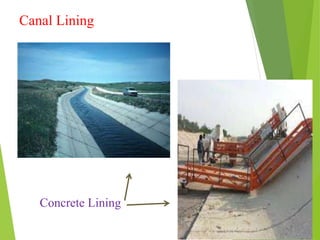
Canal Lining
Concrete Lining
Canal Lining
Concrete tiles canal lining
Canal Lining
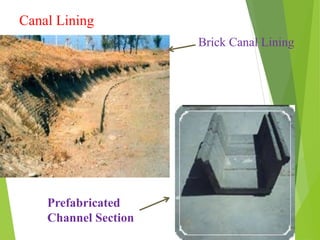
Brick Canal Lining
Prefabricated
Channel Section
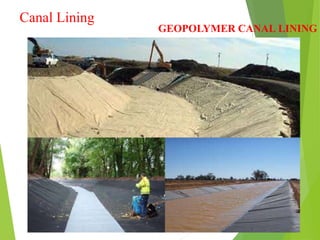
Canal Lining
GEOPOLYMER CANAL LINING

Unit 4-canal lining

  • 2.
    Canal Lining ๏ต Itis the treatment given to the canal bed and banks to make the canal section impervious. ๏ต Canal lining is the process of during seepage loss of irrigation water by adding an impermeable layer to the edges of the trench. ๏ต Seepage can result in losses of 30 to 50 percent of irrigation water from canals, so adding lining can make irrigation systems more efficient. ๏ต Common lining materials include compacted earth, concrete, and plastic membranes.
  • 3.
    Advantages of Lining WaterConservation: Lining a canal results in reduction in water losses, as water losses in unlined irrigation canals can be high. No seepage of water into adjacent land or roads: If canal banks are highly permeable, the seepage of water will cause very wet or waterlogged conditions, or even standing water on adjacent fields or roads. Lining of such a canal can solve this problem.
  • 4.
    Advantages of Lining Canallinings improve command: Lining makes it possible to maintain high velocity in the canal. Generally lined canals are designed with normal value of silt factor (f= 1.2) and maximum permissible velocity (from 1.8 m/sec to 2.5 m/sec). For these values of f and V steepest practicable longitudinal slope may be adopted. Even then this slope will be flatter than the slope of unlined canal.
  • 5.
    Advantages of Lining Thusthis flat slope raises the FSL in general and brings the high area of land under command which have not been irrigated before. Another advantage of maintaining high velocities can be recognized from the fact that โ€œlined canals require smaller sections to convey same amount of water as that carried by unlined canalsโ€.
  • 6.
    Advantages of Lining ๏ƒ˜Canal linings increase available head for power generation. ๏ƒ˜ Canal linings make the canal section stable. ๏ƒ˜Canal linings prevent bank erosion and breaches. ๏ƒ˜Canal linings assure economical water distribution ๏ƒ˜Canal linings reduce maintenance costs
  • 7.
    Types of CanalLining Hard Surface Lining Cast Insitu Cement Concrete Lining Shotcrete or Plastic Lining Cement Concrete Tile Lining or Brick Lining Asphaltic Concrete Lining Boulder Lining Earth Type Lining Compacted Earth Lining Soil Cement Lining
  • 8.
    Types of CanalLining ๏ƒ˜ Exposed and Hard Surface Linings ๏ƒ˜ Earth type canal lining. ๏ƒ˜ Buried Membrane Linings
  • 9.
    Types of CanalLining ๏ƒ˜ Exposed and Hard Surface Linings:- It includes all linings exposed to wear, erosion and deterioration effect of the flowing water, operation and maintenance equipment and other hazards. Such linings are constructed across of cement concrete and mortars, bricks, stones and exposed membranes. Although the initial cost of all these linings is generally high, the reinforced cement concrete linings are costliest and are usually recommended for use only where structural safety is the primary consideration
  • 10.
    Types of CanalLining ๏ƒ˜ Exposed and Hard Surface Linings:- 1. Cast in situ cement concrete lining 2. Shotcrete or plastic lining. 3. Cement concrete tiles lining or Brick lining. 4. Asphalt concrete lining. 5. Boulder lining. 6. Exposed Membrane Linings.
  • 11.
    Types of CanalLining ๏ƒ˜ Earth type canal lining. Thick compacted earth lining is durable and can withstand considerable external hydrostatic pressure. Bentonite has shown considerable promise for use as a good lining material. Bentonite containing large percentage of montmorillonite, is characterised by high water absorption accompanied by swelling and imperviousness. It can be used as 5.0 cm thick membrane covered by protective blanket or as a mixed inplace layer of soil bentonite and well compacted.
  • 12.
    Types of CanalLining ๏ƒ˜ Buried Membrane Linings Hot-applied asphaltic, prefabricated asphalt materials, plastic film and a layer of bentonite or other types of clays protected by earth or gravel cover are cheap linings. These linings can be provided immediately after completion of excavation or even later. Membrane linings are susceptible to damage by weed root and permissible water velocity is limited to avoid erosion. The life of the lining is uncertain.
  • 13.
    Cast In-situ CementConcrete Lining
  • 14.
  • 15.
  • 16.
  • 17.
    Canal Lining Brick CanalLining Prefabricated Channel Section
  • 18.