UNIT- 5
Canal Lining
Prof. Manjunath. B
Assistant Professor
Sanjivani College of Engineering
Kopargaon
Advantages of Lining
Water Conservation: Lining a canal results in
reduction in water losses, as water losses in unlined
irrigation canals can be high.
No seepage of water into adjacent land or
roads: If canal banks are highly permeable, the
seepage of water will cause very wet or waterlogged
conditions, or even standing water on adjacent fields or
roads. Lining of such a canal can solve this problem.
Reduced canal dimensions: The resistance to flow of a lined
canal is less than that of an unlined canal, and thus the flow velocity
will be higher in the lined canal . Therefore, with the higher velocity,
the canal cross-section for a lined canal can be smaller than that of an
unlined canal.
 Reduced maintenance: Maintenance costs for the following
issues are eliminated using lining of canals.
 Periodical removal of silt deposited on the beds and sides of
canals.
 Removal of weeds and water canals.
 Minor repairs like plugging of cracks, uneven settlements of
banks, etc.
Advantages of Canal Lining
Prevents water seepage through surface of the canal.
Helps in preventing Water-Logging.
Increases discharge carrying capacity of the channel.
Increases channel life and reduce the maintenance cost.
Increases Gross area under cultivation.
Silting is prevented as velocity is increased.
Prevents or Reduces Weed Growth.
Increase available head for power generation due to
flatter gradient.
Disadvantages of Canal Lining
Heavy initial investment is required.
Difficult to shift the outlets as lining is permanent.
Difficult to repair the damaged lining.
Berm is absent in Lined channels, so safety to
vehicular and
Materials for Lining
 Main types of concrete lining used in Indiaare:
 HARD SURFACE TYPE LINING:
 >> Cement concrete Lining
 >>Shotcrete Lining
 >>Precast concrete Lining
 >>Cement Mortar Lining
 >>Brick Lining
 >>Stone blocks Lining
 >>Asphaltic Lining
 EARTH TYPE LINING:
 >>Soil cement Lining
 >>Clay puddle Lining
 >>Sodium carbonate Lining
Cement Concrete Lining
It has high initial cost so its use is limited.
It has excellent hydraulic properties.
Thickness varies from 5-10cm for M 15 concrete and 7.5 to
15cm for M 10 concrete.
A subgrade is prepared and compacted.
Subgrade is saturated to a depth of 30cm in sandy soil and
15cm in other soils.
Lay a base coat of 1:4 cement and sand slurry on the
subgrade.
Spread oil paper/crude oil on the subgrade.
The concrete is usually laid in alternate blocks.
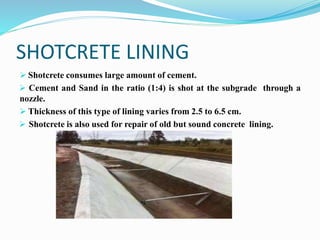
SHOTCRETE LINING
 Shotcrete consumes large amount of cement.
 Cement and Sand in the ratio (1:4) is shot at the subgrade through a
nozzle.
 Thickness of this type of lining varies from 2.5 to 6.5 cm.
 Shotcrete is also used for repair of old but sound concrete lining.
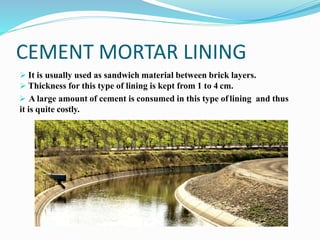
CEMENT MORTAR LINING
 It is usually used as sandwich material between brick layers.
 Thickness for this type of lining is kept from 1 to 4 cm.
 A large amount of cement is consumed in this type of lining and thus
it is quite costly.
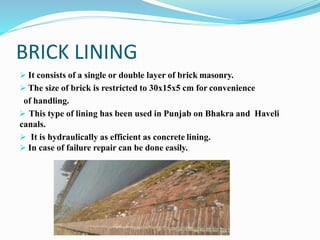
BRICK LINING
 It consists of a single or double layer of brick masonry.
 The size of brick is restricted to 30x15x5 cm for convenience
of handling.
 This type of lining has been used in Punjab on Bhakra and Haveli
canals.
 It is hydraulically as efficient as concrete lining.
 In case of failure repair can be done easily.

Canal lining

  • 1.
    UNIT- 5 Canal Lining Prof.Manjunath. B Assistant Professor Sanjivani College of Engineering Kopargaon
  • 2.
    Advantages of Lining WaterConservation: Lining a canal results in reduction in water losses, as water losses in unlined irrigation canals can be high. No seepage of water into adjacent land or roads: If canal banks are highly permeable, the seepage of water will cause very wet or waterlogged conditions, or even standing water on adjacent fields or roads. Lining of such a canal can solve this problem.
  • 3.
    Reduced canal dimensions:The resistance to flow of a lined canal is less than that of an unlined canal, and thus the flow velocity will be higher in the lined canal . Therefore, with the higher velocity, the canal cross-section for a lined canal can be smaller than that of an unlined canal.  Reduced maintenance: Maintenance costs for the following issues are eliminated using lining of canals.  Periodical removal of silt deposited on the beds and sides of canals.  Removal of weeds and water canals.  Minor repairs like plugging of cracks, uneven settlements of banks, etc.
  • 4.
    Advantages of CanalLining Prevents water seepage through surface of the canal. Helps in preventing Water-Logging. Increases discharge carrying capacity of the channel. Increases channel life and reduce the maintenance cost. Increases Gross area under cultivation. Silting is prevented as velocity is increased. Prevents or Reduces Weed Growth. Increase available head for power generation due to flatter gradient.
  • 5.
    Disadvantages of CanalLining Heavy initial investment is required. Difficult to shift the outlets as lining is permanent. Difficult to repair the damaged lining. Berm is absent in Lined channels, so safety to vehicular and
  • 6.
    Materials for Lining Main types of concrete lining used in Indiaare:  HARD SURFACE TYPE LINING:  >> Cement concrete Lining  >>Shotcrete Lining  >>Precast concrete Lining  >>Cement Mortar Lining  >>Brick Lining  >>Stone blocks Lining  >>Asphaltic Lining  EARTH TYPE LINING:  >>Soil cement Lining  >>Clay puddle Lining  >>Sodium carbonate Lining
  • 7.
    Cement Concrete Lining Ithas high initial cost so its use is limited. It has excellent hydraulic properties. Thickness varies from 5-10cm for M 15 concrete and 7.5 to 15cm for M 10 concrete. A subgrade is prepared and compacted. Subgrade is saturated to a depth of 30cm in sandy soil and 15cm in other soils. Lay a base coat of 1:4 cement and sand slurry on the subgrade. Spread oil paper/crude oil on the subgrade. The concrete is usually laid in alternate blocks.
  • 8.
    SHOTCRETE LINING  Shotcreteconsumes large amount of cement.  Cement and Sand in the ratio (1:4) is shot at the subgrade through a nozzle.  Thickness of this type of lining varies from 2.5 to 6.5 cm.  Shotcrete is also used for repair of old but sound concrete lining.
  • 9.
    CEMENT MORTAR LINING It is usually used as sandwich material between brick layers.  Thickness for this type of lining is kept from 1 to 4 cm.  A large amount of cement is consumed in this type of lining and thus it is quite costly.
  • 10.
    BRICK LINING  Itconsists of a single or double layer of brick masonry.  The size of brick is restricted to 30x15x5 cm for convenience of handling.  This type of lining has been used in Punjab on Bhakra and Haveli canals.  It is hydraulically as efficient as concrete lining.  In case of failure repair can be done easily.