RETAINING WALL DESIGN PRINCIPLES


 Tweet
Retaining structures
Generally speaking, any wall that sustains significant lateral soil pressure is
a retaining wall. However, the term is usually used with reference to a
cantilever retaining wall, which is a freestanding wall without lateral support
at its top. For such a wall, the major design consideration is for the actual
dimensions of the ground-level difference that the wall serves to facilitate.
The range of its dimensions establishes some different categories for the
retaining structure as follow
(a) Curbs
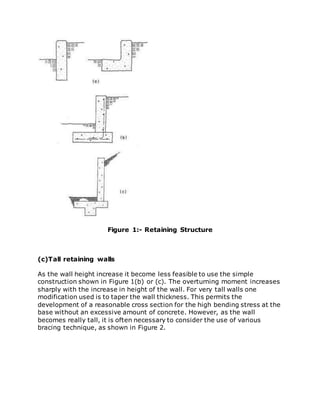
Curbs are the shortest freestanding retaining structures. The two most
common forms are as shown in Figure 1(a), the selection being made on the
basis of whether or not it is necessary to have a gutter on the how side of
the curb. Use of these structure is typically limited to grade level changes of
about 0.6m or less.
(b) Short retaining walls
Vertical walls up to about 3m in height are usually built as shown in Figure
1(b). these consists of a concrete or masonry wall of uniform thickness,
vertical wall reinforcing, and transverse footing reinforcing are all designed
for the lateral shear and cantilever bending movement plus the vertical
weights of the wall, footing, and earth fills.
When the bottom of the footing is a show distance below grade on the low
side of the wall and/or the lateral passive resistance of the soil is low, it may
be necessary to use an extension below the footing – called a shear key – to
increase the resistance to sliding. The form of such a key is shown in Figure
1(c)
Figure 1:- Retaining Structure
(c)Tall retaining walls
As the wall height increase it become less feasible to use the simple
construction shown in Figure 1(b) or (c). The overturning moment increases
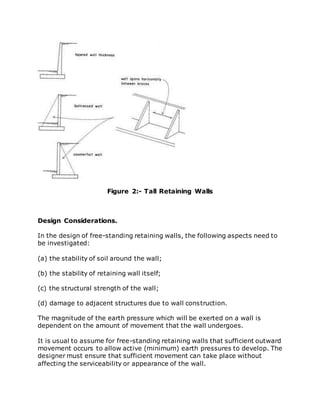
sharply with the increase in height of the wall. For very tall walls one
modification used is to taper the wall thickness. This permits the
development of a reasonable cross section for the high bending stress at the
base without an excessive amount of concrete. However, as the wall
becomes really tall, it is often necessary to consider the use of various
bracing technique, as shown in Figure 2.
Figure 2:- Tall Retaining Walls
Design Considerations.
In the design of free-standing retaining walls, the following aspects need to
be investigated:
(a) the stability of soil around the wall;
(b) the stability of retaining wall itself;
(c) the structural strength of the wall;
(d) damage to adjacent structures due to wall construction.
The magnitude of the earth pressure which will be exerted on a wall is
dependent on the amount of movement that the wall undergoes.
It is usual to assume for free-standing retaining walls that sufficient outward
movement occurs to allow active (minimum) earth pressures to develop. The
designer must ensure that sufficient movement can take place without
affecting the serviceability or appearance of the wall.
Where it is not possible for the required outward movement to occur, for
instance due to wall or foundation rigidity, higher pressures will develop and
the wall must be designed for these.
Basic Loading
The basic pressure loading to be considered for the design is:
Normal Loading = static earth pressure + water pressure + pressure due to
live loads or surcharge.
In general, the resulting design pressure for earth retaining structures
should not be less than the pressure due to a fluid of unit weight 5kN/m3.
Other considerations
The possible occurrence of other design cases, or variation of the one above,
caused by construction sequence or future development of surrounding
areas should also be considered. For instances, additional surcharges may
need to be considered and allowance made for any possible future removal
of ground in front of the wall in connection with services, particularly if the
passive resistance of this material is included in the stability calculations.
The effect of excavation on the wall bearing capacity may also need to be
considered.
For the determination of earth pressure, it is usual to consider a unit length
of the cross-section of the wall and retained soil. A unit length is also used in
the structural design of cantilever walls and other walls with a uniform cross-
section.
Support of existing fill slopes
Fill slopes constructed in Hong Kong prior to 1977 are likely to have been
end tipped or inadequately compacted. Such slopes may be subject to
liquefaction under conditions of heavy rainfall, vibration or leakage from
services, and resulting mud flows may have serious consequences.
Undercutting of the slope toe, for retaining wall construction, will increase
the risk of failure.
Soil Properties
General
For all walls higher than 5 meters, especially those with sloping backfill, the
soil properties of natural ground and backfill should be estimated in advance
of design from tests on samples of the material involved. In addition, special
attention should be paid to the determination of ground water levels,
particularly with respect to maximum probable values.
For less important walls, an estimation of the soil properties may be made
from previous tests on similar materials. A careful visual examination of the
materials, particularly that at the proposed foundation level, should be made
and index tests carried out to ensure that the assumed material type is
correct.
Selection and use of backfill
The ideal backfill for a minimum section wall is a free draining granular
material of high shearing strength. However, the final choice of material
should be based on the costs and availability of such materials balanced
against the cost of more expensive walls.
In general, the use of fine-grained clayey backfills is not recommended.
Clays are subjected to seasonal variation in moisture content and
consequent swelling and shrinkage. This effect may lead to an increase in
pressure against a wall when these soils are used as backfill. Due to
consolidation, long term settlement problems are considerably greater than
with cohesion less materials.
For cohesive backfills, special attention must be paid to the provision of
drainage to prevent the built-up water pressure. Free draining cohesionless
materials may not require the same amount of attention in this respect.
They may still require protection by properly designed filter layers.
In Hong Kong, backfill for retaining walls usually comprises selected
decomposed grainite or decomposed volcanic rock. This material is in
general suitable for backfill provided that it is properly compacted and
drainage measures are carefully designed and properly installed to prevent
build-up of water pressure.
In fact, rock fill is a very suitable material for use as a backfill to retaining
walls and consideration should be given to its use when available. In
general, the rockfill should be well graded and have a nominal maximum
size of 200mm. A well-graded densely compacted rockfill should not have
more than about 2% finer than if it is to remain free-draining.
Earth Pressure
The earth pressure which acts on an earth retaining structure is strongly
dependent on the lateral deformations which occur in the soil. Hence, unless
the deformation condition can be estimated with reasonable accuracy,
rational prediction of the magnitude and distribution of each pressure in the
structure is not possible.
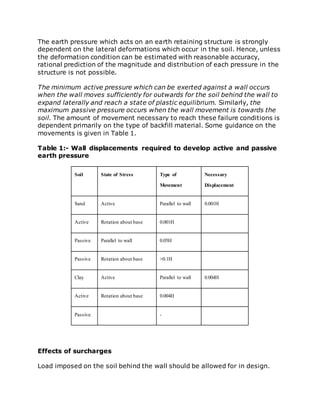
The minimum active pressure which can be exerted against a wall occurs
when the wall moves sufficiently for outwards for the soil behind the wall to
expand laterally and reach a state of plastic equilibrium. Similarly, the
maximum passive pressure occurs when the wall movement is towards the
soil. The amount of movement necessary to reach these failure conditions is
dependent primarily on the type of backfill material. Some guidance on the
movements is given in Table 1.
Table 1:- Wall displacements required to develop active and passive
earth pressure
Soil State of Stress Type of
Movement
Necessary
Displacement
Sand Active Parallel to wall 0.001H
Active Rotation about base 0.001H
Passive Parallel to wall 0.05H
Passive Rotation about base >0.1H
Clay Active Parallel to wall 0.004H
Active Rotation about base 0.004H
Passive -
Effects of surcharges
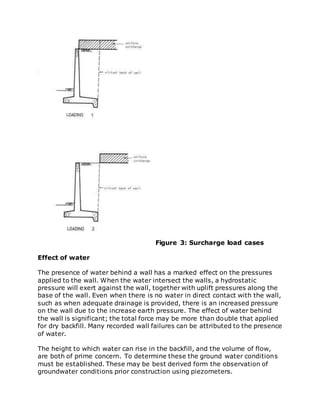
Load imposed on the soil behind the wall should be allowed for in design.
Uniform surcharge loads may be converted to an equivalent height of fill and
the earth pressures calculated for the correspondingly greater height. For
example, the buildings with shallow foundation may be taken as a uniform
surcharge of 10kPa per storey. (Figure 1.3)
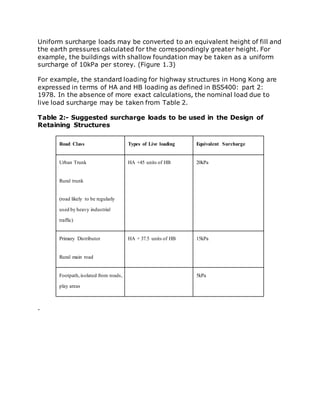
For example, the standard loading for highway structures in Hong Kong are
expressed in terms of HA and HB loading as defined in BS5400: part 2:
1978. In the absence of more exact calculations, the nominal load due to
live load surcharge may be taken from Table 2.
Table 2:- Suggested surcharge loads to be used in the Design of
Retaining Structures
Road Class Types of Live loading Equivalent Surcharge
Urban Trunk
Rural trunk
(road likely to be regularly
used by heavy industrial
traffic)
HA +45 units of HB 20kPa
Primary Distributor
Rural main road
HA + 37.5 units of HB 15kPa
Footpath,isolated from roads,
play areas
5kPa
.
Figure 3: Surcharge load cases
Effect of water
The presence of water behind a wall has a marked effect on the pressures
applied to the wall. When the water intersect the walls, a hydrostatic
pressure will exert against the wall, together with uplift pressures along the
base of the wall. Even when there is no water in direct contact with the wall,
such as when adequate drainage is provided, there is an increased pressure
on the wall due to the increase earth pressure. The effect of water behind
the wall is significant; the total force may be more than double that applied
for dry backfill. Many recorded wall failures can be attributed to the presence
of water.
The height to which water can rise in the backfill, and the volume of flow,
are both of prime concern. To determine these the ground water conditions
must be established. These may be best derived form the observation of
groundwater conditions prior construction using piezometers.
Notwithstanding the results of groundwater monitoring, the groundwater
level assumed for design should be not lower than one-third of the retained
height.
The effect of leakage from services can be significant. There is evidence
from field measurements and failures in Hong Kong that this leakage
contributes substantially to both perched and main groundwater tables.
Where inadequate drainage is provided behind a retaining structure, there
may be a damming effect which would result in raising groundwater levels
locally and in the general areas. Such a rise may adversely affect the
stability of slopes and retaining walls. Effective drainage measures should
always be provided in such cases.
Stability of Retaining walls
The stability of a free standing retaining structure and the wall contained by
it is determined by computing factors of safety (or stability factors), which
may be defined in general terms as:
Fs = Moments or forces aiding stability / moments or forces causing
instability
Factors of safety should be calculated for the following separate modes of
failure and should apply to the 1 in 10 year groundwater condition:
(a) sliding of the wall outwards from the retaining soil,
(b) overturning of the retaining wall about its toe,
(c) foundation bearing failure, and
(d) larger scale slope or other failure in the surrounding soil.
The forces that produce overturning and sliding also produce the foundation
bearing pressures and, therefore, (a) and (b) above are inter-related with
(c) in most soils.
In cases where the foundation material is soil, overturning stability is usually
satisfied if bearing criteria are satisfied. However, overturning stability may
be critical for strong foundation materials such as rock and so on.
In general, to limit settlement and tilting of walls on soil materials, the
resultant of the loading on the base should be within the middle third. For
rock foundation material, the resultant should be within the middle half of
the base.
When calculating overall stability of a wall, the lateral such pressure is
calculated to the bottom of the blinding layer, or in the case of a base with a
key, to the bottom of the key where the actual failure mechanism extends to
that point.
Concrete framing system
There are many different reinforced concrete floor system, both cast in place
and precast. The cast-in-place systems are generally of one of the following
types:
(a) One-way solid slab and beam
(b) Two-way solid slab and beam
(c) One-way concrete joist construction
(d) Two-way flat slab or flat plate without beams
(e) Two-way joist construction, called waffle construction.
Each system has its distinct advantages and limitations, depending on the
spacing of supports, magnitude of loads, required fire rating, and cost of the
construction. The floor plan of the building and the propose for which the
building is to be used determine loading conditions and the layout of
supports. Whenever possible, columns should be aligned in rows and spaced
at regular intervals in order to simplify and lower the cost of the building
construction.
One-way joist construction
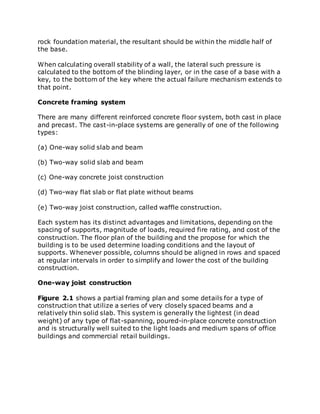
Figure 2.1 shows a partial framing plan and some details for a type of
construction that utilize a series of very closely spaced beams and a
relatively thin solid slab. This system is generally the lightest (in dead
weight) of any type of flat-spanning, poured-in-place concrete construction
and is structurally well suited to the light loads and medium spans of office
buildings and commercial retail buildings.
Figure 2.1:- Typical Concrete One-way joist construction
Waffle construction
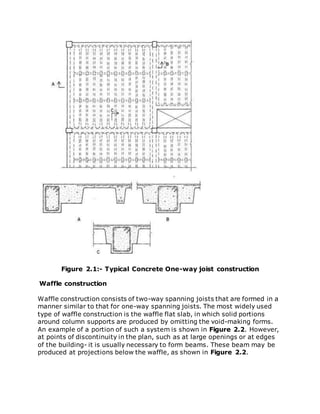
Waffle construction consists of two-way spanning joists that are formed in a
manner similar to that for one-way spanning joists. The most widely used
type of waffle construction is the waffle flat slab, in which solid portions
around column supports are produced by omitting the void-making forms.
An example of a portion of such a system is shown in Figure 2.2. However,
at points of discontinuity in the plan, such as at large openings or at edges
of the building- it is usually necessary to form beams. These beam may be
produced at projections below the waffle, as shown in Figure 2.2.
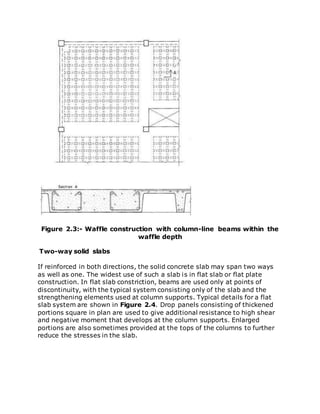
Figure 2.2:- Typical concrete waffle construction
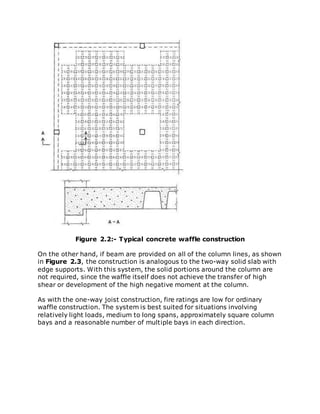
On the other hand, if beam are provided on all of the column lines, as shown
in Figure 2.3, the construction is analogous to the two-way solid slab with
edge supports. With this system, the solid portions around the column are
not required, since the waffle itself does not achieve the transfer of high
shear or development of the high negative moment at the column.
As with the one-way joist construction, fire ratings are low for ordinary
waffle construction. The system is best suited for situations involving
relatively light loads, medium to long spans, approximately square column
bays and a reasonable number of multiple bays in each direction.
Figure 2.3:- Waffle construction with column-line beams within the
waffle depth
Two-way solid slabs
If reinforced in both directions, the solid concrete slab may span two ways
as well as one. The widest use of such a slab is in flat slab or flat plate
construction. In flat slab constriction, beams are used only at points of
discontinuity, with the typical system consisting only of the slab and the
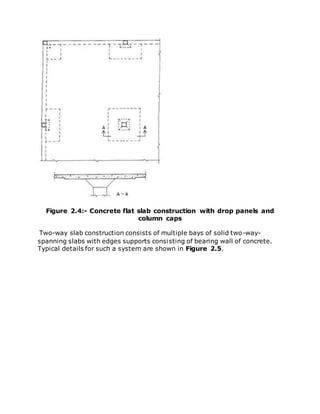
strengthening elements used at column supports. Typical details for a flat
slab system are shown in Figure 2.4. Drop panels consisting of thickened
portions square in plan are used to give additional resistance to high shear
and negative moment that develops at the column supports. Enlarged
portions are also sometimes provided at the tops of the columns to further
reduce the stresses in the slab.
Figure 2.4:- Concrete flat slab construction with drop panels and
column caps
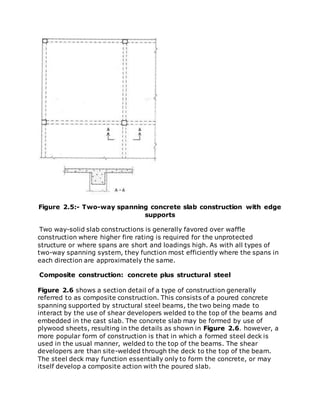
Two-way slab construction consists of multiple bays of solid two-way-
spanning slabs with edges supports consisting of bearing wall of concrete.
Typical details for such a system are shown in Figure 2.5.
Figure 2.5:- Two-way spanning concrete slab construction with edge
supports
Two way-solid slab constructions is generally favored over waffle
construction where higher fire rating is required for the unprotected
structure or where spans are short and loadings high. As with all types of
two-way spanning system, they function most efficiently where the spans in
each direction are approximately the same.
Composite construction: concrete plus structural steel
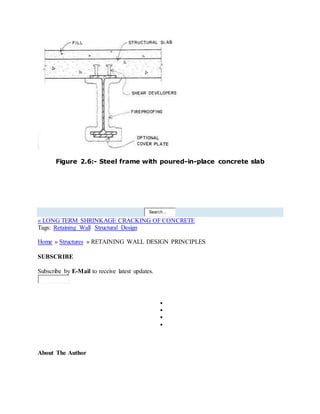
Figure 2.6 shows a section detail of a type of construction generally
referred to as composite construction. This consists of a poured concrete
spanning supported by structural steel beams, the two being made to
interact by the use of shear developers welded to the top of the beams and
embedded in the cast slab. The concrete slab may be formed by use of
plywood sheets, resulting in the details as shown in Figure 2.6. however, a
more popular form of construction is that in which a formed steel deck is
used in the usual manner, welded to the top of the beams. The shear
developers are than site-welded through the deck to the top of the beam.
The steel deck may function essentially only to form the concrete, or may
itself develop a composite action with the poured slab.
Figure 2.6:- Steel frame with poured-in-place concrete slab
Search...
« LONG TERM SHRINKAGE CRACKING OF CONCRETE
Tags: Retaining Wall Structural Design
Home » Structures » RETAINING WALL DESIGN PRINCIPLES
SUBSCRIBE
Subscribe by E-Mail to receive latest updates.




About The Author
This blog is authored and maintained by Gopal Mishra. He is the founder of The Constructor.
WE ARE ON FACEBOOK
POPULAR
Concrete Technology HowToGuide GeotechnicalEngineering Structural GE LabTests Structural Design Material TestingGuide
Construction Buildings Building Materials Soil Foundation ConstructionManagement Structure Design Structural Analysis Water Resources
Earthquake Engineering
Most Commented Posts
 COMPRESSIVE STRENGTH OF CONCRETE CUBES
 TYPES OF FORMWORK (SHUTTERING)
 QUANTITIES OF MATERIALS PER CUBIC METRE OF CONCRETE
 QUANTITY & RATE ANALYSIS FOR REINFORCED CONCRETE
 Combined Footing Design with Example
 Home
 About Us
 Co

Retaing wall

  • 1.
    RETAINING WALL DESIGNPRINCIPLES    Tweet Retaining structures Generally speaking, any wall that sustains significant lateral soil pressure is a retaining wall. However, the term is usually used with reference to a cantilever retaining wall, which is a freestanding wall without lateral support at its top. For such a wall, the major design consideration is for the actual dimensions of the ground-level difference that the wall serves to facilitate. The range of its dimensions establishes some different categories for the retaining structure as follow (a) Curbs Curbs are the shortest freestanding retaining structures. The two most common forms are as shown in Figure 1(a), the selection being made on the basis of whether or not it is necessary to have a gutter on the how side of the curb. Use of these structure is typically limited to grade level changes of about 0.6m or less. (b) Short retaining walls Vertical walls up to about 3m in height are usually built as shown in Figure 1(b). these consists of a concrete or masonry wall of uniform thickness, vertical wall reinforcing, and transverse footing reinforcing are all designed for the lateral shear and cantilever bending movement plus the vertical weights of the wall, footing, and earth fills. When the bottom of the footing is a show distance below grade on the low side of the wall and/or the lateral passive resistance of the soil is low, it may be necessary to use an extension below the footing – called a shear key – to increase the resistance to sliding. The form of such a key is shown in Figure 1(c)
  • 2.
    Figure 1:- RetainingStructure (c)Tall retaining walls As the wall height increase it become less feasible to use the simple construction shown in Figure 1(b) or (c). The overturning moment increases sharply with the increase in height of the wall. For very tall walls one modification used is to taper the wall thickness. This permits the development of a reasonable cross section for the high bending stress at the base without an excessive amount of concrete. However, as the wall becomes really tall, it is often necessary to consider the use of various bracing technique, as shown in Figure 2.
  • 3.
    Figure 2:- TallRetaining Walls Design Considerations. In the design of free-standing retaining walls, the following aspects need to be investigated: (a) the stability of soil around the wall; (b) the stability of retaining wall itself; (c) the structural strength of the wall; (d) damage to adjacent structures due to wall construction. The magnitude of the earth pressure which will be exerted on a wall is dependent on the amount of movement that the wall undergoes. It is usual to assume for free-standing retaining walls that sufficient outward movement occurs to allow active (minimum) earth pressures to develop. The designer must ensure that sufficient movement can take place without affecting the serviceability or appearance of the wall.
  • 4.
    Where it isnot possible for the required outward movement to occur, for instance due to wall or foundation rigidity, higher pressures will develop and the wall must be designed for these. Basic Loading The basic pressure loading to be considered for the design is: Normal Loading = static earth pressure + water pressure + pressure due to live loads or surcharge. In general, the resulting design pressure for earth retaining structures should not be less than the pressure due to a fluid of unit weight 5kN/m3. Other considerations The possible occurrence of other design cases, or variation of the one above, caused by construction sequence or future development of surrounding areas should also be considered. For instances, additional surcharges may need to be considered and allowance made for any possible future removal of ground in front of the wall in connection with services, particularly if the passive resistance of this material is included in the stability calculations. The effect of excavation on the wall bearing capacity may also need to be considered. For the determination of earth pressure, it is usual to consider a unit length of the cross-section of the wall and retained soil. A unit length is also used in the structural design of cantilever walls and other walls with a uniform cross- section. Support of existing fill slopes Fill slopes constructed in Hong Kong prior to 1977 are likely to have been end tipped or inadequately compacted. Such slopes may be subject to liquefaction under conditions of heavy rainfall, vibration or leakage from services, and resulting mud flows may have serious consequences. Undercutting of the slope toe, for retaining wall construction, will increase the risk of failure. Soil Properties General
  • 5.
    For all wallshigher than 5 meters, especially those with sloping backfill, the soil properties of natural ground and backfill should be estimated in advance of design from tests on samples of the material involved. In addition, special attention should be paid to the determination of ground water levels, particularly with respect to maximum probable values. For less important walls, an estimation of the soil properties may be made from previous tests on similar materials. A careful visual examination of the materials, particularly that at the proposed foundation level, should be made and index tests carried out to ensure that the assumed material type is correct. Selection and use of backfill The ideal backfill for a minimum section wall is a free draining granular material of high shearing strength. However, the final choice of material should be based on the costs and availability of such materials balanced against the cost of more expensive walls. In general, the use of fine-grained clayey backfills is not recommended. Clays are subjected to seasonal variation in moisture content and consequent swelling and shrinkage. This effect may lead to an increase in pressure against a wall when these soils are used as backfill. Due to consolidation, long term settlement problems are considerably greater than with cohesion less materials. For cohesive backfills, special attention must be paid to the provision of drainage to prevent the built-up water pressure. Free draining cohesionless materials may not require the same amount of attention in this respect. They may still require protection by properly designed filter layers. In Hong Kong, backfill for retaining walls usually comprises selected decomposed grainite or decomposed volcanic rock. This material is in general suitable for backfill provided that it is properly compacted and drainage measures are carefully designed and properly installed to prevent build-up of water pressure. In fact, rock fill is a very suitable material for use as a backfill to retaining walls and consideration should be given to its use when available. In general, the rockfill should be well graded and have a nominal maximum size of 200mm. A well-graded densely compacted rockfill should not have more than about 2% finer than if it is to remain free-draining. Earth Pressure
  • 6.
    The earth pressurewhich acts on an earth retaining structure is strongly dependent on the lateral deformations which occur in the soil. Hence, unless the deformation condition can be estimated with reasonable accuracy, rational prediction of the magnitude and distribution of each pressure in the structure is not possible. The minimum active pressure which can be exerted against a wall occurs when the wall moves sufficiently for outwards for the soil behind the wall to expand laterally and reach a state of plastic equilibrium. Similarly, the maximum passive pressure occurs when the wall movement is towards the soil. The amount of movement necessary to reach these failure conditions is dependent primarily on the type of backfill material. Some guidance on the movements is given in Table 1. Table 1:- Wall displacements required to develop active and passive earth pressure Soil State of Stress Type of Movement Necessary Displacement Sand Active Parallel to wall 0.001H Active Rotation about base 0.001H Passive Parallel to wall 0.05H Passive Rotation about base >0.1H Clay Active Parallel to wall 0.004H Active Rotation about base 0.004H Passive - Effects of surcharges Load imposed on the soil behind the wall should be allowed for in design.
  • 7.
    Uniform surcharge loadsmay be converted to an equivalent height of fill and the earth pressures calculated for the correspondingly greater height. For example, the buildings with shallow foundation may be taken as a uniform surcharge of 10kPa per storey. (Figure 1.3) For example, the standard loading for highway structures in Hong Kong are expressed in terms of HA and HB loading as defined in BS5400: part 2: 1978. In the absence of more exact calculations, the nominal load due to live load surcharge may be taken from Table 2. Table 2:- Suggested surcharge loads to be used in the Design of Retaining Structures Road Class Types of Live loading Equivalent Surcharge Urban Trunk Rural trunk (road likely to be regularly used by heavy industrial traffic) HA +45 units of HB 20kPa Primary Distributor Rural main road HA + 37.5 units of HB 15kPa Footpath,isolated from roads, play areas 5kPa .
  • 8.
    Figure 3: Surchargeload cases Effect of water The presence of water behind a wall has a marked effect on the pressures applied to the wall. When the water intersect the walls, a hydrostatic pressure will exert against the wall, together with uplift pressures along the base of the wall. Even when there is no water in direct contact with the wall, such as when adequate drainage is provided, there is an increased pressure on the wall due to the increase earth pressure. The effect of water behind the wall is significant; the total force may be more than double that applied for dry backfill. Many recorded wall failures can be attributed to the presence of water. The height to which water can rise in the backfill, and the volume of flow, are both of prime concern. To determine these the ground water conditions must be established. These may be best derived form the observation of groundwater conditions prior construction using piezometers.
  • 9.
    Notwithstanding the resultsof groundwater monitoring, the groundwater level assumed for design should be not lower than one-third of the retained height. The effect of leakage from services can be significant. There is evidence from field measurements and failures in Hong Kong that this leakage contributes substantially to both perched and main groundwater tables. Where inadequate drainage is provided behind a retaining structure, there may be a damming effect which would result in raising groundwater levels locally and in the general areas. Such a rise may adversely affect the stability of slopes and retaining walls. Effective drainage measures should always be provided in such cases. Stability of Retaining walls The stability of a free standing retaining structure and the wall contained by it is determined by computing factors of safety (or stability factors), which may be defined in general terms as: Fs = Moments or forces aiding stability / moments or forces causing instability Factors of safety should be calculated for the following separate modes of failure and should apply to the 1 in 10 year groundwater condition: (a) sliding of the wall outwards from the retaining soil, (b) overturning of the retaining wall about its toe, (c) foundation bearing failure, and (d) larger scale slope or other failure in the surrounding soil. The forces that produce overturning and sliding also produce the foundation bearing pressures and, therefore, (a) and (b) above are inter-related with (c) in most soils. In cases where the foundation material is soil, overturning stability is usually satisfied if bearing criteria are satisfied. However, overturning stability may be critical for strong foundation materials such as rock and so on. In general, to limit settlement and tilting of walls on soil materials, the resultant of the loading on the base should be within the middle third. For
  • 10.
    rock foundation material,the resultant should be within the middle half of the base. When calculating overall stability of a wall, the lateral such pressure is calculated to the bottom of the blinding layer, or in the case of a base with a key, to the bottom of the key where the actual failure mechanism extends to that point. Concrete framing system There are many different reinforced concrete floor system, both cast in place and precast. The cast-in-place systems are generally of one of the following types: (a) One-way solid slab and beam (b) Two-way solid slab and beam (c) One-way concrete joist construction (d) Two-way flat slab or flat plate without beams (e) Two-way joist construction, called waffle construction. Each system has its distinct advantages and limitations, depending on the spacing of supports, magnitude of loads, required fire rating, and cost of the construction. The floor plan of the building and the propose for which the building is to be used determine loading conditions and the layout of supports. Whenever possible, columns should be aligned in rows and spaced at regular intervals in order to simplify and lower the cost of the building construction. One-way joist construction Figure 2.1 shows a partial framing plan and some details for a type of construction that utilize a series of very closely spaced beams and a relatively thin solid slab. This system is generally the lightest (in dead weight) of any type of flat-spanning, poured-in-place concrete construction and is structurally well suited to the light loads and medium spans of office buildings and commercial retail buildings.
  • 11.
    Figure 2.1:- TypicalConcrete One-way joist construction Waffle construction Waffle construction consists of two-way spanning joists that are formed in a manner similar to that for one-way spanning joists. The most widely used type of waffle construction is the waffle flat slab, in which solid portions around column supports are produced by omitting the void-making forms. An example of a portion of such a system is shown in Figure 2.2. However, at points of discontinuity in the plan, such as at large openings or at edges of the building- it is usually necessary to form beams. These beam may be produced at projections below the waffle, as shown in Figure 2.2.
  • 12.
    Figure 2.2:- Typicalconcrete waffle construction On the other hand, if beam are provided on all of the column lines, as shown in Figure 2.3, the construction is analogous to the two-way solid slab with edge supports. With this system, the solid portions around the column are not required, since the waffle itself does not achieve the transfer of high shear or development of the high negative moment at the column. As with the one-way joist construction, fire ratings are low for ordinary waffle construction. The system is best suited for situations involving relatively light loads, medium to long spans, approximately square column bays and a reasonable number of multiple bays in each direction.
  • 13.
    Figure 2.3:- Waffleconstruction with column-line beams within the waffle depth Two-way solid slabs If reinforced in both directions, the solid concrete slab may span two ways as well as one. The widest use of such a slab is in flat slab or flat plate construction. In flat slab constriction, beams are used only at points of discontinuity, with the typical system consisting only of the slab and the strengthening elements used at column supports. Typical details for a flat slab system are shown in Figure 2.4. Drop panels consisting of thickened portions square in plan are used to give additional resistance to high shear and negative moment that develops at the column supports. Enlarged portions are also sometimes provided at the tops of the columns to further reduce the stresses in the slab.
  • 14.
    Figure 2.4:- Concreteflat slab construction with drop panels and column caps Two-way slab construction consists of multiple bays of solid two-way- spanning slabs with edges supports consisting of bearing wall of concrete. Typical details for such a system are shown in Figure 2.5.
  • 15.
    Figure 2.5:- Two-wayspanning concrete slab construction with edge supports Two way-solid slab constructions is generally favored over waffle construction where higher fire rating is required for the unprotected structure or where spans are short and loadings high. As with all types of two-way spanning system, they function most efficiently where the spans in each direction are approximately the same. Composite construction: concrete plus structural steel Figure 2.6 shows a section detail of a type of construction generally referred to as composite construction. This consists of a poured concrete spanning supported by structural steel beams, the two being made to interact by the use of shear developers welded to the top of the beams and embedded in the cast slab. The concrete slab may be formed by use of plywood sheets, resulting in the details as shown in Figure 2.6. however, a more popular form of construction is that in which a formed steel deck is used in the usual manner, welded to the top of the beams. The shear developers are than site-welded through the deck to the top of the beam. The steel deck may function essentially only to form the concrete, or may itself develop a composite action with the poured slab.
  • 16.
    Figure 2.6:- Steelframe with poured-in-place concrete slab Search... « LONG TERM SHRINKAGE CRACKING OF CONCRETE Tags: Retaining Wall Structural Design Home » Structures » RETAINING WALL DESIGN PRINCIPLES SUBSCRIBE Subscribe by E-Mail to receive latest updates.     About The Author
  • 17.
    This blog isauthored and maintained by Gopal Mishra. He is the founder of The Constructor. WE ARE ON FACEBOOK POPULAR Concrete Technology HowToGuide GeotechnicalEngineering Structural GE LabTests Structural Design Material TestingGuide Construction Buildings Building Materials Soil Foundation ConstructionManagement Structure Design Structural Analysis Water Resources Earthquake Engineering Most Commented Posts  COMPRESSIVE STRENGTH OF CONCRETE CUBES  TYPES OF FORMWORK (SHUTTERING)  QUANTITIES OF MATERIALS PER CUBIC METRE OF CONCRETE  QUANTITY & RATE ANALYSIS FOR REINFORCED CONCRETE  Combined Footing Design with Example  Home  About Us  Co