EARTH AND ROCKFILL DAMS
TYPES OF EARTH DAMS
Depending upon the method of
construction:
1- Rolled fill dam.
2- Hydraulic fill dam.
ROLLED FILL DAM
 The embankment is constructed by placing
suitable soil materials in thin layers (15 to
30 cm) and compacting them with rollers.
 The soil is brought to the site from burrow
pits and spread by bulldozers, etc., in
layers.
 These layers are thoroughly compacted by
rollers of designed weights.
ROLLED FILL DAM
 Ordinary road rollers can be used for low
embankments (such as for levees or
bunds); while power-operated rollers are
to be used for dams.
 The moisture content of the soil fill must
be properly controlled.
ROLLED FILL DAM
 The best compaction can be obtained at a
moisture content somewhere near the
optimum moisture content. (The optimum
moisture content is the moisture required
for obtaining optimum density in the fill).
 Compaction of coarse gravels cannot be
properly done by rolling and is best done by
vibrating equipment.
HYDRAULIC FILL DAM
 In this method of construction, the dam body
is constructed by excavating and transporting
soils by using water.
 Pipes called flumes, are laid along the outer
edge of the embankment.
 The soil materials are mixed with water and
pumped into these flumes.
 The slush is discharged through the outlets in
the flumes at suitable intervals along their
lengths.
ROLLED-FILL DAMS
 Rolled-fill earth dams can be sub-divided
into following types:
1- Homogeneous embankment type.
2- Zoned embankment type.
3- Diaphragm embankment type.
HOMOGENEOUS EMBANKMENT TYPE
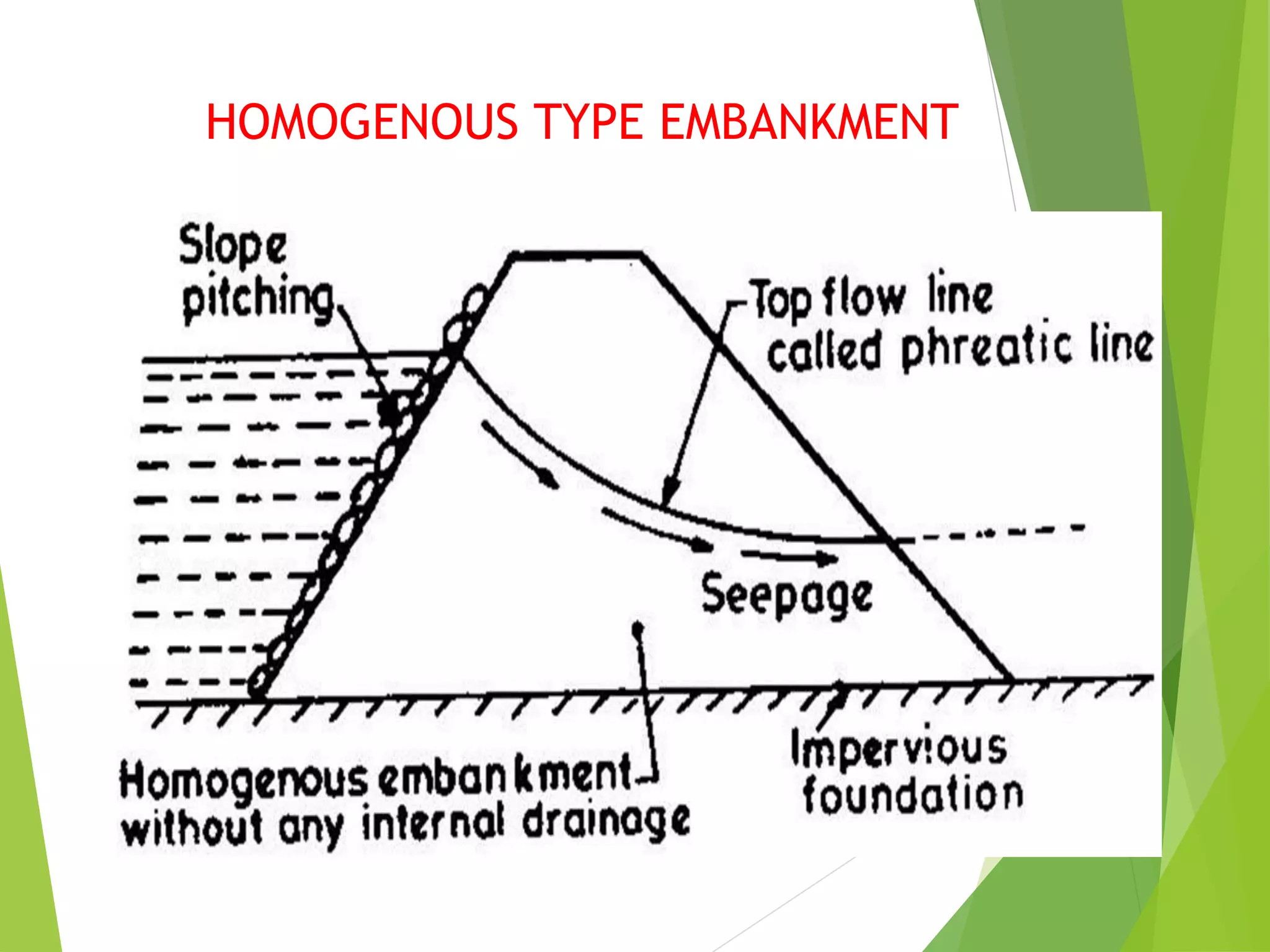
 The simplest type of an earthen embankment
consists of a single material and is homogeneous
throughout.
 Sometimes, a blanket of relatively impervious
material may be placed on the upstream face.
 A purely homogeneous section is used, when only
one type of material is economically or locally
available. Such a section is used to moderately
high dams for levees.
HOMOGENOUS TYPE EMBANKMENT
HOMOGENEOUS EMBANKMENT TYPE
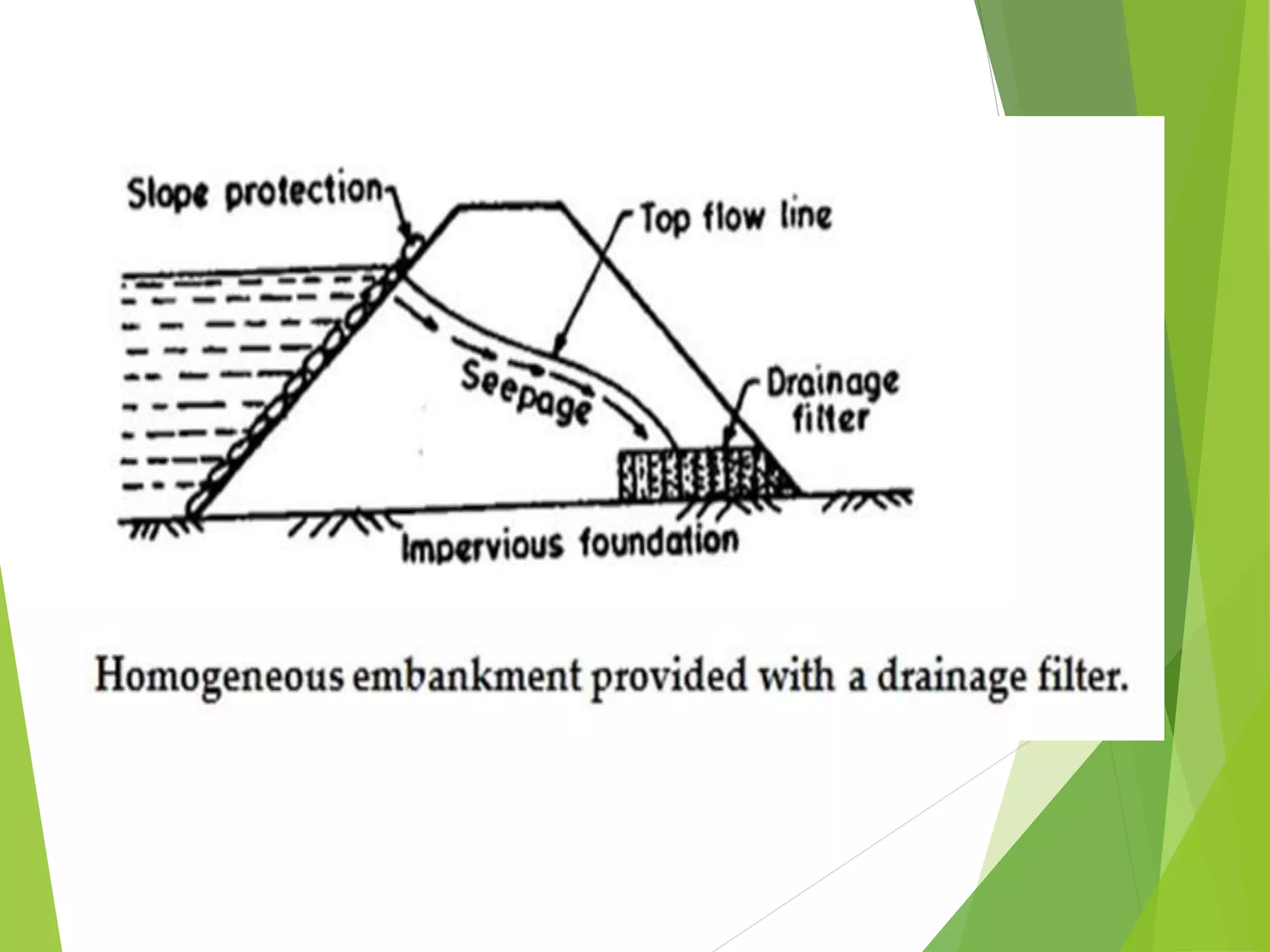
 A modified homogeneous section in which
internal drainage system (horizontal filter
drain or rock toe) is provided
 Advantages:
controls the action of seepage, so as to
permit much steeper slopes.
ZONED EMBANKMENT TYPE
 Zoned embankment type earth dam is
the one in which the dam is made up of
more than one material.
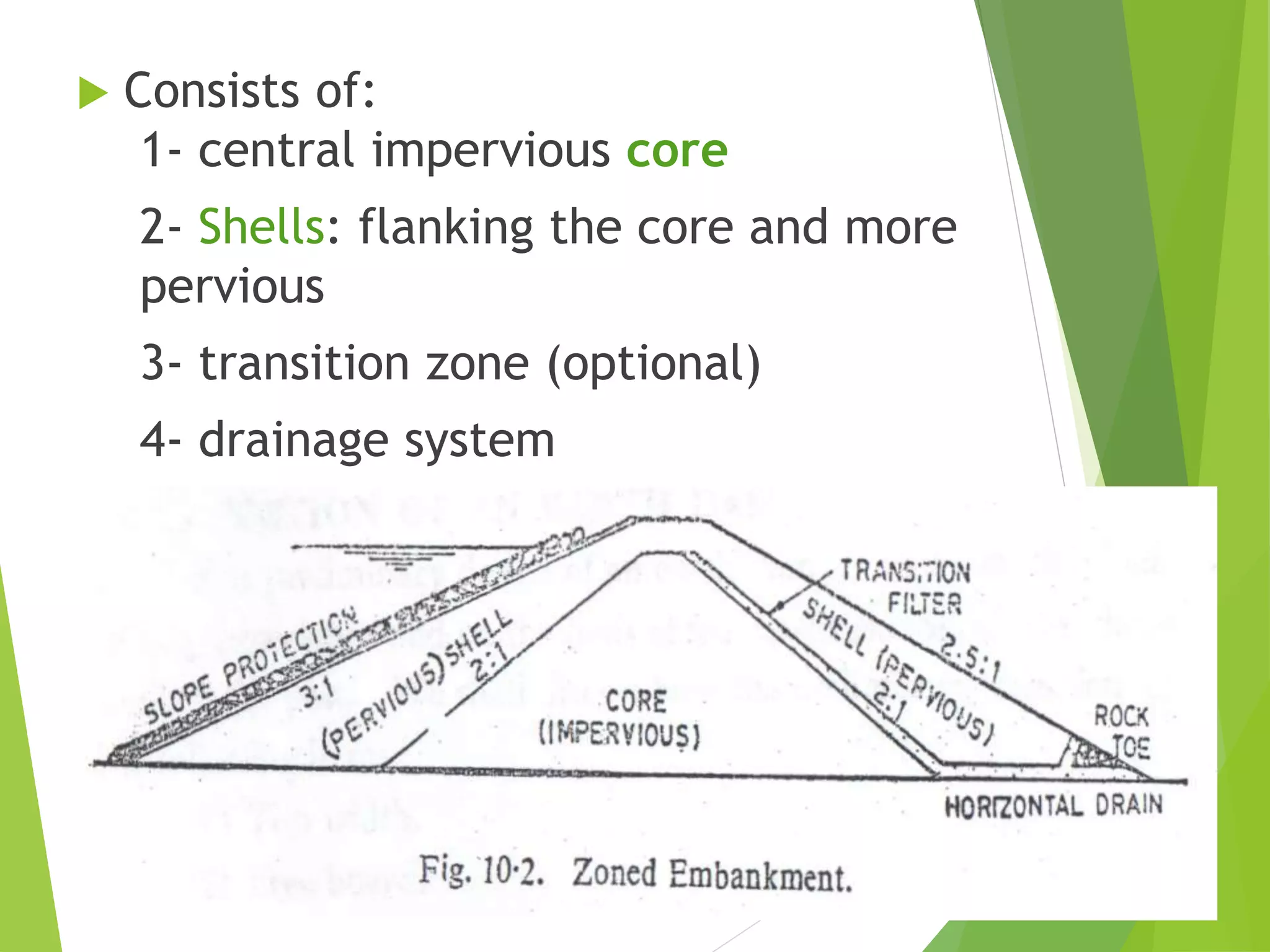
 Consists of:
1- central impervious core
2- Shells: flanking the core and more
pervious
3- transition zone (optional)
4- drainage system
ZONED EMBANKMENT TYPE
 The central core checks the seepage.
 The transition zone prevents piping
through cracks which may develop in the
core.
 The outer zone gives stability to the
central impervious fill and also distribute
the load over a large area of foundations.
ZONED EMBANKMENT TYPE
 This type of embankment are widely
constructed and the materials of the zones
are selected depending upon their
availabilities.
 Clay, inspite of it being highly impervious,
may not make the best core, if it shrinks and
swells too much. Due to this reason, clay is
sometimes mixed with fine sand or fine
gavel, so as to use it as the most suitable
material for the central impervious core.
ZONED EMBANKMENT TYPE
 Silts or silty clays may be used as the
satisfactory central core materials.
 Freely draining materials, such as coarse
sands and gravels, are used in the outer shell.
 Transition filters are provided between the
inner zone and the outer zone, as shown in
fig.
 This type of transition filters are always
provided, whenever there is an abrupt change
of permeability from one zone to the other.
ZONED EMBANKMENT TYPE
 Function of shell layer:
1- Give stability to the central core.
2- Distribute the load over a larger area in
the foundation.
3- The upstream pervious zone affords
stability against rapid drawdown
4- The downstream pervious zone acts as
a drain to control the line of seepage
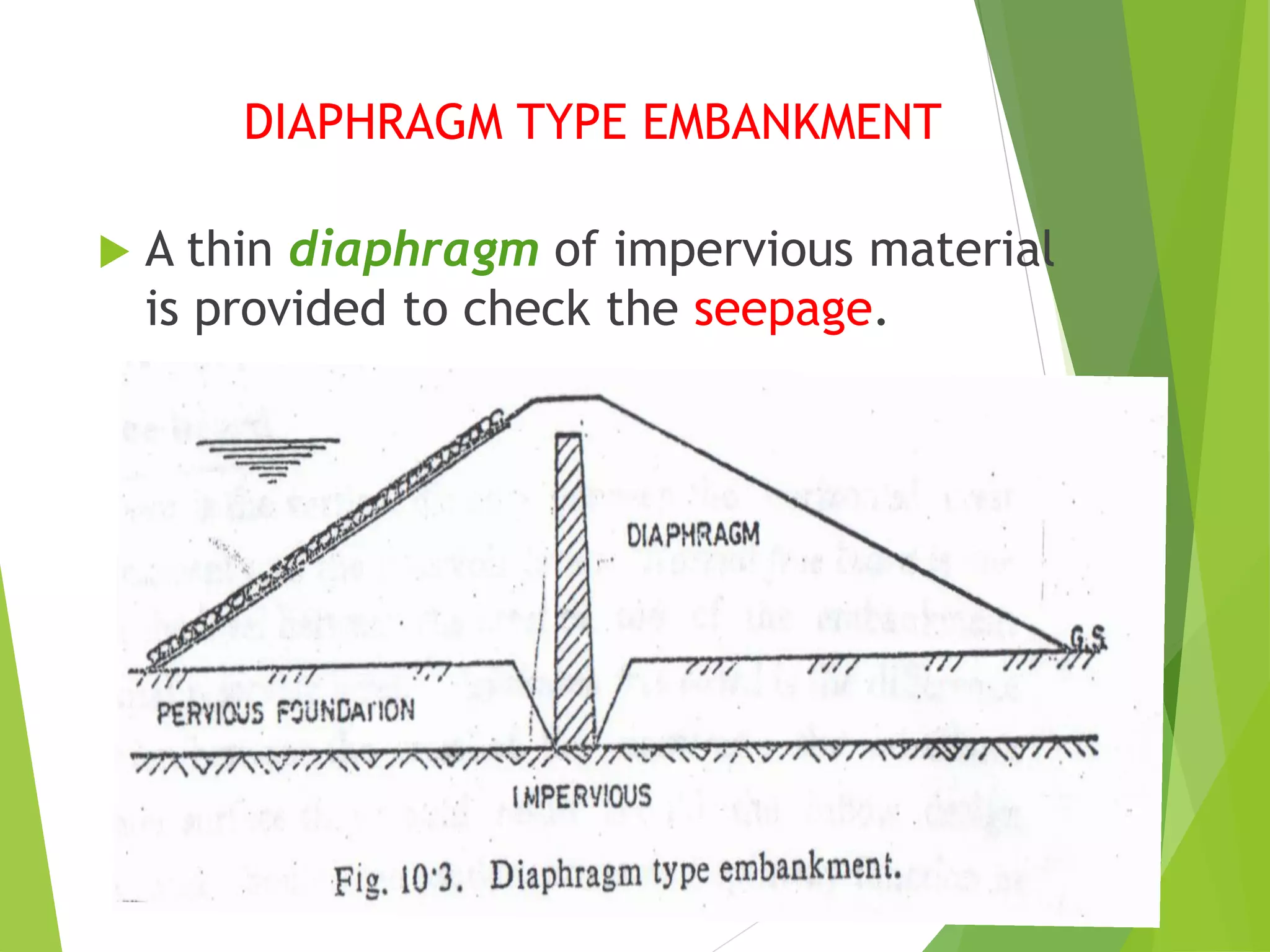
DIAPHRAGM TYPE EMBANKMENT
 A thin diaphragm of impervious material
is provided to check the seepage.
DIAPHRAGM TYPE EMBANKMENT
 Material: impervious soil, cement concrete,
bituminous concrete.
 Types: - Central vertical core
- a blanket at the upstream face
DIAPHRAGM TYPE EMBANKMENT
 Diaphragm type embankments have a thin
impervious core, which is surrounded by
earth or rock fill.
 The impervious core, called diaphragm, is
made of impervious soils, concrete, steel,
timber or any other material.
 It acts as a water barrier to prevent
seepage through the dam.
DIAPHRAGM TYPE EMBANKMENT
 The diaphragm may be placed either at the
centre as a central vertical core or at the
upstream face as a blanket.
 The diaphragm must also be tied to the bed
rock or to a very impervious foundation
material, if excessive under-seepage
through the existing previous foundations
has to be avoided.
DIAPHRAGM TYPE EMBANKMENT
 Difference between a diaphragm type and
zoned type:
The thickness of the diaphragm is less than
10 m or the height of embankment.
SECTION OF AN EARTH DAM
 Empirical assumptions shall be made for:
1- Top width.
2- Free board.
3- Upstream and downstream slopes.
4- Central Impervious core.
5- Downstream Drainage system.
1- TOP WIDTH
Z = height of the dam
b = top width or crest width
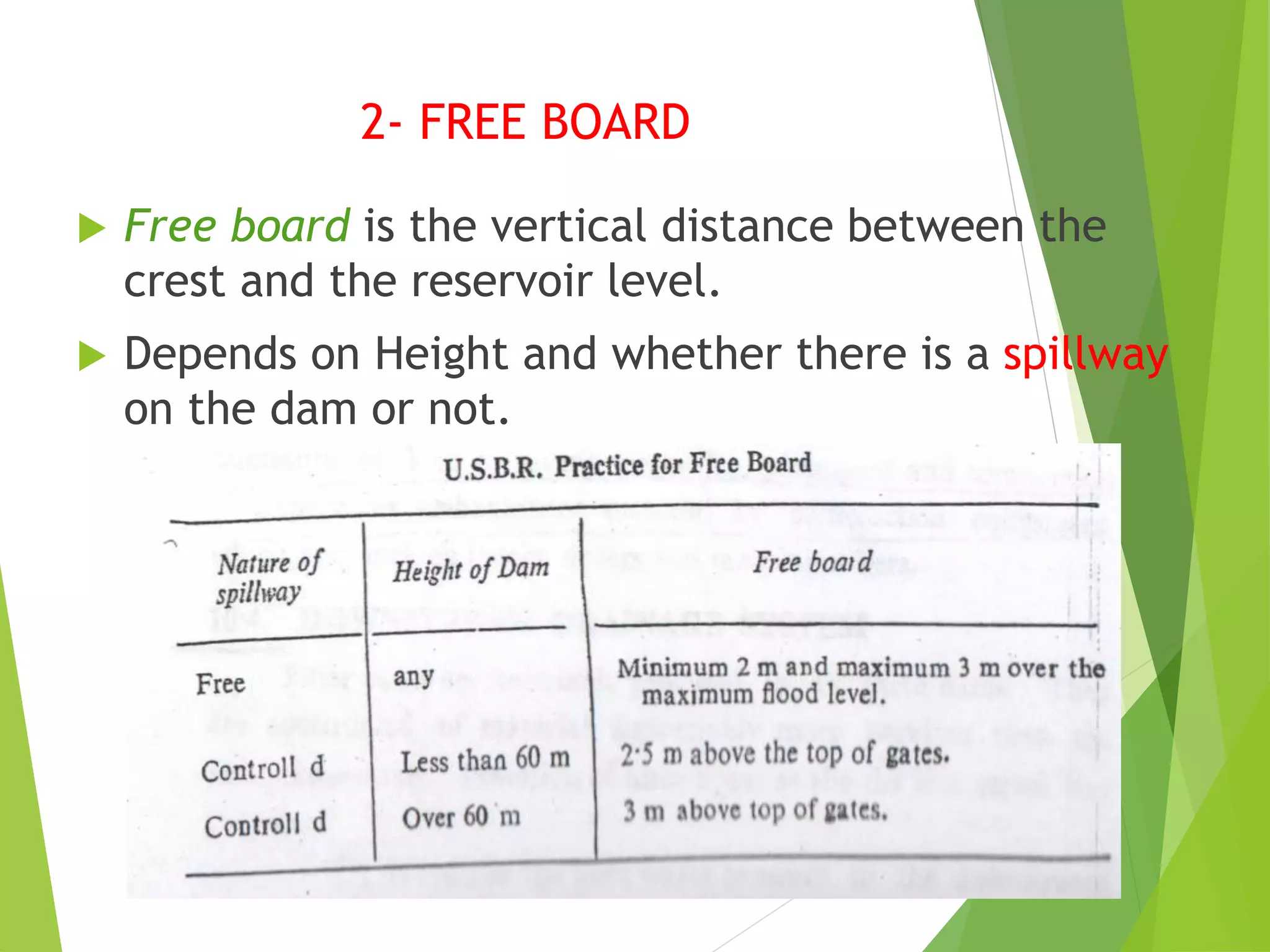
2- FREE BOARD
 Free board is the vertical distance between the
crest and the reservoir level.
 Depends on Height and whether there is a spillway
on the dam or not.
3- UPSTREAM AND DOWNSTREAM SLOPES
 Assume upstream slope 3:1 and downstream
slope 2.5:1 or use the table given below:
4- CENTRAL IMPERVIOUS CORE
1- The thickness of the core at any
elevation is not less than the height
of the embankment at that
elevation.
2- The width of the core at the crest
of the dam should be a minimum of
3 m
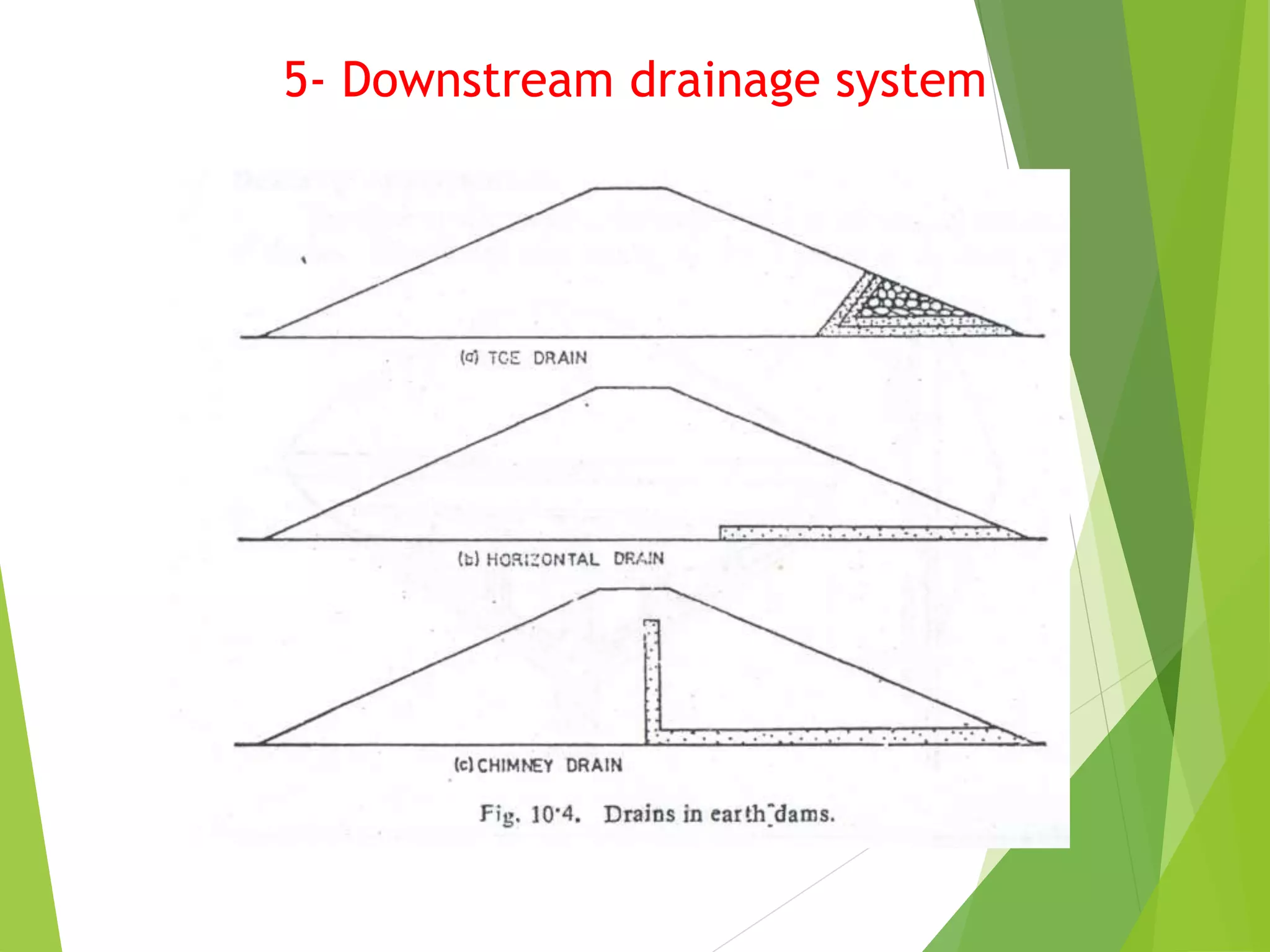
5- Downstream drainage system
 Types of drains:
1- Toe drains
2- Horizontal blanket drains
3- chimney drains
5- Downstream drainage system

Types of earth dams

  • 1.
  • 2.
    TYPES OF EARTHDAMS Depending upon the method of construction: 1- Rolled fill dam. 2- Hydraulic fill dam.
  • 3.
    ROLLED FILL DAM The embankment is constructed by placing suitable soil materials in thin layers (15 to 30 cm) and compacting them with rollers.  The soil is brought to the site from burrow pits and spread by bulldozers, etc., in layers.  These layers are thoroughly compacted by rollers of designed weights.
  • 4.
    ROLLED FILL DAM Ordinary road rollers can be used for low embankments (such as for levees or bunds); while power-operated rollers are to be used for dams.  The moisture content of the soil fill must be properly controlled.
  • 5.
    ROLLED FILL DAM The best compaction can be obtained at a moisture content somewhere near the optimum moisture content. (The optimum moisture content is the moisture required for obtaining optimum density in the fill).  Compaction of coarse gravels cannot be properly done by rolling and is best done by vibrating equipment.
  • 6.
    HYDRAULIC FILL DAM In this method of construction, the dam body is constructed by excavating and transporting soils by using water.  Pipes called flumes, are laid along the outer edge of the embankment.  The soil materials are mixed with water and pumped into these flumes.  The slush is discharged through the outlets in the flumes at suitable intervals along their lengths.
  • 7.
    ROLLED-FILL DAMS  Rolled-fillearth dams can be sub-divided into following types: 1- Homogeneous embankment type. 2- Zoned embankment type. 3- Diaphragm embankment type.
  • 8.
    HOMOGENEOUS EMBANKMENT TYPE The simplest type of an earthen embankment consists of a single material and is homogeneous throughout.  Sometimes, a blanket of relatively impervious material may be placed on the upstream face.  A purely homogeneous section is used, when only one type of material is economically or locally available. Such a section is used to moderately high dams for levees.
  • 9.
  • 10.
    HOMOGENEOUS EMBANKMENT TYPE A modified homogeneous section in which internal drainage system (horizontal filter drain or rock toe) is provided  Advantages: controls the action of seepage, so as to permit much steeper slopes.
  • 13.
    ZONED EMBANKMENT TYPE Zoned embankment type earth dam is the one in which the dam is made up of more than one material.
  • 14.
     Consists of: 1-central impervious core 2- Shells: flanking the core and more pervious 3- transition zone (optional) 4- drainage system
  • 15.
    ZONED EMBANKMENT TYPE The central core checks the seepage.  The transition zone prevents piping through cracks which may develop in the core.  The outer zone gives stability to the central impervious fill and also distribute the load over a large area of foundations.
  • 16.
    ZONED EMBANKMENT TYPE This type of embankment are widely constructed and the materials of the zones are selected depending upon their availabilities.  Clay, inspite of it being highly impervious, may not make the best core, if it shrinks and swells too much. Due to this reason, clay is sometimes mixed with fine sand or fine gavel, so as to use it as the most suitable material for the central impervious core.
  • 17.
    ZONED EMBANKMENT TYPE Silts or silty clays may be used as the satisfactory central core materials.  Freely draining materials, such as coarse sands and gravels, are used in the outer shell.  Transition filters are provided between the inner zone and the outer zone, as shown in fig.  This type of transition filters are always provided, whenever there is an abrupt change of permeability from one zone to the other.
  • 18.
    ZONED EMBANKMENT TYPE Function of shell layer: 1- Give stability to the central core. 2- Distribute the load over a larger area in the foundation. 3- The upstream pervious zone affords stability against rapid drawdown 4- The downstream pervious zone acts as a drain to control the line of seepage
  • 19.
    DIAPHRAGM TYPE EMBANKMENT A thin diaphragm of impervious material is provided to check the seepage.
  • 20.
    DIAPHRAGM TYPE EMBANKMENT Material: impervious soil, cement concrete, bituminous concrete.  Types: - Central vertical core - a blanket at the upstream face
  • 21.
    DIAPHRAGM TYPE EMBANKMENT Diaphragm type embankments have a thin impervious core, which is surrounded by earth or rock fill.  The impervious core, called diaphragm, is made of impervious soils, concrete, steel, timber or any other material.  It acts as a water barrier to prevent seepage through the dam.
  • 22.
    DIAPHRAGM TYPE EMBANKMENT The diaphragm may be placed either at the centre as a central vertical core or at the upstream face as a blanket.  The diaphragm must also be tied to the bed rock or to a very impervious foundation material, if excessive under-seepage through the existing previous foundations has to be avoided.
  • 23.
    DIAPHRAGM TYPE EMBANKMENT Difference between a diaphragm type and zoned type: The thickness of the diaphragm is less than 10 m or the height of embankment.
  • 24.
    SECTION OF ANEARTH DAM  Empirical assumptions shall be made for: 1- Top width. 2- Free board. 3- Upstream and downstream slopes. 4- Central Impervious core. 5- Downstream Drainage system.
  • 25.
    1- TOP WIDTH Z= height of the dam b = top width or crest width
  • 26.
    2- FREE BOARD Free board is the vertical distance between the crest and the reservoir level.  Depends on Height and whether there is a spillway on the dam or not.
  • 27.
    3- UPSTREAM ANDDOWNSTREAM SLOPES  Assume upstream slope 3:1 and downstream slope 2.5:1 or use the table given below:
  • 28.
    4- CENTRAL IMPERVIOUSCORE 1- The thickness of the core at any elevation is not less than the height of the embankment at that elevation. 2- The width of the core at the crest of the dam should be a minimum of 3 m
  • 29.
    5- Downstream drainagesystem  Types of drains: 1- Toe drains 2- Horizontal blanket drains 3- chimney drains
  • 30.