LOVELY PROFESSIONAL
UNIVERSITY
GEOMETRIC DESIGN
Topic: Road Side Ditches
AMANULLAH KHAN
Reg. No.: 11608087
Road Side Ditches
Definition: A ditch is a small to moderate
depression created to channel water.
A ditch can be used for drainage, to drain water
from low-lying areas, alongside roadways or
fields, or to channel water from a more distant
source for plant irrigation.
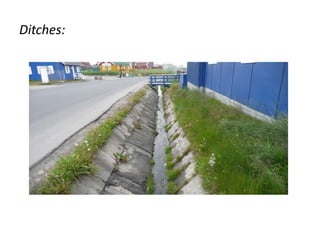
Ditches:
Cross-Section of Ditches
• The three main types of cross-sections for
road side ditches are:
Triangular
Parabolic
Trapezoidal
The parabolic shaped id hydraulically the best
resistant to erosion, but it is little complicated in
design than the Triangular and trapezoidal one.
The triangular section, although easy to
construct is very much susceptible to erosion
and gets easily blocked with debris and is
generally not recommended.
The most commonly used X-section is the
trapezoidal section as it is acceptable from both
considerations- hydraulic as well as of
construction.
The side slopes of the ditches
As for earth slopes should be flat, lying in the
range 2:1 to 4:1 their intersections also should
be rounded as recommended in case of earth
slopes from the view point of ease in grassing
and continuity of the turf.
While the quantity of water to be drained, the
length of drain and the gradient will actually
determine the width at bottom, it should
normally be not less than 0.3m.
Also to fulfill the requirement of the roadside
ditch to drain the base course of the road
pavement, the bottom of the ditch has to be
taken at least to a depth of 0.3m to 0.6m below
the shoulder level.
Surface Drain linings
Why?
Unlined, bare earth surface of roadside ditches
are highly susceptible to erosion unless the flow
is limited to a very small amount. It is, therefore
necessary that road side ditches generally be
provided with a protective lining which would
avoid serious erosion problems and keep them
serviceable.
Types of lining?
Turfing:
This lining is more economical than other lining
to establish and with proper maintenance it will
provide adequate protection against erosion for
most of the site situations.
Key factor: Should form firm turf.
The efficiency of this technique depends upon
making the water flow over the NET.
Experience has shown that under two extreme
site conditions-on very flat grades and then
again on very steep grades. Technique of
grassing as a surface lining does not always
provide satisfactory.
Becoz- On very flat grades (less than 0.5 %) the
flow over a grass lining is too slow, and giving
rise to the problems of silting or occurrence of
deposition which is rather difficult to maintain.
And over extremely steep grades erosive
velocities are reached, which due to scouring
action can destroy the grass lining completely.
Under these conditions we provide:
Cement Concrete Lining
Brick/Rubble Masonry and even
Bituminous mixes.
Paved lining
The most practical concrete lining is the
prefabricated type. In this construction, the
panels are cast in standard form at a convenient
central plant.
Constructed easily on smooth base ground and
a panel size of 0.3m x 1m x 0.05 is a practical
size for handling. Narrow units may be cast for
the bottom of small ditch sections.
The ditch section is shaped to line and grade and
the surface smoothened. The slabs are then
placed in the ditch.
The banks are seeded to establish a turf right up
to the edge of the lining.
The concrete for precast slabs should be of
uniform consistency, using 20mm maximum size
of the aggregate.
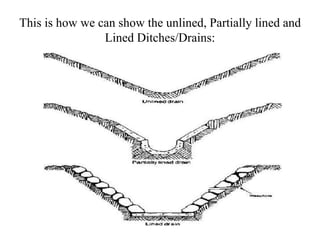
This is how we can show the unlined, Partially lined and
Lined Ditches/Drains:
Velocity of Flow
For efficient functioning of a road side ditch, the flow
must be fast enough to prevent silting or deposition but
at the same time the flow must not be so fast as to cause
serious damage by scouring action.
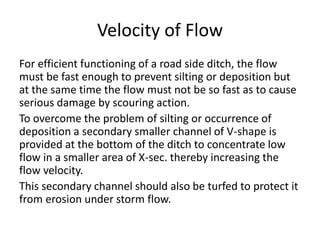
To overcome the problem of silting or occurrence of
deposition a secondary smaller channel of V-shape is
provided at the bottom of the ditch to concentrate low
flow in a smaller area of X-sec. thereby increasing the
flow velocity.
This secondary channel should also be turfed to protect it
from erosion under storm flow.
A good turf lining will be able to withstand
velocities of about 5 to 6 Km/hr.
To get a fairly good idea of water velocity in the
ditch, throw a wooden chip into the ditch during
an intense storm and if a man can keep up with
the chip at a moderate walking speed, the
velocity of water is below maximum.
But if he has to run to keep up pace with the
chip the velocity is above the safe maximum.
Design Steps
1. From the known soil type, arrive at the value of Manning’s
Rugosity Coefficient.
2. Calculate the hydraulic mean depth from the Manning’s
formula.
3. Find out the X-sec. area from the given discharge and the
max permissible velocity.
4. From step 2 and 3 solve the simultaneous =n’s to obtain
bottom width and depth.
5. Calculate the critical depth and determine whether the
flow is Tranquil or Turbulent.
If it is Tranquil add a freeboard to the depth and
finalize the X-sec. and if flow is turbulent it may be necessary
to line the channel or decrease the longitudinal slope.
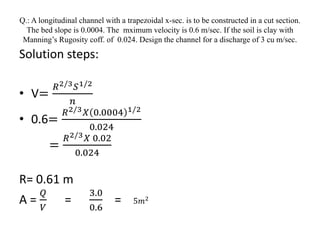
Q.: A longitudinal channel with a trapezoidal x-sec. is to be constructed in a cut section.
The bed slope is 0.0004. The mximum velocity is 0.6 m/sec. If the soil is clay with
Manning’s Rugosity coff. of 0.024. Design the channel for a discharge of 3 cu m/sec.
Solution steps:
• V=
𝑅2/3 𝑆1/2
𝑛
• 0.6=
𝑅2/3 𝑋 0.0004 1/2
0.024
=
𝑅2/3 𝑋 0.02
0.024
R= 0.61 m
A =
𝑄
𝑉
=
3.0
0.6
= 5𝑚2
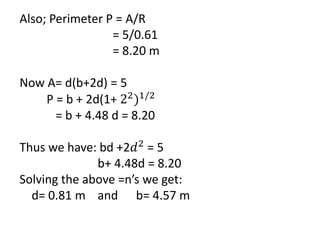
Also; Perimeter P = A/R
= 5/0.61
= 8.20 m
Now A= d(b+2d) = 5
P = b + 2d(1+ 22
)1/2
= b + 4.48 d = 8.20
Thus we have: bd +2𝑑2
= 5
b+ 4.48d = 8.20
Solving the above =n’s we get:
d= 0.81 m and b= 4.57 m
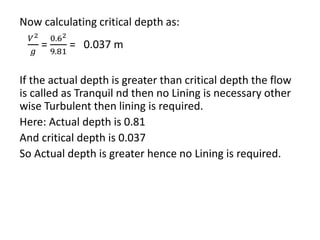
Now calculating critical depth as:
𝑉2
𝑔
=
0.62
9.81
= 0.037 m
If the actual depth is greater than critical depth the flow
is called as Tranquil nd then no Lining is necessary other
wise Turbulent then lining is required.
Here: Actual depth is 0.81
And critical depth is 0.037
So Actual depth is greater hence no Lining is required.
Thanks for listening…
Good Bye

Raod side ditches

  • 1.
    LOVELY PROFESSIONAL UNIVERSITY GEOMETRIC DESIGN Topic:Road Side Ditches AMANULLAH KHAN Reg. No.: 11608087
  • 2.
    Road Side Ditches Definition:A ditch is a small to moderate depression created to channel water. A ditch can be used for drainage, to drain water from low-lying areas, alongside roadways or fields, or to channel water from a more distant source for plant irrigation.
  • 3.
  • 5.
    Cross-Section of Ditches •The three main types of cross-sections for road side ditches are: Triangular Parabolic Trapezoidal The parabolic shaped id hydraulically the best resistant to erosion, but it is little complicated in design than the Triangular and trapezoidal one.
  • 6.
    The triangular section,although easy to construct is very much susceptible to erosion and gets easily blocked with debris and is generally not recommended. The most commonly used X-section is the trapezoidal section as it is acceptable from both considerations- hydraulic as well as of construction.
  • 7.
    The side slopesof the ditches As for earth slopes should be flat, lying in the range 2:1 to 4:1 their intersections also should be rounded as recommended in case of earth slopes from the view point of ease in grassing and continuity of the turf.
  • 8.
    While the quantityof water to be drained, the length of drain and the gradient will actually determine the width at bottom, it should normally be not less than 0.3m. Also to fulfill the requirement of the roadside ditch to drain the base course of the road pavement, the bottom of the ditch has to be taken at least to a depth of 0.3m to 0.6m below the shoulder level.
  • 9.
    Surface Drain linings Why? Unlined,bare earth surface of roadside ditches are highly susceptible to erosion unless the flow is limited to a very small amount. It is, therefore necessary that road side ditches generally be provided with a protective lining which would avoid serious erosion problems and keep them serviceable.
  • 10.
    Types of lining? Turfing: Thislining is more economical than other lining to establish and with proper maintenance it will provide adequate protection against erosion for most of the site situations. Key factor: Should form firm turf. The efficiency of this technique depends upon making the water flow over the NET.
  • 11.
    Experience has shownthat under two extreme site conditions-on very flat grades and then again on very steep grades. Technique of grassing as a surface lining does not always provide satisfactory. Becoz- On very flat grades (less than 0.5 %) the flow over a grass lining is too slow, and giving rise to the problems of silting or occurrence of deposition which is rather difficult to maintain.
  • 12.
    And over extremelysteep grades erosive velocities are reached, which due to scouring action can destroy the grass lining completely. Under these conditions we provide: Cement Concrete Lining Brick/Rubble Masonry and even Bituminous mixes.
  • 13.
    Paved lining The mostpractical concrete lining is the prefabricated type. In this construction, the panels are cast in standard form at a convenient central plant. Constructed easily on smooth base ground and a panel size of 0.3m x 1m x 0.05 is a practical size for handling. Narrow units may be cast for the bottom of small ditch sections.
  • 14.
    The ditch sectionis shaped to line and grade and the surface smoothened. The slabs are then placed in the ditch. The banks are seeded to establish a turf right up to the edge of the lining. The concrete for precast slabs should be of uniform consistency, using 20mm maximum size of the aggregate.
  • 15.
    This is howwe can show the unlined, Partially lined and Lined Ditches/Drains:
  • 16.
    Velocity of Flow Forefficient functioning of a road side ditch, the flow must be fast enough to prevent silting or deposition but at the same time the flow must not be so fast as to cause serious damage by scouring action. To overcome the problem of silting or occurrence of deposition a secondary smaller channel of V-shape is provided at the bottom of the ditch to concentrate low flow in a smaller area of X-sec. thereby increasing the flow velocity. This secondary channel should also be turfed to protect it from erosion under storm flow.
  • 17.
    A good turflining will be able to withstand velocities of about 5 to 6 Km/hr. To get a fairly good idea of water velocity in the ditch, throw a wooden chip into the ditch during an intense storm and if a man can keep up with the chip at a moderate walking speed, the velocity of water is below maximum. But if he has to run to keep up pace with the chip the velocity is above the safe maximum.
  • 18.
    Design Steps 1. Fromthe known soil type, arrive at the value of Manning’s Rugosity Coefficient. 2. Calculate the hydraulic mean depth from the Manning’s formula. 3. Find out the X-sec. area from the given discharge and the max permissible velocity. 4. From step 2 and 3 solve the simultaneous =n’s to obtain bottom width and depth. 5. Calculate the critical depth and determine whether the flow is Tranquil or Turbulent. If it is Tranquil add a freeboard to the depth and finalize the X-sec. and if flow is turbulent it may be necessary to line the channel or decrease the longitudinal slope.
  • 19.
    Q.: A longitudinalchannel with a trapezoidal x-sec. is to be constructed in a cut section. The bed slope is 0.0004. The mximum velocity is 0.6 m/sec. If the soil is clay with Manning’s Rugosity coff. of 0.024. Design the channel for a discharge of 3 cu m/sec. Solution steps: • V= 𝑅2/3 𝑆1/2 𝑛 • 0.6= 𝑅2/3 𝑋 0.0004 1/2 0.024 = 𝑅2/3 𝑋 0.02 0.024 R= 0.61 m A = 𝑄 𝑉 = 3.0 0.6 = 5𝑚2
  • 20.
    Also; Perimeter P= A/R = 5/0.61 = 8.20 m Now A= d(b+2d) = 5 P = b + 2d(1+ 22 )1/2 = b + 4.48 d = 8.20 Thus we have: bd +2𝑑2 = 5 b+ 4.48d = 8.20 Solving the above =n’s we get: d= 0.81 m and b= 4.57 m
  • 21.
    Now calculating criticaldepth as: 𝑉2 𝑔 = 0.62 9.81 = 0.037 m If the actual depth is greater than critical depth the flow is called as Tranquil nd then no Lining is necessary other wise Turbulent then lining is required. Here: Actual depth is 0.81 And critical depth is 0.037 So Actual depth is greater hence no Lining is required.
  • 22.