Canal Regulation Works
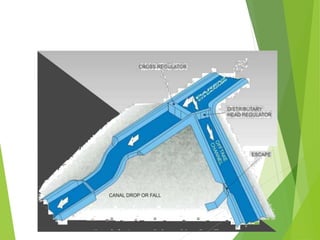
 Any structure constructed to regulate the discharge, full
supply level or velocity in a canal is known as a regulation
work.
 Such a structure is necessary for the effieient working and
safety of an irrigation channel.
 The various regulation works may be categorised as under:
 Canal fall
 Head regulator
 Cross regulator
 Canal escape
 Canal outlet
Head Regulator
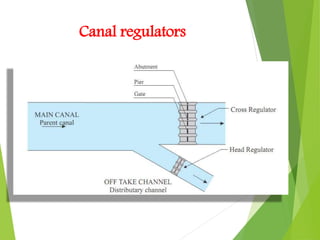
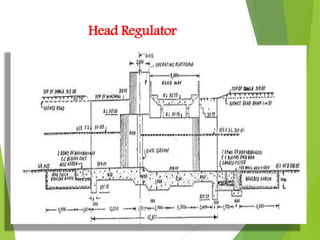
 Regulators Constructed at the off taking point are
called head regulators.
 When it is constructed at the head of main canal it is
known as canal head regulator.
 When it is constructed at the head of distributary, it is
called distributary head regulator.
Head Regulator
Function:
 They regulate or control the supply of water to
the offtaking channel from the parent channel
 They control the entry of silt in the offtaking
channel.
 They serve as meter for measuring the discharge
entering into the offtaking canal
 They help in shutting off the supplies when not
needed in the offtaking channel is required to be
closed for repairs
Head Regulator
Construction:
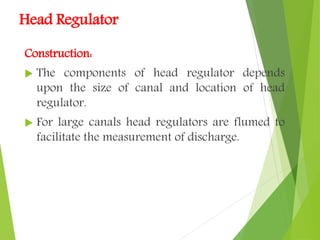
 The components of head regulator depends
upon the size of canal and location of head
regulator.
 For large canals head regulators are flumed to
facilitate the measurement of discharge.
Cross Regulator
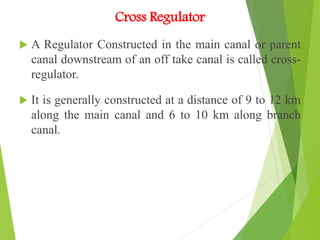
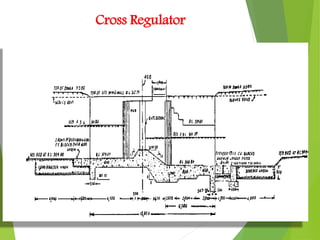
 A Regulator Constructed in the main canal or parent
canal downstream of an off take canal is called cross-
regulator.
 It is generally constructed at a distance of 9 to 12 km
along the main canal and 6 to 10 km along branch
canal.
Functions of Cross Regulator
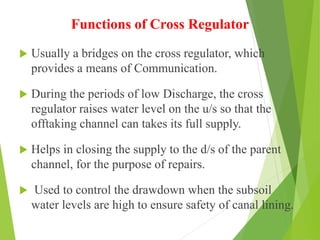
 Usually a bridges on the cross regulator, which
provides a means of Communication.
 During the periods of low Discharge, the cross
regulator raises water level on the u/s so that the
offtaking channel can takes its full supply.
 Helps in closing the supply to the d/s of the parent
channel, for the purpose of repairs.
 Used to control the drawdown when the subsoil
water levels are high to ensure safety of canal lining.
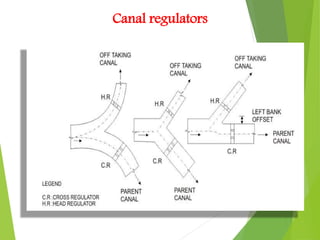
Canal regulators
Canal regulators
Cross Regulator
Head Regulator
Canal Outlet/modules
 A canal outlet or a module is a small structure
which admits water from the distributing channel to a
water course of field channel.
 An outlet is a sort of head regulator for the field channel
delivering water to the irrigation fields.
 It acts as a connecting link between the system manager
and the farmers.
 The discharge through an outlet is usually not less than
0.03 cumec & not more than 0.085 cumec.
Requirements of good Outlet
 It should be simple in design ,construction and
maintenance.
 It should be quite strong and durable.
 It should not be easily tampered with by the cultivators, but
if tampered with it should be easily detected
 It should be worked efficiently with a small working load.
 It should not be expensive.
 It design should be such that it can be easily constructed by
the local workers.
Types of Outlets
Outlets may be classified under the following
there heads:
 Non-modular outlet
 Semi-module of Flexible Module
 Rigid Module
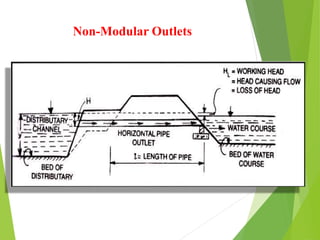
Non-Modular Outlets
 Non-modular Outlets are those through which
the discharge depends upon the head
difference between the distributary and the
water course.
Common examples are:
(i) Open sluice
(ii) Drowned pipe outlet
Non-Modular Outlets
 Non-modular modules
Semi-modular outlets
 The discharge through these outlets depend on the water
level of the distributing channel but is independent of the
water level in the watercourse so long as the minimum
working head required for their working is available.
Types of Semi-modules
 Pipe Outlet Discharging Freely into Air
 Venturi Flume Oulet or Kennedy Guage Outlet
 Open Flume Outlet
 Adjustable Orifice Semi-module
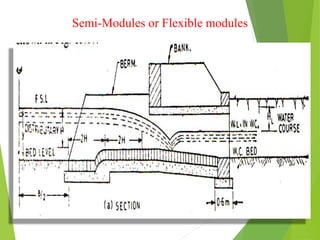
Semi-Modules or Flexible modules
 Due to construction, a super-critical velocity is ensured in
the throat and thereby allowing the formation of a jump in
the expanding flume.
 The formation of hydraulic jump makes the outlet discharge
independent of the water level in water course, thus making
it a semi module.
 Semi-modules or flexible modules are those through which
the discharge is independent of the water level of the water
course but depends only upon the water level of the
distributary so long as a minimum working head is available.
Semi-Modules or Flexible modules
Rigid Modules or Modular Outlets
 Rigid modules or modular outlets are those
through which discharge is constant and fixed
within limits, irrespective of the fluctuations of
the water levels of either the distributary or of
the water course or both.
Types of Rigid Modules
 Gibb’s Module
 Khanna’s Rigid Module
 Foote Module
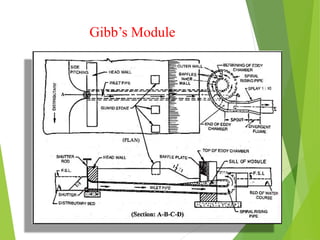
Gibb’s Module
GIBB’S MODULE
 DESIGNED BY A.S.GIBB{Punjab Irrigation Dept.}
 Q Varies b/w 0.03 to 0.45 cumec
 For lower value of Q b/w 1 to 3 cusecs, it is
economical in RCC structure
 For higher value of Q , it is constructed in brick
masonry.

Canal outlets

  • 1.
    Canal Regulation Works Any structure constructed to regulate the discharge, full supply level or velocity in a canal is known as a regulation work.  Such a structure is necessary for the effieient working and safety of an irrigation channel.  The various regulation works may be categorised as under:  Canal fall  Head regulator  Cross regulator  Canal escape  Canal outlet
  • 3.
    Head Regulator  RegulatorsConstructed at the off taking point are called head regulators.  When it is constructed at the head of main canal it is known as canal head regulator.  When it is constructed at the head of distributary, it is called distributary head regulator.
  • 4.
    Head Regulator Function:  Theyregulate or control the supply of water to the offtaking channel from the parent channel  They control the entry of silt in the offtaking channel.  They serve as meter for measuring the discharge entering into the offtaking canal  They help in shutting off the supplies when not needed in the offtaking channel is required to be closed for repairs
  • 5.
    Head Regulator Construction:  Thecomponents of head regulator depends upon the size of canal and location of head regulator.  For large canals head regulators are flumed to facilitate the measurement of discharge.
  • 6.
    Cross Regulator  ARegulator Constructed in the main canal or parent canal downstream of an off take canal is called cross- regulator.  It is generally constructed at a distance of 9 to 12 km along the main canal and 6 to 10 km along branch canal.
  • 7.
    Functions of CrossRegulator  Usually a bridges on the cross regulator, which provides a means of Communication.  During the periods of low Discharge, the cross regulator raises water level on the u/s so that the offtaking channel can takes its full supply.  Helps in closing the supply to the d/s of the parent channel, for the purpose of repairs.  Used to control the drawdown when the subsoil water levels are high to ensure safety of canal lining.
  • 8.
  • 9.
  • 10.
  • 11.
  • 12.
    Canal Outlet/modules  Acanal outlet or a module is a small structure which admits water from the distributing channel to a water course of field channel.  An outlet is a sort of head regulator for the field channel delivering water to the irrigation fields.  It acts as a connecting link between the system manager and the farmers.  The discharge through an outlet is usually not less than 0.03 cumec & not more than 0.085 cumec.
  • 13.
    Requirements of goodOutlet  It should be simple in design ,construction and maintenance.  It should be quite strong and durable.  It should not be easily tampered with by the cultivators, but if tampered with it should be easily detected  It should be worked efficiently with a small working load.  It should not be expensive.  It design should be such that it can be easily constructed by the local workers.
  • 14.
    Types of Outlets Outletsmay be classified under the following there heads:  Non-modular outlet  Semi-module of Flexible Module  Rigid Module
  • 15.
    Non-Modular Outlets  Non-modularOutlets are those through which the discharge depends upon the head difference between the distributary and the water course. Common examples are: (i) Open sluice (ii) Drowned pipe outlet
  • 16.
  • 17.
    Semi-modular outlets  Thedischarge through these outlets depend on the water level of the distributing channel but is independent of the water level in the watercourse so long as the minimum working head required for their working is available. Types of Semi-modules  Pipe Outlet Discharging Freely into Air  Venturi Flume Oulet or Kennedy Guage Outlet  Open Flume Outlet  Adjustable Orifice Semi-module
  • 18.
    Semi-Modules or Flexiblemodules  Due to construction, a super-critical velocity is ensured in the throat and thereby allowing the formation of a jump in the expanding flume.  The formation of hydraulic jump makes the outlet discharge independent of the water level in water course, thus making it a semi module.  Semi-modules or flexible modules are those through which the discharge is independent of the water level of the water course but depends only upon the water level of the distributary so long as a minimum working head is available.
  • 19.
  • 20.
    Rigid Modules orModular Outlets  Rigid modules or modular outlets are those through which discharge is constant and fixed within limits, irrespective of the fluctuations of the water levels of either the distributary or of the water course or both. Types of Rigid Modules  Gibb’s Module  Khanna’s Rigid Module  Foote Module
  • 21.
  • 22.
    GIBB’S MODULE  DESIGNEDBY A.S.GIBB{Punjab Irrigation Dept.}  Q Varies b/w 0.03 to 0.45 cumec  For lower value of Q b/w 1 to 3 cusecs, it is economical in RCC structure  For higher value of Q , it is constructed in brick masonry.