Canal Irrigation
Cross-Section of
Irrigation Canal
Introduction
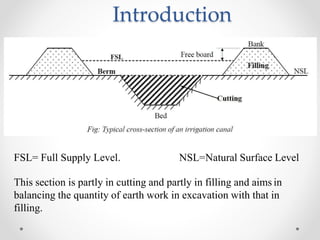
FSL= Full Supply Level. NSL=Natural Surface Level
This section is partly in cutting and partly in filling and aims in
balancing the quantity of earth work in excavation with that in
filling.
Introduction
 When the NSL is above the top of the bank, the entire
canal section will have to be in cutting, and it shall be
called ‘canal in cutting’.
 Similarly, when the NSL is lower than the bed level of
the canal, the entire canal section will have to be built in
filling, and it is called ‘canal in filling’.
Components of Cross- Section
 Side slope
 Berm
 Freeboard
 Bank
 Service road
 Back Berm or CounterBerm
 SpoilBank
 BorrowPit
Side Slope
 The side slopes should be such that they are stable,
depending upon the type of the soil.
 A comparatively steeper slope can be provided in
cutting rather than in filling, as the soil in the former case
shall be more stable.
Berm
 Berm is the horizontal distance left at ground level
between the toe of the bank and the top edge of cutting.
Berm
Berm (contd.)
Purposes of Berms:
 They give additional strength to the banks and provide
protection against erosion and breaches.
 They protect the banks from erosion due to wave action.
 They provide a scope for future widening of the canal.
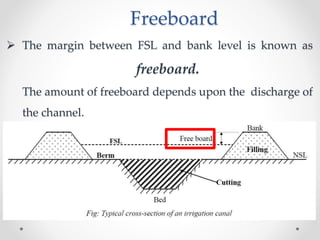
Freeboard
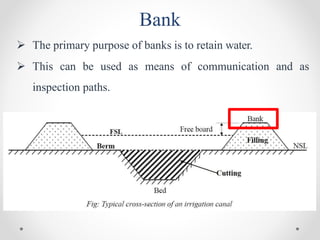
 The margin between FSL and bank level is known as
freeboard.
The amount of freeboard depends upon the discharge of
the channel.
Bank
 The primary purpose of banks is to retain water.
 This can be used as means of communication and as
inspection paths.
Service Road
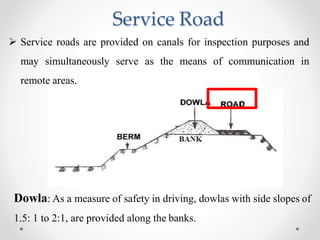
 Service roads are provided on canals for inspection purposes and
may simultaneously serve as the means of communication in
remote areas.
Dowla: As a measure of safety in driving, dowlas with side slopes of
1.5: 1 to 2:1, are provided along the banks.
Back Berm or Counter Berm
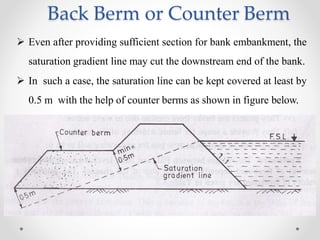
 Even after providing sufficient section for bank embankment, the
saturation gradient line may cut the downstream end of the bank.
 In such a case, the saturation line can be kept covered at least by
0.5 m with the help of counter berms as shown in figure below.
Spoil Bank
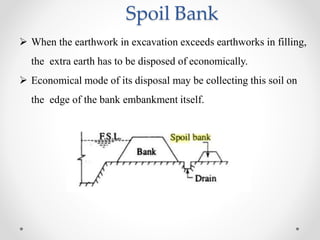
 When the earthwork in excavation exceeds earthworks in filling,
the extra earth has to be disposed of economically.
 Economical mode of its disposal may be collecting this soil on
the edge of the bank embankment itself.
Borrow Pit
When earthwork in filling exceeds the earthwork in
excavation, the earth has to be brought from somewhere.
The pits, which are dug for bringing earth, are known as
borrow pits.
If such pits are excavated outside the channel, they are known
as external borrow pits, and if they are excavated somewhere
within the channel, they are known as internal borrow pits.
Internal borrow pits are more preferred than external one.
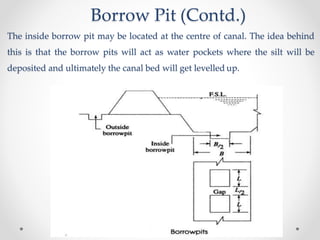
Borrow Pit (Contd.)
The inside borrow pit may be located at the centre of canal. The idea behind
this is that the borrow pits will act as water pockets where the silt will be
deposited and ultimately the canal bed will get levelled up.
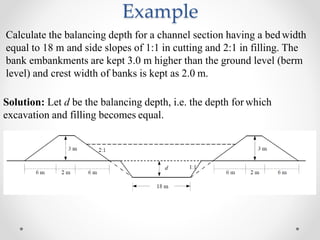
Example
Calculate the balancing depth for a channel section having a bedwidth
equal to 18 m and side slopes of 1:1 in cutting and 2:1 in filling. The
bank embankments are kept 3.0 m higher than the ground level (berm
level) and crest width of banks is kept as 2.0 m.
Solution: Let d be the balancing depth, i.e. the depth for which
excavation and filling becomes equal.
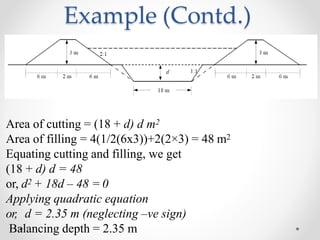
Example (Contd.)
Area of cutting = (18 + d) d m2
Area of filling = 4(1/2(6x3))+2(2×3) = 48 m2
Equating cutting and filling, we get
(18 + d) d = 48
or, d2 + 18d – 48 = 0
Applying quadratic equation
or, d = 2.35 m (neglecting –ve sign)
Balancing depth = 2.35 m
Losses of water in canal
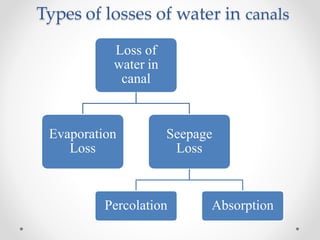
Types of losses of water in canals
Loss of
water in
canal
Evaporation
Loss
Seepage
Loss
Percolation Absorption
Evaporation Loss
 The water lost by evaporation is generally very
small, as compared to seepage loss.
 Evaporation Loss are generally 2-3% of total loss
(max. 7% in summer)
Seepage Loss
Percolation:
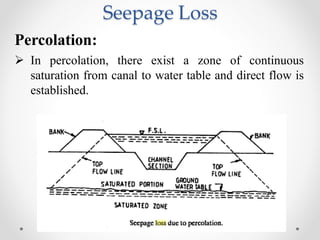
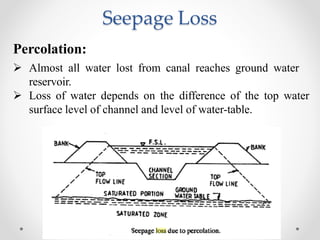
 In percolation, there exist a zone of continuous
saturation from canal to water table and direct flow is
established.
Seepage Loss
Percolation:
 Almost all water lost from canal reaches ground water
reservoir.
 Loss of water depends on the difference of the top water
surface level of channel and level of water-table.
Seepage Loss
Absorption:
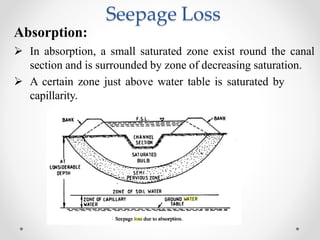
 In absorption, a small saturated zone exist round the canal
section and is surrounded by zone of decreasing saturation.
 A certain zone just above water table is saturated by
capillarity.
Seepage Loss
Absorption:
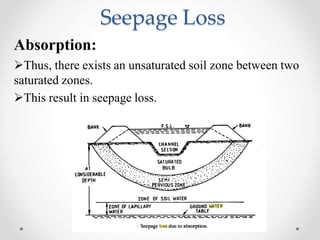
Thus, there exists an unsaturated soil zone between two
saturated zones.
This result in seepage loss.
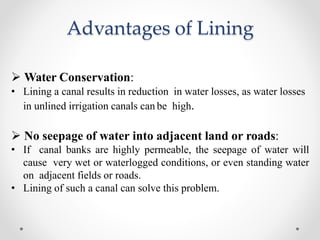
Canal Lining
Advantages of Lining
 Water Conservation:
• Lining a canal results in reduction in water losses, as water losses
in unlined irrigation canals can be high.
 No seepage of water into adjacent land or roads:
• If canal banks are highly permeable, the seepage of water will
cause very wet or waterlogged conditions, or even standing water
on adjacent fields or roads.
• Lining of such a canal can solve this problem.
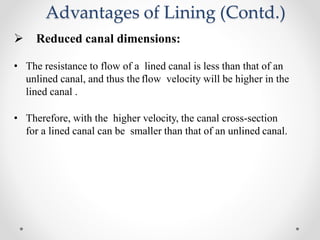
Advantages of Lining (Contd.)
 Reduced canal dimensions:
• The resistance to flow of a lined canal is less than that of an
unlined canal, and thus the flow velocity will be higher in the
lined canal .
• Therefore, with the higher velocity, the canal cross-section
for a lined canal can be smaller than that of an unlined canal.
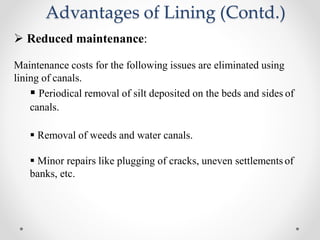
Advantages of Lining (Contd.)
 Reduced maintenance:
Maintenance costs for the following issues are eliminated using
lining of canals.
 Periodical removal of silt deposited on the beds and sides of
canals.
 Removal of weeds and water canals.
 Minor repairs like plugging of cracks, uneven settlements of
banks, etc.
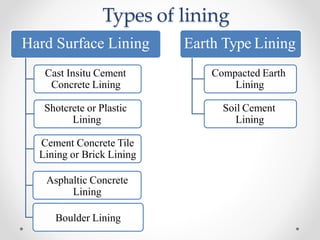
Types of lining
Cast Insitu Cement
Concrete Lining
Shotcrete or Plastic
Lining
Cement Concrete Tile
Lining or Brick Lining
Asphaltic Concrete
Lining
Boulder Lining
Hard Surface Lining Earth Type Lining
Compacted Earth
Lining
Soil Cement
Lining
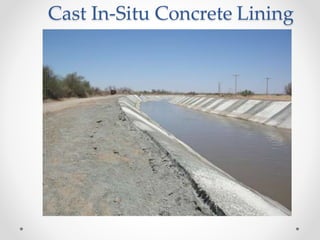
Cast In-Situ Concrete Lining
Thank
You

Canal Irrigation

  • 1.
  • 2.
  • 3.
    Introduction FSL= Full SupplyLevel. NSL=Natural Surface Level This section is partly in cutting and partly in filling and aims in balancing the quantity of earth work in excavation with that in filling.
  • 4.
    Introduction  When theNSL is above the top of the bank, the entire canal section will have to be in cutting, and it shall be called ‘canal in cutting’.  Similarly, when the NSL is lower than the bed level of the canal, the entire canal section will have to be built in filling, and it is called ‘canal in filling’.
  • 5.
    Components of Cross-Section  Side slope  Berm  Freeboard  Bank  Service road  Back Berm or CounterBerm  SpoilBank  BorrowPit
  • 6.
    Side Slope  Theside slopes should be such that they are stable, depending upon the type of the soil.  A comparatively steeper slope can be provided in cutting rather than in filling, as the soil in the former case shall be more stable.
  • 7.
    Berm  Berm isthe horizontal distance left at ground level between the toe of the bank and the top edge of cutting. Berm
  • 8.
    Berm (contd.) Purposes ofBerms:  They give additional strength to the banks and provide protection against erosion and breaches.  They protect the banks from erosion due to wave action.  They provide a scope for future widening of the canal.
  • 9.
    Freeboard  The marginbetween FSL and bank level is known as freeboard. The amount of freeboard depends upon the discharge of the channel.
  • 10.
    Bank  The primarypurpose of banks is to retain water.  This can be used as means of communication and as inspection paths.
  • 11.
    Service Road  Serviceroads are provided on canals for inspection purposes and may simultaneously serve as the means of communication in remote areas. Dowla: As a measure of safety in driving, dowlas with side slopes of 1.5: 1 to 2:1, are provided along the banks.
  • 12.
    Back Berm orCounter Berm  Even after providing sufficient section for bank embankment, the saturation gradient line may cut the downstream end of the bank.  In such a case, the saturation line can be kept covered at least by 0.5 m with the help of counter berms as shown in figure below.
  • 13.
    Spoil Bank  Whenthe earthwork in excavation exceeds earthworks in filling, the extra earth has to be disposed of economically.  Economical mode of its disposal may be collecting this soil on the edge of the bank embankment itself.
  • 14.
    Borrow Pit When earthworkin filling exceeds the earthwork in excavation, the earth has to be brought from somewhere. The pits, which are dug for bringing earth, are known as borrow pits. If such pits are excavated outside the channel, they are known as external borrow pits, and if they are excavated somewhere within the channel, they are known as internal borrow pits. Internal borrow pits are more preferred than external one.
  • 15.
    Borrow Pit (Contd.) Theinside borrow pit may be located at the centre of canal. The idea behind this is that the borrow pits will act as water pockets where the silt will be deposited and ultimately the canal bed will get levelled up.
  • 16.
    Example Calculate the balancingdepth for a channel section having a bedwidth equal to 18 m and side slopes of 1:1 in cutting and 2:1 in filling. The bank embankments are kept 3.0 m higher than the ground level (berm level) and crest width of banks is kept as 2.0 m. Solution: Let d be the balancing depth, i.e. the depth for which excavation and filling becomes equal.
  • 17.
    Example (Contd.) Area ofcutting = (18 + d) d m2 Area of filling = 4(1/2(6x3))+2(2×3) = 48 m2 Equating cutting and filling, we get (18 + d) d = 48 or, d2 + 18d – 48 = 0 Applying quadratic equation or, d = 2.35 m (neglecting –ve sign) Balancing depth = 2.35 m
  • 18.
  • 19.
    Types of lossesof water in canals Loss of water in canal Evaporation Loss Seepage Loss Percolation Absorption
  • 20.
    Evaporation Loss  Thewater lost by evaporation is generally very small, as compared to seepage loss.  Evaporation Loss are generally 2-3% of total loss (max. 7% in summer)
  • 21.
    Seepage Loss Percolation:  Inpercolation, there exist a zone of continuous saturation from canal to water table and direct flow is established.
  • 22.
    Seepage Loss Percolation:  Almostall water lost from canal reaches ground water reservoir.  Loss of water depends on the difference of the top water surface level of channel and level of water-table.
  • 23.
    Seepage Loss Absorption:  Inabsorption, a small saturated zone exist round the canal section and is surrounded by zone of decreasing saturation.  A certain zone just above water table is saturated by capillarity.
  • 24.
    Seepage Loss Absorption: Thus, thereexists an unsaturated soil zone between two saturated zones. This result in seepage loss.
  • 25.
  • 26.
    Advantages of Lining Water Conservation: • Lining a canal results in reduction in water losses, as water losses in unlined irrigation canals can be high.  No seepage of water into adjacent land or roads: • If canal banks are highly permeable, the seepage of water will cause very wet or waterlogged conditions, or even standing water on adjacent fields or roads. • Lining of such a canal can solve this problem.
  • 27.
    Advantages of Lining(Contd.)  Reduced canal dimensions: • The resistance to flow of a lined canal is less than that of an unlined canal, and thus the flow velocity will be higher in the lined canal . • Therefore, with the higher velocity, the canal cross-section for a lined canal can be smaller than that of an unlined canal.
  • 28.
    Advantages of Lining(Contd.)  Reduced maintenance: Maintenance costs for the following issues are eliminated using lining of canals.  Periodical removal of silt deposited on the beds and sides of canals.  Removal of weeds and water canals.  Minor repairs like plugging of cracks, uneven settlements of banks, etc.
  • 29.
    Types of lining CastInsitu Cement Concrete Lining Shotcrete or Plastic Lining Cement Concrete Tile Lining or Brick Lining Asphaltic Concrete Lining Boulder Lining Hard Surface Lining Earth Type Lining Compacted Earth Lining Soil Cement Lining
  • 30.
  • 31.