Types of spillways
Introduction
A spillway is an integral part of a Dam (large
wall built to hold back water usually across
rivers).
A spillway is usually used to remove
excessive water from a reservoir to prevent
overflow and to release pressure on a dam
from increasing quantities of water.
Different types of spill ways
ď‚— Spill ways are generally classified as controlled and
uncontrolled spill ways.
ď‚— Controlled Spillway:
ď‚— A controlled spillway has mechanical structures or
gates to regulate the rate of flow of water from the
reservoir. This design allows nearly the full height of
the dam to be used for water storage year-round, and
flood waters can be released as required by opening
one or more gates.
Continued……..
Uncontrolled Spillway:
An uncontrolled spillway, in contrast, does not have
gates; when the water rises above the lip or crest of
the spillway it begins to be released from the reservoir.
The rate of discharge is controlled only by the depth of
water within the reservoir. All of the storage volume in
the reservoir above the spillway crest can be used
only for the temporary storage of flood water, and
cannot be used as water supply storage because it is
normally empty.
Sub classification
ď‚— Each of controlled and uncontrolled spillways are
further classified on the basis of the their shapes,
structures and main working procedure.
ď‚— Straight drop spillway (free over fall).
ď‚— Ogee spillway.
ď‚— Side channel spillway.
ď‚— Labyrinth spillway.
ď‚— Chute (open channel) spillway.
Continued……..
ď‚— Conduit and Tunnel spill way.
ď‚— Baffled chute spill way.
ď‚— Culvert spill way.
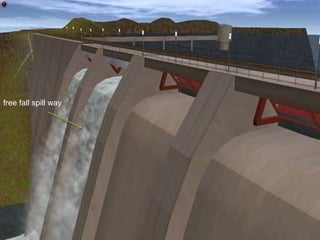
Straight drop spill way
ď‚— Flow drops freely from the crest of dam.
ď‚— It may be provided with gates.
ď‚— Flows may be freely discharging or may be supported by narrow
channel section.
ď‚— This type of spillways may be economical for low heads as
compared to other types.
ď‚— Floor blocks and an end sill are provided.
ď‚— Widely used on Gravity dams, Arch dams, and Buttress dams.
ď‚— Not recommended for very high dams.
free fall spill way
Side channel spillway
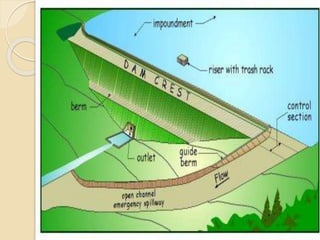
ď‚— A side channel spillway is one whose control weir is placed
alongside and approximately parallel to the upper portion of the
spillway discharge channel.
ď‚— Flow may be directed into an open channel, or a closed conduit
or in an inclined tunnel.
ď‚— It may be used as principal spillway or emergency spillway.
ď‚— Lining of the side channel spillway with concrete is required.
ď‚— If a sufficient crest length is not available for an over flow
spillways in narrow valleys, excess water is removed from the
reservoir through a side channel spillway.
Ogee Spillway
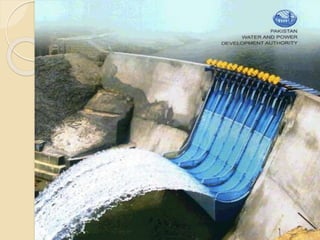
ď‚— The ogee spillway has a control weir that is ogee shaped (s-
shaped)
ď‚— It is also an overflow type spillway.
ď‚— Reduce the impact of water at downstream.
ď‚— To drop off the water at downstream from the foundation of
dam.
ď‚— Reduce scouring etc.
ď‚— Used for small concrete dams.
ď‚— Provide recreational impact at downstream side.
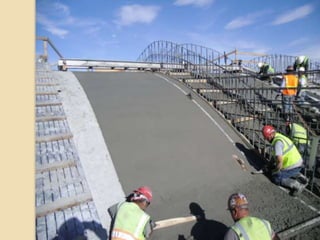
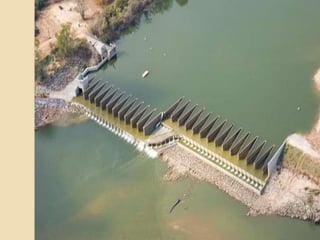
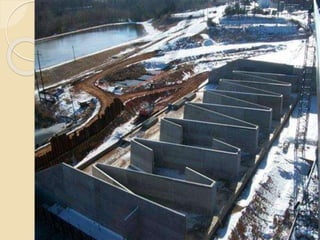
Labyrinth spillway
ď‚— The concept behind labyrinth spillway is to provide added crest for a
given spillway width, so that less head is required to pass a given
discharge.
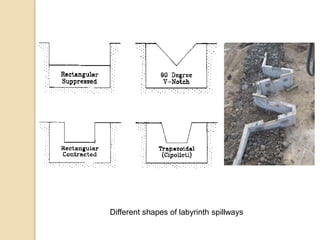
ď‚— The additional crest length is obtained by a series of trapezoidal or
rectangular walls.
ď‚— Labyrinth design is particularly beneficial when spillway width is fixed,
u/s water surface elevation is restricted and large discharge must be
passed.
ď‚— An excellent alternative to traditional method of adding another
spillway.
ď‚— Labyrinth spillways are more economical than gated structures.
ď‚— Flow pattern are very complicated.
Different shapes of labyrinth spillways
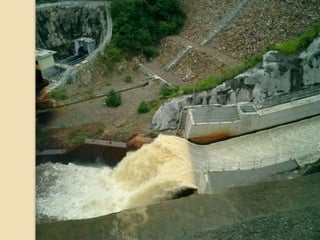
Chute spillway
ď‚— A spillway whose discharge is conveyed from the reservoir to
the d/s through an open channel or through a saddle (chute).
ď‚— Used for earth fill dam.
ď‚— Factors influencing the selection of chute spillways are simplicity
of their design, and construction, their adoptability to any
foundation condition and overall economy.
ď‚— Profile of chute spillway is greatly influenced by site topography.
ď‚— These types of spillways may be provided with gated orifice, a
side channel crest or other control device etc.
ď‚— Abrupt slope changes should be avoided.
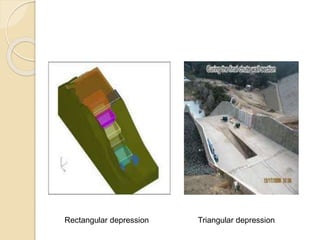
Rectangular depression Triangular depression
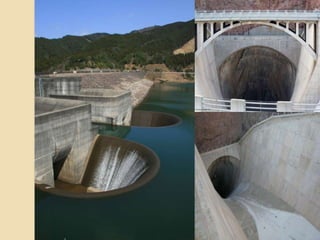
Conduit and tunnel spillway
ď‚— It is a spillway in the form of a closed channel used to convey the
discharge around or under the dam.
ď‚— The closed channel may be in the form of vertical or inclined
shaft, a horizontal tunnel through earth or rock filled dam.
ď‚— For free flow in the tunnel, the ratio of the flow area to the total
tunnel area is often limited to about 75%.
ď‚— Designed for partially full flow throughout the length of tunnel.
ď‚— Air slots are provided for prevention of cavitations.
ď‚— Suitable in rockslide and snow slide areas.
ď‚— Expensive type of spillways.
Inclined tunnel
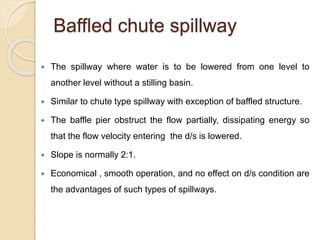
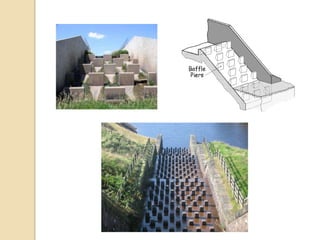
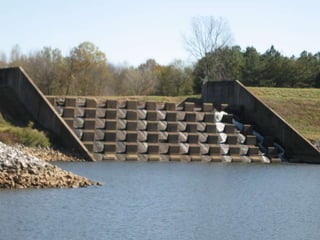
Baffled chute spillway
ď‚— The spillway where water is to be lowered from one level to
another level without a stilling basin.
ď‚— Similar to chute type spillway with exception of baffled structure.
ď‚— The baffle pier obstruct the flow partially, dissipating energy so
that the flow velocity entering the d/s is lowered.
ď‚— Slope is normally 2:1.
ď‚— Economical , smooth operation, and no effect on d/s condition are
the advantages of such types of spillways.
Spillways
Spillways
Spillways

Spillways

  • 1.
  • 2.
    Introduction A spillway isan integral part of a Dam (large wall built to hold back water usually across rivers). A spillway is usually used to remove excessive water from a reservoir to prevent overflow and to release pressure on a dam from increasing quantities of water.
  • 3.
    Different types ofspill ways ď‚— Spill ways are generally classified as controlled and uncontrolled spill ways. ď‚— Controlled Spillway: ď‚— A controlled spillway has mechanical structures or gates to regulate the rate of flow of water from the reservoir. This design allows nearly the full height of the dam to be used for water storage year-round, and flood waters can be released as required by opening one or more gates.
  • 4.
    Continued…….. Uncontrolled Spillway: An uncontrolledspillway, in contrast, does not have gates; when the water rises above the lip or crest of the spillway it begins to be released from the reservoir. The rate of discharge is controlled only by the depth of water within the reservoir. All of the storage volume in the reservoir above the spillway crest can be used only for the temporary storage of flood water, and cannot be used as water supply storage because it is normally empty.
  • 5.
    Sub classification ď‚— Eachof controlled and uncontrolled spillways are further classified on the basis of the their shapes, structures and main working procedure. ď‚— Straight drop spillway (free over fall). ď‚— Ogee spillway. ď‚— Side channel spillway. ď‚— Labyrinth spillway. ď‚— Chute (open channel) spillway.
  • 6.
    Continued……..  Conduit andTunnel spill way.  Baffled chute spill way.  Culvert spill way.
  • 7.
    Straight drop spillway ď‚— Flow drops freely from the crest of dam. ď‚— It may be provided with gates. ď‚— Flows may be freely discharging or may be supported by narrow channel section. ď‚— This type of spillways may be economical for low heads as compared to other types. ď‚— Floor blocks and an end sill are provided. ď‚— Widely used on Gravity dams, Arch dams, and Buttress dams. ď‚— Not recommended for very high dams.
  • 8.
  • 9.
    Side channel spillway ď‚—A side channel spillway is one whose control weir is placed alongside and approximately parallel to the upper portion of the spillway discharge channel. ď‚— Flow may be directed into an open channel, or a closed conduit or in an inclined tunnel. ď‚— It may be used as principal spillway or emergency spillway. ď‚— Lining of the side channel spillway with concrete is required. ď‚— If a sufficient crest length is not available for an over flow spillways in narrow valleys, excess water is removed from the reservoir through a side channel spillway.
  • 11.
    Ogee Spillway ď‚— Theogee spillway has a control weir that is ogee shaped (s- shaped) ď‚— It is also an overflow type spillway. ď‚— Reduce the impact of water at downstream. ď‚— To drop off the water at downstream from the foundation of dam. ď‚— Reduce scouring etc. ď‚— Used for small concrete dams. ď‚— Provide recreational impact at downstream side.
  • 14.
    Labyrinth spillway ď‚— Theconcept behind labyrinth spillway is to provide added crest for a given spillway width, so that less head is required to pass a given discharge. ď‚— The additional crest length is obtained by a series of trapezoidal or rectangular walls. ď‚— Labyrinth design is particularly beneficial when spillway width is fixed, u/s water surface elevation is restricted and large discharge must be passed. ď‚— An excellent alternative to traditional method of adding another spillway. ď‚— Labyrinth spillways are more economical than gated structures. ď‚— Flow pattern are very complicated.
  • 16.
    Different shapes oflabyrinth spillways
  • 18.
    Chute spillway ď‚— Aspillway whose discharge is conveyed from the reservoir to the d/s through an open channel or through a saddle (chute). ď‚— Used for earth fill dam. ď‚— Factors influencing the selection of chute spillways are simplicity of their design, and construction, their adoptability to any foundation condition and overall economy. ď‚— Profile of chute spillway is greatly influenced by site topography. ď‚— These types of spillways may be provided with gated orifice, a side channel crest or other control device etc. ď‚— Abrupt slope changes should be avoided.
  • 19.
  • 22.
    Conduit and tunnelspillway ď‚— It is a spillway in the form of a closed channel used to convey the discharge around or under the dam. ď‚— The closed channel may be in the form of vertical or inclined shaft, a horizontal tunnel through earth or rock filled dam. ď‚— For free flow in the tunnel, the ratio of the flow area to the total tunnel area is often limited to about 75%. ď‚— Designed for partially full flow throughout the length of tunnel. ď‚— Air slots are provided for prevention of cavitations. ď‚— Suitable in rockslide and snow slide areas. ď‚— Expensive type of spillways.
  • 23.
  • 25.
    Baffled chute spillway ď‚—The spillway where water is to be lowered from one level to another level without a stilling basin. ď‚— Similar to chute type spillway with exception of baffled structure. ď‚— The baffle pier obstruct the flow partially, dissipating energy so that the flow velocity entering the d/s is lowered. ď‚— Slope is normally 2:1. ď‚— Economical , smooth operation, and no effect on d/s condition are the advantages of such types of spillways.