Who Founded
the Colonies
and Why?
Unit 4, Lesson 2
By Mr. Casey
Agenda
• Vocabulary
• Unit 4, Lesson 2 - Who Founded
the Colonies and Why?
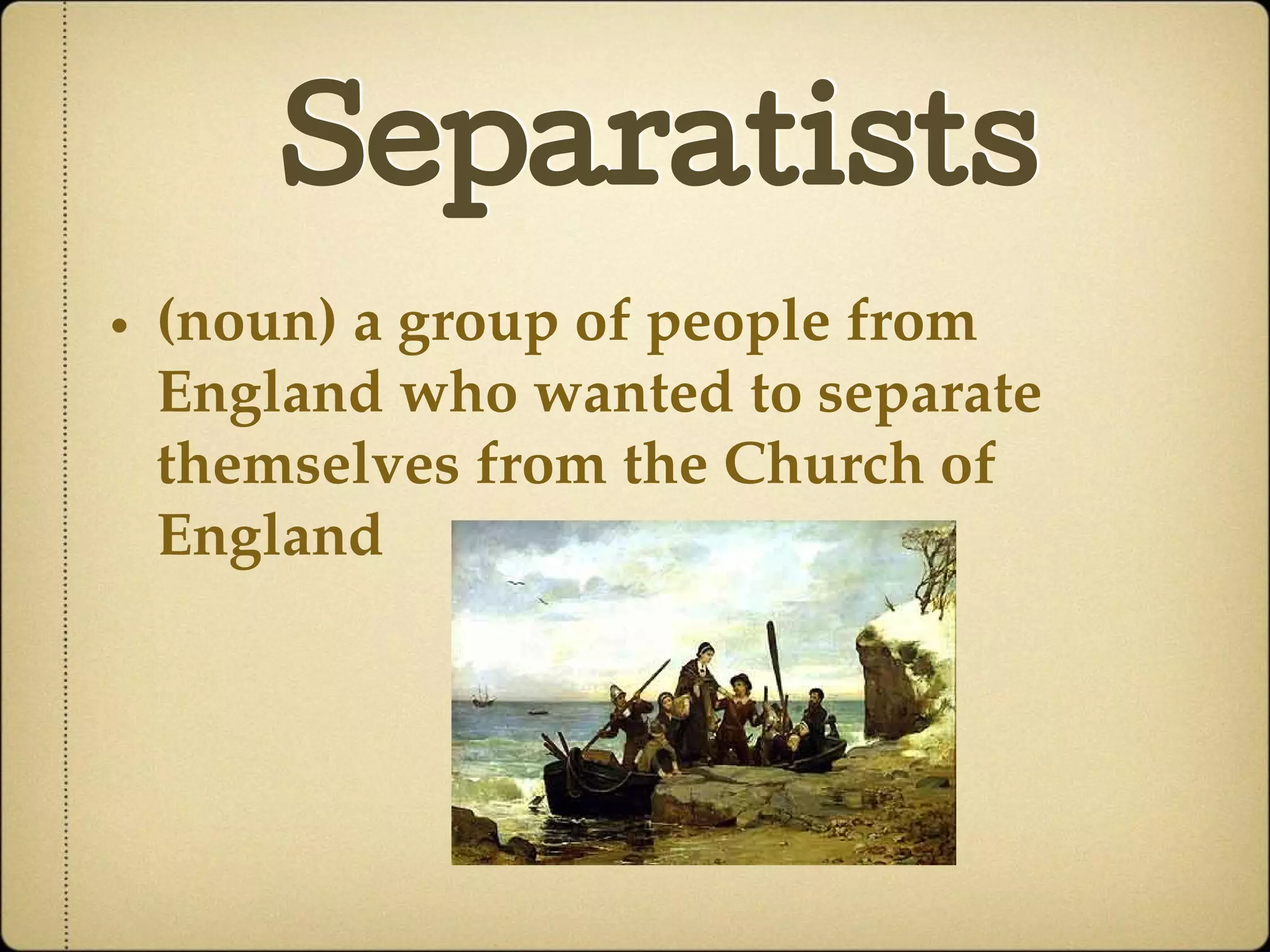
Separatists
• (noun) a group of people from
England who wanted to separate
themselves from the Church of
England
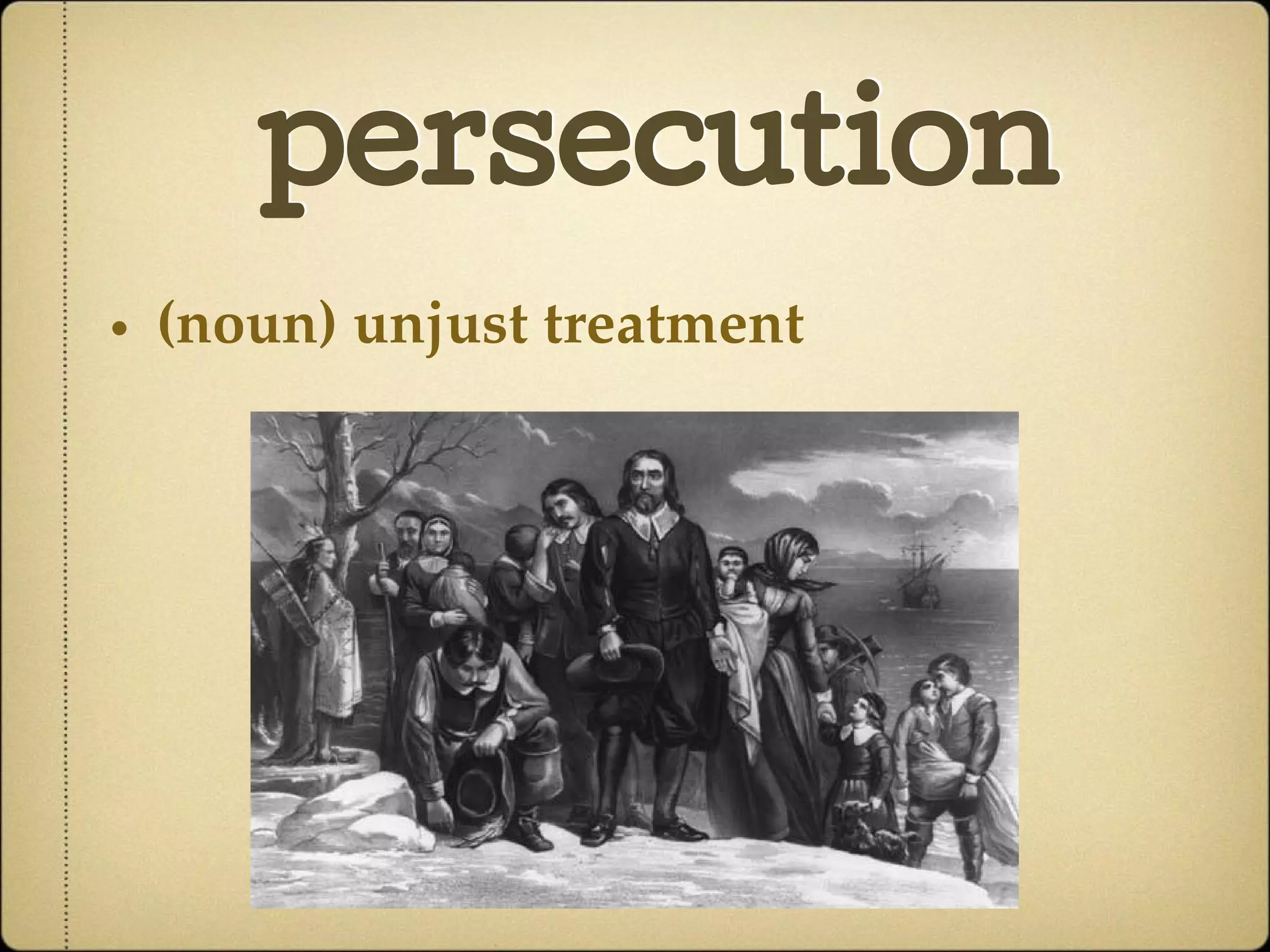
persecution
• (noun) unjust treatment
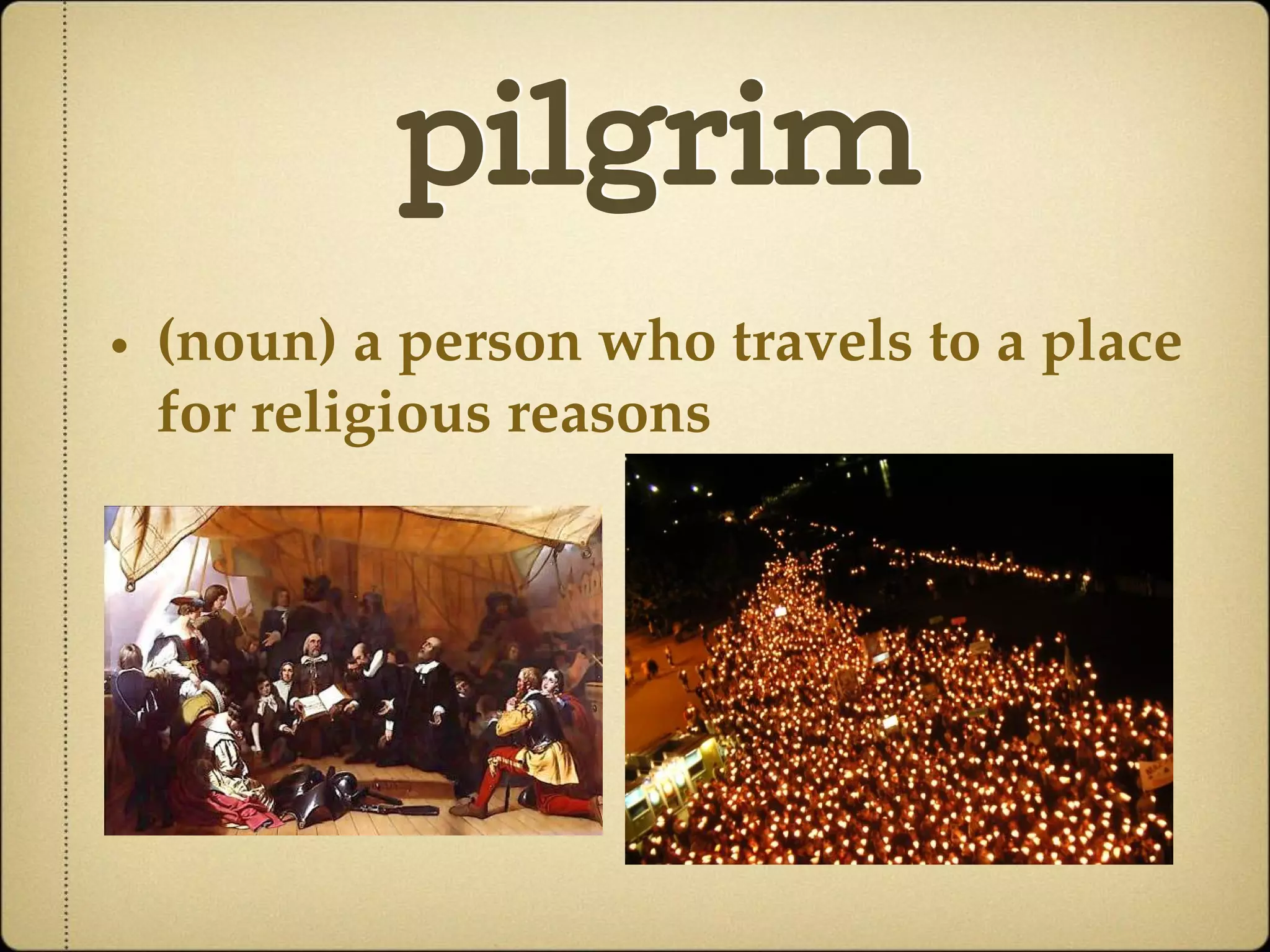
pilgrim
• (noun) a person who travels to a place
for religious reasons
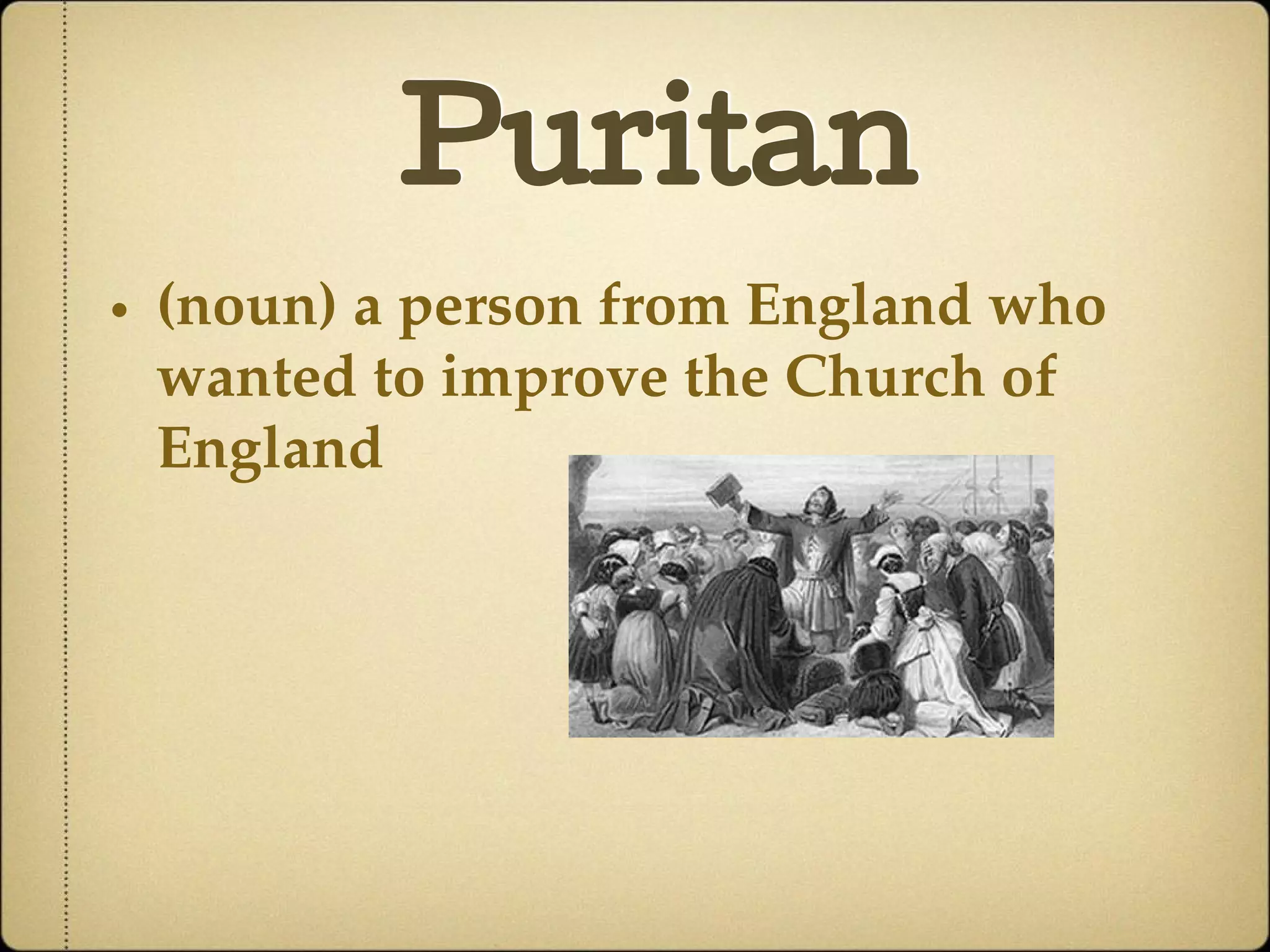
Puritan
• (noun) a person from England who
wanted to improve the Church of
England
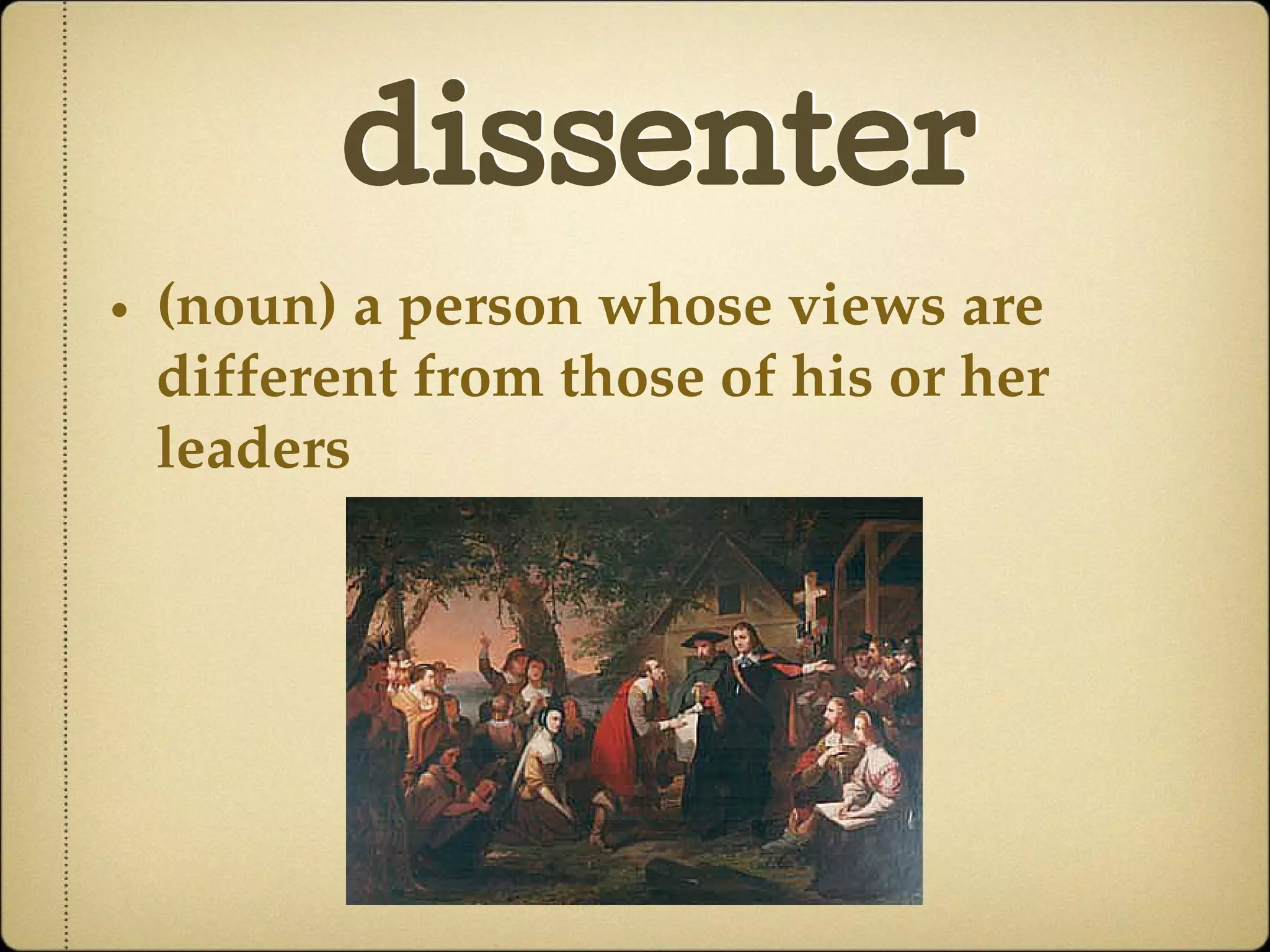
dissenter
• (noun) a person whose views are
different from those of his or her
leaders
Lesson 2- Colonies
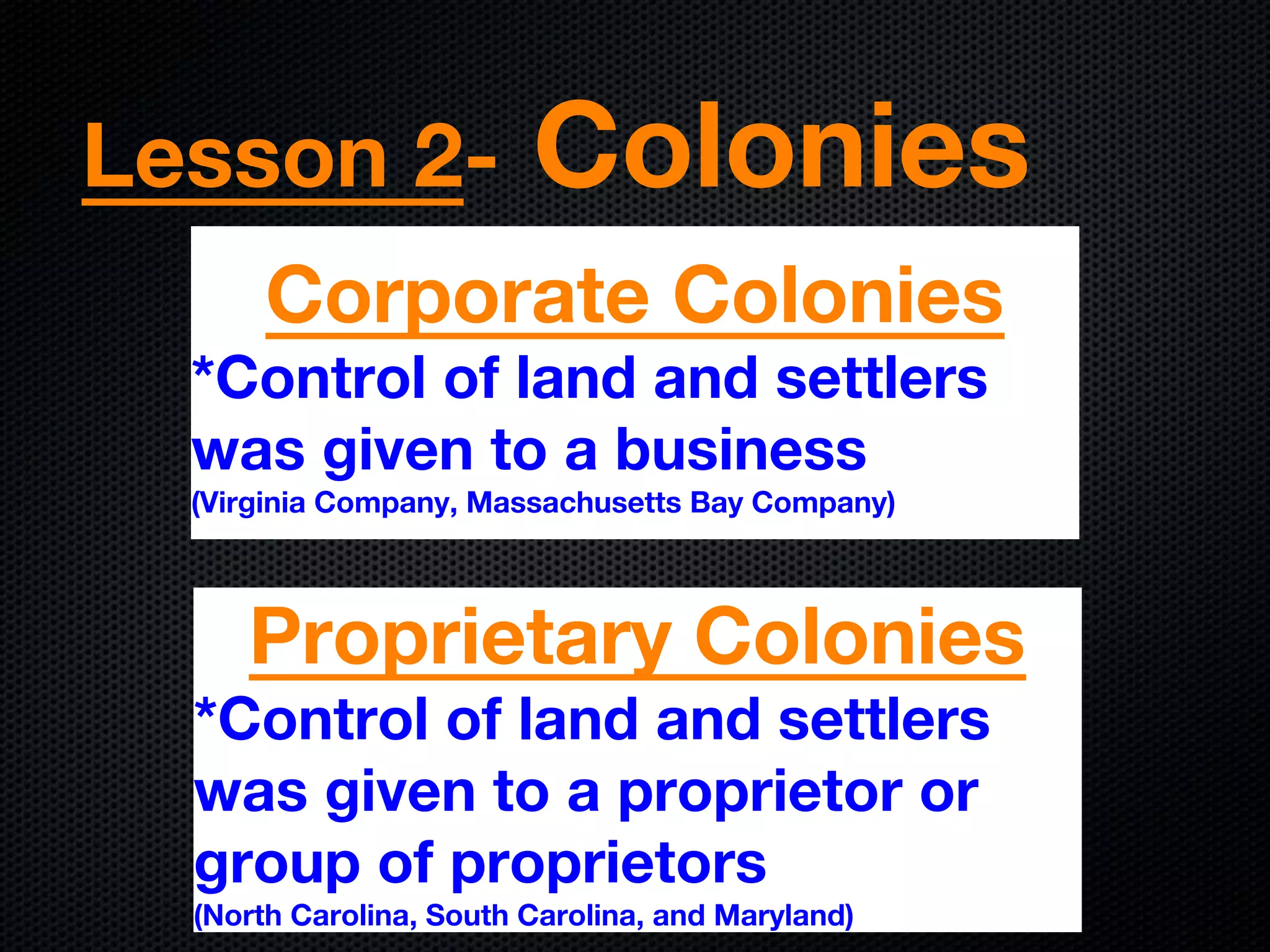
Corporate Colonies
*Control of land and settlers
was given to a business
(Virginia Company, Massachusetts Bay Company)
Proprietary Colonies
*Control of land and settlers
was given to a proprietor or
group of proprietors
(North Carolina, South Carolina, and Maryland)
Lesson 2- Colonies
Royal Colonies
*Control of land and settlers
stayed with the monarch (king)
and was run through officials
By 1752 monarchs had changed most of the
colonies into Royal Colonies:
Virginia, New York, New Jersey,Massachusetts, New
Hampshire, North Carolina, South Carolina
Lesson 2- The Puritans
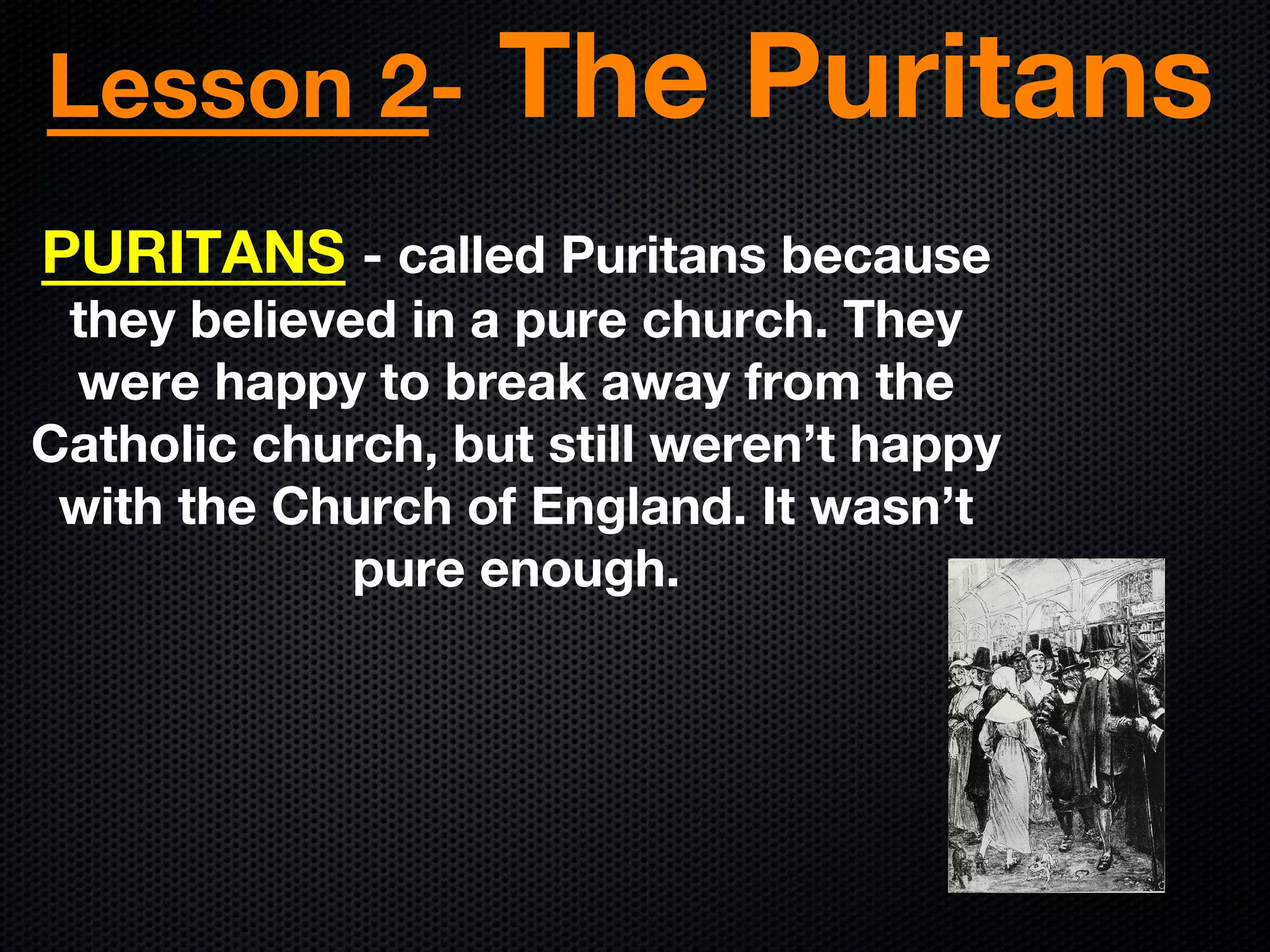
PURITANS - called Puritans because
they believed in a pure church. They
were happy to break away from the
Catholic church, but still weren’t happy
with the Church of England. It wasn’t
pure enough.
Lesson 2- The Puritans
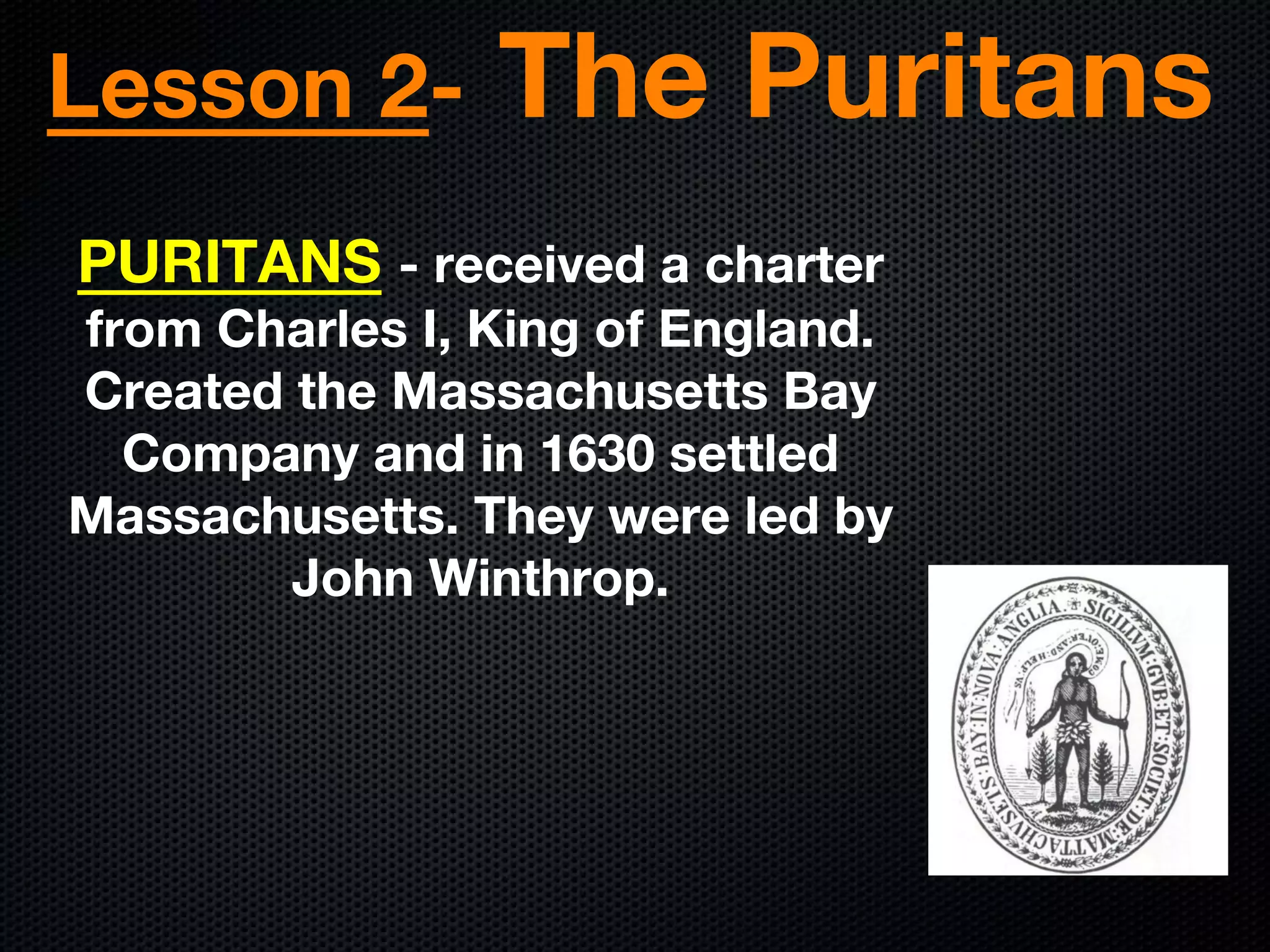
PURITANS - received a charter
from Charles I, King of England.
Created the Massachusetts Bay
Company and in 1630 settled
Massachusetts. They were led by
John Winthrop.
Lesson 2- The Puritans
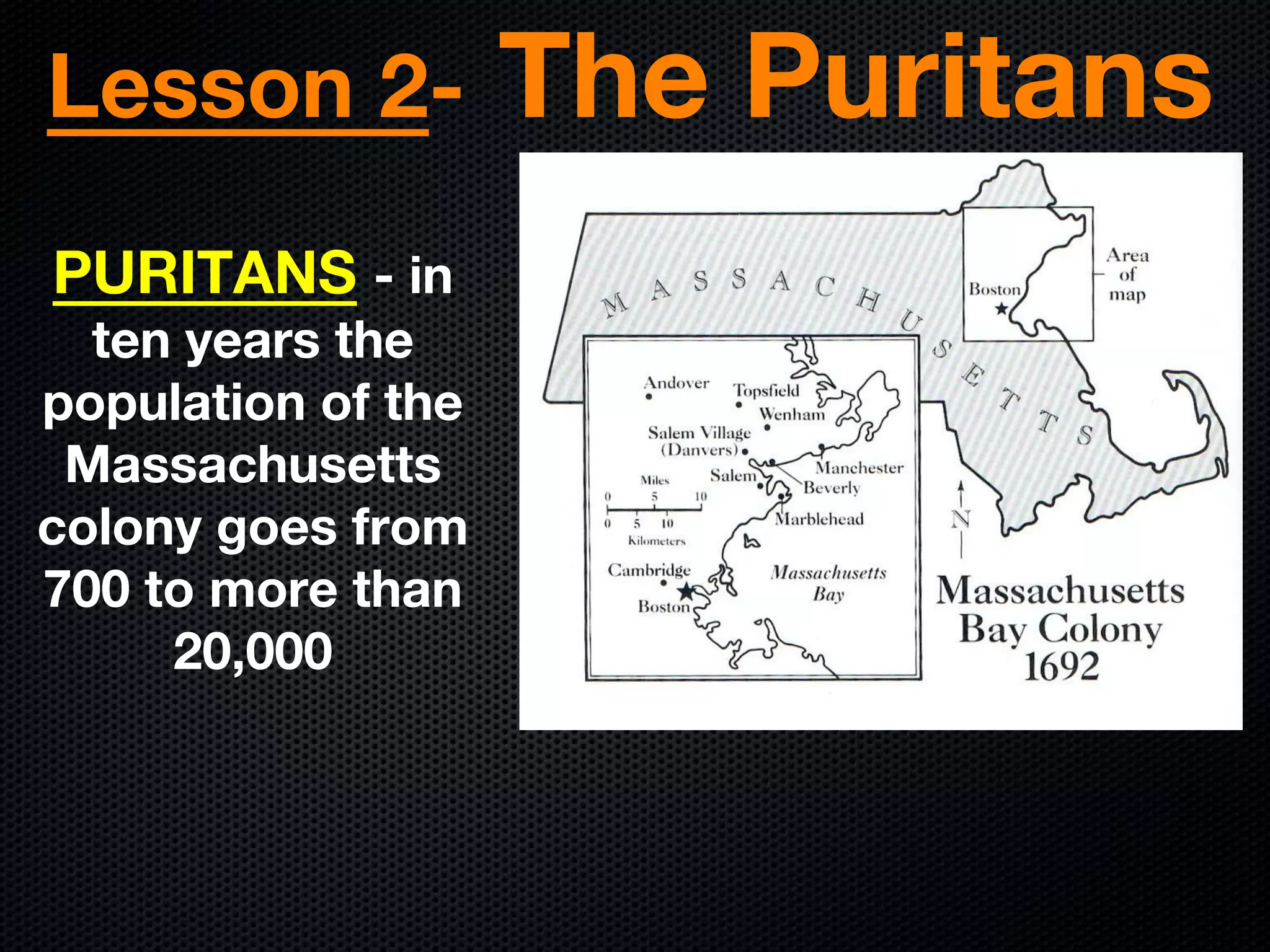
PURITANS - in
ten years the
population of the
Massachusetts
colony goes from
700 to more than
20,000
Lesson 2- The Puritans
PURITANS - They wanted to follow
the bible 100%. They wanted to
create a community that was an
example for the world.
They escaped religious persecution
but they created a new community
that didn’t tolerate any other
religions.
Lesson 2- The Puritans
Why are the Puritans important?
1. Created a system of self-government (every
man could vote)
2. Church leaders were most important people
in society but they didn’t create laws
(separation of church and state...kind of)
3. Valued Education (Harvard & Public
Education)
4. 1641 -Made slavery legal
Puritan Dissenters
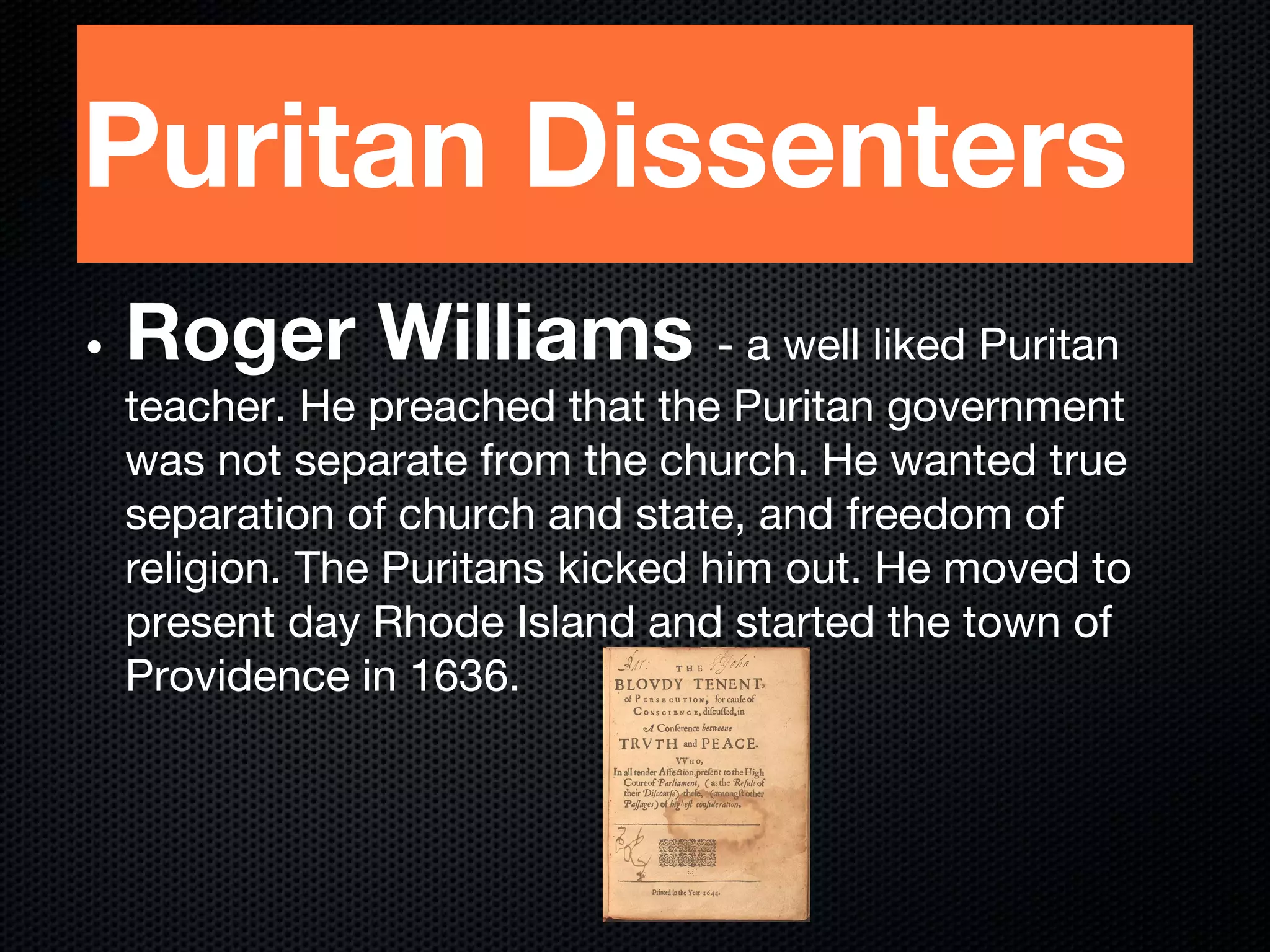
• Roger Williams - a well liked Puritan
teacher. He preached that the Puritan government
was not separate from the church. He wanted true
separation of church and state, and freedom of
religion. The Puritans kicked him out. He moved to
present day Rhode Island and started the town of
Providence in 1636.
Puritan Dissenters
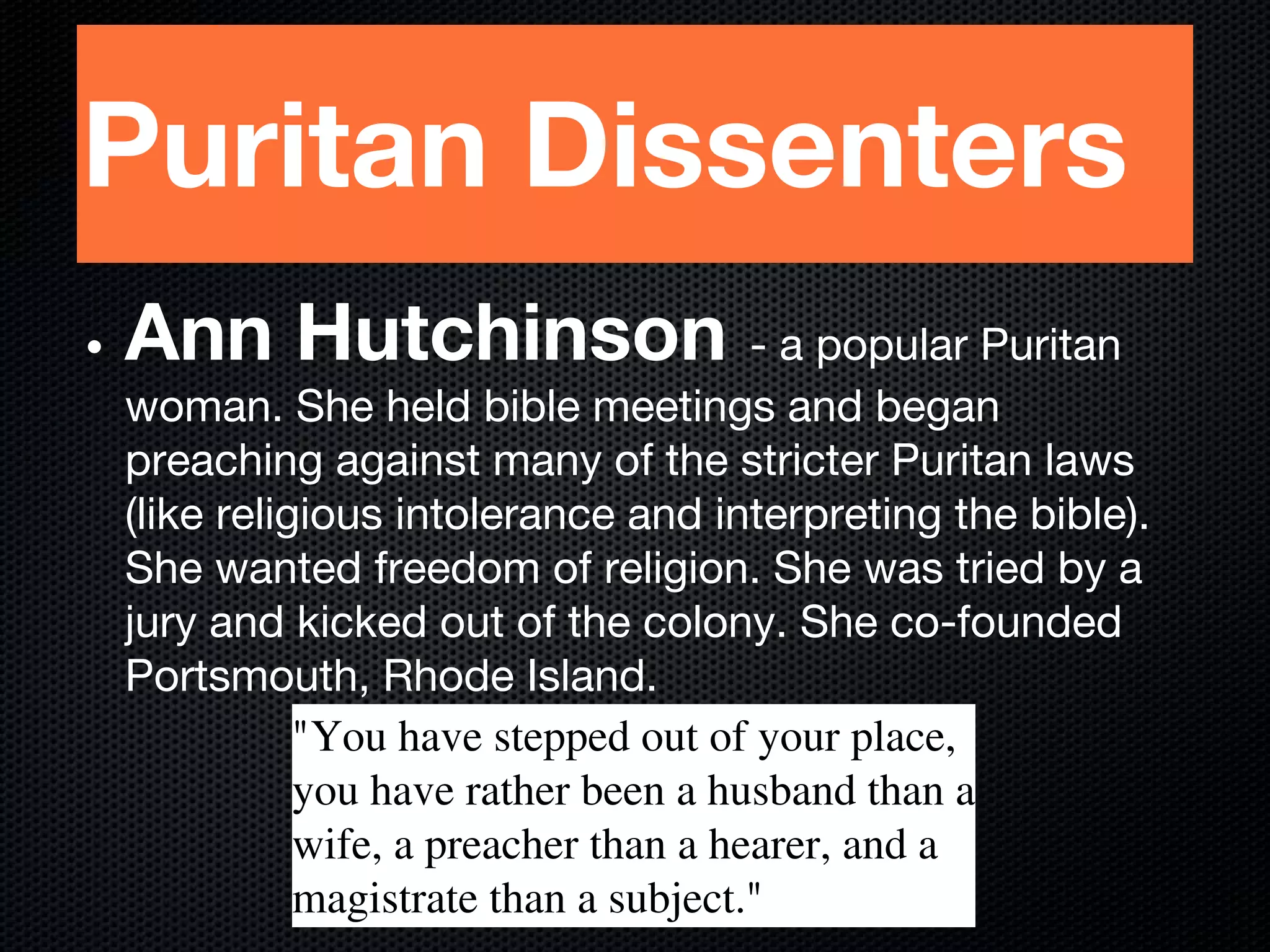
• Ann Hutchinson - a popular Puritan
woman. She held bible meetings and began
preaching against many of the stricter Puritan laws
(like religious intolerance and interpreting the bible).
She wanted freedom of religion. She was tried by a
jury and kicked out of the colony. She co-founded
Portsmouth, Rhode Island.
"You have stepped out of your place,
you have rather been a husband than a
wife, a preacher than a hearer, and a
magistrate than a subject."
Puritan Dissenters
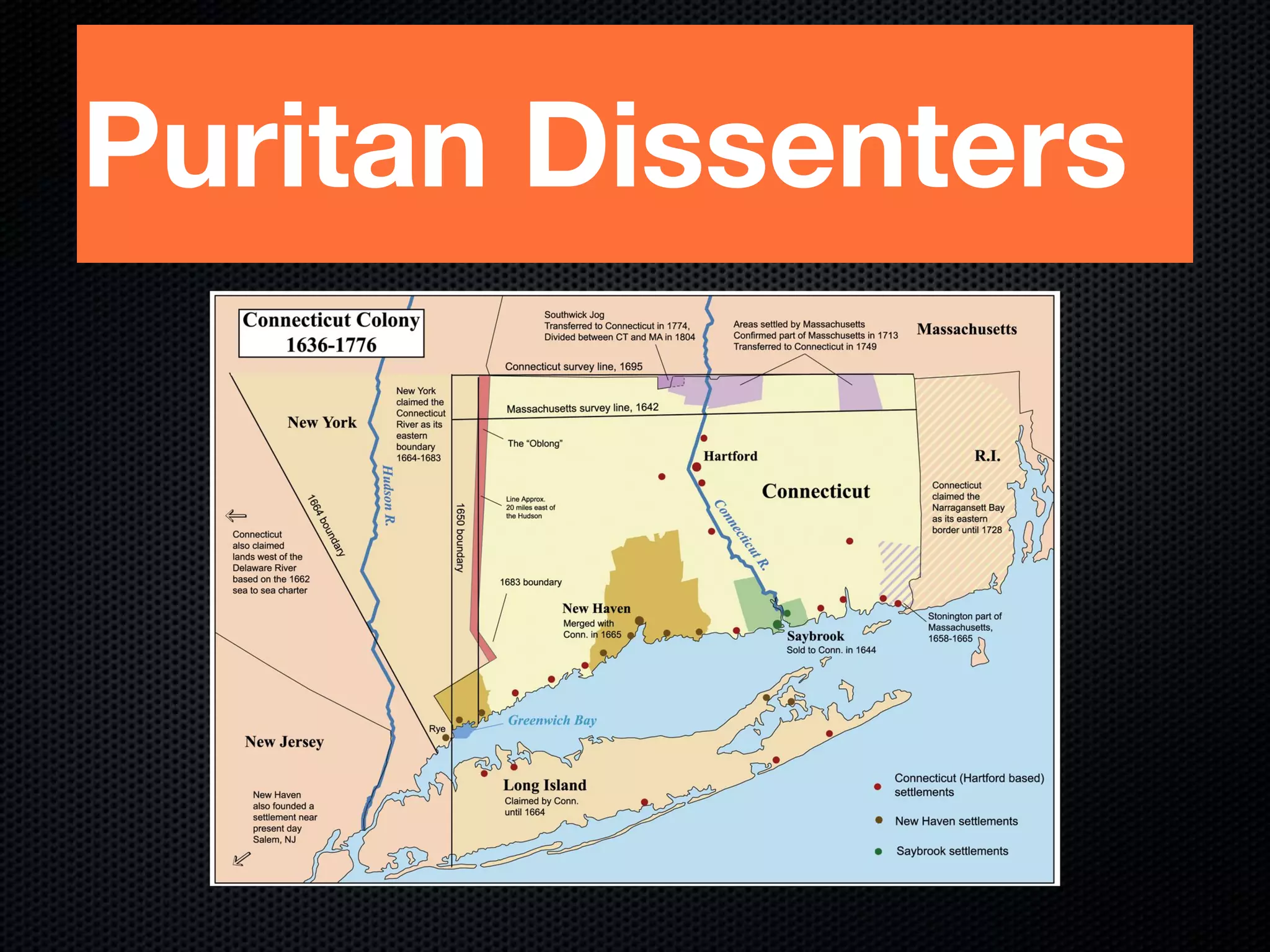
• Thomas Hooker - a great speaker and
respected Puritan, he disagreed with John Cotton,
the leader of the Puritan community. In 1636 he
founded Hartford and the colony of Connecticut. He
helped create the Fundamental Orders of
Connecticut (considered to be the first written
constitution).
Puritan Dissenters

Unit 4, Lesson 2.ppt

  • 1.
    Who Founded the Colonies andWhy? Unit 4, Lesson 2 By Mr. Casey
  • 2.
    Agenda • Vocabulary • Unit4, Lesson 2 - Who Founded the Colonies and Why?
  • 3.
    Separatists • (noun) agroup of people from England who wanted to separate themselves from the Church of England
  • 4.
  • 5.
    pilgrim • (noun) aperson who travels to a place for religious reasons
  • 6.
    Puritan • (noun) aperson from England who wanted to improve the Church of England
  • 7.
    dissenter • (noun) aperson whose views are different from those of his or her leaders
  • 8.
    Lesson 2- Colonies CorporateColonies *Control of land and settlers was given to a business (Virginia Company, Massachusetts Bay Company) Proprietary Colonies *Control of land and settlers was given to a proprietor or group of proprietors (North Carolina, South Carolina, and Maryland)
  • 9.
    Lesson 2- Colonies RoyalColonies *Control of land and settlers stayed with the monarch (king) and was run through officials By 1752 monarchs had changed most of the colonies into Royal Colonies: Virginia, New York, New Jersey,Massachusetts, New Hampshire, North Carolina, South Carolina
  • 10.
    Lesson 2- ThePuritans PURITANS - called Puritans because they believed in a pure church. They were happy to break away from the Catholic church, but still weren’t happy with the Church of England. It wasn’t pure enough.
  • 11.
    Lesson 2- ThePuritans PURITANS - received a charter from Charles I, King of England. Created the Massachusetts Bay Company and in 1630 settled Massachusetts. They were led by John Winthrop.
  • 12.
    Lesson 2- ThePuritans PURITANS - in ten years the population of the Massachusetts colony goes from 700 to more than 20,000
  • 13.
    Lesson 2- ThePuritans PURITANS - They wanted to follow the bible 100%. They wanted to create a community that was an example for the world. They escaped religious persecution but they created a new community that didn’t tolerate any other religions.
  • 14.
    Lesson 2- ThePuritans Why are the Puritans important? 1. Created a system of self-government (every man could vote) 2. Church leaders were most important people in society but they didn’t create laws (separation of church and state...kind of) 3. Valued Education (Harvard & Public Education) 4. 1641 -Made slavery legal
  • 15.
    Puritan Dissenters • RogerWilliams - a well liked Puritan teacher. He preached that the Puritan government was not separate from the church. He wanted true separation of church and state, and freedom of religion. The Puritans kicked him out. He moved to present day Rhode Island and started the town of Providence in 1636.
  • 16.
    Puritan Dissenters • AnnHutchinson - a popular Puritan woman. She held bible meetings and began preaching against many of the stricter Puritan laws (like religious intolerance and interpreting the bible). She wanted freedom of religion. She was tried by a jury and kicked out of the colony. She co-founded Portsmouth, Rhode Island. "You have stepped out of your place, you have rather been a husband than a wife, a preacher than a hearer, and a magistrate than a subject."
  • 17.
    Puritan Dissenters • ThomasHooker - a great speaker and respected Puritan, he disagreed with John Cotton, the leader of the Puritan community. In 1636 he founded Hartford and the colony of Connecticut. He helped create the Fundamental Orders of Connecticut (considered to be the first written constitution).
  • 18.