The Puritan Legacy 
American Literature’s Colonial Roots
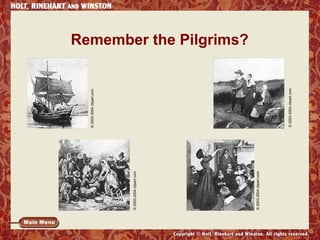
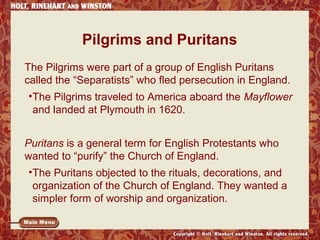
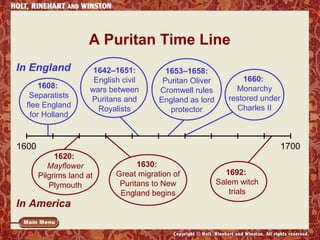
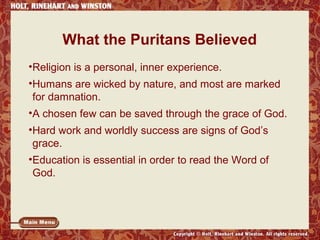
Remember the Pilgrims? 
© 2003-2004 clipart.com 
© 2003-2004 clipart.com
Pilgrims and Puritans 
The Pilgrims were part of a group of English Puritans 
called the “Separatists” who fled persecution in England. 
•The Pilgrims traveled to America aboard the Mayflower 
and landed at Plymouth in 1620. 
Puritans is a general term for English Protestants who 
wanted to “purify” the Church of England. 
•The Puritans objected to the rituals, decorations, and 
organization of the Church of England. They wanted a 
simpler form of worship and organization.
A Puritan Time Line 
In England 
1600 1700 
1620: 
Mayflower 
Pilgrims land at 
Plymouth 
1630: 
Great migration of 
Puritans to New 
England begins 
1692: 
Salem witch 
trials 
1653–1658: 
Puritan Oliver 
Cromwell rules 
England as lord 
protector 
1642–1651: 
English civil 
wars between 
Puritans and 
Royalists 
1660: 
Monarchy 
restored under 
Charles II 
1608: 
Separatists 
flee England 
for Holland 
In America
What the Puritans Believed 
•Religion is a personal, inner experience. 
•Humans are wicked by nature, and most are marked 
for damnation. 
•A chosen few can be saved through the grace of God. 
•Hard work and worldly success are signs of God’s 
grace. 
•Education is essential in order to read the Word of 
God.
Grace: The Puritan Ideal 
•Grace—God’s special favor—was the only way to 
escape an eternity in Hell. 
•People did not know for certain if they had grace, but 
they could feel the arrival of grace as an intense 
emotion. 
•People who had grace were among the “elect” (saved). 
•People who did not have grace were among the 
“unregenerate” (damned).
Grace: The Puritan Ideal 
•The presence of grace was demonstrated by a 
person’s outward behavior. People with grace 
displayed 
•self-reliance 
•personal responsibility 
•industriousness 
•temperance 
•simplicity
Puritan Government 
In Theory 
•Every individual had an equal covenant with God. 
•Laws came from God, as revealed in scripture. 
In Practice 
•Most people yielded authority to those seen as the 
saintly “elect.” 
•Conformity and obedience took precedence over 
individual rights.
Puritan Literature 
What the Puritans Read 
•The Bible and other religious texts 
Why They Read 
•Puritans stressed individual responsibility for spiritual 
development. 
•Every person was responsible for reading and 
understanding the Bible.
Puritan Literature 
What the Puritans Wrote 
•Sermons, essays, and poems on spiritual and religious 
subjects 
•Diaries and histories that recorded inner and outer 
events of their lives 
Why They Wrote 
•Puritans used writing to explore their lives for signs of 
grace and to describe the workings of God in their 
communities.
Plain Style 
Puritans favored a plain style of writing. Plain style is a 
way of writing that stresses simplicity and clarity of 
expression. Plain style 
•emphasizes uncomplicated sentences and the use of 
everyday words from common speech 
•avoids elaborate figures of speech and imagery 
“There is nothing between you and hell but the air; it is only 
the power and mere pleasure of God that holds you up.” 
from “Sinners in the Hands of an Angry God” by Jonathan Edwards
Salem: Believers Run Amok 
•1692—Girls suffer from mysterious illness in Salem, 
Massachusetts. 
•Doctors blame witchcraft. 
•Mass hysteria erupts; neighbors accuse one another. 
•In the end, about 150 people were accused, and 20 
were executed.
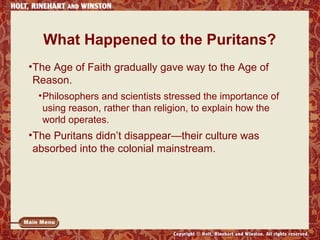
What Happened to the Puritans? 
•The Age of Faith gradually gave way to the Age of 
Reason. 
•Philosophers and scientists stressed the importance of 
using reason, rather than religion, to explain how the 
world operates. 
•The Puritans didn’t disappear—their culture was 
absorbed into the colonial mainstream.
The Puritan Legacy 
In the United States, we generally value 
•individual rights and responsibilities 
•equality of individuals 
•literacy and education 
•spiritual and worldly rewards for hard work
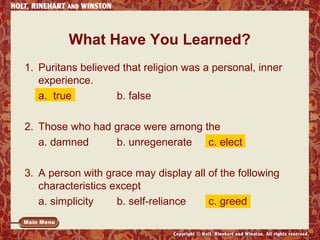
What Have You Learned? 
1. Puritans believed that religion was a personal, inner 
experience. 
a. true b. false 
2. Those who had grace were among the 
a. damned b. unregenerate c. elect 
3. A person with grace may display all of the following 
characteristics except 
a. simplicity b. self-reliance c. greed
The End

The Puritan Legacy

  • 1.
    The Puritan Legacy American Literature’s Colonial Roots
  • 2.
    Remember the Pilgrims? © 2003-2004 clipart.com © 2003-2004 clipart.com © 2003-2004 clipart.com © 2003-2004 clipart.com
  • 3.
    Pilgrims and Puritans The Pilgrims were part of a group of English Puritans called the “Separatists” who fled persecution in England. •The Pilgrims traveled to America aboard the Mayflower and landed at Plymouth in 1620. Puritans is a general term for English Protestants who wanted to “purify” the Church of England. •The Puritans objected to the rituals, decorations, and organization of the Church of England. They wanted a simpler form of worship and organization.
  • 4.
    A Puritan TimeLine In England 1600 1700 1620: Mayflower Pilgrims land at Plymouth 1630: Great migration of Puritans to New England begins 1692: Salem witch trials 1653–1658: Puritan Oliver Cromwell rules England as lord protector 1642–1651: English civil wars between Puritans and Royalists 1660: Monarchy restored under Charles II 1608: Separatists flee England for Holland In America
  • 5.
    What the PuritansBelieved •Religion is a personal, inner experience. •Humans are wicked by nature, and most are marked for damnation. •A chosen few can be saved through the grace of God. •Hard work and worldly success are signs of God’s grace. •Education is essential in order to read the Word of God.
  • 6.
    Grace: The PuritanIdeal •Grace—God’s special favor—was the only way to escape an eternity in Hell. •People did not know for certain if they had grace, but they could feel the arrival of grace as an intense emotion. •People who had grace were among the “elect” (saved). •People who did not have grace were among the “unregenerate” (damned).
  • 7.
    Grace: The PuritanIdeal •The presence of grace was demonstrated by a person’s outward behavior. People with grace displayed •self-reliance •personal responsibility •industriousness •temperance •simplicity
  • 8.
    Puritan Government InTheory •Every individual had an equal covenant with God. •Laws came from God, as revealed in scripture. In Practice •Most people yielded authority to those seen as the saintly “elect.” •Conformity and obedience took precedence over individual rights.
  • 9.
    Puritan Literature Whatthe Puritans Read •The Bible and other religious texts Why They Read •Puritans stressed individual responsibility for spiritual development. •Every person was responsible for reading and understanding the Bible.
  • 10.
    Puritan Literature Whatthe Puritans Wrote •Sermons, essays, and poems on spiritual and religious subjects •Diaries and histories that recorded inner and outer events of their lives Why They Wrote •Puritans used writing to explore their lives for signs of grace and to describe the workings of God in their communities.
  • 11.
    Plain Style Puritansfavored a plain style of writing. Plain style is a way of writing that stresses simplicity and clarity of expression. Plain style •emphasizes uncomplicated sentences and the use of everyday words from common speech •avoids elaborate figures of speech and imagery “There is nothing between you and hell but the air; it is only the power and mere pleasure of God that holds you up.” from “Sinners in the Hands of an Angry God” by Jonathan Edwards
  • 12.
    Salem: Believers RunAmok •1692—Girls suffer from mysterious illness in Salem, Massachusetts. •Doctors blame witchcraft. •Mass hysteria erupts; neighbors accuse one another. •In the end, about 150 people were accused, and 20 were executed.
  • 13.
    What Happened tothe Puritans? •The Age of Faith gradually gave way to the Age of Reason. •Philosophers and scientists stressed the importance of using reason, rather than religion, to explain how the world operates. •The Puritans didn’t disappear—their culture was absorbed into the colonial mainstream.
  • 14.
    The Puritan Legacy In the United States, we generally value •individual rights and responsibilities •equality of individuals •literacy and education •spiritual and worldly rewards for hard work
  • 15.
    What Have YouLearned? 1. Puritans believed that religion was a personal, inner experience. a. true b. false 2. Those who had grace were among the a. damned b. unregenerate c. elect 3. A person with grace may display all of the following characteristics except a. simplicity b. self-reliance c. greed
  • 16.