Unit 2:Part 1 Between Heaven and Hell American Literature Ms. Harrigan
Who Were The Puritans? Puritans (Protestants) were Elizabethan reformers who sought a return to simpler church rituals and doctrine without corrupt political collusion Persecuted in England, fled to Netherlands, emigrated to the New World The path to righteousness was study and adherence to the Bible But also imposed a strict, religious uniformity
Understanding Puritanism:  Basic Puritan Beliefs 1. Total Depravity - through Adam and Eve's fall, every person is born sinful - concept of Original Sin.  2. Unconditional Election - God "saves" those he wishes - only a few are selected for salvation - concept of predestination.  3. Limited Atonement - Jesus died for the chosen only, not for everyone.
Basic Puritan Beliefs Part2 4. Irresistible Grace - God's grace is freely given, it cannot be earned or denied. Grace is defined as the saving and transfiguring power of God.  5. Perseverance of the "saints" - those elected by God have full power to interpret the will of God, and to live uprightly. If anyone rejects grace after feeling its power in his life, he will be going against the will of God - something impossible in Puritanism.
Backsliding….  Puritan Values : God, Family, Hard Work The belief that "saved" believers, those with visible signs of grace, can fall into temptation and become sinners.  To prevent this, believers were expected not to become smug, do constant soul-searching, be introspective, and pray constantly. Satan was particularly interested in snaring such believers.  Thus, it was important to be hyper vigilant in piety.
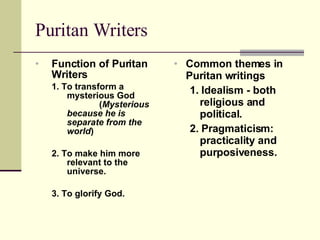
Puritan Writers Function of Puritan Writers 1. To transform a mysterious God  ( Mysterious because he is separate from the world )  2. To make him more relevant to the universe.  3. To glorify God. Common themes in Puritan writings 1. Idealism - both religious and political.  2. Pragmaticism: practicality and purposiveness.
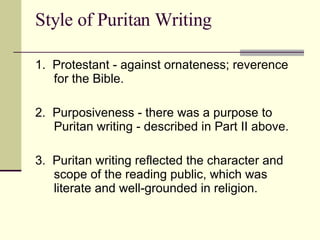
Style of Puritan Writing 1.  Protestant - against ornateness; reverence for the Bible.  2.  Purposiveness - there was a purpose to Puritan writing - described in Part II above.  3.  Puritan writing reflected the character and scope of the reading public, which was literate and well-grounded in religion.

Puritan Intro

  • 1.
    Unit 2:Part 1Between Heaven and Hell American Literature Ms. Harrigan
  • 2.
    Who Were ThePuritans? Puritans (Protestants) were Elizabethan reformers who sought a return to simpler church rituals and doctrine without corrupt political collusion Persecuted in England, fled to Netherlands, emigrated to the New World The path to righteousness was study and adherence to the Bible But also imposed a strict, religious uniformity
  • 3.
    Understanding Puritanism: Basic Puritan Beliefs 1. Total Depravity - through Adam and Eve's fall, every person is born sinful - concept of Original Sin. 2. Unconditional Election - God "saves" those he wishes - only a few are selected for salvation - concept of predestination. 3. Limited Atonement - Jesus died for the chosen only, not for everyone.
  • 4.
    Basic Puritan BeliefsPart2 4. Irresistible Grace - God's grace is freely given, it cannot be earned or denied. Grace is defined as the saving and transfiguring power of God. 5. Perseverance of the "saints" - those elected by God have full power to interpret the will of God, and to live uprightly. If anyone rejects grace after feeling its power in his life, he will be going against the will of God - something impossible in Puritanism.
  • 5.
    Backsliding…. PuritanValues : God, Family, Hard Work The belief that "saved" believers, those with visible signs of grace, can fall into temptation and become sinners. To prevent this, believers were expected not to become smug, do constant soul-searching, be introspective, and pray constantly. Satan was particularly interested in snaring such believers. Thus, it was important to be hyper vigilant in piety.
  • 6.
    Puritan Writers Functionof Puritan Writers 1. To transform a mysterious God ( Mysterious because he is separate from the world ) 2. To make him more relevant to the universe. 3. To glorify God. Common themes in Puritan writings 1. Idealism - both religious and political. 2. Pragmaticism: practicality and purposiveness.
  • 7.
    Style of PuritanWriting 1. Protestant - against ornateness; reverence for the Bible. 2. Purposiveness - there was a purpose to Puritan writing - described in Part II above. 3. Puritan writing reflected the character and scope of the reading public, which was literate and well-grounded in religion.