Exploration of the New World:  SPAIN The 1500s was the century of SPAIN Why? GOLD, GLORY, & GOD
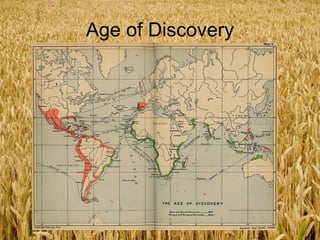
GOLD :  Desire to find a trade route to India/Southeast Asia to break the Italian/Arab monopoly on the spice trade
Age of Discovery
http://www.ucalgary.ca/applied_history/tutor/eurvoya/vasco.html
GLORY :  The desire for adventure, born out of the Renaissance
GOD :  The desire to convert native “heathens” to Christianity
DEVELOPMENTS Columbus discovers the “New World” in 1492
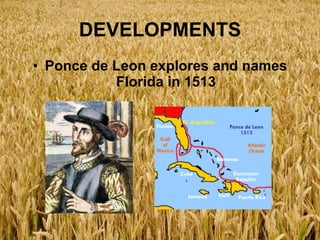
DEVELOPMENTS Ponce de Leon explores and names Florida in 1513
DEVELOPMENTS Cortez conquers the Aztecs of Mexico
DEVELOPMENTS Conquistadores explore southwest & California coast
Exploration of the New World:  ENGLAND 1600s was the century of  ENGLAND How? The defeat of Spanish Armada in 1588
DEVELOPMENTS Why? Religious Persecution The Great Puritan Migration:  1625 - 1628
THE FIRST COLONIES
First attempt at colonization :  Sir Walter Raleigh,  The Lost Colony, in 1587
First permanent colony: Jamestown, VA 1607
It would not be until 1733 when all 13 English Colonies were established
 
Colony  – a group of people in one place who are ruled by a parent country elsewhere
Regions New England Southern Middle Colonial
Southern Colonies Virginia (Jamestown) 1607 Maryland 1632 Carolina 1660’s Georgia 1730’s
Common Characteristics of  Southern Colonies •   Spread Out  • •   Plantation Economic System  • •   Land and Crops are not rotated  • • Cash Crops • •   Slave Labor  • •   County form of local government  • •   Less well organized churches and schools  •
Agriculture  was the primary economic activity in the southern colonies.
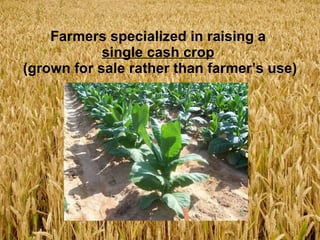
Farmers specialized in raising a  single cash crop   (grown for sale rather than farmer’s use)
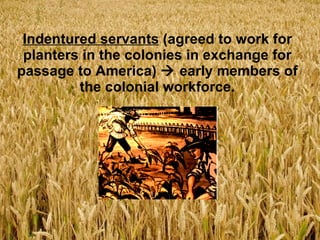
Indentured servants  (agreed to work for planters in the colonies in exchange for passage to America)    early members of the colonial workforce.
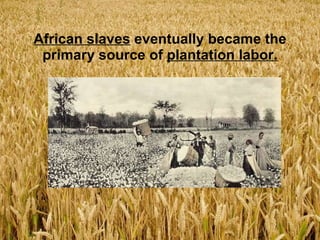
African slaves  eventually became the primary source of  plantation labor.
Wealthy  planters  dominated the  South’s  economic, social, and political life.
Women  could not  vote  or own  property . However, they were valuable sources of  labor  on farms and plantations.
Indentured servants  had  few rights  while in bondage, and faced hardships afterward
Slaves  were treated as  property  and forced to work for life  without pay .
Virginia 1607  (Jamestown )  John Smith 1610 John Rolfe (tobacco) 1619 House of Burgesses First Black Workers Arrives 1620 Women Arrive Carolina 1660’s Charter from Charles II North is more Democratic South is more  Economically advanced with port in Charleston
Jamestown, VA The first permanent colony The  Virginia Company  chose a governor & council to run Jamestown
Jamestown survived because of  TOBACCO
The  House of Burgesses  (1619) – 22 men met w/ governor to advise him; the beginnings of colonial self-government
The  House of Burgesses  was the first representative body in the New World
The House of Burgesses is an example of  representative democracy (Indirect democracy)
Historic Charleston, SC
Georgia 1730’s James Oglethorpe Debtors from British prisons Gets support from British to keep Spanish at bay Maryland 1632 Haven for Catholics Maryland Toleration Act - for Christian settlers 1649
Remember:  Maryland was a haven for  CATHOLICS  (land of Queen Mary)
Massachusetts Rhode Island Connecticut New Hampshire New England Colonies
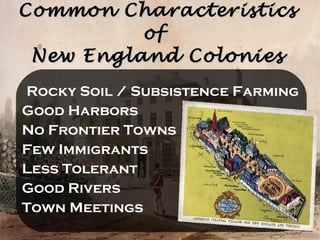
Common Characteristics of  New England Colonies Rocky Soil / Subsistence Farming Good Harbors No Frontier Towns Few Immigrants Less Tolerant Good Rivers Town Meetings
Massachusetts Pilgrims 1620 separatist Plymouth Mayflower Compact Theocracy Puritans 1630 Boston John Winthrop Absorb Plymouth by 1690 Rhode Island Roger Williams Baptists could not stand how Native  Americans were  treated Close to Religious  Freedom
Pilgrims landed in  Plymouth Rock, MA in 1620
 
Plymouth was the second permanent colony in the New World
Plymouth colony recreated
The Mayflower Compact
Signing of the Mayflower Compact
The Mayflower Compact  established that the  41 men would make the laws  for the community
The Mayflower Compact  established a  direct democracy
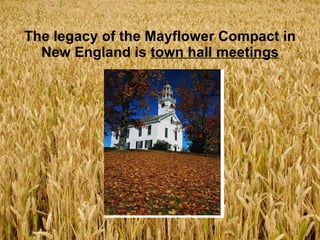
The legacy of the Mayflower Compact in New England is  town hall meetings
The Puritans The Pilgrims were Puritans The  Puritans  were followers of John Calvin They wanted to establish a  theocracy  – a government run to enforce the laws of God NO separation  between Church & State The Puritans wanted to establish a model  Christian  society The Puritans persecuted and drove out non-believers
The Puritans
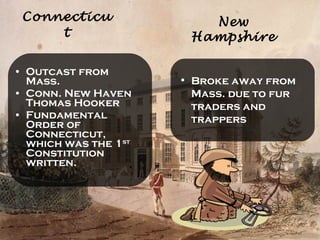
Connecticut Outcast from Mass. Conn. New Haven Thomas Hooker Fundamental Order of Connecticut, which was the 1 st  Constitution written. New Hampshire Broke away from Mass. due to fur traders and trappers
The Fundamental Orders of Connecticut: First Colonial Constitution (1639)
A  diversified  economy developed  in New England. Rocky soil and cold temperatures  limited farming .
Good harbors led to  shipbuilding ,  fishing , and  iron  production  (major industries) Industries    growth of  cities     problems (sanitation, overcrowding, etc)
Merchants  and  business owners  were the most powerful members of society.
The absence of large-scale agriculture meant  fewer slaves  were brought to the North Free blacks were common, but enjoyed  fewer rights  than whites
Less tolerant due to Puritan influence
Middle Colonies Pennsylvania New York New Jersey Delaware
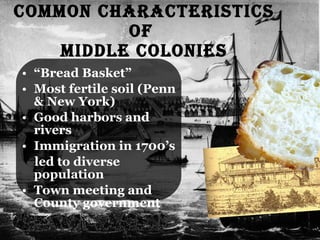
Common Characteristics of  Middle Colonies “ Bread Basket” Most fertile soil (Penn & New York) Good harbors and rivers Immigration in 1700’s led to diverse population Town meeting and County government
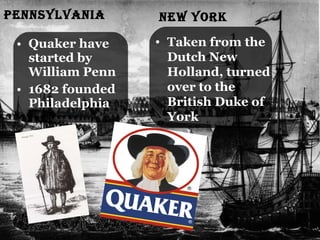
Pennsylvania Quaker have started by William Penn 1682 founded Philadelphia New York Taken from the Dutch New Holland, turned over to the British Duke of York
New Jersey Grant of land to two proprietors Delaware Founded by Swedes taken over by Penn.
Characteristics of ALL Colonies Better off economically Highest standard of living More Religious and Political Freedom Economic Opportunities Same rights as British (according to Jamestown Charter) 3000 miles away from “Home” (Britain)
The colonists had no separate identity (the development of an “American” identity will come later)
Religion in the colonies Although many colonists came to America seeking religious freedom, it was  hard to find . Many colonies had an “ official ” church (Puritan in New England, Anglican in Virginia, etc.) Challenging the authority or beliefs of the church could lead to severe punishment or expulsion. Great Awakening  – 1740s religious revival    creation of new churches, greater religious toleration, and new colleges (Princeton, Brown)
Education in the Colonies New England  – universal education so everyone could read the Bible and understand the laws. Middle Colonies  – Education was widespread, but not universal. Southern Colonies  – limited to children of wealthy; distances between farms made schooling difficult. Most women received  little  formal education. Early colleges founded to train men for  ministry .

The colonial experience

  • 1.
  • 2.
    Exploration of theNew World: SPAIN The 1500s was the century of SPAIN Why? GOLD, GLORY, & GOD
  • 3.
    GOLD : Desire to find a trade route to India/Southeast Asia to break the Italian/Arab monopoly on the spice trade
  • 4.
  • 5.
  • 6.
    GLORY : The desire for adventure, born out of the Renaissance
  • 7.
    GOD : The desire to convert native “heathens” to Christianity
  • 8.
    DEVELOPMENTS Columbus discoversthe “New World” in 1492
  • 9.
    DEVELOPMENTS Ponce deLeon explores and names Florida in 1513
  • 10.
    DEVELOPMENTS Cortez conquersthe Aztecs of Mexico
  • 11.
    DEVELOPMENTS Conquistadores exploresouthwest & California coast
  • 12.
    Exploration of theNew World: ENGLAND 1600s was the century of ENGLAND How? The defeat of Spanish Armada in 1588
  • 13.
    DEVELOPMENTS Why? ReligiousPersecution The Great Puritan Migration: 1625 - 1628
  • 14.
  • 15.
    First attempt atcolonization : Sir Walter Raleigh, The Lost Colony, in 1587
  • 16.
    First permanent colony:Jamestown, VA 1607
  • 17.
    It would notbe until 1733 when all 13 English Colonies were established
  • 18.
  • 19.
    Colony –a group of people in one place who are ruled by a parent country elsewhere
  • 20.
    Regions New EnglandSouthern Middle Colonial
  • 21.
    Southern Colonies Virginia(Jamestown) 1607 Maryland 1632 Carolina 1660’s Georgia 1730’s
  • 22.
    Common Characteristics of Southern Colonies • Spread Out • • Plantation Economic System • • Land and Crops are not rotated • • Cash Crops • • Slave Labor • • County form of local government • • Less well organized churches and schools •
  • 23.
    Agriculture wasthe primary economic activity in the southern colonies.
  • 24.
    Farmers specialized inraising a single cash crop (grown for sale rather than farmer’s use)
  • 25.
    Indentured servants (agreed to work for planters in the colonies in exchange for passage to America)  early members of the colonial workforce.
  • 26.
    African slaves eventually became the primary source of plantation labor.
  • 27.
    Wealthy planters dominated the South’s economic, social, and political life.
  • 28.
    Women couldnot vote or own property . However, they were valuable sources of labor on farms and plantations.
  • 29.
    Indentured servants had few rights while in bondage, and faced hardships afterward
  • 30.
    Slaves weretreated as property and forced to work for life without pay .
  • 31.
    Virginia 1607 (Jamestown ) John Smith 1610 John Rolfe (tobacco) 1619 House of Burgesses First Black Workers Arrives 1620 Women Arrive Carolina 1660’s Charter from Charles II North is more Democratic South is more Economically advanced with port in Charleston
  • 32.
    Jamestown, VA Thefirst permanent colony The Virginia Company chose a governor & council to run Jamestown
  • 33.
  • 34.
    The Houseof Burgesses (1619) – 22 men met w/ governor to advise him; the beginnings of colonial self-government
  • 35.
    The Houseof Burgesses was the first representative body in the New World
  • 36.
    The House ofBurgesses is an example of representative democracy (Indirect democracy)
  • 37.
  • 38.
    Georgia 1730’s JamesOglethorpe Debtors from British prisons Gets support from British to keep Spanish at bay Maryland 1632 Haven for Catholics Maryland Toleration Act - for Christian settlers 1649
  • 39.
    Remember: Marylandwas a haven for CATHOLICS (land of Queen Mary)
  • 40.
    Massachusetts Rhode IslandConnecticut New Hampshire New England Colonies
  • 41.
    Common Characteristics of New England Colonies Rocky Soil / Subsistence Farming Good Harbors No Frontier Towns Few Immigrants Less Tolerant Good Rivers Town Meetings
  • 42.
    Massachusetts Pilgrims 1620separatist Plymouth Mayflower Compact Theocracy Puritans 1630 Boston John Winthrop Absorb Plymouth by 1690 Rhode Island Roger Williams Baptists could not stand how Native Americans were treated Close to Religious Freedom
  • 43.
    Pilgrims landed in Plymouth Rock, MA in 1620
  • 44.
  • 45.
    Plymouth was thesecond permanent colony in the New World
  • 46.
  • 47.
  • 48.
    Signing of theMayflower Compact
  • 49.
    The Mayflower Compact established that the 41 men would make the laws for the community
  • 50.
    The Mayflower Compact established a direct democracy
  • 51.
    The legacy ofthe Mayflower Compact in New England is town hall meetings
  • 52.
    The Puritans ThePilgrims were Puritans The Puritans were followers of John Calvin They wanted to establish a theocracy – a government run to enforce the laws of God NO separation between Church & State The Puritans wanted to establish a model Christian society The Puritans persecuted and drove out non-believers
  • 53.
  • 54.
    Connecticut Outcast fromMass. Conn. New Haven Thomas Hooker Fundamental Order of Connecticut, which was the 1 st Constitution written. New Hampshire Broke away from Mass. due to fur traders and trappers
  • 55.
    The Fundamental Ordersof Connecticut: First Colonial Constitution (1639)
  • 56.
    A diversified economy developed in New England. Rocky soil and cold temperatures limited farming .
  • 57.
    Good harbors ledto shipbuilding , fishing , and iron production (major industries) Industries  growth of cities  problems (sanitation, overcrowding, etc)
  • 58.
    Merchants and business owners were the most powerful members of society.
  • 59.
    The absence oflarge-scale agriculture meant fewer slaves were brought to the North Free blacks were common, but enjoyed fewer rights than whites
  • 60.
    Less tolerant dueto Puritan influence
  • 61.
    Middle Colonies PennsylvaniaNew York New Jersey Delaware
  • 62.
    Common Characteristics of Middle Colonies “ Bread Basket” Most fertile soil (Penn & New York) Good harbors and rivers Immigration in 1700’s led to diverse population Town meeting and County government
  • 63.
    Pennsylvania Quaker havestarted by William Penn 1682 founded Philadelphia New York Taken from the Dutch New Holland, turned over to the British Duke of York
  • 64.
    New Jersey Grantof land to two proprietors Delaware Founded by Swedes taken over by Penn.
  • 65.
    Characteristics of ALLColonies Better off economically Highest standard of living More Religious and Political Freedom Economic Opportunities Same rights as British (according to Jamestown Charter) 3000 miles away from “Home” (Britain)
  • 66.
    The colonists hadno separate identity (the development of an “American” identity will come later)
  • 67.
    Religion in thecolonies Although many colonists came to America seeking religious freedom, it was hard to find . Many colonies had an “ official ” church (Puritan in New England, Anglican in Virginia, etc.) Challenging the authority or beliefs of the church could lead to severe punishment or expulsion. Great Awakening – 1740s religious revival  creation of new churches, greater religious toleration, and new colleges (Princeton, Brown)
  • 68.
    Education in theColonies New England – universal education so everyone could read the Bible and understand the laws. Middle Colonies – Education was widespread, but not universal. Southern Colonies – limited to children of wealthy; distances between farms made schooling difficult. Most women received little formal education. Early colleges founded to train men for ministry .