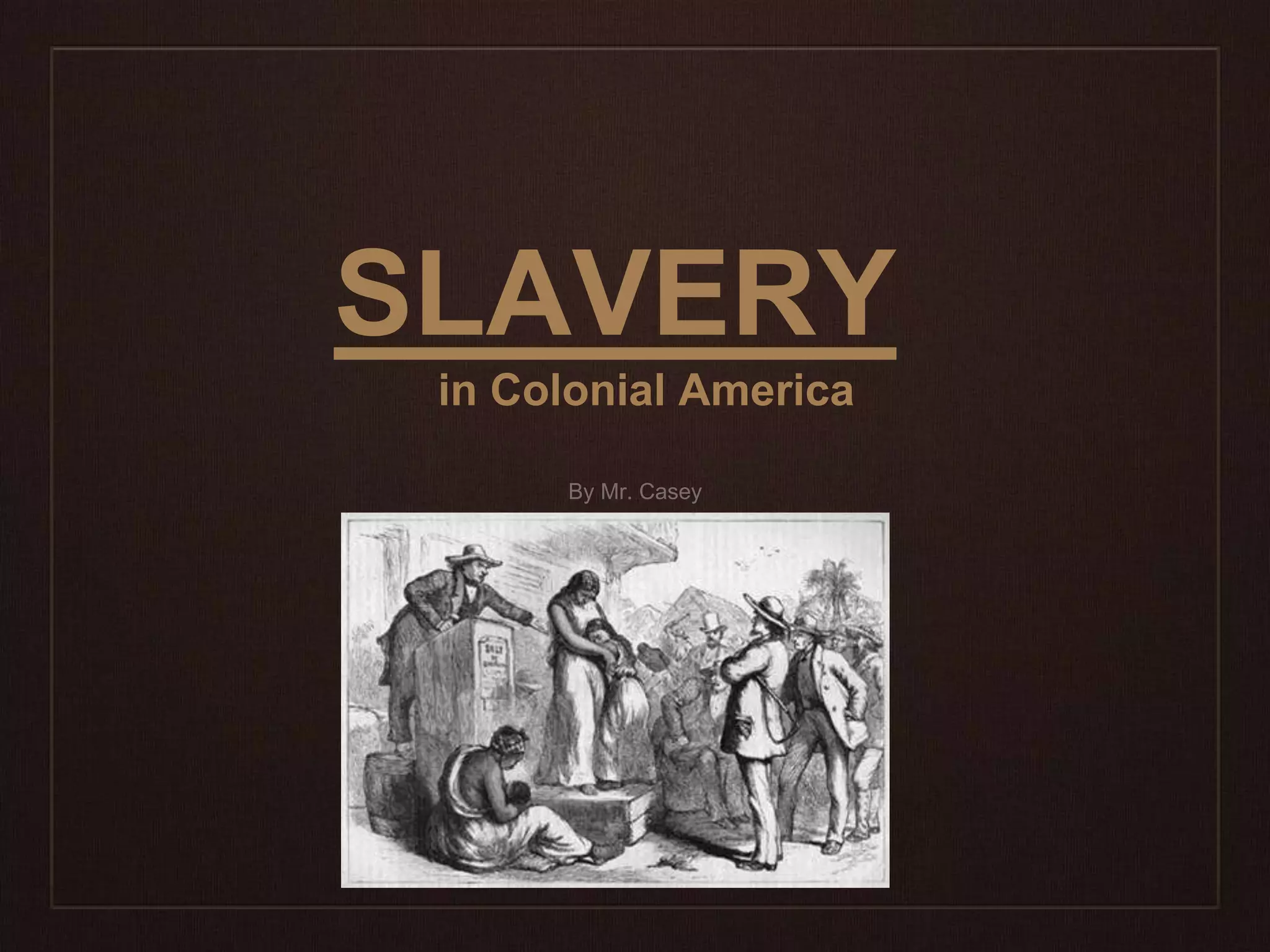
SLAVERY
in Colonial America
By Mr. Casey
AGENDA
● Vocabulary
● History of Slavery in the Colonies
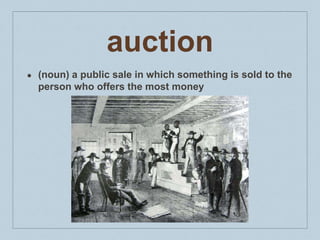
auction
● (noun) a public sale in which something is sold to the
person who offers the most money
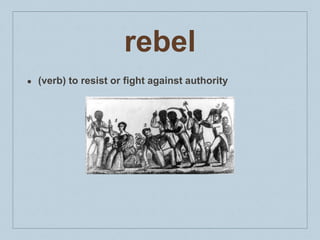
rebel
● (verb) to resist or fight against authority
proponent
● (noun) a person who supports something
SLAVERY
1526 - 1765
The Beginning
1450 Colonial Slavery Begins
Portuguese begin exploring Africa
and trading for goods; including ten
slaves brought back to Portugal
The Beginning
The Spanish begin enslaving
Native Americans in America, but
soon switch to African slaves
because the Native Americans die
of disease, will not work, or often
escape
The Beginning
Early slaves often had the right to
marry, worship, go to court, and
sometimes own land.
However, things began to change as
the colonies began to prosper and
more slaves were imported
Free Colonies
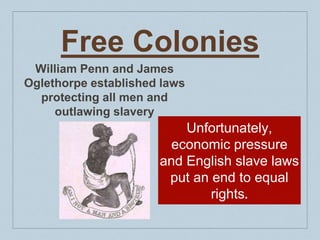
William Penn and James
Oglethorpe established laws
protecting all men and
outlawing slavery
Unfortunately,
economic pressure
and English slave laws
put an end to equal
rights.
STOP AND DISCUSS
●Why do you think the rights
of slaves began to
disappear as the colonies
became more prosperous
and more slaves were
imported?
Growth of Slavery
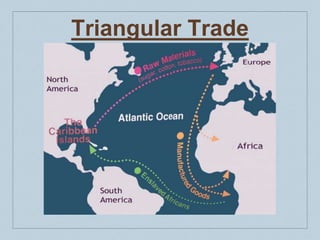
● The growth of the rice, indigo,
tobacco and cotton industries
creates a massive need for slaves
(free labor) in the south. By 1700,
the triangular trade routes were
established
Growth of Slavery
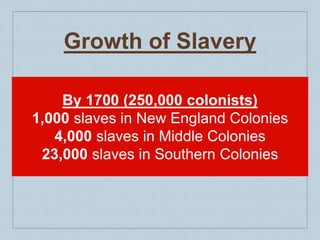
By 1700 (250,000 colonists)
1,000 slaves in New England Colonies
4,000 slaves in Middle Colonies
23,000 slaves in Southern Colonies
Triangular Trade
Slave Resistance &
Rebellions
● Many slaves resisted by working slower,
escaping, and occasionally fighting or
killing slave owners
● Although the slave population
outnumbered white colonists in some
colonies, slaves were held down with
strict laws and rules set up by colonial and
English laws
Slave Resistance &
Rebellions
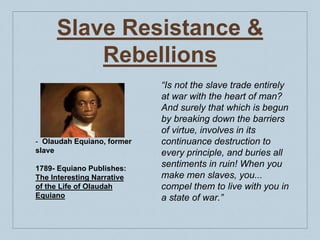
- Olaudah Equiano, former
slave
1789- Equiano Publishes:
The Interesting Narrative
of the Life of Olaudah
Equiano
“Is not the slave trade entirely
at war with the heart of man?
And surely that which is begun
by breaking down the barriers
of virtue, involves in its
continuance destruction to
every principle, and buries all
sentiments in ruin! When you
make men slaves, you...
compel them to live with you in
a state of war.”
Slave Codes
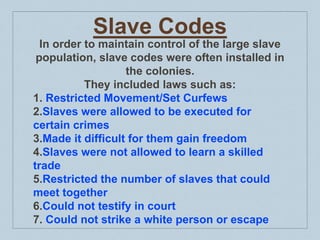
In order to maintain control of the large slave
population, slave codes were often installed in
the colonies.
They included laws such as:
1. Restricted Movement/Set Curfews
2.Slaves were allowed to be executed for
certain crimes
3.Made it difficult for them gain freedom
4.Slaves were not allowed to learn a skilled
trade
5.Restricted the number of slaves that could
meet together
6.Could not testify in court
7. Could not strike a white person or escape
Slave Resistance &
Rebellions
STONO REBELLION
The largest and most violent slave rebellion occurred
in 1739 in South Carolina. A group of about 20 slaves
kill a few guards, steal a few weapons and begin
marching toward Florida. As they march south they
gather more slaves, burn houses and kill colonists
along the way. Later, a militia of local colonists
catches up with the slaves and kills many of them.
The rest are tracked down, returned to slavery or
killed.
Slave Resistance &
Rebellions
According to historian,
Herbert Aptheker, there
were more than 250 slave
revolts between 1619 and
1835
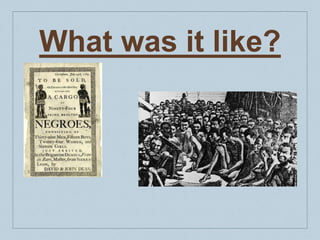
What was it like?
The End
1865 Slavery Ends
The end of the Civil War and the
13th amendment officially end
slavery
The End
*During the slave trade 30 million
Africans are captured.
* Millions will die during capture and
transport
*Only about 4% of captured slaves were
brought to the 13 Colonies; most were
sent to sugar producing regions like
Brazil and the West Indies

Unit 4, Lesson 6 (Slavery)

  • 1.
  • 2.
    AGENDA ● Vocabulary ● Historyof Slavery in the Colonies
  • 3.
    auction ● (noun) apublic sale in which something is sold to the person who offers the most money
  • 4.
    rebel ● (verb) toresist or fight against authority
  • 5.
    proponent ● (noun) aperson who supports something
  • 6.
  • 7.
    The Beginning 1450 ColonialSlavery Begins Portuguese begin exploring Africa and trading for goods; including ten slaves brought back to Portugal
  • 8.
    The Beginning The Spanishbegin enslaving Native Americans in America, but soon switch to African slaves because the Native Americans die of disease, will not work, or often escape
  • 9.
    The Beginning Early slavesoften had the right to marry, worship, go to court, and sometimes own land. However, things began to change as the colonies began to prosper and more slaves were imported
  • 10.
    Free Colonies William Pennand James Oglethorpe established laws protecting all men and outlawing slavery Unfortunately, economic pressure and English slave laws put an end to equal rights.
  • 11.
    STOP AND DISCUSS ●Whydo you think the rights of slaves began to disappear as the colonies became more prosperous and more slaves were imported?
  • 12.
    Growth of Slavery ●The growth of the rice, indigo, tobacco and cotton industries creates a massive need for slaves (free labor) in the south. By 1700, the triangular trade routes were established
  • 13.
    Growth of Slavery By1700 (250,000 colonists) 1,000 slaves in New England Colonies 4,000 slaves in Middle Colonies 23,000 slaves in Southern Colonies
  • 14.
  • 15.
    Slave Resistance & Rebellions ●Many slaves resisted by working slower, escaping, and occasionally fighting or killing slave owners ● Although the slave population outnumbered white colonists in some colonies, slaves were held down with strict laws and rules set up by colonial and English laws
  • 16.
    Slave Resistance & Rebellions -Olaudah Equiano, former slave 1789- Equiano Publishes: The Interesting Narrative of the Life of Olaudah Equiano “Is not the slave trade entirely at war with the heart of man? And surely that which is begun by breaking down the barriers of virtue, involves in its continuance destruction to every principle, and buries all sentiments in ruin! When you make men slaves, you... compel them to live with you in a state of war.”
  • 17.
    Slave Codes In orderto maintain control of the large slave population, slave codes were often installed in the colonies. They included laws such as: 1. Restricted Movement/Set Curfews 2.Slaves were allowed to be executed for certain crimes 3.Made it difficult for them gain freedom 4.Slaves were not allowed to learn a skilled trade 5.Restricted the number of slaves that could meet together 6.Could not testify in court 7. Could not strike a white person or escape
  • 18.
    Slave Resistance & Rebellions STONOREBELLION The largest and most violent slave rebellion occurred in 1739 in South Carolina. A group of about 20 slaves kill a few guards, steal a few weapons and begin marching toward Florida. As they march south they gather more slaves, burn houses and kill colonists along the way. Later, a militia of local colonists catches up with the slaves and kills many of them. The rest are tracked down, returned to slavery or killed.
  • 19.
    Slave Resistance & Rebellions Accordingto historian, Herbert Aptheker, there were more than 250 slave revolts between 1619 and 1835
  • 20.
  • 21.
    The End 1865 SlaveryEnds The end of the Civil War and the 13th amendment officially end slavery
  • 22.
    The End *During theslave trade 30 million Africans are captured. * Millions will die during capture and transport *Only about 4% of captured slaves were brought to the 13 Colonies; most were sent to sugar producing regions like Brazil and the West Indies