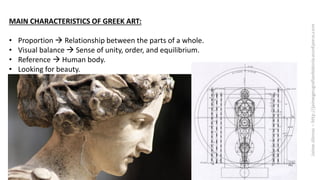
MAIN CHARACTERISTICS OF GREEK ART:
• Proportion  Relationship between the parts of a whole.
• Visual balance  Sense of unity, order, and equilibrium.
• Reference  Human body.
• Looking for beauty.
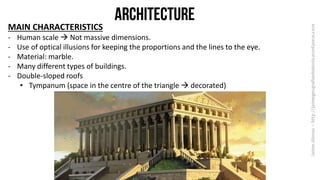
MAIN CHARACTERISTICS
- Human scale  Not massive dimensions.
- Use of optical illusions for keeping the proportions and the lines to the eye.
- Material: marble.
- Many different types of buildings.
- Double-sloped roofs
• Tympanum (space in the centre of the triangle  decorated)
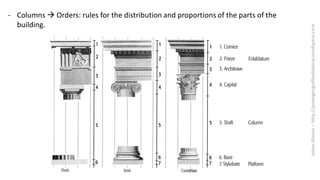
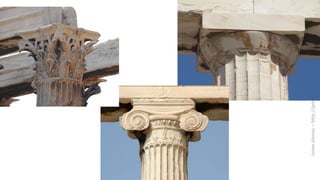
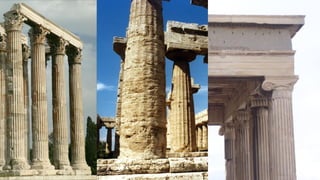
- Columns  Orders: rules for the distribution and proportions of the parts of the
building.
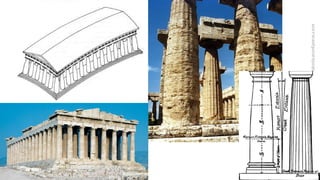
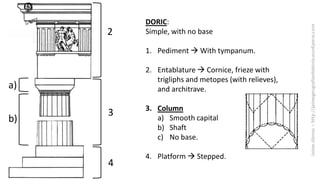
DORIC:
Simple, with no base
1. Pediment  With tympanum.
2. Entablature  Cornice, frieze with
trigliphs and metopes (with relieves),
and architrave.
3. Column
a) Smooth capital
b) Shaft
c) No base.
4. Platform  Stepped.
2
3
4
a)
b)
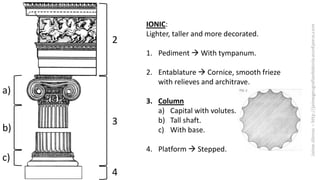
IONIC:
Lighter, taller and more decorated.
1. Pediment  With tympanum.
2. Entablature  Cornice, smooth frieze
with relieves and architrave.
3. Column
a) Capital with volutes.
b) Tall shaft.
c) With base.
4. Platform  Stepped.
2
3
4
a)
b)
c)
a)
b)
c)
2
3
4
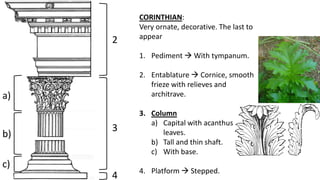
CORINTHIAN:
Very ornate, decorative. The last to
appear
1. Pediment  With tympanum.
2. Entablature  Cornice, smooth
frieze with relieves and
architrave.
3. Column
a) Capital with acanthus
leaves.
b) Tall and thin shaft.
c) With base.
4. Platform  Stepped.
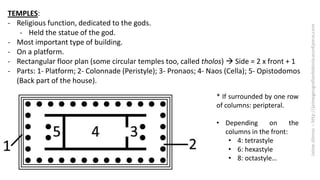
TEMPLES:
- Religious function, dedicated to the gods.
- Held the statue of the god.
- Most important type of building.
- On a platform.
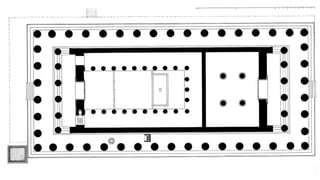
- Rectangular floor plan (some circular temples too, called tholos)  Side = 2 x front + 1
- Parts: 1- Platform; 2- Colonnade (Peristyle); 3- Pronaos; 4- Naos (Cella); 5- Opistodomos
(Back part of the house).
* If surrounded by one row
of columns: peripteral.
• Depending on the
columns in the front:
• 4: tetrastyle
• 6: hexastyle
• 8: octastyle…
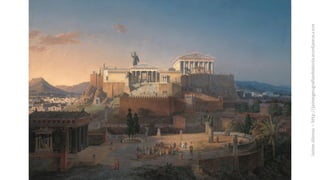
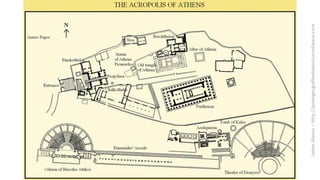
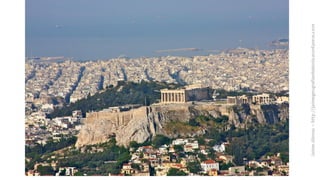
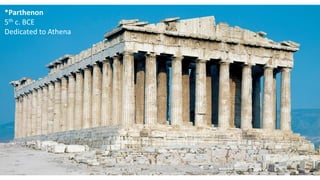
*Parthenon
5th c. BCE
Dedicated to Athena
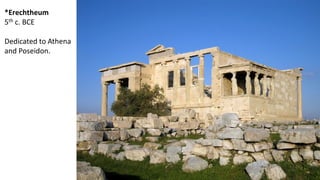
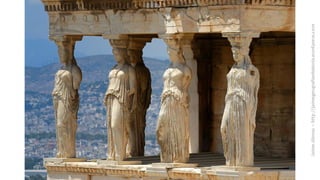
*Erechtheum
5th c. BCE
Dedicated to Athena
and Poseidon.
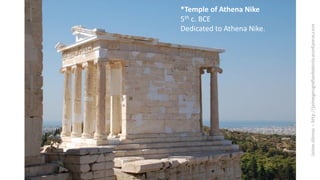
*Temple of Athena Nike
5th c. BCE
Dedicated to Athena Nike.
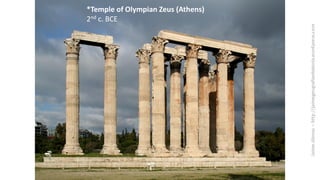
*Temple of Olympian Zeus (Athens)
2nd c. BCE
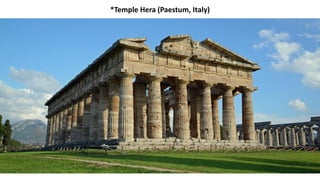
*Temple Hera (Paestum, Italy)
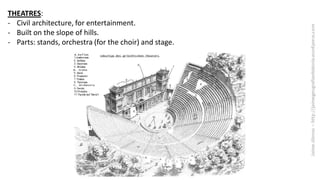
THEATRES:
- Civil architecture, for entertainment.
- Built on the slope of hills.
- Parts: stands, orchestra (for the choir) and stage.
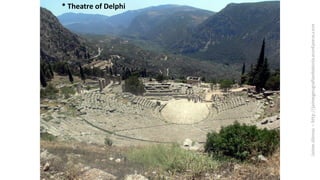
* Theatre of Delphi
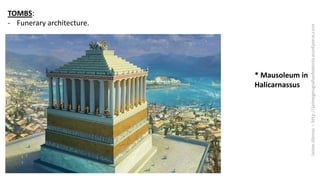
TOMBS:
- Funerary architecture.
* Mausoleum in
Halicarnassus
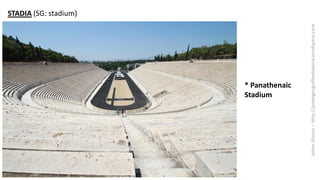
STADIA (SG: stadium)
* Panathenaic
Stadium
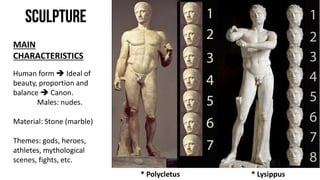
MAIN
CHARACTERISTICS
Human form  Ideal of
beauty, proportion and
balance  Canon.
Males: nudes.
Material: Stone (marble)
Themes: gods, heroes,
athletes, mythological
scenes, fights, etc.
* Polycletus * Lysippus
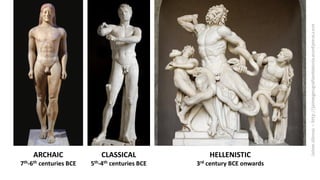
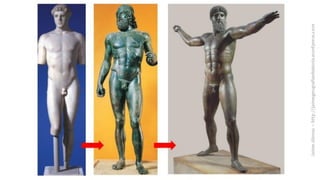
ARCHAIC
7th-6th centuries BCE
CLASSICAL
5th-4th centuries BCE
HELLENISTIC
3rd century BCE onwards
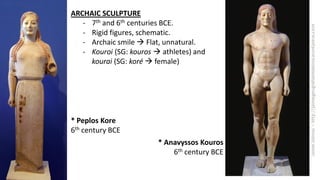
ARCHAIC SCULPTURE
- 7th and 6th centuries BCE.
- Rigid figures, schematic.
- Archaic smile  Flat, unnatural.
- Kouroi (SG: kouros  athletes) and
kourai (SG: koré  female)
* Peplos Kore
6th century BCE
* Anavyssos Kouros
6th century BCE
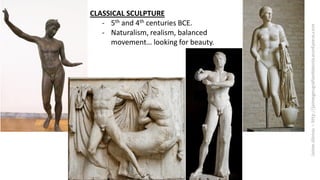
CLASSICAL SCULPTURE
- 5th and 4th centuries BCE.
- Naturalism, realism, balanced
movement… looking for beauty.
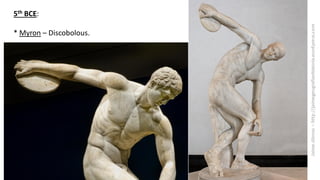
5th BCE:
* Myron – Discobolous.
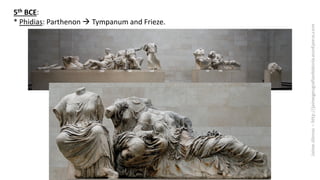
5th BCE:
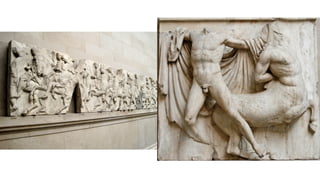
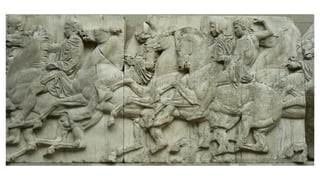
* Phidias: Parthenon  Tympanum and Frieze.
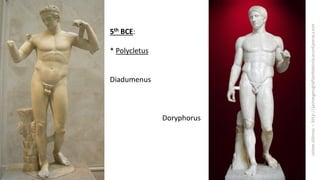
5th BCE:
* Polycletus
Diadumenus
Doryphorus
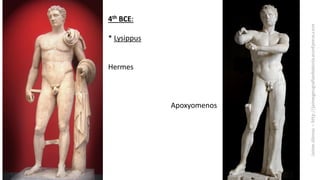
4th BCE:
* Lysippus
Hermes
Apoxyomenos
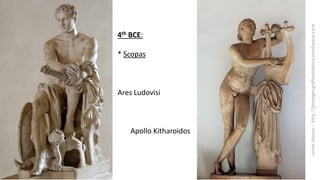
4th BCE:
* Scopas
Ares Ludovisi
Apollo Kitharoidos
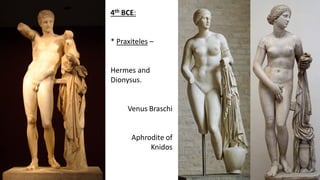
4th BCE:
* Praxiteles –
Hermes and
Dionysus.
Venus Braschi
Aphrodite of
Knidos
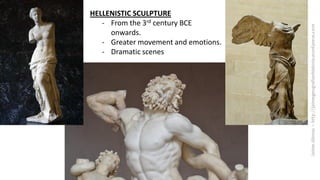
HELLENISTIC SCULPTURE
- From the 3rd century BCE
onwards.
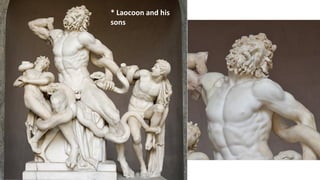
- Greater movement and emotions.
- Dramatic scenes
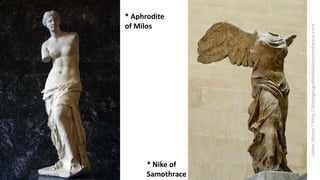
* Nike of
Samothrace
* Aphrodite
of Milos
* Laocoon and his
sons

Unit 4 - Greek art - Presentation