UNIT 3
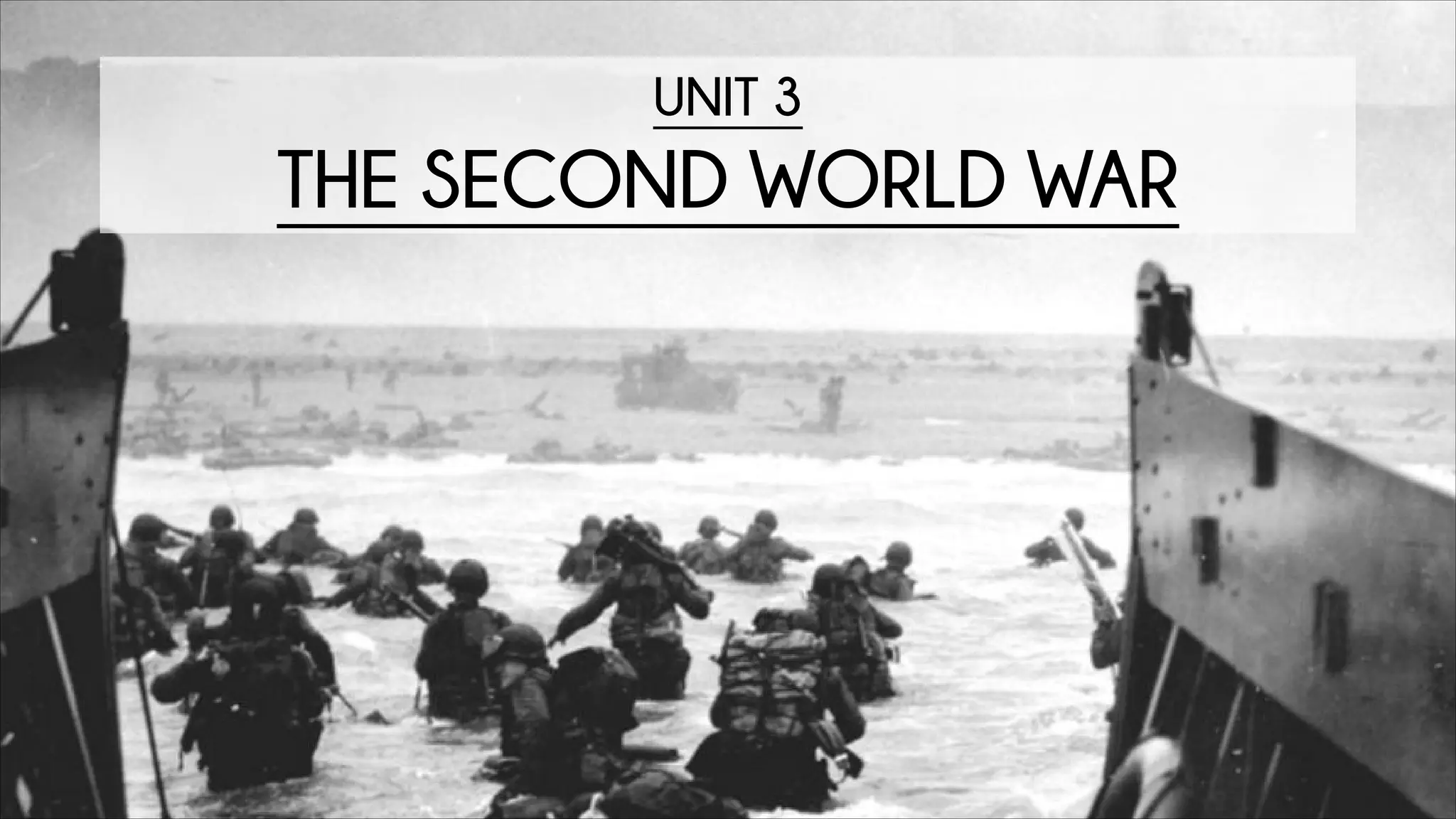
THE SECOND WORLD WAR
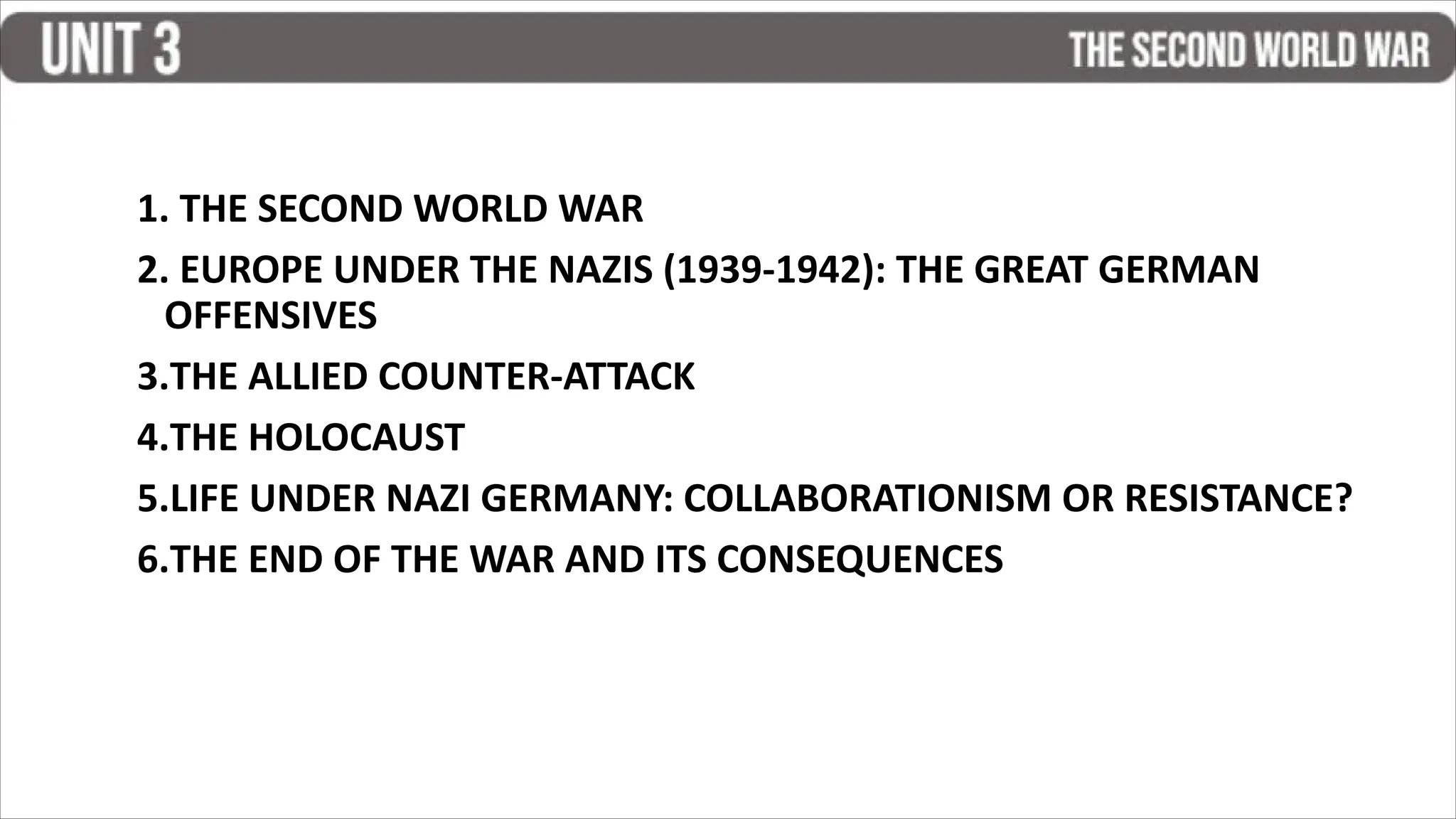
1. THE SECOND WORLD WAR
2. EUROPE UNDER THE NAZIS (1939-1942): THE GREAT GERMAN
OFFENSIVES
3.THE ALLIED COUNTER-ATTACK
4.THE HOLOCAUST
5.LIFE UNDER NAZI GERMANY: COLLABORATIONISM OR RESISTANCE?
6.THE END OF THE WAR AND ITS CONSEQUENCES
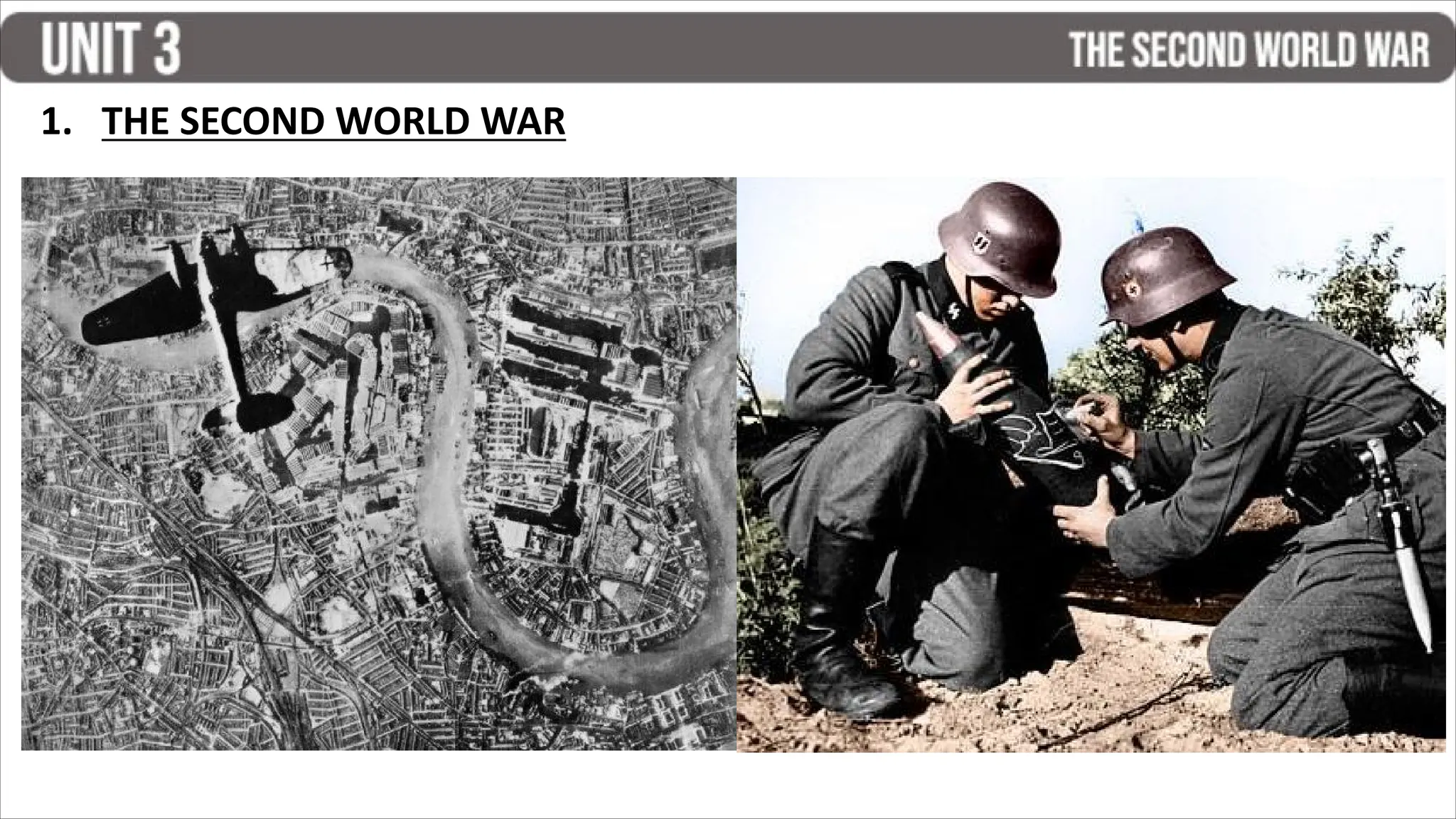
1. THE SECOND WORLD WAR
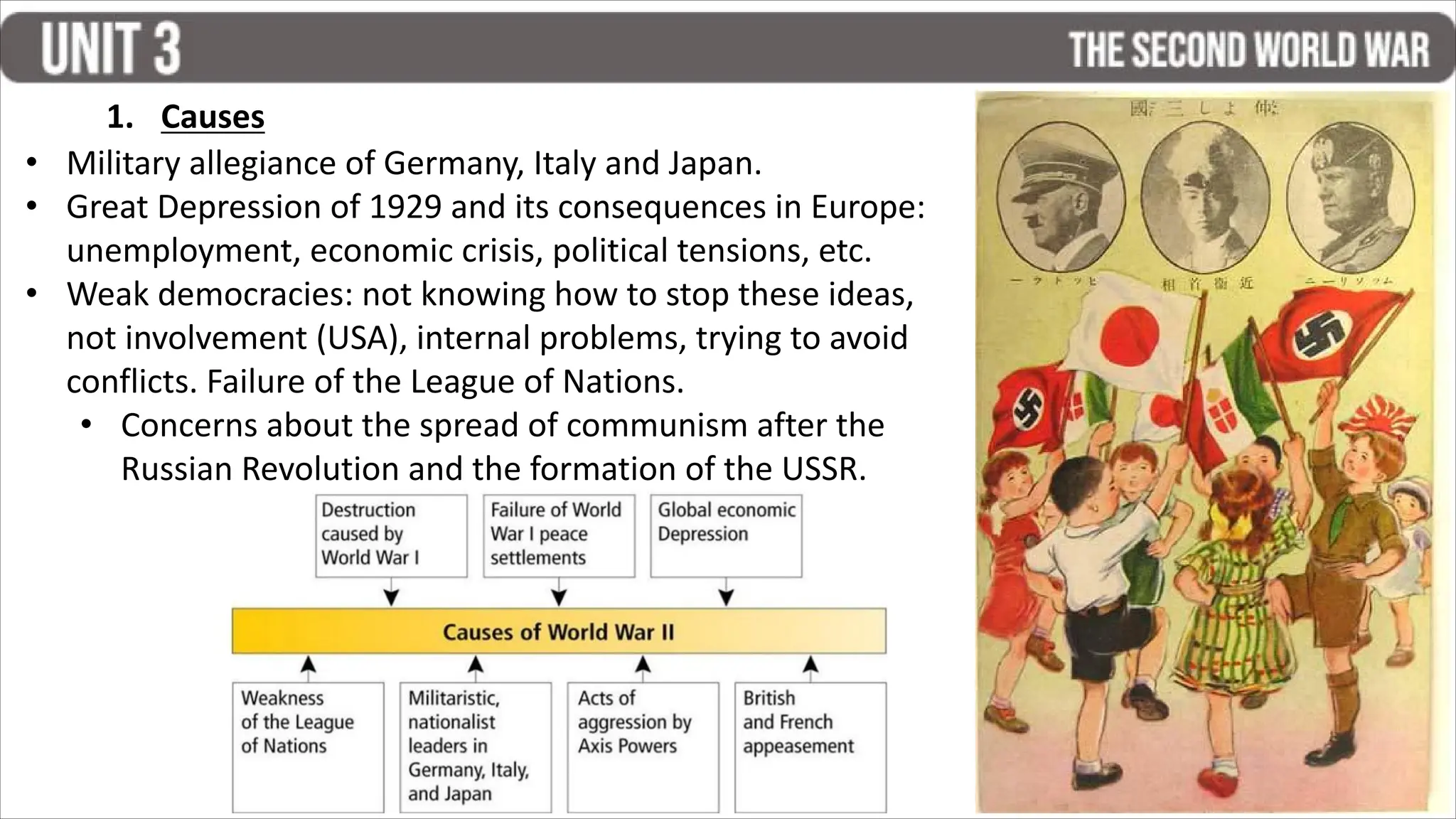
1. Causes
• Military allegiance of Germany, Italy and Japan.
• Great Depression of 1929 and its consequences in Europe:
unemployment, economic crisis, political tensions, etc.
• Weak democracies: not knowing how to stop these ideas,
not involvement (USA), internal problems, trying to avoid
conflicts. Failure of the League of Nations.
• Concerns about the spread of communism after the
Russian Revolution and the formation of the USSR.
2. The formation of blocs
Two opposing blocs:
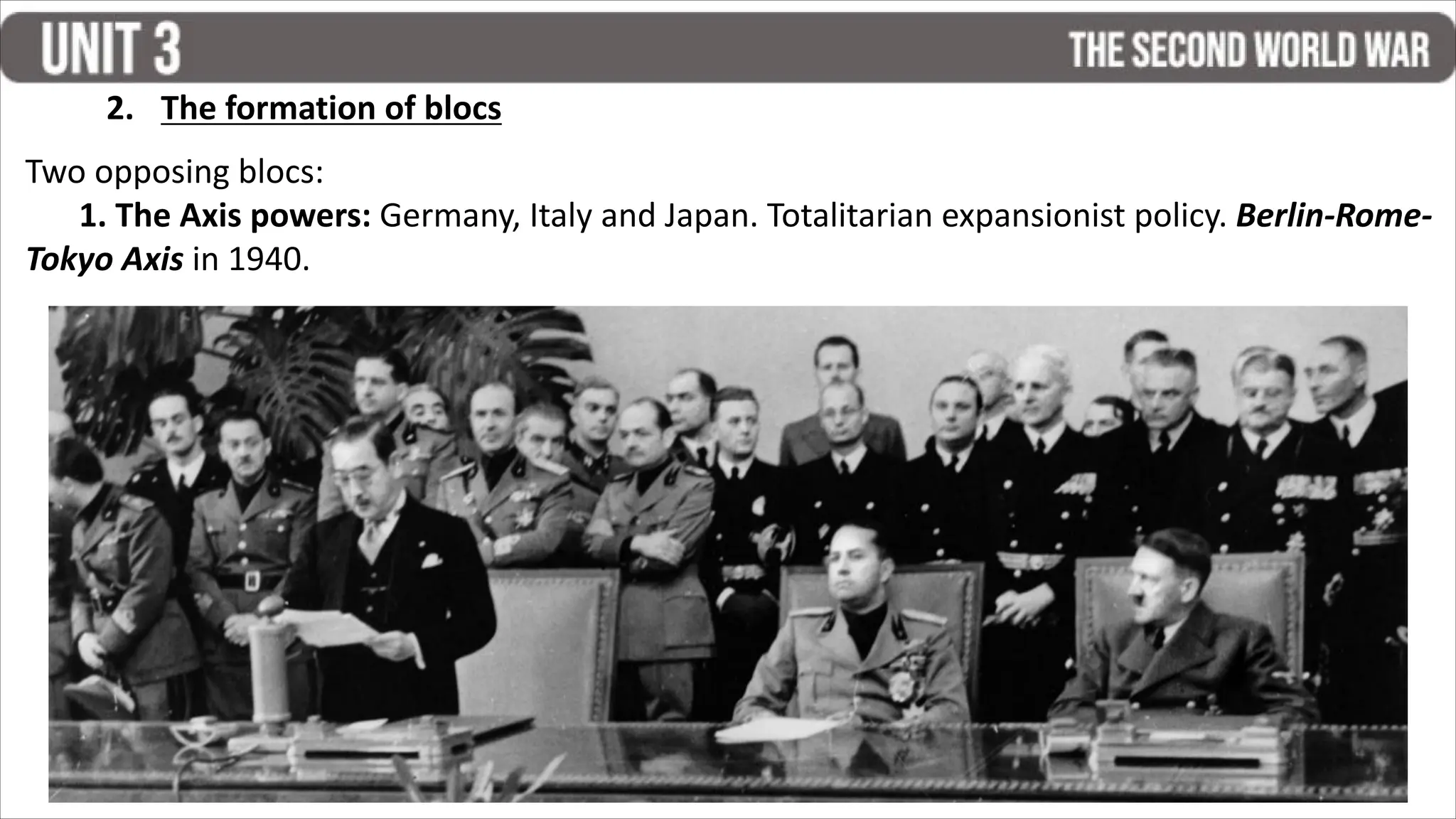
1. The Axis powers: Germany, Italy and Japan. Totalitarian expansionist policy. Berlin-Rome-
Tokyo Axis in 1940.
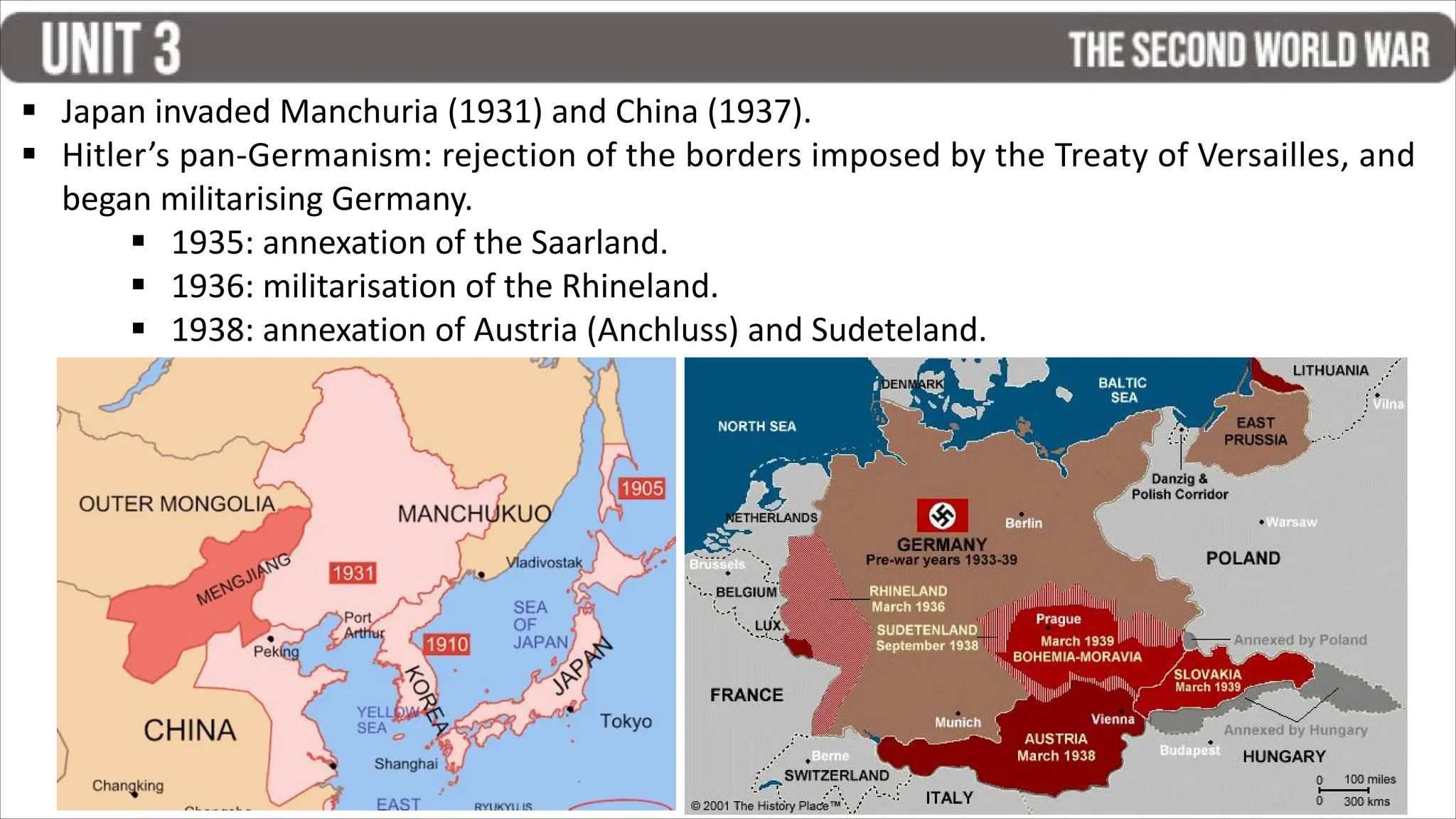
§ Japan invaded Manchuria (1931) and China (1937).
§ Hitler’s pan-Germanism: rejection of the borders imposed by the Treaty of Versailles, and
began militarising Germany.
§ 1935: annexation of the Saarland.
§ 1936: militarisation of the Rhineland.
§ 1938: annexation of Austria (Anchluss) and Sudeteland.
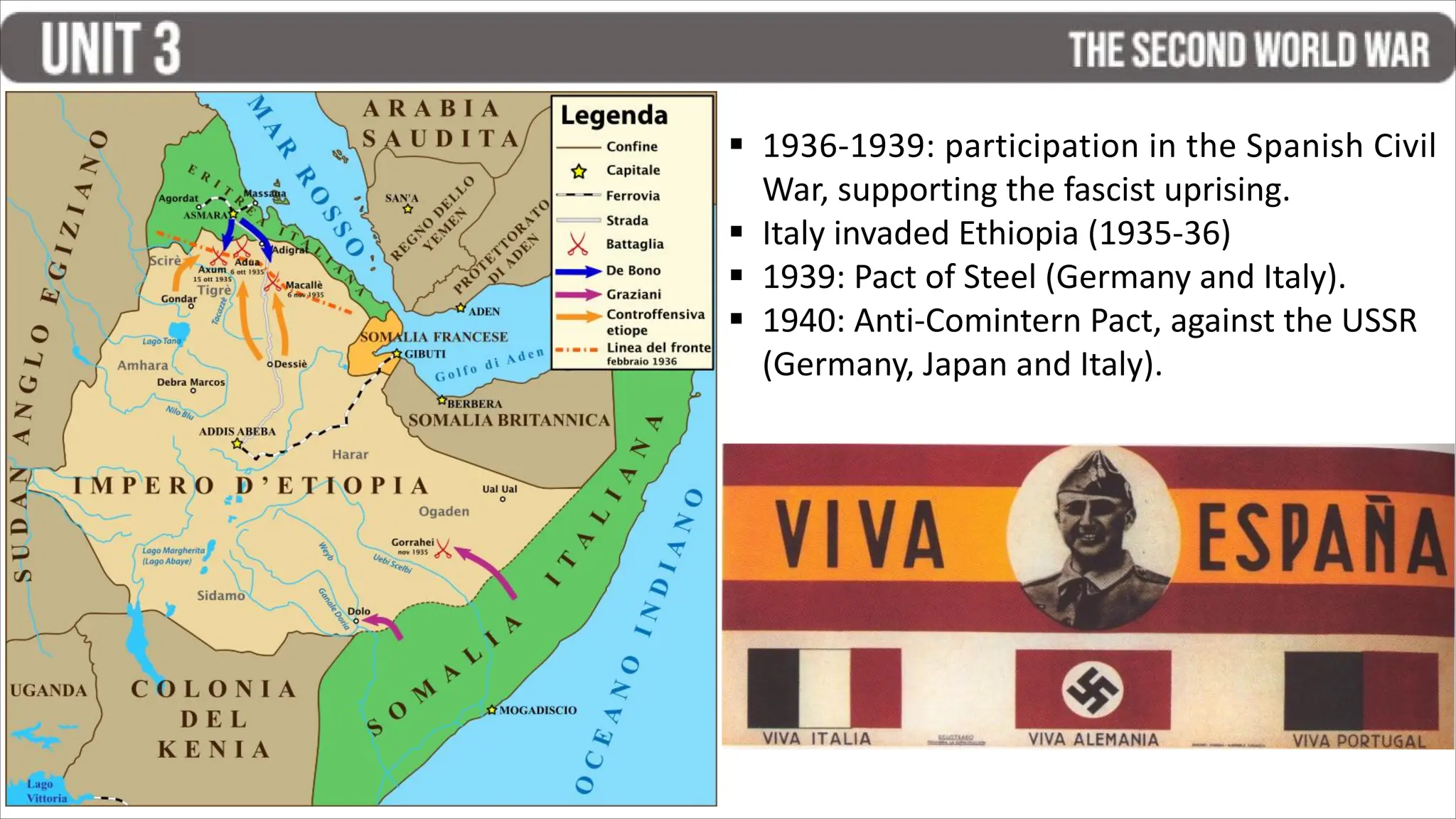
§ 1936-1939: participation in the Spanish Civil
War, supporting the fascist uprising.
§ Italy invaded Ethiopia (1935-36)
§ 1939: Pact of Steel (Germany and Italy).
§ 1940: Anti-Comintern Pact, against the USSR
(Germany, Japan and Italy).
2. The Allies powers:
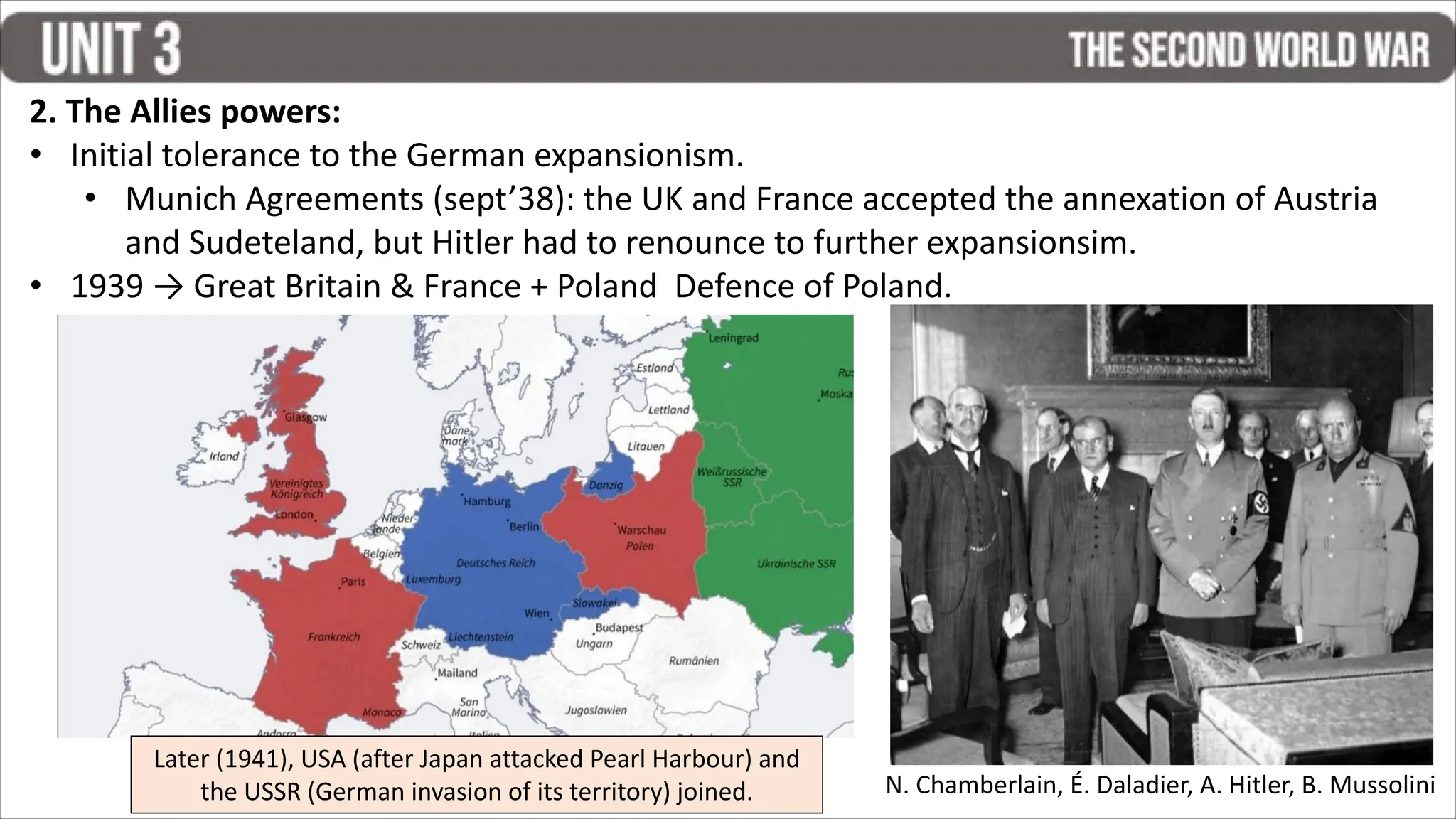
• Initial tolerance to the German expansionism.
• Munich Agreements (sept’38): the UK and France accepted the annexation of Austria
and Sudeteland, but Hitler had to renounce to further expansionsim.
• 1939 → Great Britain & France + Poland Defence of Poland.
N. Chamberlain, É. Daladier, A. Hitler, B. Mussolini
Later (1941), USA (after Japan attacked Pearl Harbour) and
the USSR (German invasion of its territory) joined.
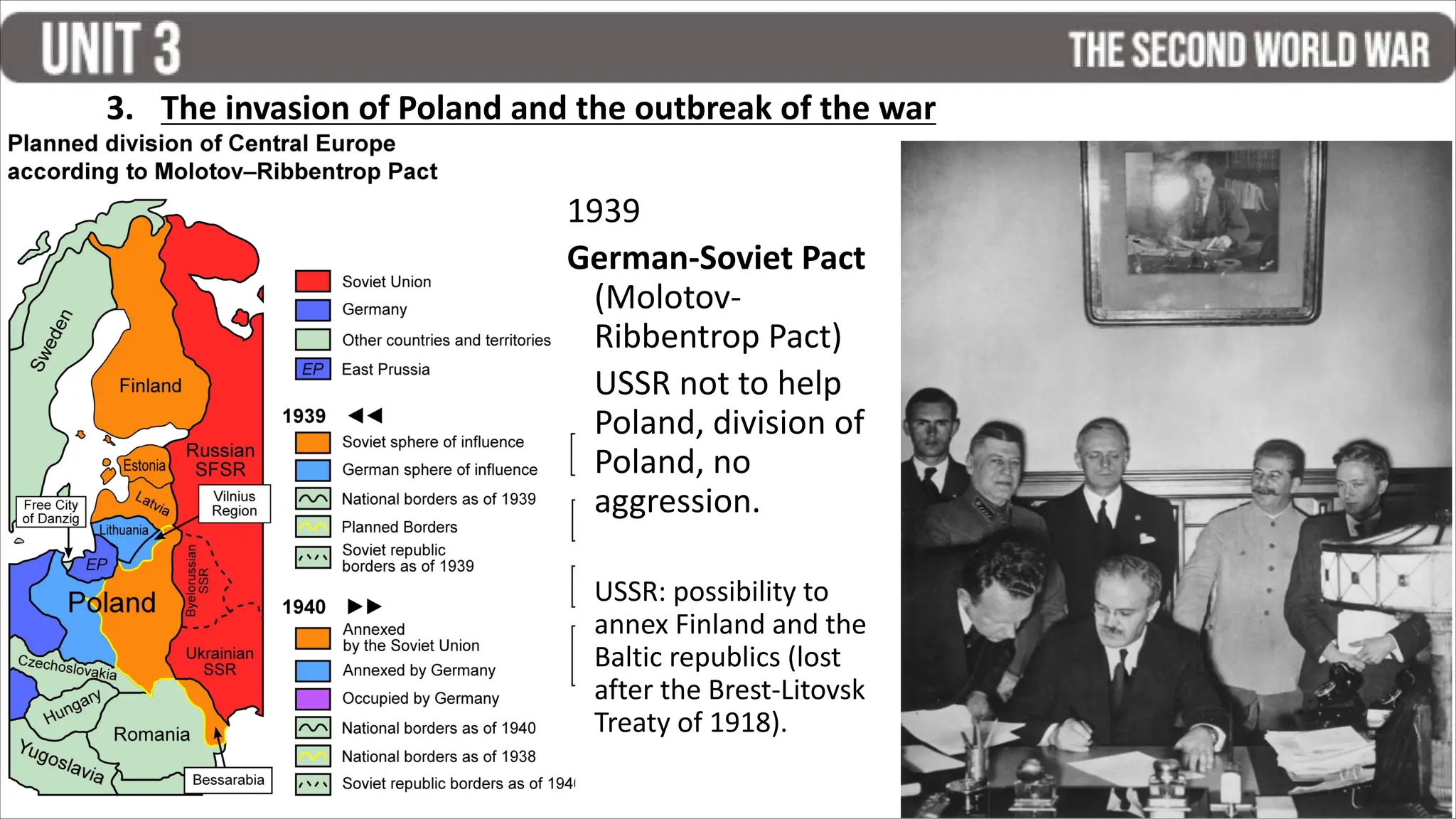
1939
German-Soviet Pact
(Molotov-
Ribbentrop Pact)
USSR not to help
Poland, division of
Poland, no
aggression.
USSR: possibility to
annex Finland and the
Baltic republics (lost
after the Brest-Litovsk
Treaty of 1918).
3. The invasion of Poland and the outbreak of the war
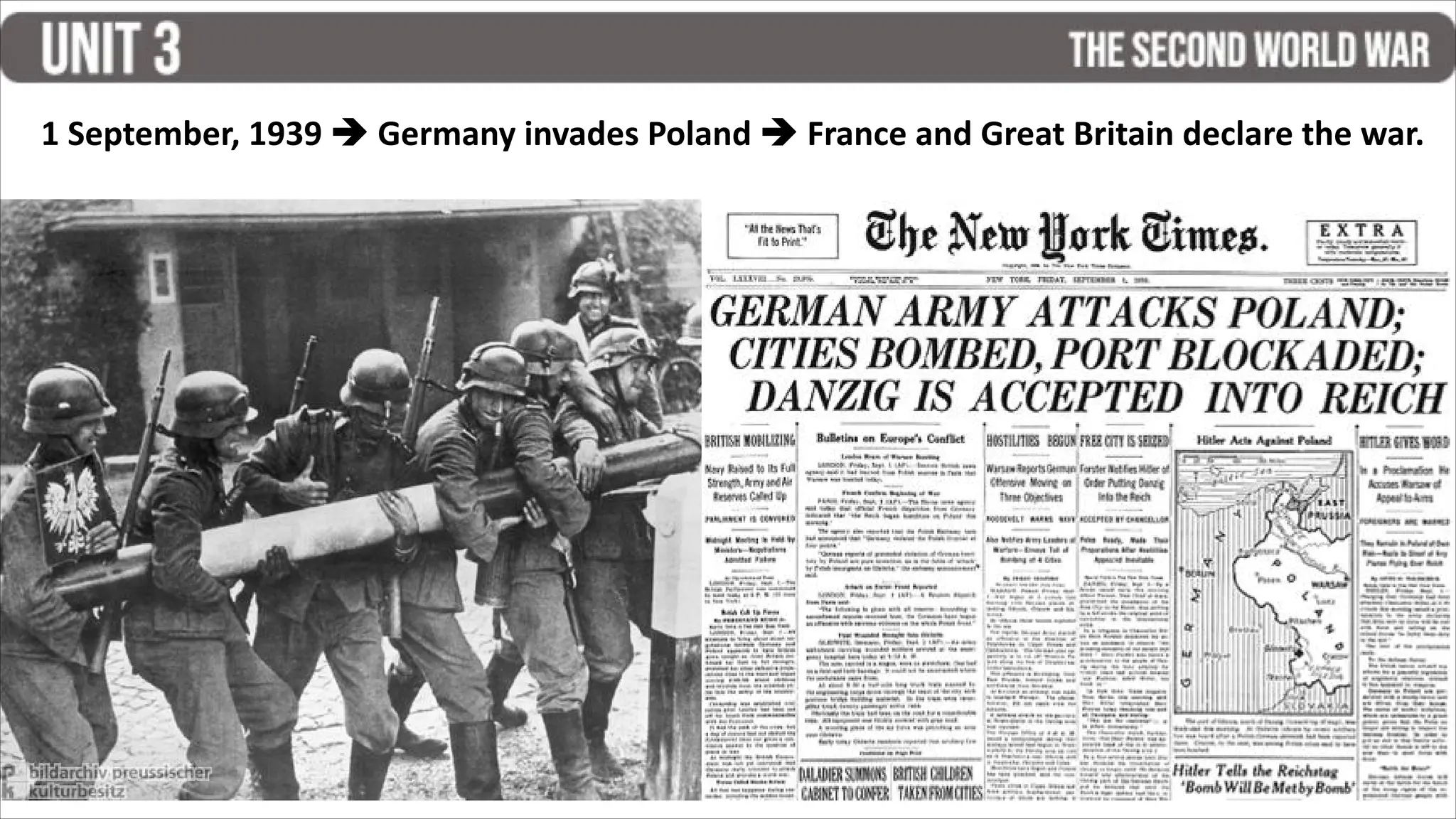
1 September, 1939  Germany invades Poland  France and Great Britain declare the war.
2. EUROPE UNDER THE NAZIS (1939-1942): THE GREAT GERMAN OFFENSIVES
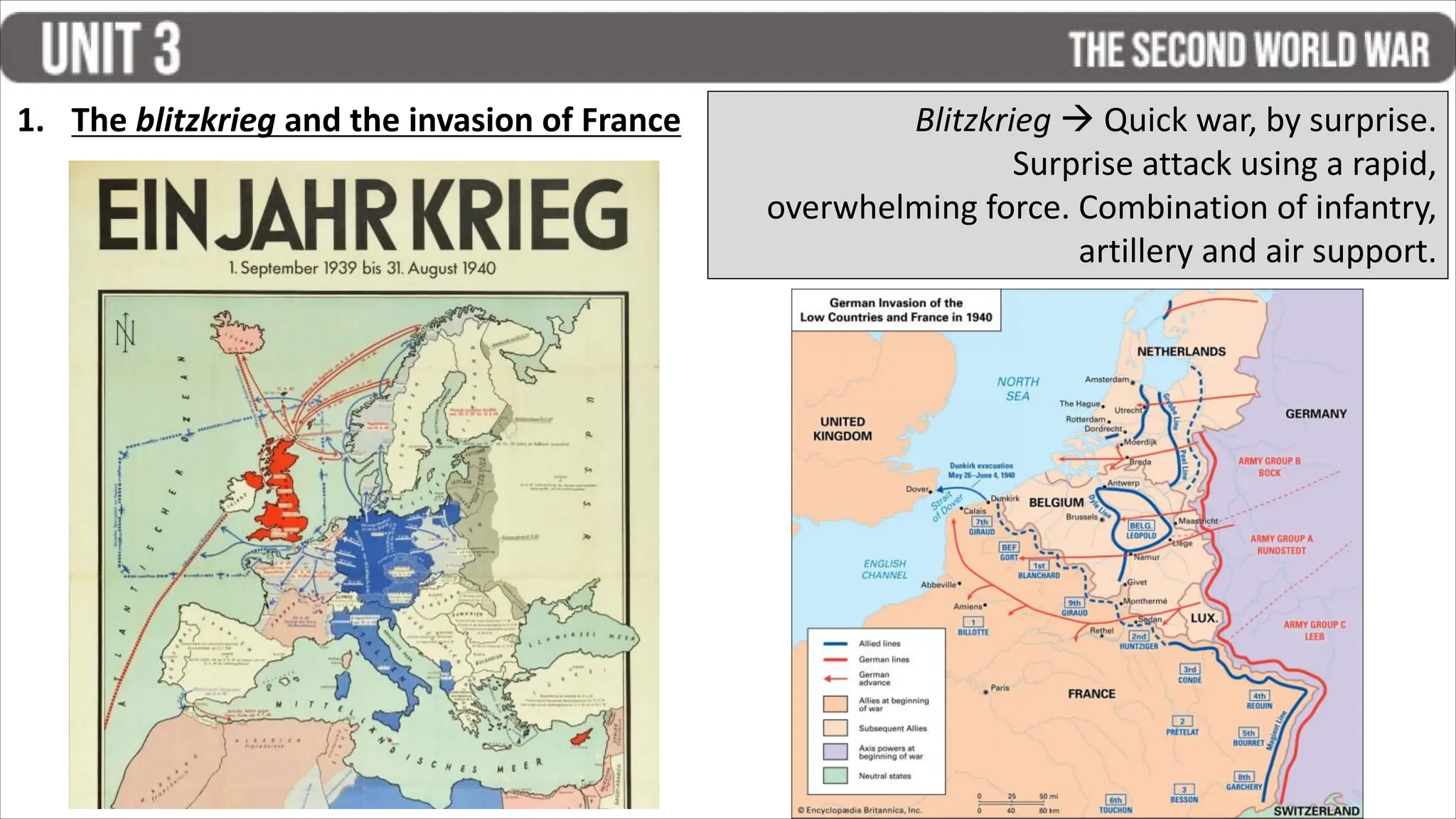
Blitzkrieg  Quick war, by surprise.
Surprise attack using a rapid,
overwhelming force. Combination of infantry,
artillery and air support.
1. The blitzkrieg and the invasion of France
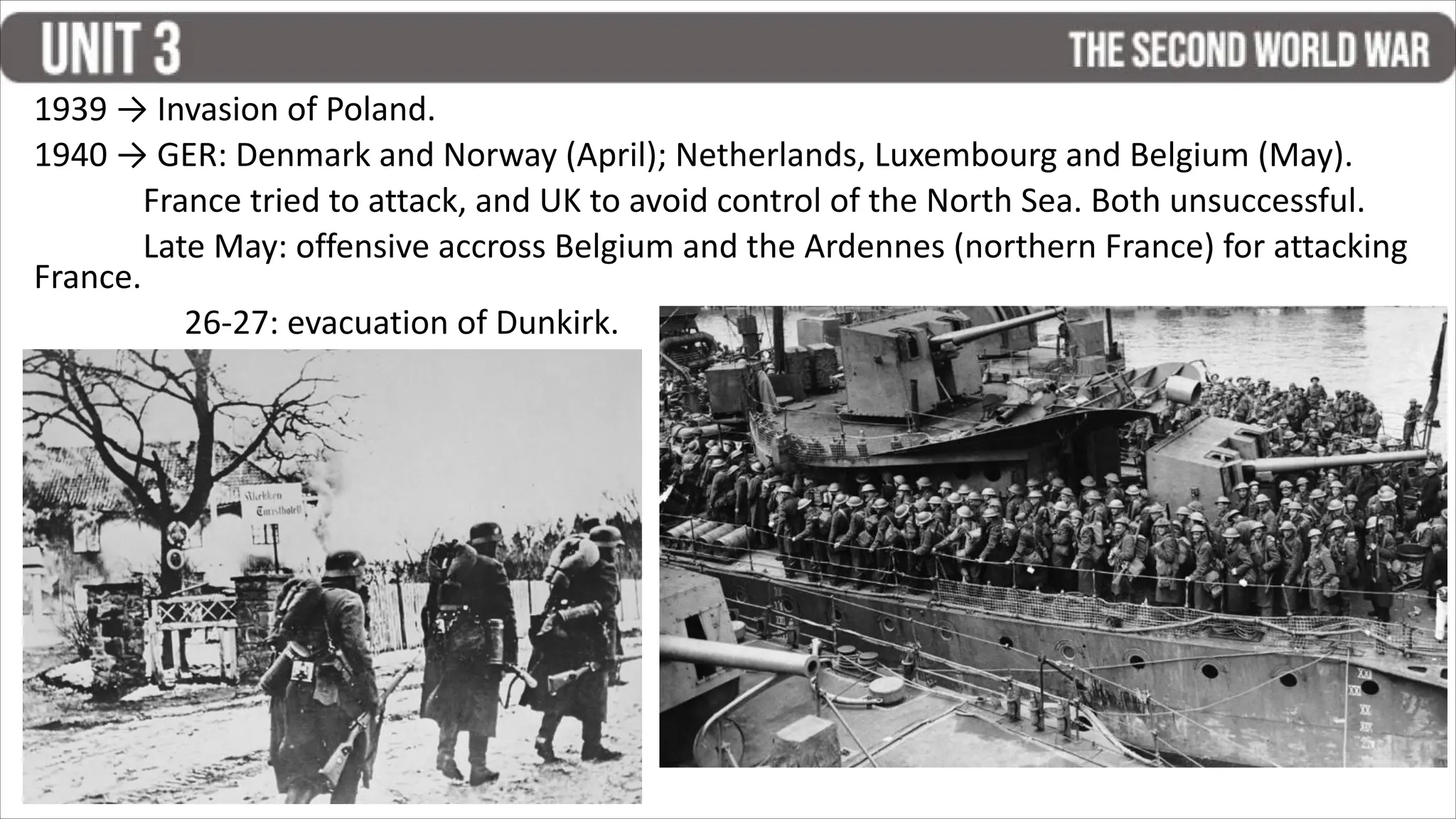
1939 → Invasion of Poland.
1940 → GER: Denmark and Norway (April); Netherlands, Luxembourg and Belgium (May).
France tried to attack, and UK to avoid control of the North Sea. Both unsuccessful.
Late May: offensive accross Belgium and the Ardennes (northern France) for attacking
France.
26-27: evacuation of Dunkirk.
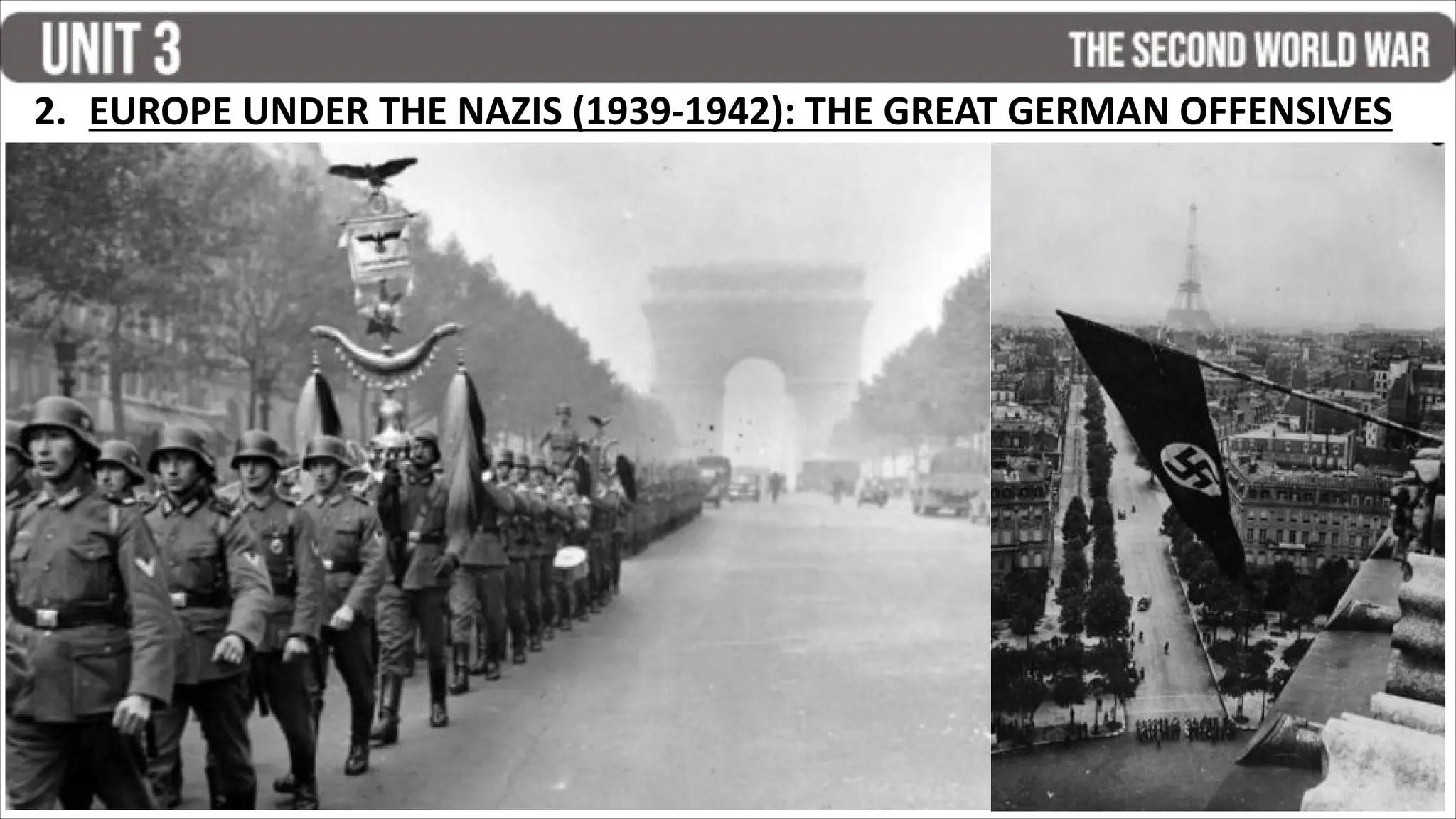
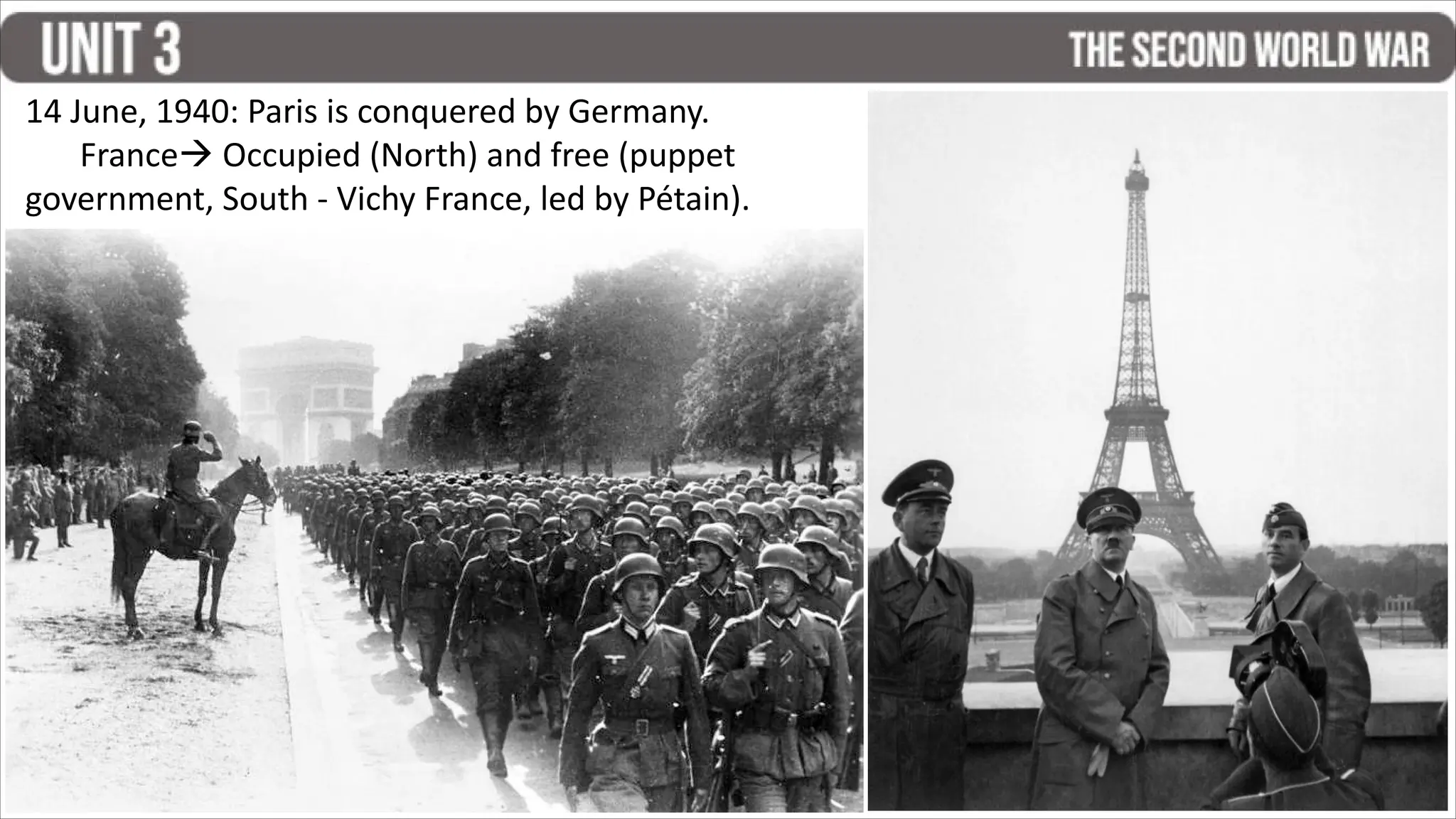
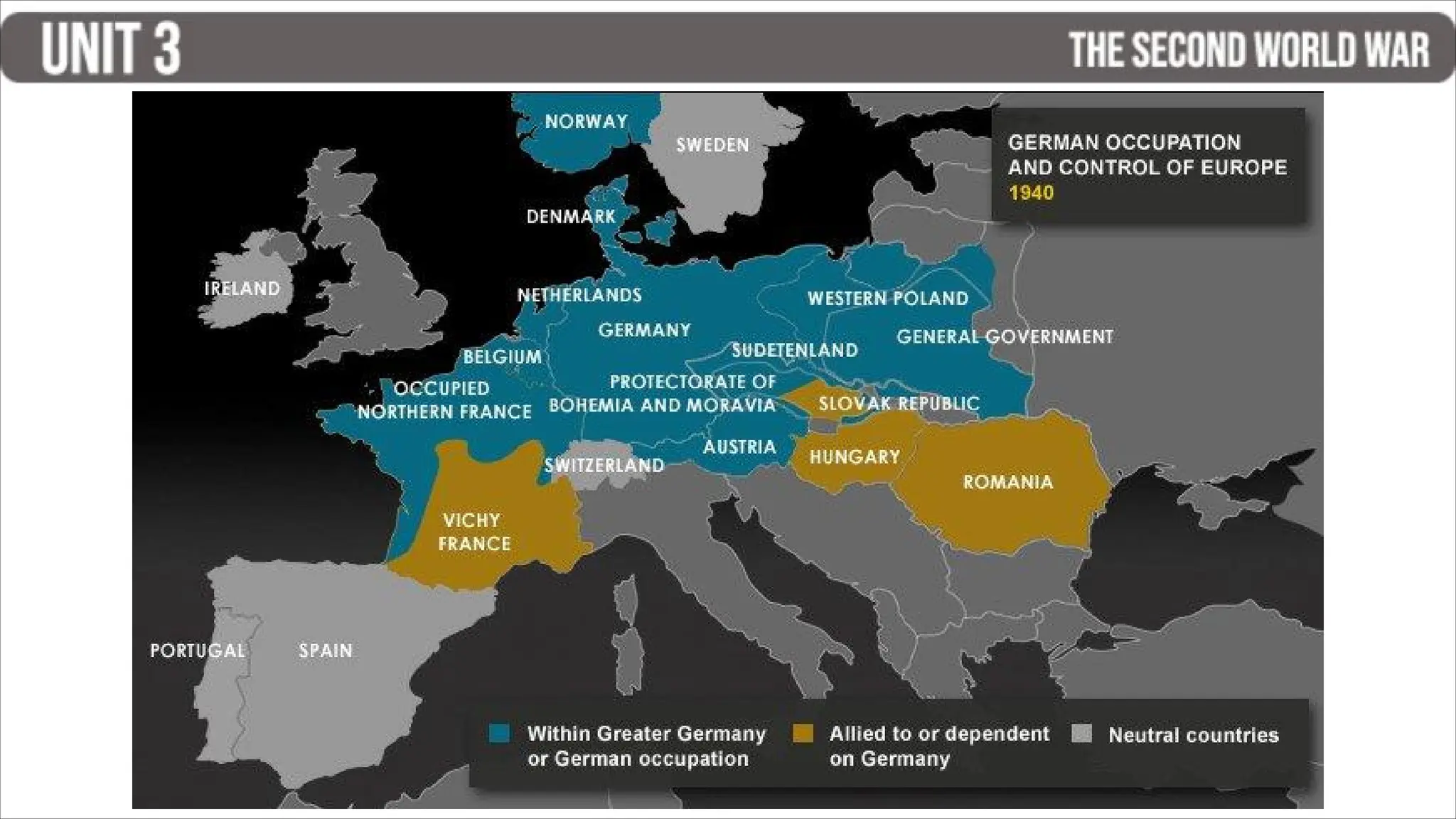
14 June, 1940: Paris is conquered by Germany.
France Occupied (North) and free (puppet
government, South - Vichy France, led by Pétain).
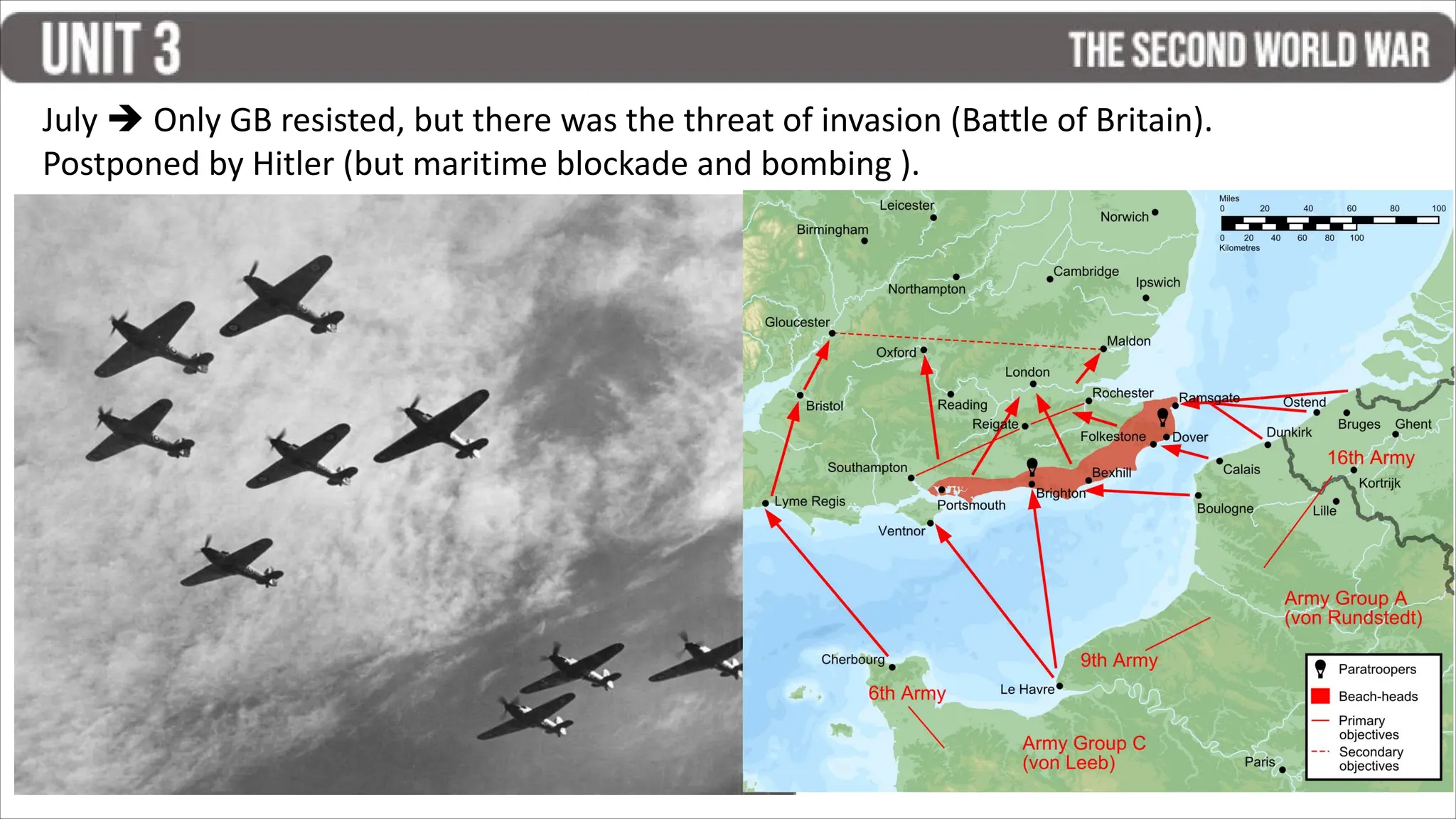
July  Only GB resisted, but there was the threat of invasion (Battle of Britain).
Postponed by Hitler (but maritime blockade and bombing ).
Winston Churchill’s First Speech as Prime Minister to House of Commons (May 13, 1940).
“That this House welcomes the formation of a Government representing the united and inflexible resolve of the
nation to prosecute the war with Germany to a victorious conclusion. [...]
To form an Administration of this scale and complexity is a serious undertaking in itself, but it must be
remembered that we are in the preliminary stage of one of the greatest battles in history, that we are in action at
many other points in Norway and in Holland, that we have to be prepared in the Mediterranean, that the air
battle is continuous and that many preparations [...] have to be made here at home. [...] I hope that any of my
friends and colleagues, or former colleagues, who are affected by the political reconstruction, will make allowance,
all allowance, for any lack of ceremony with which it has been necessary to act. I would say to the House, as I said
to those who have joined this government: “I have nothing to offer but blood, toil, tears and sweat.”
We have before us an ordeal of the most grievous kind. We have before us many, many long months of struggle
and of suffering. You ask, what is our policy? I can say: It is to wage war, by sea, land and air, with all our might and
with all the strength that God can give us; to wage war against a monstrous tyranny, never surpassed in the dark,
lamentable catalogue of human crime. That is our policy. You ask, what is our aim? I can answer in one word: It is
victory, victory at all costs, victory in spite of all terror, victory, however long and hard the road may be; for
without victory, there is no survival. Let that be realised; no survival for the British Empire, no survival for all that
the British Empire has stood for, no survival for the urge and impulse of the ages, that mankind will move forward
towards its goal. But I take up my task with buoyancy and hope. I feel sure that our cause will not be suffered to
fail among men. At this time I feel entitled to claim the aid of all, and I say, “come then, let us go forward together
with our united strength.”
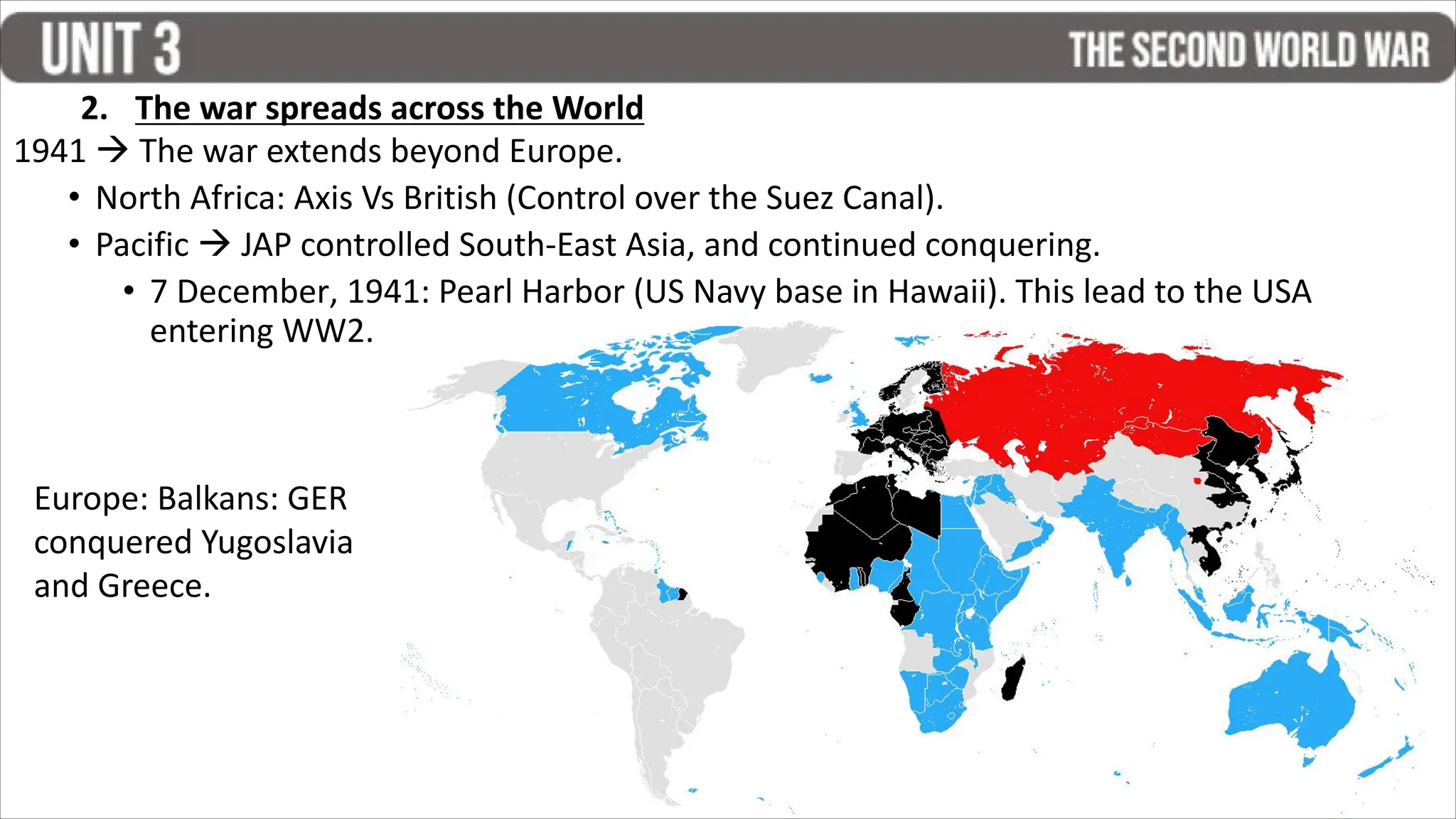
1941  The war extends beyond Europe.
• North Africa: Axis Vs British (Control over the Suez Canal).
• Pacific  JAP controlled South-East Asia, and continued conquering.
• 7 December, 1941: Pearl Harbor (US Navy base in Hawaii). This lead to the USA
entering WW2.
2. The war spreads across the World
Europe: Balkans: GER
conquered Yugoslavia
and Greece.
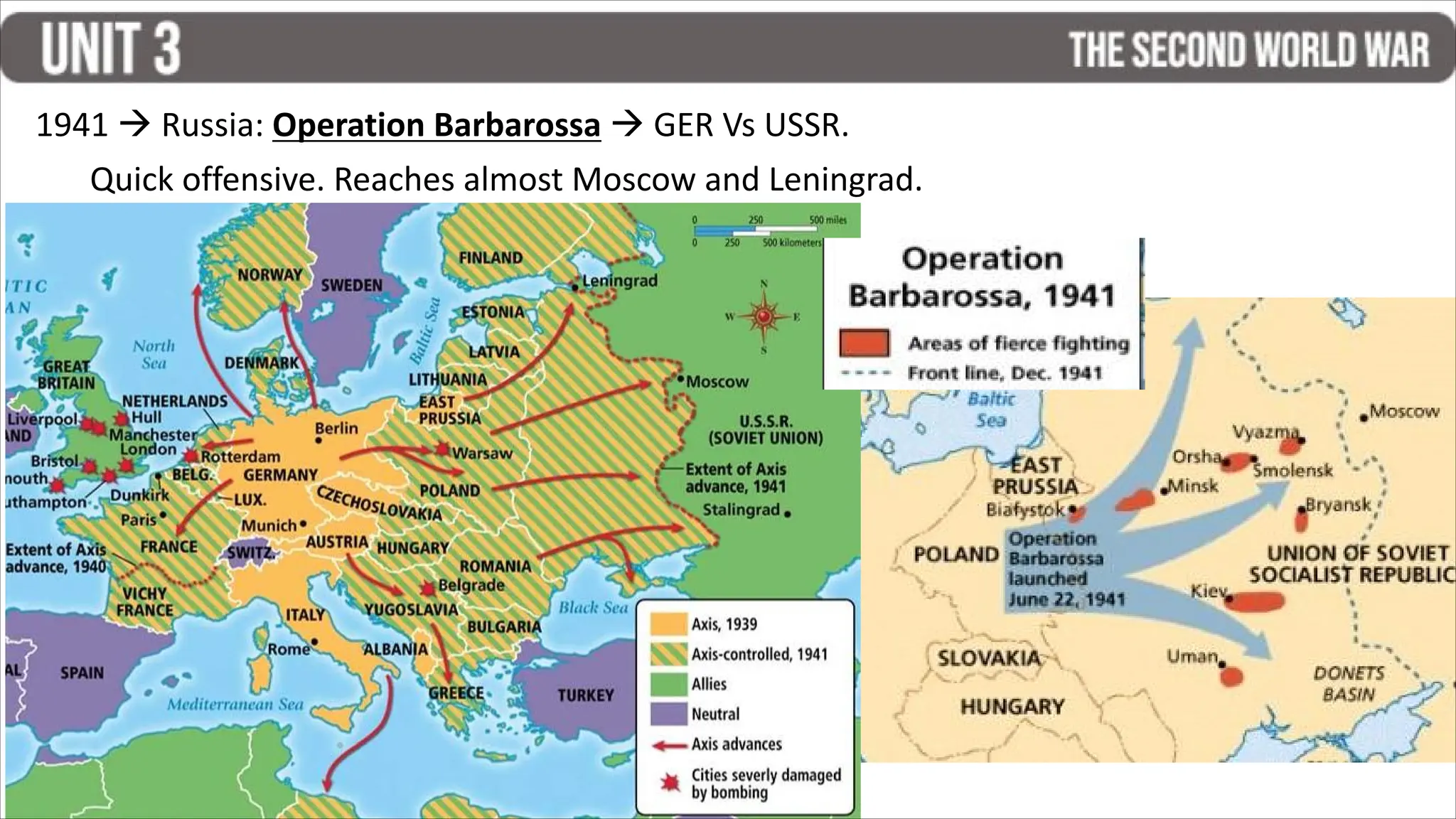
1941  Russia: Operation Barbarossa  GER Vs USSR.
Quick offensive. Reaches almost Moscow and Leningrad.
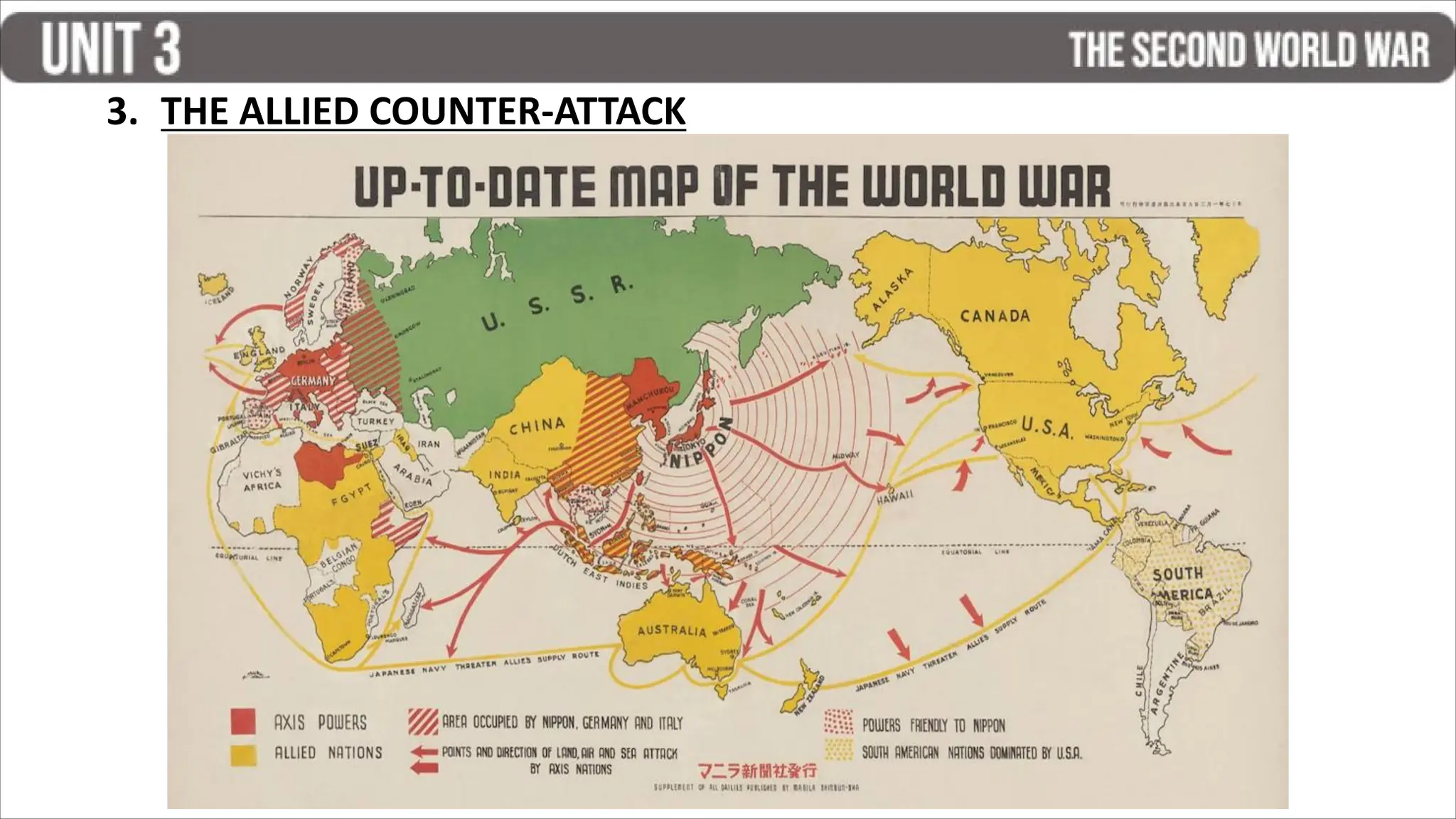
3. THE ALLIED COUNTER-ATTACK
a) Operation Barbarossa: German invasion of the USSR.
Vs Molotov-Ribbentrop Pact (non-aggression) → USSR joined the Allies.
b) Japanese attack to Pearl Harbour: USA joined the Allies.
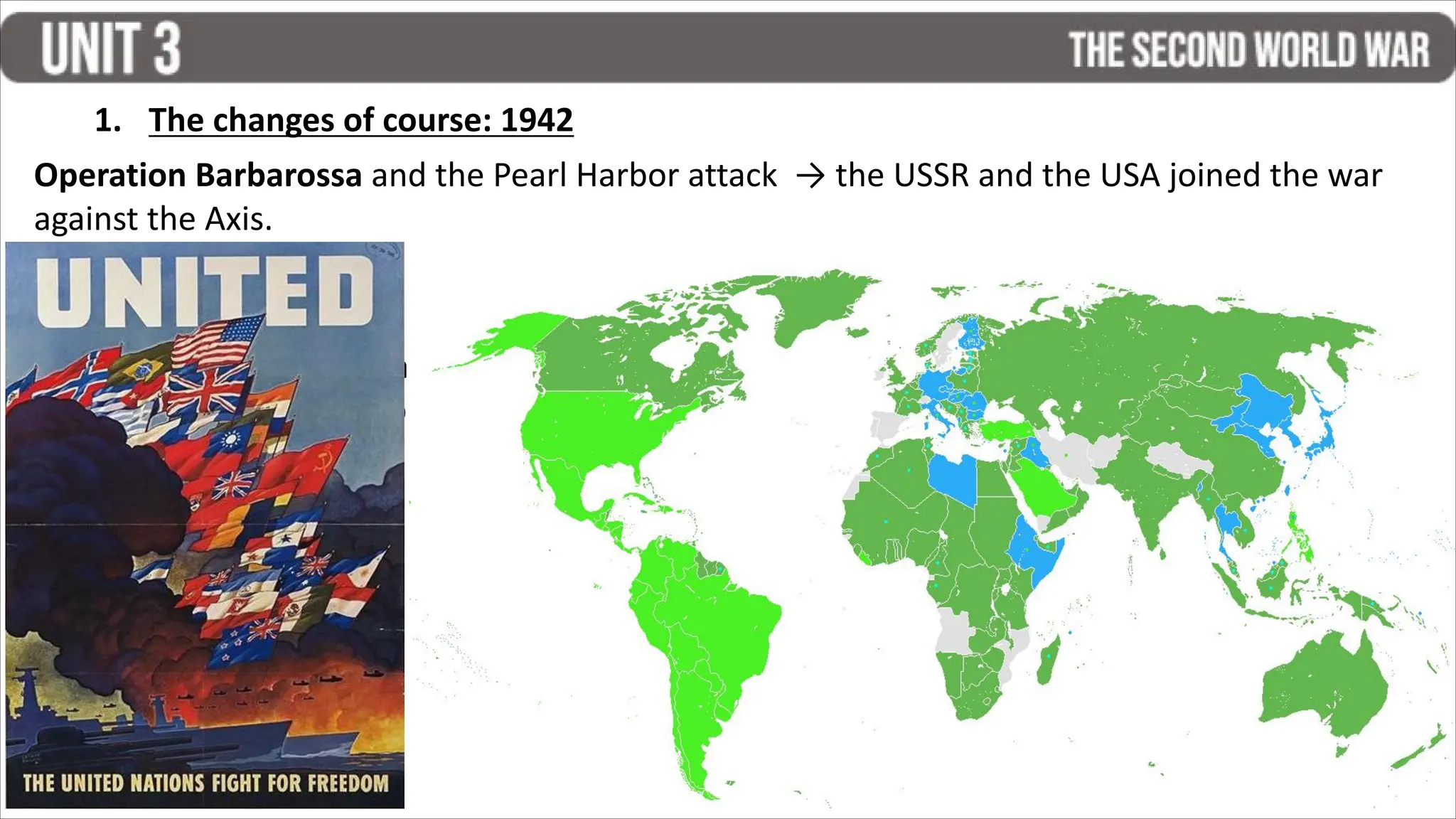
Operation Barbarossa and the Pearl Harbor attack → the USSR and the USA joined the war
against the Axis.
1. The changes of course: 1942
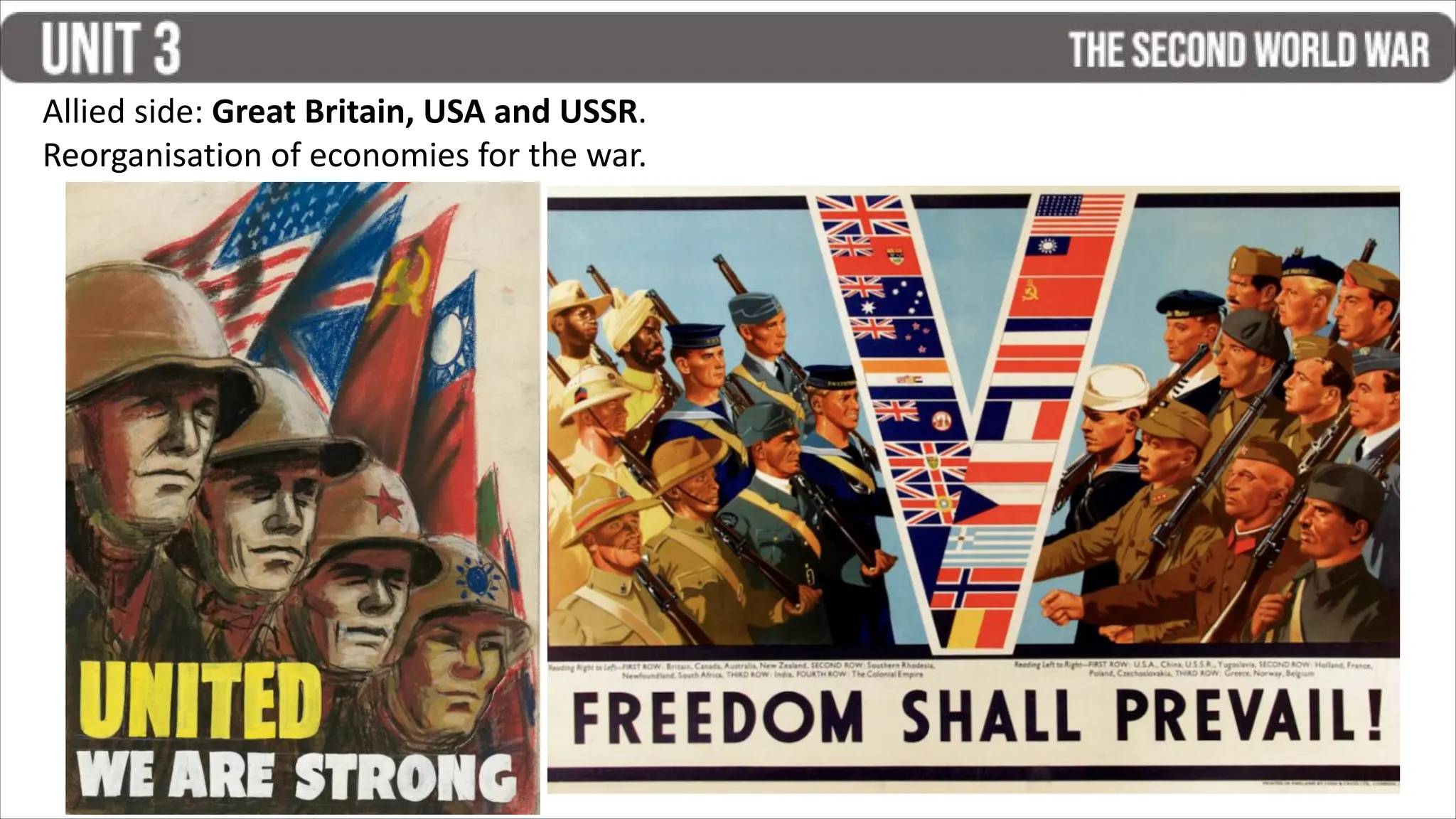
Allied side: Great Britain, USA and USSR.
Reorganisation of economies for the war.
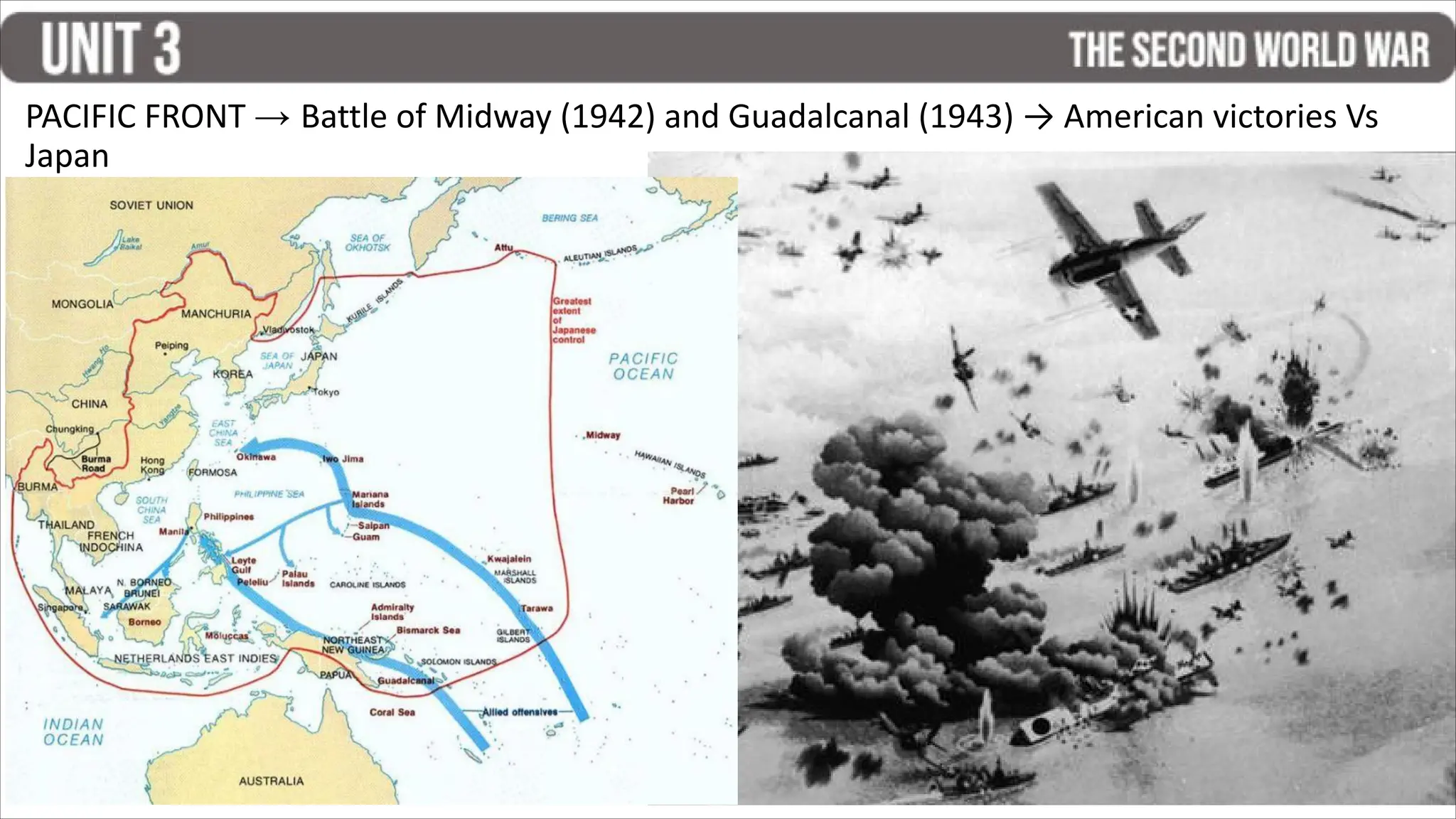
PACIFIC FRONT → Battle of Midway (1942) and Guadalcanal (1943) → American victories Vs
Japan
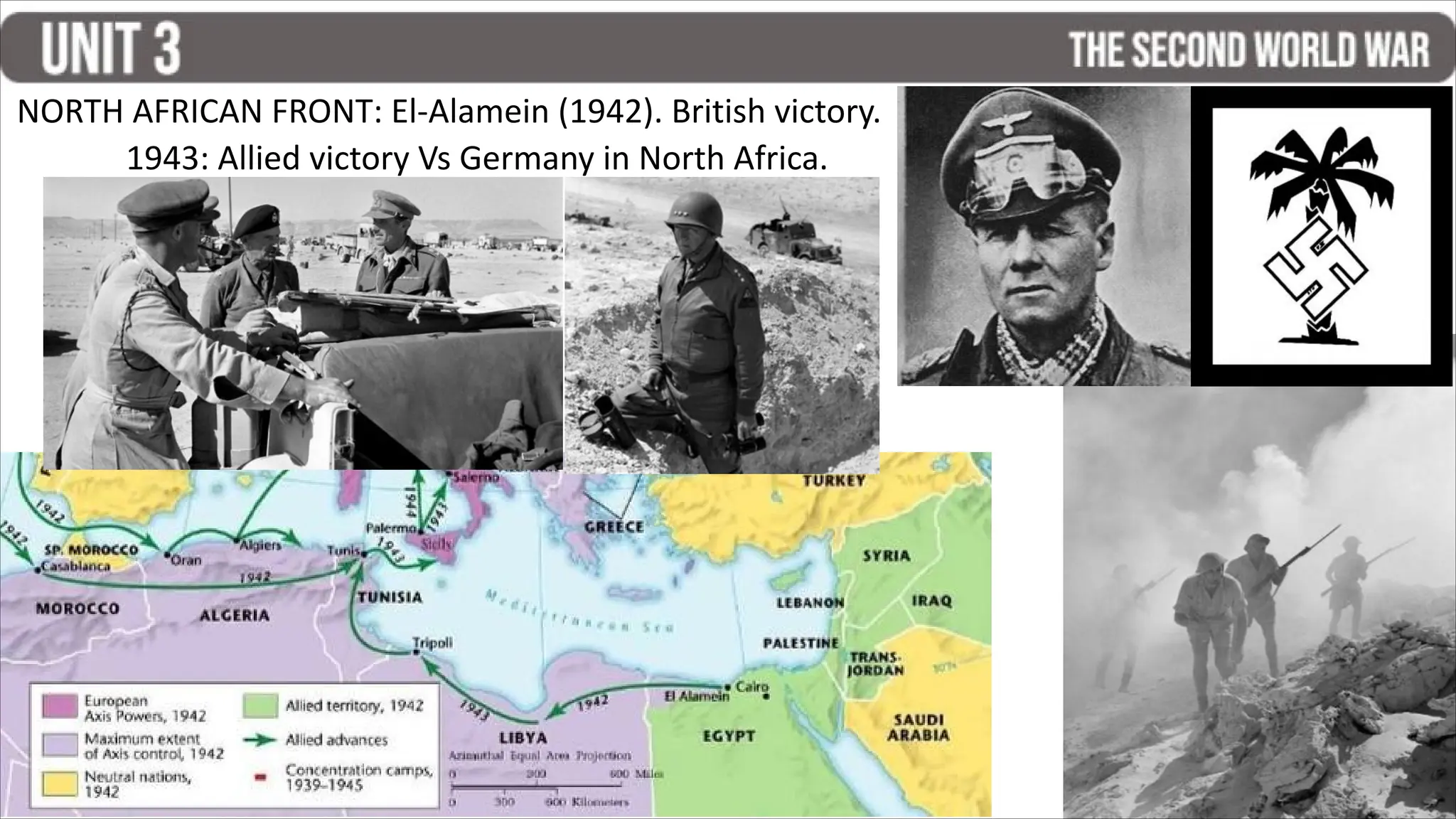
NORTH AFRICAN FRONT: El-Alamein (1942). British victory.
1943: Allied victory Vs Germany in North Africa.
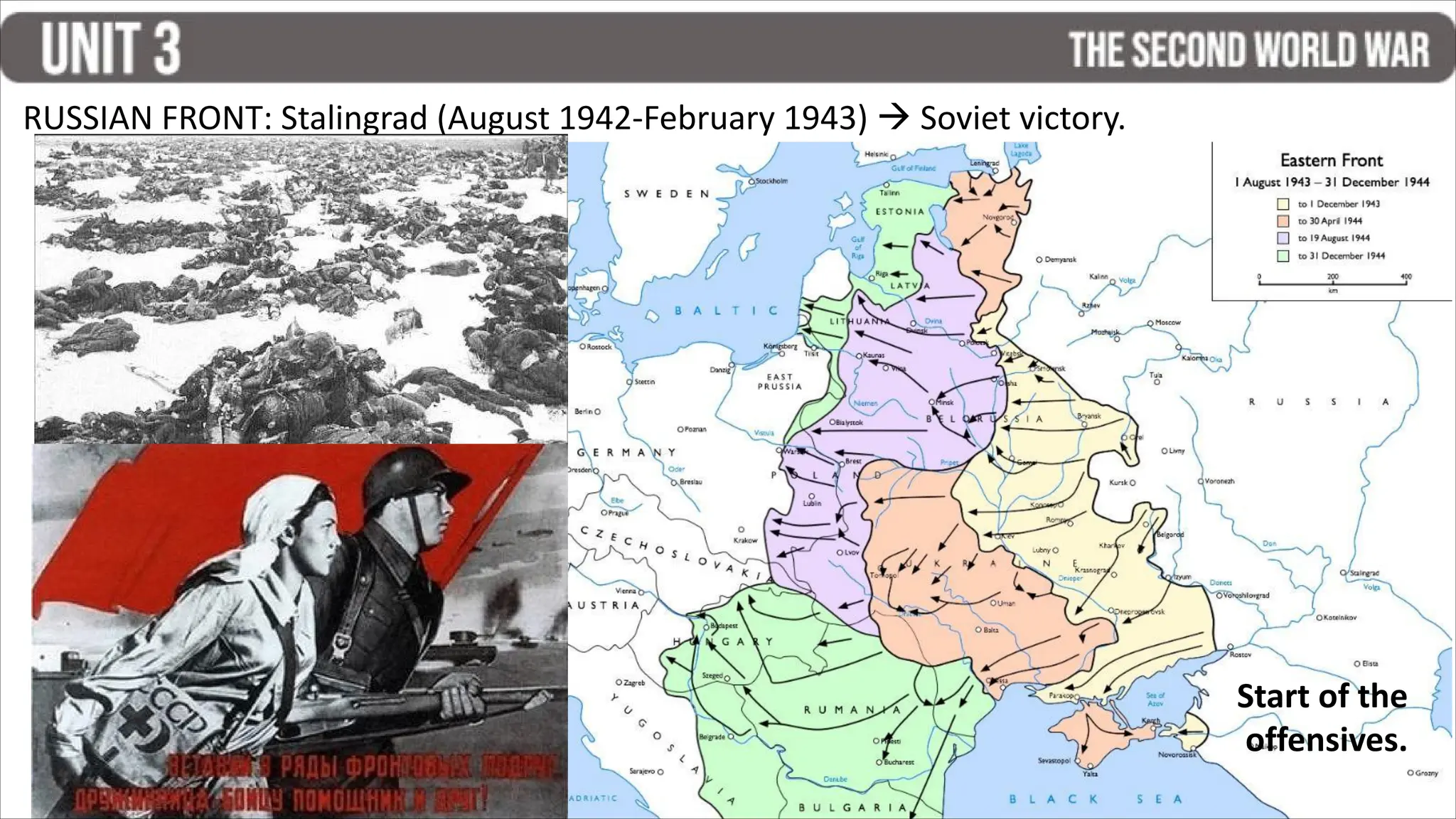
RUSSIAN FRONT: Stalingrad (August 1942-February 1943)  Soviet victory.
Start of the
offensives.
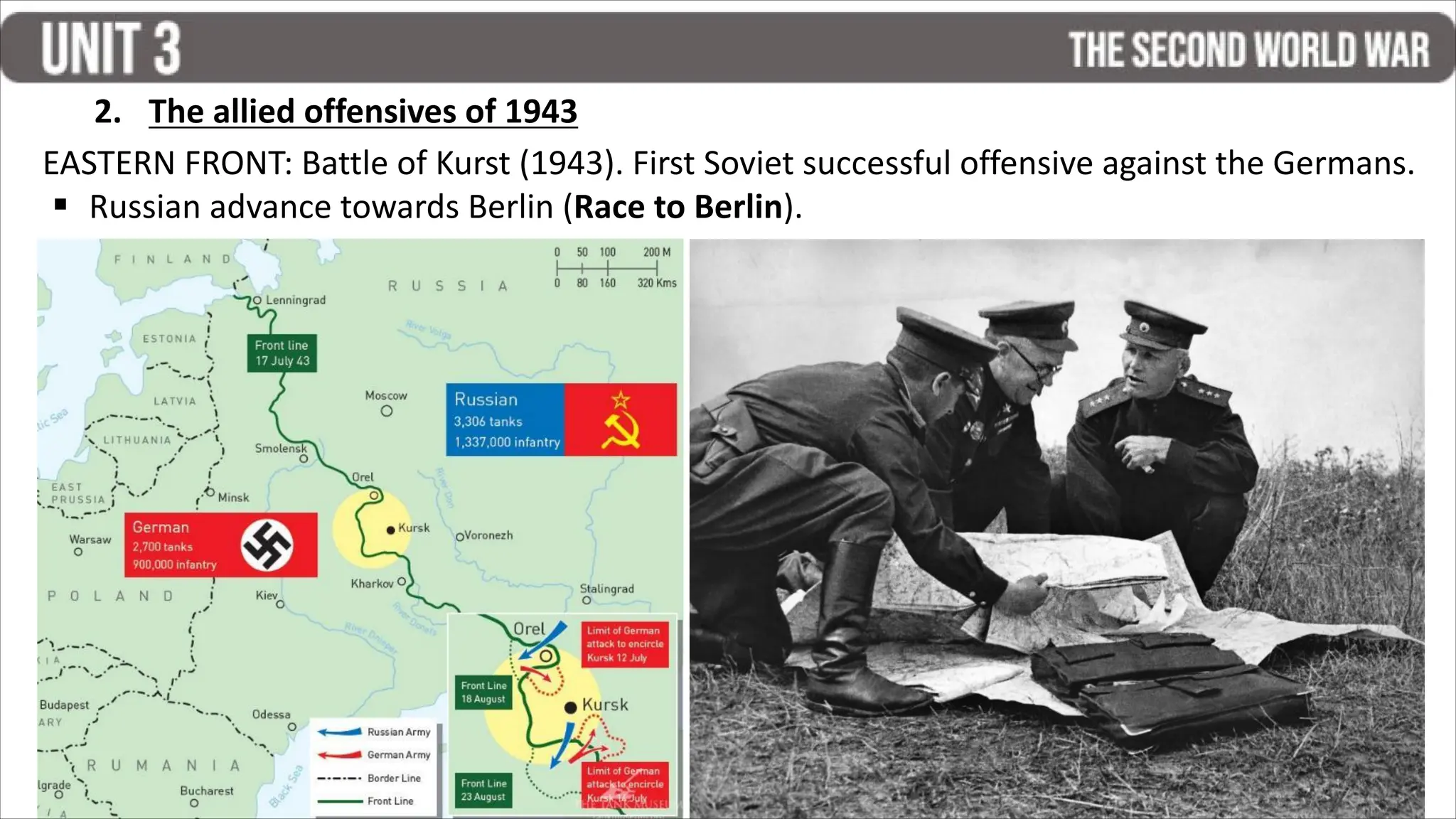
2. The allied offensives of 1943
EASTERN FRONT: Battle of Kurst (1943). First Soviet successful offensive against the Germans.
▪ Russian advance towards Berlin (Race to Berlin).
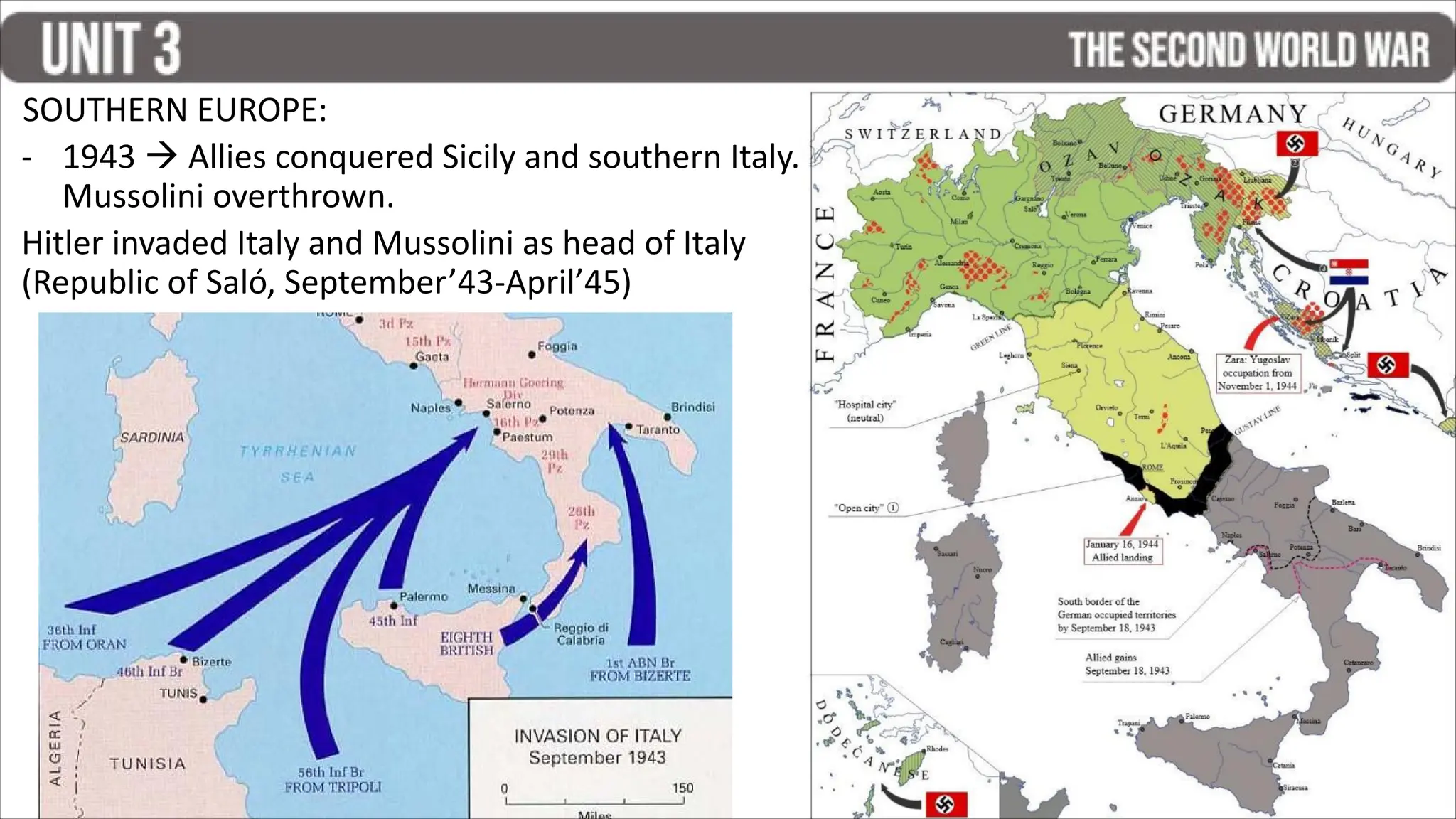
SOUTHERN EUROPE:
- 1943  Allies conquered Sicily and southern Italy.
Mussolini overthrown.
Hitler invaded Italy and Mussolini as head of Italy
(Republic of Saló, September’43-April’45)
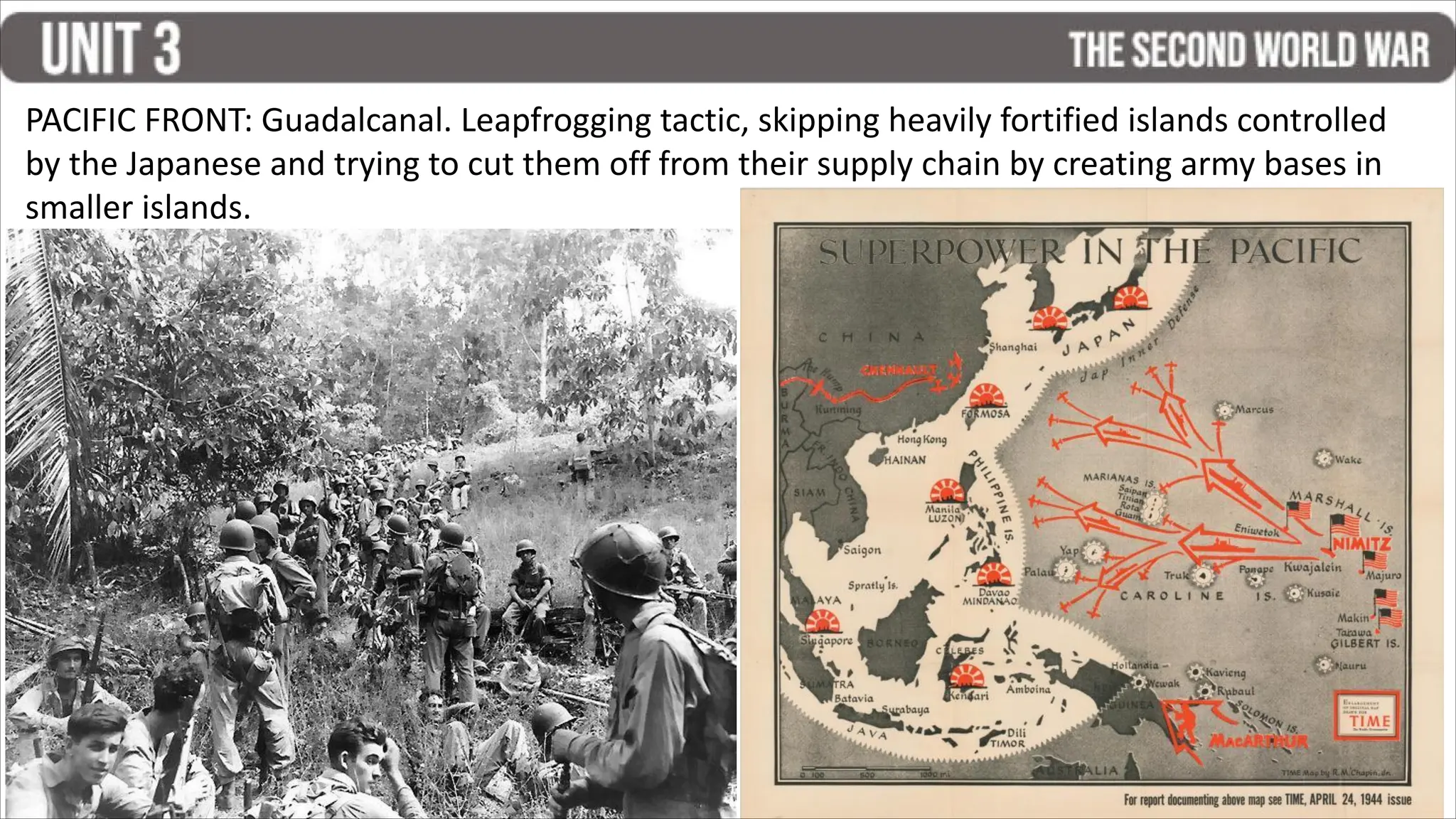
PACIFIC FRONT: Guadalcanal. Leapfrogging tactic, skipping heavily fortified islands controlled
by the Japanese and trying to cut them off from their supply chain by creating army bases in
smaller islands.
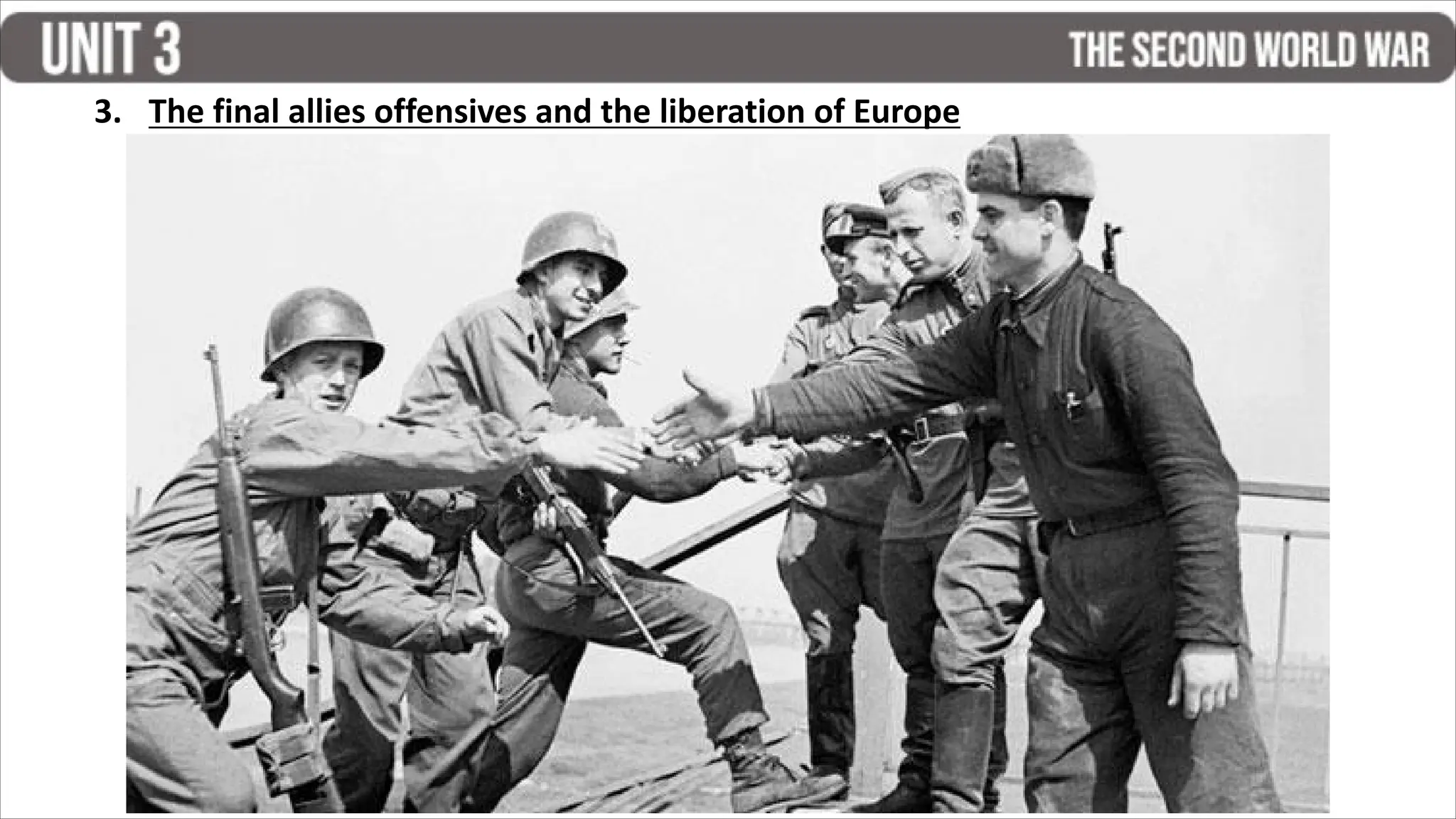
3. The final allies offensives and the liberation of Europe
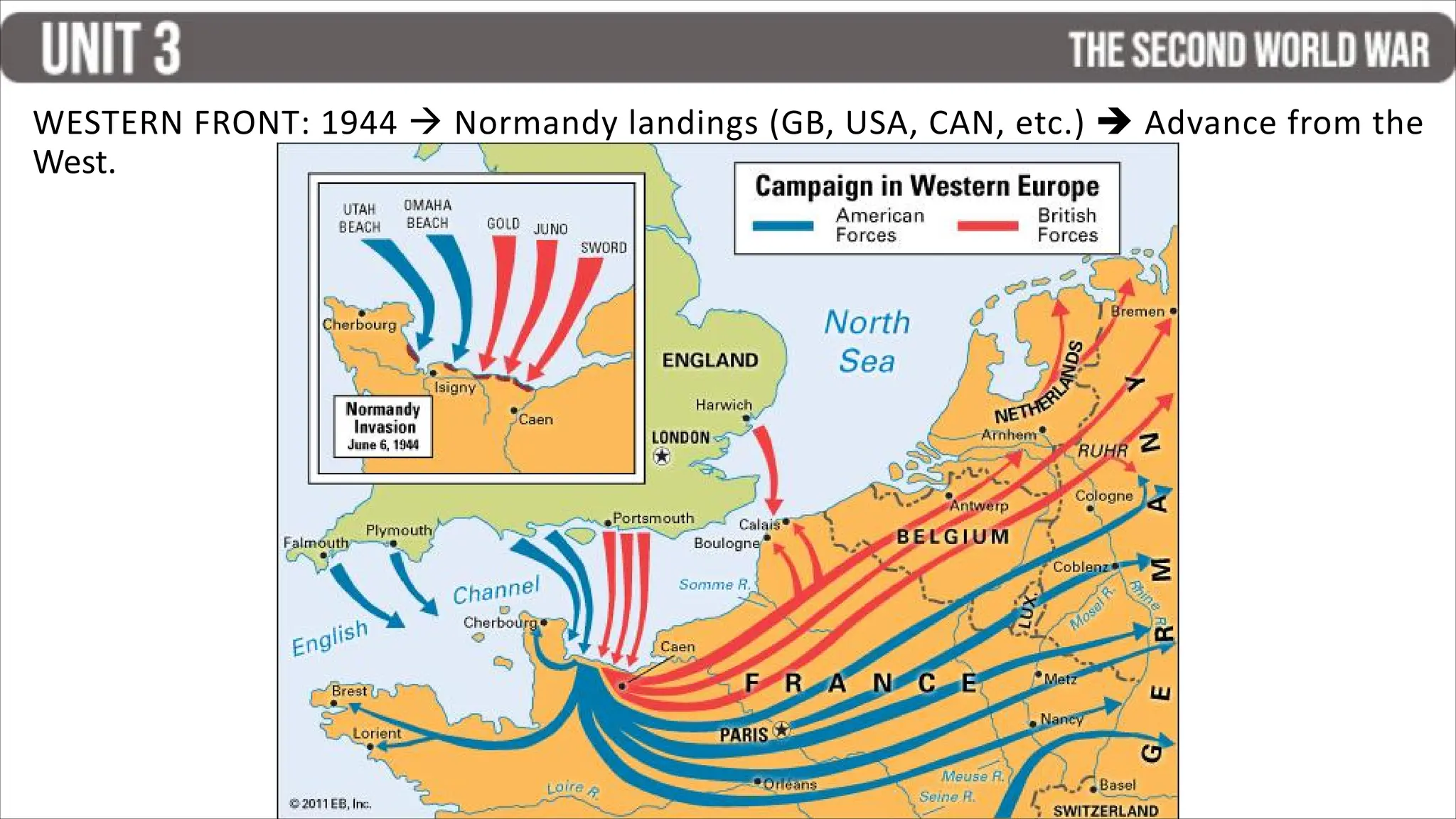
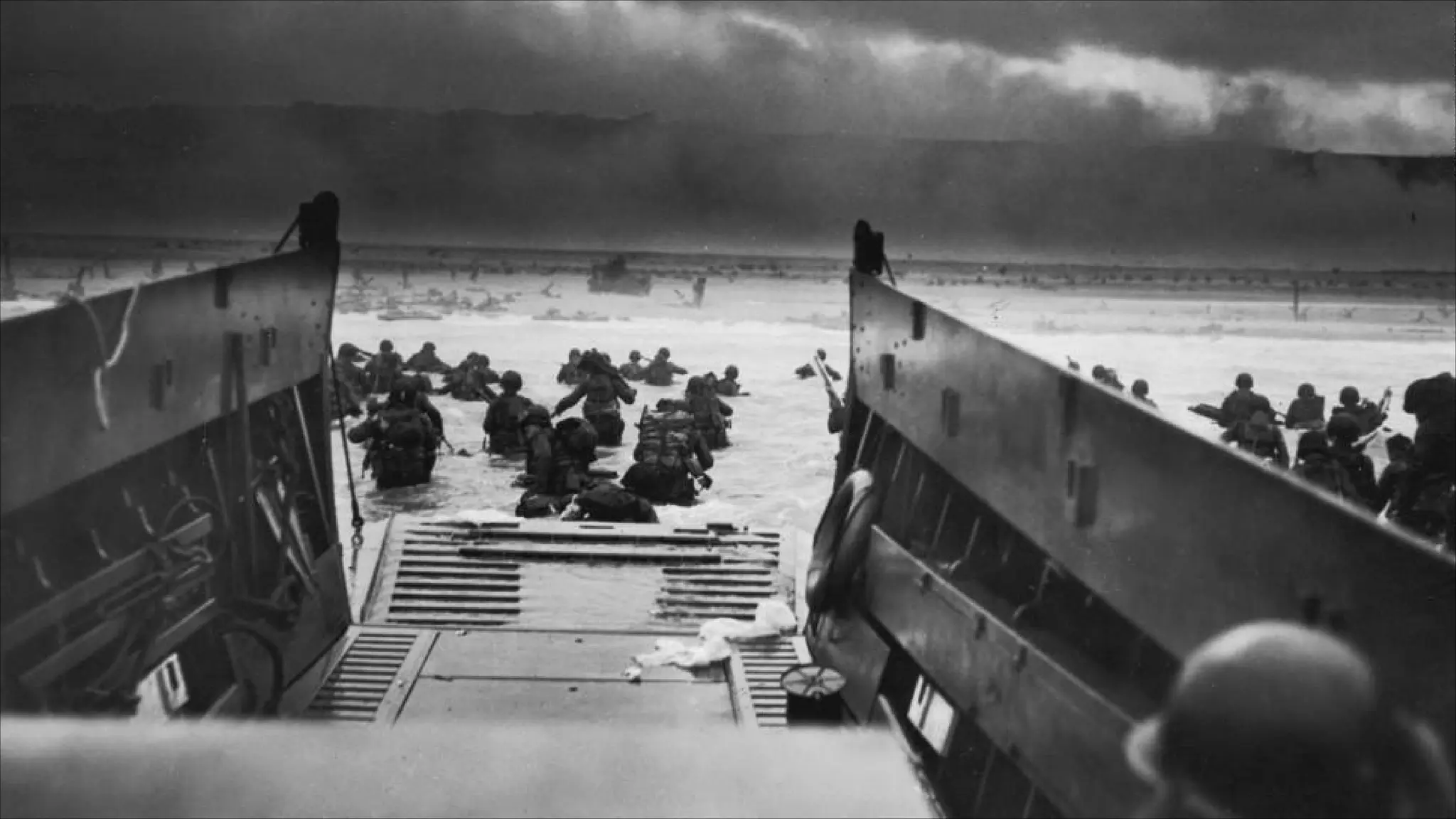
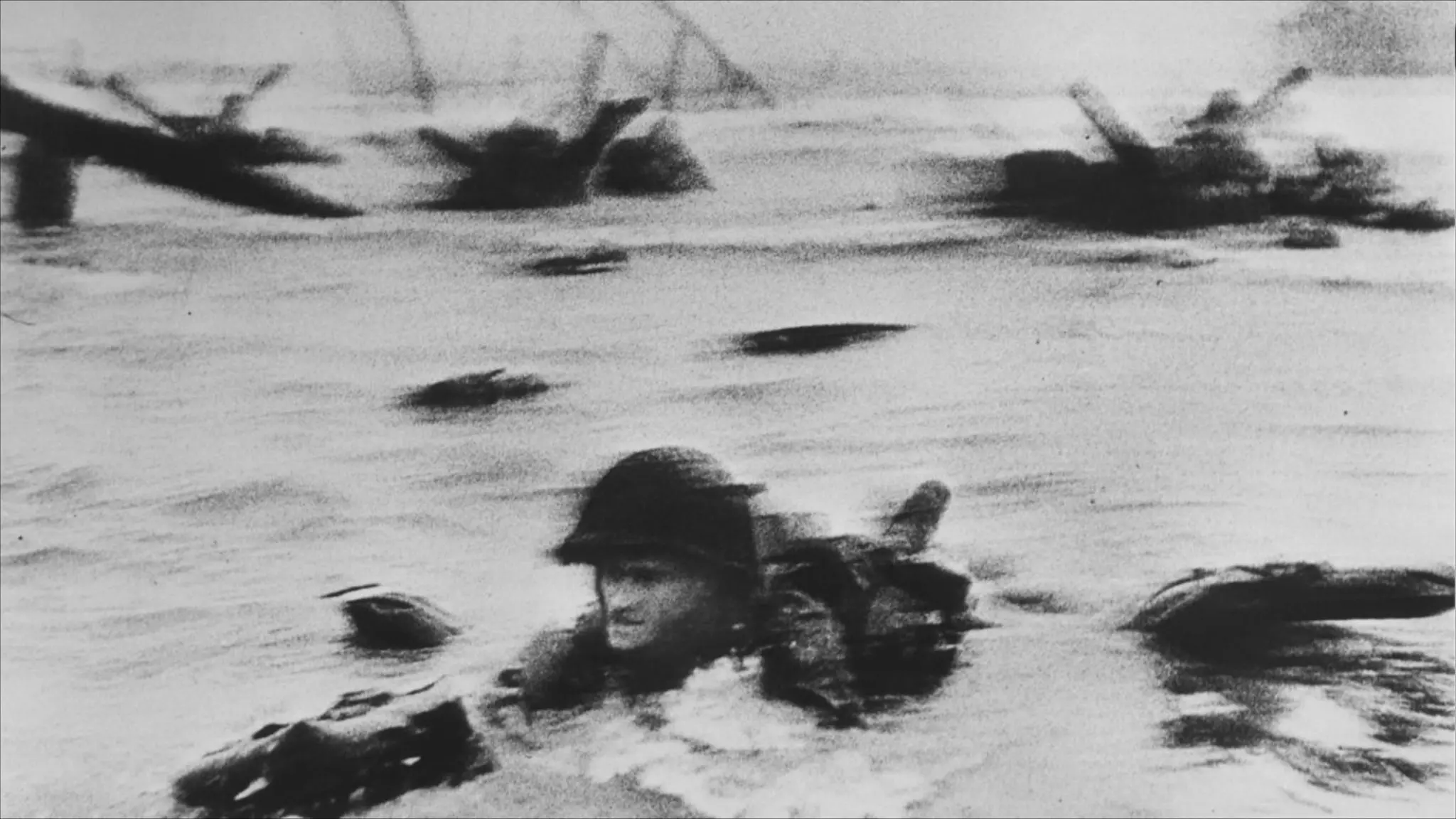
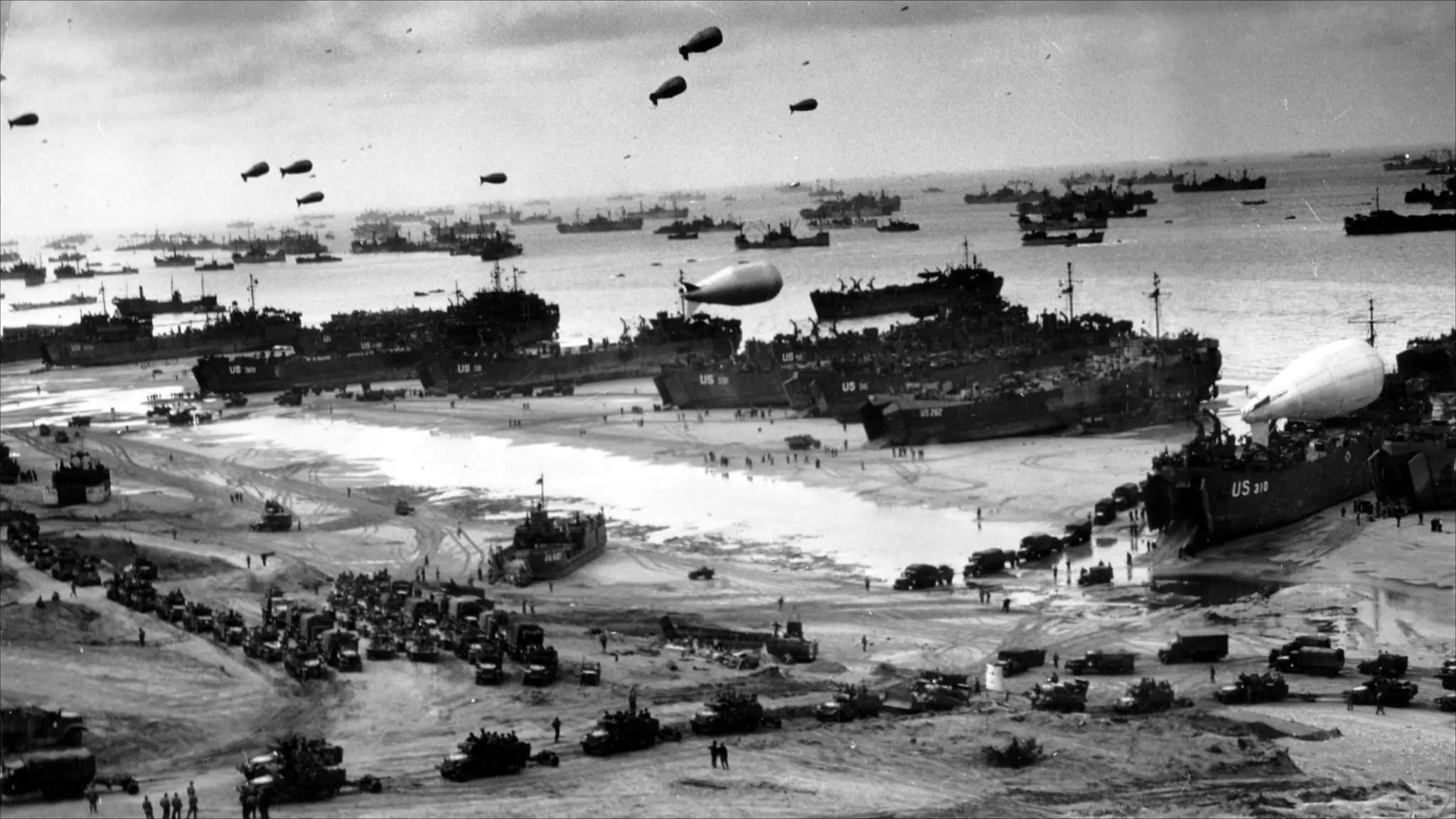
WESTERN FRONT: 1944  Normandy landings (GB, USA, CAN, etc.)  Advance from the
West.
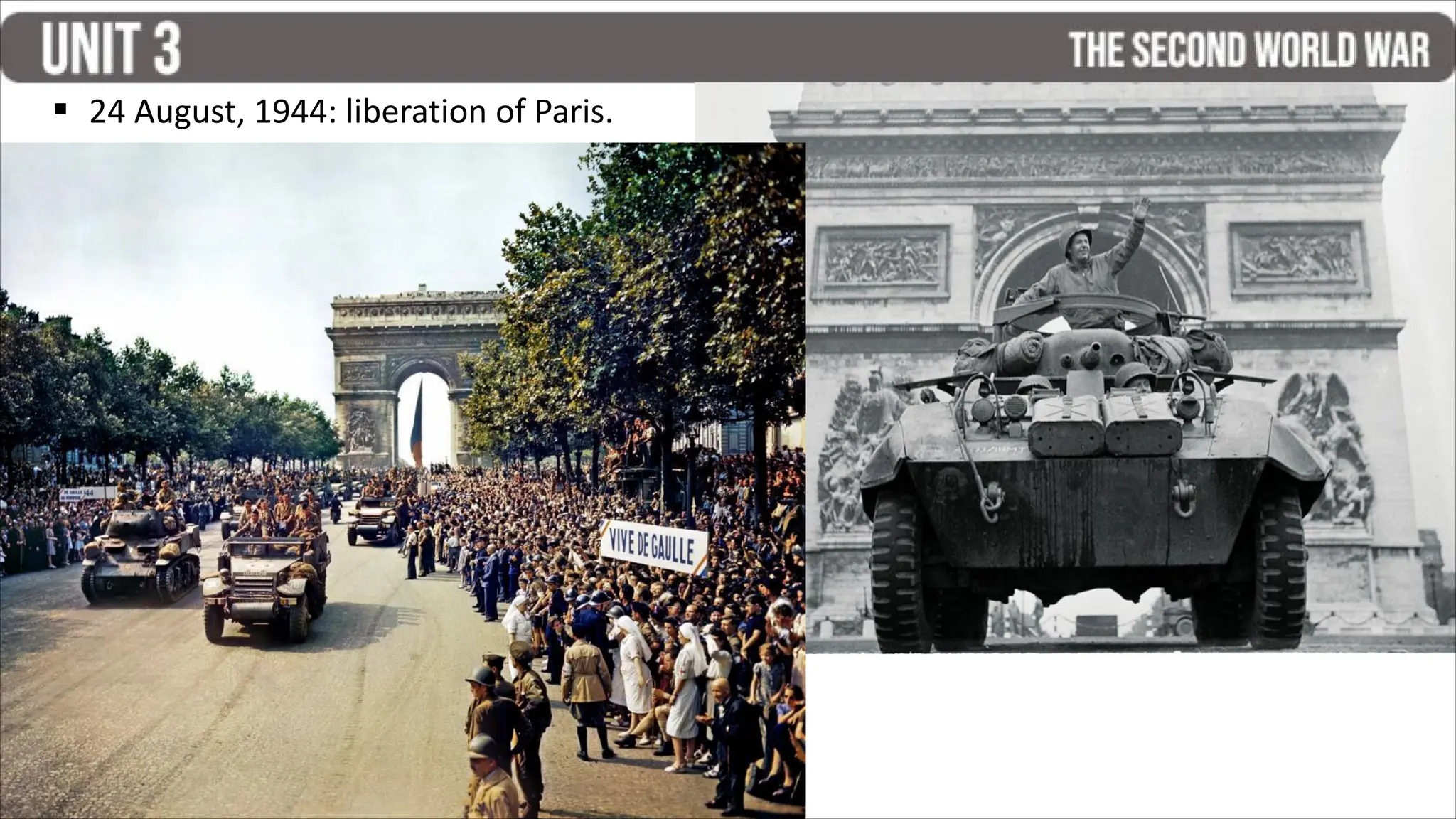
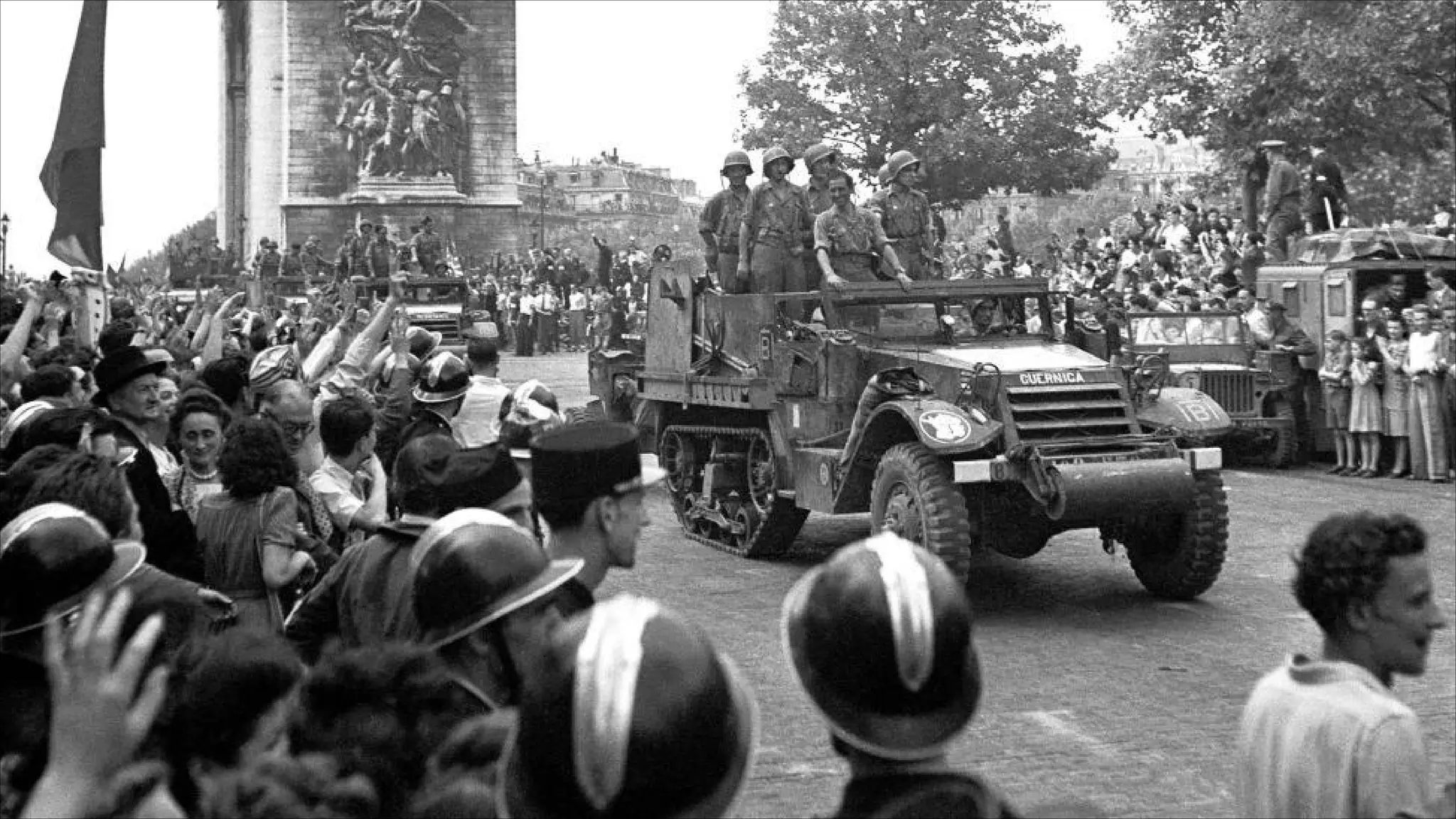
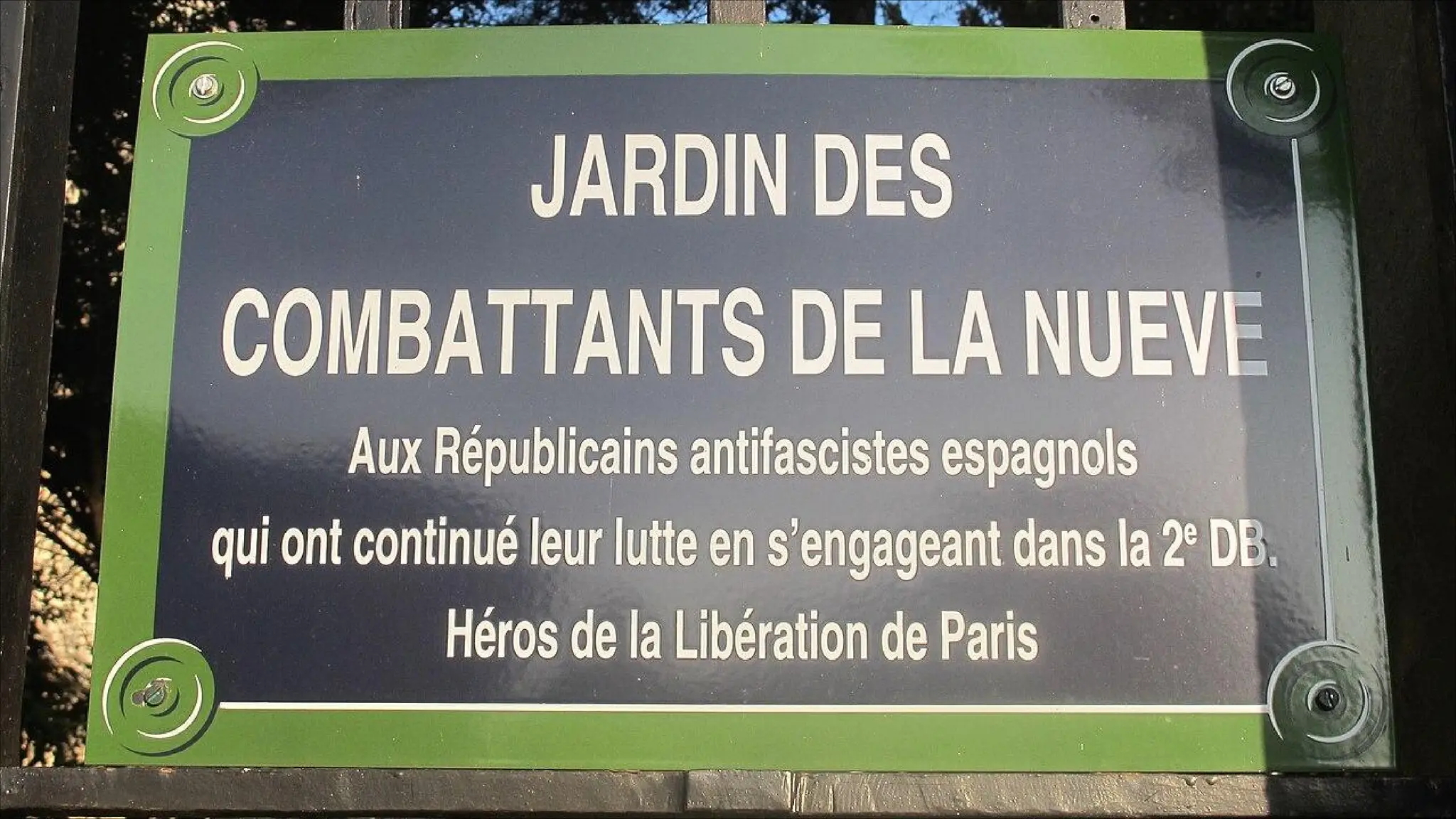
▪ 24 August, 1944: liberation of Paris.
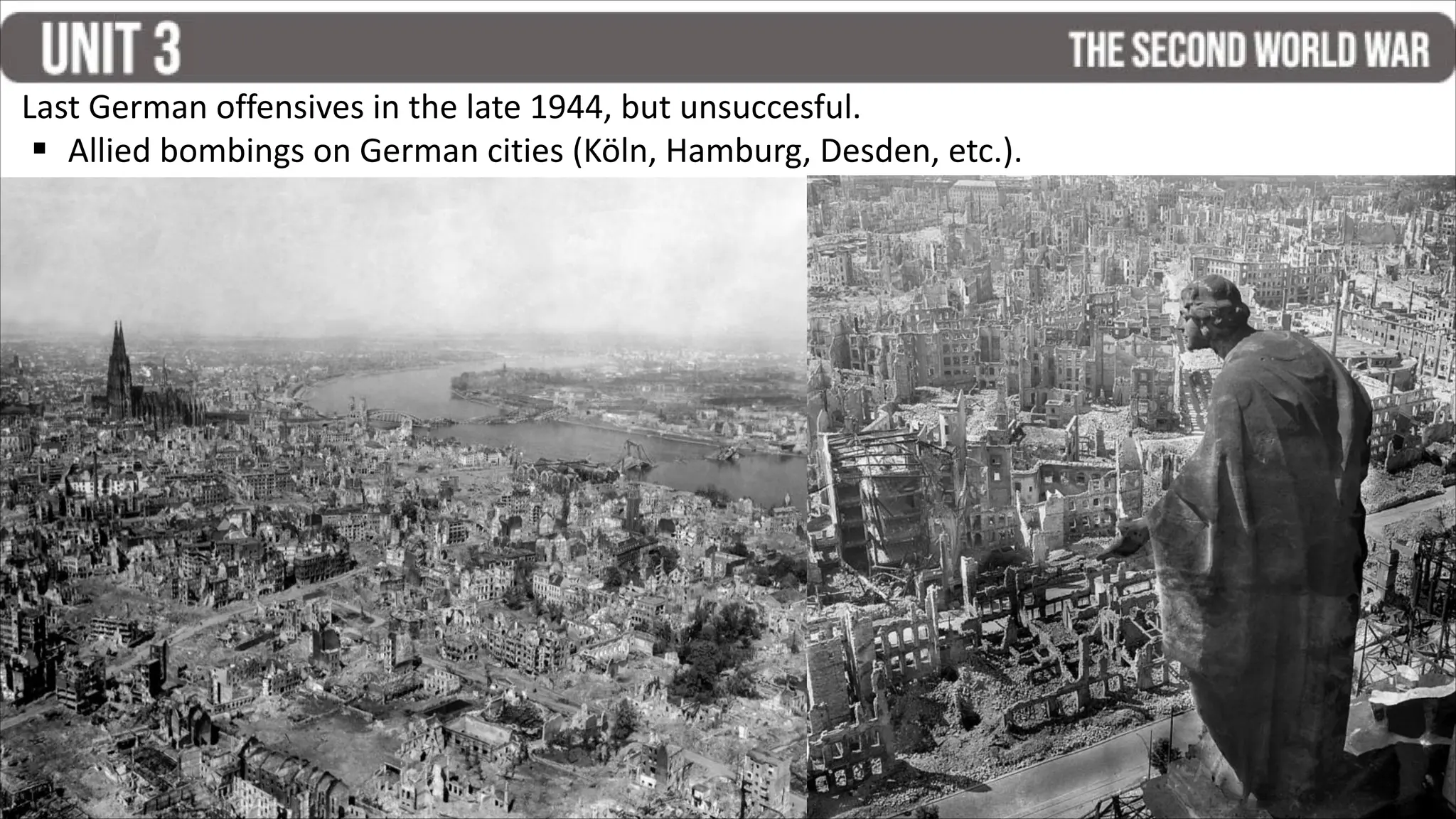
Last German offensives in the late 1944, but unsuccesful.
▪ Allied bombings on German cities (Köln, Hamburg, Desden, etc.).
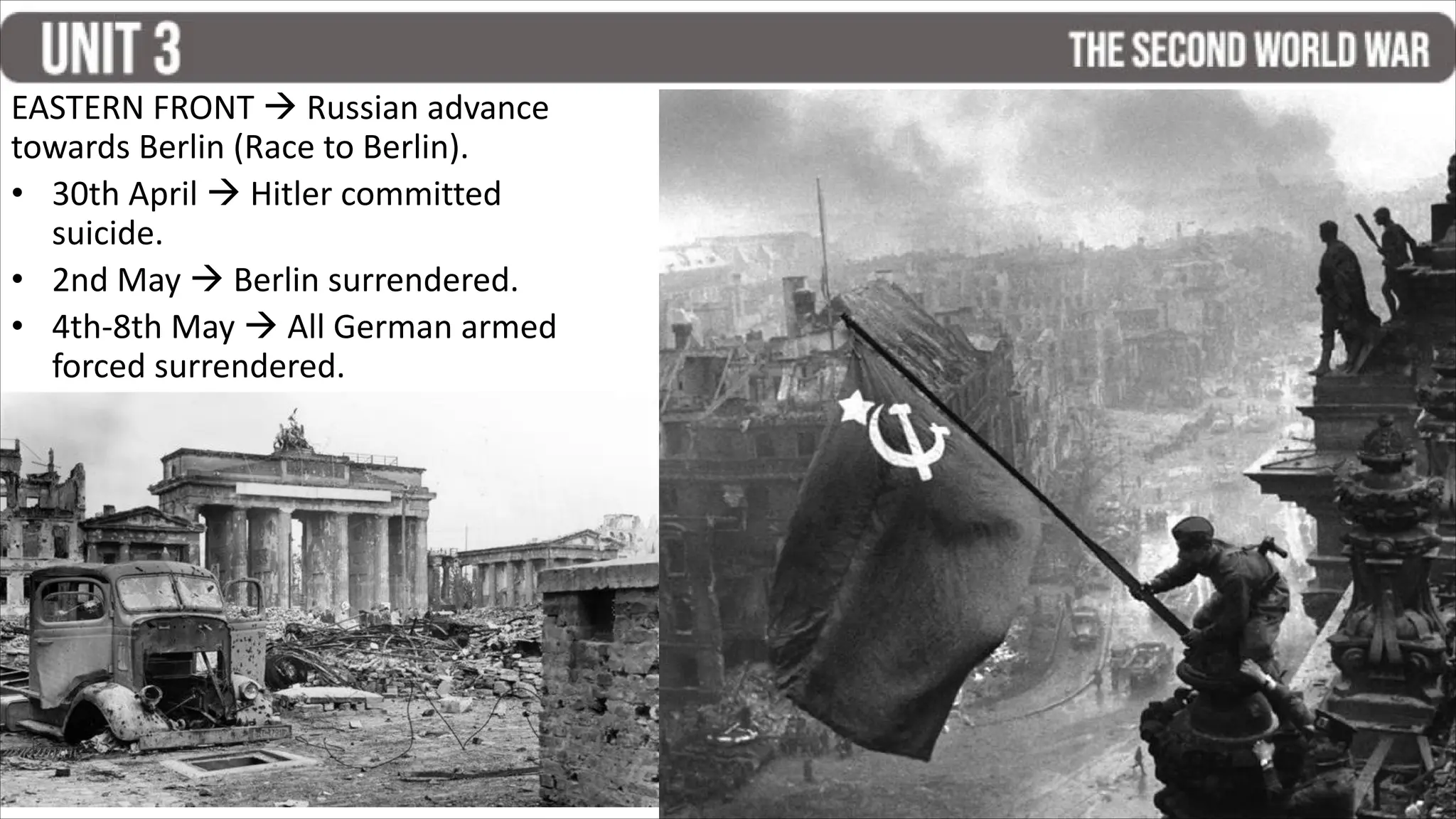
EASTERN FRONT  Russian advance
towards Berlin (Race to Berlin).
• 30th April  Hitler committed
suicide.
• 2nd May  Berlin surrendered.
• 4th-8th May  All German armed
forced surrendered.
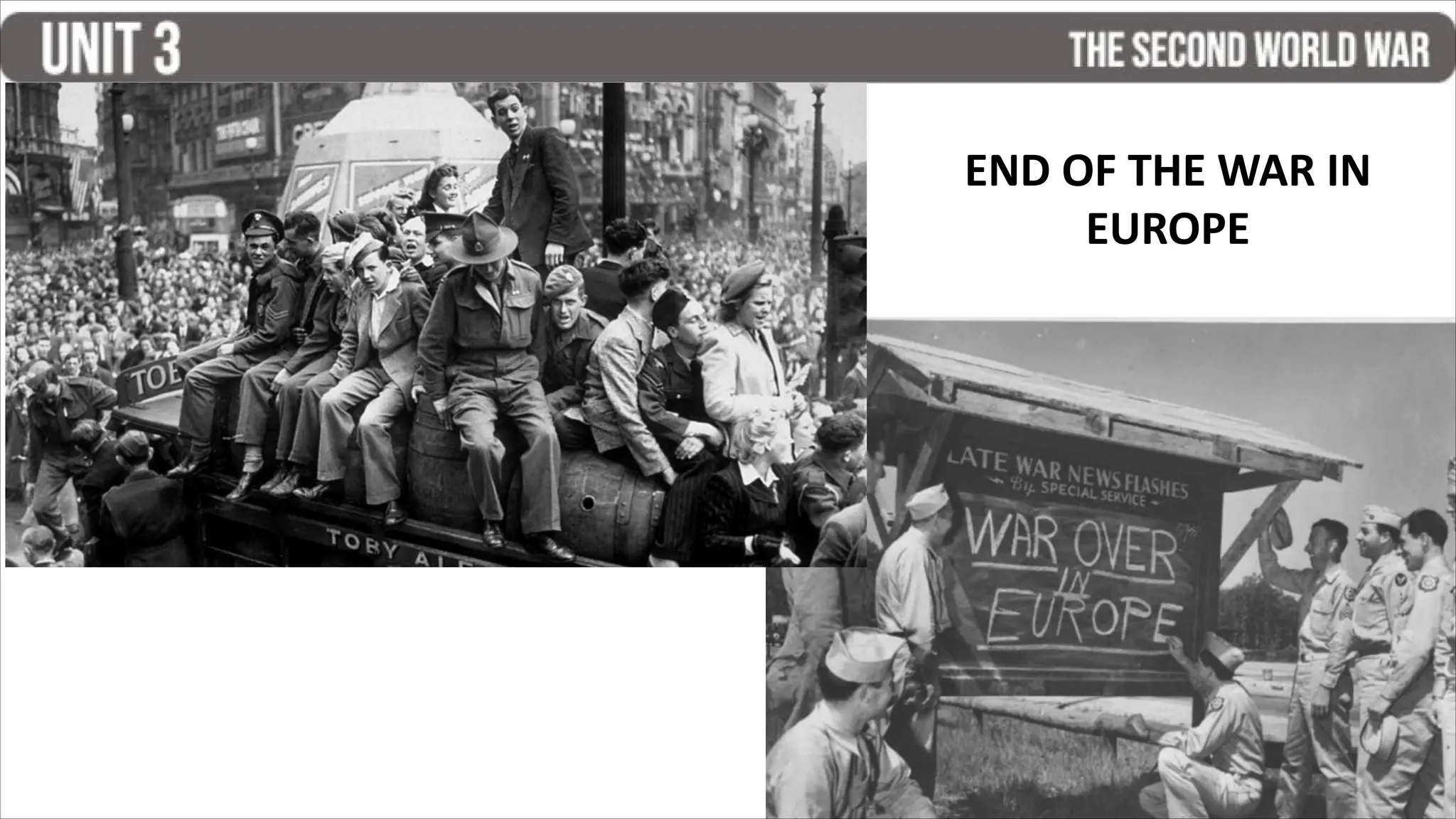
END OF THE WAR IN
EUROPE
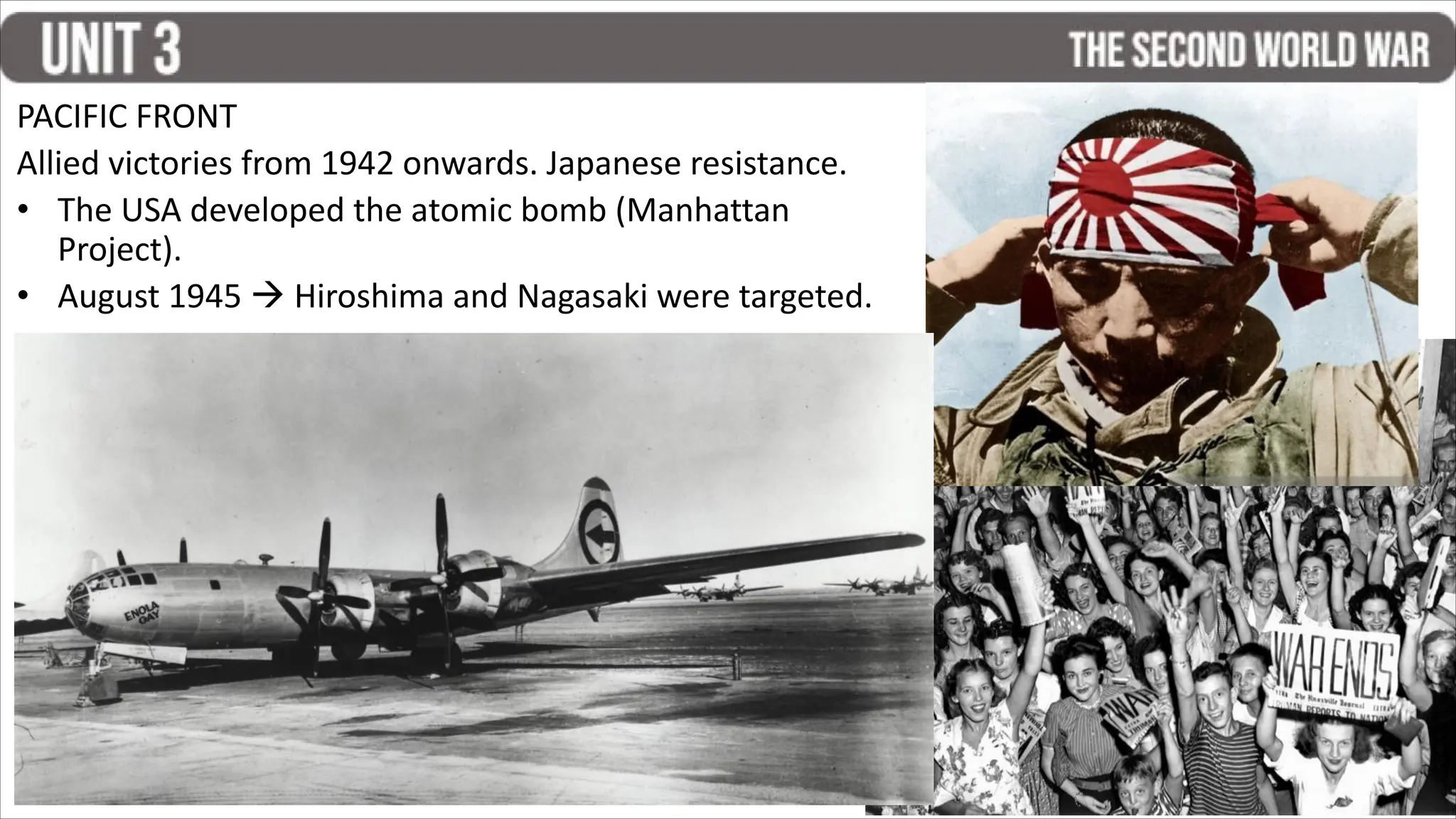
PACIFIC FRONT
Allied victories from 1942 onwards. Japanese resistance.
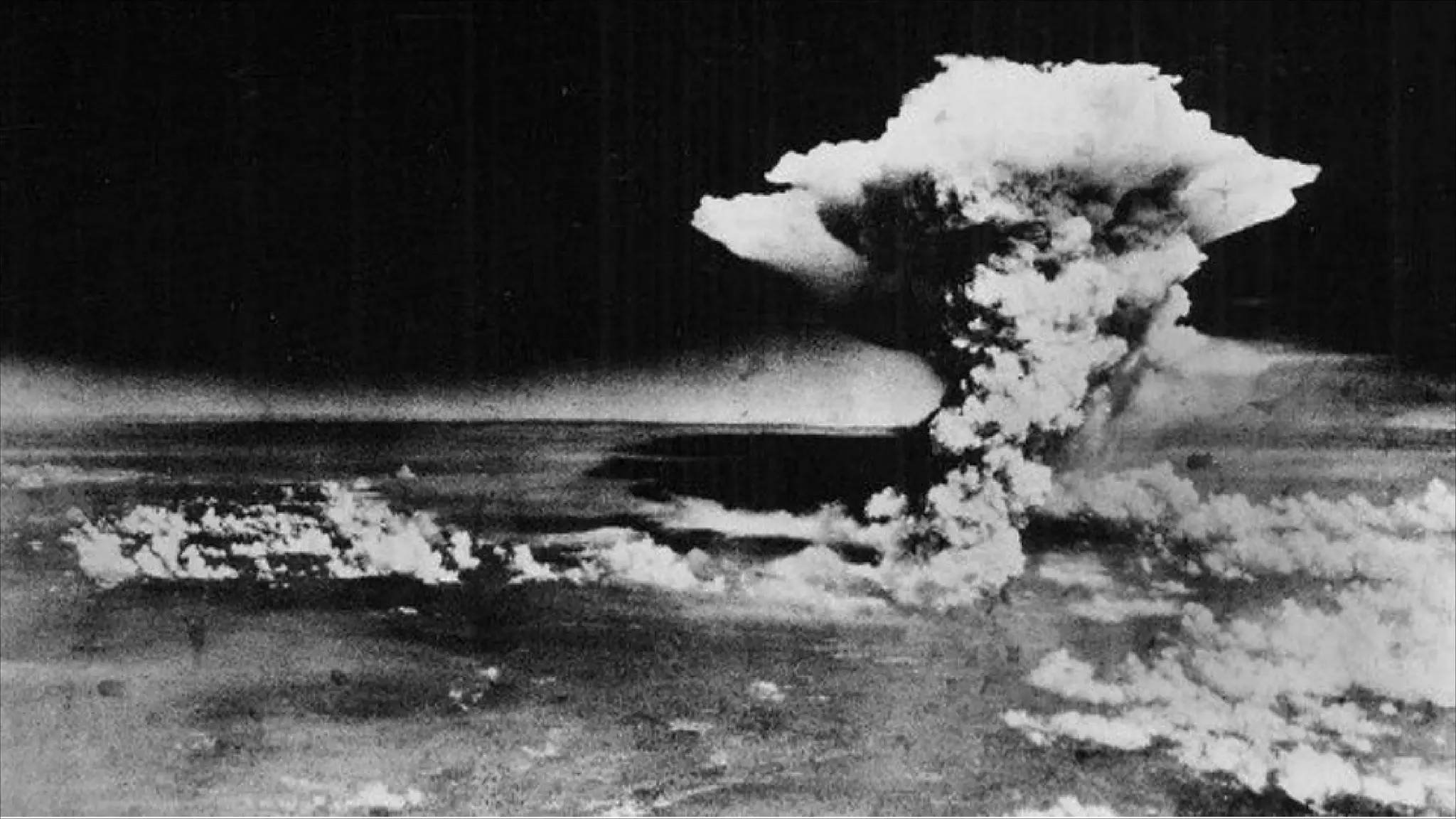
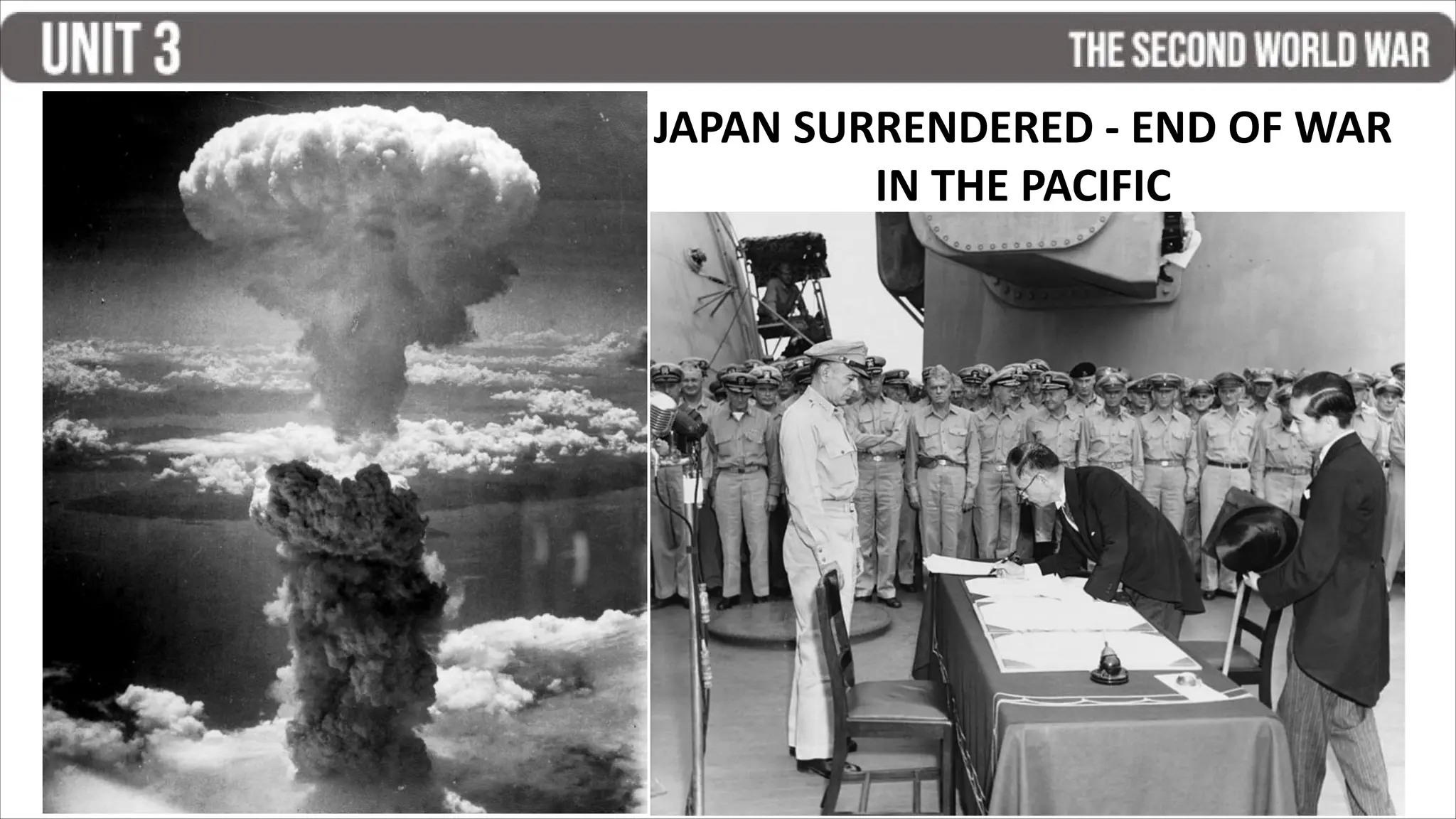
• The USA developed the atomic bomb (Manhattan
Project).
• August 1945  Hiroshima and Nagasaki were targeted.
JAPAN SURRENDERED - END OF WAR
IN THE PACIFIC
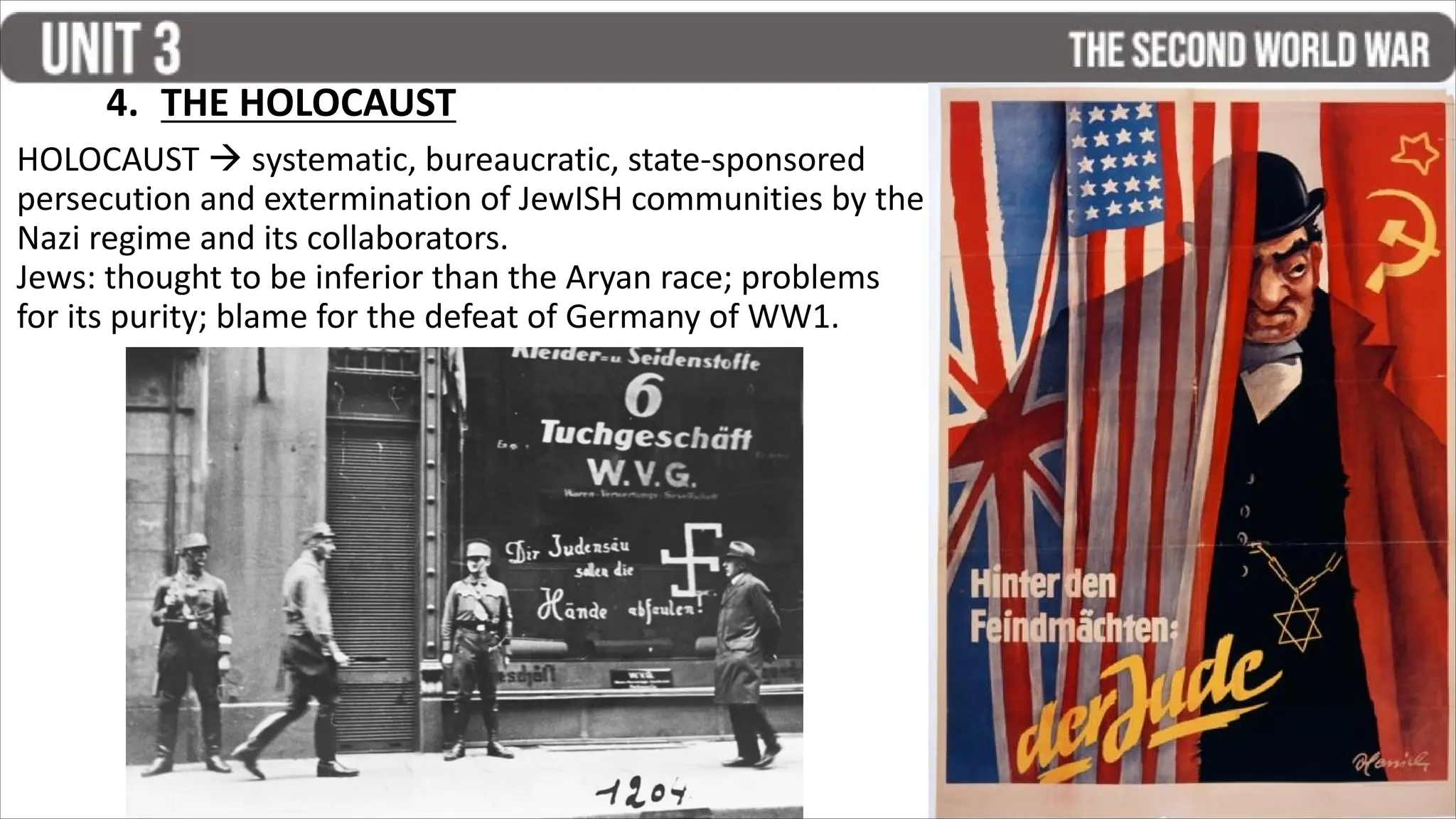
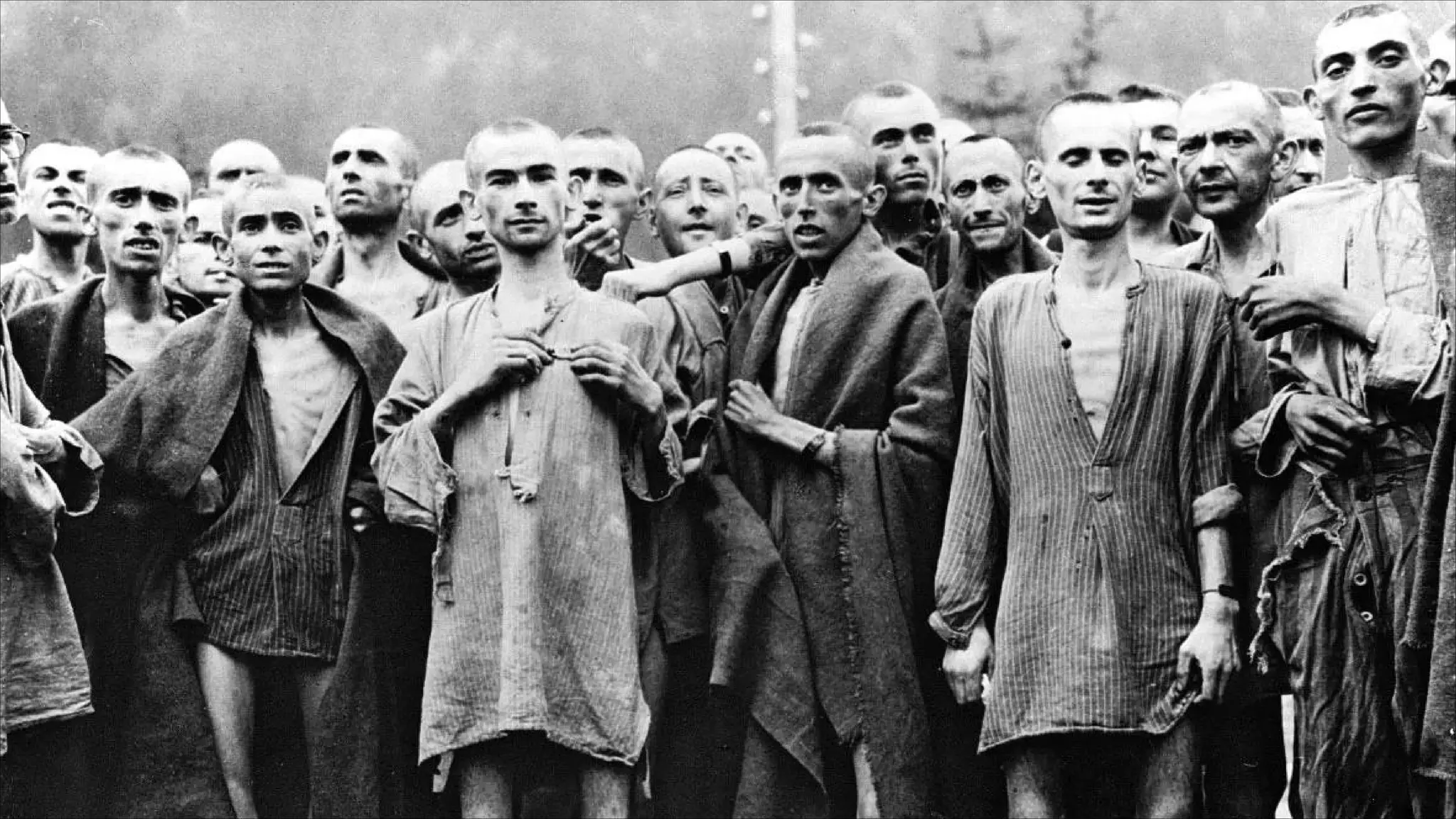
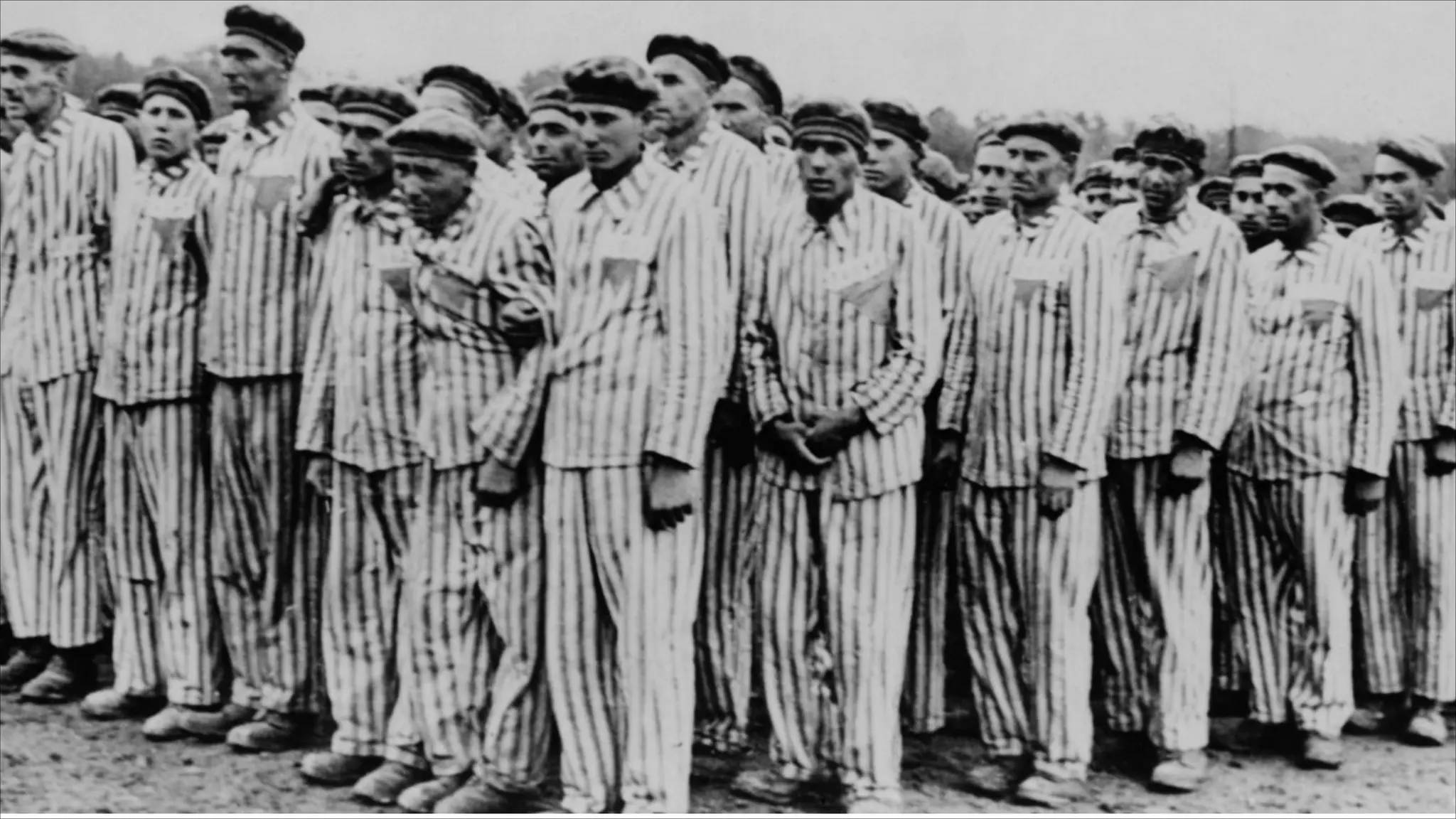
HOLOCAUST  systematic, bureaucratic, state-sponsored
persecution and extermination of JewISH communities by the
Nazi regime and its collaborators.
Jews: thought to be inferior than the Aryan race; problems
for its purity; blame for the defeat of Germany of WW1.
4. THE HOLOCAUST
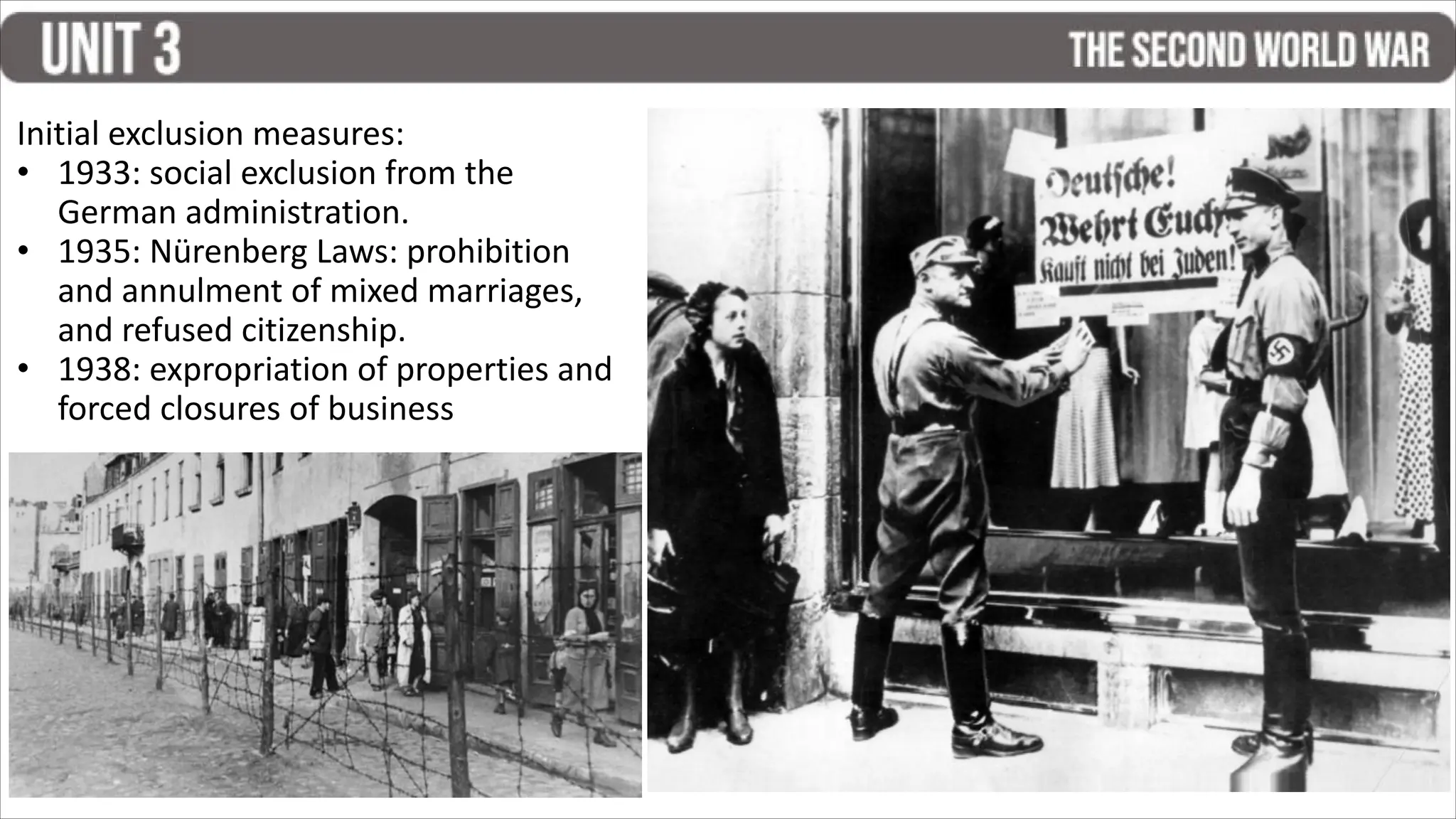
Initial exclusion measures:
• 1933: social exclusion from the
German administration.
• 1935: Nürenberg Laws: prohibition
and annulment of mixed marriages,
and refused citizenship.
• 1938: expropriation of properties and
forced closures of business
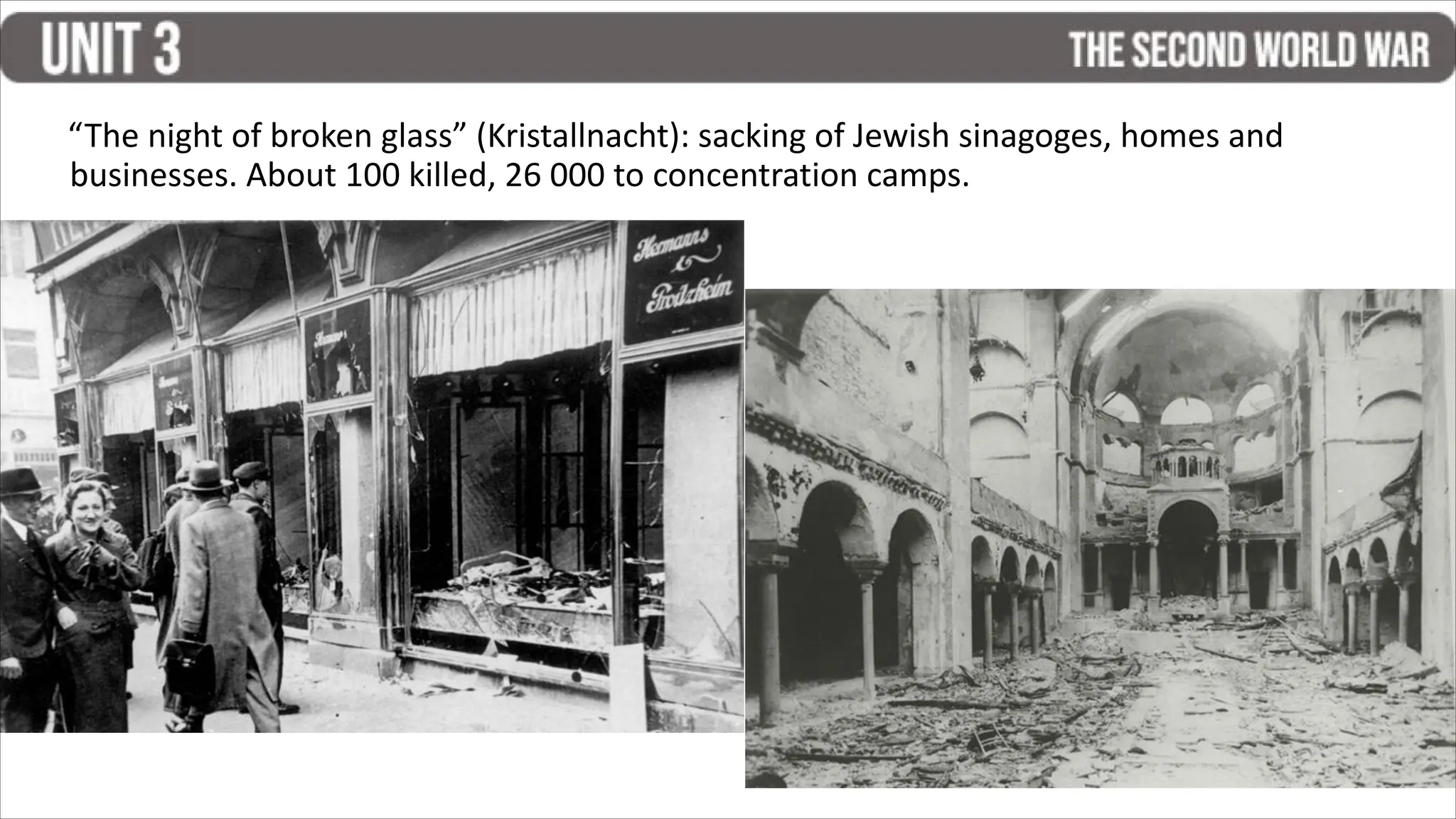
“The night of broken glass” (Kristallnacht): sacking of Jewish sinagoges, homes and
businesses. About 100 killed, 26 000 to concentration camps.
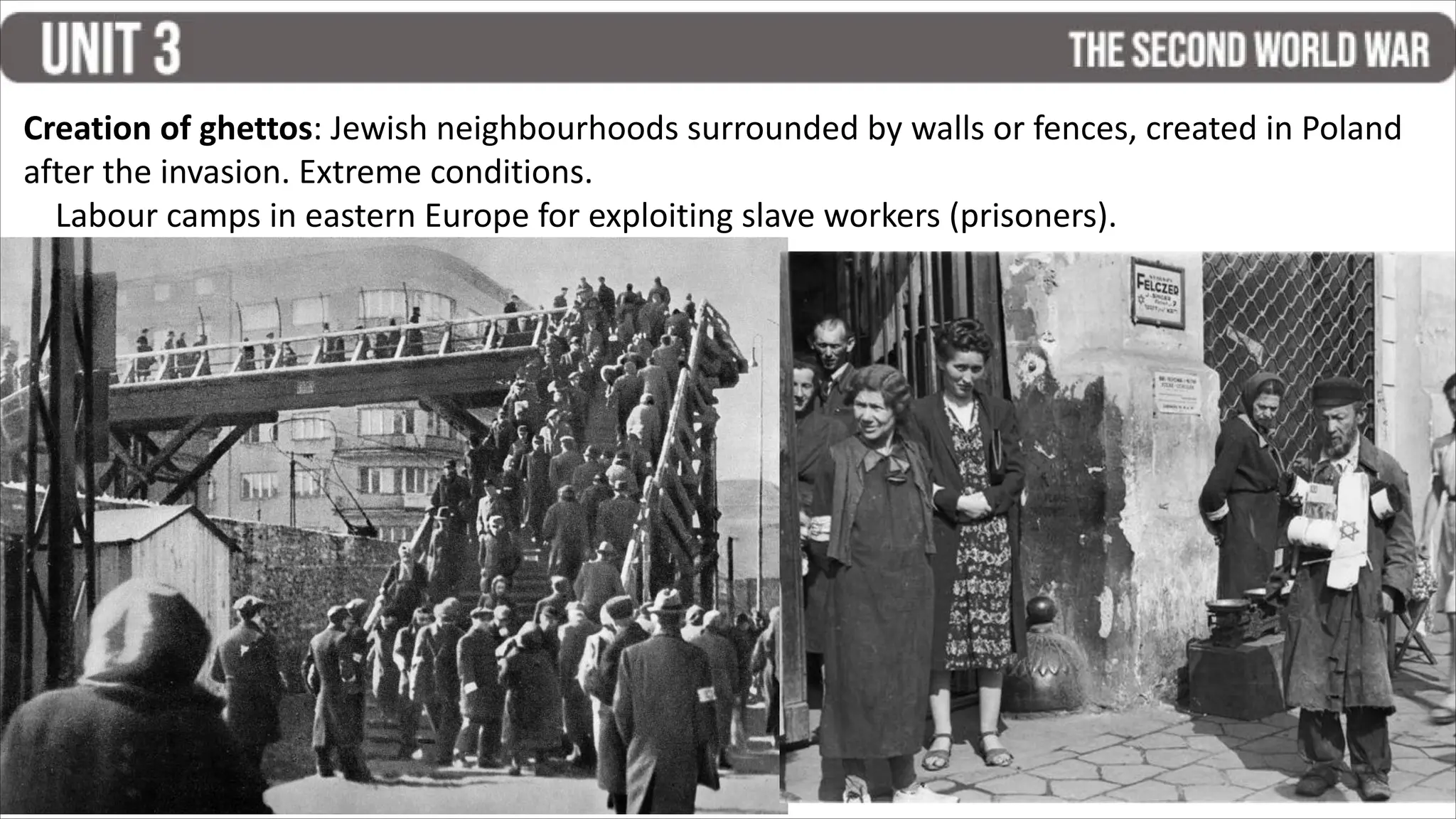
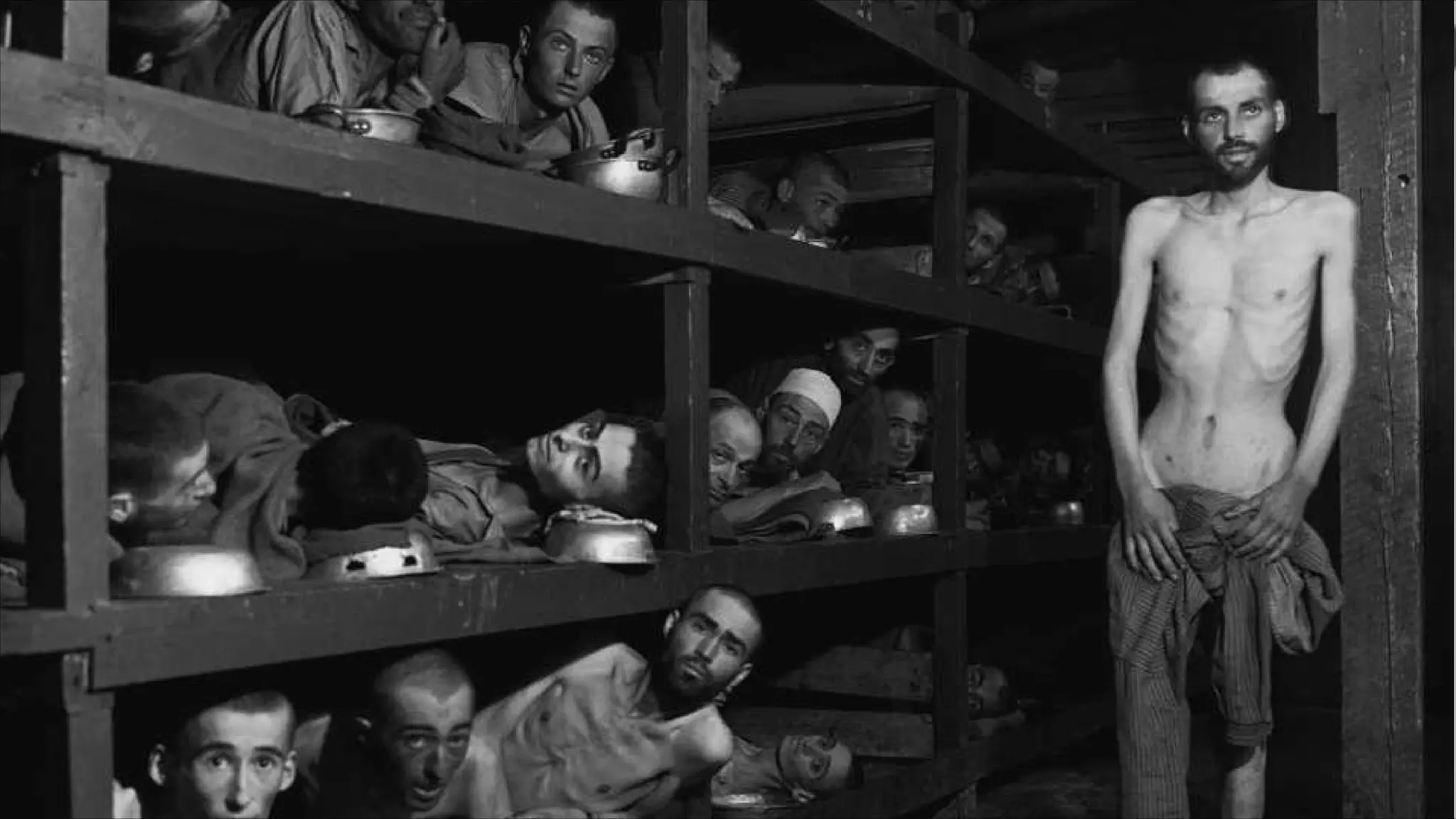
Creation of ghettos: Jewish neighbourhoods surrounded by walls or fences, created in Poland
after the invasion. Extreme conditions.
Labour camps in eastern Europe for exploiting slave workers (prisoners).
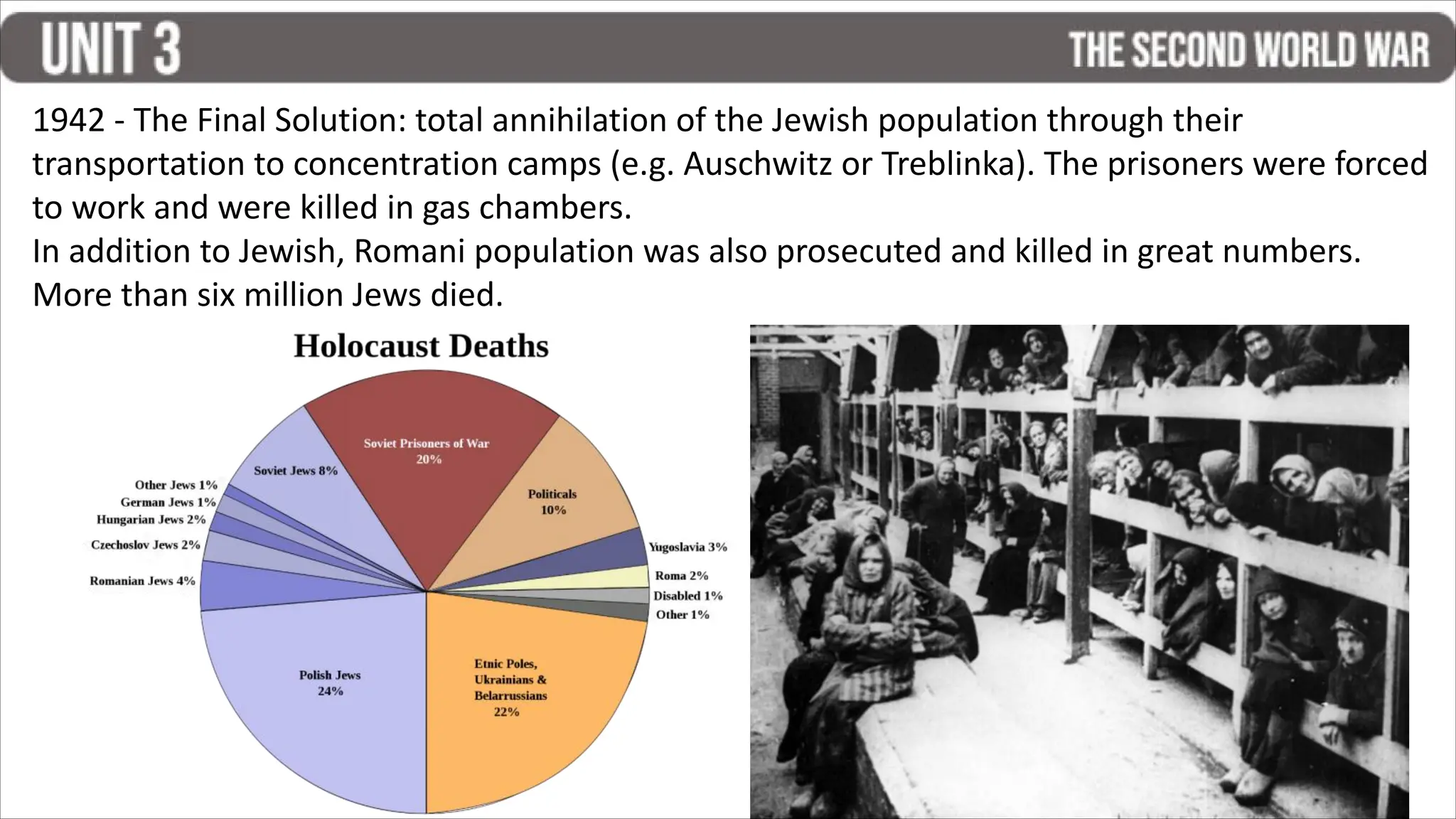
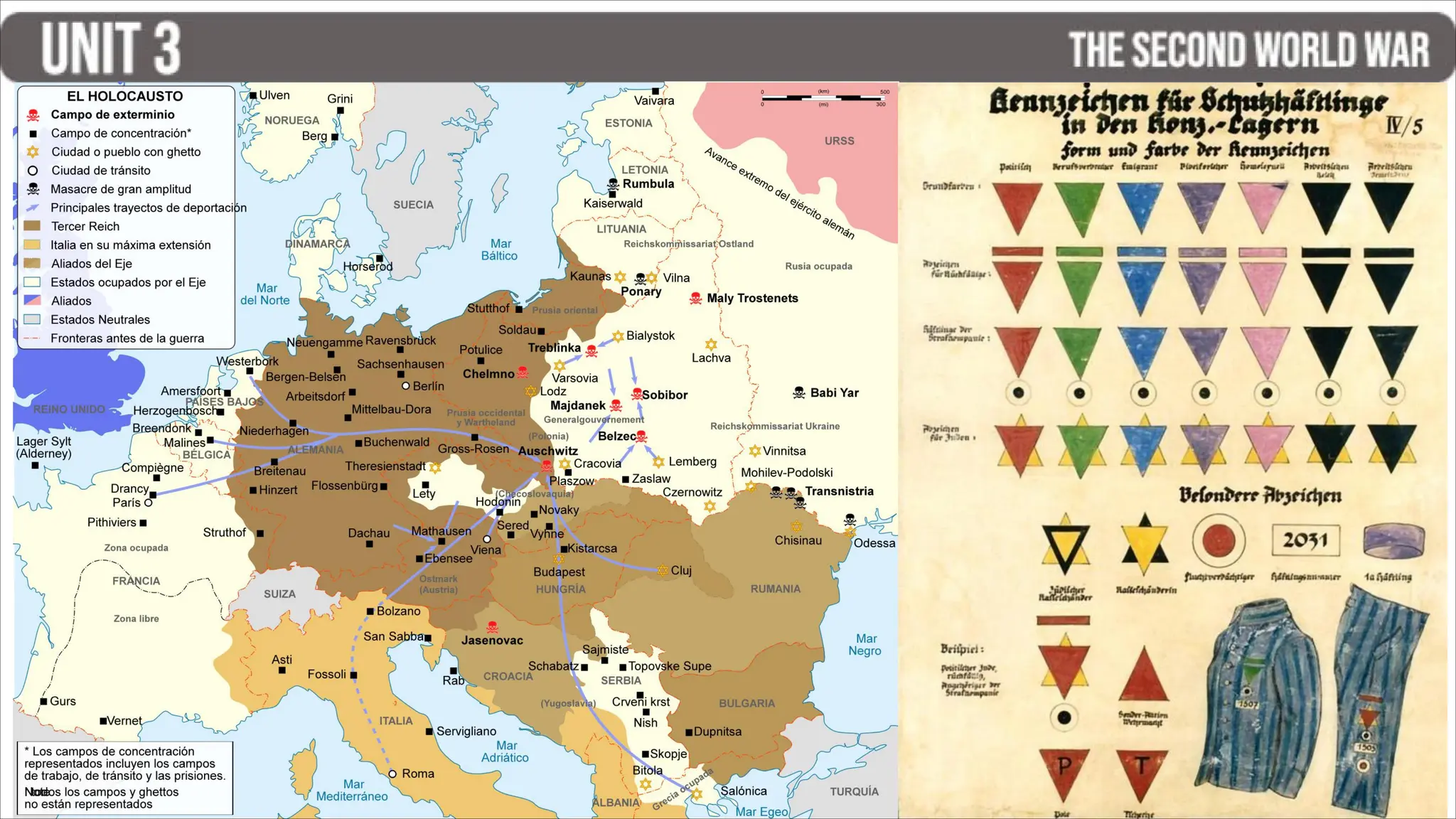
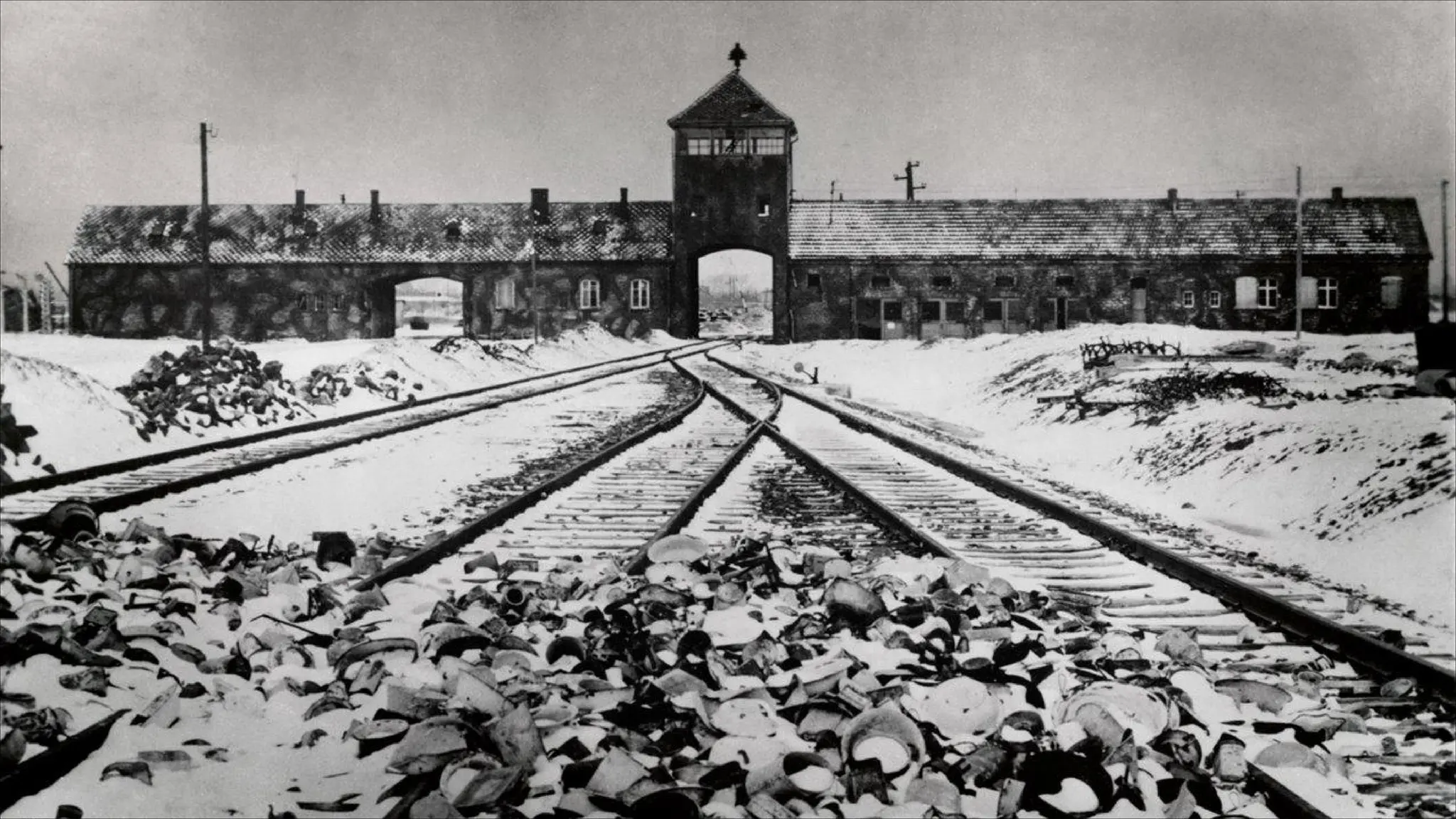
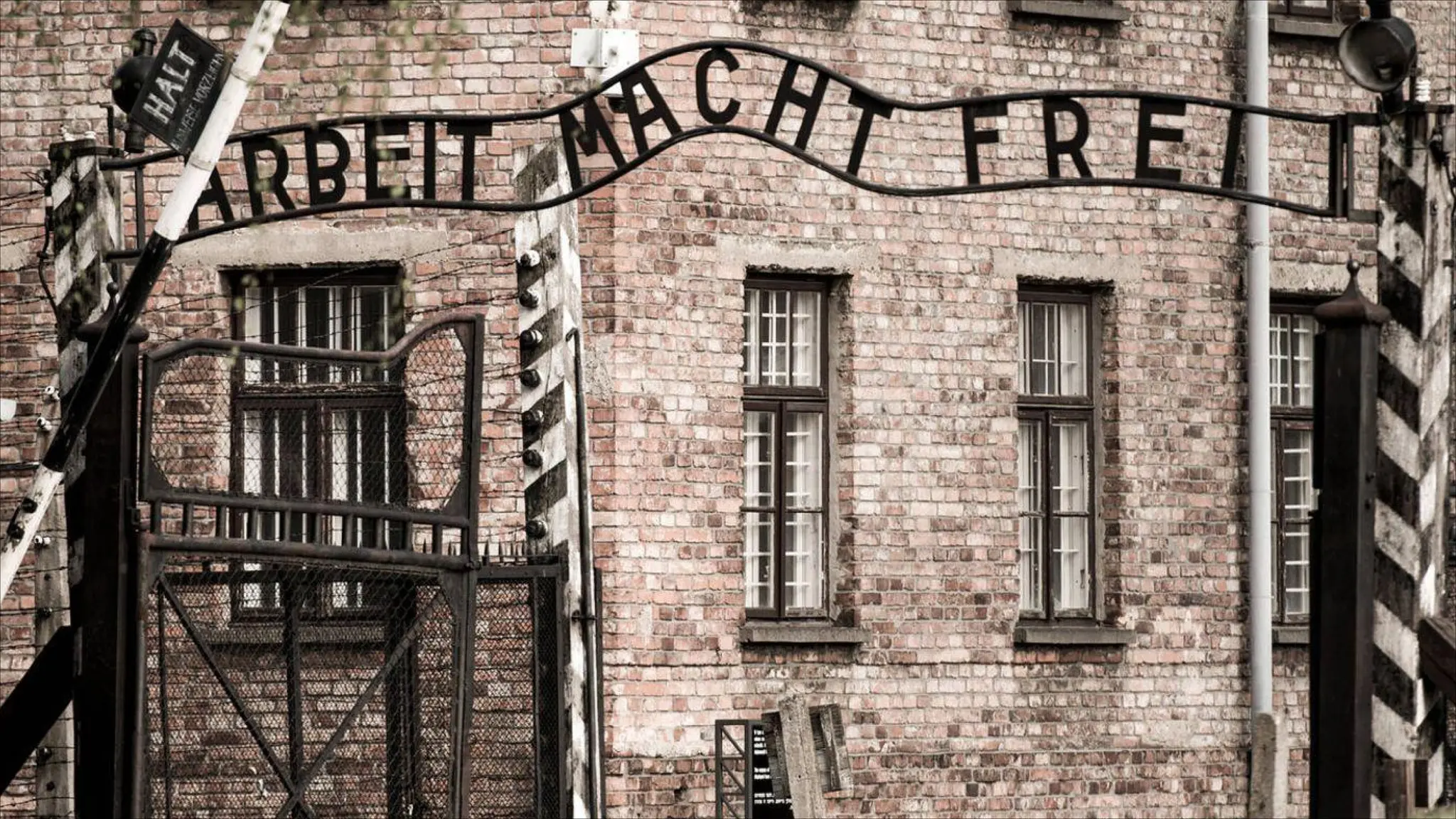
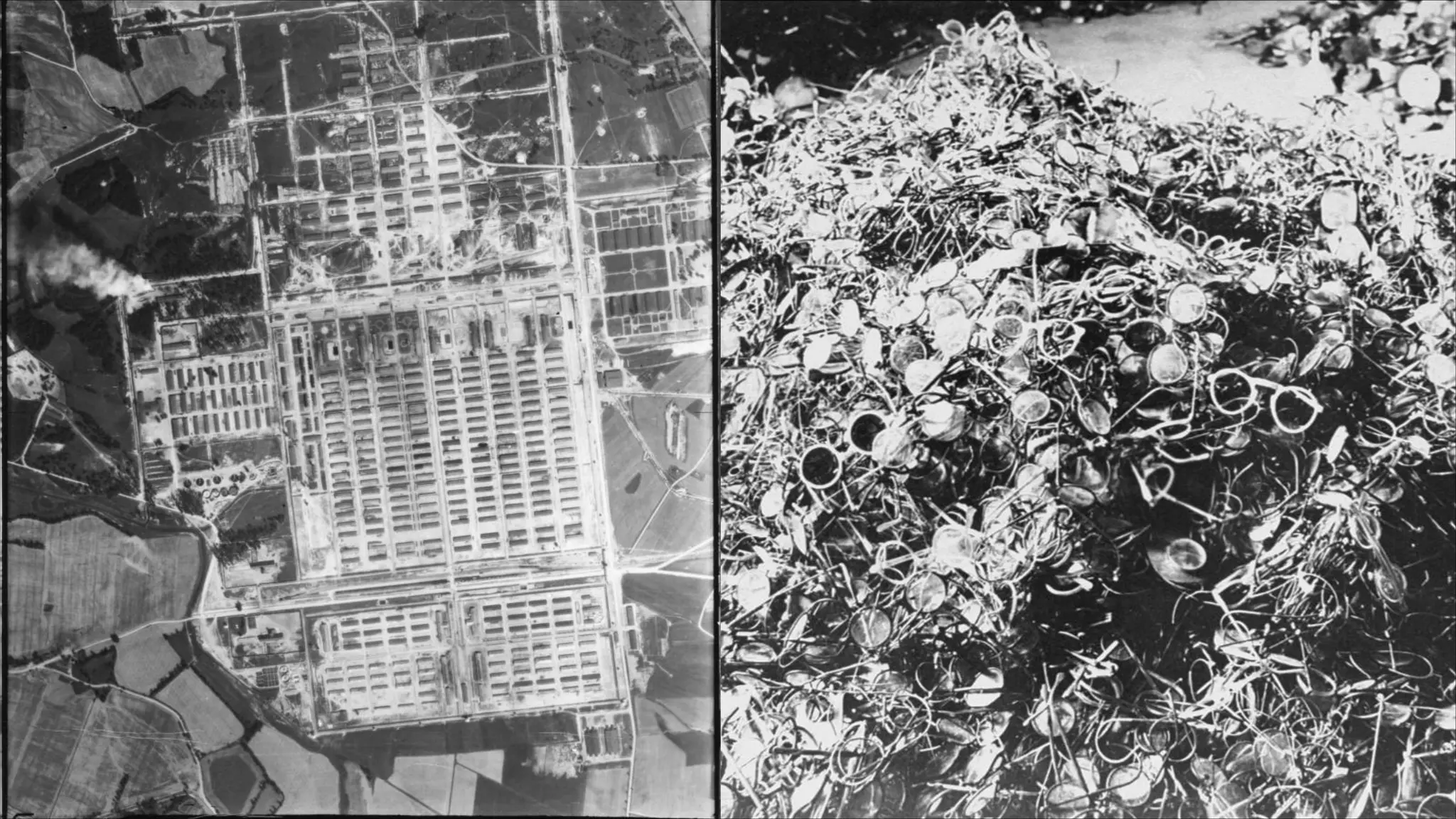
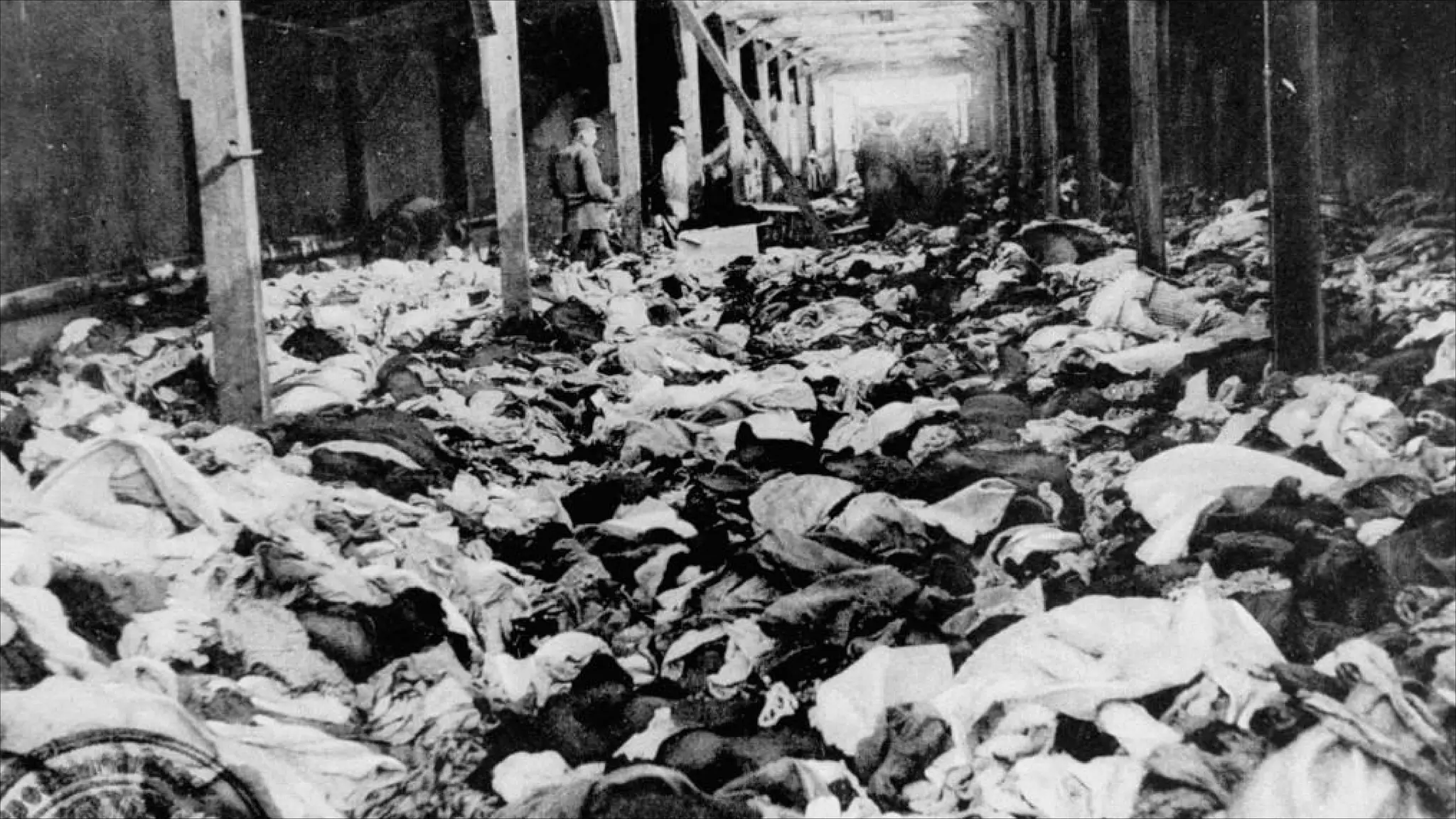
1942 - The Final Solution: total annihilation of the Jewish population through their
transportation to concentration camps (e.g. Auschwitz or Treblinka). The prisoners were forced
to work and were killed in gas chambers.
In addition to Jewish, Romani population was also prosecuted and killed in great numbers.
More than six million Jews died.
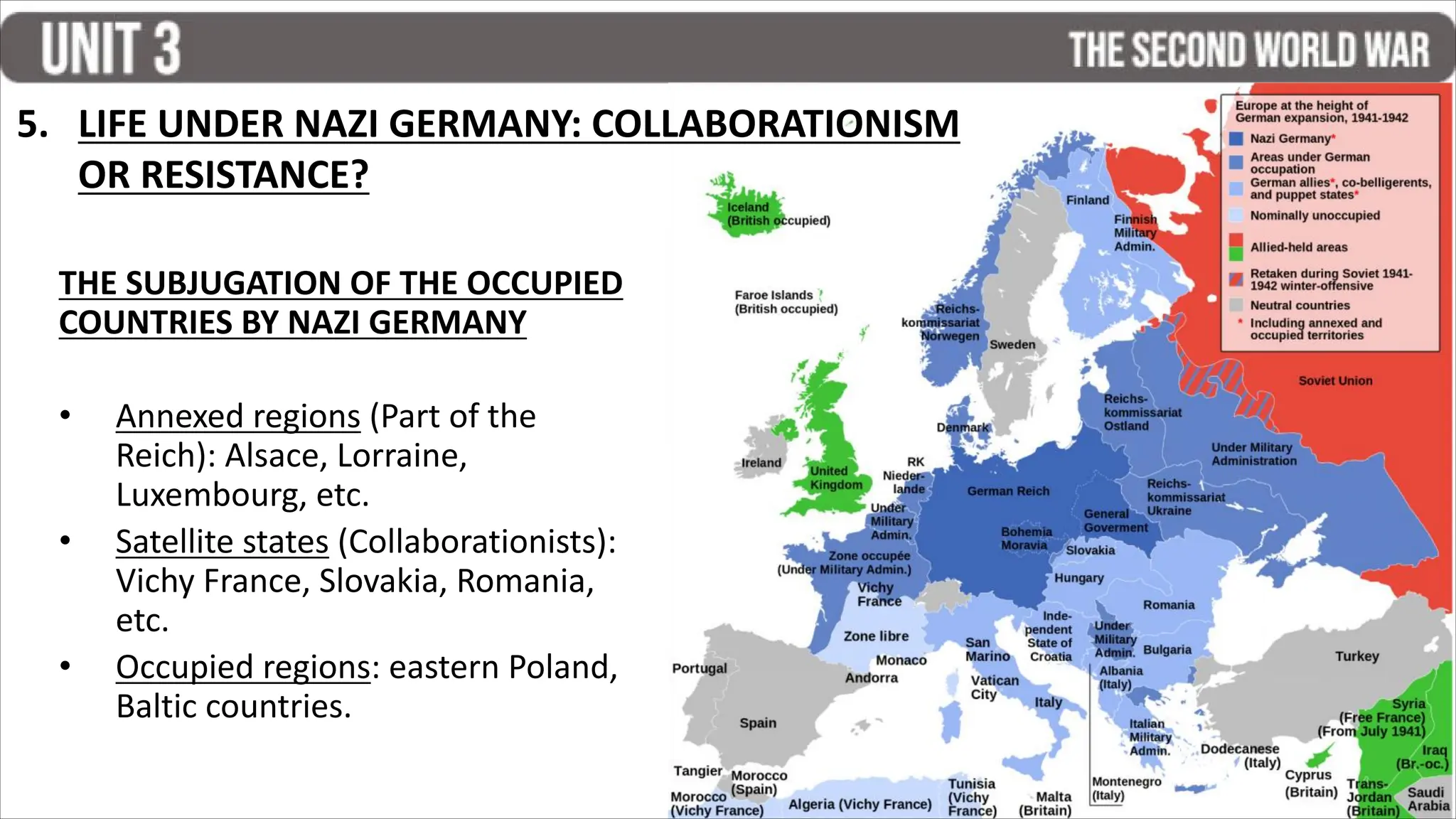
THE SUBJUGATION OF THE OCCUPIED
COUNTRIES BY NAZI GERMANY
• Annexed regions (Part of the
Reich): Alsace, Lorraine,
Luxembourg, etc.
• Satellite states (Collaborationists):
Vichy France, Slovakia, Romania,
etc.
• Occupied regions: eastern Poland,
Baltic countries.
5. LIFE UNDER NAZI GERMANY: COLLABORATIONISM
OR RESISTANCE?
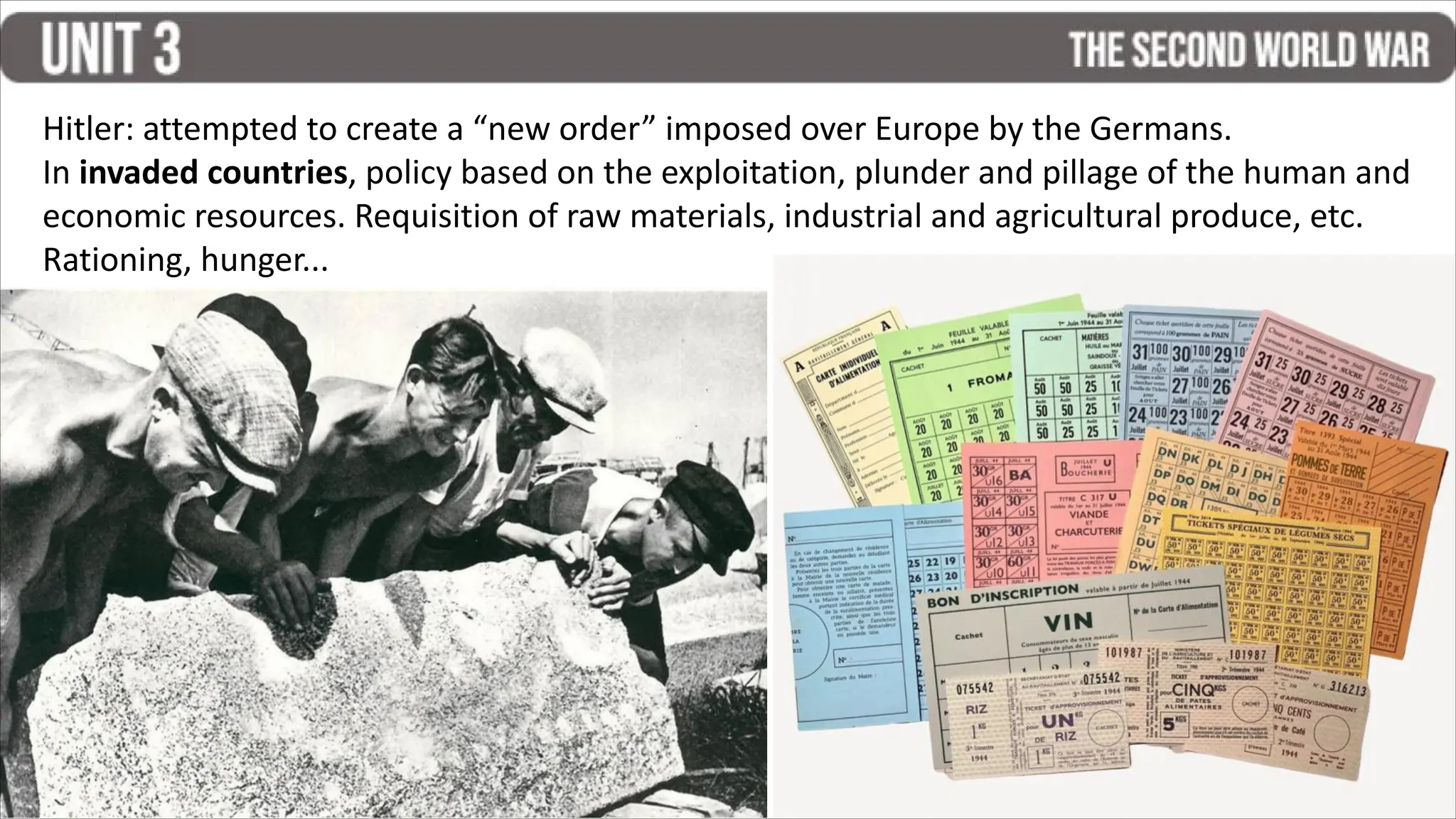
Hitler: attempted to create a “new order” imposed over Europe by the Germans.
In invaded countries, policy based on the exploitation, plunder and pillage of the human and
economic resources. Requisition of raw materials, industrial and agricultural produce, etc.
Rationing, hunger...
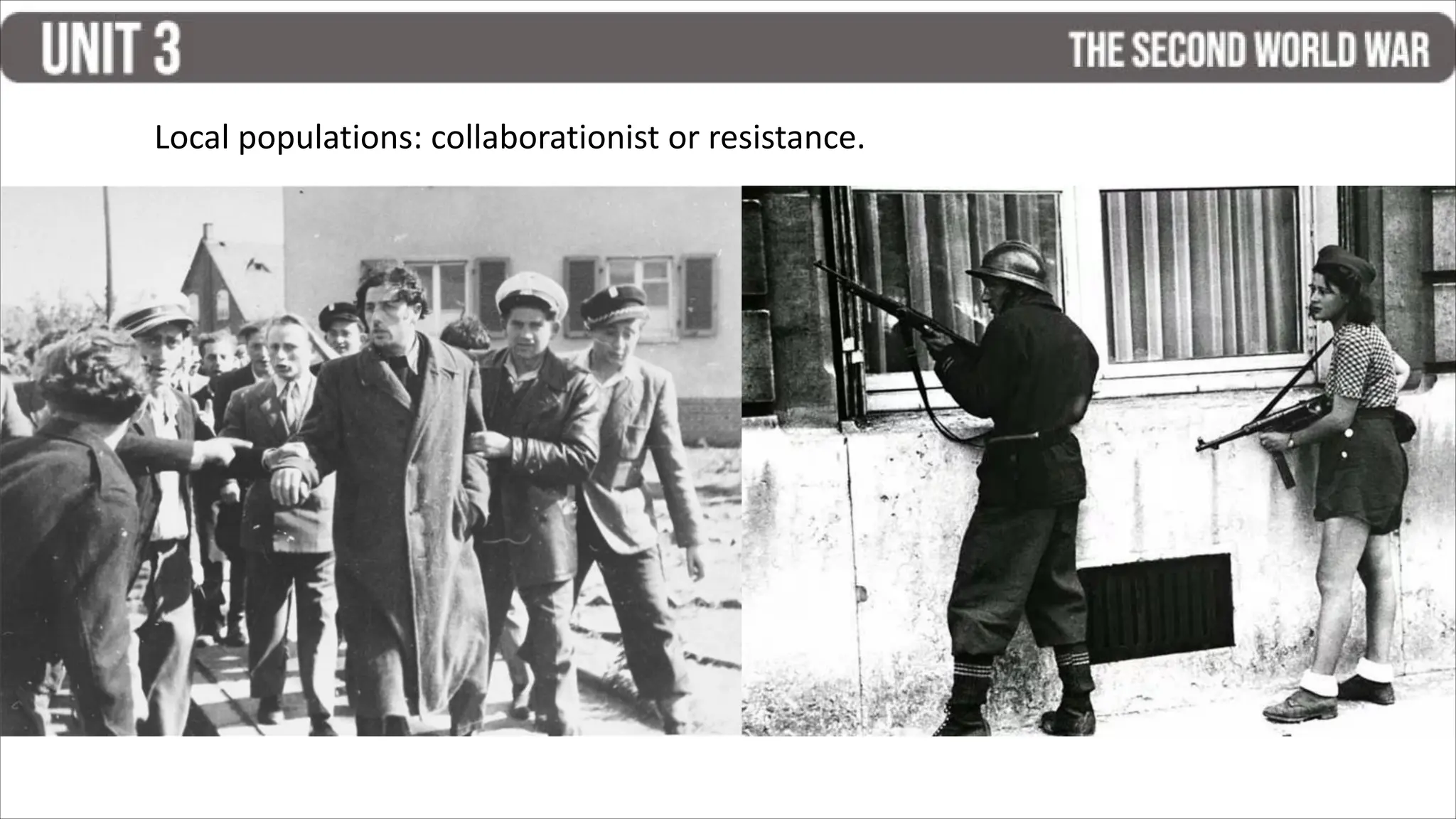
Local populations: collaborationist or resistance.
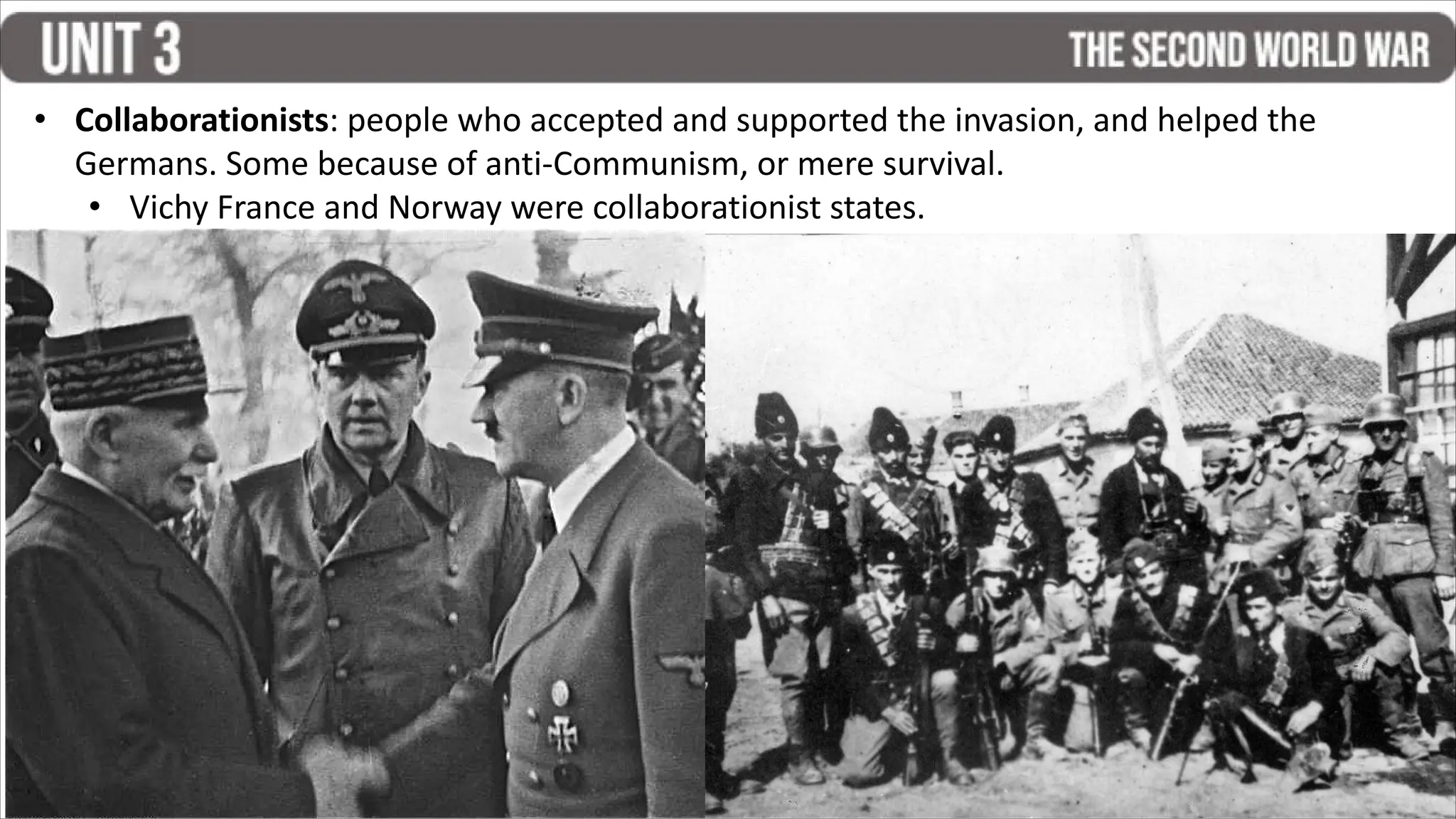
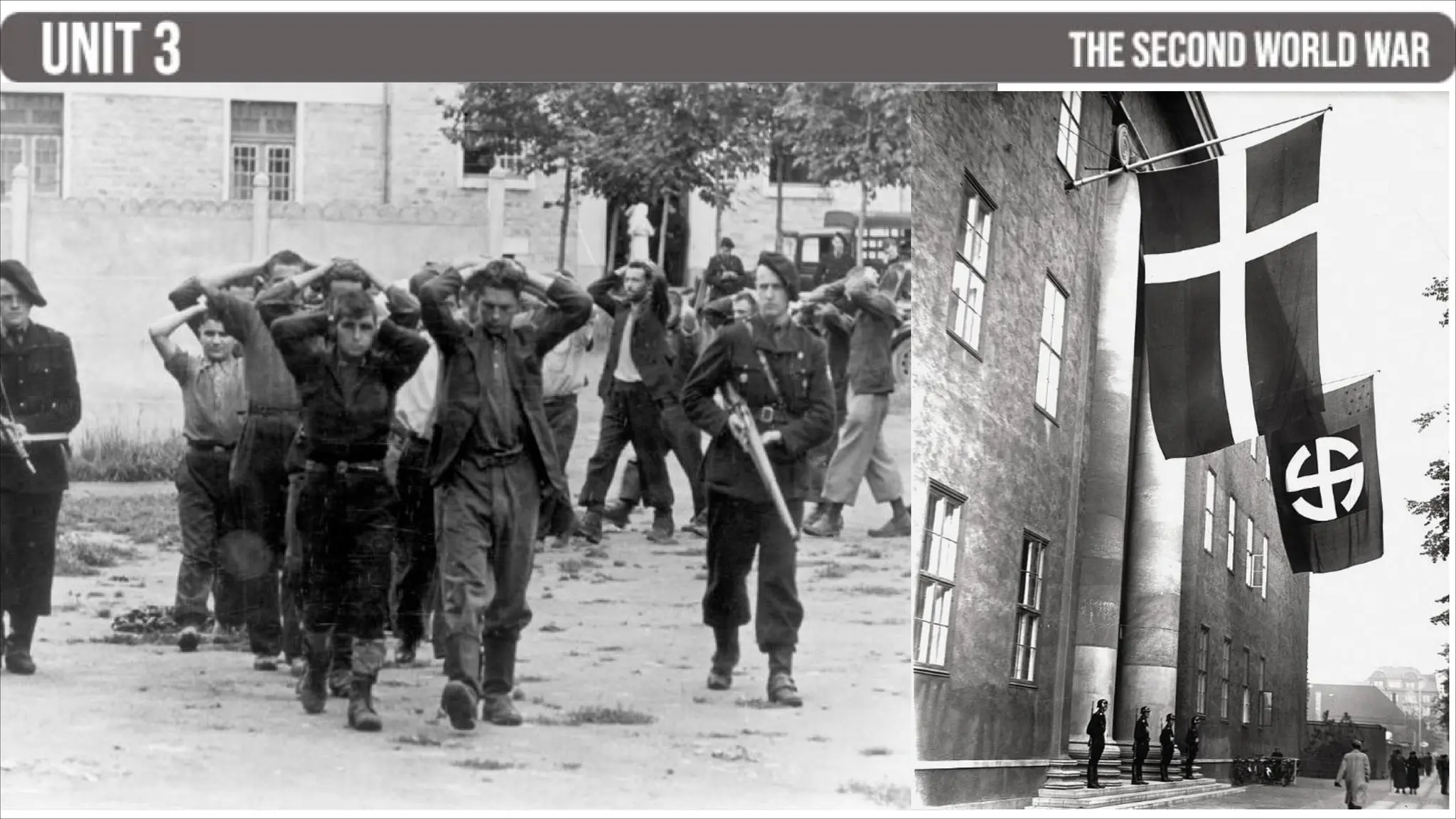
• Collaborationists: people who accepted and supported the invasion, and helped the
Germans. Some because of anti-Communism, or mere survival.
• Vichy France and Norway were collaborationist states.
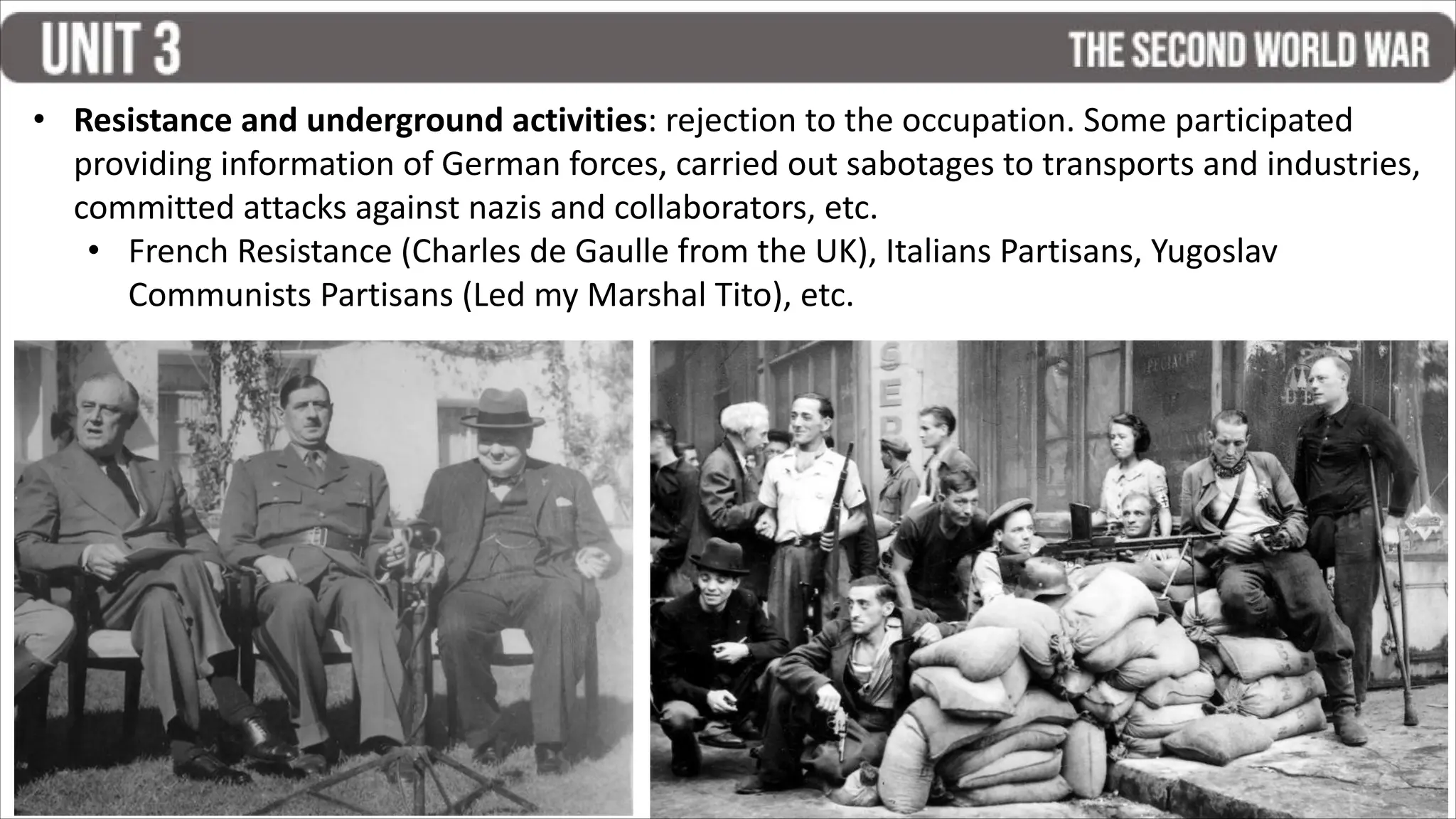
• Resistance and underground activities: rejection to the occupation. Some participated
providing information of German forces, carried out sabotages to transports and industries,
committed attacks against nazis and collaborators, etc.
• French Resistance (Charles de Gaulle from the UK), Italians Partisans, Yugoslav
Communists Partisans (Led my Marshal Tito), etc.
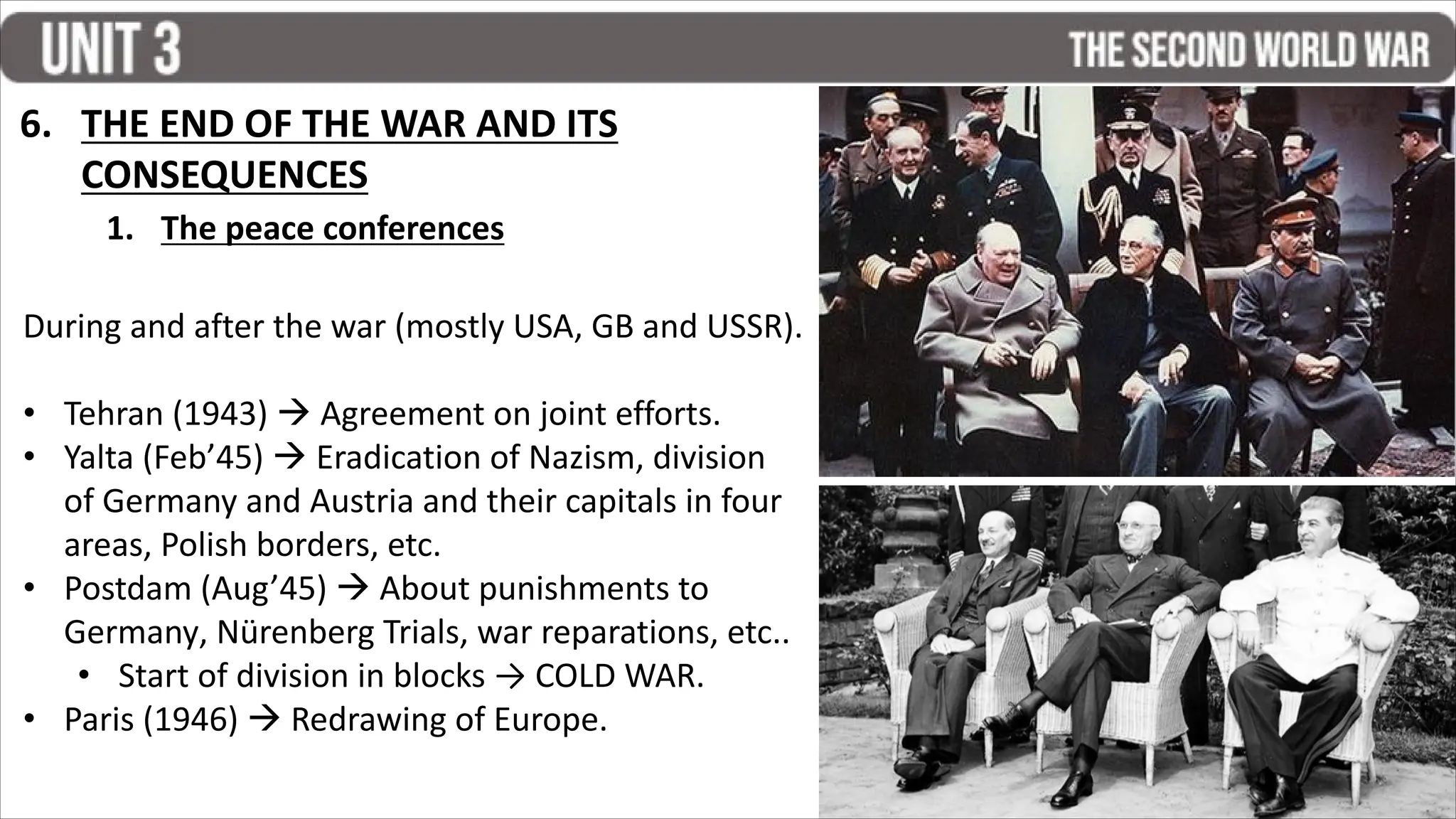
1. The peace conferences
During and after the war (mostly USA, GB and USSR).
• Tehran (1943)  Agreement on joint efforts.
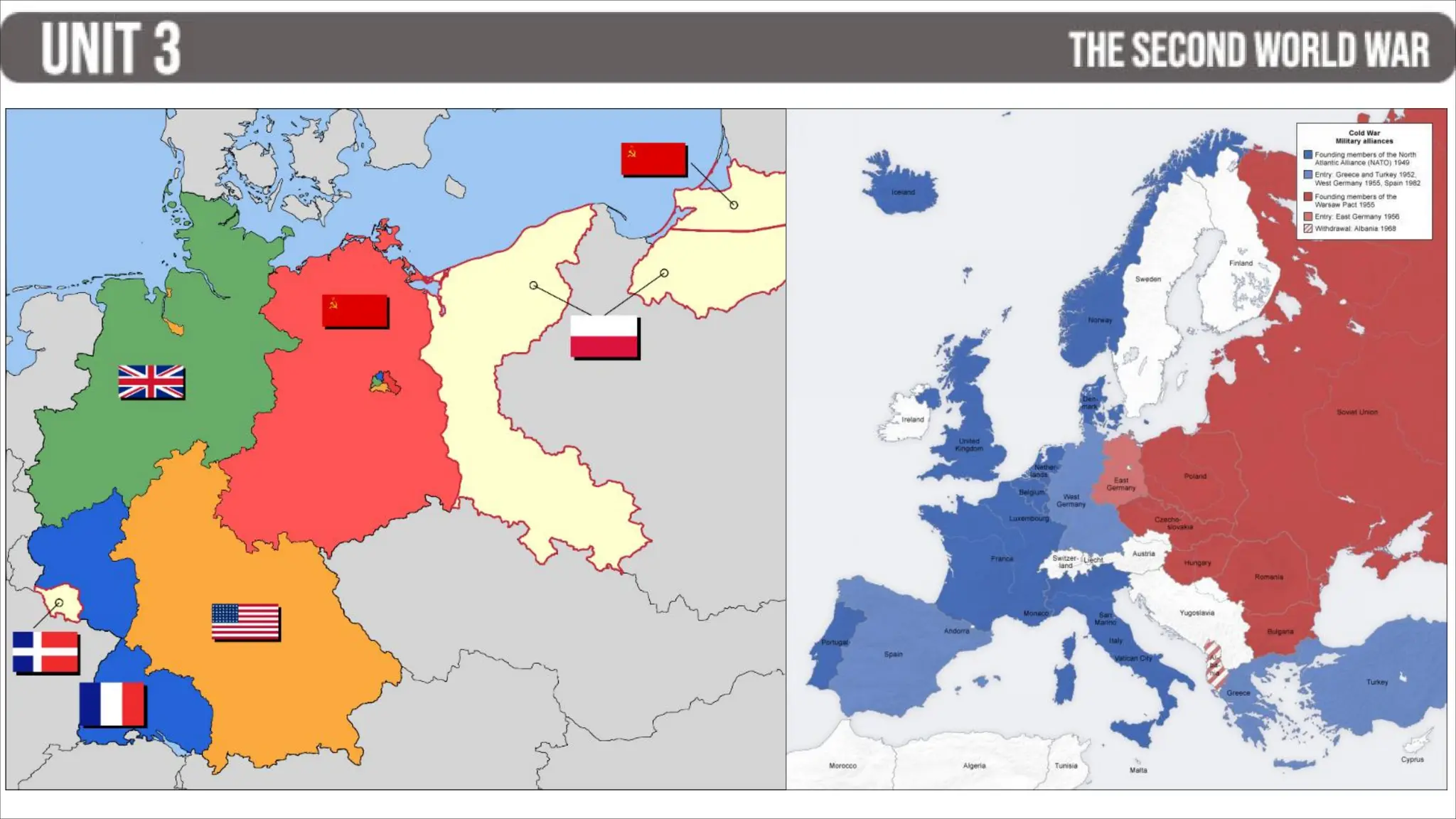
• Yalta (Feb’45)  Eradication of Nazism, division
of Germany and Austria and their capitals in four
areas, Polish borders, etc.
• Postdam (Aug’45)  About punishments to
Germany, Nürenberg Trials, war reparations, etc..
• Start of division in blocks → COLD WAR.
• Paris (1946)  Redrawing of Europe.
6. THE END OF THE WAR AND ITS
CONSEQUENCES
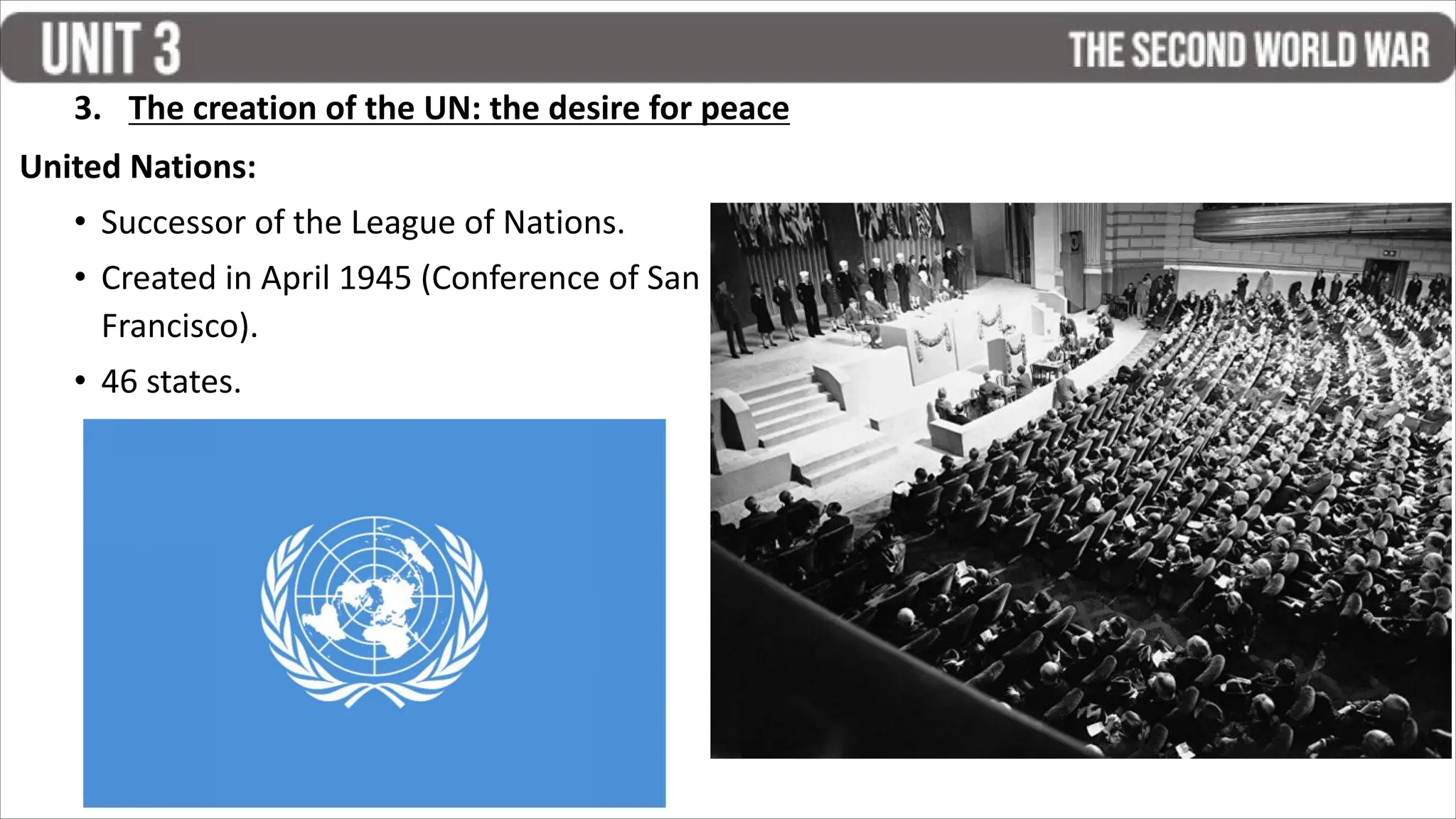
United Nations:
• Successor of the League of Nations.
• Created in April 1945 (Conference of San
Francisco).
• 46 states.
3. The creation of the UN: the desire for peace
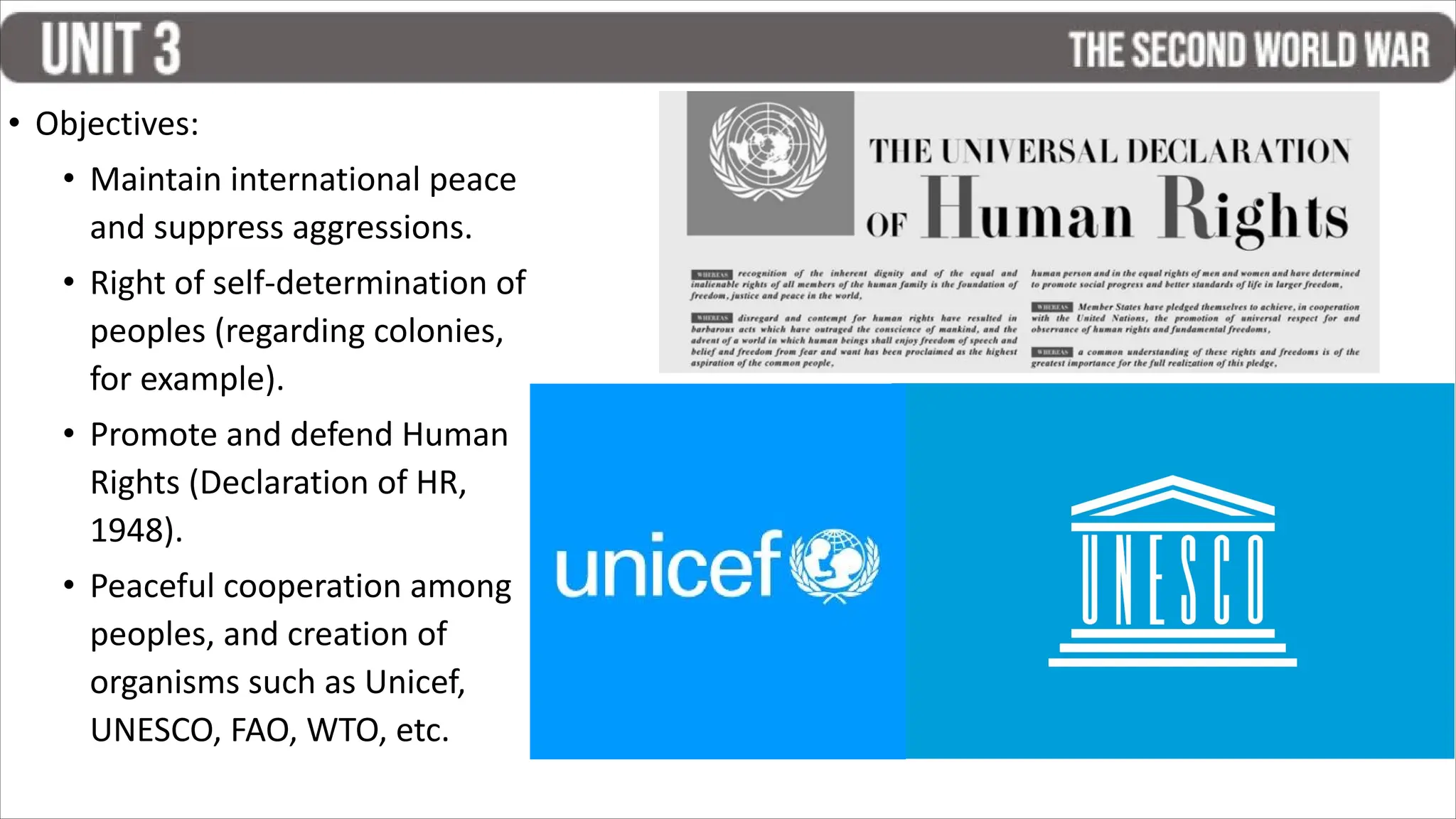
• Objectives:
• Maintain international peace
and suppress aggressions.
• Right of self-determination of
peoples (regarding colonies,
for example).
• Promote and defend Human
Rights (Declaration of HR,
1948).
• Peaceful cooperation among
peoples, and creation of
organisms such as Unicef,
UNESCO, FAO, WTO, etc.
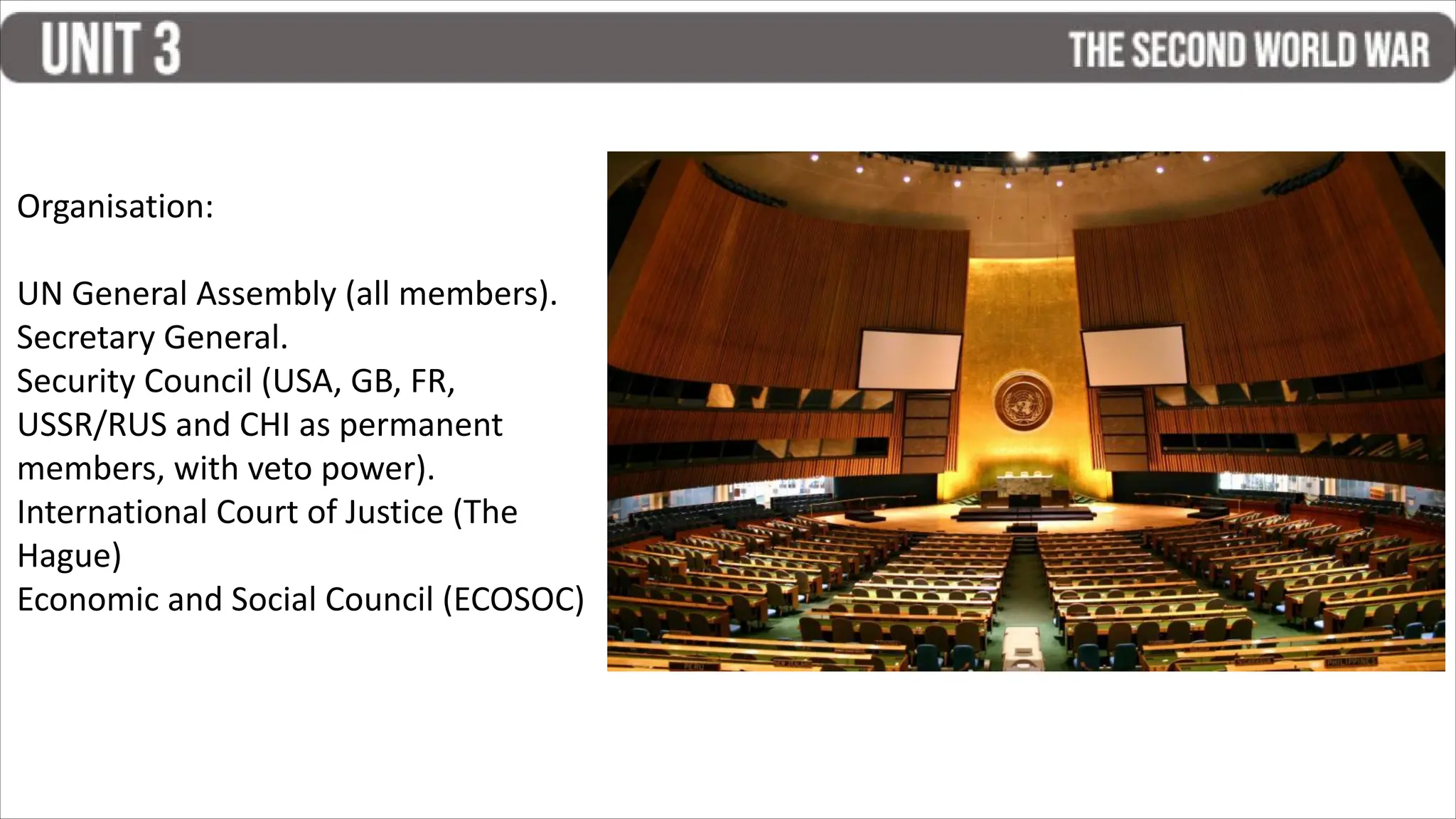
Organisation:
UN General Assembly (all members).
Secretary General.
Security Council (USA, GB, FR,
USSR/RUS and CHI as permanent
members, with veto power).
International Court of Justice (The
Hague)
Economic and Social Council (ECOSOC)
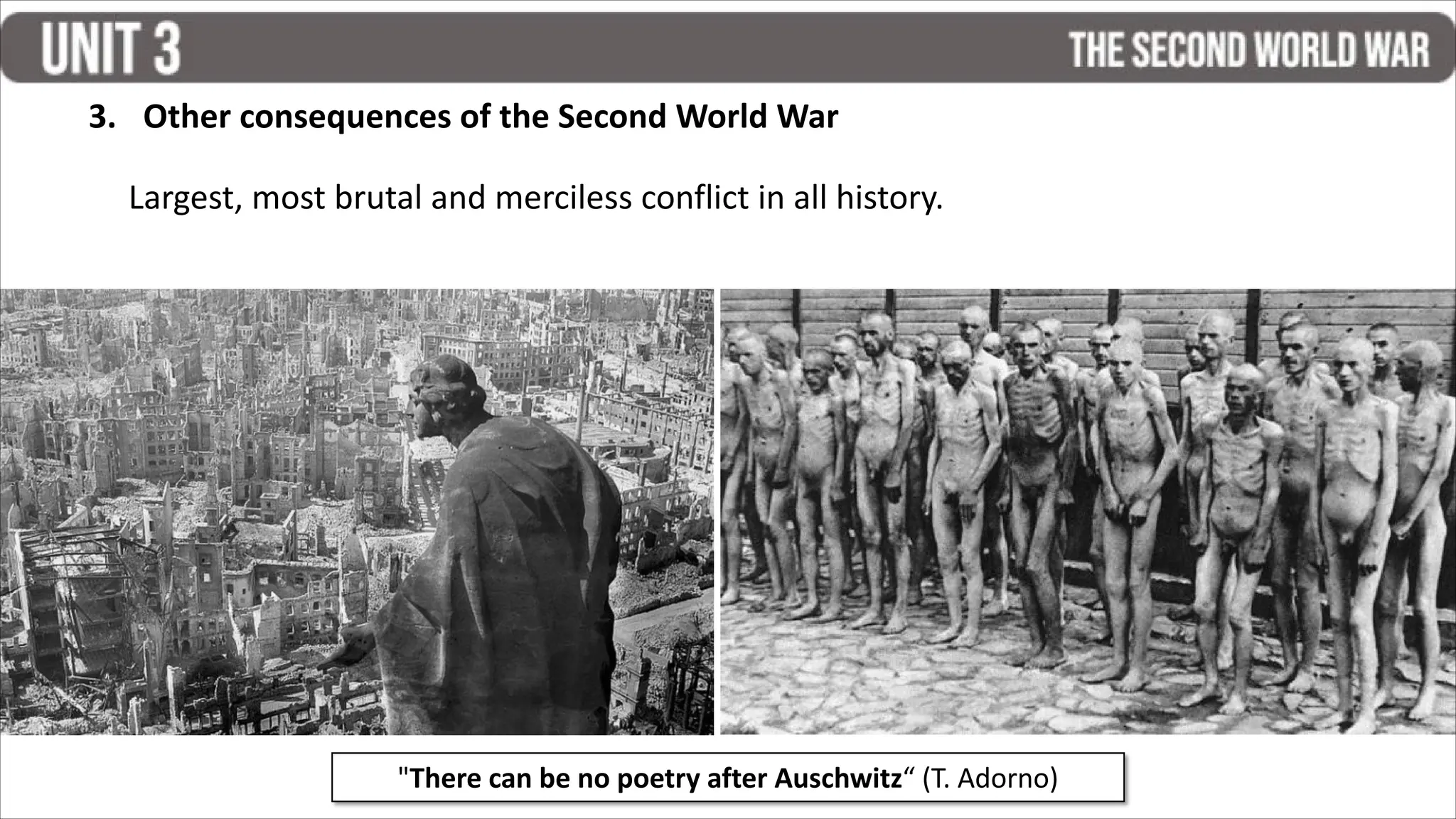
3. Other consequences of the Second World War
Largest, most brutal and merciless conflict in all history.
"There can be no poetry after Auschwitz“ (T. Adorno)
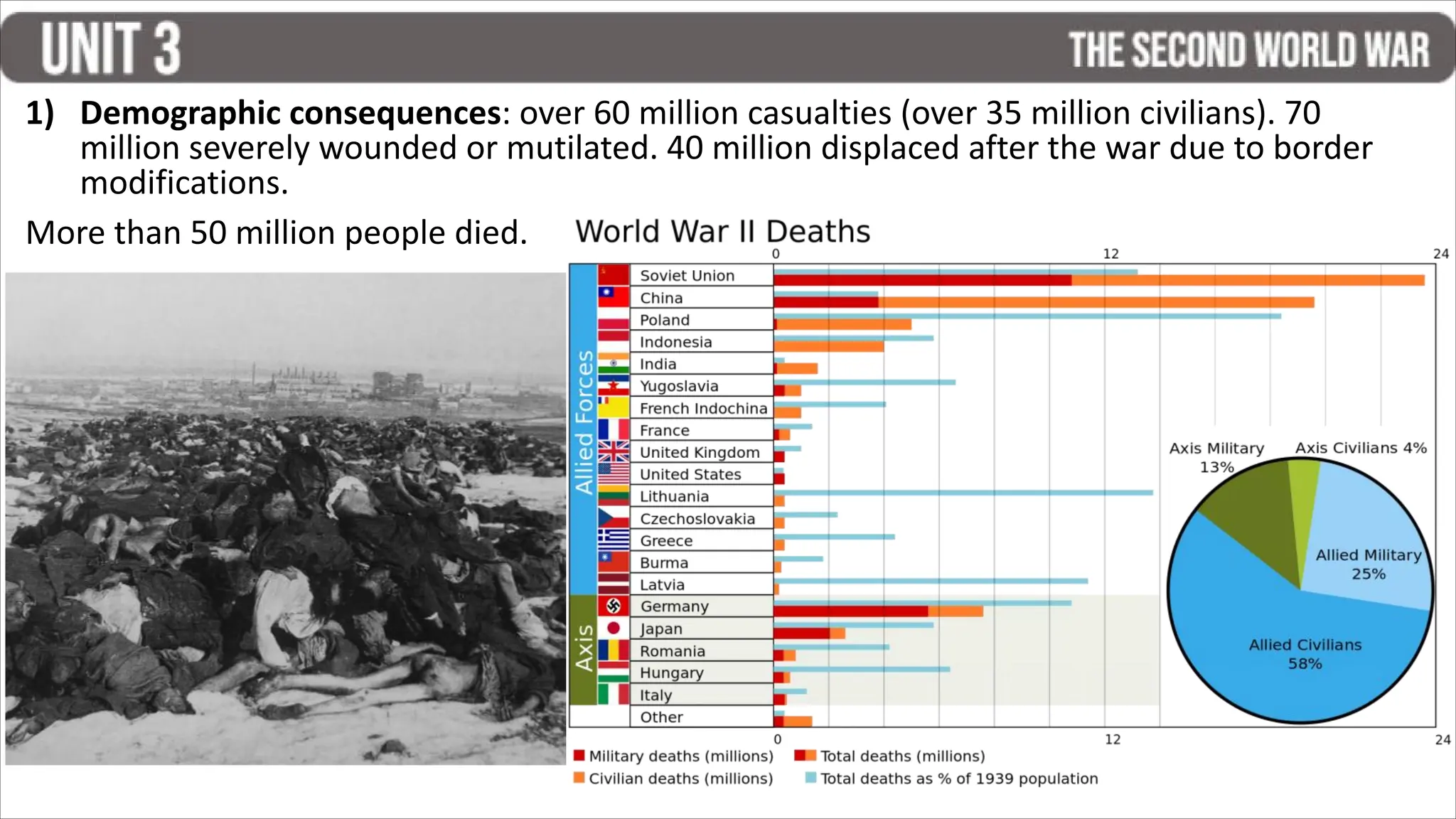
1) Demographic consequences: over 60 million casualties (over 35 million civilians). 70
million severely wounded or mutilated. 40 million displaced after the war due to border
modifications.
More than 50 million people died.
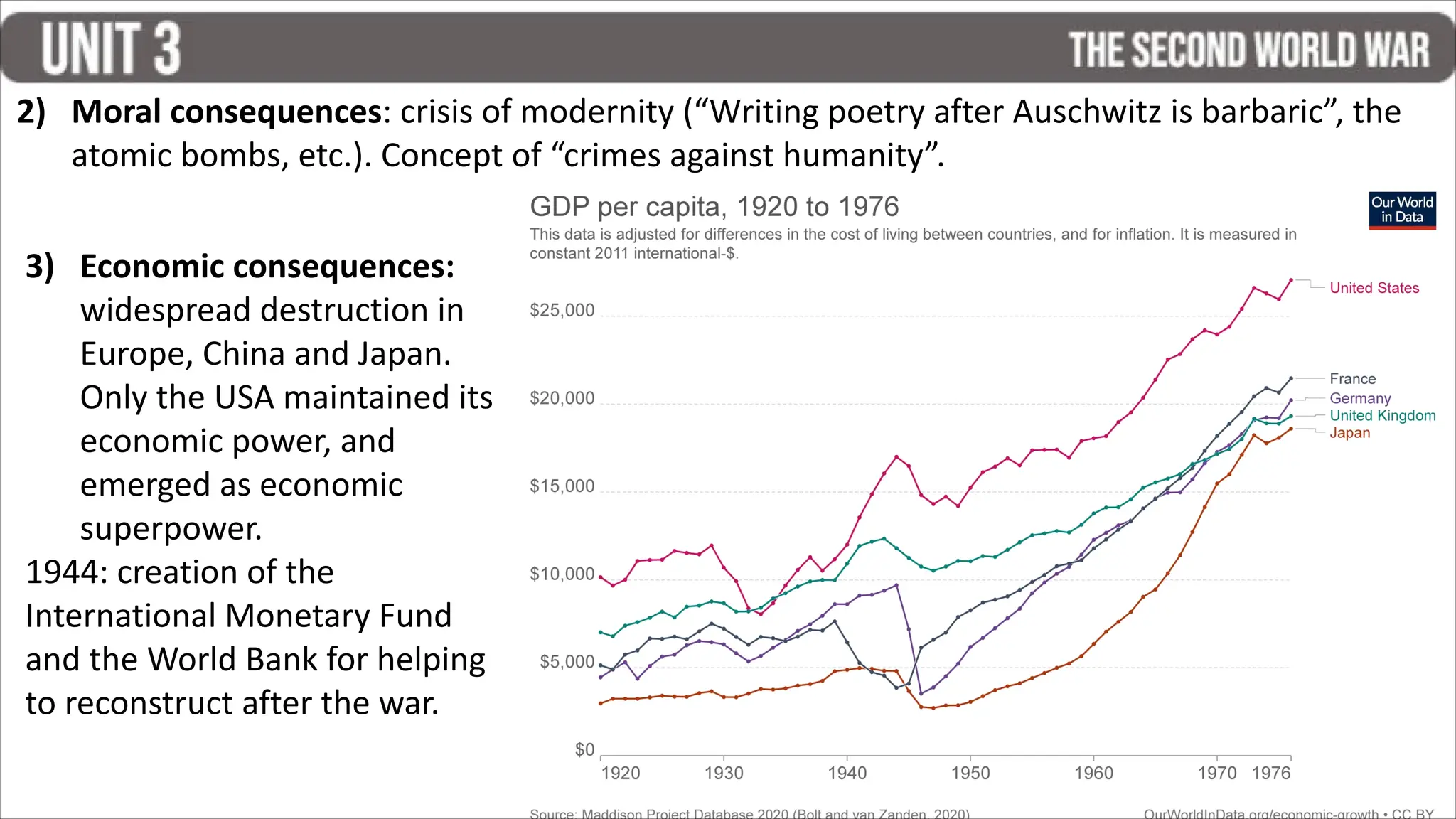
3) Economic consequences:
widespread destruction in
Europe, China and Japan.
Only the USA maintained its
economic power, and
emerged as economic
superpower.
1944: creation of the
International Monetary Fund
and the World Bank for helping
to reconstruct after the war.
2) Moral consequences: crisis of modernity (“Writing poetry after Auschwitz is barbaric”, the
atomic bombs, etc.). Concept of “crimes against humanity”.
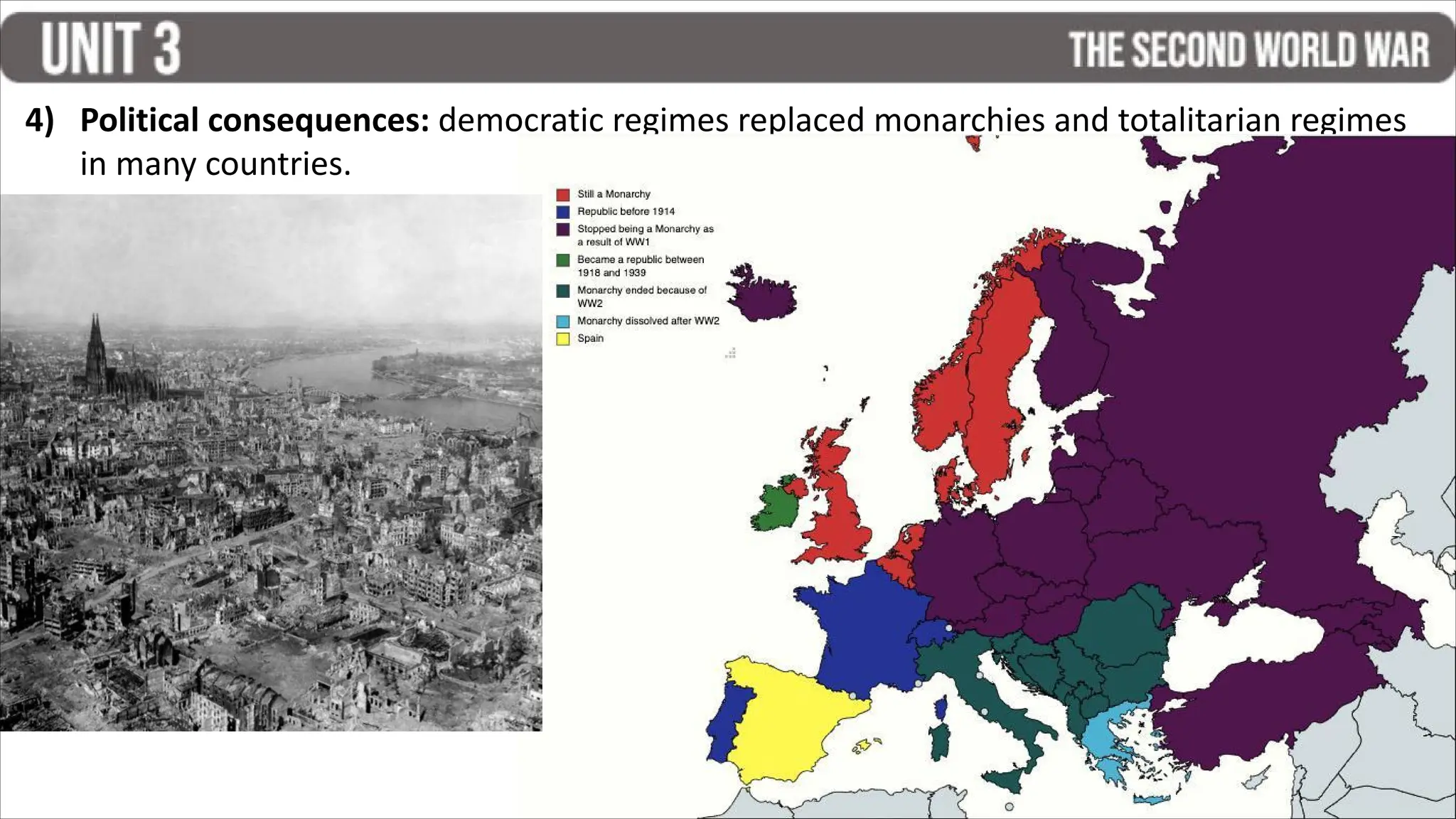
4) Political consequences: democratic regimes replaced monarchies and totalitarian regimes
in many countries.
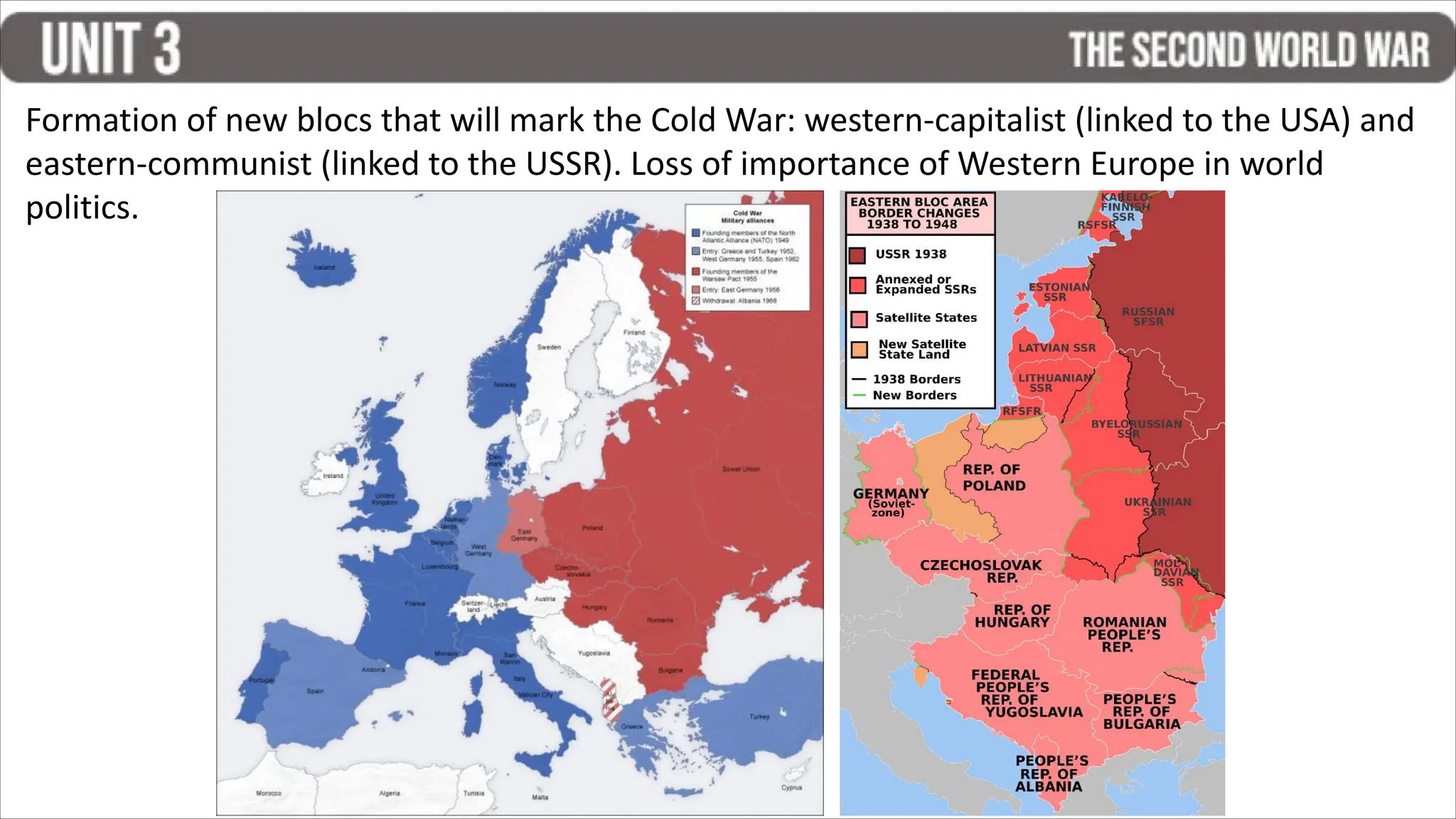
Formation of new blocs that will mark the Cold War: western-capitalist (linked to the USA) and
eastern-communist (linked to the USSR). Loss of importance of Western Europe in world
politics.
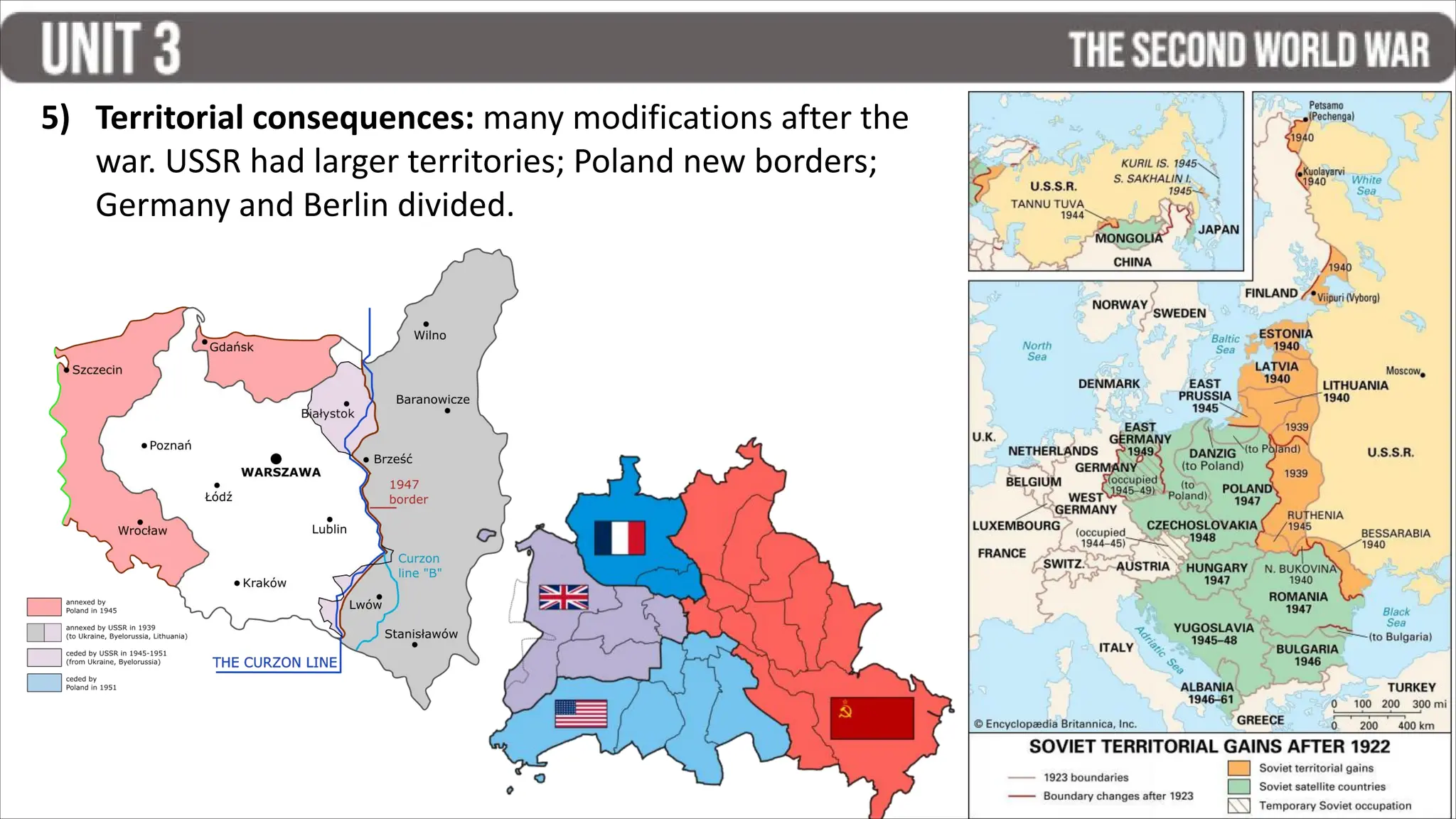
5) Territorial consequences: many modifications after the
war. USSR had larger territories; Poland new borders;
Germany and Berlin divided.

UNIT 3 - The Second World War PPT (Low Res).pdf

  • 1.
  • 2.
    1. THE SECONDWORLD WAR 2. EUROPE UNDER THE NAZIS (1939-1942): THE GREAT GERMAN OFFENSIVES 3.THE ALLIED COUNTER-ATTACK 4.THE HOLOCAUST 5.LIFE UNDER NAZI GERMANY: COLLABORATIONISM OR RESISTANCE? 6.THE END OF THE WAR AND ITS CONSEQUENCES
  • 3.
    1. THE SECONDWORLD WAR
  • 4.
    1. Causes • Militaryallegiance of Germany, Italy and Japan. • Great Depression of 1929 and its consequences in Europe: unemployment, economic crisis, political tensions, etc. • Weak democracies: not knowing how to stop these ideas, not involvement (USA), internal problems, trying to avoid conflicts. Failure of the League of Nations. • Concerns about the spread of communism after the Russian Revolution and the formation of the USSR.
  • 5.
    2. The formationof blocs Two opposing blocs: 1. The Axis powers: Germany, Italy and Japan. Totalitarian expansionist policy. Berlin-Rome- Tokyo Axis in 1940.
  • 6.
    § Japan invadedManchuria (1931) and China (1937). § Hitler’s pan-Germanism: rejection of the borders imposed by the Treaty of Versailles, and began militarising Germany. § 1935: annexation of the Saarland. § 1936: militarisation of the Rhineland. § 1938: annexation of Austria (Anchluss) and Sudeteland.
  • 7.
    § 1936-1939: participationin the Spanish Civil War, supporting the fascist uprising. § Italy invaded Ethiopia (1935-36) § 1939: Pact of Steel (Germany and Italy). § 1940: Anti-Comintern Pact, against the USSR (Germany, Japan and Italy).
  • 8.
    2. The Alliespowers: • Initial tolerance to the German expansionism. • Munich Agreements (sept’38): the UK and France accepted the annexation of Austria and Sudeteland, but Hitler had to renounce to further expansionsim. • 1939 → Great Britain & France + Poland Defence of Poland. N. Chamberlain, É. Daladier, A. Hitler, B. Mussolini Later (1941), USA (after Japan attacked Pearl Harbour) and the USSR (German invasion of its territory) joined.
  • 9.
    1939 German-Soviet Pact (Molotov- Ribbentrop Pact) USSRnot to help Poland, division of Poland, no aggression. USSR: possibility to annex Finland and the Baltic republics (lost after the Brest-Litovsk Treaty of 1918). 3. The invasion of Poland and the outbreak of the war
  • 10.
    1 September, 1939 Germany invades Poland  France and Great Britain declare the war.
  • 11.
    2. EUROPE UNDERTHE NAZIS (1939-1942): THE GREAT GERMAN OFFENSIVES
  • 12.
    Blitzkrieg  Quickwar, by surprise. Surprise attack using a rapid, overwhelming force. Combination of infantry, artillery and air support. 1. The blitzkrieg and the invasion of France
  • 13.
    1939 → Invasionof Poland. 1940 → GER: Denmark and Norway (April); Netherlands, Luxembourg and Belgium (May). France tried to attack, and UK to avoid control of the North Sea. Both unsuccessful. Late May: offensive accross Belgium and the Ardennes (northern France) for attacking France. 26-27: evacuation of Dunkirk.
  • 14.
    14 June, 1940:Paris is conquered by Germany. France Occupied (North) and free (puppet government, South - Vichy France, led by Pétain).
  • 16.
    July  OnlyGB resisted, but there was the threat of invasion (Battle of Britain). Postponed by Hitler (but maritime blockade and bombing ).
  • 17.
    Winston Churchill’s FirstSpeech as Prime Minister to House of Commons (May 13, 1940). “That this House welcomes the formation of a Government representing the united and inflexible resolve of the nation to prosecute the war with Germany to a victorious conclusion. [...] To form an Administration of this scale and complexity is a serious undertaking in itself, but it must be remembered that we are in the preliminary stage of one of the greatest battles in history, that we are in action at many other points in Norway and in Holland, that we have to be prepared in the Mediterranean, that the air battle is continuous and that many preparations [...] have to be made here at home. [...] I hope that any of my friends and colleagues, or former colleagues, who are affected by the political reconstruction, will make allowance, all allowance, for any lack of ceremony with which it has been necessary to act. I would say to the House, as I said to those who have joined this government: “I have nothing to offer but blood, toil, tears and sweat.” We have before us an ordeal of the most grievous kind. We have before us many, many long months of struggle and of suffering. You ask, what is our policy? I can say: It is to wage war, by sea, land and air, with all our might and with all the strength that God can give us; to wage war against a monstrous tyranny, never surpassed in the dark, lamentable catalogue of human crime. That is our policy. You ask, what is our aim? I can answer in one word: It is victory, victory at all costs, victory in spite of all terror, victory, however long and hard the road may be; for without victory, there is no survival. Let that be realised; no survival for the British Empire, no survival for all that the British Empire has stood for, no survival for the urge and impulse of the ages, that mankind will move forward towards its goal. But I take up my task with buoyancy and hope. I feel sure that our cause will not be suffered to fail among men. At this time I feel entitled to claim the aid of all, and I say, “come then, let us go forward together with our united strength.”
  • 18.
    1941  Thewar extends beyond Europe. • North Africa: Axis Vs British (Control over the Suez Canal). • Pacific  JAP controlled South-East Asia, and continued conquering. • 7 December, 1941: Pearl Harbor (US Navy base in Hawaii). This lead to the USA entering WW2. 2. The war spreads across the World Europe: Balkans: GER conquered Yugoslavia and Greece.
  • 19.
    1941  Russia:Operation Barbarossa  GER Vs USSR. Quick offensive. Reaches almost Moscow and Leningrad.
  • 20.
    3. THE ALLIEDCOUNTER-ATTACK
  • 21.
    a) Operation Barbarossa:German invasion of the USSR. Vs Molotov-Ribbentrop Pact (non-aggression) → USSR joined the Allies. b) Japanese attack to Pearl Harbour: USA joined the Allies. Operation Barbarossa and the Pearl Harbor attack → the USSR and the USA joined the war against the Axis. 1. The changes of course: 1942
  • 22.
    Allied side: GreatBritain, USA and USSR. Reorganisation of economies for the war.
  • 23.
    PACIFIC FRONT →Battle of Midway (1942) and Guadalcanal (1943) → American victories Vs Japan
  • 24.
    NORTH AFRICAN FRONT:El-Alamein (1942). British victory. 1943: Allied victory Vs Germany in North Africa.
  • 25.
    RUSSIAN FRONT: Stalingrad(August 1942-February 1943)  Soviet victory. Start of the offensives.
  • 26.
    2. The alliedoffensives of 1943 EASTERN FRONT: Battle of Kurst (1943). First Soviet successful offensive against the Germans. ▪ Russian advance towards Berlin (Race to Berlin).
  • 27.
    SOUTHERN EUROPE: - 1943 Allies conquered Sicily and southern Italy. Mussolini overthrown. Hitler invaded Italy and Mussolini as head of Italy (Republic of Saló, September’43-April’45)
  • 28.
    PACIFIC FRONT: Guadalcanal.Leapfrogging tactic, skipping heavily fortified islands controlled by the Japanese and trying to cut them off from their supply chain by creating army bases in smaller islands.
  • 29.
    3. The finalallies offensives and the liberation of Europe
  • 30.
    WESTERN FRONT: 1944 Normandy landings (GB, USA, CAN, etc.)  Advance from the West.
  • 34.
    ▪ 24 August,1944: liberation of Paris.
  • 37.
    Last German offensivesin the late 1944, but unsuccesful. ▪ Allied bombings on German cities (Köln, Hamburg, Desden, etc.).
  • 38.
    EASTERN FRONT Russian advance towards Berlin (Race to Berlin). • 30th April  Hitler committed suicide. • 2nd May  Berlin surrendered. • 4th-8th May  All German armed forced surrendered.
  • 39.
    END OF THEWAR IN EUROPE
  • 40.
    PACIFIC FRONT Allied victoriesfrom 1942 onwards. Japanese resistance. • The USA developed the atomic bomb (Manhattan Project). • August 1945  Hiroshima and Nagasaki were targeted.
  • 42.
    JAPAN SURRENDERED -END OF WAR IN THE PACIFIC
  • 43.
    HOLOCAUST  systematic,bureaucratic, state-sponsored persecution and extermination of JewISH communities by the Nazi regime and its collaborators. Jews: thought to be inferior than the Aryan race; problems for its purity; blame for the defeat of Germany of WW1. 4. THE HOLOCAUST
  • 44.
    Initial exclusion measures: •1933: social exclusion from the German administration. • 1935: Nürenberg Laws: prohibition and annulment of mixed marriages, and refused citizenship. • 1938: expropriation of properties and forced closures of business
  • 45.
    “The night ofbroken glass” (Kristallnacht): sacking of Jewish sinagoges, homes and businesses. About 100 killed, 26 000 to concentration camps.
  • 46.
    Creation of ghettos:Jewish neighbourhoods surrounded by walls or fences, created in Poland after the invasion. Extreme conditions. Labour camps in eastern Europe for exploiting slave workers (prisoners).
  • 47.
    1942 - TheFinal Solution: total annihilation of the Jewish population through their transportation to concentration camps (e.g. Auschwitz or Treblinka). The prisoners were forced to work and were killed in gas chambers. In addition to Jewish, Romani population was also prosecuted and killed in great numbers. More than six million Jews died.
  • 56.
    THE SUBJUGATION OFTHE OCCUPIED COUNTRIES BY NAZI GERMANY • Annexed regions (Part of the Reich): Alsace, Lorraine, Luxembourg, etc. • Satellite states (Collaborationists): Vichy France, Slovakia, Romania, etc. • Occupied regions: eastern Poland, Baltic countries. 5. LIFE UNDER NAZI GERMANY: COLLABORATIONISM OR RESISTANCE?
  • 57.
    Hitler: attempted tocreate a “new order” imposed over Europe by the Germans. In invaded countries, policy based on the exploitation, plunder and pillage of the human and economic resources. Requisition of raw materials, industrial and agricultural produce, etc. Rationing, hunger...
  • 58.
  • 59.
    • Collaborationists: peoplewho accepted and supported the invasion, and helped the Germans. Some because of anti-Communism, or mere survival. • Vichy France and Norway were collaborationist states.
  • 61.
    • Resistance andunderground activities: rejection to the occupation. Some participated providing information of German forces, carried out sabotages to transports and industries, committed attacks against nazis and collaborators, etc. • French Resistance (Charles de Gaulle from the UK), Italians Partisans, Yugoslav Communists Partisans (Led my Marshal Tito), etc.
  • 62.
    1. The peaceconferences During and after the war (mostly USA, GB and USSR). • Tehran (1943)  Agreement on joint efforts. • Yalta (Feb’45)  Eradication of Nazism, division of Germany and Austria and their capitals in four areas, Polish borders, etc. • Postdam (Aug’45)  About punishments to Germany, Nürenberg Trials, war reparations, etc.. • Start of division in blocks → COLD WAR. • Paris (1946)  Redrawing of Europe. 6. THE END OF THE WAR AND ITS CONSEQUENCES
  • 64.
    United Nations: • Successorof the League of Nations. • Created in April 1945 (Conference of San Francisco). • 46 states. 3. The creation of the UN: the desire for peace
  • 65.
    • Objectives: • Maintaininternational peace and suppress aggressions. • Right of self-determination of peoples (regarding colonies, for example). • Promote and defend Human Rights (Declaration of HR, 1948). • Peaceful cooperation among peoples, and creation of organisms such as Unicef, UNESCO, FAO, WTO, etc.
  • 66.
    Organisation: UN General Assembly(all members). Secretary General. Security Council (USA, GB, FR, USSR/RUS and CHI as permanent members, with veto power). International Court of Justice (The Hague) Economic and Social Council (ECOSOC)
  • 67.
    3. Other consequencesof the Second World War Largest, most brutal and merciless conflict in all history. "There can be no poetry after Auschwitz“ (T. Adorno)
  • 68.
    1) Demographic consequences:over 60 million casualties (over 35 million civilians). 70 million severely wounded or mutilated. 40 million displaced after the war due to border modifications. More than 50 million people died.
  • 69.
    3) Economic consequences: widespreaddestruction in Europe, China and Japan. Only the USA maintained its economic power, and emerged as economic superpower. 1944: creation of the International Monetary Fund and the World Bank for helping to reconstruct after the war. 2) Moral consequences: crisis of modernity (“Writing poetry after Auschwitz is barbaric”, the atomic bombs, etc.). Concept of “crimes against humanity”.
  • 70.
    4) Political consequences:democratic regimes replaced monarchies and totalitarian regimes in many countries.
  • 71.
    Formation of newblocs that will mark the Cold War: western-capitalist (linked to the USA) and eastern-communist (linked to the USSR). Loss of importance of Western Europe in world politics.
  • 72.
    5) Territorial consequences:many modifications after the war. USSR had larger territories; Poland new borders; Germany and Berlin divided.