Gothic art:
artistic style
Europe, 12th-15th
centuries.
Appeared in France,
spread throughout Europe.
Urban  Promoted by the
bourgeoisie and the clergy.
MAIN CHARACTERISTICS
It reflected the changes of the Late Middle
Ages (urban life, bourgeoisie, etc.).
Typologies:
Religious: churches and cathedrals
Civil: palaces, town halls, universities, etc.
Looking for height  Symbol of power.
Materials:
Stone
Hold elements:
Pointed arch  It distributes the forces more vertically  Towards the pillars  More
height.
Groin vault  two pointed arches crossing diagonally  Only the corners load weight
 Large pillars.
Holding elements:
- Pillars (with attached columns)
- Flying buttresses outside.
- Wall  No holding function  Windows and stained glass 
Curtain-wall.
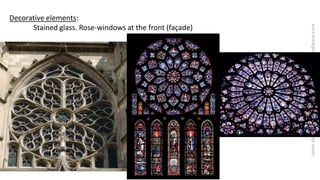
Decorative elements:
Stained glass. Rose-windows at the front (façade)
CIVIL ARCHITECTURE:
Reflecting the functions and power of cities.
Political  Town halls: Brussels, Bruges, etc.
Bruges Town
Hall
(Bruges,
Belgium)
Brussels Town Hall
(Brussels, Belgium)
Leuven Town Hall
(Leuven, Belgium)
Saint Quentin
Town Hall
(St. Quentin,
France)
CIVIL ARCHITECTURE  Palaces.
Doge’s Palace
(Venice, Italy)
Palais des Papes
(Avignon, France)
CIVIL ARCHITECTURE:
Economic  Trade exchanges (Lonjas) Ypres Cloth
Hall (Ypres,
Belgium)
Lonja de la
Seda
(Valencia)
CIVIL ARCHITECTURE:
Cultural Universities
King’s College (Cambridge,
United Kingdom)
RELIGIOUS ARCHITECTURE:
Floor plans:
Latin-cross plan (3 or 5 aisles) with centred transept.
Basilica plan.
Double ambulatory with apses.
They may even have two transepts.
RELIGIOUS ARCHITECTURE:
Great height and luminosity.
Interior: three levels in the sides
Naves (arcades)  separated by arches.
Triforium (gallery)  very narrow.
Clerestory  Stained-glass windows.
RELIGIOUS ARCHITECTURE:
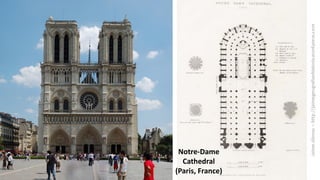
Exterior:
Towers
Several entrances with archivolts  Decorated.
Notre-Dame
Cathedral
(Paris, France)
Chartes Cathedral
(Chartres, France)
Reims Cathedral
(Chartres, France)
Sainte Chapelle
(Paris, France)
Köln
Cathedral
(Köln,
Germany)
Salisbury Cathedral
(Salisbury, United Kingdom)
Milan Cathedral
(Milan, Italy)
MAIN CHARACTERISTICS
SCULPTURE:
- Mostly in façades (archivolts, tympanum, etc.) and
round bulge.
- Freed from the architectural frame.
- Christ on the cross  Suffering.
- Virgin and Child  Kind, maternal.
Examples: Klaus Sluter.
- Also, gargoyles.
Claus Sluter - Chartreuse de Champmol (Dijon,France)
Claus Sluter -
Chartreuse de
Champmol
Tomb of Philip the
Bold, Duke of
Burgundy
(Dijon,France)
Sepulcro del Doncel – Tumba de
Martín Vázquez de Arce
Catedral de Sigüenza (Sigüenza,
Guadalajara)
Gil de Siloé
Tumba de Juan II de Castilla
Cartuja de Miraflores (Burgos)
PAINTING:
- On wood. Barely any wall painting (because of stained-glass windows)
- Reredos (Altarpieces, retablo): behind the altar.
- Bright colours, golden colour for light, intention of volume and space.
Duccio – Maestà (Galeria degli Uffizi, Florence, Italy)
Giotto – Capella degli Scrovegni (Padova, Italy)
15th century  Flanders
o Great details
o Bright and strong colours  Power.
o Great domain of portraits.
o Oil painting.
Jan van Eyck – Arnolfini
Portrait
(National Gallery, London,
United Kingdom)
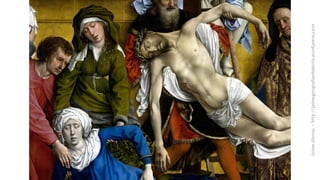
Roger van der
Weyden
The Descent from the
Cross
(Museo del Prado)
Unit 4  - Gothic art

Unit 4 - Gothic art