SIVA
1
Soil Science Engineering
ENGINEERING PROPERTIES OF SOIL
ground
S.Satheeshkumar
AP/AGE
Kongunadu College of Engineering and
Technology
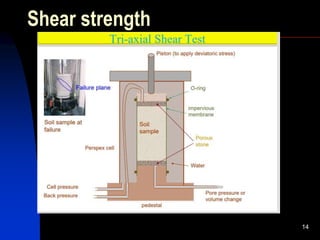
Shear strength
2
Shear strength
3
Shear strength
4
Shear strength
5
Shear strength
6
Shear strength
7
Shear strength
8
Shear strength
9
Shear strength
10
Shear strength
11
Shear strength
12
Shear strength
13
Shear strength
14
15
SOIL PERMEABILITY AND SEEPAGE
 Soils are assemblages of solid particles with interconnected
voids where water can flow from a point of high energy to
a point of low energy.
 The study of flow water through porous media is
important for stability analyses of earth retaining
structures subjected to seepage force
 Permeability:
 The property of soils that allows water to pass through them
at some rate
 The property is a product of the granular nature of the soil,
although it can be affected by other factors (such as water
bonding in clays). Different soil has different permeabilities.16
 The permeability of soils has a decisive effect on
the stability of foundations, seepage loss through
embankments of reservoirs, drainage of sub
grades, excavation of open cuts in water bearing
sand, rate of flow of water into wells and many
others.
17
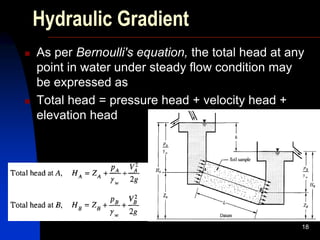
Hydraulic Gradient
 As per Bernoulli's equation, the total head at any
point in water under steady flow condition may
be expressed as
 Total head = pressure head + velocity head +
elevation head
18
19
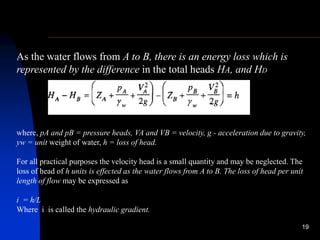
As the water flows from A to B, there is an energy loss which is
represented by the difference in the total heads HA, and HD
where, pA and pB = pressure heads, VA and VB = velocity, g - acceleration due to gravity,
yw = unit weight of water, h = loss of head.
For all practical purposes the velocity head is a small quantity and may be neglected. The
loss of head of h units is effected as the water flows from A to B. The loss of head per unit
length of flow may be expressed as
i = h/L
Where i is called the hydraulic gradient.
DARCY'S LAW
 Darcy in 1856 derived an empirical formula for the behavior of
flow through saturated soils. He found that the quantity of
water q per sec flowing through a cross-sectional area of soil
under hydraulic gradient i can be expressed by the formula.
 q = kiA
 or the velocity of flow can be written as v = ki
 where k is termed the hydraulic conductivity (or coefficient
of permeability)with units of velocity.
 A is the cross-sectional area of soil normal to the direction
of flow
 It is found that, on the basis of extensive investigations
made since Darcy introduced his law in 1856, this law
is valid strictly for fine grained types of soils.
20
METHODS OF DETERMINATION OF HYDRAULIC
CONDUCTIVITY OF SOILS
 Methods that are in common use for determining
the coefficient of permeability k can be classified
under laboratory and field methods.
 Laboratory methods:
 Constant head permeability method
 Falling head permeability method
 Field methods:
 Pumping tests
 Bore hole tests
 Indirect Method:
 Empirical correlations
21
CONSTANT HEAD PERMEABILITY TEST
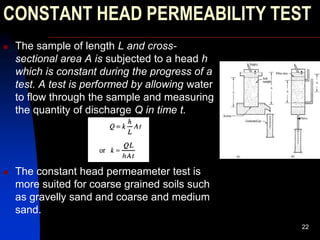
 The sample of length L and cross-
sectional area A is subjected to a head h
which is constant during the progress of a
test. A test is performed by allowing water
to flow through the sample and measuring
the quantity of discharge Q in time t.
 The constant head permeameter test is
more suited for coarse grained soils such
as gravelly sand and coarse and medium
sand.
22
HYDRAULIC CONDUCTIVITY IN STRATIFIED
LAYERS OF SOILS
 Hydraulic conductivity of a disturbed sample may be
different from that of the undisturbed sample even though
the void ratio is the same.
 This may be due to a change in the structure or due to the
stratification of the undisturbed soil or a combination of both
of these factors.
 Two fine-grained soils at the same void ratio, one dispersed
and the other flocculated, will exhibit different permeabilities.
 The average permeability of stratified soil can be computed
if the permeabilities of each layer are determined in the
laboratory.
23
The essential points are:
1. The flow of water through soils is governed by
Darcy's law, which states that the average flow
velocity is proportional to the hydraulic gradient.
2. The proportionality coefficient in Darcy's law is
called the coefficient of permeability or hydraulic
conductivity, k.
3. The value of k is influenced by the void ratio,
particle size distribution, and the wholeness of the
soil mass.
4. Homogeneous clays are practically impervious
while sands and gravels are pervious.
24
Effects of Seepage
The interaction between soils and percolating water has an
important influence on:
 The design of foundations and earth slopes,
 The quantity of water that will be lost by percolation
through a dam or its subsoil.
 As water flows through soil it exerts a frictional drag on the
soil particles resulting in head losses. The frictional drag is
called seepage force in soil mechanics.
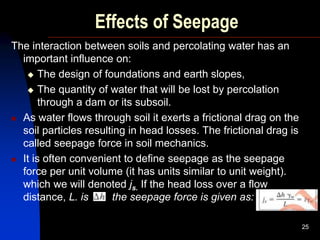
 It is often convenient to define seepage as the seepage
force per unit volume (it has units similar to unit weight).
which we will denoted js. If the head loss over a flow
distance, L. is the seepage force is given as:
25
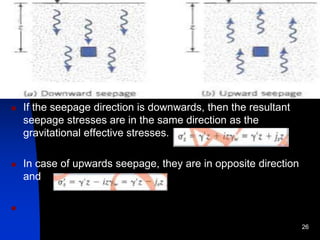
 If the seepage direction is downwards, then the resultant
seepage stresses are in the same direction as the
gravitational effective stresses.
 In case of upwards seepage, they are in opposite direction
and

26
Effect of seepage on structures
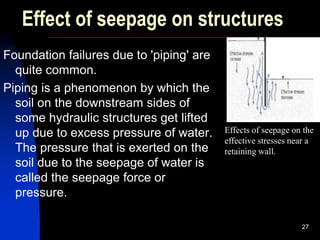
Foundation failures due to 'piping' are
quite common.
Piping is a phenomenon by which the
soil on the downstream sides of
some hydraulic structures get lifted
up due to excess pressure of water.
The pressure that is exerted on the
soil due to the seepage of water is
called the seepage force or
pressure.
27
Effects of seepage on the
effective stresses near a
retaining wall.
Effects of Seepage Cont’d
In the stability of slopes, the seepage force is a very
important factor. Shear strengths of soils are
reduced due to the development of neutral stress or
pore pressures.
A detailed understanding of the hydraulic conditions is
therefore essential for a satisfactory design of
structures. The computation of seepage loss under
or through a dam, the uplift pressures caused by
the water on the base of a concrete dam and the
effect of seepage on the stability of earth slopes can
be studied by constructing flow nets.
28
Effect of seepage on structures
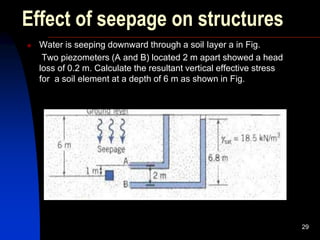
 Water is seeping downward through a soil Iayer a in Fig.
Two piezometers (A and B) located 2 m apart showed a head
loss of 0.2 m. Calculate the resultant vertical effective stress
for a soil element at a depth of 6 m as shown in Fig.
29
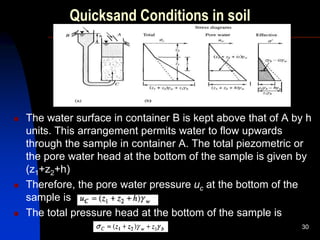
Quicksand Conditions in soil
 The water surface in container B is kept above that of A by h
units. This arrangement permits water to flow upwards
through the sample in container A. The total piezometric or
the pore water head at the bottom of the sample is given by
(z1+z2+h)
 Therefore, the pore water pressure uc at the bottom of the
sample is
 The total pressure head at the bottom of the sample is
30
Filter Requirements to Control Piping.
 Filter drains are required on the downstream sides of hydraulic
structures and around drainage pipes.
 A properly graded filter prevents the erosion of soil in contact
with it due to seepage forces.
 To prevent the movement of erodible soils into or through
filters, the pore spaces between the filter particles should be
small enough to hold some of the protected materials in place.
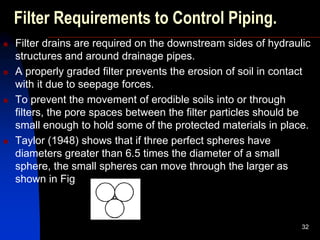
 Taylor (1948) shows that if three perfect spheres have
diameters greater than 6.5 times the diameter of a small
sphere, the small spheres can move through the larger as
shown in Fig
32
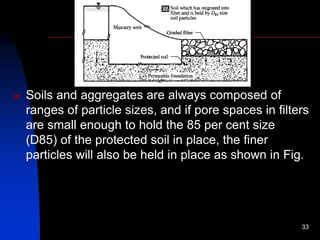
 Soils and aggregates are always composed of
ranges of particle sizes, and if pore spaces in filters
are small enough to hold the 85 per cent size
(D85) of the protected soil in place, the finer
particles will also be held in place as shown in Fig.
33

Unit 4 ENGINEERING PROPERTIES OF SOIL.ppt

  • 1.
    SIVA 1 Soil Science Engineering ENGINEERINGPROPERTIES OF SOIL ground S.Satheeshkumar AP/AGE Kongunadu College of Engineering and Technology
  • 2.
  • 3.
  • 4.
  • 5.
  • 6.
  • 7.
  • 8.
  • 9.
  • 10.
  • 11.
  • 12.
  • 13.
  • 14.
  • 15.
  • 16.
     Soils areassemblages of solid particles with interconnected voids where water can flow from a point of high energy to a point of low energy.  The study of flow water through porous media is important for stability analyses of earth retaining structures subjected to seepage force  Permeability:  The property of soils that allows water to pass through them at some rate  The property is a product of the granular nature of the soil, although it can be affected by other factors (such as water bonding in clays). Different soil has different permeabilities.16
  • 17.
     The permeabilityof soils has a decisive effect on the stability of foundations, seepage loss through embankments of reservoirs, drainage of sub grades, excavation of open cuts in water bearing sand, rate of flow of water into wells and many others. 17
  • 18.
    Hydraulic Gradient  Asper Bernoulli's equation, the total head at any point in water under steady flow condition may be expressed as  Total head = pressure head + velocity head + elevation head 18
  • 19.
    19 As the waterflows from A to B, there is an energy loss which is represented by the difference in the total heads HA, and HD where, pA and pB = pressure heads, VA and VB = velocity, g - acceleration due to gravity, yw = unit weight of water, h = loss of head. For all practical purposes the velocity head is a small quantity and may be neglected. The loss of head of h units is effected as the water flows from A to B. The loss of head per unit length of flow may be expressed as i = h/L Where i is called the hydraulic gradient.
  • 20.
    DARCY'S LAW  Darcyin 1856 derived an empirical formula for the behavior of flow through saturated soils. He found that the quantity of water q per sec flowing through a cross-sectional area of soil under hydraulic gradient i can be expressed by the formula.  q = kiA  or the velocity of flow can be written as v = ki  where k is termed the hydraulic conductivity (or coefficient of permeability)with units of velocity.  A is the cross-sectional area of soil normal to the direction of flow  It is found that, on the basis of extensive investigations made since Darcy introduced his law in 1856, this law is valid strictly for fine grained types of soils. 20
  • 21.
    METHODS OF DETERMINATIONOF HYDRAULIC CONDUCTIVITY OF SOILS  Methods that are in common use for determining the coefficient of permeability k can be classified under laboratory and field methods.  Laboratory methods:  Constant head permeability method  Falling head permeability method  Field methods:  Pumping tests  Bore hole tests  Indirect Method:  Empirical correlations 21
  • 22.
    CONSTANT HEAD PERMEABILITYTEST  The sample of length L and cross- sectional area A is subjected to a head h which is constant during the progress of a test. A test is performed by allowing water to flow through the sample and measuring the quantity of discharge Q in time t.  The constant head permeameter test is more suited for coarse grained soils such as gravelly sand and coarse and medium sand. 22
  • 23.
    HYDRAULIC CONDUCTIVITY INSTRATIFIED LAYERS OF SOILS  Hydraulic conductivity of a disturbed sample may be different from that of the undisturbed sample even though the void ratio is the same.  This may be due to a change in the structure or due to the stratification of the undisturbed soil or a combination of both of these factors.  Two fine-grained soils at the same void ratio, one dispersed and the other flocculated, will exhibit different permeabilities.  The average permeability of stratified soil can be computed if the permeabilities of each layer are determined in the laboratory. 23
  • 24.
    The essential pointsare: 1. The flow of water through soils is governed by Darcy's law, which states that the average flow velocity is proportional to the hydraulic gradient. 2. The proportionality coefficient in Darcy's law is called the coefficient of permeability or hydraulic conductivity, k. 3. The value of k is influenced by the void ratio, particle size distribution, and the wholeness of the soil mass. 4. Homogeneous clays are practically impervious while sands and gravels are pervious. 24
  • 25.
    Effects of Seepage Theinteraction between soils and percolating water has an important influence on:  The design of foundations and earth slopes,  The quantity of water that will be lost by percolation through a dam or its subsoil.  As water flows through soil it exerts a frictional drag on the soil particles resulting in head losses. The frictional drag is called seepage force in soil mechanics.  It is often convenient to define seepage as the seepage force per unit volume (it has units similar to unit weight). which we will denoted js. If the head loss over a flow distance, L. is the seepage force is given as: 25
  • 26.
     If theseepage direction is downwards, then the resultant seepage stresses are in the same direction as the gravitational effective stresses.  In case of upwards seepage, they are in opposite direction and  26
  • 27.
    Effect of seepageon structures Foundation failures due to 'piping' are quite common. Piping is a phenomenon by which the soil on the downstream sides of some hydraulic structures get lifted up due to excess pressure of water. The pressure that is exerted on the soil due to the seepage of water is called the seepage force or pressure. 27 Effects of seepage on the effective stresses near a retaining wall.
  • 28.
    Effects of SeepageCont’d In the stability of slopes, the seepage force is a very important factor. Shear strengths of soils are reduced due to the development of neutral stress or pore pressures. A detailed understanding of the hydraulic conditions is therefore essential for a satisfactory design of structures. The computation of seepage loss under or through a dam, the uplift pressures caused by the water on the base of a concrete dam and the effect of seepage on the stability of earth slopes can be studied by constructing flow nets. 28
  • 29.
    Effect of seepageon structures  Water is seeping downward through a soil Iayer a in Fig. Two piezometers (A and B) located 2 m apart showed a head loss of 0.2 m. Calculate the resultant vertical effective stress for a soil element at a depth of 6 m as shown in Fig. 29
  • 30.
    Quicksand Conditions insoil  The water surface in container B is kept above that of A by h units. This arrangement permits water to flow upwards through the sample in container A. The total piezometric or the pore water head at the bottom of the sample is given by (z1+z2+h)  Therefore, the pore water pressure uc at the bottom of the sample is  The total pressure head at the bottom of the sample is 30
  • 31.
    Filter Requirements toControl Piping.  Filter drains are required on the downstream sides of hydraulic structures and around drainage pipes.  A properly graded filter prevents the erosion of soil in contact with it due to seepage forces.  To prevent the movement of erodible soils into or through filters, the pore spaces between the filter particles should be small enough to hold some of the protected materials in place.  Taylor (1948) shows that if three perfect spheres have diameters greater than 6.5 times the diameter of a small sphere, the small spheres can move through the larger as shown in Fig 32
  • 32.
     Soils andaggregates are always composed of ranges of particle sizes, and if pore spaces in filters are small enough to hold the 85 per cent size (D85) of the protected soil in place, the finer particles will also be held in place as shown in Fig. 33