COMPACTION
R.Ravindranath,M.E(Geo. Tech)
WHAT IS COMPACTION?
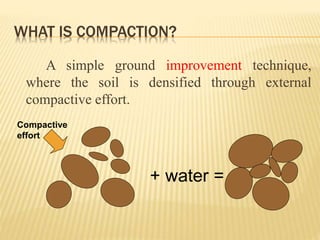
A simple ground improvement technique,
where the soil is densified through external
compactive effort.
Compactive
effort
+ water =
Compaction is the process,
The soil particles are artificially rearranged
& packed together into closer state of contact
by mechanical means in order to decrease the
porosity of soil and increase its dry density.
LABORATORY COMPACTION TEST
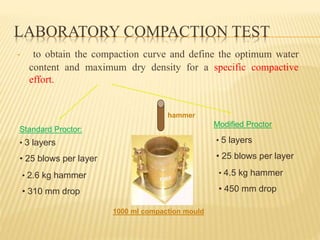
- to obtain the compaction curve and define the optimum water
content and maximum dry density for a specific compactive
effort.
1000 ml compaction mould
hammer
Standard Proctor:
Modified Proctor:
• 3 layers
• 25 blows per layer
• 2.6 kg hammer
• 310 mm drop
• 5 layers
• 25 blows per layer
• 4.5 kg hammer
• 450 mm drop
LABORATORY COMPACTION TEST
STANDARD PROCTOR TEST :
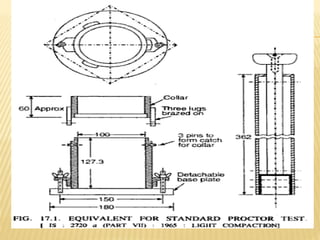
 A cylindrical mould of 100mm internal diameter,
internal effective height 127.3mm, capacity of
1000 cc.
 Detachable base plate with removable extension
collar
 Metallic rammer of diameter 50mm, weight 2.6
kg with a fall of 310 mm
 Steel straight edge of about 300 mm in length
with one edge leveled
 Balance (0.01g sensitivity, 10 kg capacity)
 Is sieve 20mm and 4.75 mm
PROCEDURE
 Prepare about 6 kg of soil sample for 1000cc mould
by sieving it through 20mm and retained at 4.75 mm
 Clean, dry and slightly grease the mould and the
base plate. Weigh the empty mould with the base plate
without extension collar
 Take about 2.5 kg of soil for 100 mm dia mould for
light compaction.
 Add water to the soil specimen to bring the moisture
content to about 4 to 5 % in sandy soil. Mix the water
with soil thoroughly.
 Divide the wet soil into three equal parts. Put the soil
in three layers and compact. Each layer is given 25 blows.
 Before putting the second layer, make scratches on
the first layer with the help of a sharp edged tool.
 The second and third layers are similarly compacted.
 Rotate the collar to break the bond between it and soil
and then remove the collar.
 Trim off the soil to make it flush with the top of the
mould.
 Clean the loose soil from outside and base of the
mould.
 Weigh the mould with base plate and compacted soil.
Now eject the soil out of mould. Take a representative soil
sample from the centre and keep it in oven for water
content determination.
 Repeat the procedure by six to seven times by
increasing the water content by 2% in each turn
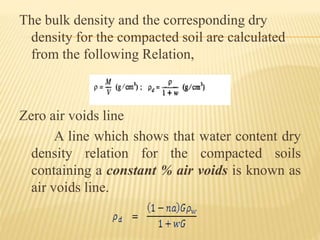
The bulk density and the corresponding dry
density for the compacted soil are calculated
from the following Relation,
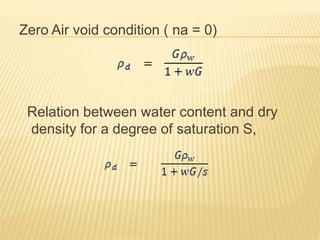
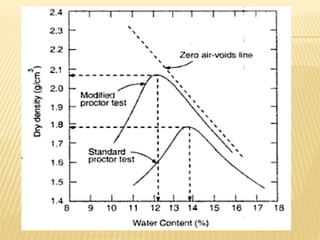
Zero air voids line
A line which shows that water content dry
density relation for the compacted soils
containing a constant % air voids is known as
air voids line.
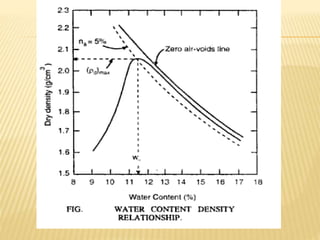
Zero Air void condition ( na = 0)
Relation between water content and dry
density for a degree of saturation S,
MODIFIED PROCTOR TEST
This compaction is needed for heavier
transport and military aircraft.
In this test ,
• 5 layers
• 25 blows per layer
• 4.5 kg hammer
• 450 mm drop
FIELD COMPACTION TEST
Soils can be compacted in the field by 3
method
1.Rolling
2.Ramming(impact)
3.vibration
1.Rolling Equipments:
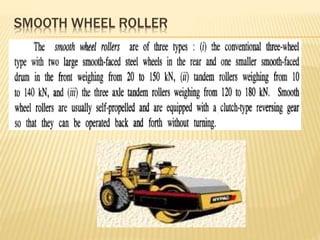
1.Smooth wheel Roller(crushed rock ,
granular , sand)
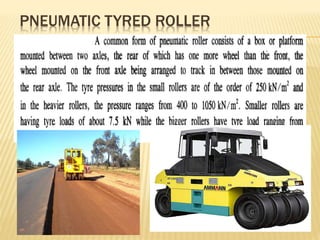
2. Pneumatic tyred roller (both soils)
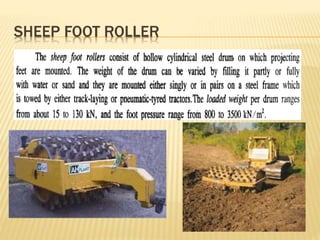
3.Sheep foot roller ( cohesive soil)
4.Lorries and Pneumatic tyred roller
construction plant.
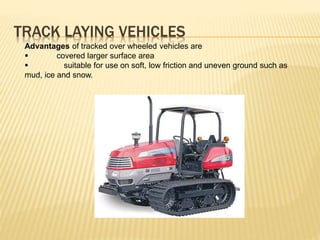
5.Track laying vehicles.
2.Ramming Equipments ( confined place)
1.dropping weight type.
2.Internal combustion type.
3. Pneumatic type.
3.Vibratiors( Cohesion less soil)
1.dropping weight type
2.pulsating hydraulic types
SMOOTH WHEEL ROLLER
PNEUMATIC TYRED ROLLER
SHEEP FOOT ROLLER
TRACK LAYING VEHICLES
Advantages of tracked over wheeled vehicles are
 covered larger surface area
 suitable for use on soft, low friction and uneven ground such as
mud, ice and snow.
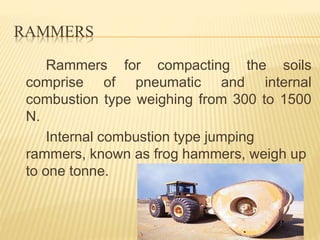
RAMMERS
Rammers for compacting the soils
comprise of pneumatic and internal
combustion type weighing from 300 to 1500
N.
Internal combustion type jumping
rammers, known as frog hammers, weigh up
to one tonne.
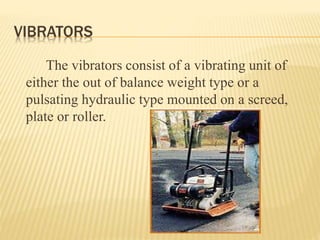
VIBRATORS
The vibrators consist of a vibrating unit of
either the out of balance weight type or a
pulsating hydraulic type mounted on a screed,
plate or roller.
FACTOR AFFECTING COMPACTION
 WATER CONTENT
 AMOUNT OF COMPACTION
 TYPE OF COMPACTION
 TYPE OF SOIL
 ADDITION OF ADMIXTURE
WATER CONTENT:
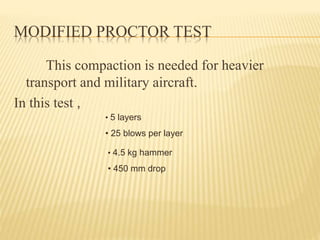
From laboratory compaction tests
the water content is increased , the
compacted density goes on increasing, till a
max dry density is achieved after which
further addition of water decrease the
density.
AMOUNT OF COMPACTION:
The effect of increasing the
compacting energy result in an increase in tne
max dry density and decrease the optimum
water content.
METHOD OF COMPACTION:
The various aspects are ,
1. Weight of compacting equipment.
2. The manner of operation
3. Time & area of contact between the
compacting element & the soils.
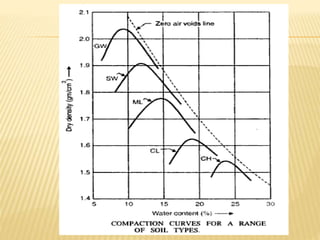
TYPE OF SOILS:
The maximum dry density of the soil depends upon “
type of soil”.
 WELL GRADED COARSE GRAINED soils attain a much
higher density & lower optimum water contents.
 FINE GRAINED soils which require more water for lubrication
because of the greater specific surface.
ADDITION OF ADMIXTURE:
Addition of certain admixtures to
soils results in modification of its compaction
properties.
CALCIUM CHLORIDE has been a
widely used chemical additive.
EFFECT OF COMPACTION ON SOME SOIL
PROPERTIES
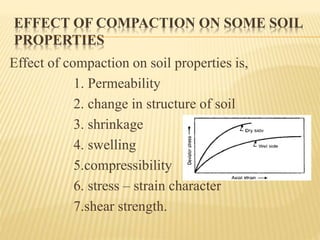
Effect of compaction on soil properties is,
1. Permeability
2. change in structure of soil
3. shrinkage
4. swelling
5.compressibility
6. stress – strain character
7.shear strength.
PLACEMENT WATER CONTENT
The water content used in the field
compaction is called the placement water
content.
It may be Equal to, lower than or higher
than the optimum water content determined in
the laboratory.

Compaction

  • 1.
  • 2.
    WHAT IS COMPACTION? Asimple ground improvement technique, where the soil is densified through external compactive effort. Compactive effort + water =
  • 3.
    Compaction is theprocess, The soil particles are artificially rearranged & packed together into closer state of contact by mechanical means in order to decrease the porosity of soil and increase its dry density.
  • 4.
    LABORATORY COMPACTION TEST -to obtain the compaction curve and define the optimum water content and maximum dry density for a specific compactive effort. 1000 ml compaction mould hammer Standard Proctor: Modified Proctor: • 3 layers • 25 blows per layer • 2.6 kg hammer • 310 mm drop • 5 layers • 25 blows per layer • 4.5 kg hammer • 450 mm drop
  • 5.
    LABORATORY COMPACTION TEST STANDARDPROCTOR TEST :  A cylindrical mould of 100mm internal diameter, internal effective height 127.3mm, capacity of 1000 cc.  Detachable base plate with removable extension collar  Metallic rammer of diameter 50mm, weight 2.6 kg with a fall of 310 mm  Steel straight edge of about 300 mm in length with one edge leveled  Balance (0.01g sensitivity, 10 kg capacity)  Is sieve 20mm and 4.75 mm
  • 7.
    PROCEDURE  Prepare about6 kg of soil sample for 1000cc mould by sieving it through 20mm and retained at 4.75 mm  Clean, dry and slightly grease the mould and the base plate. Weigh the empty mould with the base plate without extension collar  Take about 2.5 kg of soil for 100 mm dia mould for light compaction.  Add water to the soil specimen to bring the moisture content to about 4 to 5 % in sandy soil. Mix the water with soil thoroughly.  Divide the wet soil into three equal parts. Put the soil in three layers and compact. Each layer is given 25 blows.
  • 8.
     Before puttingthe second layer, make scratches on the first layer with the help of a sharp edged tool.  The second and third layers are similarly compacted.  Rotate the collar to break the bond between it and soil and then remove the collar.  Trim off the soil to make it flush with the top of the mould.  Clean the loose soil from outside and base of the mould.  Weigh the mould with base plate and compacted soil. Now eject the soil out of mould. Take a representative soil sample from the centre and keep it in oven for water content determination.  Repeat the procedure by six to seven times by increasing the water content by 2% in each turn
  • 9.
    The bulk densityand the corresponding dry density for the compacted soil are calculated from the following Relation, Zero air voids line A line which shows that water content dry density relation for the compacted soils containing a constant % air voids is known as air voids line.
  • 10.
    Zero Air voidcondition ( na = 0) Relation between water content and dry density for a degree of saturation S,
  • 12.
    MODIFIED PROCTOR TEST Thiscompaction is needed for heavier transport and military aircraft. In this test , • 5 layers • 25 blows per layer • 4.5 kg hammer • 450 mm drop
  • 14.
    FIELD COMPACTION TEST Soilscan be compacted in the field by 3 method 1.Rolling 2.Ramming(impact) 3.vibration
  • 15.
    1.Rolling Equipments: 1.Smooth wheelRoller(crushed rock , granular , sand) 2. Pneumatic tyred roller (both soils) 3.Sheep foot roller ( cohesive soil) 4.Lorries and Pneumatic tyred roller construction plant. 5.Track laying vehicles.
  • 16.
    2.Ramming Equipments (confined place) 1.dropping weight type. 2.Internal combustion type. 3. Pneumatic type. 3.Vibratiors( Cohesion less soil) 1.dropping weight type 2.pulsating hydraulic types
  • 17.
  • 18.
  • 19.
  • 20.
    TRACK LAYING VEHICLES Advantagesof tracked over wheeled vehicles are  covered larger surface area  suitable for use on soft, low friction and uneven ground such as mud, ice and snow.
  • 21.
    RAMMERS Rammers for compactingthe soils comprise of pneumatic and internal combustion type weighing from 300 to 1500 N. Internal combustion type jumping rammers, known as frog hammers, weigh up to one tonne.
  • 22.
    VIBRATORS The vibrators consistof a vibrating unit of either the out of balance weight type or a pulsating hydraulic type mounted on a screed, plate or roller.
  • 23.
    FACTOR AFFECTING COMPACTION WATER CONTENT  AMOUNT OF COMPACTION  TYPE OF COMPACTION  TYPE OF SOIL  ADDITION OF ADMIXTURE
  • 24.
    WATER CONTENT: From laboratorycompaction tests the water content is increased , the compacted density goes on increasing, till a max dry density is achieved after which further addition of water decrease the density.
  • 25.
    AMOUNT OF COMPACTION: Theeffect of increasing the compacting energy result in an increase in tne max dry density and decrease the optimum water content. METHOD OF COMPACTION: The various aspects are , 1. Weight of compacting equipment. 2. The manner of operation 3. Time & area of contact between the compacting element & the soils.
  • 26.
    TYPE OF SOILS: Themaximum dry density of the soil depends upon “ type of soil”.  WELL GRADED COARSE GRAINED soils attain a much higher density & lower optimum water contents.  FINE GRAINED soils which require more water for lubrication because of the greater specific surface.
  • 28.
    ADDITION OF ADMIXTURE: Additionof certain admixtures to soils results in modification of its compaction properties. CALCIUM CHLORIDE has been a widely used chemical additive.
  • 29.
    EFFECT OF COMPACTIONON SOME SOIL PROPERTIES Effect of compaction on soil properties is, 1. Permeability 2. change in structure of soil 3. shrinkage 4. swelling 5.compressibility 6. stress – strain character 7.shear strength.
  • 30.
    PLACEMENT WATER CONTENT Thewater content used in the field compaction is called the placement water content. It may be Equal to, lower than or higher than the optimum water content determined in the laboratory.