Addis Ababa University Institute of Technology
School of Civil and Environmental Engneering
Hydraulic Engineering Stream
Course: Planning and Design of Dams(CENG-6607)
Project work: Design and Stability Analysis of Gravity Dam
Group -1
Presentation Title : Loads on Gravity Dam
Presenter : Dereje Fituma
ID: GSR/7847/11
Instructor : Dr. Daneal F.Sillassie
Load on Gravity Dam
Based on applicability and relative importance load applied on
gravity dam classified as:
• Primary load
• Secondary load
• Exceptional load
 Primary load: are identified as those major importance for all dams,
irrespective of type,
Example; Head water ,self weight, Uplift pressure
load.png
Cont…
Water Load :the hydrostatic distribution pressure, for head water and tail water.
• It magnitude can be quantified as; unit weight of water times by water depth
measured from the base.
• Two condition possible to determine force components : when upstream is vertical
and upstream is inclined face .
Picture1.png
• For over flow section the water load determined :
• Capture.JPG
Dead Load: self weight of the structure
• Its magnitude quantified as; unit weight of concrete times by cross sectional area
of the dam.
• Unit weight determined from material test, usually 24 kN/m3.
Cont…
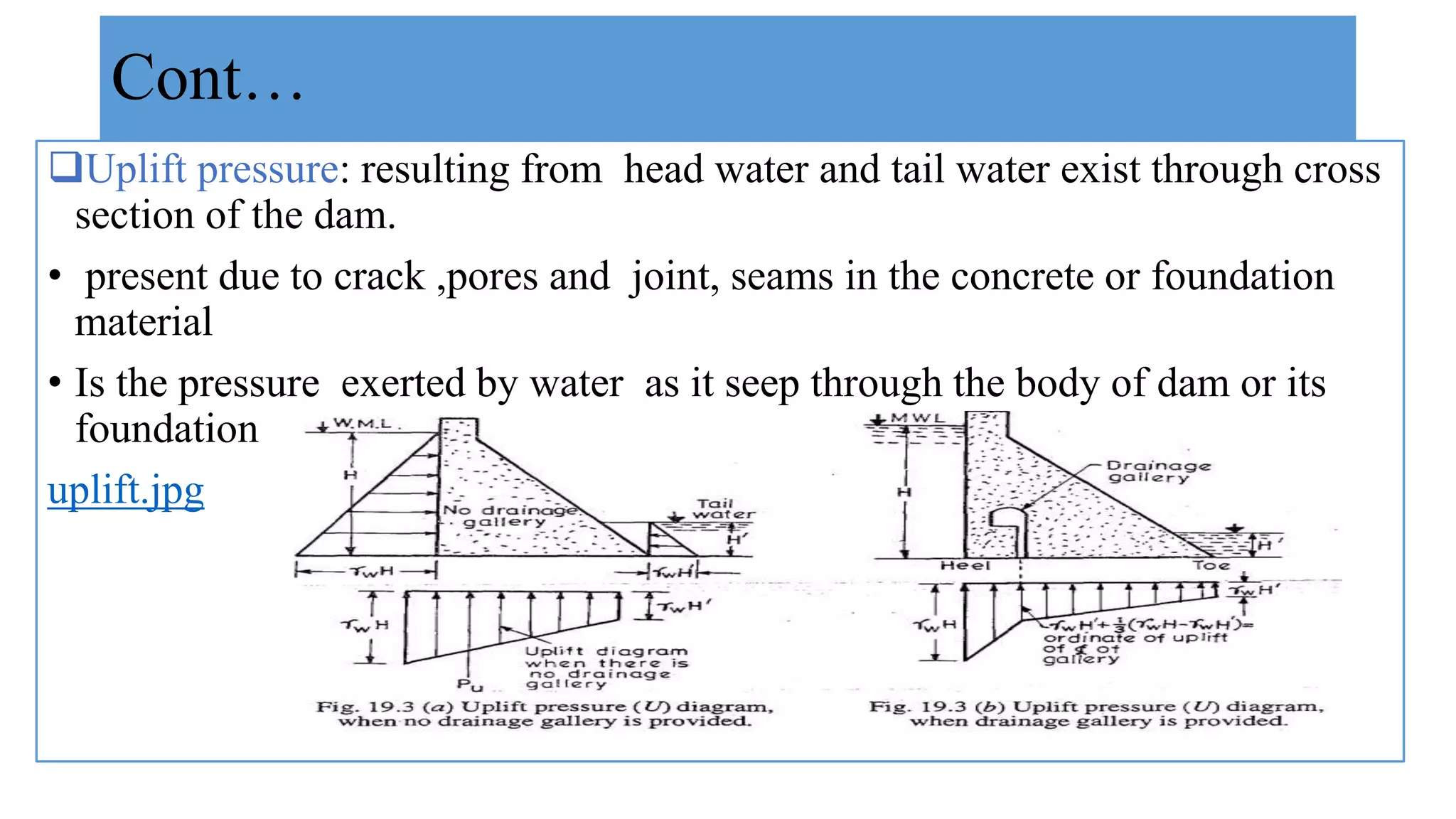
Uplift pressure: resulting from head water and tail water exist through cross
section of the dam.
• present due to crack ,pores and joint, seams in the concrete or foundation
material
• Is the pressure exerted by water as it seep through the body of dam or its
foundation
uplift.jpg
Secondary load
Are universally applicable although lesser magnitude or Major importance
only certain type of dams
• Example: Silt load, wave pressure, thermal load
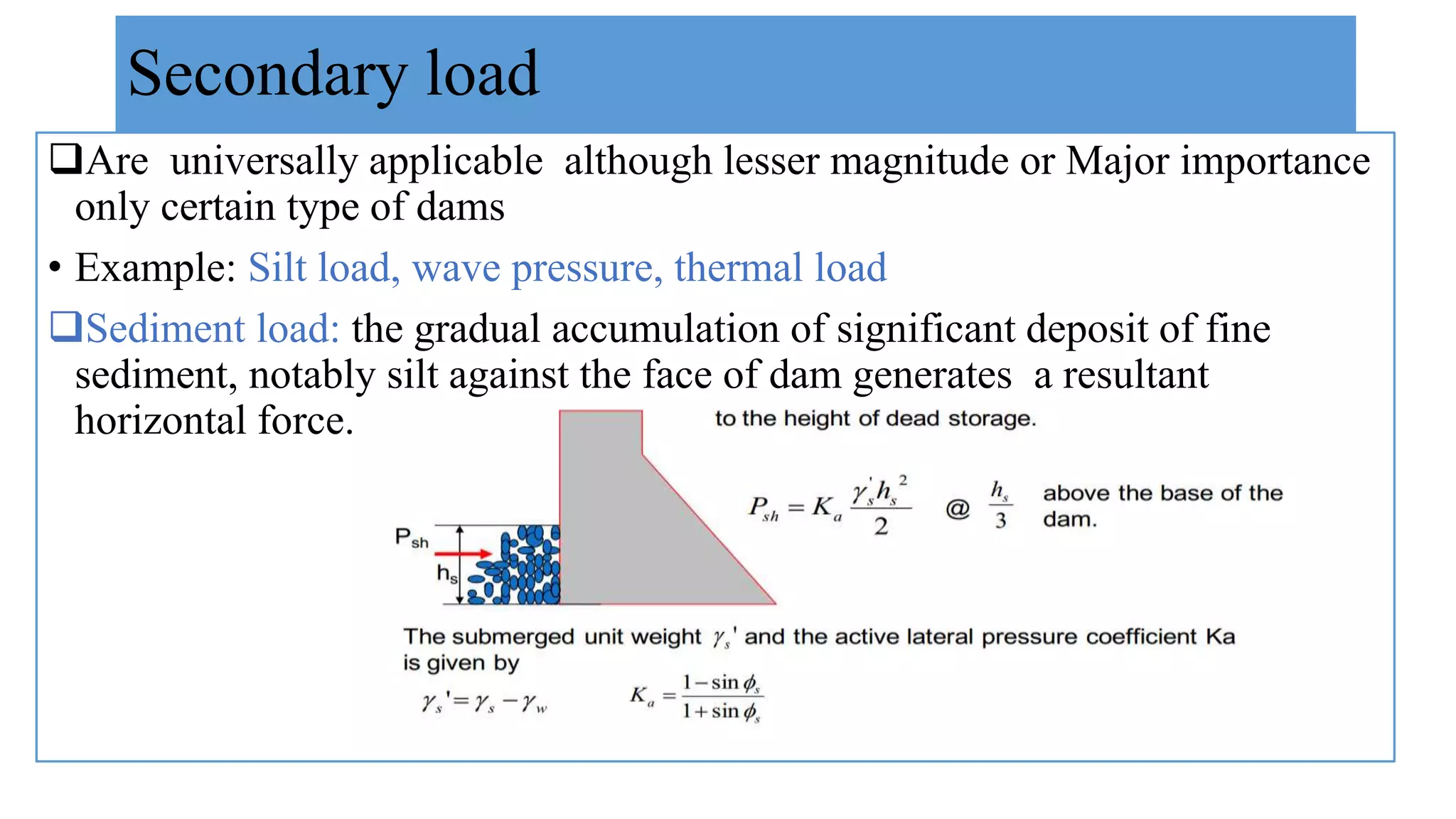
Sediment load: the gradual accumulation of significant deposit of fine
sediment, notably silt against the face of dam generates a resultant
horizontal force.
Cont..
Wave pressure :wave are generated on the reservoir by blowing winds
Cont…
Wind load: when dam is full wind acts only on down stream side thus contribute
to stability .
• The top exposed portion of the dam is small and hence the wind pressure on this
portion of dam is negligible
• It may be taken as 100 to 150 kg/m² for
the area exposed to the wind pressure
(Varshney, 1986)
Cont…
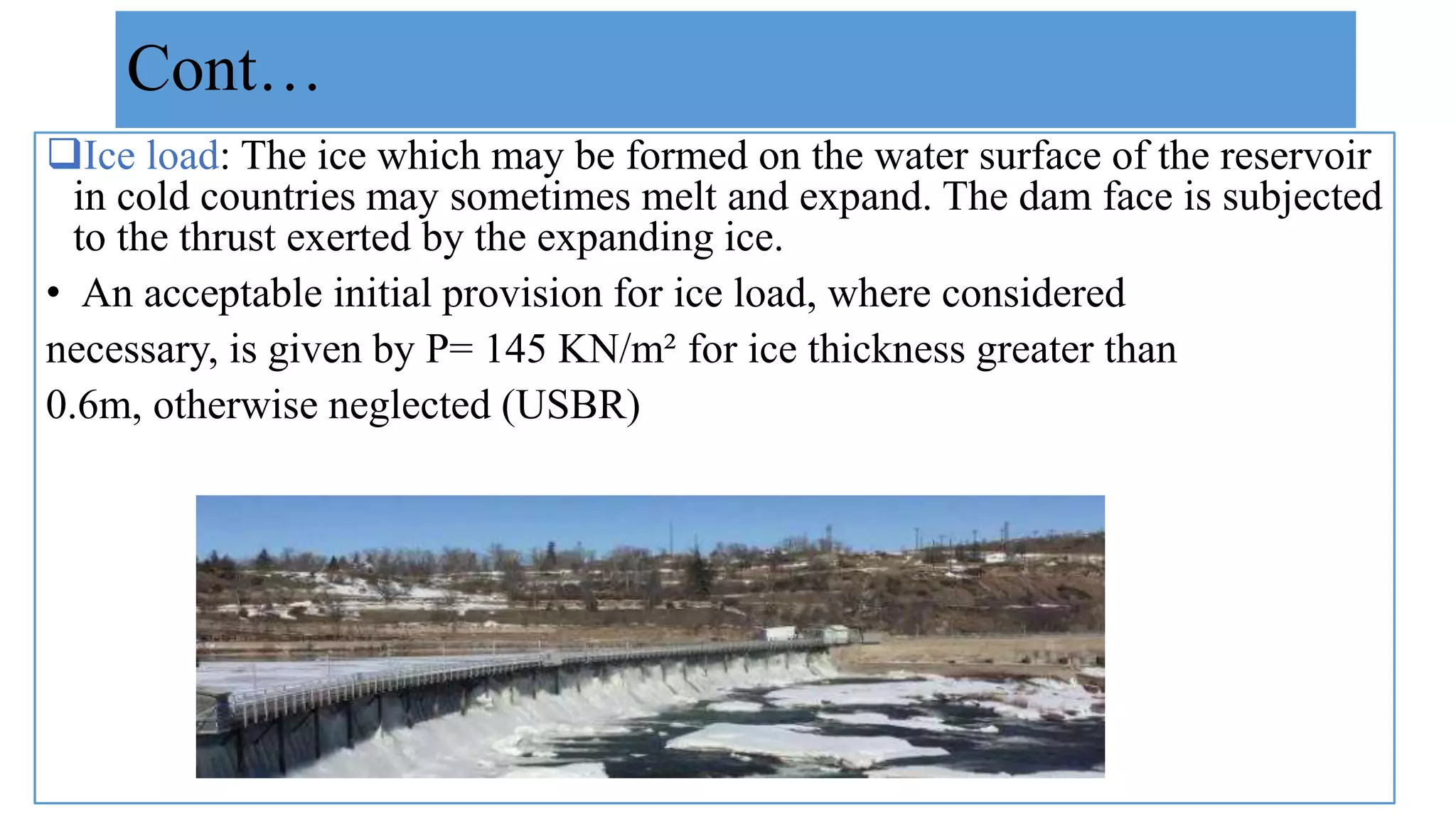
Ice load: The ice which may be formed on the water surface of the reservoir
in cold countries may sometimes melt and expand. The dam face is subjected
to the thrust exerted by the expanding ice.
• An acceptable initial provision for ice load, where considered
necessary, is given by P= 145 KN/m² for ice thickness greater than
0.6m, otherwise neglected (USBR)
Exceptional loads
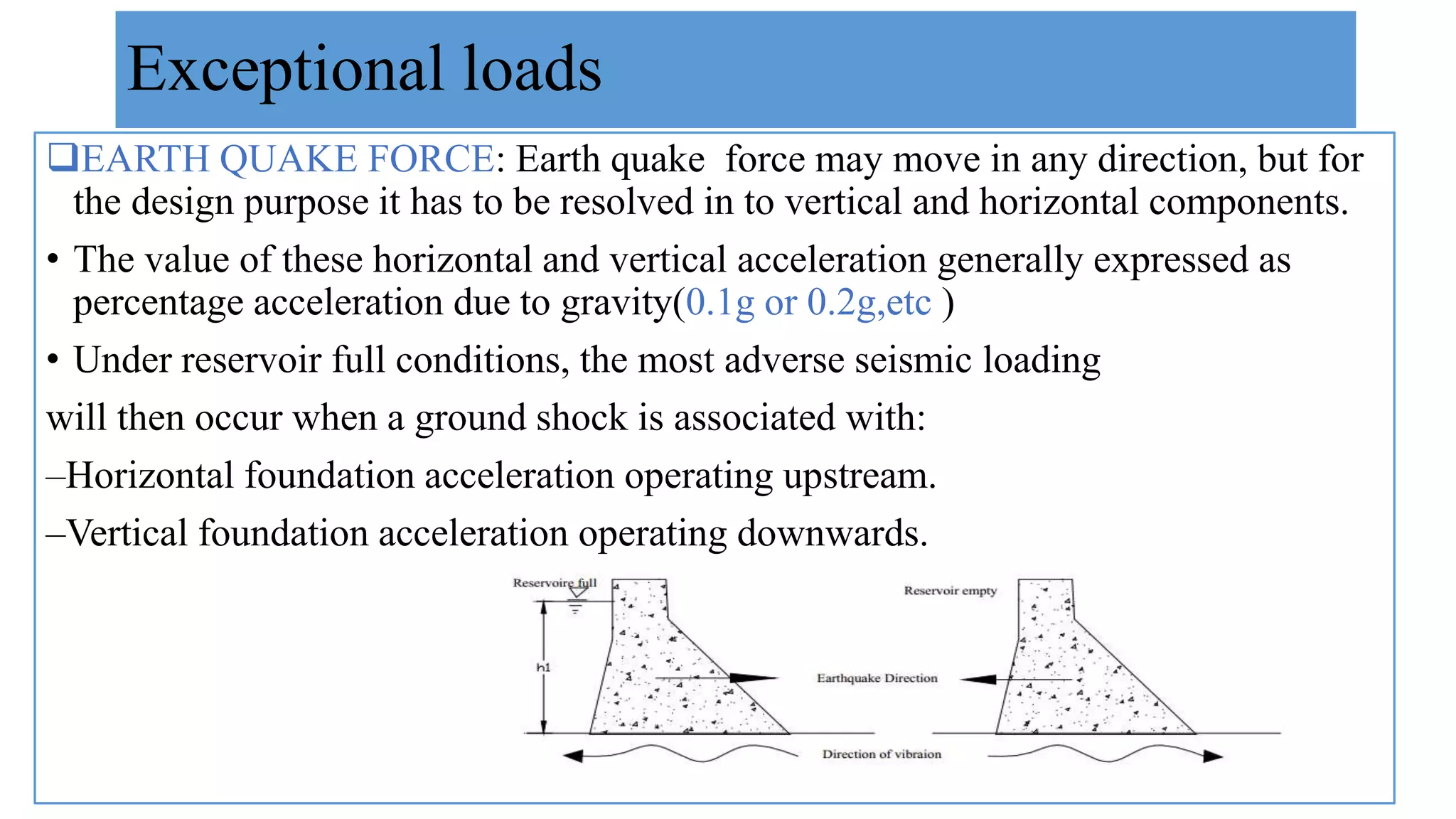
EARTH QUAKE FORCE: Earth quake force may move in any direction, but for
the design purpose it has to be resolved in to vertical and horizontal components.
• The value of these horizontal and vertical acceleration generally expressed as
percentage acceleration due to gravity(0.1g or 0.2g,etc )
• Under reservoir full conditions, the most adverse seismic loading
will then occur when a ground shock is associated with:
–Horizontal foundation acceleration operating upstream.
–Vertical foundation acceleration operating downwards.
Cont..
Earth quake force on foundation, dam ,reservoir acts inform of: Inertia force
and water body
Load Combination
Gravity Dam: Normal load ,unusual load, extreme load combination
Thank you!!

Load on Gravity Dam

  • 1.
    Addis Ababa UniversityInstitute of Technology School of Civil and Environmental Engneering Hydraulic Engineering Stream Course: Planning and Design of Dams(CENG-6607) Project work: Design and Stability Analysis of Gravity Dam Group -1 Presentation Title : Loads on Gravity Dam Presenter : Dereje Fituma ID: GSR/7847/11 Instructor : Dr. Daneal F.Sillassie
  • 2.
    Load on GravityDam Based on applicability and relative importance load applied on gravity dam classified as: • Primary load • Secondary load • Exceptional load  Primary load: are identified as those major importance for all dams, irrespective of type, Example; Head water ,self weight, Uplift pressure load.png
  • 3.
    Cont… Water Load :thehydrostatic distribution pressure, for head water and tail water. • It magnitude can be quantified as; unit weight of water times by water depth measured from the base. • Two condition possible to determine force components : when upstream is vertical and upstream is inclined face . Picture1.png • For over flow section the water load determined : • Capture.JPG Dead Load: self weight of the structure • Its magnitude quantified as; unit weight of concrete times by cross sectional area of the dam. • Unit weight determined from material test, usually 24 kN/m3.
  • 4.
    Cont… Uplift pressure: resultingfrom head water and tail water exist through cross section of the dam. • present due to crack ,pores and joint, seams in the concrete or foundation material • Is the pressure exerted by water as it seep through the body of dam or its foundation uplift.jpg
  • 5.
    Secondary load Are universallyapplicable although lesser magnitude or Major importance only certain type of dams • Example: Silt load, wave pressure, thermal load Sediment load: the gradual accumulation of significant deposit of fine sediment, notably silt against the face of dam generates a resultant horizontal force.
  • 6.
    Cont.. Wave pressure :waveare generated on the reservoir by blowing winds
  • 7.
    Cont… Wind load: whendam is full wind acts only on down stream side thus contribute to stability . • The top exposed portion of the dam is small and hence the wind pressure on this portion of dam is negligible • It may be taken as 100 to 150 kg/m² for the area exposed to the wind pressure (Varshney, 1986)
  • 8.
    Cont… Ice load: Theice which may be formed on the water surface of the reservoir in cold countries may sometimes melt and expand. The dam face is subjected to the thrust exerted by the expanding ice. • An acceptable initial provision for ice load, where considered necessary, is given by P= 145 KN/m² for ice thickness greater than 0.6m, otherwise neglected (USBR)
  • 9.
    Exceptional loads EARTH QUAKEFORCE: Earth quake force may move in any direction, but for the design purpose it has to be resolved in to vertical and horizontal components. • The value of these horizontal and vertical acceleration generally expressed as percentage acceleration due to gravity(0.1g or 0.2g,etc ) • Under reservoir full conditions, the most adverse seismic loading will then occur when a ground shock is associated with: –Horizontal foundation acceleration operating upstream. –Vertical foundation acceleration operating downwards.
  • 10.
    Cont.. Earth quake forceon foundation, dam ,reservoir acts inform of: Inertia force and water body
  • 11.
    Load Combination Gravity Dam:Normal load ,unusual load, extreme load combination
  • 12.