SOIL COMPACTION
AND ITS EFFECTS ON
PROPERTIES
GEORGE P
THAMPY
ROLL NO.40
CIVIL.A
TOPICS
INTRODUCTION TO COMPACTION.
EFFECTS OF COMPACTION ON SOIL
INTRODUCTION
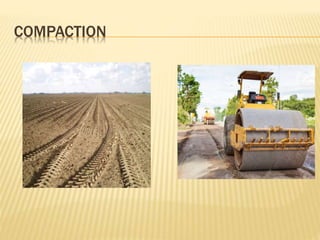
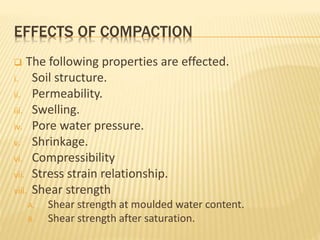
 Compaction means pressing of the soil particles
close to each other by mechanical methods.
 Air is expelled from soil mass and mass density is
increased.
 It is done to improve the engineering properties.
 Like shear strength,stability etc..
 Reduces compressibility and permeability.
COMPACTION
EFFECTS OF COMPACTION
 The following properties are effected.
i. Soil structure.
ii. Permeability.
iii. Swelling.
iv. Pore water pressure.
v. Shrinkage.
vi. Compressibility
vii. Stress strain relationship.
viii. Shear strength
A. Shear strength at moulded water content.
B. Shear strength after saturation.
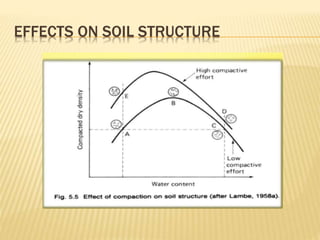
EFFECTS ON SOIL STRUCTURE
 The water content at which the soil is compacted
plays an important role in soil structure
 Soil compacted at water content less than
optimum water content have flocculated
structure.
EFFECT ON SOIL STRUCTURE
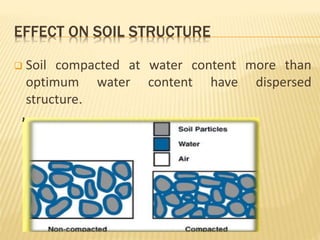
 Soil compacted at water content more than
optimum water content have dispersed
structure.
EFFECTS ON SOIL STRUCTURE
EFFECT ON SOIL STRUCTURE
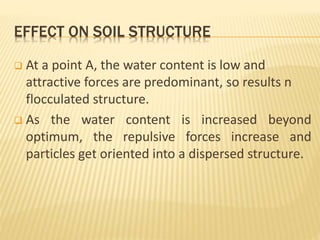
 At a point A, the water content is low and
attractive forces are predominant, so results n
flocculated structure.
 As the water content is increased beyond
optimum, the repulsive forces increase and
particles get oriented into a dispersed structure.
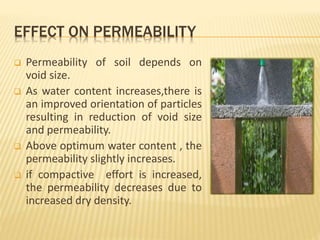
EFFECT ON PERMEABILITY
 Permeability of soil depends on
void size.
 As water content increases,there is
an improved orientation of particles
resulting in reduction of void size
and permeability.
 Above optimum water content , the
permeability slightly increases.
 if compactive effort is increased,
the permeability decreases due to
increased dry density.
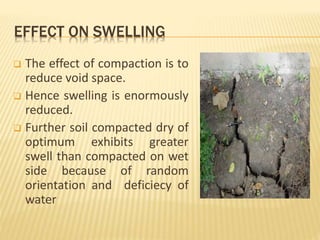
EFFECT ON SWELLING
 The effect of compaction is to
reduce void space.
 Hence swelling is enormously
reduced.
 Further soil compacted dry of
optimum exhibits greater
swell than compacted on wet
side because of random
orientation and deficiecy of
water
EFFECT OF PORE WATER PRESSURE
 It is defined as pressure of ground water held
within a rock or soil, in gaps between
particles(pores).
 The pore water pressure for soil compacted dry
of optimum is therefore less than that for the
same soil compacted wet of optimum.
EFFECT ON COMPRESSIBILITY
 The flocculated structure o the dry side of
optimum offers greater resistance to
compression than the dispersed structure on wet
side.
 So, the soil compacted dry of optimum are less
compressible.
EFFECTS ON STRESS-STRAIN RELATIONSHIP
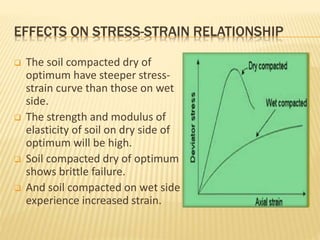
 The soil compacted dry of
optimum have steeper stress-
strain curve than those on wet
side.
 The strength and modulus of
elasticity of soil on dry side of
optimum will be high.
 Soil compacted dry of optimum
shows brittle failure.
 And soil compacted on wet side
experience increased strain.
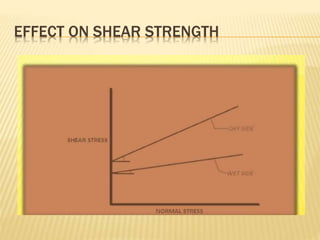
EFFECT ON SHEAR STRENGTH
 In general the soils compacted dry of optimum
have a higher shear strength than wet of
optimum at lower strains.
 However at large strains the flocculated structure
of soil is broken and ultimate strength will be
equal for both dry and wet sides.
EFFECT ON SHEAR STRENGTH
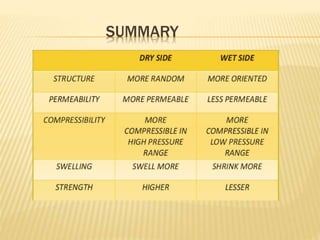
SUMMARY
COMPACTION GROUTING
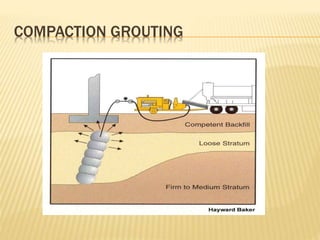
 It is a the use of a mortar or concrete to laterally
compact soils without vibration.
 The treatment involves the injection of a mortar,
generally with high viscosity, under pressure and
at controlled flow rate, which displaces the soil
around the drilling tool and subsequently
compacts it.
 Compaction ratios for this technique can be quite
high and are generally in the range of 6-10%.
COMPACTION GROUTING PROCEDURE
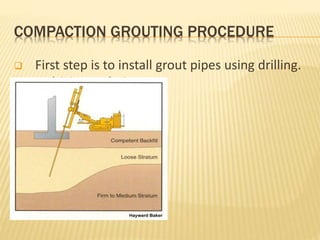
 First step is to install grout pipes using drilling.
or driving techniques.
COMPACTION GROUTING PROCEDURE
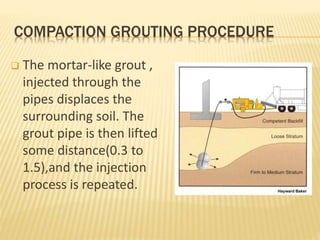
 The mortar-like grout ,
injected through the
pipes displaces the
surrounding soil. The
grout pipe is then lifted
some distance(0.3 to
1.5),and the injection
process is repeated.
COMPACTION GROUTING PROCEDURE
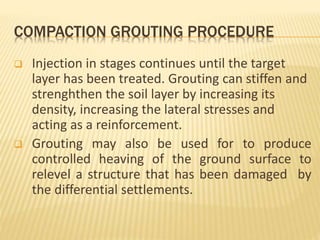
 Injection in stages continues until the target
layer has been treated. Grouting can stiffen and
strenghthen the soil layer by increasing its
density, increasing the lateral stresses and
acting as a reinforcement.
 Grouting may also be used for to produce
controlled heaving of the ground surface to
relevel a structure that has been damaged by
the differential settlements.
COMPACTION GROUTING
COMPACTION GROUTING
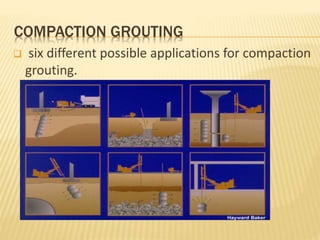
 six different possible applications for compaction
grouting.
EXPLOSIVE COMPACTION
 Explosive compaction is the ground modification
technique where by the energy released from
setting off explosives in subsoil inducing artificial
earthquake effects.
 The efficiency depends on soil profile, grainsize,
initial status and intensity of energy applied to
the soil.
 The first successful application of EC method was
the Franklin dam in New Hampshire in 1930.
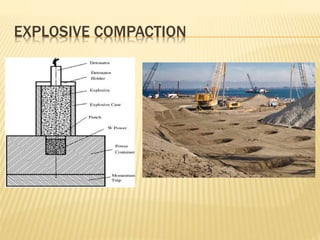
PROCEDURE FOR EXPLOSIVE COMPACTION
 Series of boreholes are drilled and Pipe of 7.5
to 10 cm is driven to the required depth.
 The detonator and the dynamic sticks are both
enclosed in a water proof bundle and is
lowered through casings.
 Casing is withdrawn and a wad of paper or
wood is placed against the charge of Explosive
(To protect it from misfire).
 Boreholes are backfilled with sand to obtain
full force of blast.
 The charge is fired in definite pattern.
EXPLOSIVE COMPACTION
 Blasting is more effective in loose sands that contain less
than 20% silt and less than 5% clay.
 The capillary action obstructs the densification tendency
by preventing soil particles to come close. So this method
is not useful for partial saturated soils.
 The top surface up to 1m gets disturbed and needs surface
compaction. Although blasting is quite economical, it’s
limited by several considerations as it produces strong
vibrations that may damage nearbystructures or produce
significant ground movements.

SOIL COMPACTION AND ITS EFFECT ON PROPERTIES

  • 1.
    SOIL COMPACTION AND ITSEFFECTS ON PROPERTIES GEORGE P THAMPY ROLL NO.40 CIVIL.A
  • 2.
  • 3.
    INTRODUCTION  Compaction meanspressing of the soil particles close to each other by mechanical methods.  Air is expelled from soil mass and mass density is increased.  It is done to improve the engineering properties.  Like shear strength,stability etc..  Reduces compressibility and permeability.
  • 4.
  • 5.
    EFFECTS OF COMPACTION The following properties are effected. i. Soil structure. ii. Permeability. iii. Swelling. iv. Pore water pressure. v. Shrinkage. vi. Compressibility vii. Stress strain relationship. viii. Shear strength A. Shear strength at moulded water content. B. Shear strength after saturation.
  • 6.
    EFFECTS ON SOILSTRUCTURE  The water content at which the soil is compacted plays an important role in soil structure  Soil compacted at water content less than optimum water content have flocculated structure.
  • 7.
    EFFECT ON SOILSTRUCTURE  Soil compacted at water content more than optimum water content have dispersed structure.
  • 8.
    EFFECTS ON SOILSTRUCTURE
  • 9.
    EFFECT ON SOILSTRUCTURE  At a point A, the water content is low and attractive forces are predominant, so results n flocculated structure.  As the water content is increased beyond optimum, the repulsive forces increase and particles get oriented into a dispersed structure.
  • 10.
    EFFECT ON PERMEABILITY Permeability of soil depends on void size.  As water content increases,there is an improved orientation of particles resulting in reduction of void size and permeability.  Above optimum water content , the permeability slightly increases.  if compactive effort is increased, the permeability decreases due to increased dry density.
  • 11.
    EFFECT ON SWELLING The effect of compaction is to reduce void space.  Hence swelling is enormously reduced.  Further soil compacted dry of optimum exhibits greater swell than compacted on wet side because of random orientation and deficiecy of water
  • 12.
    EFFECT OF POREWATER PRESSURE  It is defined as pressure of ground water held within a rock or soil, in gaps between particles(pores).  The pore water pressure for soil compacted dry of optimum is therefore less than that for the same soil compacted wet of optimum.
  • 13.
    EFFECT ON COMPRESSIBILITY The flocculated structure o the dry side of optimum offers greater resistance to compression than the dispersed structure on wet side.  So, the soil compacted dry of optimum are less compressible.
  • 14.
    EFFECTS ON STRESS-STRAINRELATIONSHIP  The soil compacted dry of optimum have steeper stress- strain curve than those on wet side.  The strength and modulus of elasticity of soil on dry side of optimum will be high.  Soil compacted dry of optimum shows brittle failure.  And soil compacted on wet side experience increased strain.
  • 15.
    EFFECT ON SHEARSTRENGTH  In general the soils compacted dry of optimum have a higher shear strength than wet of optimum at lower strains.  However at large strains the flocculated structure of soil is broken and ultimate strength will be equal for both dry and wet sides.
  • 16.
  • 17.
  • 18.
    COMPACTION GROUTING  Itis a the use of a mortar or concrete to laterally compact soils without vibration.  The treatment involves the injection of a mortar, generally with high viscosity, under pressure and at controlled flow rate, which displaces the soil around the drilling tool and subsequently compacts it.  Compaction ratios for this technique can be quite high and are generally in the range of 6-10%.
  • 19.
    COMPACTION GROUTING PROCEDURE First step is to install grout pipes using drilling. or driving techniques.
  • 20.
    COMPACTION GROUTING PROCEDURE The mortar-like grout , injected through the pipes displaces the surrounding soil. The grout pipe is then lifted some distance(0.3 to 1.5),and the injection process is repeated.
  • 21.
    COMPACTION GROUTING PROCEDURE Injection in stages continues until the target layer has been treated. Grouting can stiffen and strenghthen the soil layer by increasing its density, increasing the lateral stresses and acting as a reinforcement.  Grouting may also be used for to produce controlled heaving of the ground surface to relevel a structure that has been damaged by the differential settlements.
  • 22.
  • 23.
    COMPACTION GROUTING  sixdifferent possible applications for compaction grouting.
  • 24.
    EXPLOSIVE COMPACTION  Explosivecompaction is the ground modification technique where by the energy released from setting off explosives in subsoil inducing artificial earthquake effects.  The efficiency depends on soil profile, grainsize, initial status and intensity of energy applied to the soil.  The first successful application of EC method was the Franklin dam in New Hampshire in 1930.
  • 25.
    PROCEDURE FOR EXPLOSIVECOMPACTION  Series of boreholes are drilled and Pipe of 7.5 to 10 cm is driven to the required depth.  The detonator and the dynamic sticks are both enclosed in a water proof bundle and is lowered through casings.  Casing is withdrawn and a wad of paper or wood is placed against the charge of Explosive (To protect it from misfire).  Boreholes are backfilled with sand to obtain full force of blast.  The charge is fired in definite pattern.
  • 26.
  • 27.
    EXPLOSIVE COMPACTION  Blastingis more effective in loose sands that contain less than 20% silt and less than 5% clay.  The capillary action obstructs the densification tendency by preventing soil particles to come close. So this method is not useful for partial saturated soils.  The top surface up to 1m gets disturbed and needs surface compaction. Although blasting is quite economical, it’s limited by several considerations as it produces strong vibrations that may damage nearbystructures or produce significant ground movements.