SOIL AND WATER
CONSERVATION ENGINEERING
S.Satheeshkumar
AP/AGE
Kongunadu College of
Engineering and Technology
Trichy
UNIT I SOIL EROSION PRINCIPLES
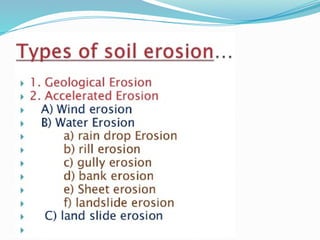
Introduction – Approaches to soil conservation –- Erosion – Agents - Causes – types– Mechanics of water
erosion Erosion agents; Factors affecting and effects of erosion– Soil erosion problems – Types of water
erosion: Raindrop erosion Rainfall erosivity estimation by KE>25 and EI 30 methods, Sheet erosion, Rill
erosion, Gully erosion, Stream bank erosion – Classification of Gully stages of development– Gully
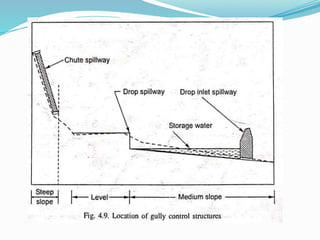
Control Structures: Drop Spillway, Drop Inlet, Chute Spillways and vegetative measures – reclamation.
UNIT II ESTIMATION OF SOIL EROSION
Runoff computation for soil conservation: Evolution of Universal Soil Loss Equation: Applications and
Limitations – Modified Universal Soil Loss Equation – Revised Universal Soil Loss Equation –
Permissible erosion – Land use capability classification – Classification of eroded soils – Soil erodibility
and other management factors.
UNIT III EROSION CONTROL MEASURES
Agronomic practices: contour cultivation – strip cropping – tillage practices – Soil management
practices. Bunding: Types and design specifications – Mechanical measures for hill slopes. Terracing:
Classification and design specification of bench terrace. Grassed waterways: Location, construction and
maintenance –Types of temporary and permanent gully control structures.
UNIT IV WATER CONSERVATION MEASURES
In-situ soil moisture conservation – Water harvesting principles and techniques: Micro
catchments, catchment yield using morphometric analysis – Farm ponds: Components,
Design, Construction and Protection – Check dams – Earthen dam – Retaining wall.
UNIT V SEDIMENTATION
Sediment: Sources – Types of sediment load – Mechanics of sediment transport –
Estimation of bed load – Sediment Graph. Reservoir sedimentation: Basics – Factors
affecting sediment distribution pattern, Rates of reservoir sedimentation – Silt Detention
Tanks – sediment control methods.
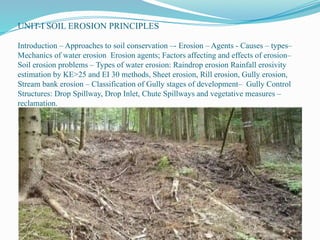
UNIT-I SOIL EROSION PRINCIPLES
Introduction – Approaches to soil conservation –- Erosion – Agents - Causes – types–
Mechanics of water erosion Erosion agents; Factors affecting and effects of erosion–
Soil erosion problems – Types of water erosion: Raindrop erosion Rainfall erosivity
estimation by KE>25 and EI 30 methods, Sheet erosion, Rill erosion, Gully erosion,
Stream bank erosion – Classification of Gully stages of development– Gully Control
Structures: Drop Spillway, Drop Inlet, Chute Spillways and vegetative measures –
reclamation.
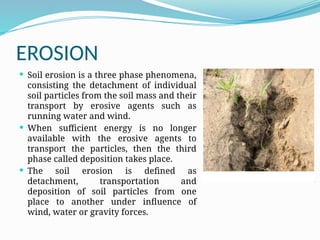
EROSION
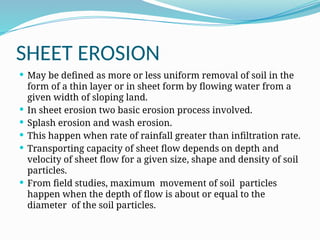
 Soil erosion is a three phase phenomena,
consisting the detachment of individual
soil particles from the soil mass and their
transport by erosive agents such as
running water and wind.
 When sufficient energy is no longer
available with the erosive agents to
transport the particles, then the third
phase called deposition takes place.
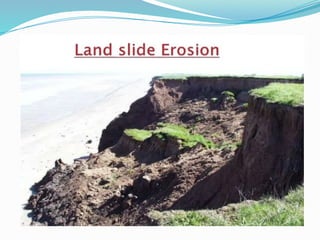
 The soil erosion is defined as
detachment, transportation and
deposition of soil particles from one
place to another under influence of
wind, water or gravity forces.
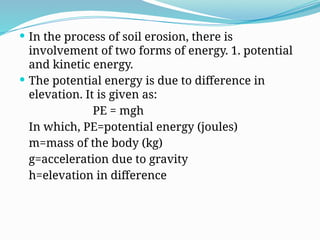
 In the process of soil erosion, there is
involvement of two forms of energy. 1. potential
and kinetic energy.
 The potential energy is due to difference in
elevation. It is given as:
PE = mgh
In which, PE=potential energy (joules)
m=mass of the body (kg)
g=acceleration due to gravity
h=elevation in difference
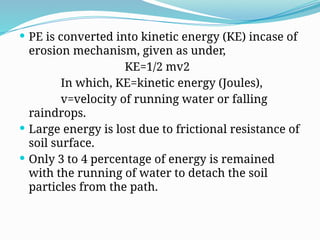
 PE is converted into kinetic energy (KE) incase of
erosion mechanism, given as under,
KE=1/2 mv2
In which, KE=kinetic energy (Joules),
v=velocity of running water or falling
raindrops.
 Large energy is lost due to frictional resistance of
soil surface.
 Only 3 to 4 percentage of energy is remained
with the running of water to detach the soil
particles from the path.
Erosive forces:
 In erosion process basically two components 1.
soil 2.external force.
 Soil always resists the erosion by its
texture/structure, organic matters and
permeability.
 The potential susceptibility of of soil to get
detach is the soil erodibility.
 the potential ability of external force to detach
the soil particle from soil mass is erosivity.
 The soil erosion as whole is the function of soil
erodibility & erosivity.
 Soil erosion only happens when erosivity >
erodibility.
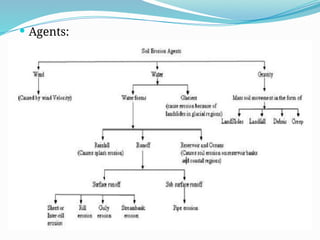
 The external forces
1,. ICE (plucking, crushing, abrasion
& fracturing )
2. Wind (more in arid & semi-arid
regions)
3. Water (sheet flow & rain drops)
 Agents:
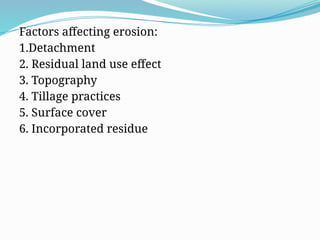
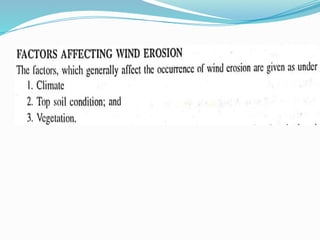
Factors affecting erosion:
1.Detachment
2. Residual land use effect
3. Topography
4. Tillage practices
5. Surface cover
6. Incorporated residue
1.detachment:
 Erosive force of rain drop impact and flowing water.
 Presence of materials reducing eroding force.
 Transport is the function of force of transporting
agent.
 The detachment/transport capacity limits the erosion
in slope.
 The amount of available sediment for transport is
less than its capacity, then the sediment load moving
down slope will be equal to the amount of detached
sediment.
 If the detached sediment load exceeds the transport
capacity, then there starts deposition of sediment
load.
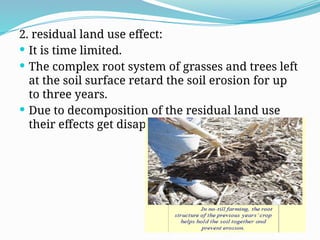
2. residual land use effect:
 It is time limited.
 The complex root system of grasses and trees left
at the soil surface retard the soil erosion for up
to three years.
 Due to decomposition of the residual land use
their effects get disappear in next seasons.
4. Incorporated residue:
 It is refer to all biomasses associated to the
grown crop, which get decomposed and mixed in
the soil.
 The crop residues or mulch materials like corn
stalks etc can be as the crop residues.
 On incorporation of residues in the soil, the level
of organic contents in the soil gets increase.
 It improves the favorable properties of soil to
upgrade the structure and to prevent rill
enlargement.
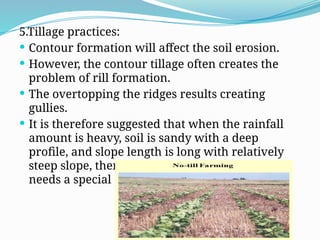
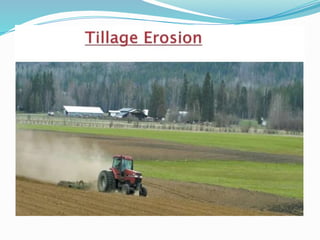
5.Tillage practices:
 Contour formation will affect the soil erosion.
 However, the contour tillage often creates the
problem of rill formation.
 The overtopping the ridges results creating
gullies.
 It is therefore suggested that when the rainfall
amount is heavy, soil is sandy with a deep
profile, and slope length is long with relatively
steep slope, then practice of contour farming
needs a special care.
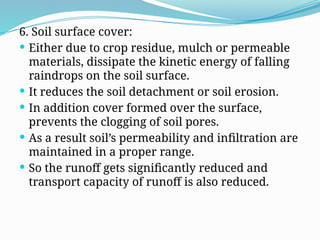
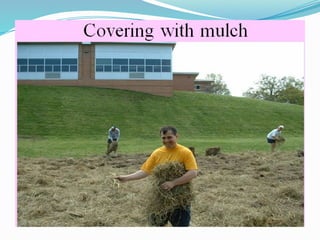
6. Soil surface cover:
 Either due to crop residue, mulch or permeable
materials, dissipate the kinetic energy of falling
raindrops on the soil surface.
 It reduces the soil detachment or soil erosion.
 In addition cover formed over the surface,
prevents the clogging of soil pores.
 As a result soil’s permeability and infiltration are
maintained in a proper range.
 So the runoff gets significantly reduced and
transport capacity of runoff is also reduced.
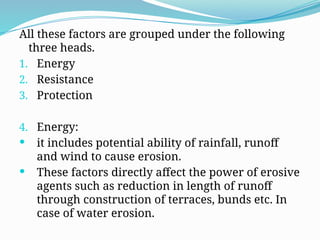
All these factors are grouped under the following
three heads.
1. Energy
2. Resistance
3. Protection
4. Energy:
 it includes potential ability of rainfall, runoff
and wind to cause erosion.
 These factors directly affect the power of erosive
agents such as reduction in length of runoff
through construction of terraces, bunds etc. In
case of water erosion.
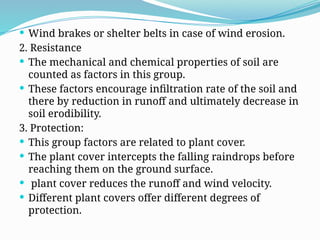
 Wind brakes or shelter belts in case of wind erosion.
2. Resistance
 The mechanical and chemical properties of soil are
counted as factors in this group.
 These factors encourage infiltration rate of the soil and
there by reduction in runoff and ultimately decrease in
soil erodibility.
3. Protection:
 This group factors are related to plant cover.
 The plant cover intercepts the falling raindrops before
reaching them on the ground surface.
 plant cover reduces the runoff and wind velocity.
 Different plant covers offer different degrees of
protection.
MECHANICS OF WATER EROSION
Different geological actions generated by the
flowing water over the land surface, by which
soil erosion takes place, are given as under:
1. Hydraulic action
2. Abrasion
3. Attrition
4. Solution
5. Transportation
6. Deposition
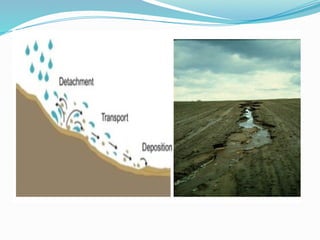
1.Hydraulic action
 When water runs over the soil surface, it
compresses the soil.
 The air present in the voids exerts a pressure on
the soil particles and make soil detachment.
 The pressure exerted by the void’s air is called
hydraulic pressure.
 The detached soil particles are removed by
running water. It is more in loose condition.
2.ABRASION
 Soil particles mixed in the running water.
 It creates an abrasive power in the water.
 Due to this effect greater soil particles are
eroded by flowing water.
 River bank erosion and erosion from the bottom
of valley are examples of abrasion.
3.ATTRITION
 Mechanical break down of soil loads running
along the moving water due to collision of
particles with each other.
 When big size rock fragments, boulders or
pebbles present in the moving water break down
due to their striking with each other.
 The broken particles are moved along with the
flow which generate abrasion effect on the
bottom and banks of the water course.
4.SOLUTION
 Due to chemical action between running
water/rock.
 This is happening where existing soil/rock are
easily dissolved in the water.
5.TRANSPORTATION
Transportation of particles mainly depends on
 Velocity at which water is running
 Load present in the water.
 impediments/obstacles present in the flow of
water path
 Carrying capacity of running water
TRANSPORTATION PROCESS
1.Solution (dissolved chemicals such as calcium
carbonate)
2.Suspension (fine particles)
3. Saltation and surface creep (coarser soil
particles which takes place in the actions of
jumping, collosion and creeping)
5.DEPOSITION
The deposition of sediment load mixed in the
running water happened under the following
condition.
1. Force
2. Presence of surface obstructions
3. Curves of stream
FACTORS AFFECTING WATER EROSION
1. Climatic factors
2. Soil
3. Vegetation
4. Topographic factors
1. CLIMATIC FACTORS
 Rainfall characteristics, atmospheric
temperature and wind velocity.
 Rainfall amount, intensity, frequency and
duration are major reason.
 Infiltration rate and size of rain drops.
 Frequent rain fall maintain soil moisture.
2. SOIL CHARACTERISTICS
 Infiltration rate and soil cover
 When infiltration rate is greater than the rainfall
intensity there is zero runoff.
 Infiltration rate depends upon soil profile,
surface condition and presence of moisture
content.
3. VEGETATION
Vegetations create surface obstruction for direct falling
of rain drops on the land surface. The vegetation
affects rainfall in the following ways:
 Vegetative foliage-interception loss(evaporation
process)-reduces the impact of falling rain drops.
 Vegetative cover-hindrance in flowing of path-
reduces runoff velocity.
 Root system-makes more porous-absorbs more water.
 Biological point of view-forest cover- earth worms
and other lives
 transpiration
4. TOPOGRAPHICAL EFFECT
 Land slope, length of slope and shape of slope.
 Flat land has not affect by erosion.
 Land slope increases mild to steep erosion
increases in large proportion.
 From field observations, land slope increases
four times, the velocity of flowing runoff exceeds
twice and its kinetic energy increases about four
times. The transportation of the particles
increases by thirty two times.
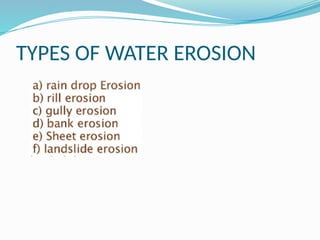
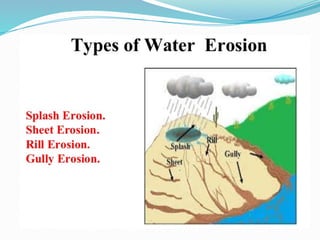
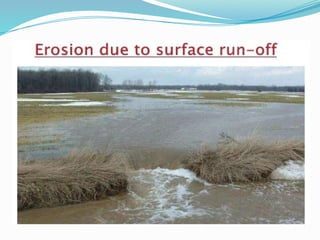
TYPES OF WATER EROSION
1. Raindrop erosion
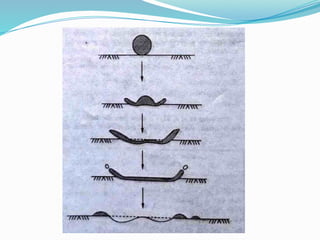
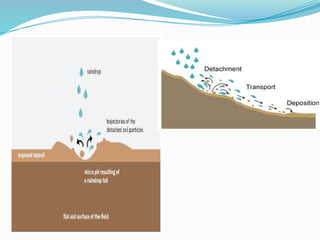
 It is also known as splash erosion.
 When rain drop strikes the open moist soil surface forms a
crater.
 This by creating a blast which bounces the water and soil up
and return back around crater.
 The soil may splashed into the air upto height of 50 to 75cm
depending the size of rain drops.
 The soil particles also move horizontally as much as 1.50m on
level and surface.
 On sloping land more than half of the splashed particles move
down with the sheet flow.
 The soil is subject to rigorous and repeated loosening and lifting
actions during heavy rains.
 Finer detached particles enter into the pores and
seal them, causing water accumulation over the
surface.
 Remaining detached particles mixed with the
accumulated water.
 This water ultimately starts move over the land
surface.
 In this way, the detached particles transported by
the running water over the land surface.
 Many of scientist reported that kinetic energy is
the causative forces to initiate the detachment of
soil particles.
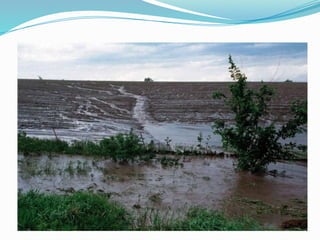
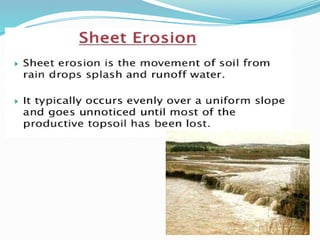
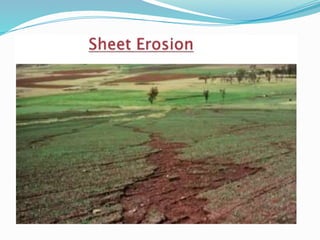
SHEET EROSION
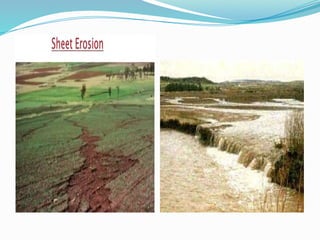
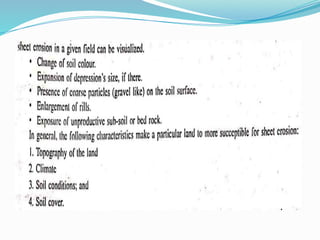
 May be defined as more or less uniform removal of soil in the
form of a thin layer or in sheet form by flowing water from a
given width of sloping land.
 In sheet erosion two basic erosion process involved.
 Splash erosion and wash erosion.
 This happen when rate of rainfall greater than infiltration rate.
 Transporting capacity of sheet flow depends on depth and
velocity of sheet flow for a given size, shape and density of soil
particles.
 From field studies, maximum movement of soil particles
happen when the depth of flow is about or equal to the
diameter of the soil particles.
v
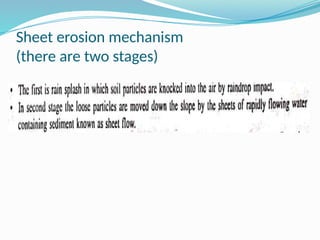
Sheet erosion mechanism
(there are two stages)
Sheet erosion mechanism
 First,When rainfall intensity exceeds infiltration rate excess
water accumulates in the small depressions.
 As soon as all depressions are filled, the water spills out and
starts flowing down the slope is called overland flow. This
overflow also called horton overland flow.
 This overflow depends upon infiltration rate and intensity of
rainfall.
 Second, sometimes water gets collect over the surface directly
from the water table.
 This water called exfiltration water and return flow.
 The collected water moves starts due to poor infiltration rate
and land gradient. This is called saturation over land
flow(constitute of overland flow and return flow).
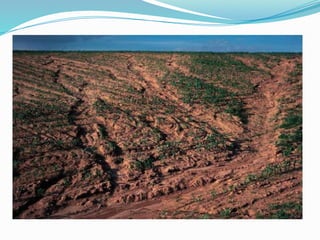
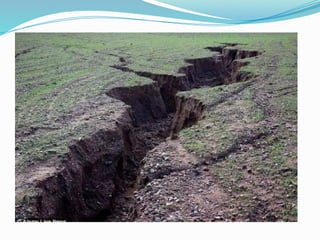
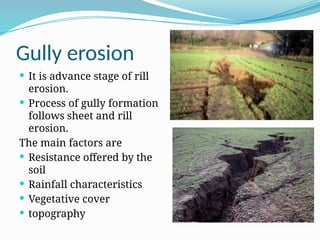
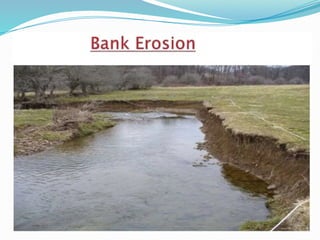
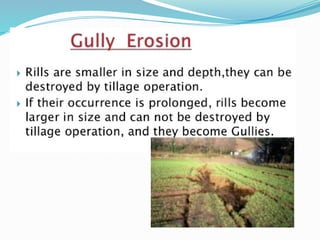
Gully erosion
 It is advance stage of rill
erosion.
 Process of gully formation
follows sheet and rill
erosion.
The main factors are
 Resistance offered by the
soil
 Rainfall characteristics
 Vegetative cover
 topography
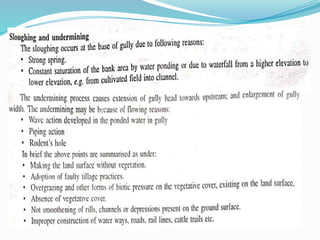
Causes of gully formation
Increase of surface and subsurface water flow
 Magnitude of surface and subsurface water flow
 Improvement in drainage channels and removal
of water holding areas and enlargement of
catchment.
Decrease in soil resistance to erosion
 Removal of vegetative cover
 Breakdown of soil structure due to poor tillage
practices and crop practices.
 Constant saturation.
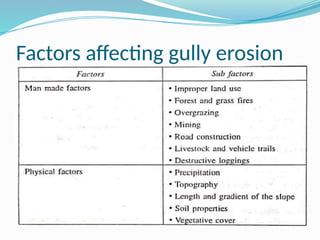
Factors affecting gully erosion
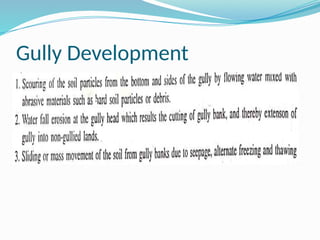
Gully Development
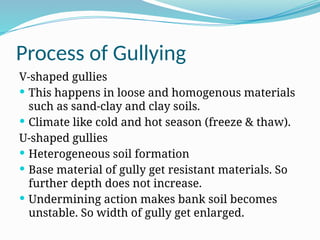
Process of Gullying
V-shaped gullies
 This happens in loose and homogenous materials
such as sand-clay and clay soils.
 Climate like cold and hot season (freeze & thaw).
U-shaped gullies
 Heterogeneous soil formation
 Base material of gully get resistant materials. So
further depth does not increase.
 Undermining action makes bank soil becomes
unstable. So width of gully get enlarged.
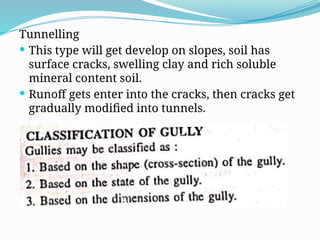
Tunnelling
 This type will get develop on slopes, soil has
surface cracks, swelling clay and rich soluble
mineral content soil.
 Runoff gets enter into the cracks, then cracks get
gradually modified into tunnels.
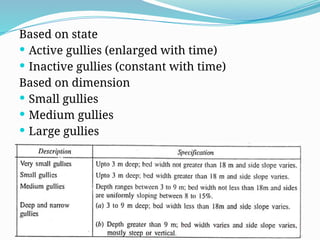
Based on state
 Active gullies (enlarged with time)
 Inactive gullies (constant with time)
Based on dimension
 Small gullies
 Medium gullies
 Large gullies
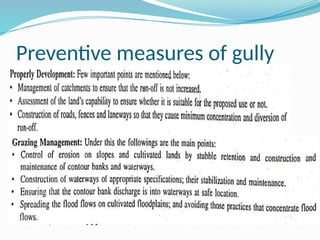
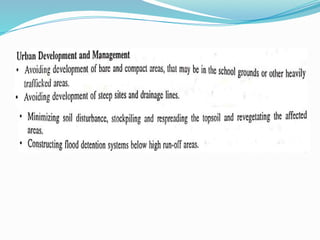
Preventive measures of gully
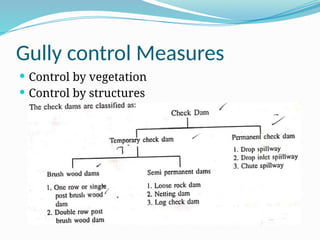
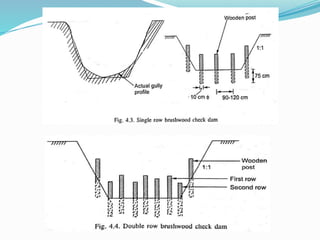
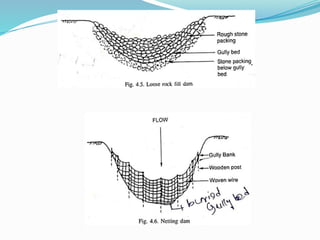
Gully control Measures
 Control by vegetation
 Control by structures
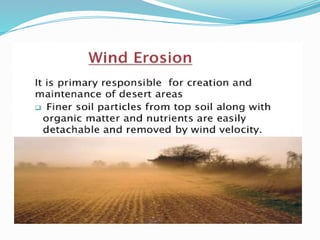
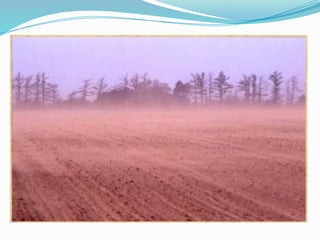
WIND EROSION
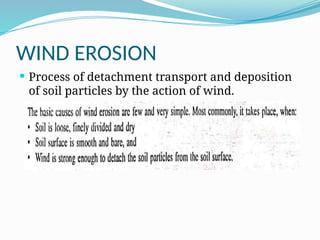
 Process of detachment transport and deposition
of soil particles by the action of wind.
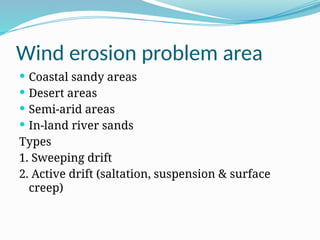
Wind erosion problem area
 Coastal sandy areas
 Desert areas
 Semi-arid areas
 In-land river sands
Types
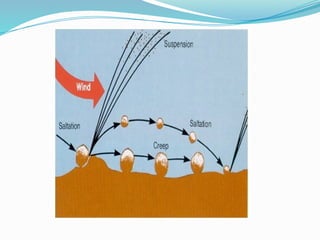
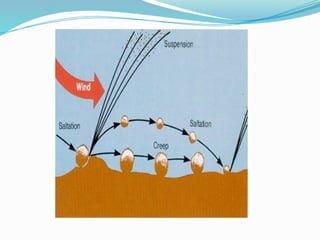
1. Sweeping drift
2. Active drift (saltation, suspension & surface
creep)
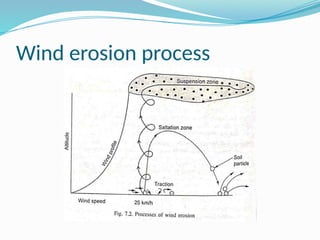
Wind erosion process
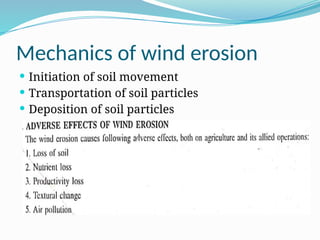
Mechanics of wind erosion
 Initiation of soil movement
 Transportation of soil particles
 Deposition of soil particles
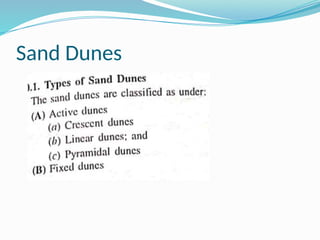
Sand Dunes
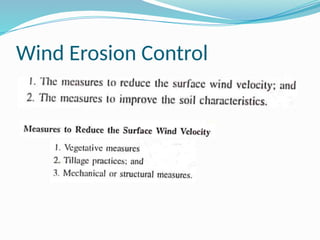
Wind Erosion Control
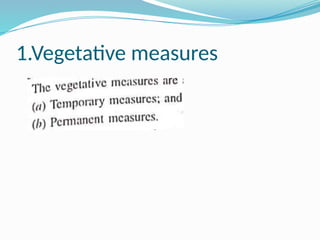
1.Vegetative measures
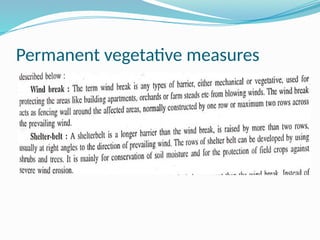
Permanent vegetative measures
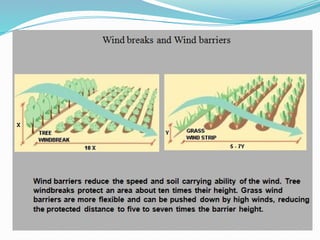
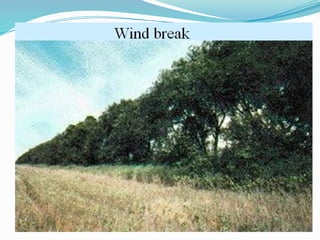
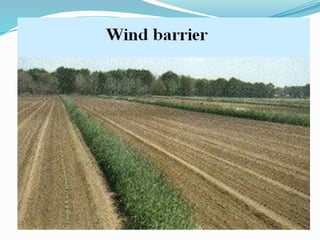
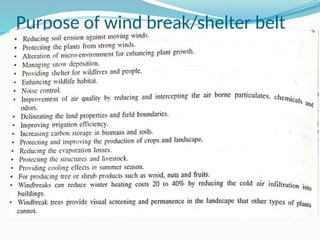
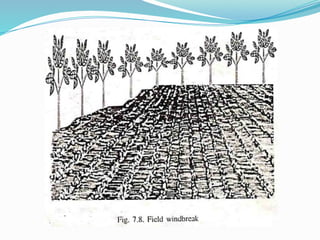
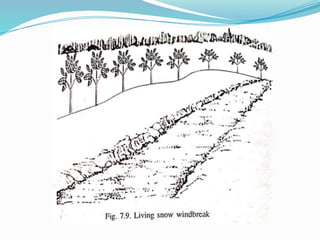
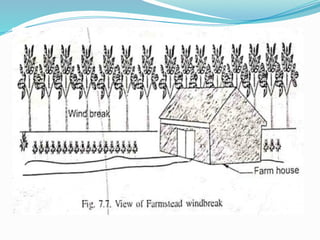
Purpose of wind break/shelter belt
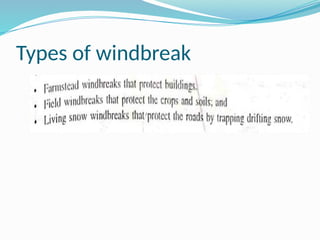
Types of windbreak
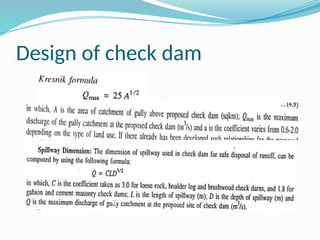
Design of check dam
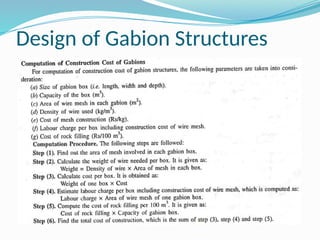
Design of Gabion Structures
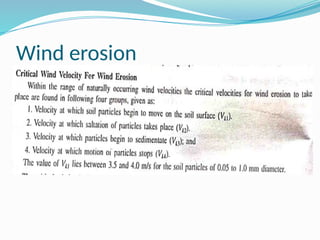
Wind erosion
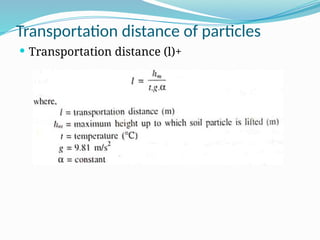
Transportation distance of particles
 Transportation distance (l)+
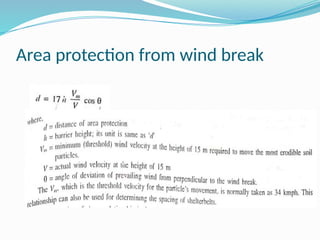
Area protection from wind break
Thank you

UNIT 1 SOIL EROSION PRINCIPLES TO DEVELOP WATERSHED

  • 1.
    SOIL AND WATER CONSERVATIONENGINEERING S.Satheeshkumar AP/AGE Kongunadu College of Engineering and Technology Trichy
  • 2.
    UNIT I SOILEROSION PRINCIPLES Introduction – Approaches to soil conservation –- Erosion – Agents - Causes – types– Mechanics of water erosion Erosion agents; Factors affecting and effects of erosion– Soil erosion problems – Types of water erosion: Raindrop erosion Rainfall erosivity estimation by KE>25 and EI 30 methods, Sheet erosion, Rill erosion, Gully erosion, Stream bank erosion – Classification of Gully stages of development– Gully Control Structures: Drop Spillway, Drop Inlet, Chute Spillways and vegetative measures – reclamation. UNIT II ESTIMATION OF SOIL EROSION Runoff computation for soil conservation: Evolution of Universal Soil Loss Equation: Applications and Limitations – Modified Universal Soil Loss Equation – Revised Universal Soil Loss Equation – Permissible erosion – Land use capability classification – Classification of eroded soils – Soil erodibility and other management factors. UNIT III EROSION CONTROL MEASURES Agronomic practices: contour cultivation – strip cropping – tillage practices – Soil management practices. Bunding: Types and design specifications – Mechanical measures for hill slopes. Terracing: Classification and design specification of bench terrace. Grassed waterways: Location, construction and maintenance –Types of temporary and permanent gully control structures. UNIT IV WATER CONSERVATION MEASURES In-situ soil moisture conservation – Water harvesting principles and techniques: Micro catchments, catchment yield using morphometric analysis – Farm ponds: Components, Design, Construction and Protection – Check dams – Earthen dam – Retaining wall. UNIT V SEDIMENTATION Sediment: Sources – Types of sediment load – Mechanics of sediment transport – Estimation of bed load – Sediment Graph. Reservoir sedimentation: Basics – Factors affecting sediment distribution pattern, Rates of reservoir sedimentation – Silt Detention Tanks – sediment control methods.
  • 3.
    UNIT-I SOIL EROSIONPRINCIPLES Introduction – Approaches to soil conservation –- Erosion – Agents - Causes – types– Mechanics of water erosion Erosion agents; Factors affecting and effects of erosion– Soil erosion problems – Types of water erosion: Raindrop erosion Rainfall erosivity estimation by KE>25 and EI 30 methods, Sheet erosion, Rill erosion, Gully erosion, Stream bank erosion – Classification of Gully stages of development– Gully Control Structures: Drop Spillway, Drop Inlet, Chute Spillways and vegetative measures – reclamation.
  • 4.
    EROSION  Soil erosionis a three phase phenomena, consisting the detachment of individual soil particles from the soil mass and their transport by erosive agents such as running water and wind.  When sufficient energy is no longer available with the erosive agents to transport the particles, then the third phase called deposition takes place.  The soil erosion is defined as detachment, transportation and deposition of soil particles from one place to another under influence of wind, water or gravity forces.
  • 5.
     In theprocess of soil erosion, there is involvement of two forms of energy. 1. potential and kinetic energy.  The potential energy is due to difference in elevation. It is given as: PE = mgh In which, PE=potential energy (joules) m=mass of the body (kg) g=acceleration due to gravity h=elevation in difference
  • 6.
     PE isconverted into kinetic energy (KE) incase of erosion mechanism, given as under, KE=1/2 mv2 In which, KE=kinetic energy (Joules), v=velocity of running water or falling raindrops.  Large energy is lost due to frictional resistance of soil surface.  Only 3 to 4 percentage of energy is remained with the running of water to detach the soil particles from the path.
  • 7.
    Erosive forces:  Inerosion process basically two components 1. soil 2.external force.  Soil always resists the erosion by its texture/structure, organic matters and permeability.  The potential susceptibility of of soil to get detach is the soil erodibility.  the potential ability of external force to detach the soil particle from soil mass is erosivity.  The soil erosion as whole is the function of soil erodibility & erosivity.  Soil erosion only happens when erosivity > erodibility.
  • 8.
     The externalforces 1,. ICE (plucking, crushing, abrasion & fracturing ) 2. Wind (more in arid & semi-arid regions) 3. Water (sheet flow & rain drops)
  • 9.
  • 10.
    Factors affecting erosion: 1.Detachment 2.Residual land use effect 3. Topography 4. Tillage practices 5. Surface cover 6. Incorporated residue
  • 11.
    1.detachment:  Erosive forceof rain drop impact and flowing water.  Presence of materials reducing eroding force.  Transport is the function of force of transporting agent.  The detachment/transport capacity limits the erosion in slope.  The amount of available sediment for transport is less than its capacity, then the sediment load moving down slope will be equal to the amount of detached sediment.  If the detached sediment load exceeds the transport capacity, then there starts deposition of sediment load.
  • 12.
    2. residual landuse effect:  It is time limited.  The complex root system of grasses and trees left at the soil surface retard the soil erosion for up to three years.  Due to decomposition of the residual land use their effects get disappear in next seasons.
  • 15.
    4. Incorporated residue: It is refer to all biomasses associated to the grown crop, which get decomposed and mixed in the soil.  The crop residues or mulch materials like corn stalks etc can be as the crop residues.  On incorporation of residues in the soil, the level of organic contents in the soil gets increase.  It improves the favorable properties of soil to upgrade the structure and to prevent rill enlargement.
  • 16.
    5.Tillage practices:  Contourformation will affect the soil erosion.  However, the contour tillage often creates the problem of rill formation.  The overtopping the ridges results creating gullies.  It is therefore suggested that when the rainfall amount is heavy, soil is sandy with a deep profile, and slope length is long with relatively steep slope, then practice of contour farming needs a special care.
  • 17.
    6. Soil surfacecover:  Either due to crop residue, mulch or permeable materials, dissipate the kinetic energy of falling raindrops on the soil surface.  It reduces the soil detachment or soil erosion.  In addition cover formed over the surface, prevents the clogging of soil pores.  As a result soil’s permeability and infiltration are maintained in a proper range.  So the runoff gets significantly reduced and transport capacity of runoff is also reduced.
  • 19.
    All these factorsare grouped under the following three heads. 1. Energy 2. Resistance 3. Protection 4. Energy:  it includes potential ability of rainfall, runoff and wind to cause erosion.  These factors directly affect the power of erosive agents such as reduction in length of runoff through construction of terraces, bunds etc. In case of water erosion.
  • 20.
     Wind brakesor shelter belts in case of wind erosion. 2. Resistance  The mechanical and chemical properties of soil are counted as factors in this group.  These factors encourage infiltration rate of the soil and there by reduction in runoff and ultimately decrease in soil erodibility. 3. Protection:  This group factors are related to plant cover.  The plant cover intercepts the falling raindrops before reaching them on the ground surface.  plant cover reduces the runoff and wind velocity.  Different plant covers offer different degrees of protection.
  • 46.
    MECHANICS OF WATEREROSION Different geological actions generated by the flowing water over the land surface, by which soil erosion takes place, are given as under: 1. Hydraulic action 2. Abrasion 3. Attrition 4. Solution 5. Transportation 6. Deposition
  • 47.
    1.Hydraulic action  Whenwater runs over the soil surface, it compresses the soil.  The air present in the voids exerts a pressure on the soil particles and make soil detachment.  The pressure exerted by the void’s air is called hydraulic pressure.  The detached soil particles are removed by running water. It is more in loose condition.
  • 49.
    2.ABRASION  Soil particlesmixed in the running water.  It creates an abrasive power in the water.  Due to this effect greater soil particles are eroded by flowing water.  River bank erosion and erosion from the bottom of valley are examples of abrasion.
  • 50.
    3.ATTRITION  Mechanical breakdown of soil loads running along the moving water due to collision of particles with each other.  When big size rock fragments, boulders or pebbles present in the moving water break down due to their striking with each other.  The broken particles are moved along with the flow which generate abrasion effect on the bottom and banks of the water course.
  • 51.
    4.SOLUTION  Due tochemical action between running water/rock.  This is happening where existing soil/rock are easily dissolved in the water.
  • 52.
    5.TRANSPORTATION Transportation of particlesmainly depends on  Velocity at which water is running  Load present in the water.  impediments/obstacles present in the flow of water path  Carrying capacity of running water
  • 53.
    TRANSPORTATION PROCESS 1.Solution (dissolvedchemicals such as calcium carbonate) 2.Suspension (fine particles) 3. Saltation and surface creep (coarser soil particles which takes place in the actions of jumping, collosion and creeping)
  • 55.
    5.DEPOSITION The deposition ofsediment load mixed in the running water happened under the following condition. 1. Force 2. Presence of surface obstructions 3. Curves of stream
  • 56.
    FACTORS AFFECTING WATEREROSION 1. Climatic factors 2. Soil 3. Vegetation 4. Topographic factors
  • 57.
    1. CLIMATIC FACTORS Rainfall characteristics, atmospheric temperature and wind velocity.  Rainfall amount, intensity, frequency and duration are major reason.  Infiltration rate and size of rain drops.  Frequent rain fall maintain soil moisture.
  • 58.
    2. SOIL CHARACTERISTICS Infiltration rate and soil cover  When infiltration rate is greater than the rainfall intensity there is zero runoff.  Infiltration rate depends upon soil profile, surface condition and presence of moisture content.
  • 59.
    3. VEGETATION Vegetations createsurface obstruction for direct falling of rain drops on the land surface. The vegetation affects rainfall in the following ways:  Vegetative foliage-interception loss(evaporation process)-reduces the impact of falling rain drops.  Vegetative cover-hindrance in flowing of path- reduces runoff velocity.  Root system-makes more porous-absorbs more water.  Biological point of view-forest cover- earth worms and other lives  transpiration
  • 60.
    4. TOPOGRAPHICAL EFFECT Land slope, length of slope and shape of slope.  Flat land has not affect by erosion.  Land slope increases mild to steep erosion increases in large proportion.  From field observations, land slope increases four times, the velocity of flowing runoff exceeds twice and its kinetic energy increases about four times. The transportation of the particles increases by thirty two times.
  • 61.
  • 63.
    1. Raindrop erosion It is also known as splash erosion.  When rain drop strikes the open moist soil surface forms a crater.  This by creating a blast which bounces the water and soil up and return back around crater.  The soil may splashed into the air upto height of 50 to 75cm depending the size of rain drops.  The soil particles also move horizontally as much as 1.50m on level and surface.  On sloping land more than half of the splashed particles move down with the sheet flow.  The soil is subject to rigorous and repeated loosening and lifting actions during heavy rains.
  • 64.
     Finer detachedparticles enter into the pores and seal them, causing water accumulation over the surface.  Remaining detached particles mixed with the accumulated water.  This water ultimately starts move over the land surface.  In this way, the detached particles transported by the running water over the land surface.  Many of scientist reported that kinetic energy is the causative forces to initiate the detachment of soil particles.
  • 67.
    SHEET EROSION  Maybe defined as more or less uniform removal of soil in the form of a thin layer or in sheet form by flowing water from a given width of sloping land.  In sheet erosion two basic erosion process involved.  Splash erosion and wash erosion.  This happen when rate of rainfall greater than infiltration rate.  Transporting capacity of sheet flow depends on depth and velocity of sheet flow for a given size, shape and density of soil particles.  From field studies, maximum movement of soil particles happen when the depth of flow is about or equal to the diameter of the soil particles.
  • 68.
  • 70.
  • 71.
    Sheet erosion mechanism First,When rainfall intensity exceeds infiltration rate excess water accumulates in the small depressions.  As soon as all depressions are filled, the water spills out and starts flowing down the slope is called overland flow. This overflow also called horton overland flow.  This overflow depends upon infiltration rate and intensity of rainfall.  Second, sometimes water gets collect over the surface directly from the water table.  This water called exfiltration water and return flow.  The collected water moves starts due to poor infiltration rate and land gradient. This is called saturation over land flow(constitute of overland flow and return flow).
  • 72.
    Gully erosion  Itis advance stage of rill erosion.  Process of gully formation follows sheet and rill erosion. The main factors are  Resistance offered by the soil  Rainfall characteristics  Vegetative cover  topography
  • 73.
    Causes of gullyformation Increase of surface and subsurface water flow  Magnitude of surface and subsurface water flow  Improvement in drainage channels and removal of water holding areas and enlargement of catchment. Decrease in soil resistance to erosion  Removal of vegetative cover  Breakdown of soil structure due to poor tillage practices and crop practices.  Constant saturation.
  • 75.
  • 76.
  • 77.
    Process of Gullying V-shapedgullies  This happens in loose and homogenous materials such as sand-clay and clay soils.  Climate like cold and hot season (freeze & thaw). U-shaped gullies  Heterogeneous soil formation  Base material of gully get resistant materials. So further depth does not increase.  Undermining action makes bank soil becomes unstable. So width of gully get enlarged.
  • 78.
    Tunnelling  This typewill get develop on slopes, soil has surface cracks, swelling clay and rich soluble mineral content soil.  Runoff gets enter into the cracks, then cracks get gradually modified into tunnels.
  • 79.
    Based on state Active gullies (enlarged with time)  Inactive gullies (constant with time) Based on dimension  Small gullies  Medium gullies  Large gullies
  • 80.
  • 82.
    Gully control Measures Control by vegetation  Control by structures
  • 86.
    WIND EROSION  Processof detachment transport and deposition of soil particles by the action of wind.
  • 87.
    Wind erosion problemarea  Coastal sandy areas  Desert areas  Semi-arid areas  In-land river sands Types 1. Sweeping drift 2. Active drift (saltation, suspension & surface creep)
  • 89.
  • 91.
    Mechanics of winderosion  Initiation of soil movement  Transportation of soil particles  Deposition of soil particles
  • 92.
  • 93.
  • 94.
  • 95.
  • 96.
    Purpose of windbreak/shelter belt
  • 97.
  • 101.
  • 102.
    Design of GabionStructures
  • 103.
  • 104.
    Transportation distance ofparticles  Transportation distance (l)+
  • 105.
  • 106.